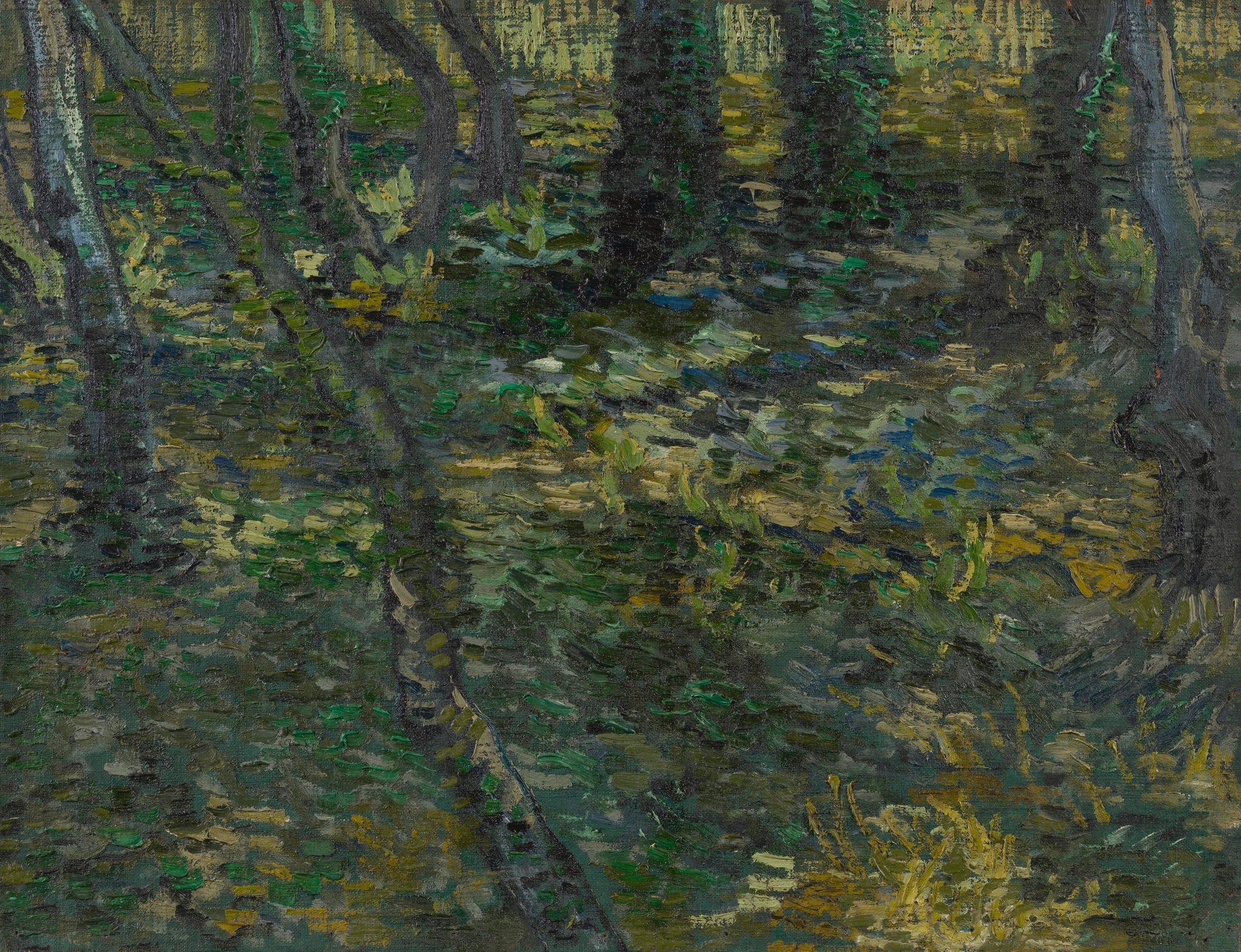
Diagonal shadows Symbolism
Diagonal shadows charge a scene with movement and tension, cutting across forms rather than enclosing them. In painting, such slanting bands of shade often mark a transitional moment where light and dark contend, guiding the eye along an oblique path and unsettling stable balance.
Diagonal shadows in Undergrowth
Vincent van Gogh’s Undergrowth (1889) drops the viewer to ground level, where diagonal shadows fall across a woven mat of ivy and slanting trunks. Van Gogh uses these oblique bands, together with short, pulsing strokes, to turn the forest floor into a rhythmic field of alternating light and shade. The diagonals press laterally through the scene, guiding the gaze and introducing a quiet tension that complicates the shelter of the undergrowth—yielding a study of endurance and renewal rather than a scenic view.