Disembodied hand Symbolism
In art, a disembodied hand signals direct, visible intervention by a higher power—an agent that enters the scene without a body to command, judge, or reveal. Because it appears from beyond the human realm, it conveys authority that cannot be ignored. In Western traditions it is closely associated with moments of judgment and revelation, notably the “writing on the wall” described in the Book of Daniel.
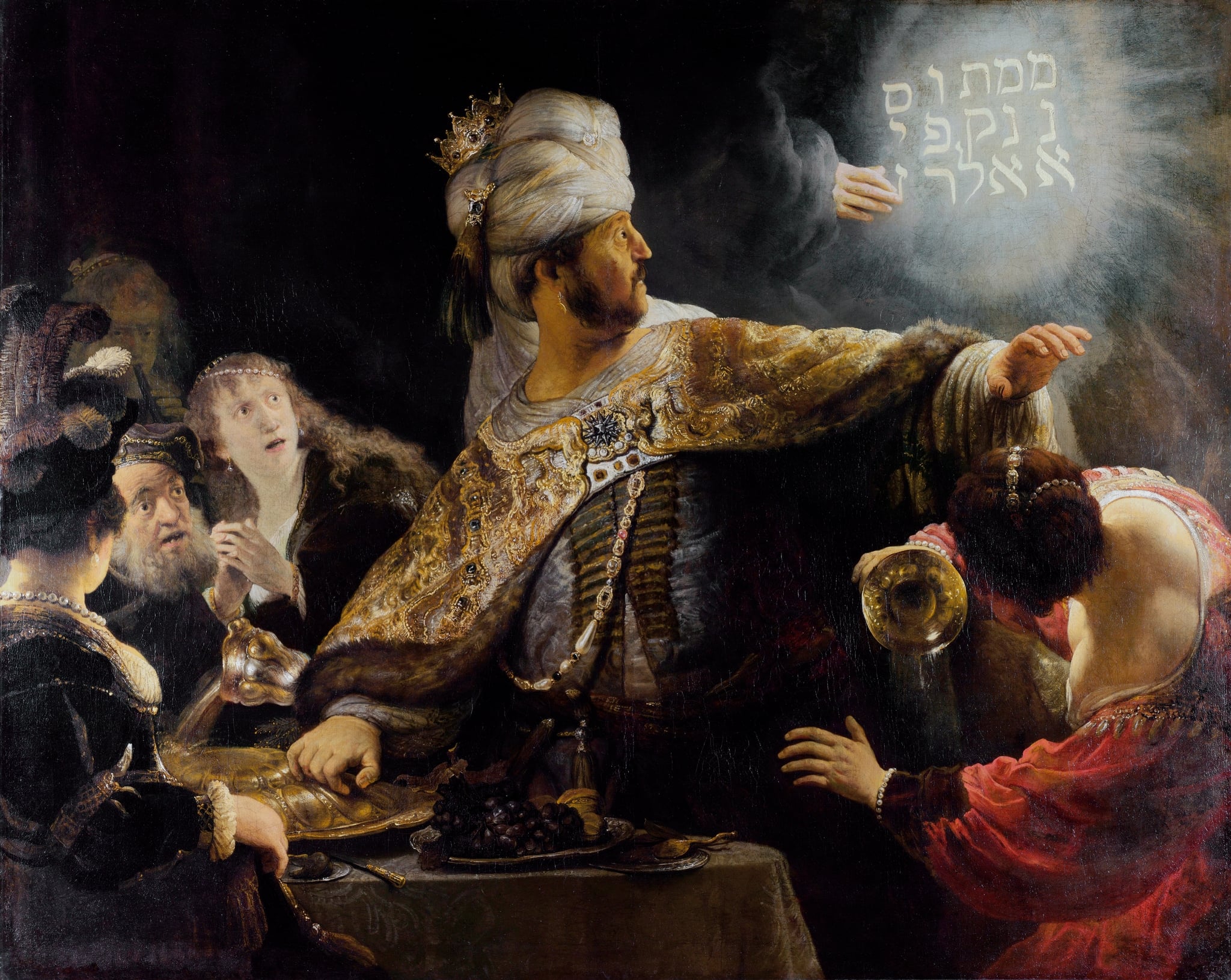
Disembodied hand in Belshazzar's Feast (study listed separately in some catalogues)
In Rembrandt van Rijn’s Belshazzar's Feast (study listed separately in some catalogues) (c. 1636–1638), a radiant, bodiless hand writes the fateful words that halt a royal celebration. The bejeweled king wheels around, courtiers recoil, and sacred vessels glint—visual contrasts that set worldly opulence against divine judgment. Here, the disembodied hand functions as both the messenger and the message: a supernatural act made visible that issues an incontrovertible decree.
By isolating the hand as a luminous sign, Rembrandt renders divine agency immediate and public. Within our collection, this example anchors the symbol’s meaning as God’s direct intervention that exposes and condemns human arrogance.