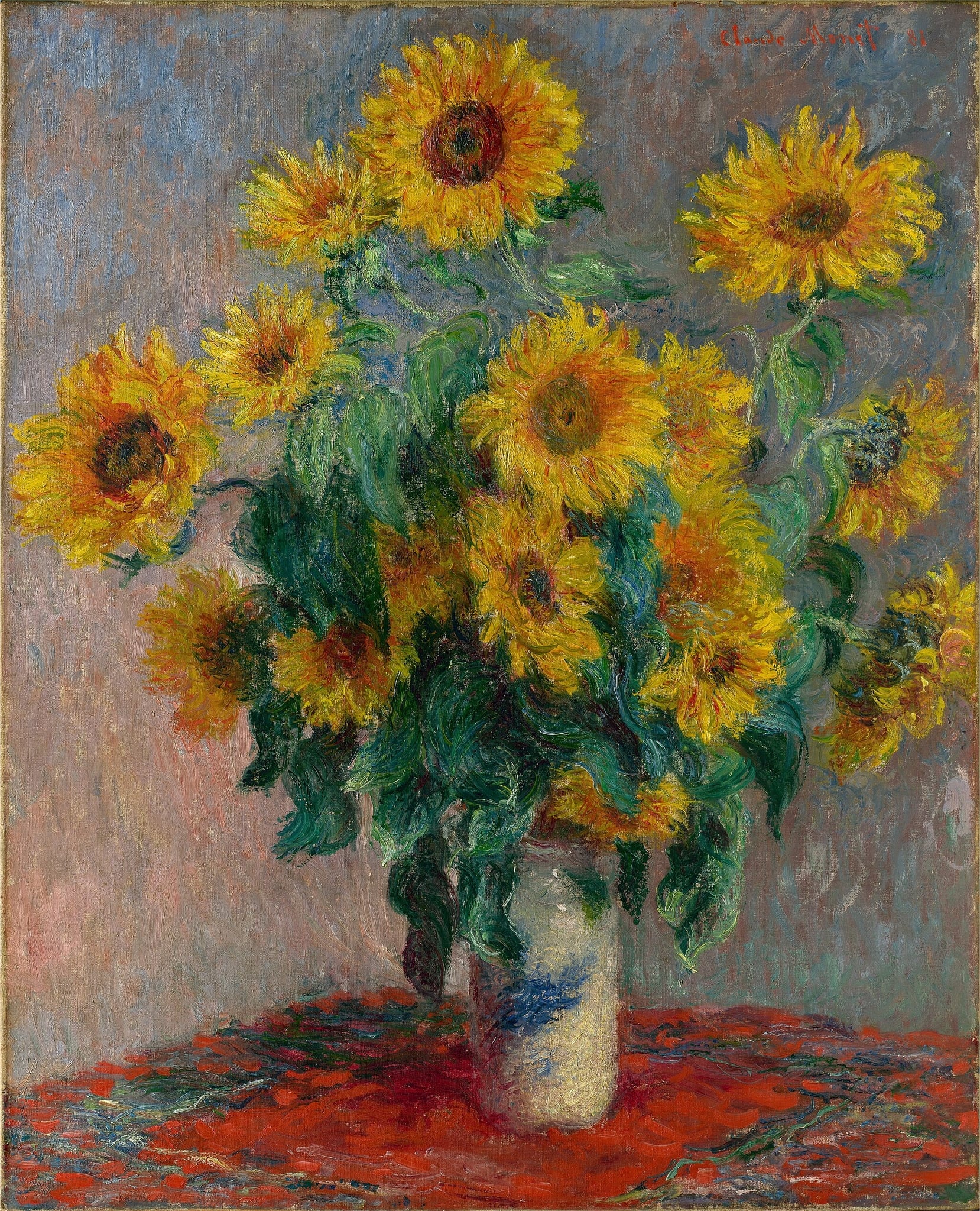
Pale ceramic (Japanese) vase Symbolism
A pale Japanese ceramic vase in painting often signifies containment and poise: a cool, glazed surface that gathers and diffuses light while steadying more volatile elements. In the late nineteenth century, it also registers Japonisme, as artists engaged with Japanese design for clarity of form and tonal restraint. As a neutral anchor, the vessel tempers high color and guides the eye.
Pale ceramic (Japanese) vase in Bouquet of Sunflowers
In Claude Monet's Bouquet of Sunflowers (1881), the pale Japanese ceramic vase serves as the composition's ballast. Placed between a blazing red cloth and a lilac-gray wall, it acts as a cool light trap, catching and softening reflections while thrusting the yellow blooms forward. The vase confers steadiness and containment on a bouquet rendered with restless touch and shifting light, anchoring the image even as the flowers move from vigor to fray.