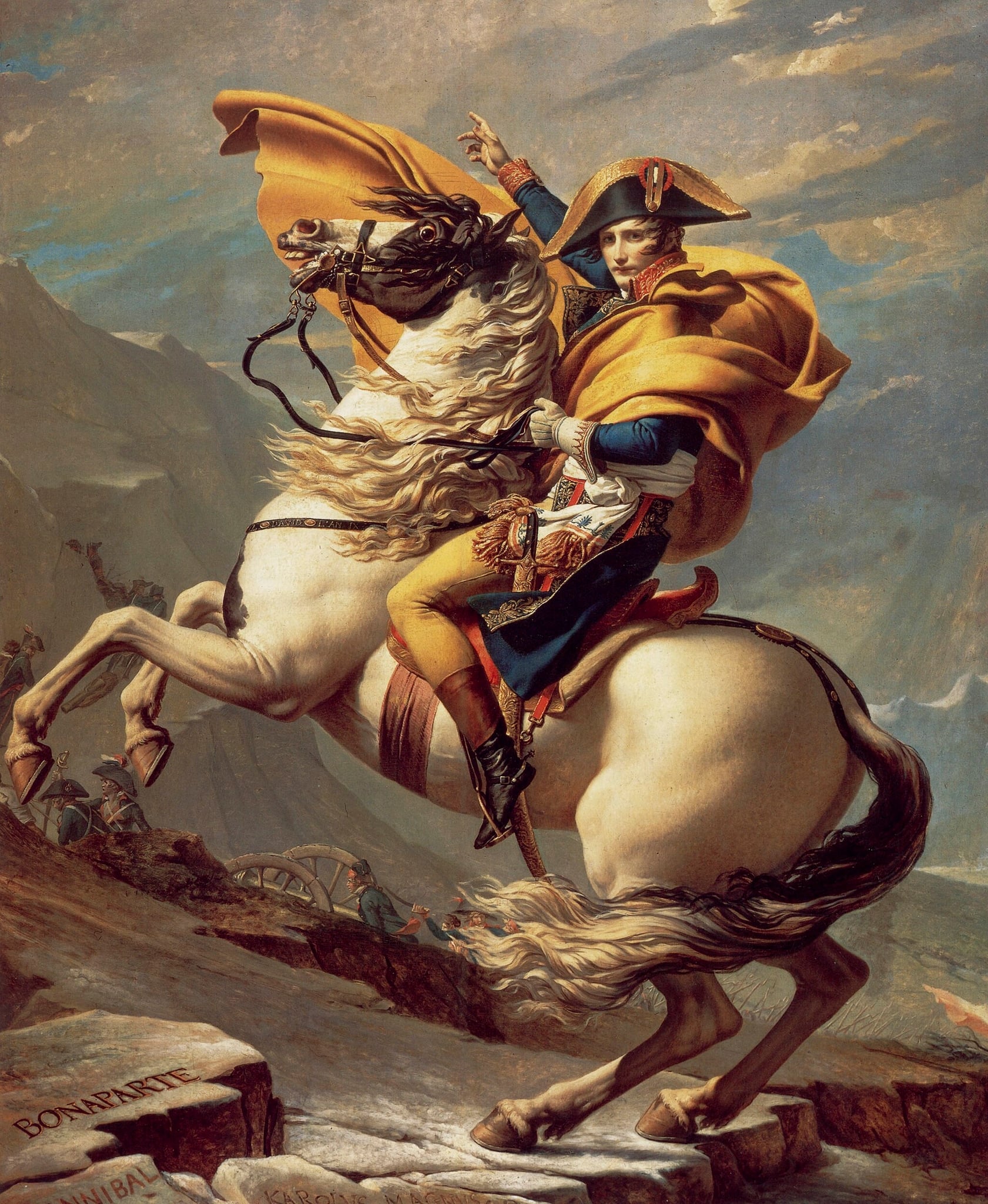
Rock inscriptions (BONAPARTE, HANNIBAL, KAROLUS MAGNUS) Symbolism
Rock inscriptions that name rulers or campaigns turn natural stone into a public epigraph. In European history painting, they construct a genealogy of conquest that aligns a present leader with illustrious predecessors to claim continuity and legitimacy. Neoclassical artists often use such carved names to borrow the authority of antiquity and empire.
Rock inscriptions (BONAPARTE, HANNIBAL, KAROLUS MAGNUS) in Napoleon Crossing the Alps
In Napoleon Crossing the Alps (1801–1805 (series of five versions)) by Jacques-Louis David, the names BONAPARTE, HANNIBAL, and KAROLUS MAGNUS are carved into the foreground rock, explicitly linking Napoleon’s passage to Hannibal and Charlemagne. The inscription works with the serene commander on a rearing charger and the billowing golden cloak to convert a difficult Alpine crossing into an upward-driving monument of legitimacy, fusing modern uniform with classical gravitas.