How Much Is Evening on Karl Johan Worth?
Last updated: April 29, 2026
Quick Facts
- Methodology
- comparable analysis
Informal open-market bracket for Edvard Munch’s Evening on Karl Johan (1892, oil on canvas, 84.5 × 121 cm) held by KODE is US$2,000,000–US$10,000,000. This range is a conservative comparable‑analysis estimate based on museum‑quality Munch sales and the work’s museum provenance, not a formal insured appraisal.
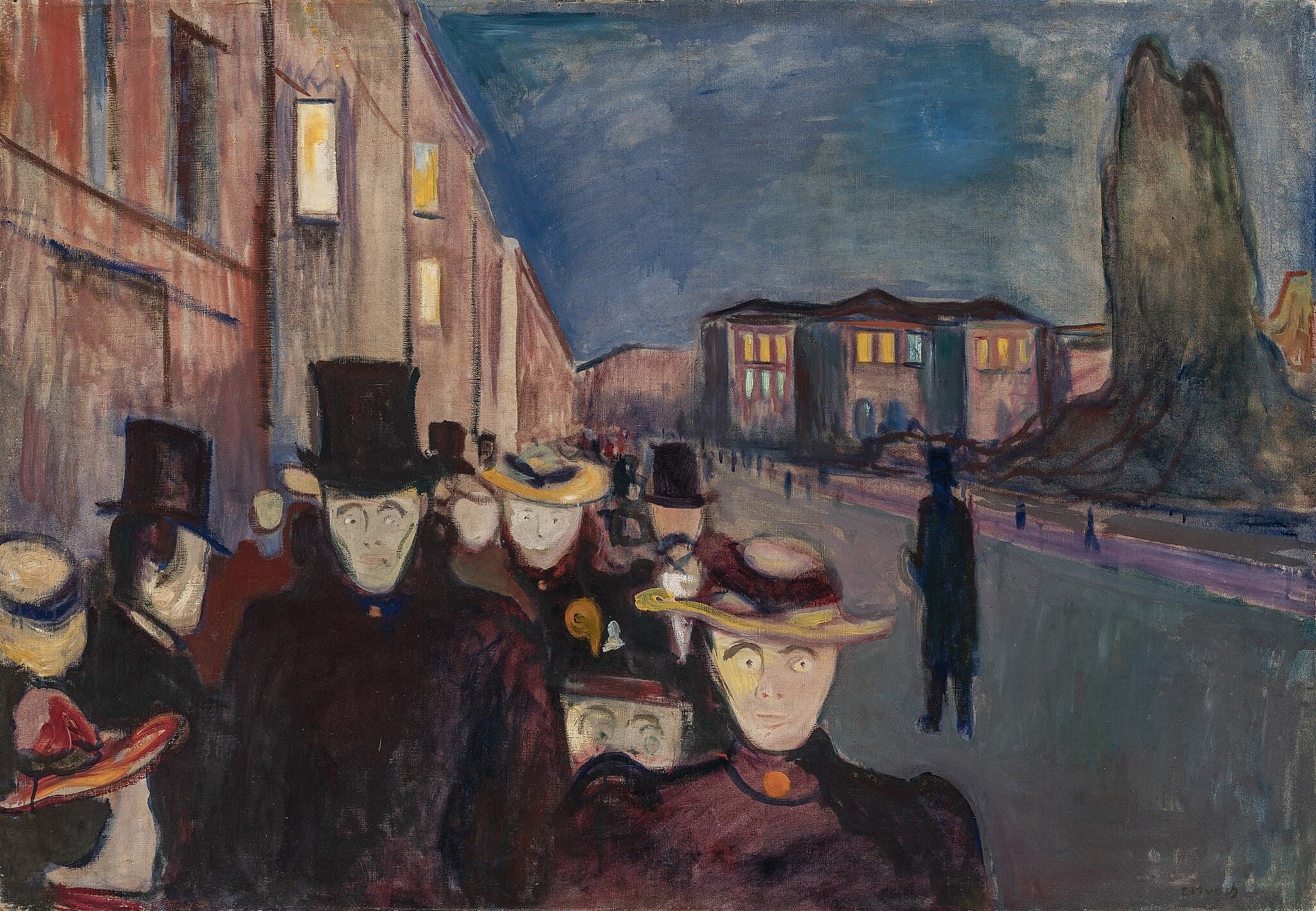
Evening on Karl Johan
Edvard Munch, 1892 • Oil on unprimed canvas
Read full analysis of Evening on Karl Johan →Valuation Analysis
Overview and conclusion: Based on publicly available comparables for museum‑quality Edvard Munch oils and the painting’s institutional provenance, my informal open‑market bracket for Evening on Karl Johan (1892; oil on canvas; 84.5 × 121 cm) — currently in the Rasmus Meyer collection at KODE, Bergen — is US$2,000,000 to US$10,000,000. The work has no identified modern auction record and the range below is derived from market comparables and market‑demand considerations rather than a recent sale of this specific canvas [1][2].
Comparable logic: Recent headline sales of museum‑quality Munch canvases show strong demand for prime works from the 1890s, but also a steep tiering between the handful of globally iconic masterworks and a broader cohort of important, but less universally recognized, canvases. Auction anchors in recent years have pushed important Munch oils into the low‑to‑mid eight‑figure band, while many notable 1890s paintings trade in the single‑ to low‑seven‑figure range when brought to market [2]. Evening on Karl Johan is art‑historically significant within Munch’s Oslo/street‑life group but is not usually listed among the small group of universally iconic, market‑driving compositions; that contextual position informs the conservative bracket above.
Upward and downward drivers: Upside to the top of the window would require a combination of: pristine condition and confirmation that this is a primary (rather than derivative/variant) version; exceptional exhibition and catalogue‑raisonné treatment; and active institutional or high‑net‑worth collector competition at sale. Downside pressure is real: the painting is museum‑held (meaning a public sale is unlikely without deaccession), there is no recent auction record for this canvas to set an established market price, and the condition/provenance/technical history are not publicly documented in a way that would support a higher presale estimate.
Practical next steps to firm value: To convert this bracket into a firm presale estimate or an insured value you should obtain KODE’s condition report and conservation history, full provenance and exhibition bibliography, and any existing technical analysis; then seek a formal pre‑sale opinion from a senior Munch specialist at Sotheby’s/Christie’s or an independent senior appraiser. Museum holdings often transfer by museum‑to‑museum agreement rather than open auction; if a public sale were possible the work would likely be marketed to institutions and major private collectors with targeted pre‑sale promotion.
Disclaimer: This is an informal valuation based on comparable analysis and public‑domain information. It is not a formal appraisal or insured valuation. Final value depends materially on condition, confirmed provenance, exhibition/history, and market testing.
Key Valuation Factors
Art Historical Significance
High ImpactEvening on Karl Johan (1892) occupies an important place within Munch’s late‑19th‑century Oslo/street‑life group: it captures urban modernity and existential themes that prefigure his more iconic Symbolist/Expressionist compositions. That context makes the work materially desirable to museums and informed collectors who prize representative examples of an artist’s key transitional periods. However, the painting is not in the very narrow set of globally emblematic canvases (e.g., The Scream, Madonna, The Sick Child) that produce outsized market multiples. As a result, while the work is art‑historically significant and collectible, it is likely to sit in the mid‑to‑upper tier of Munch marketability: highly desirable to a defined buyer pool, but unlikely to command the top of the market without exceptional supporting factors such as provenance, condition, and exhibition history.
Provenance & Ownership
High ImpactThis painting’s long‑standing ownership by Rasmus Meyer and its place in KODE’s public collection materially supports authenticity and scholarly standing, which are positive value drivers. Museum provenance tends to reduce risk for institutional buyers and can elevate interest from foundations and major collectors. Conversely, museum ownership also creates friction for an open‑market sale: deaccession procedures, legal and ethical constraints, and institutional reticence mean the painting is unlikely to appear on the market, and if it did it might be sold via museum‑to‑museum transfer or under constrained deaccession rules that limit competitive bidding. Those realities reduce the practical probability of a high‑liquidity auction outcome and therefore temper an open‑market valuation.
Condition & Conservation
High ImpactCondition is one of the single largest pricing levers for works of this date and medium. A pristine or lightly conserved original will support prices at the higher end of the bracket; conversely, extensive overpainting, relining, major restorations, or structural instability will reduce buyer confidence and can lower realized value materially (commonly by tens of percent depending on severity). Without access to KODE’s latest condition report and technical imaging (X‑ray, raking light, pigment analysis), the market window must allow for condition‑related discounting. A thorough conservation report and any technical-authentication documentation would tighten the estimate and could move the work toward the top of the stated range.
Market Comparables & Demand
High ImpactComparable auction results for museum‑quality Munch oils provide the primary empirical basis for this estimate. Recent major sales of early Munch canvases have shown both robust demand and steep stratification: several important 1890s works have realized low‑to‑mid eight figures at leading houses, while a broader set of high‑quality pieces trade comfortably in the single‑ to low‑seven‑figure band. These outcomes show market appetite for well‑provenanced, museum‑quality Munch, but they also underscore that only a small number of works achieve headline‑setting prices. Evening on Karl Johan fits the profile of a desirable institutional/collector piece that would most plausibly realize mid‑seven to low‑eight figures if marketed at auction under optimal conditions.
Rarity & Exhibition/Bibliography
Medium ImpactThe rarity of a painting on the open market increases value, and museum‑held works are intrinsically rare offerings. However, the precise bibliographic and exhibition history matters more than mere rarity: works frequently reproduced in major monographs or shown in international retrospectives command higher premiums. It’s important to establish whether the KODE canvas is considered a ‘prime’ version by scholarship or one of several iterations; a primary, well‑documented example benefits from stronger collector competition. A robust exhibition and publication record would tilt the valuation upward, while limited scholarly exposure or confusion over versioning would exert downward pressure.
Sale History
Evening on Karl Johan has never been sold at public auction.
Edvard Munch's Market
Edvard Munch is a blue‑chip modern master with a deep, widely recognized market. A handful of works (notably The Scream and other canonical canvases) have set global auction records, demonstrating extreme high‑end demand; a larger cohort of museum‑quality 1890s canvases trade in the single‑ to low‑eight‑figure range when they reach the market. Munch’s prints and smaller works create a broad base of liquidity, but primary oil paintings from key periods command the greatest prices. Primary market channels are the major international houses and institutional sales, and the buyer pool is dominated by museums, major foundations, and well‑capitalized private collectors.
Comparable Sales
Embrace on the Beach (Summer Day / 'The Linde Frieze')
Edvard Munch
Museum‑quality, large figurative Munch oil sold at auction in 2021; demonstrates demand for museum‑grade Munch canvases in the low‑eight‑figure band.
$22.3M
2021, Sotheby's, London
~$26.6M adjusted
Dance on the Beach (from the Reinhardt Frieze)
Edvard Munch
Recent sale of a museum‑quality figurative Munch oil (2023); comparable in subject/market tier and shows continued appetite for high‑quality Munch oils.
$20.5M
2023, Sotheby's, London
~$21.7M adjusted
Young Girls / The Girls on the Bridge (Pikene på broen)
Edvard Munch
Iconic, museum‑quality Munch oil from the 1890s; a high‑end benchmark showing the top tier for important Munch canvases.
$54.5M
2016, Sotheby's, New York
~$73.3M adjusted
The Scream (pastel on board, 1895)
Edvard Munch
Artist's auction record and the clearest upper bound for Munch's market; much more globally iconic and valuable than the subject painting.
$119.9M
2012, Sotheby's, New York
~$168.7M adjusted
Current Market Trends
The current market for blue‑chip modern art remains generally strong, with selective demand for museum‑quality works and continued willingness from major buyers to pay premiums for provenance and condition. Macro volatility and tighter lending/credit conditions can temper valuations and lengthen sales cycles, but Munch’s scarcity and strong institutional interest support durable demand. Museum‑held works rarely appear and therefore command particular attention when they do.
Study print
Study this painting as a print
Pair the full artwork with a museum-style study sheet focused on one meaningful detail.