How Much Is The Dance of Life Worth?
Last updated: April 29, 2026
Quick Facts
- Methodology
- comparable analysis
The Dance of Life (1899–1900) is a canonical, museum-held Munch masterpiece at the apex of his oeuvre. Based on top-tier Munch benchmarks and current trophy-market dynamics, we estimate a fair-market auction range of $120–180 million if the prime oil were deaccessioned and offered today. This would challenge or surpass the artist’s public auction record.
Valuation Analysis
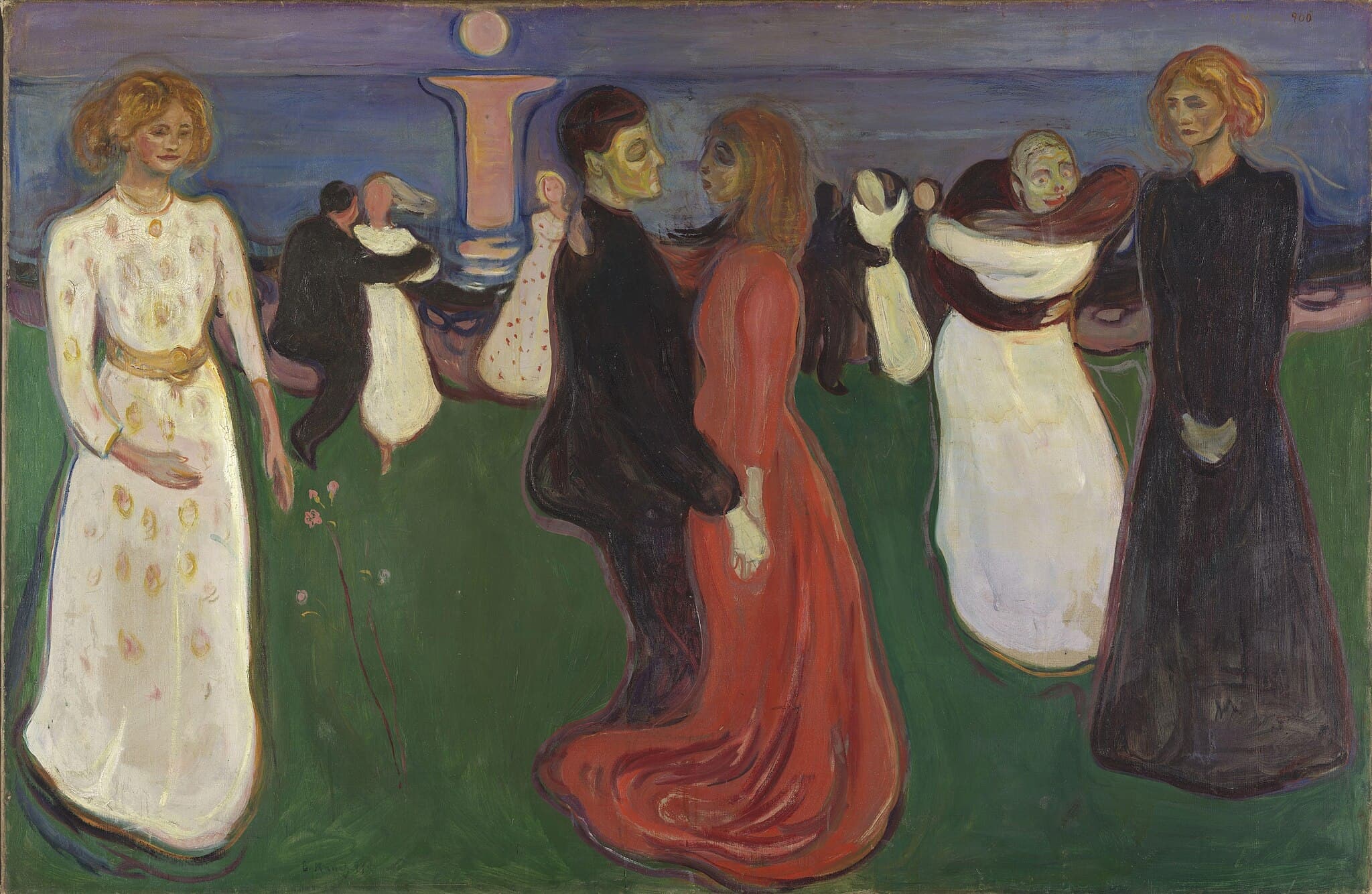
Work and status. Edvard Munch’s The Dance of Life (1899–1900; oil on canvas, approx. 125 × 191 cm) is the prime version held by the National Museum of Norway (NG.M.00941), gifted by Olaf Schou in 1910 and never publicly sold. It is a keystone of Munch’s Frieze of Life and among his most reproduced and studied images, positioning it at the very top of his oeuvre and cultural footprint [1].
Anchoring comparables. The artist’s auction record is The Scream (1895 pastel), sold for $119,922,500 at Sotheby’s New York in 2012, which establishes the brand’s proven nine‑figure ceiling [2]. For first‑rank oils, Girls on the Bridge realized $54.5 million at Sotheby’s New York in 2016, confirming deep demand for emblematic, prime‑period paintings [3]. Recent market evidence underscores continued strength: Midsummer Night (Sankthansnatt) achieved $35.11 million in 2025 [4], and the restituted, large-format frieze composition Dance on the Beach made £16.94 million (~$20.4 million) in 2023, demonstrating appetite for works tied to the Frieze of Life narrative [5].
How the range is derived. We weight these benchmarks for subject-iconicity, medium, scale, and 2025–26 market conditions. The Dance of Life is a canonical, large-format, prime-period oil—a combination that commands a substantial premium to Girls on the Bridge and Midsummer Night. At the same time, the Modern segment has re‑concentrated liquidity at the apex: collectors are paying up for singular, museum-grade masterpieces, as documented in the latest Art Basel & UBS report and corroborated by recent blue-chip results across Modern auctions [6]. Adjusting for inflation since 2012–2016, extreme scarcity of top Munch oils in private hands, and cross‑category trophy demand, we expect the work to test—and likely exceed—the artist’s prior public record under competitive evening‑sale conditions.
Final view. Our synthesized auction fair‑market range is $120–180 million, assuming sound condition, unencumbered title, and a globally marketed, guaranteed offering in New York or London. The low end maps to the established brand ceiling defined by The Scream, while the high end captures icon and scarcity premia appropriate to a museum‑caliber centerpiece of the Frieze of Life. Although the painting is not commercially available, this range represents a realistic transaction proxy for deaccession or insurance/loan negotiations and reflects where price discovery would occur today [1][2][3][4][5][6].
Key Valuation Factors
Art Historical Significance
High ImpactThe Dance of Life is a signature canvas within Munch’s Frieze of Life, distilling his central themes of love, anxiety, and mortality into one of the most recognizable images in his oeuvre. Executed 1899–1900 in prime period and at commanding scale, it is widely reproduced, regularly discussed in scholarship, and frequently taught as a cornerstone of early Expressionism. Its triadic motif (youth/erotic love/mortality) encapsulates Munch’s psychological project in a single, theatrically choreographed coastal scene. Within the artist’s visual lexicon, it ranks just below The Scream in cultural recognition, and on par with Madonna, Vampire, Ashes, and Girls on the Bridge—placing it unequivocally in the top echelon of his production and justifying a trophy‑level valuation.
Rarity and Supply Dynamics
High ImpactFirst‑rank Munch oils from the 1890s–early 1900s are exceptionally scarce at auction; many of the canonical subjects reside in museums or long‑held private collections. The prime The Dance of Life has been in institutional hands since 1910, with no modern‑era market exposure. By contrast, only a handful of emblematic oils—such as Girls on the Bridge—have surfaced in the last decade and achieved strong results. In today’s quality‑driven market, this level of rarity commands significant scarcity premia as global buyers compete for the few museum‑grade Modern masterworks that emerge. Hypothetically deaccessioned and marketed with a guarantee, this painting would be a once‑in‑a‑generation opportunity, catalyzing intense demand and price discovery at the low nine figures.
Market Benchmarks and Comparables
High ImpactThe Scream’s $119.9 million result (2012) sets the brand’s nine‑figure ceiling, even in a non‑oil medium. Among oils, the $54.5 million achieved by Girls on the Bridge (2016) and the $35.11 million for Midsummer Night (2025) demonstrate robust depth for prime‑period paintings. The 2023 £16.94 million sale of Dance on the Beach, explicitly tied to the Frieze of Life, confirms market appetite for thematically related, large‑scale works. Weighting these comps for subject-iconicity, medium (prime oil), scale, and inflation since 2012–2016 supports a valuation well above prior oil benchmarks. On this basis, The Dance of Life appropriately aligns with a $120–180 million range that would challenge or exceed the artist’s public record.
Provenance, Institutional Cachet, and Condition
Medium ImpactUnbroken museum provenance since Olaf Schou’s 1910 gift confers exceptional pedigree and confidence around authenticity and stewardship. Institutional care typically implies stable conservation histories and thorough documentation, both of which reduce transaction risk in the nine‑figure tier. While actual condition data would fine‑tune value, the work’s large format and prime‑period execution are inherently value‑accretive. In a hypothetical deaccession, the prestige of the source institution, full provenance transparency, and a pre‑sale conservation report would optimize buyer confidence and help support the upper band of the estimate. Because specific condition metrics are not public, we ascribe a medium impact to this factor pending technical examination, though the net effect is likely positive.
Sale History
The Dance of Life has never been sold at public auction.
Edvard Munch's Market
Edvard Munch is a blue‑chip Modern master with a bifurcated market: very limited supply and intense competition for first‑rank oils, alongside a deep and liquid market for prints and drawings. The artist’s public auction record is $119.9 million for The Scream (pastel, 2012), establishing a proven nine‑figure ceiling. Among oils, Girls on the Bridge achieved $54.5 million in 2016, Midsummer Night realized $35.11 million in 2025, and the restituted Dance on the Beach brought ~£16.94 million (~$20.4 million) in 2023. Despite selectivity in mid‑tier material, demand for iconic, museum‑caliber works remains strong. Collectors at the top end are global and institutionally oriented, with financial guarantees commonly used to secure and de‑risk trophy consignments.
Comparable Sales
The Scream (pastel, 1895)
Edvard Munch
Same artist; the most iconic image in Munch’s oeuvre and the market benchmark for top-tier, museum-grade Munch works. While a pastel (not oil), it sets the brand ceiling for canonical subjects within the Frieze of Life universe.
$119.9M
2012, Sotheby's New York
~$166.7M adjusted
Girls on the Bridge (1902, oil)
Edvard Munch
Same artist; prime-period oil of closely comparable scale and icon status. It is one of Munch’s most sought-after images and a key auction benchmark for first-rank oils.
$54.5M
2016, Sotheby's New York
~$72.5M adjusted
Sankthansnatt (Midsummer Night), landscape (oil)
Edvard Munch
Same artist; important oil painting sold recently at a flagship New York evening sale, evidencing current depth for major Munch oils even when subject is less iconic than Dance of Life.
$35.1M
2025, Sotheby's New York
Dans på stranden (Reinhardt Frieze) [Dance on the Beach], 1906–07, tempera
Edvard Munch
Same artist; large-scale, restituted frieze composition explicitly linked to the Frieze of Life cycle. Strong subject affinity to Dance of Life, demonstrating market appetite for related themes.
$20.4M
2023, Sotheby's London
~$21.4M adjusted
Das rote Haus (The Red House), 1926 (oil)
Edvard Munch
Same artist; later-period oil with strong provenance context (rare appearance on German market). Useful as a floor for non-iconic oils to contrast with pricing of Munch’s canonical subjects.
$2.3M
2025, Ketterer Kunst, Munich
Current Market Trends
The Modern category has rebounded since 2025 with a clear “two‑speed” profile: disciplined bidding for mid‑market works but vigorous competition for singular, museum‑grade trophies. Nine‑figure results have been concentrated in masterpieces with fresh provenance, strong scholarship, and marquee subjects, supported by robust use of third‑party guarantees. In this context, first‑rank Munch oils—rarely available and culturally iconic—track the top cohort’s momentum. Liquidity concentrates around evening sales in New York and London, where cross‑category buyers pursue best‑in‑class historical material. This backdrop is constructive for a canonical Munch, supporting a confident low‑nine‑figure valuation if a truly great example were to surface.
Study print
Study this painting as a print
Pair the full artwork with a museum-style study sheet focused on one meaningful detail.
Sources
- National Museum of Norway – The Dance of Life (NG.M.00941)
- Los Angeles Times – Munch’s The Scream sells for $119.9 million (2012)
- Antiques and The Arts Weekly – Girls on the Bridge sells for $54.5m (2016)
- Sotheby’s – Historic Night at Sotheby’s: Leonard A. Lauder Collection totals $527.5m (includes Munch’s $35.11m result)
- Sotheby’s – Kandinsky, Munch and Richter Lead the Charge in London (2023)
- Art Basel & UBS – The Art Market Report 2026