How Much Is The Scream Worth?
Last updated: April 29, 2026
Quick Facts
- Methodology
- extrapolation
The Scream (1893, oil/tempera and pastel on cardboard, National Museum of Norway) is the prime painted iteration of Munch’s signature image and a once-in-a-generation cultural icon. Extrapolating from the $119.9m sale of the 1895 pastel and aligning with recent trophy-market benchmarks, we estimate a hypothetical market value of $600 million to $1.0 billion.
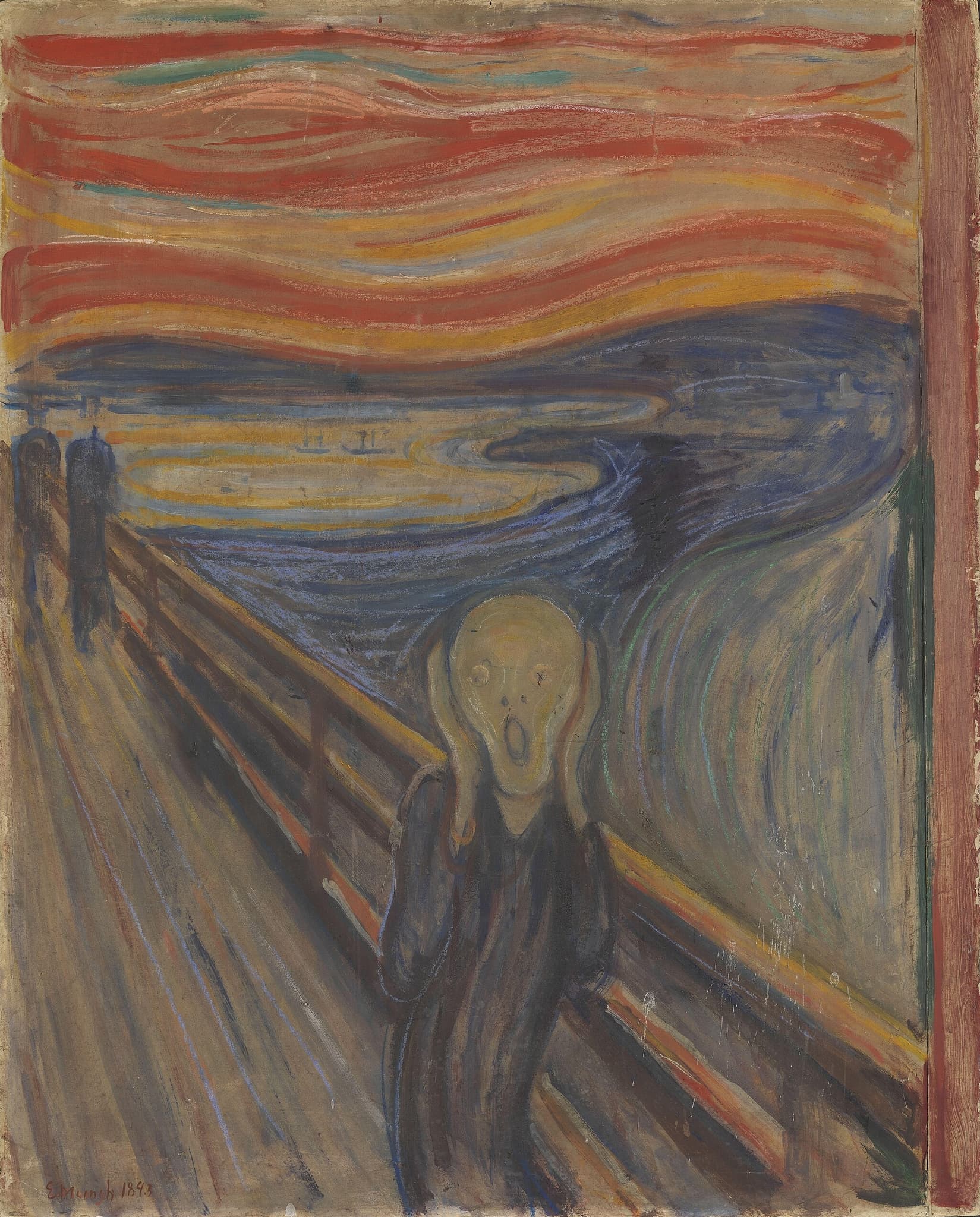
The Scream
Edvard Munch, 1893 • Tempera and oil pastel (crayon) on cardboard
Read full analysis of The Scream →Valuation Analysis
Final opinion of value: $600 million to $1.0 billion (USD). This range reflects an extrapolation from the only publicly sold Scream (the 1895 pastel) and alignment with current trophy-market budgets for singular, universally recognized masterpieces.
The only traded Scream—the 1895 pastel—sold for $119,922,500 at Sotheby’s New York on May 2, 2012 [1]. The Oslo picture is not merely another iteration: it is widely recognized as the earliest painted version (1893) and sits at the absolute apex of Munch’s oeuvre, held by the National Museum of Norway [2]. In blue-chip markets, a prime painting of an artist’s most iconic motif typically commands a large multiple over a later work on paper. Applying a conservative 3x–6x multiple to the 2012 anchor (inflation-adjusted context) supports values in the high hundreds of millions.
Cross-artist calibration reinforces this headroom. Leonardo da Vinci’s Salvator Mundi realized $450.3m in 2017, establishing the public auction record for any artwork [3]. Andy Warhol’s Shot Sage Blue Marilyn, a single-image cultural icon, achieved $195m in 2022 [4]. In late 2025, Gustav Klimt’s Portrait of Elisabeth Lederer reached $236.4m, resetting modern-era expectations for early 20th‑century masterpieces [5]. Against these markers, the prime painted Scream—arguably one of the most famous images in art—supports a valuation above $500m and credibly into the $1b conversation if two or more determined bidders emerge.
Positioning and demand: Munch’s market is deep and global, with sustained eight-figure results for major oils and a nine-figure artist record anchored by The Scream motif [1]. The 1893 painting’s primacy, near-universal recognition, and scarcity (state-held, never marketed) would unlock exceptional competition in any hypothetical sale. A well-staged, globally accessible campaign could amplify the fame premium materially beyond standard comparables.
Constraints and offsets: The support (cardboard) is inherently light-sensitive and vulnerable, and the work’s museum/state status entails legal/export complexity. These factors can temper the very top end by reducing display flexibility and adding transaction friction. Even so, the fame and primacy premiums substantially outweigh these constraints at the trophy tier.
Conclusion: We synthesize at $600m–$1.0b. A discrete private transaction would likely clear in the mid-to-high hundreds; a high-visibility auction with competitive global bidding could approach or exceed $1.0b. This valuation reflects the artwork’s singular cultural standing, intra-oeuvre primacy, and current trophy-market capacity [1][2][3][4][5].
Key Valuation Factors
Art Historical Significance
High ImpactThe Scream is a defining image of modern art and a cornerstone of Expressionism, distilling themes of psychological anxiety and urban modernity into a universally recognized icon. Its influence spans generations of artists and popular culture, making it one of the most cited motifs in art history. This depth of cultural penetration typically commands a sizable fame premium at the very top of the market. Within Munch’s oeuvre, the 1893 painted version is the touchstone against which all other iterations are measured, concentrating historical, scholarly, and public interest into a single, apex work that buyers perceive as irreplaceable.
Version Primacy and Medium
High ImpactThe 1893 work is widely regarded as the earliest painted iteration of The Scream, conferring maximum connoisseurship value. Prime painted versions of an artist’s signature image consistently outperform later or alternate-medium variants. While the 1895 pastel set the artist’s auction record, the Oslo painting’s primacy and medium would justify a significant multiple over that benchmark. At the apex of the market, collectors prize first formulations and canonical materials; the 1893 painting satisfies both, aligning it with the scarce class of artworks that can leap far beyond standard records when presented to a global audience.
Global Cultural Iconography and Fame Premium
High ImpactFew artworks match The Scream’s ubiquity across books, film, advertising, and digital culture. Such mass recognition expands the buyer pool beyond traditional connoisseurs to include sovereign and private collectors seeking universally legible trophies. Recent landmark results for singular, culturally resonant images (e.g., Leonardo’s Salvator Mundi; Warhol’s Marilyn) demonstrate the market’s willingness to pay a substantial premium for images that transcend the category of ‘important art’ to become global symbols. The 1893 Scream sits at the pinnacle of this dynamic, supporting valuations in the several-hundred-million to billion-dollar range when competitive tension is present.
Collection Status and Legal/Export Constraints
Medium ImpactThe painting is held by the National Museum of Norway and is effectively not for sale. Any hypothetical transaction would face institutional policies, potential deaccession scrutiny, and export restrictions. While such constraints reduce real-world marketability, they can also heighten perceived rarity by underscoring that the work almost never enters the market. In a carefully structured sale with government engagement, these hurdles are surmountable for qualified buyers, but the added complexity may narrow the field and marginally cap the top end compared with a fully unencumbered private consignment.
Condition, Conservation, and Display Risk
Medium ImpactExecuted on a light-sensitive cardboard support with mixed media, the 1893 Scream requires stringent conservation and limited light exposure. These factors can affect loanability and display flexibility, considerations that top-tier buyers weigh at nine-figure levels. While condition risks may temper the very top of the range, they are unlikely to deter trophy-focused collectors when balanced against the work’s singular importance. Comprehensive technical imaging, conservation history, and a robust display protocol would be expected in diligence and could influence whether the final price lands closer to the midpoint or the upper bound of the estimate.
Sale History
The Scream has never been sold at public auction.
Edvard Munch's Market
Edvard Munch is a blue‑chip, canonical modern master with deep institutional representation and a global collector base. His auction record remains the 1895 pastel version of The Scream at $119.9 million (2012), a watershed result that confirmed nine‑figure demand for his most iconic motif. Beyond The Scream, major oils from the 1890s–1910s routinely achieve strong eight‑figure prices, with results in the $20–55 million range and fresh-to-market highlights (e.g., a $35.1 million work in 2025) reinforcing depth at the upper tier. The print market is active and global, providing breadth and regular visibility. Overall, demand is selective but intense for museum‑quality paintings with strong provenance, condition, and exhibition history.
Comparable Sales
The Scream (pastel on board, 1895)
Edvard Munch
Direct comp: same artist and exact motif; only 'Scream' to have sold publicly. Differences: later iteration and pastel medium vs. the 1893 prime painted version.
$119.9M
2012, Sotheby's New York
~$169.1M adjusted
Girls on the Bridge (1902, oil on canvas)
Edvard Munch
Same artist; top‑tier, museum‑caliber oil from the core 1900s period. Calibrates ceiling for major Munch oils outside the 'Scream' motif.
$54.5M
2016, Sotheby's New York
~$74.1M adjusted
Sankthansnatt (Midsummer Night), c.1901–03 (oil on canvas)
Edvard Munch
Same artist; significant turn‑of‑century oil with fresh‑to‑market provenance. Reflects current eight‑figure demand for canonical Munch oils.
$35.1M
2025, Sotheby's New York
Dans på stranden (Dance on the Beach) (Reinhardt Frieze), 1906–07 (tempera on canvas)
Edvard Munch
Same artist; large, museum‑level composition from the same era. Restitution context and strong provenance; benchmarks demand for major figural works.
$20.4M
2023, Sotheby's London
~$21.8M adjusted
Portrait of Elisabeth Lederer (1900–02)
Gustav Klimt
Cross‑artist trophy benchmark from a closely related early‑20th‑century Modern master. Calibrates current upper‑tier budgets for era‑defining icons.
$236.4M
2025, Sotheby's New York
Shot Sage Blue Marilyn (1964)
Andy Warhol
Cross‑artist benchmark for a universally recognized single‑image masterpiece; indicates market willingness to pay a premium for global cultural icons.
$195.0M
2022, Christie's New York
~$218.4M adjusted
Current Market Trends
The top end of the Modern and Impressionist market has rebounded selectively, favoring canonical names and museum-caliber works. Recent seasons demonstrated sustained appetite for culturally resonant trophies, with multiple cross-artist benchmarks in the $200m–$450m range confirming capacity for record prices when two or more determined bidders compete. Liquidity is deepest for fresh, well-documented masterpieces with broad international recognition. Against this backdrop, the prime painted Scream, if hypothetically marketable, would sit at the very top of buyer wish lists, with fame and primacy premiums capable of pushing the price well beyond traditional artist-specific comparables.
Study print
Study this painting as a print
Pair the full artwork with a museum-style study sheet focused on one meaningful detail.

Sources
- Observer: Munch 'The Scream' sells for $119.9m at Sotheby’s (2012)
- National Museum of Norway: The Scream (1893) collection entry
- CNBC: Leonardo da Vinci's Salvator Mundi sells for $450.3m (2017)
- Christie’s Press: Warhol’s Shot Sage Blue Marilyn sells for $195m (2022)
- AP News: Klimt portrait sells for $236.4m at Sotheby’s (2025)