The Scream

by Edvard Munch

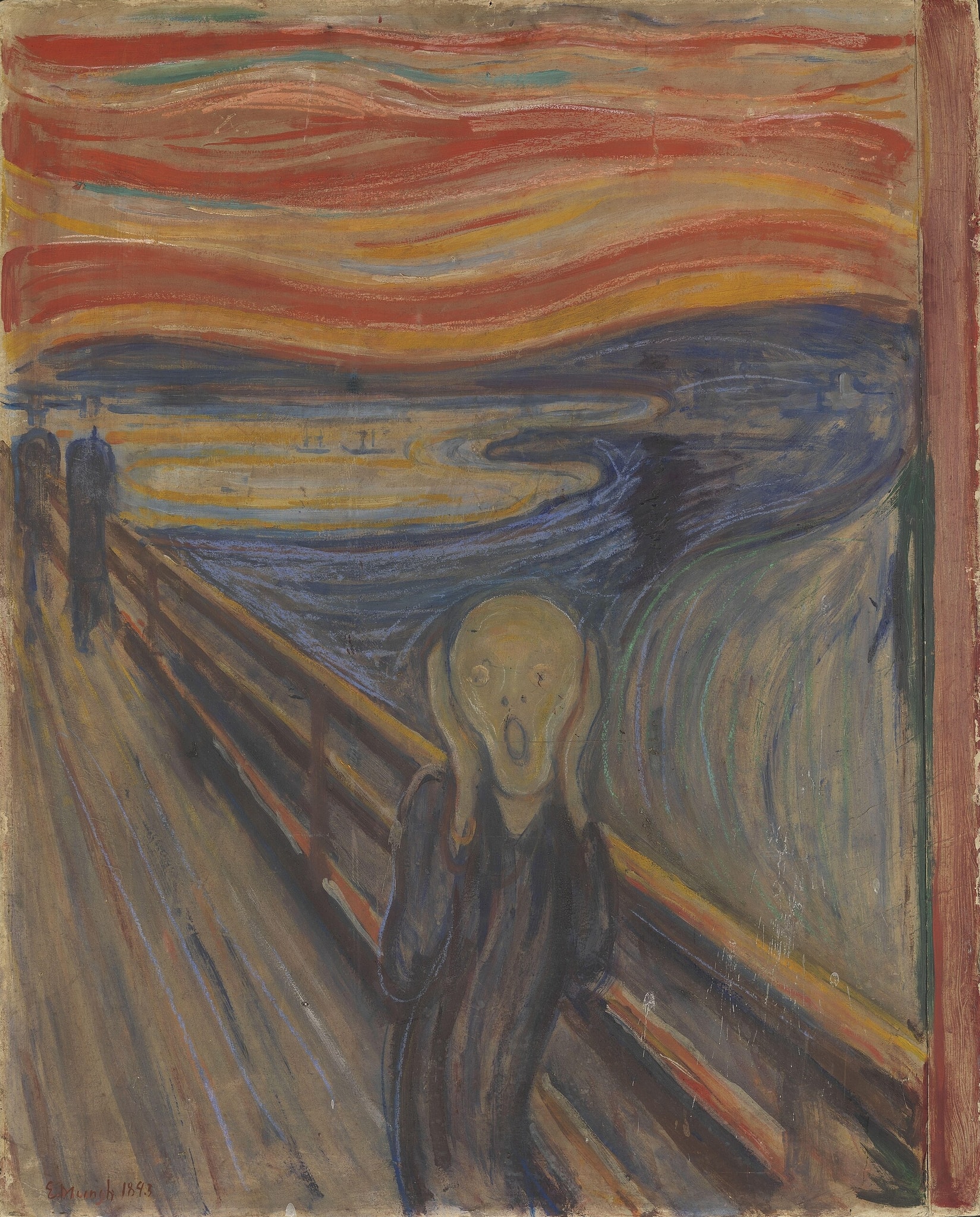
Edvard Munch’s The Scream condenses modern dread into an image where the self and the world collapse: an androgynous, skull-like figure grips its head as a blood-red sky and vibrating shoreline pulse around it. The rigid, receding bridge rails counter the turbulence, staging a clash between inner panic and outer reality [1][2].

Study Print Studio

Create a personal study print

Build a companion study sheet around the part of this painting that speaks to you most. Choose a detail, shape an interpretation, and walk away with something personal and display-worthy.

Fast Facts

Year
1893
Medium
Tempera and oil pastel (crayon) on cardboard
Dimensions
91 × 73.5 cm
Location
National Museum of Norway, Oslo
The Scream by Edvard Munch (1893) featuring Blood-red, wave-like sky, Androgynous skull-faced figure, Open mouth as void, Rigid bridge rails and planks

Click on any numbered symbol to learn more about its meaning

Meaning & Symbolism

Munch builds a total system in which emotion governs physics. The sky unfurls in incandescent bands of red and orange that behave like sound waves, while the fjord and shoreline echo in concentric curves; these forms do not describe weather but enact the artist’s line from his own note—an “infinite scream passing through nature”—so the world itself becomes the carrier of dread 21. At the center, the front-facing, androgynous figure with a skull-like head and hollow eyes clamps its hands to the sides of its face, a gesture that reads less as a cry emitted than as a body trying to block a deafening force. The two dark walkers receding along the left rail persist in their own rhythm, indifferent, and the orthogonal planks and rails of the bridge thrust sharply into depth, a rare pocket of Euclidean order. This hard scaffolding intensifies the contrast with everything else that buckles and undulates. The palette—acid yellows pressed against cold blues—carries the sensation of nausea, while the brushwork collapses boundaries so that sky, land, and water form a single pulsating field 15. The scene’s power does not depend on narrative detail but on the equivalence of line, color, and feeling: form is content. The meaning of The Scream resides in how it universalizes private panic. The figure’s sexless body and mask-like face refuse portrait identity, enabling viewers to occupy the role of the threatened self. Munch stages this self on a threshold—the Ekeberg heights above Kristiania (Oslo)—a liminal balcony between city life and vast nature, where modernity’s rails channel movement while offering no shelter 1. The painting converts the external sunset into an internal alarm: even if unusually red twilights of the era contributed to the motif (a debated link to post-Krakatoa skies), the canvas insists that perception is shaped by psyche, not optics 6. That is why the bridge’s perspective remains rigid while the rest of the world seems to liquefy; anxiety becomes the governing geometry. As museums and scholars note, this unity of expressive distortion and existential theme marks a pivotal step from late Symbolism to twentieth‑century Expressionism, where the visible world bends to the inner state 15. Munch later inscribed on the 1893 painting, faintly, “Can only have been painted by a madman!”—likely his own hand—folding reception and self-doubt into the work’s frame and reinforcing its meditation on sanity’s edge 1. The Scream is important because it forges a visual grammar for modern alienation—an image in which the individual’s cry is indistinguishable from the world’s—and because it demonstrates how art can convert biography and milieu into an archetype that still articulates contemporary fear.

Explore Deeper with AI

Ask questions about The Scream

Popular questions:

Powered by AI • Get instant insights about this artwork

💬 Ask questions about this artwork!

Interpretations

Formal Analysis: From Symbolism to Expressionism

Rather than imitate nature, Munch fuses motif and method: the undulating contour that binds sky, land, and water doubles as a diagram of anxiety. This is not ornamental distortion but a programmatic collapse of representation into affect—what museums call a pivotal move “from Symbolism into Expressionism.” In The Scream, the rigorous perspective of the bridge persists like a vestige of classical space while everything else liquefies into feeling, announcing a new priority for 20th‑century art: the primacy of inner states over optical fidelity. Art historian Reinhold Heller framed this image as a concentrated statement of modern selfhood, where identity pressures restructure the visible world, a thesis borne out by the picture’s serial reworkings and its centrality in the Frieze of Life 178.

Source: National Museum of Norway; Encyclopaedia Britannica; Reinhold Heller

Medium Reflexivity: Seriality, Text, and Print Culture

The Scream is not a single image but a serial matrix: two paintings, two pastels, and an 1895 lithograph titled in German “Der Schrei der Natur” (The Scream of Nature). By migrating the motif across supports—tempera on cardboard, pastel, then lithography—Munch tests how medium conditions emotion: dense, waxy strokes vs. the grain of a print that disseminates dread. The lithograph’s textual framing aligns the picture with Munch’s own prose note (“an infinite scream passing through nature”), making the work both image and written concept. This mobility seeded the icon’s reproducibility and modern afterlife, where authorship is less about a unique object than a performative schema that can be re‑inscribed, re‑colored, and re‑read across contexts 234.

Source: MUNCH (Munch Museum); MoMA; emunch.no

Material Time: Conservation Science and Fading Yellows

Conservation reveals that The Scream is also a time‑based object. Research on the 1910? painting shows unstable cadmium yellow pigments undergoing chemical change, prompting strict light and humidity controls and rotating display. As color balance shifts—yellows dimming relative to blues—the picture’s nauseous chromatic tension, so central to its affect, subtly reconfigures. Far from diminishing the work, this instability literalizes Munch’s theme: a world in flux where perception is precarious. The museum’s climate chamber and display strategy make conservation part of the artwork’s ongoing performance, foregrounding how materials mediate meaning and how the “scream” continues to vibrate not just culturally but physically within the painting’s chemistry 25.

Source: MUNCH (Munch Museum) – Conservation research

Environmental Hypothesis vs. Psychic Optics

One hypothesis links the “blood‑red” sky to lingering post‑Krakatoa volcanic twilights, aligning art with atmospheric science. While plausible for the motif’s spectral palette, museums and scholars caution that The Scream’s force rests on psychological optics: the sky functions as an emanation of dread, not meteorology. Treating the canvas as a data record risks missing its declaration that emotion determines what is seen. The tension between external cause (a spectacular sunset) and internal law (anxiety’s geometry) is productive: it frames the picture as a site where nature and psyche co‑author vision, with Munch decisively weighting the latter 167.

Source: Sky & Telescope (Olson et al.); National Museum of Norway; Encyclopaedia Britannica

Reception and Self-Inscription: “Painted by a Madman”

Infrared study confirms that the faint pencil note—“Can only have been painted by a madman!”—was likely written by Munch himself on the 1893 painting. This marginal text stages reception within the work: the charge of madness becomes both anticipated critique and self‑ironizing frame. It also shifts the viewer’s role: we no longer diagnose an image from outside; the image pre‑diagnoses us, asking whether our desire for clinical labels is itself a defense against what the painting exposes. By suturing commentary to composition, Munch makes authorship reflexive and turns The Scream into an essay on sanity’s threshold, iconography, and the public gaze 1.

Source: National Museum of Norway

Related Themes

About Edvard Munch

Edvard Munch (1863–1944) was a Norwegian painter and printmaker whose "Frieze of Life" cycle explored love, anxiety, and death. Shaped by early family losses and fin-de-siècle circles in Paris and Berlin, he pushed Symbolist subjects into an expressive language of distortion and color that helped catalyze modern Expressionism [5][1].
View all works by Edvard Munch

More by Edvard Munch