The Dance of Life

by Edvard Munch

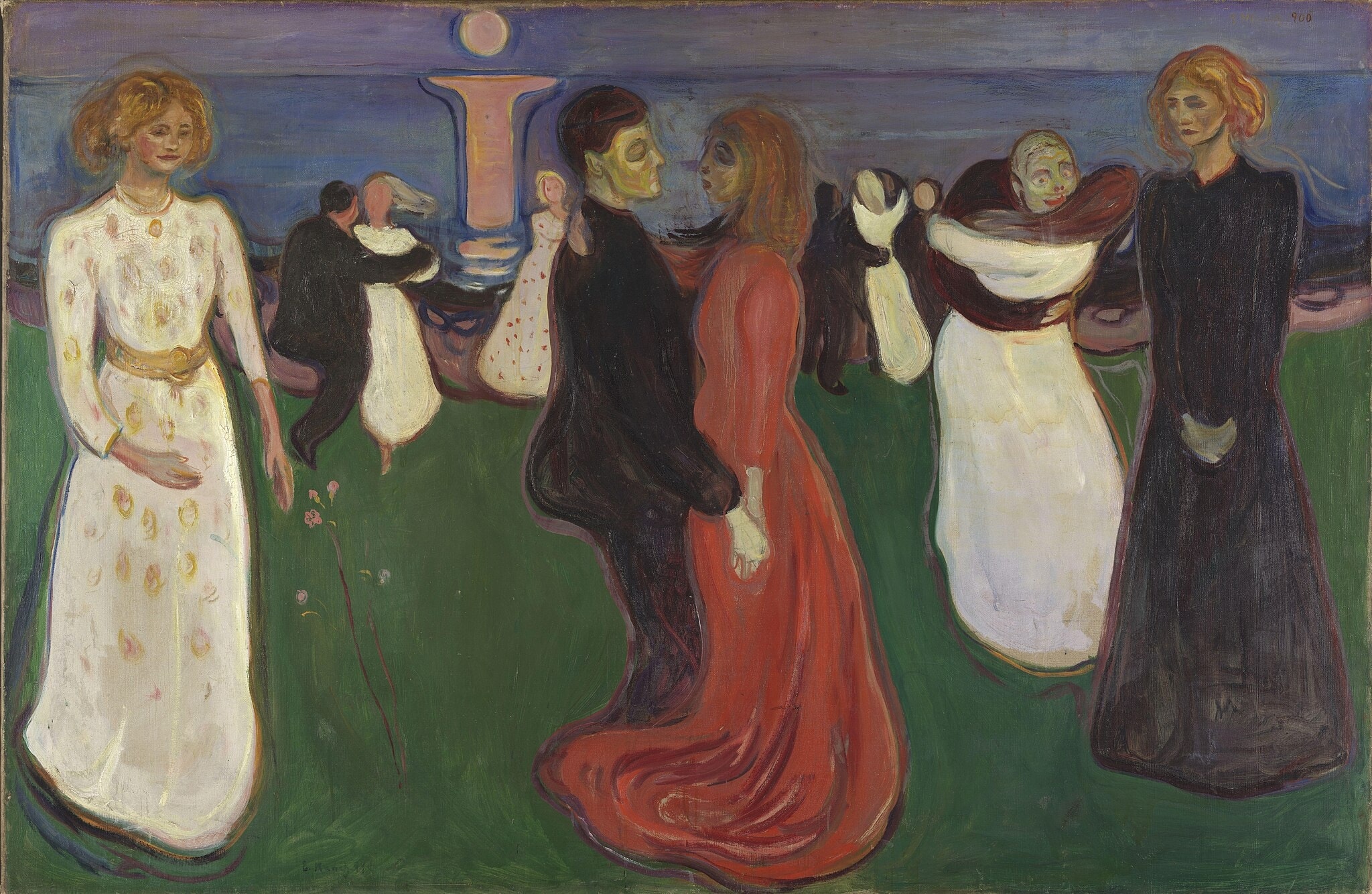
The Dance of Life compresses youth, passion, and renunciation into a single moonlit scene on the Åsgårdstrand shore. A pale girl in white, a red‑clad woman entwined with a dark-suited man, and a withdrawn figure in black form a symbolic arc that binds love to time and mortality [1][2].

Study Print Studio

Create a personal study print

Build a companion study sheet around the part of this painting that speaks to you most. Choose a detail, shape an interpretation, and walk away with something personal and display-worthy.

Fast Facts

Year
1899–1900
Medium
Oil on canvas
Dimensions
125 × 191 cm
Location
National Museum of Norway, Oslo
The Dance of Life by Edvard Munch (1899–1900) featuring Young woman in white, Red dress entwining the man, Woman in black with folded hands, Moon over the pier/column

Click on any numbered symbol to learn more about its meaning

Meaning & Symbolism

Munch structures the canvas as a triad that reads from left to right like a sentence. At left, a young woman in white stands near sprouting pink blossoms; her golden hair, light belt, and scattered golden marks announce budding desire and untested hope. She does not join the revelers; instead, her lowered hand and inward gaze stage the threshold of awakening. At center, the drama tightens: a gaunt man in black faces a woman in a flowing red dress whose hem curls around his feet like a tide, visually binding him as her hands clasp his. Their faces, yellowed and masklike, do not smile; the waltz becomes a struggle of proximity and reserve, desire and fear. At right, the third term of the sentence arrives: a woman in black, hands folded like pale gloves, turns away from the dance. Her stance arrests the motion established by the couples who whirl behind the trio; she is present yet absent, a figure of mourning or renunciation. These three stations—innocence, consummation, and withdrawal—constitute the painting’s narrative core, a cycle Munch himself summarized as the awakening of love, love at its peak, the fading of love, and finally death 2. The color code is emphatic: white for innocence, red for passion and pain, black for grief and solitude 6. The seashore setting is not background décor but an active stage. A green lawn flows to a violet sea and sky, where the white moon hovers over a pale vertical pier or column, a visual exclamation mark punctuating the scene. Along the balustrade the fête continues—couples in white and black embrace—yet this festivity only sharpens the isolation of the four principals who seem locked in their own psychic weather. Munch’s undulating contours and limited palette create a rhythm that fuses figures and ground, binding personal fate to the cyclical rhythms of nature. The shoreline of Åsgårdstrand, which Munch repeatedly used as a theatre for love, jealousy, and anxiety, here becomes the membrane between the social dance and the existential one, where waves and moonlight register the inner oscillations of desire and dread 25. Read within the Frieze of Life, the painting does not merely depict three women and a couple; it asserts that human life moves inexorably from promise to entanglement to relinquishment, and that this motion is as tidal as the sea beside them 3. The masklike faces and the stiff, almost sculptural embrace of the central pair reject anecdote in favor of symbol. The man’s dark suit compresses restraint and sobriety; the woman’s red dress swells like a living force that both animates and threatens to engulf him. Scholars often hear biographical reverberations from Munch’s fraught love life around 1899–1900, but museums stress that the scene’s power rests in its archetypal clarity rather than portraiture 24. Created at the culmination of his 1890s project and shown within the larger Frieze presentations, The Dance of Life crystallizes Munch’s aim to paint the inner life—not as sentiment, but as structure—thereby offering a grammar of modern emotion that would shape early Expressionism 237.

Explore Deeper with AI

Ask questions about The Dance of Life

Popular questions:

Powered by AI • Get instant insights about this artwork

💬 Ask questions about this artwork!

Interpretations

Serial Form and Pictorial Syntax

Munch engineers the canvas to be “read” like a line of text, with three stations that parse experience into clauses of expectation, entanglement, and cessation. This serial logic is native to the Frieze of Life, which Munch and later curators describe as a chain of motifs whose meaning accrues cumulatively. In The Dance of Life, repetition (embracing couples), variation (white/red/black figures), and rhythmic contours act as visual prosody—devices that control pacing and emphasis as language would. The result is not a vignette but a piece of narrative syntax, where placement and interval do as much signifying as gesture. Such seriality explains why the work “clicks” most fully within the larger Frieze presentations and why its clarity reads as structure rather than story 23.

Source: Nasjonalmuseet (Frieze of Life guide)

Littoral Liminality: Nature as Agent

The shore is a threshold—land meets water, day meets night—so it becomes the optimal stage for psychological transition. Munch activates this zone: the violet sea, the hovering white moon, and that pale vertical pier read like punctuation marks within a sentence of feelings. The littoral sets love’s oscillations against literal tides, converting setting into a dynamo of affect. Scholarship on Munch’s coastal motifs highlights how these recurring shores function as leitmotifs across the Frieze: not passive backdrops but agents that inflect human drama. In The Dance of Life, the environment is a co-author; it choreographs the figures’ proximity and distance, making emotion environmental and fate geographic 25.

Source: Clark Art Institute (On the Shore)

Chromatic Allegory and Gendered Costume

Color and dress operate as allegorical code and gender script. The man’s black suit—angular, sober—compresses restraint; the woman’s red dress swells, its hem curling like surf that both animates and ensnares him. White, red, and black form a chromatic trinity: innocence, passion/pain, and grief/solitude. This palette is not descriptive but programmatic, making emotion legible at a glance. Read within fin-de-siècle anxieties, the scene plays gender as counterpoint—discipline against overflow—without collapsing into caricature; the faces are masklike, denying anecdotal flirtation and insisting on type. Munch turns costume into a semiotics of desire and dread, a system that fuses Symbolist allegory with a modern psychology of the couple 27.

Source: MoMA (Edvard Munch: The Modern Life of the Soul)

Biography as Undercurrent, Archetype as Goal

Letters from 1899–1900 document Munch’s turbulent liaison with Tulla Larsen and the ensuing crisis that peaked with the 1902 hand injury. Scholars often hear these tremors beneath The Dance of Life’s dramaturgy. Yet the museums stress the painting’s archetypal, not portrait, ambition: figures become roles within a grammar—innocence, erotic fusion, renunciation—rather than likenesses. This tension—biographical charge vs. archetypal clarity—may explain the work’s uncanny force: it feels lived yet impersonal, intimate yet emblematic. Munch harnesses private ordeal to build a public iconography of love’s life cycle, transforming confession into structure and turning experience into a transposable modern myth 24.

Source: Munch Museum / eMunch (letters and notes)

From Symbolism to Expressionism: Form as Feeling

The painting’s anti-naturalist faces, compressed space, and undulating contours move Symbolist signification toward Expressionist intensity. Munch’s stated aim to paint the “inner life” yields forms that are less mimetic than diagnostic: surfaces carry psychic pressure. This approach—rigorous color-emblem, masklike physiognomy, emotive line—proved catalytic for early German Expressionists who sought structures for modern emotion. In The Dance of Life, form is not a vehicle but the content itself: the waltz’s geometry, the sea’s vibration, the moon’s chill—each is a vector of feeling. The work thus stands as a hinge: Symbolist allegory consolidates into a grammar that Expressionism will amplify into raw, structural affect 26.

Source: Britannica (movement and influence)

Related Themes

About Edvard Munch

Edvard Munch (1863–1944) was a Norwegian painter and printmaker whose "Frieze of Life" cycle explored love, anxiety, and death. Shaped by early family losses and fin-de-siècle circles in Paris and Berlin, he pushed Symbolist subjects into an expressive language of distortion and color that helped catalyze modern Expressionism [5][1].
View all works by Edvard Munch

More by Edvard Munch