Madonna

by Edvard Munch

Munch’s Madonna stages a collision of sanctity and sensuality: a half-length nude, eyes closed, tilts into a crimson nimbus while a dark, tidal field seems to carry her body. With smeared contours and a sparse palette, the figure hovers between emergence and dissolution, turning the Virgin’s icon into a modern emblem of eros, creation, and death [1][2][3].

Study Print Studio

Create a personal study print

Build a companion study sheet around the part of this painting that speaks to you most. Choose a detail, shape an interpretation, and walk away with something personal and display-worthy.

Fast Facts

Year
1894
Medium
Oil on canvas
Dimensions
90.5 × 70.5 cm
Location
National Museum of Norway (Nasjonalmuseet), Oslo
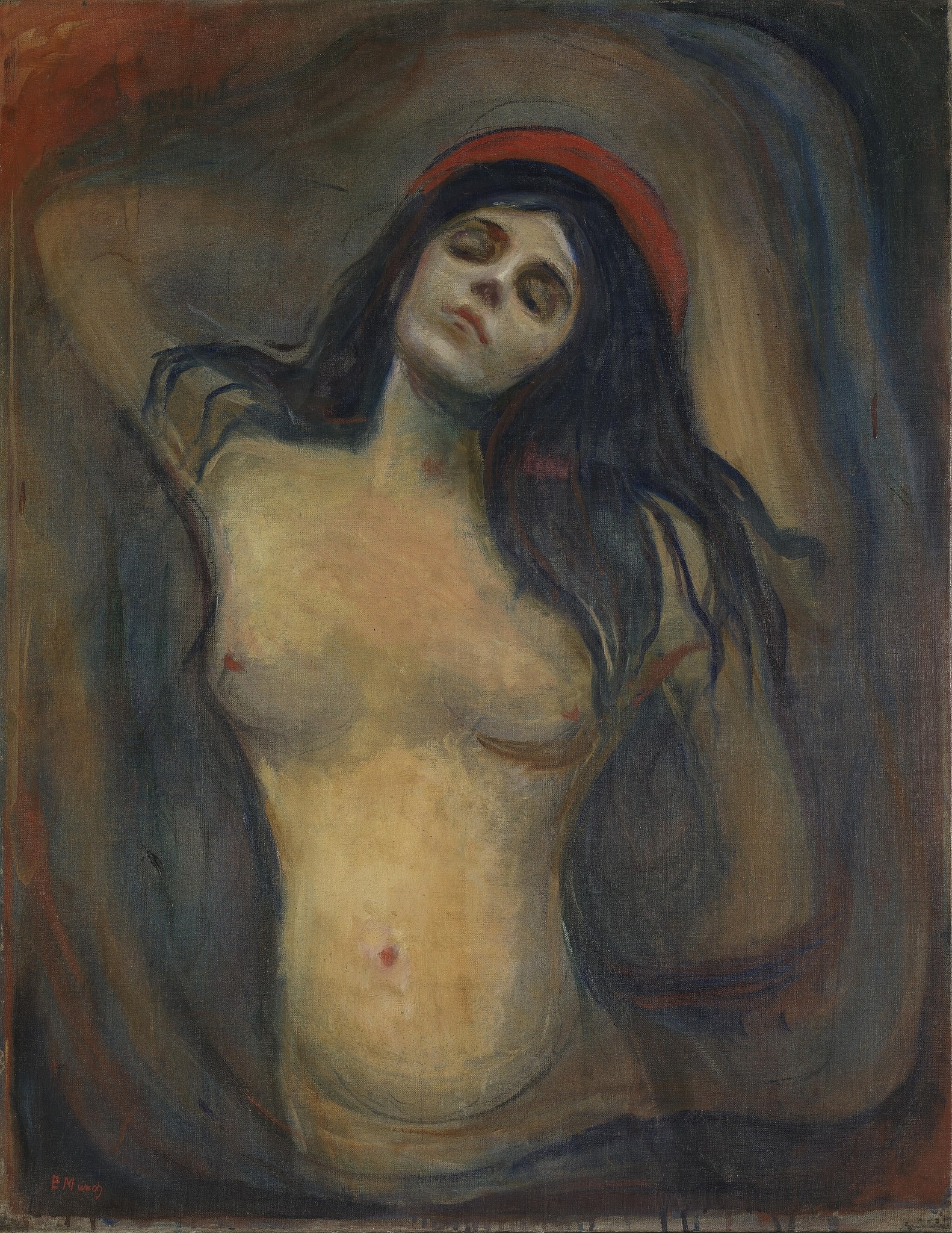
Madonna by Edvard Munch (1894) featuring Red nimbus (halo), Closed eyes and tilted head, Flowing dark hair, Undulating tidal background

Click on any numbered symbol to learn more about its meaning

Meaning & Symbolism

The painting insists that spiritual elevation and bodily risk are indivisible. The red nimbus—painted not as a steady circle but as a frayed, blood-tinged ring—crowns a figure whose head tips back as if offering both surrender and ascension. Her eyes close; her mouth slackens; the pulse points of color on her nipples and the faint blush at the navel puncture the otherwise ashen skin, signs that life’s heat persists even as the face drifts toward a funereal mask. Around her, blue-green and ochre bands flow like a tide or amniotic current, wrapping the torso and then pulling away, so that the body seems to be both born and borne away. This ambiguity was deliberate: Munch developed the motif in the mid‑1890s precisely to collapse ecstasy and loss, a point he underscored in the text published with the print—“The smile of a corpse… Now life offers death its hand”—which clarifies the image’s program even when not physically present on the canvas 23. The title Madonna completes the provocation. Rather than a Mater Dei, we meet a woman in the act of loving whose sexuality is not veiled but central. The paint handling refuses hard outlines; shoulders, hair, and abdomen blur into the surrounding field, as if the figure were a psychological apparition surfacing from memory. Infrared studies of the Oslo version further show Munch wrestling with arm positions to accentuate this staged, in‑between pose—neither clearly standing nor fully reclined—which heightens the sensation of suspension between body and spirit 5. Munch’s iconographic strategy binds biology to myth. In the graphic versions of Madonna, he made the association explicit with a border of wriggling sperm and a fetal form; although that border is not present in this painted image, it belongs to the same conceived motif and confirms that the red nimbus, the tidal background, and the woman’s closed-eyed rapture should be read as a scene of conception shadowed by mortality 23. Hair, a charged sign of erotic power in Munch’s work, spills darkly over the shoulders, both framing and weighing the head; the shadowed eye sockets and sickly illumination bring the body close to vanitas, so that bliss reads as a prelude to loss. Situated within the evolving Frieze of Life, Madonna articulates the cycle’s core dialectic: love generates life and invites death, and modern subjectivity is the consciousness that can feel both at once 12. This is why Madonna is important: it pioneers a Symbolist language—subverted halo, drifting contours, atmospheric fields—that modern artists would adapt to picture inner states rather than external appearances, opening a path from fin‑de‑siècle symbolism toward Expressionism 34.

Explore Deeper with AI

Ask questions about Madonna

Popular questions:

Powered by AI • Get instant insights about this artwork

💬 Ask questions about this artwork!

Interpretations

Iconography as Subversion

Munch weaponizes sacred form. The red nimbus and the title “Madonna” invoke Marian devotion only to invert it with erotic frankness and a liminal, eyes-closed pose. Early presentations intensified the affront by pairing the image with a frame or graphic border of sperm and a foetus, relocating divine creation to biological process. This strategy is not mere shock; it is a Symbolist retooling of Christian iconography to stage a modern mystery where conception, sanctity, and death interpenetrate. The work’s alternate titles (e.g., “Loving Woman,” “Woman Making Love”) complete the provocation, anchoring the sacred-profane fusion in language as well as image. Munch thus converts the Madonna into a symbolic engine of origin—at once shrine and laboratory—whose holiness lies in life’s risk itself 123.

Source: MUNCH (Munch Museum); Nasjonalmuseet; MoMA

Process, Pose, and Liminality

Infrared reflectography of the Oslo painting uncovered revised arm positions and underdrawing, evidence of Munch’s trial-and-error to engineer a pose that is neither fully standing nor fully reclined. This meticulous recalibration yields a figure suspended between gravity and lift, eros and renunciation. The result amplifies Symbolist ambiguity: the body reads as both present and dissolving, the head tipping into trance while the abdomen brightens with life’s heat. Such process findings demonstrate that the painting’s ambivalence is built, not incidental—a formal architecture of in-betweenness that sustains the image’s metaphysical charge and makes the ecstatic-spiritual oscillation legible without narrative props 24.

Source: Nasjonalmuseet; The Guardian (reporting National Museum conservation study)

Print Culture and Modular Provocation

Madonna’s most explicit biological cues fully bloom in the 1895 lithograph, where a writhing border of sperm and a fetal form can be printed, hand-colored, or masked. Munch exploits printmaking’s seriality to calibrate offense and meaning for different publics, transforming the frame into a semantic switch. This modularity turns the image into a modern, reproducible thought-experiment: is conception sacred or clinical, exalted or grotesque? The graphic medium’s inky tactility and option for color-states intensify the aura of amniotic flux while tethering Symbolist mystery to the mechanics of the press. As MoMA notes, the result is a cornerstone of modern printmaking in which medium and message co-produce the work’s scandal and profundity 136.

Source: MUNCH (Munch Museum); MoMA; National Galleries of Scotland

Gender Politics of the 1890s

Forged in the debates on women’s emancipation and “free love” in Berlin and Kristiania, Madonna recasts the female subject as an agent of desire rather than a passive saint. The title’s theological drag collides with the alternative “Woman Making Love,” asserting a sexuality owned by the sitter and confronting viewers trained on chaste Marian ideals. This was not only iconographic daring; it was a cultural intervention in how modern viewers imagine female pleasure, reproduction, and moral authority. Munch’s text—“Now life offers death its hand”—acknowledges the cost, binding autonomy to existential risk. The painting’s controversial reception and the adaptable print borders show an artist testing how far modern publics would follow a woman’s ecstasy into the sanctum of art 135.

Source: MUNCH (Munch Museum); MoMA; Hamburger Kunsthalle

From Symbolism to Expressionism

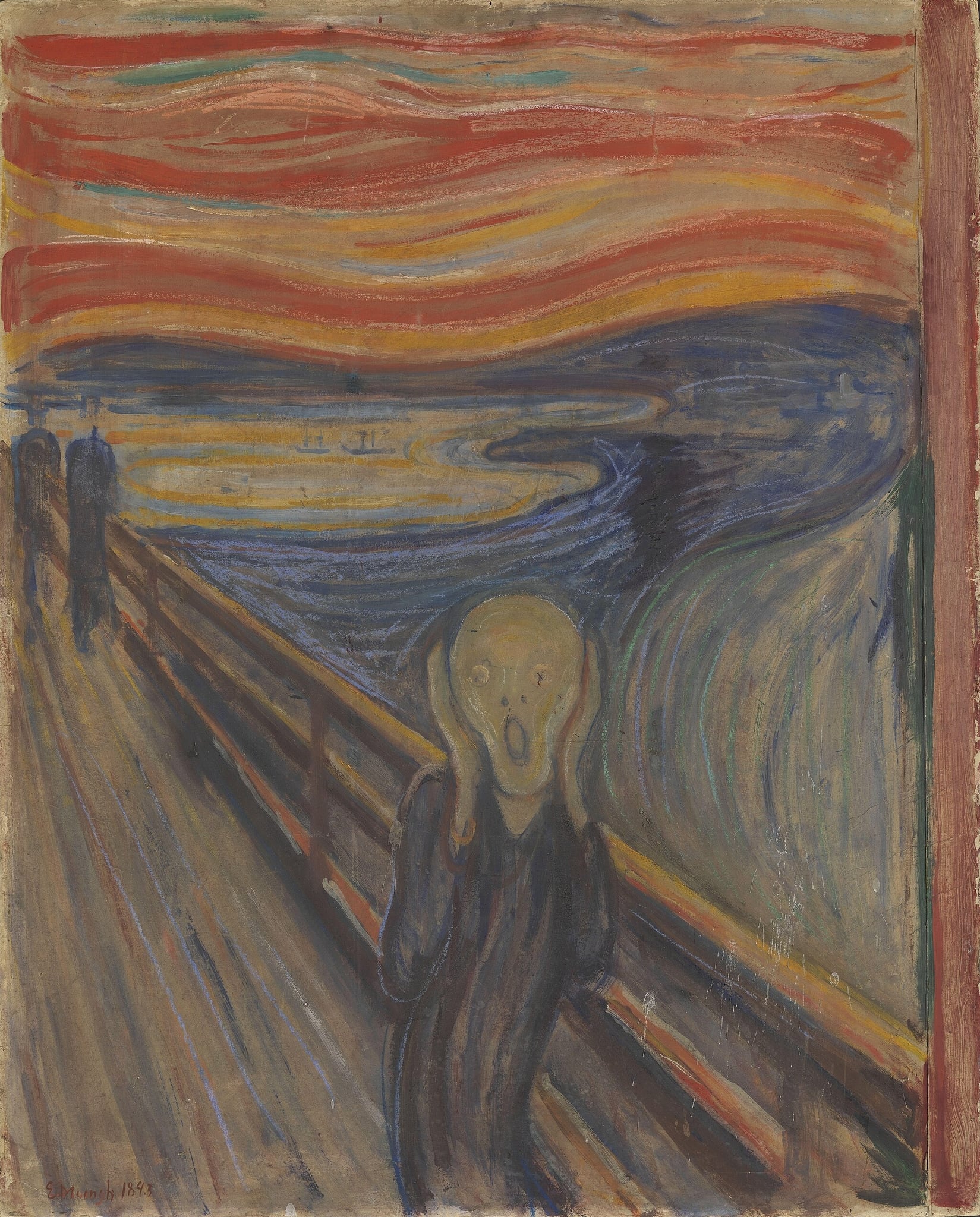
Within the “Frieze of Life,” Madonna perfects a Symbolist syntax—subverted halo, drifting contours, atmospheric fields—that prioritizes inner states over external description. This psychic picturing, paired with erotic-sacred tension, seeded Expressionist preoccupations with subjectivity and existential dread. Institutions situate Madonna alongside The Scream as a hinge between fin‑de‑siècle symbolist mood and the raw, affective intensity prized by early modernists. The work’s life/death dialectic, and its fusion of biology with myth, become not just a theme but a method: material facture, color fields, and pose are tasked with conveying consciousness itself. In this sense, Madonna is less a person than a prototype for modern painting’s turn inward 35.

Source: MoMA; Hamburger Kunsthalle

Related Themes

About Edvard Munch

Edvard Munch (1863–1944) was a Norwegian painter and printmaker whose "Frieze of Life" cycle explored love, anxiety, and death. Shaped by early family losses and fin-de-siècle circles in Paris and Berlin, he pushed Symbolist subjects into an expressive language of distortion and color that helped catalyze modern Expressionism [5][1].
View all works by Edvard Munch

More by Edvard Munch