How Much Is Puberty Worth?
Last updated: April 29, 2026
Quick Facts
- Methodology
- comparable analysis
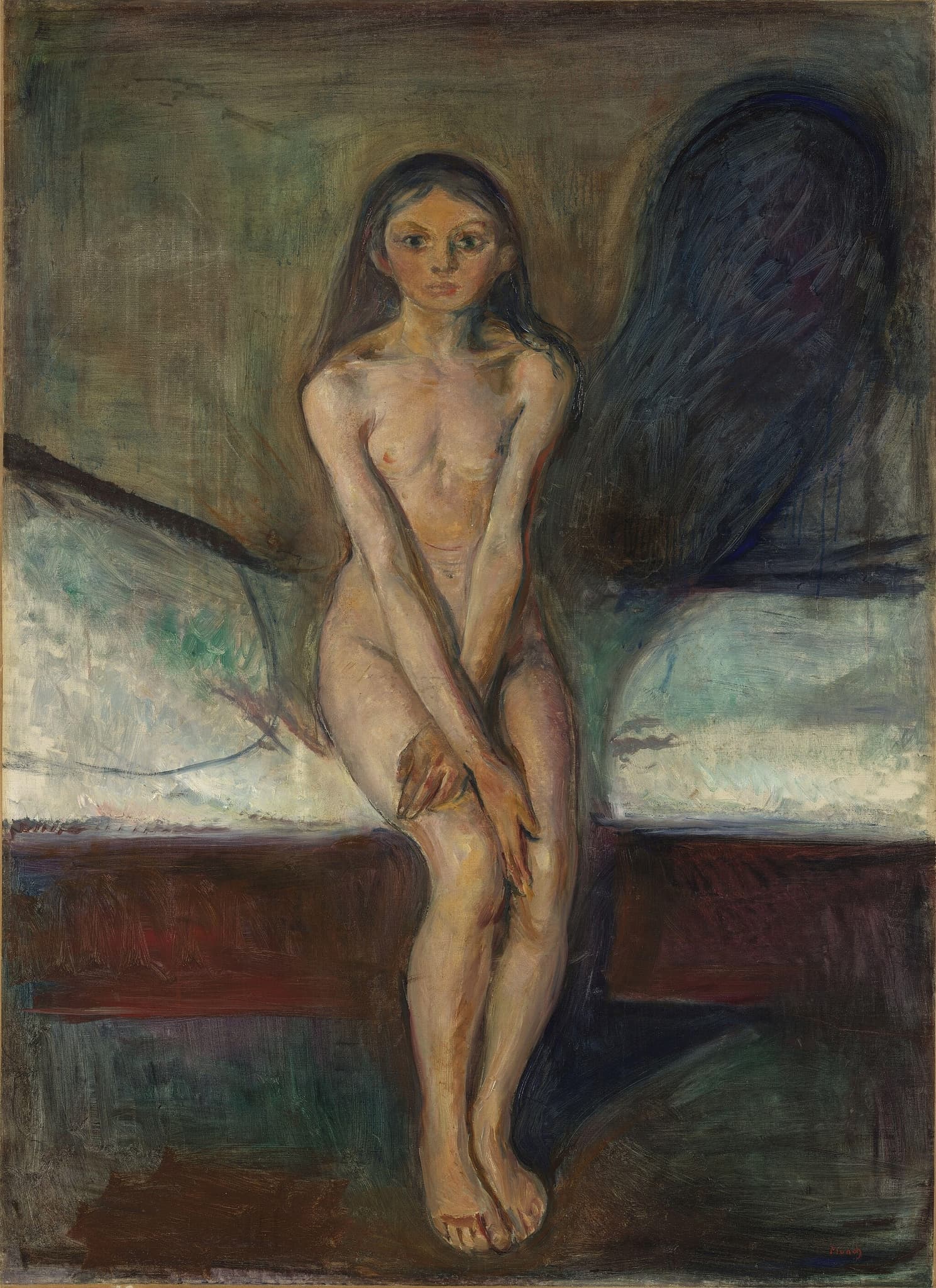
Assuming an authenticated primary 1894 oil‑on‑canvas Puberty by Edvard Munch, my auction estimate is USD 8–40 million. This range balances Munch’s blue‑chip market and high‑end oil precedents with the fact that canonical 1894 Puberty oils are museum‑held and lack direct open‑market comparables; final price will depend critically on version, provenance, condition and exhibition history.
Valuation Analysis
Valuation conclusion: Assuming the object is an authenticated, primary 1894 oil‑on‑canvas by Edvard Munch, I place a reasonable auction range of USD 8–40 million. The band is driven by two countervailing forces: Munch’s established blue‑chip market and precedent for very high prices for unique oils (the artist’s ceiling is demonstrated by The Scream) [1], while the absence of a recent open‑market sale for the canonical 1894 Puberty oil means direct comparables are scarce, producing greater uncertainty.
The most relevant open‑market oil comparable is Girls on the Bridge (1902), which realised a substantial mid‑eight‑figure price at Sotheby’s and shows that museum‑quality Munch oils can reach very high levels when provenance and condition are immaculate [2]. By contrast, the Puberty motif appears in numerous prints and graphic states—these are active in the secondary market and demonstrate motif demand, but editioned works sit in a distinctly lower price band (see museum impressions such as the MoMA example) [4]. Importantly, public collection records indicate canonical 1894 Puberty oils are held by institutions, which explains the lack of a canonical oil sale and is a principal reason the estimate is wide [3].
Price outcome will therefore hinge on a few determinative variables. Upward drivers are clear: confirmed attribution to Munch and identification as the canonical 1894 state; continuous, museum‑quality provenance; extensive exhibition and publication history; and excellent physical condition. Negative drivers include identification as a later version or studio replica, substantial restorations or structural issues, title disputes, or gaps in provenance. Any of these factors can materially alter buyer participation and competitive dynamics at auction.
Operationally, the lower bound (~USD 8M) reflects scenarios in which the painting proves to be a later variant, has significant condition or provenance issues, or only attracts transactional private buyers. The upper bound (~USD 40M) reflects a market outcome in which the picture is authenticated as a primary 1894 oil, is in excellent condition, has unbroken high‑quality provenance and exhibition history, and provokes institutional and private competition. While exceptional outliers (comparable to The Scream) are theoretically possible, they would require an unusually rare combination of historical importance, provenance and market circumstances.
Next steps to narrow the estimate: secure high‑resolution imagery and technical analysis (X‑ray, IR, pigment testing); obtain a conservator’s condition report; check the Munch catalogue raisonné and institutional records; and solicit a formal pre‑sale opinion from a senior Impressionist & Modern specialist at a major auction house. I can assist in drafting outreach or compiling the documentation package for a specialist review.
Key Valuation Factors
Art Historical Significance
High ImpactPuberty (c.1894) occupies a central place in Munch’s Symbolist, psychologically focused output. Executed during a formative period when Munch explored adolescence, sexuality and existential unease, this motif is regularly discussed in monographs and exhibition literature. While not as globally iconic as The Scream or Madonna, the 1894 Puberty is art‑historically important: it captures a key technical and thematic phase, and scholarly recognition translates directly into market desirability. For institutions and advanced private collectors that prioritize canonical works, a confirmed primary 1894 oil therefore commands a substantial premium over later variants, workshop copies or printed states. Its significance increases institutional interest and the likelihood of competitive bidding.
Provenance & Exhibition History
High ImpactProvenance and documented exhibition/publication history are among the single largest determinants of value. A continuous chain of title that includes reputable dealers, named private collectors or museum loans materially reduces buyer risk and supports higher estimates. Significant exhibition history—appearances in major retrospectives or international loans—bolsters scholarly value and institutional willingness to pay premium sums. Conversely, gaps in provenance, undocumented transfers, or associations with contested wartime ownership can depress realizations or rule out institution buyers entirely. For Puberty, clean, museum‑grade provenance can be the difference between a low‑single‑digit million sale and a high‑teens/low‑tens of millions outcome.
Condition & Conservation
High ImpactPhysical condition and conservation history directly influence both marketability and price. A primary 1894 oil with an intact original paint surface, minimal retouching and no major structural compromise will attract top buyers and institutions. Major issues—extensive inpainting, relining, flaking paint or structural instability—reduce buyer confidence and can impose discounts that are materially large (often tens of percent or more, depending on severity). Technical imaging (X‑ray, infrared reflectography) and pigment analysis are essential to separate original material from later interventions and to confirm attribution. A detailed conservator’s report is therefore a prerequisite for firm valuation and sale planning.
Version Identification & Rarity
High ImpactMunch produced multiple versions and graphic states of the Puberty motif; distinguishing a primary 1894 oil from later revisions, studio replicas or prints is crucial. A verified canonical 1894 oil is scarce—most canonical examples are held by museums—which increases its potential market value and institutional appeal. Later studio variants or commercial reproductions are far more common and command substantially lower prices. Rarity of a museum‑quality oil directly correlates with the market ceiling: uniqueness combined with confirmed authorship and pristine condition drives the upper end of the estimate band, whereas misidentified or derivative states push value toward the lower bound.
Market Demand & Comparable Sales
Medium ImpactDemand for Munch’s unique oils is strong at the high end—blockbuster results like The Scream and high‑value oils such as Girls on the Bridge demonstrate institutional and private appetite for primary works [1][2]. That demand supports the possibility of high realizations for well‑provenanced, museum‑quality paintings. However, because many canonical Munch oils are already in institutional collections, open‑market supply is limited and direct comparables for a canonical 1894 Puberty are scarce, which increases outcome variability. Comparable sales therefore provide directional guidance but must be applied cautiously given differences in provenance, condition and state.
Sale History
Puberty has never been sold at public auction.
Edvard Munch's Market
Edvard Munch is a blue‑chip modern artist whose most important unique works have fetched high eight‑figure and nine‑figure prices, demonstrating strong global collector and institutional demand. The market differentiates sharply between unique, museum‑quality oils (which command top prices) and prints/variants (which occupy significantly lower bands). Auction houses, museums and deep‑pocketed private collectors comprise the primary buyer pool for major works. Because many canonical Munch pieces reside in public collections, supply of top‑tier oils is limited; that scarcity, combined with strong provenance and condition, supports multi‑million valuations when primary works appear on the market.
Comparable Sales
The Scream
Edvard Munch
Artist's market ceiling and iconic, canonical work — sets the top benchmark for what collectors will pay for a unique, museum‑quality Munch. Although medium is pastel (not oil), it demonstrates collector willingness to pay nine‑figure sums for canonical Munch works.
$119.9M
2012, Sotheby's, New York
~$167.7M adjusted
Girls on the Bridge
Edvard Munch
Large, museum‑quality Munch oil sold at major auction — the most directly relevant public‑sale oil comparable available; shows that top oils by Munch can reach high eight‑figure results and provides a closer oil‑to‑oil analogue for valuing a primary oil version of Puberty.
$54.5M
2016, Sotheby's, New York
~$72.9M adjusted
Puberty (etching/print), high-quality impression
Edvard Munch
Same motif/title but editioned print — directly shows market demand and realised levels for Puberty impressions (high five‑ to low six‑figure range). Important to separate printed/editioned market from unique oil market when valuing a painting.
$620K
2023, Auction‑aggregator reported sale (various houses; 2022–23 high‑quality impressions)
~$652K adjusted
Current Market Trends
Current market dynamics favor scarcity, provenance and institutional validation: collectors prize museum‑quality, well‑documented works by canonical modern artists. Demand at the top end has remained concentrated and comparatively resilient, while secondary tiers (prints and variants) continue to provide liquidity. The infrequency of canonical oils entering the market increases both potential upside for genuinely rare offerings and uncertainty; sale outcomes will therefore hinge on documentation, condition and the sale venue chosen.