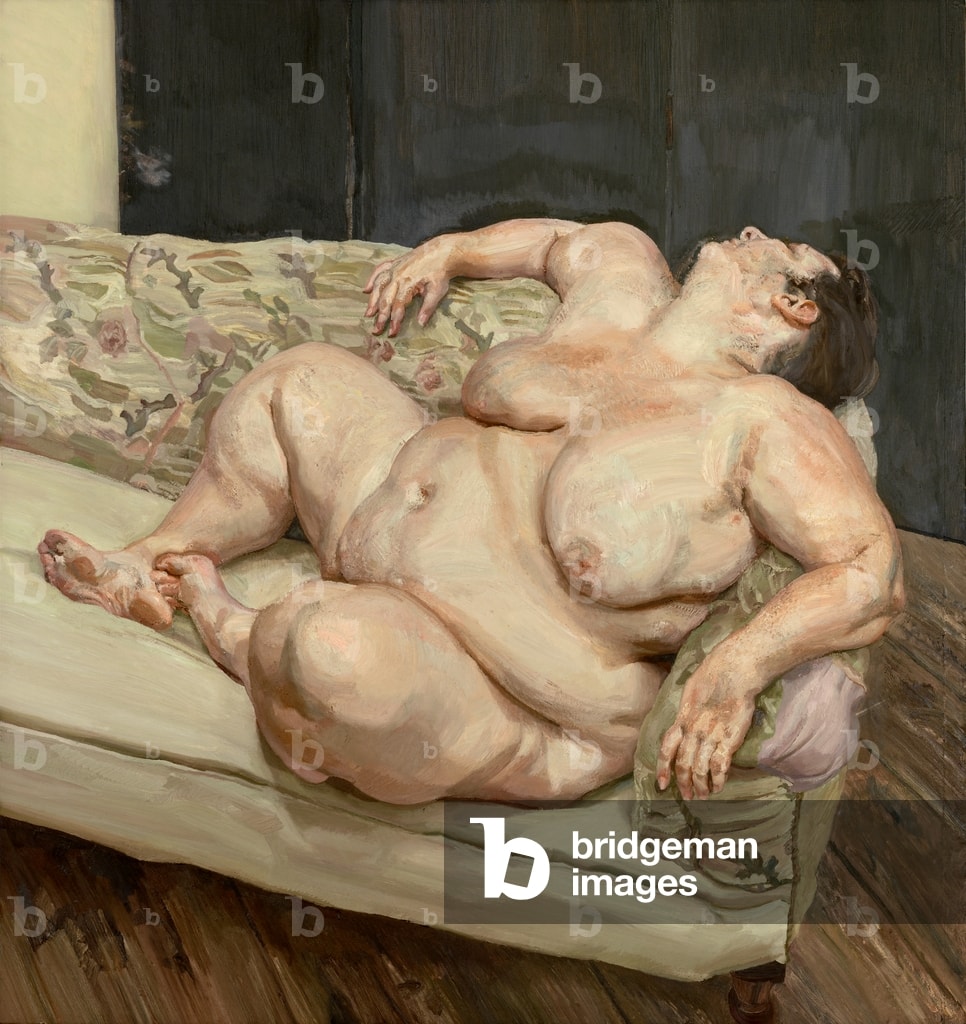
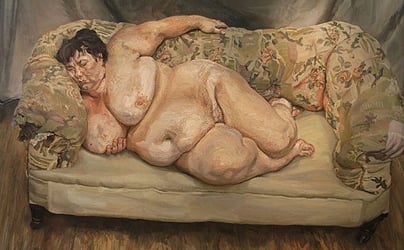
Benefits Supervisor Resting

by Lucian Freud

Benefits Supervisor Resting confronts the reclining‑nude tradition with unvarnished corporeality and quiet dignity. Sprawled on a sagging floral sofa, the sitter’s tilted head and unarranged limbs shift attention from face to the landscape of flesh, rendered in dense, mottled strokes. The humble studio—scuffed wooden floor, dark wall—magnifies the body’s monumental presence rather than flattering it [1].

Study Print Studio

Create a personal study print

Build a companion study sheet around the part of this painting that speaks to you most. Choose a detail, shape an interpretation, and walk away with something personal and display-worthy.

Fast Facts

Year
1994
Medium
Oil on canvas
Dimensions
150.5 × 161.2 cm
Location
Private collection
Benefits Supervisor Resting by Lucian Freud (1994) featuring Sagging floral sofa, Tipped‑back, averted head, Diagonal sprawl of the body, Knotted toes at the cushion’s edge

Click on any numbered symbol to learn more about its meaning

Meaning & Symbolism

Freud constructs monumentality from the most ordinary materials: a battered studio sofa with faded florals, a scuffed plank floor, and a dark, workmanlike wall. Against this humble stage, the body sprawls diagonally, hips and belly cresting like topography while a hand drapes over the armrest and toes knot together at the cushion’s edge. The head tips back so the face is more absent than available; desire, if it looks for conventional cues, finds none. Instead, the eye engages with paint behaving like flesh—thick, combed strokes in bruised pinks, olives, and greys that record weight, temperature, pressure. Light rakes across shin, thigh, and abdomen, revealing seams and folds not as defects but as evidence: gravity, time, and use. The pose’s casual sprawl—one forearm thrown up, the other sinking into upholstery—asserts a claim to space that is neither apologetic nor theatrical, simply present. In this insistence on unarranged limbs and tipped‑back head, the picture refuses the odalisque’s choreography and substitutes a posture of rest as right 1. Freud further alters the genre by naming the sitter through work, not myth. “Benefits Supervisor” relocates the reclining nude from fantasy to bureaucracy, implicating labor, paperwork, and public service in the act of lying down. Rest becomes social, even political: it is earned, necessary, and unglamorous. The studio’s material facts—splintered floorboards, the sofa’s sag, the thin cushion under the left foot—echo this theme, staging the body not on a couch of antiquity but on furniture that bears and displays weight. In doing so, the painting turns class marker into dignity, elevating the everyday without beautifying it. Freud’s vaunted “truth‑telling” about flesh is not cruelty; it is tenderness disciplined by attention. The mottled passages around knee and elbow, the pallor pooled at the throat, the greenish halations where blood seems to cool—all register a living organism rather than an idealized sign. That truthfulness also resists easy psychologizing: with the face tipped away, identity is carried by the entire body—by posture, temperature, and fatigue—so that personhood is inferred from corporeal fact, not theatrical expression 13. Within late‑20th‑century painting, this recalibration matters. At a moment when much advanced art pursued dematerialization or concept, Freud argued—by craft alone—that looking hard at bodies could still push painting forward. Benefits Supervisor Resting belongs to the apex of his 1990s practice, when sustained sittings and thickened facture yielded his most commanding nudes. Its ambition is historical as well as social: the diagonal sprawl and head‑back profile recall the Western reclining tradition only to reverse its values—beauty becomes evidence, allure becomes presence, and the nude becomes a specific person anchored in time and class. That is why Benefits Supervisor Resting is important: it collapses the distance between high art and ordinary life without sentimentality, insisting that the right to occupy space, to be heavy with rest, is itself a profound human claim 1234.

Explore Deeper with AI

Ask questions about Benefits Supervisor Resting

Popular questions:

Powered by AI • Get instant insights about this artwork

💬 Ask questions about this artwork!

Interpretations

Symbolic Reading: Bureaucracy Enters the Nude

By naming the sitter “Benefits Supervisor,” Freud sutures the odalisque to the Jobcentre. The title functions like a captioned readymade: it imports the administrative state—paperwork, queues, public service—into the intimate genre of the reclining nude. In doing so, rest is coded as earned rather than offered, and the viewer’s gaze is rerouted from anonymous allure to a specific social identity. This bureaucratic marker complicates desire with civic proximity: the model is not myth but a worker whose labor frames the very possibility of repose. Critics and curators have underscored how Freud’s late portraits hinge on this specificity of status and job, re-siting the nude from fantasy to the everyday apparatus of welfare and work 13.

Source: National Portrait Gallery; Christie’s

Formal Analysis: Workroom Aesthetics and the Ethics of Surface

The dilapidated sofa, scuffed plank floor, and dark wall establish a workroom aesthetic that mirrors Freud’s ethos: painting as labor performed in time. Thick, directional strokes accumulate into a tactile skin that records pressure, temperature, and weight; paint here is not merely descriptive but phenomenological, acting as skin acts. The studio’s humble facts—fabric sag, cushion compression—cooperate with facture to testify rather than idealize. This is a rigor of looking in which the medium’s resistance becomes an ethical guarantee: attention paid equals dignity conferred. Exhibition materials around Freud’s etchings clarify how his sustained sittings and dense impasto sought to make paint “work like flesh,” anchoring observation in material process rather than psychology 12.

Source: MoMA; Christie’s

Art-Historical Comparison: After Titian, Against the Odalisque

Freud positions a modern body within the reclining tradition—Titian to Manet—only to reverse the value system. Instead of softening surfaces into ideal beauty, he converts beauty into evidence: of gravity on the abdomen, of circulation along the shin. Kenneth Clark’s “naked” vs. “nude” dichotomy is short‑circuited; the figure is naked in fact yet granted the monumentality of the nude without its sanitizing conventions. The tipped‑back head and unchoreographed limbs refuse the odalisque’s erotically legible pose, substituting a claim to space that is present rather than enticing. Sale catalogues explicitly frame this work within the lineage precisely to show how Freud’s handling displaces allure with corporeal truth and historical seriousness 1.

Source: Christie’s (invoking Clark and the reclining nude lineage)

Physiological/Temporal Reading: Time Stamped in Skin

Light rakes across the body to reveal micro-events—cooling greens at the extremities, pooled pallor at the throat, bruised transitions over joints—treating skin as a temporal register. The result is less erotic display than a chronicle of use, where fatigue and circulation become the portrait’s expressive force. Contemporary criticism has noted that Freud’s supposed “cruelty” is actually tender empiricism: he withholds melodrama to let physiology carry meaning. In this key, the painting addresses aging and rest not as decline but as evidence of life maintained, substituting clinical specificity for sentiment. The lens of time, not psyche, structures recognition; identity is inferred from the body’s ongoing negotiations with gravity, time, and use 15.

Source: The New Yorker; Christie’s

Historical Context: Figuration Against Dematerialization

Within the late twentieth century’s tilt toward conceptualism and “dematerialized” practices, Freud’s School of London cohort argued—by craft—that rigorous figuration could still be avant‑garde. Benefits Supervisor Resting epitomizes this countercurrent: prolonged sittings, dense impasto, and observational extremity as progressive method. Institutional overviews stress how this loose circle (Bacon, Auerbach, Kossoff, Freud) sustained the body as a site where modernity remains thinkable in paint. MoMA’s checklisting of this canvas within a print/painting dialogue further positions Freud’s labor-intensive looking as a contemporary answer to concept: material presence as thought. The work claims contemporaneity not by novelty of medium but by the intensity of attention it demands and records 24.

Source: National Galleries of Scotland; MoMA

Reception/Market Reading: Canon by Auction?

The painting’s 2015 auction record consolidated its public profile, translating critical esteem into market canonization. While price does not determine value, the sale amplified debates about what kind of bodies attain museum‑scale seriousness and how classed flesh circulates as high-value culture. That a benefits supervisor’s rest could command blue‑chip attention underscores the work’s wager: collapsing high/low without sentiment. Framed by major retrospectives before and after, the market moment functions less as anomaly than as confirmation of an interpretive shift—presence over allure—now legible to institutions and collectors alike. Tracking this reception history clarifies how Freud’s “truth to flesh” became a widely shared criterion for importance across criticism, exhibition, and commerce 36.

Source: Christie’s (post-sale release); National Portrait Gallery

Related Themes

About Lucian Freud

Lucian Freud (1922–2011) was a Berlin-born, British painter and a leading figure of postwar figurative art associated with the School of London. Across decades, he shifted from linear precision to dense impasto, developing an exacting practice of prolonged sittings that produced psychologically charged “naked portraits” challenging the idealized tradition of the nude [3][4].
View all works by Lucian Freud

More by Lucian Freud

Benefits Supervisor Sleeping by Lucian Freud

Benefits Supervisor Sleeping

Lucian Freud (1995)

Benefits Supervisor Sleeping is a 1995 oil painting in which Lucian Freud renders a sleeping, unidealized body across a sagging, floral sofa. With dense, tactile brushwork and a close, low vantage, the work asserts <strong>monumental presence</strong> while confronting viewers with the <strong>material truth of flesh</strong> and time’s imprint. It is a late‑century landmark of the School of London’s uncompromising figurative art <sup>[1]</sup><sup>[4]</sup>.
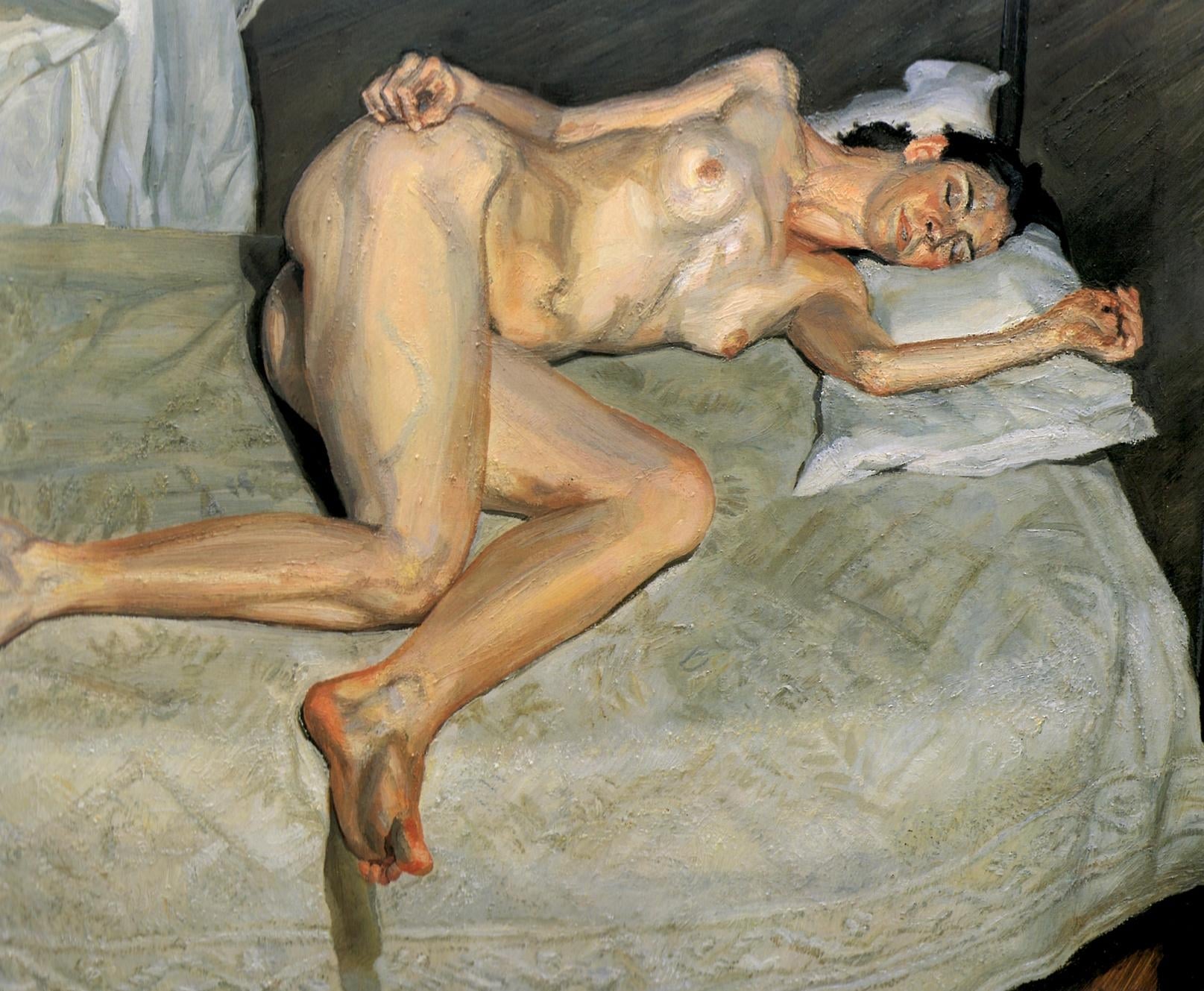
Portrait on a White Cover by Lucian Freud

Portrait on a White Cover

Lucian Freud (2002–2003)

Lucian Freud’s Portrait on a White Cover turns the human body into a field of <strong>material truth</strong>, setting warm, bruised flesh against a <strong>cool, worked cloth</strong> that is named in the title. The diagonal sprawl, clenched left hand, and twisted feet make <strong>gravity</strong> and <strong>duration</strong> felt as subjects in their own right <sup>[1]</sup><sup>[2]</sup>.
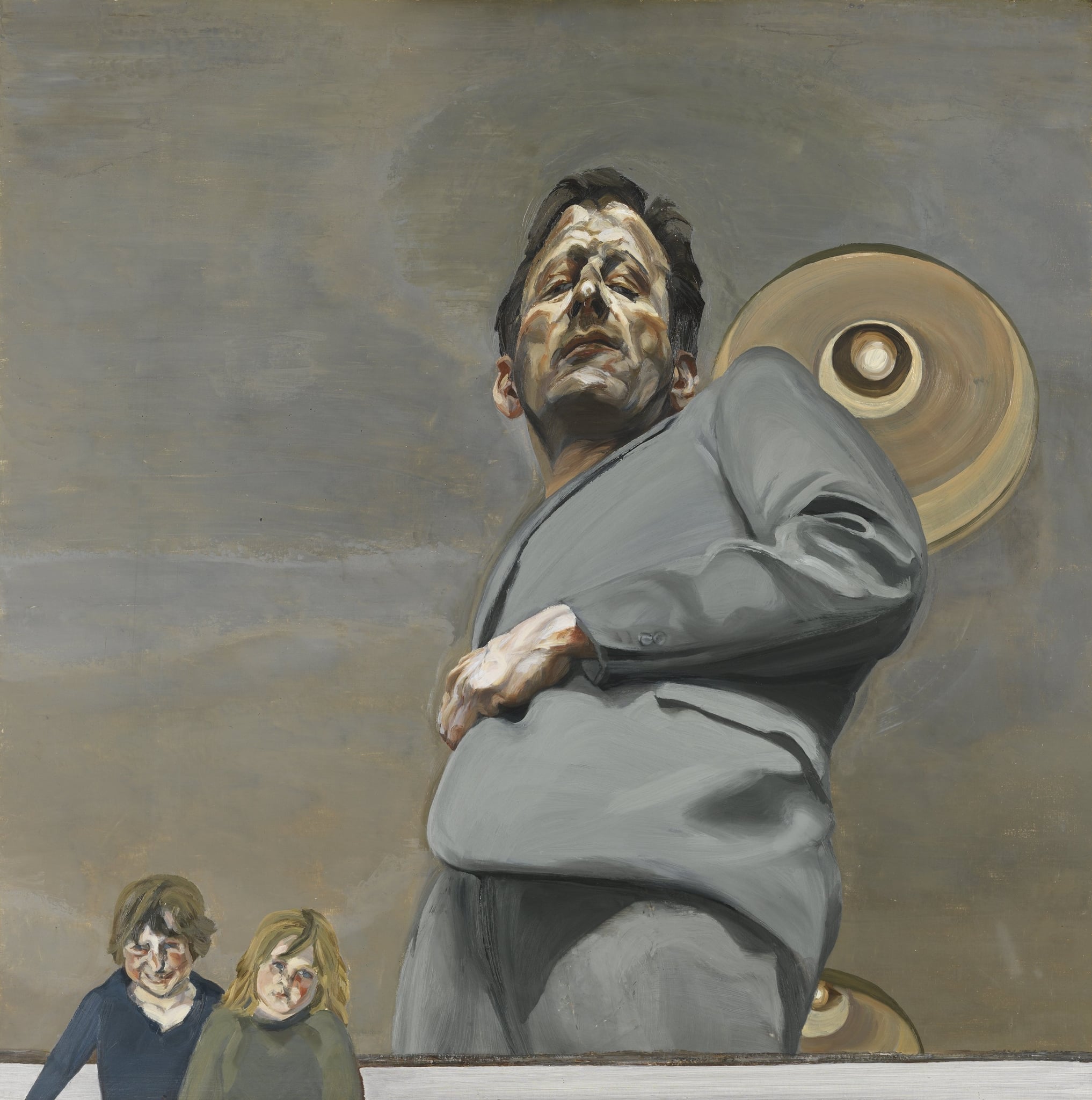
Reflection with Two Children by Lucian Freud

Reflection with Two Children

Lucian Freud (1965)

Lucian Freud’s Reflection with Two Children stages a self‑portrait as a confrontation with a mirror placed on the floor, forcing a vertiginous, low viewpoint. A suited figure looms while a ceiling lamp hovers like a disc behind his head, and two small children puncture the frame at the bottom edge. The painting converts self‑representation into a drama of <strong>authority</strong>, <strong>exposure</strong>, and <strong>accountability</strong> <sup>[1]</sup><sup>[2]</sup>.
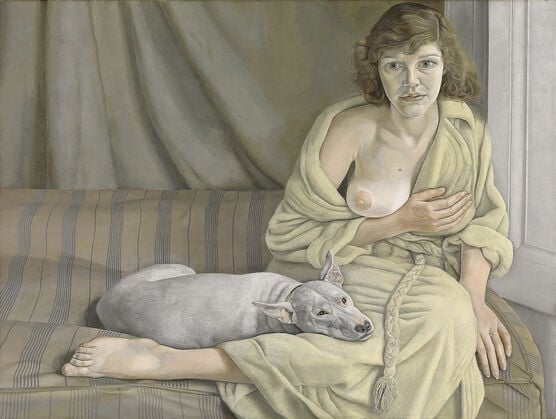
Girl with a White Dog by Lucian Freud

Girl with a White Dog

Lucian Freud (1950–51)

Lucian Freud’s Girl with a White Dog stages a charged quiet: a woman in a parted robe exposes one breast while shielding herself with a hand, as a white dog’s head lies heavy on her lap. The cool, fine-grained paint makes every surface hyper-present—the matte skin, the nap of the robe, the striped sofa—turning domestic calm into <strong>uneasy intimacy</strong> <sup>[1]</sup><sup>[2]</sup>.