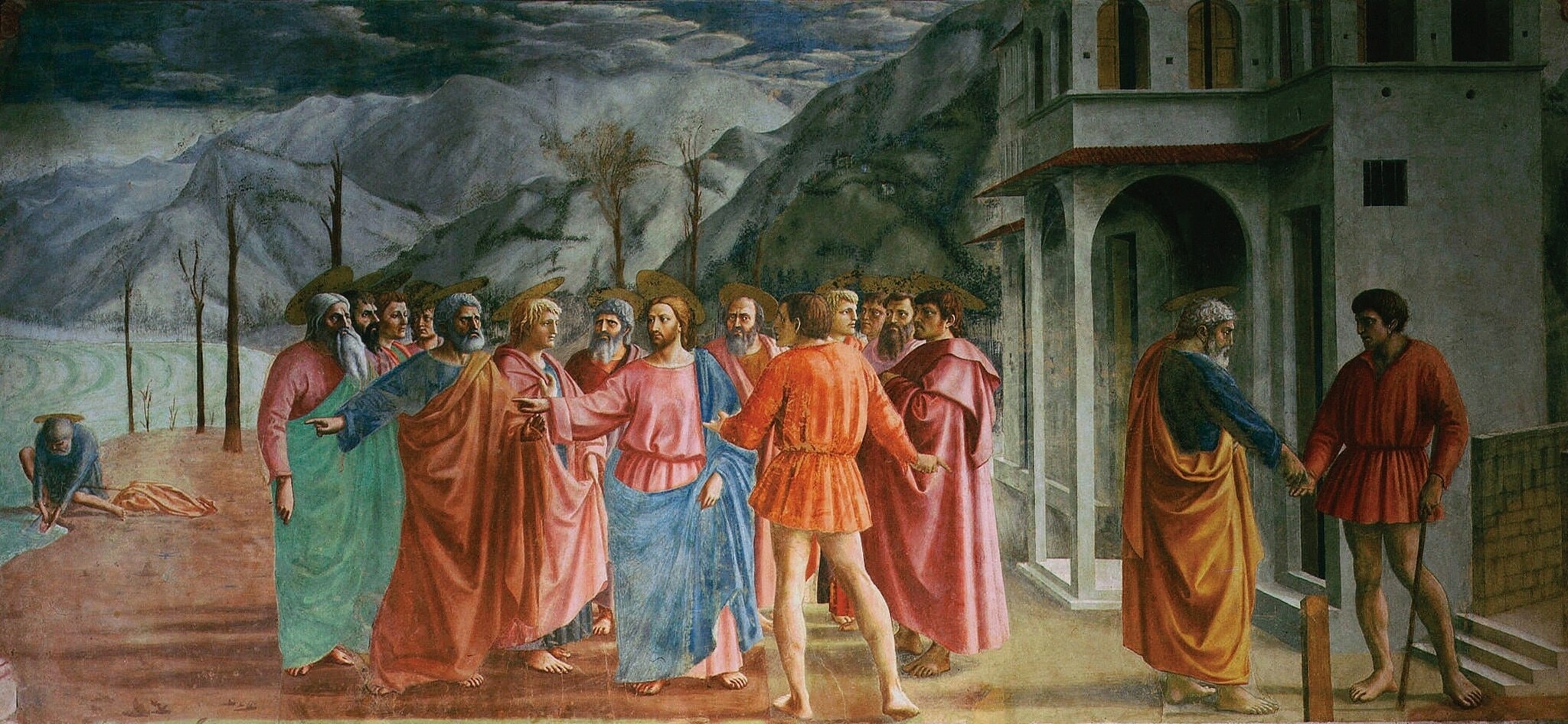
The Tribute Money
by Masaccio
Masaccio’s The Tribute Money unifies three Gospel moments into one rational space, using continuous narrative, coherent light from the right, and strict linear perspective to dramatize Christ’s directive to Peter about the temple tax. The red-clad tax collector confronts the group at center, Peter retrieves the coin at the lake on the left, and he pays the dues at the portico on the right, all bound by emphatic pointing hands and a shared illumination [2][3].
Study Print Studio
Create a personal study print
Build a companion study sheet around the part of this painting that speaks to you most. Choose a detail, shape an interpretation, and walk away with something personal and display-worthy.
Fast Facts
- Year
- c. 1425–1427
- Medium
- Buon fresco (wall painting)
- Dimensions
- Approx. 255 × 598 cm
- Location
- Brancacci Chapel, Santa Maria del Carmine, Florence (in situ)
Click on any numbered symbol to learn more about its meaning
Meaning & Symbolism
Masaccio constructs authority through space. The orthogonals of the right‑hand portico converge near Christ’s head, making him the visual axis of judgment while his calm right hand directs Peter to the shore, initiating the sequence leftward 25. The group of apostles forms a compressed semicircle whose bodies are carved by a consistent light descending from the right—the same direction as the actual chapel window—so that cast shadows lean left and volumes read as solid and weighty, like sculpture translated into paint 2. Halos shrink into foreshortened discs that obey perspective, preserving sanctity without violating realism; the unhaloed tax collector in vivid vermilion stands apart as secular power, his stance a contrapuntal echo to Peter’s mirrored gestures across the scenes 25. The distant mountains fade into cool atmospheric blues, slowing the eye and deepening the stage for Peter’s crouched retrieval of the coin at the lakeshore, while the foreground tiles and the portico’s measured bays provide a rational grid for the final payment 25.
This orchestration of light, gesture, and perspective advances a precise claim about community. Christ’s directive embeds obedience within freedom: his acknowledgment of the tax does not concede divine filiation; it averts scandal and upholds peace—"so that we may not offend them"—as Peter both fishes and pays 6. In a city moving toward the 1427 catasto, a landmark for fairer direct taxation, the fresco functions as a civic homily: lawful dues stabilize the body politic when anchored to rightful authority 3. Scholars also read the Brancacci program’s Petrine focus as pro‑Roman, aligning Florentine identity with apostolic and papal legitimacy amid volatile regional politics; Peter’s leadership here becomes the hinge between spiritual commission and public order 15. The red of the official’s tunic and his bare legs project worldly urgency; yet he is bracketed—first by Christ’s measured command at center, then by Peter’s dignified compliance at the portico—showing secular exaction constrained by sacred prudence 25.
The painting’s realism is polemical. By tying the narrative to the chapel’s actual illumination, Masaccio argues that truth is intelligible and embodied in the world’s rational structure; doctrine becomes legible through nature’s laws—light, perspective, and the geometry of architecture 2. The continuous narrative is not a flourish but a moral syllogism: Christ’s command (center) necessitates action (left) and culminates in social settlement (right). Even small details serve the thesis: the locked gazes among apostles transmit consent; the measured grip in the paying of the coin frames duty as voluntary peace rather than coercion. In this way, The Tribute Money codifies a Renaissance ideal in which visual reason secures theological meaning and civic concord—an innovation that made the Brancacci Chapel a school for generations after Masaccio’s early death 12.
Explore Deeper with AI
Ask questions about The Tribute Money
Popular questions:
Powered by AI • Get instant insights about this artwork
💬 Ask questions about this artwork!
Interpretations
Civic-Economic Lens: Tax Reform and Visual Consent
Read against Florence’s 1427 catasto, the fresco stages a didactic choreography of payment as consensual order rather than coercion. The narrative’s tripartite arc—command, action, settlement—normalizes the levy by embedding it in apostolic obedience, while the measured exchange at the portico models decorum in fiscal relations. Such pictorial etiquette matters: gestures and spacing de-escalate confrontation, translating a potentially divisive demand into civic virtue. In a republic negotiating fairer direct taxation, Masaccio’s scene acts as policy rhetoric in paint, suggesting that equity and transparency (a visible coin, a public porch, a shared light) legitimate exaction. The red-clad, unhaloed official remains socially distinct, yet bracketed by sacred prudence, indicating civil power accountable to higher reason 325.
Source: Web Gallery of Art; Smarthistory; Wikipedia (scholarship synthesis)
Petrine Politics: Pro‑Roman Alignments
Within a chapel centered on St. Peter, The Tribute Money magnifies Petrine jurisdiction as the hinge between miracle and municipality. Peter executes Christ’s prudential policy and performs the transaction, embodying a chain of authority that runs from the divine to the civic. Florentines of the 1420s, entangled with papal diplomacy and regional conflict, would have recognized this as visual statecraft: affirming Roman apostolic legitimacy while smoothing church–city frictions over taxation. The fresco thus reads as a local oath to a wider Roman order, locating Florentine identity inside a Petrine dispensation. Masaccio’s cool rational space—Brunelleschian in spirit—confers institutional gravitas on Peter’s office, turning the apostle into an early Renaissance magistrate of conscience and coin 512.
Source: Wikipedia (aggregated scholarship on Brancacci program); Britannica; Smarthistory
Medium & Restoration: Fresco as Proof of Light
Buon fresco binds pigment to wet plaster, fixing Masaccio’s single right‑hand light into the wall’s very fabric. The 1981–90 restoration peeled away grime and later overpaint, re‑exposing the sculptural chiaroscuro that calibrates volumes and shadows. This matters interpretively: the fresco’s "truth-claim" rests on a verified, consistent illumination that mirrors the chapel window, turning architectural reality into epistemic evidence. Fresco’s speed and planning demands likely reinforced the work’s geometric discipline—measured bays, tiled floor, and foreshortened halos—which restoration has made newly legible for viewers. In short, conservation didn’t just clean a picture; it restored a theological argument in which nature’s light authenticates doctrine, making the wall a medium of public reason 42.
Source: City of Florence/Musei Civici (Brancacci conservation); Smarthistory
Spatial Theology: Vanishing Point as Axis of Judgment
The orthogonals of the right‑hand portico lead to or near Christ’s head, installing him as the painting’s vanishing point of judgment. This Brunelleschian device is not neutral optics; it is a metaphysical diagram where visibility, legality, and salvation converge. The apostles’ semicircle compresses toward this axis, while atmospheric perspective recesses the miracle, staging proximity to Christ as proximity to clarity. The result is a spatial liturgy: approach the center to see rightly; move outward to enact duty. By fusing precise geometry with moral hierarchy, Masaccio advances a theology of order in which perspective is a sacramental technology—an outward sign conferring inward intelligibility on doctrine and law 21.
Source: Smarthistory; Britannica
Narrative Mechanics: Continuous Time as Moral Logic
Masaccio’s continuous narrative is a temporal machine that compresses scriptural sequence into visible causality. Christ’s directive (center) necessitates the lakeside action (left) and the payment (right), making the fresco read as a syllogism: command → act → concord. Gestural rhyme (Christ pointing left; Peter answering right), repeated actors, and a unified light vault prevent fragmentation, so viewers grasp time by scanning space. This is less illusionism than argument: montage without rupture, designed to instruct lay audiences in doctrinal prudence and civic compliance. The clarity of this staging—rare in Trecento precedent—becomes an ethical pedagogy of looking, where understanding the story trains citizens to understand their obligations in the city 23.
Source: Smarthistory; Web Gallery of Art
Related Themes
About Masaccio
Masaccio (1401–1428) revolutionized painting by joining Brunelleschian perspective with sculptural chiaroscuro, yielding convincing bodies in coherent space. His brief career—centered on the Brancacci Chapel and Holy Trinity—set the template for Quattrocento naturalism and influenced generations from Filippino Lippi to Piero della Francesca [1][2].
View all works by Masaccio →