The Return of the Hunters
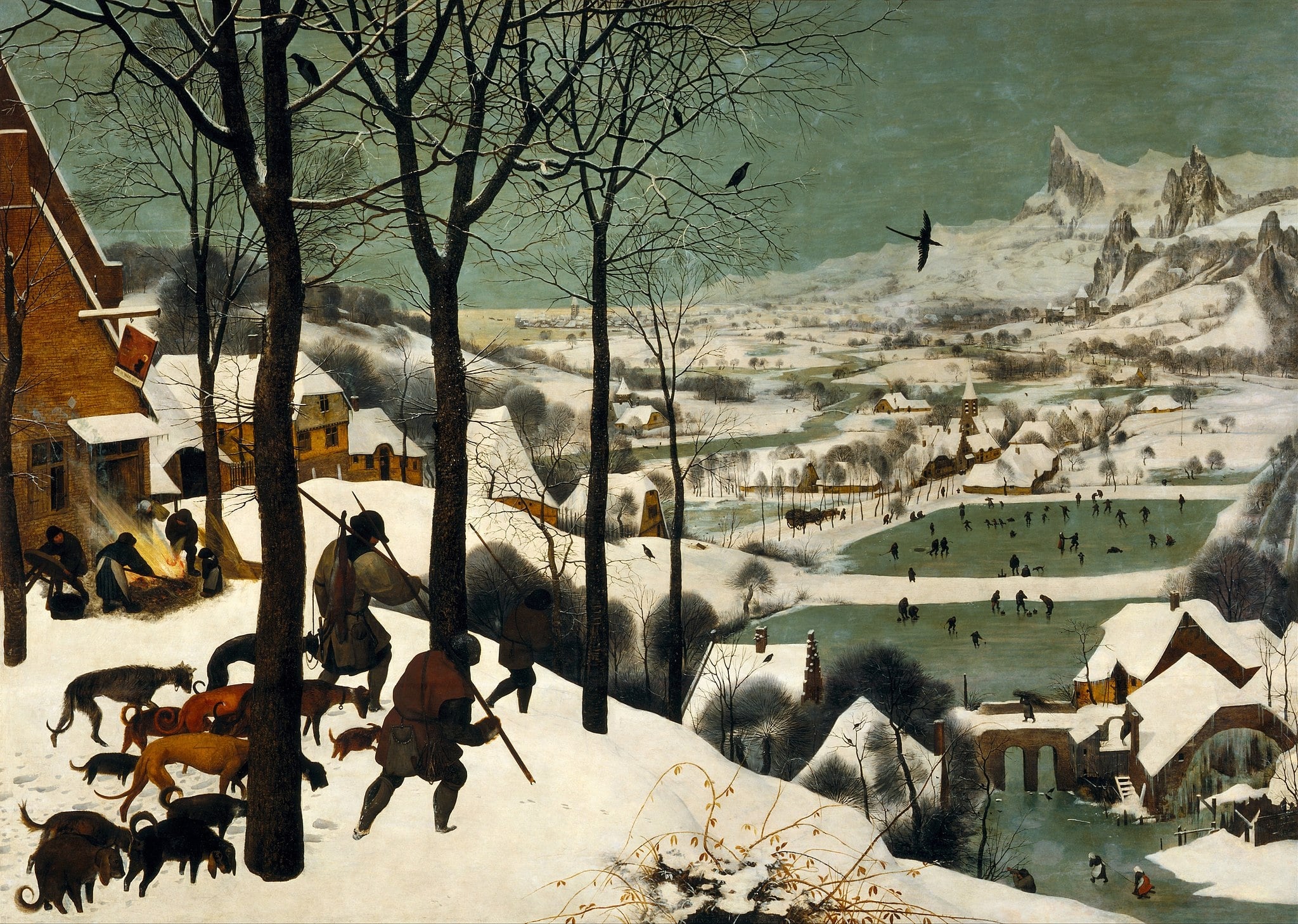
In The Return of the Hunters, Pieter Bruegel the Elder stages a wintry descent where three exhausted hunters and their dogs enter a valley alive with skaters and village chores. The painting forges a panoramic drama of hardship and resilience, contrasting scant game with communal play beneath a cold, teal sky [1][2].
Study Print Studio
Create a personal study print
Build a companion study sheet around the part of this painting that speaks to you most. Choose a detail, shape an interpretation, and walk away with something personal and display-worthy.
Fast Facts
- Year
- 1565
- Medium
- Oil on oak panel
- Dimensions
- 116.5 × 162 cm
- Location
- Kunsthistorisches Museum, Vienna
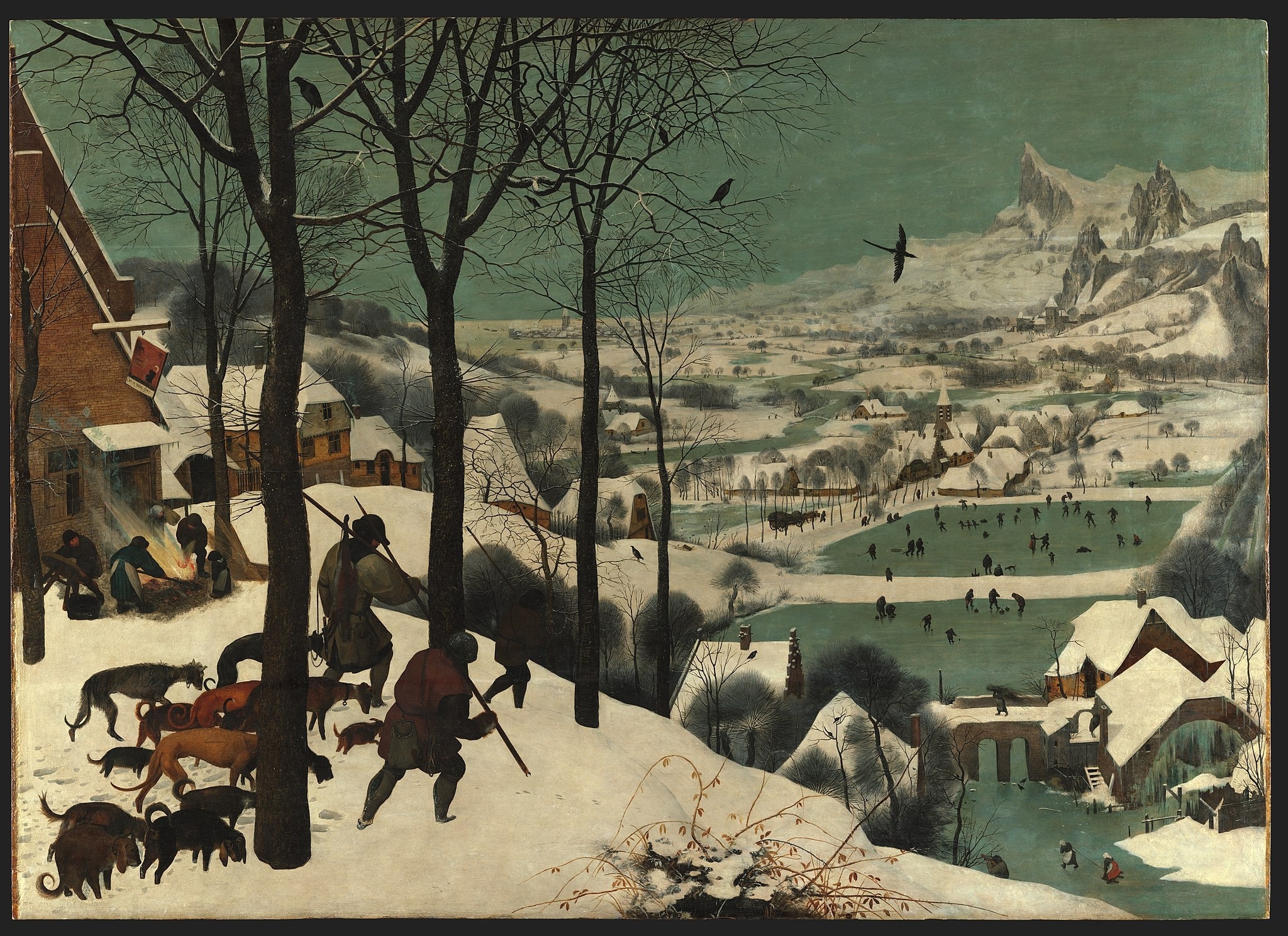
Click on any numbered symbol to learn more about its meaning
Meaning & Symbolism
Bruegel composes the scene as a downward procession from labor toward community: three hunters and a pack of weary dogs cross a steep, tracked slope toward ponds crowded with skaters. Their harvest is pointedly thin—a single fox dangled on a spear, a few birds—while tiny rabbit prints elude the foremost hunter. At left, an inn’s tilted sign bears a stag; scholars connect this to the legend of St. Hubert, the hunters’ patron, suggesting a spiritual cue the men ignore as they trudge past with eyes downcast 14. Just beyond, villagers singe a pig at a small fire—an established December task in the Labours of the Months—quietly fixing the panel in the cycle’s depths of winter 12. Above the village sprawls a high, invented range of crags—Alpine in spirit, drawn from the artist’s travel sketches—pressing human endeavor against a vast, indifferent nature 23.
The picture’s argument unfolds through movement and constraint. A chain of dark tree trunks and crows sets the tempo of the descent; the sweeping diagonal pulls the eye from the hunters’ tracks to the frozen millrace and bridges, then outward across patchwork fields to jagged peaks. Industry is stalled—the mill-wheel is locked in ice—yet the valley hums: figures skate, toboggan, and play kolf- or curling-like games, converting peril into pastime 23. Bruegel’s winter is not sentimental; it is a system of adaptation, in which scarcity at the slope’s edge is offset by social density below. The color key—muted browns and sooty greens under a cold teal sky—binds the terrain into a single breath of frost, a painterly register of mid‑sixteenth‑century winters often grouped under the Little Ice Age 23. The result is neither courtly spectacle nor isolated vignette but a cartographic panorama that maps human rhythms onto seasonal force.
Moral resonance threads this realism. Reindert Falkenburg reads the skewed stag sign (likely “Dit is inden hert”) as a pointed emblem: the time is December–January, the season of Christmas; the hunters’ averted attention marks spiritual near‑sightedness amid worldly toil 4. Whether or not viewers press that symbolism, Bruegel undeniably integrates sacred time into secular space, inviting recognition that meaning may be veiled within daily life. Thus the panel argues for the dignity and fragility of ordinary existence: people appear small, yet purposeful; nature is dominant, yet negotiated. This is the core meaning of The Return of the Hunters and why The Return of the Hunters is important: it pioneers a Northern vision in which landscape is not backdrop but protagonist, and community persistence—labor, leisure, ritual—becomes the measure of human wisdom within the seasons 12.
Explore Deeper with AI
Ask questions about The Return of the Hunters
Popular questions:
Powered by AI • Get instant insights about this artwork
💬 Ask questions about this artwork!
Interpretations
Historical Context: A Merchant’s Year on the Walls
Commissioned by Antwerp banker Niclaes Jonghelinck for a villa dining room, the 1565 Months cycle functioned as an immersive, year‑round calendar of civic time and resource management. In this setting, winter’s privations would have dialogued with the rhythms of urban trade and table sociability, reframing peasant labors as data about supply, transit, and feast days. “Hunters in the Snow” thus reads less as quaint genre than as a merchant’s macro‑ledger—tracking tasks (singeing, hunting), infrastructure under ice (mill, bridges), and crowd behaviors (games), all crucial to winter provisioning. The picture’s cool tonality and panoramic scope suit a cycle meant to be read comparatively, panel to panel, as a managerial instrument for thinking with the seasons rather than merely looking at them 21.
Source: Smarthistory; Kunsthistorisches Museum
Symbolic Reading: The Skewed Stag and Advent Attention
Reindert Falkenburg’s reading of the inn sign—likely “Dit is inden hert”—links the painted stag to St. Hubert/Eustace, the hunters’ patron whose epiphany occurs through a deer bearing a cross. Bruegel tilts the sign and sends the men past it downcast, staging a failure of Advent attentiveness: sacred presence is legible yet overlooked. Set in December–January, the panel folds Christmas time into secular circulation, inviting viewers—not just the depicted hunters—to practice discernment. The moral is not scolding but phenomenological: grace is ambient, inscribed in local signage and seasonal chores, if one reads the world rightly. This subtle spiritual layer complicates the cheery rink below, asking whether diversion and routine can coexist with contemplative vigilance 41.
Source: Reindert L. Falkenburg
Formal Analysis: Mapping a World with Diagonals
Bruegel “maps” winter using a sweeping diagonal from dark repoussoir (hunters, trees, crows) to luminous ice fields and serrated peaks. This cartographic staging fuses near‑field notations—tracks, rabbit prints, the fox—into a bird’s‑eye orchestration of routes, pauses, and nodes (bridges, millrace, ponds). The invented Alpine skyline, informed by Italian travel sketches, supplies a jagged horizon datum that both caps depth and scales human striving. Tonally, sooty greens and browns under a cold teal distribute a single breath of frost, while the locked mill-wheel performs a still‑life of arrested industry. The result is a total design where composition becomes knowledge: a graphic of winter’s flows and impediments, not a mosaic of anecdotes 23.
Source: Smarthistory; Britannica
Climate History Lens: Little Ice Age Realism
Painted amid mid‑16th‑century cold spells, the scene’s hard freeze is not picturesque garnish but climatic structure: immobilized waterpower, thin game returns, and thickening crowds on safe ice. Writers connect the panel to the severe winter of 1564/65, cautioning against linear causality yet acknowledging how Bruegel renders a lived thermodynamics—energy diverted from mills to bodies, from fields to games. This is a theory of adaptation in paint: scarcity at the margins offset by density at the center. The work complicates modern nostalgia for “idyllic winter,” staging pleasure as a byproduct of constraint and risk management—curated ice, supervised play, navigable bridges—rather than a denial of hardship 52.
Source: Artsy editorial; Smarthistory
Social Anthropology of Play: Rules on the Ice
Below the hunters, skaters, sledders, and players of kolf- or curling‑like games enact rule‑bound interactions that redistribute danger and maintain cohesion when agrarian labor ebbs. These activities aren’t mere diversion; they rehearse coordination, signal trust in ice thickness, and keep pathways open for exchange. The rink becomes a seasonal commons where status flattens in motion, contrasting with the uphill hierarchy of hunt and inn. In Bruegel’s pictorial economy, play is a social technology: it keeps bodies warm, tempers conflict, and converts an immobilized landscape into a mesh of predictable glides and stops—an index of a community’s capacity to self‑organize under environmental constraint 23.
Source: Smarthistory; Britannica
Related Themes
About Pieter Bruegel the Elder
Pieter Bruegel the Elder (c. 1525/30–1569) trained in the Netherlandish tradition, traveled through the Alps to Italy, and became the leading painter of large-scale scenes of peasant life and panoramic landscapes. His fusion of close social observation with moral and spiritual undercurrents shaped Northern art for generations [3].
View all works by Pieter Bruegel the Elder →