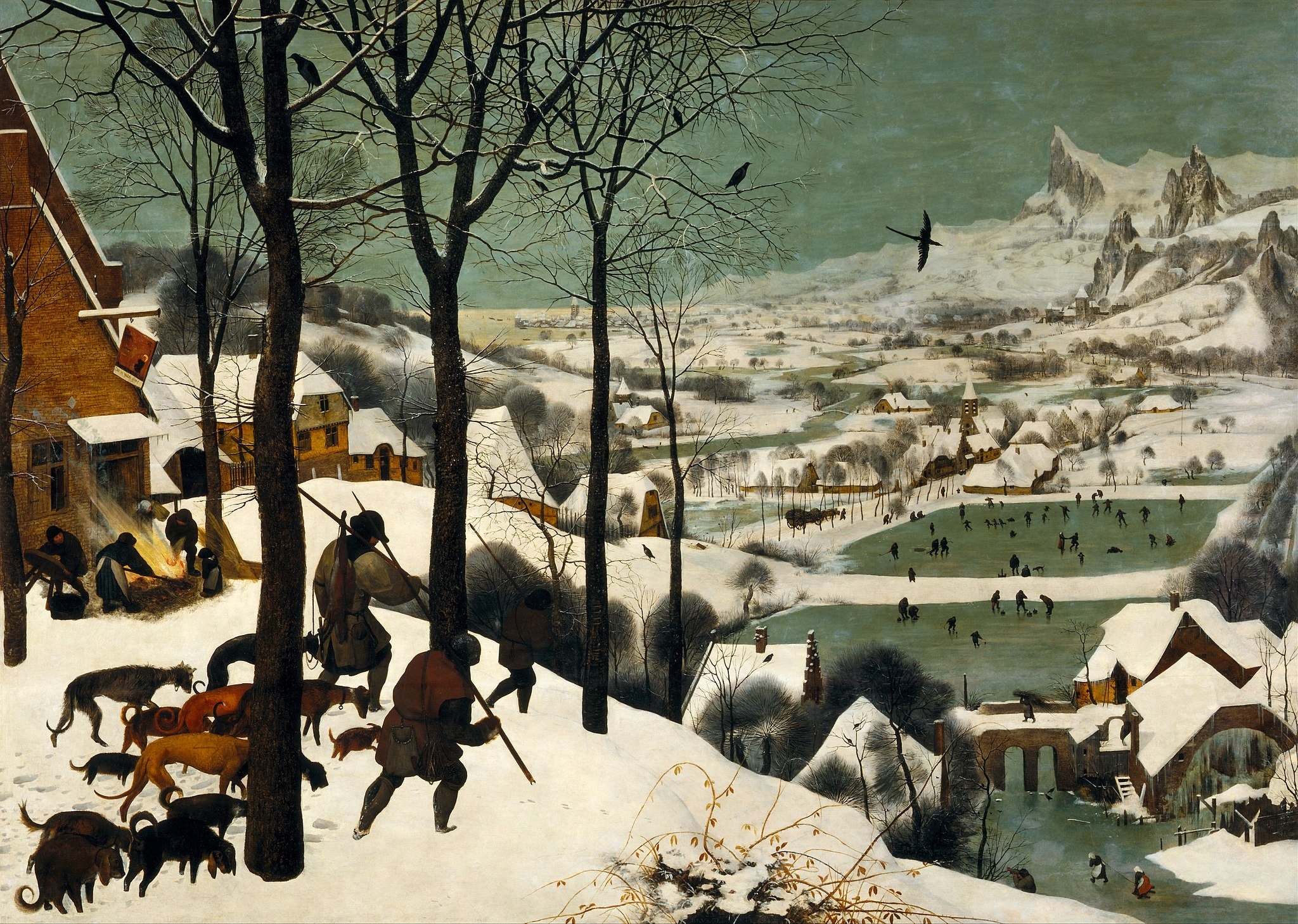
Hunters in the Snow

by Pieter Bruegel the Elder

In Pieter Bruegel the Elder’s Hunters in the Snow (1565), a trio of tired hunters and gaunt dogs descend past an inn toward a vast frozen valley where villagers work, play, and endure. Bruegel fuses winter scarcity (a single fox, bare trees, crows) with communal resilience (pig-singeing fire, skaters, mill smoke) to stage a world ordered by the season’s cycle.

Study Print Studio

Create a personal study print

Build a companion study sheet around the part of this painting that speaks to you most. Choose a detail, shape an interpretation, and walk away with something personal and display-worthy.

Fast Facts

Year
1565
Medium
Oil on oak panel
Dimensions
116.5 × 162.0 cm
Location
Kunsthistorisches Museum, Vienna
Hunters in the Snow by Pieter Bruegel the Elder (1565) featuring Single fox on the hunter’s pole, Gaunt hunting dogs, Pig-singeing/hearth fire

Click on any numbered symbol to learn more about its meaning

Meaning & Symbolism

Bruegel structures the picture as a moral argument. Entering from the left, three hunters and their thinning pack pick their way downhill; one shoulders a lone fox, the day’s meager result. The dogs’ ribs show and their heads droop—visual synecdoches for winter scarcity—while the inn yard’s pig-singeing and small hearth fire acknowledge that survival will come more from husbandry and shared labor than from the hunt 1. Over the inn swings a sign showing a stag with a cross between its antlers, the emblem of St. Hubert/Eustace, patrons and cautionary saints of hunters who are called to see beyond mere quarry. The men pass beneath without looking up. Bruegel thus opposes spiritual sight to worldly preoccupation, making the sign a quiet hinge between the painting’s somber left and its expansive, populous right 5. Across the valley, Bruegel arrays a communal choreography: adults and children skate on the greenish ice; small groups crouch at curling-like games; a mill turns and a bridge carries traffic; church and chimneys pipe smoke into cold air 123. These dispersed acts of labor and leisure articulate what the foreground lacks: collective rhythms robust enough to absorb the season’s harshness. Bruegel’s high vantage and the diagonal descent of the hunters pull the eye into a meticulously tiered world—fields, frozen streams, hedgerows, hamlets—that fades by atmospheric perspective into jagged, wintry peaks. The dotted crows and a magpie stationed in trees and air read as winter’s sentinels, auditors of scarcity and time 2. In this ordered panorama, no single event dominates; instead, value resides in the continuity of tasks and rites that bridge household, village, and parish. As the winter panel in the commission for Niclaes Jonghelinck’s Months/Seasons cycle, Hunters in the Snow compresses a program about time, providence, and civic life into one cold day 2. The work’s claim to importance is twofold. First, it modernizes the medieval Labors of the Months by replacing emblematic scenes with a full world landscape where small acts ramify through a society’s ecosystem 23. Second, painted in the wake of the severe 1564–65 winter, it is an early, lucid example of art answering climate with social imagination—not apocalypse, but adjustment: slaughtering and storing, playing and praying, mending and milling 4. Bruegel’s muted greens and browns against articulate snow deliver an ethic as much as an image: in winter, vision widens as horizons lengthen and individuals fold into the village’s web. The contrast between the oblivious hunters and the sign they ignore is not condemnation but instruction. Meaning resides where the painting’s two halves meet: at the threshold where human resilience learns to read the signs—both sacred and seasonal—that make endurance possible 15.

Explore Deeper with AI

Ask questions about Hunters in the Snow

Popular questions:

Powered by AI • Get instant insights about this artwork

💬 Ask questions about this artwork!

Interpretations

Social Anthropology of Play: Rules on the Ice

Bruegel’s rink is not idle frolic but a grammar of rules: organized skating lanes, curling-/kolf-like play, sledges negotiating shared space. In winter scarcity, play becomes social technology—teaching balance, spacing, and cooperation that mirror workshop and field. The ice, a temporary commons, rehearses the norms that sustain the parish in harsher tasks: queuing, yielding, synchronizing motion. By coupling butchery’s hearth with the rink’s rituals, Bruegel argues that survival is not only caloric but cultural, produced by habits of coordination that winter clarifies and codifies 41.

Source: Britannica; Kunsthistorisches Museum

Iconographic Reading: The Unseen Epiphany

The signboard with the stag bearing a cross is more than décor: it inserts the conversion legends of St. Hubert/Eustace—the moment when a hunter “sees” beyond quarry—into a landscape of distracted routine. Bruegel choreographs a near-miss of meaning: the weary hunters pass beneath the emblem without looking up, while the inn’s ordinary bustle continues. Reindert Falkenburg reads such embedded cues as invitations to spiritual sight within the secularized cycles of rural time, a form of quiet epiphany staged in everyday space. The sign thus acts as a pictorial hinge between scarcity and community, between outward action and inward discernment, turning a winter panorama into a meditation on how, and what, we choose to see 51.

Source: Reindert L. Falkenburg; Kunsthistorisches Museum

Environmental History: Little Ice Age Realism

Painted after the severe winter of 1564–65 in the Low Countries, the panel registers Little Ice Age conditions with empirical clarity: thin game, gaunt hounds, frozen waterways, and smoke columns marking enclosed warmth. Rather than prophesying catastrophe, Bruegel imagines adaptation—singeing and storing, milling and skating—as a repertoire of social responses to climate. This is early climate-conscious art, translating meteorology into civic choreography, where leisure and labor cushion environmental shock. The scene’s observational candor aligns with Northern naturalism while recoding weather as a shared, structuring force that binds households into a resilient economy of time 643.

Source: Department of Meteorology, University of Reading; Britannica; The Met Heilbrunn Timeline

Formal Analysis: World Landscape as Civic Network

Bruegel fuses the Northern world landscape with social mapping: a high viewpoint, repoussoir trees, and the hunters’ diagonal descent guide the eye from parochial foreground to a tiered ecology of mills, bridges, ponds, and hamlets. Atmospheric perspective cools hues and softens forms toward the alpine distance, dilating local action into a continuum of place. Crucially, no single incident dominates; instead, value accrues through distributed attention—skaters, stokers, herders—stitched by roads and waterways. The format reframes “genre” episodes as infrastructural nodes in a communal system, aligning formal recession with ethical extension from self to village to creation 27.

Source: CODART Canon; Web Gallery of Art

Patronage & Civic Imagination: From Villa to Habsburgs

Commissioned for Antwerp merchant-banker Niclaes Jonghelinck as part of a Months/Seasons suite, the panel originally ordered a suburban villa’s walls into a calendar of civic life. Its later transfer—via Antwerp’s 1594 gift to Archduke Ernst and absorption into Habsburg collections—adds a political afterlife: urban identity, mercantile pride, and Habsburg display meet in one image. The painting’s emphasis on coordinated labor, regulated play, and parish centrality reads as a visual ethic suitable to a patrician patron yet legible to princely collectors. Patronage here is not ornament but program: a spatialized timepiece aligning household virtue with public order 12.

Source: Kunsthistorisches Museum; CODART Canon

Genre Innovation: From Labors to Living Systems

Transforming the medieval Labors of the Months, Bruegel abandons emblematic single-task panels for a systems view where “small acts ramify” across a landscape. The result elevates the autonomous status of landscape in Northern art while preserving moral charge through distributed incident. Work, worship, transit, and play are interdependent variables in a climate-bound matrix, not isolated vignettes. The panel thus marks a shift in mimesis: truth emerges from networked observation—roads, mills, iceflows—rather than allegorical captions. Bruegel’s innovation is both pictorial and epistemic, modeling how to know a society by reading space, season, and habit in concert 372.

Source: The Met Heilbrunn Timeline; Web Gallery of Art; CODART Canon

Related Themes

About Pieter Bruegel the Elder

Pieter Bruegel the Elder (c. 1525/30–1569) trained in the Netherlandish tradition, traveled through the Alps to Italy, and became the leading painter of large-scale scenes of peasant life and panoramic landscapes. His fusion of close social observation with moral and spiritual undercurrents shaped Northern art for generations [3].
View all works by Pieter Bruegel the Elder

More by Pieter Bruegel the Elder
The Return of the Hunters by Pieter Bruegel the Elder

The Return of the Hunters

Pieter Bruegel the Elder (1565)

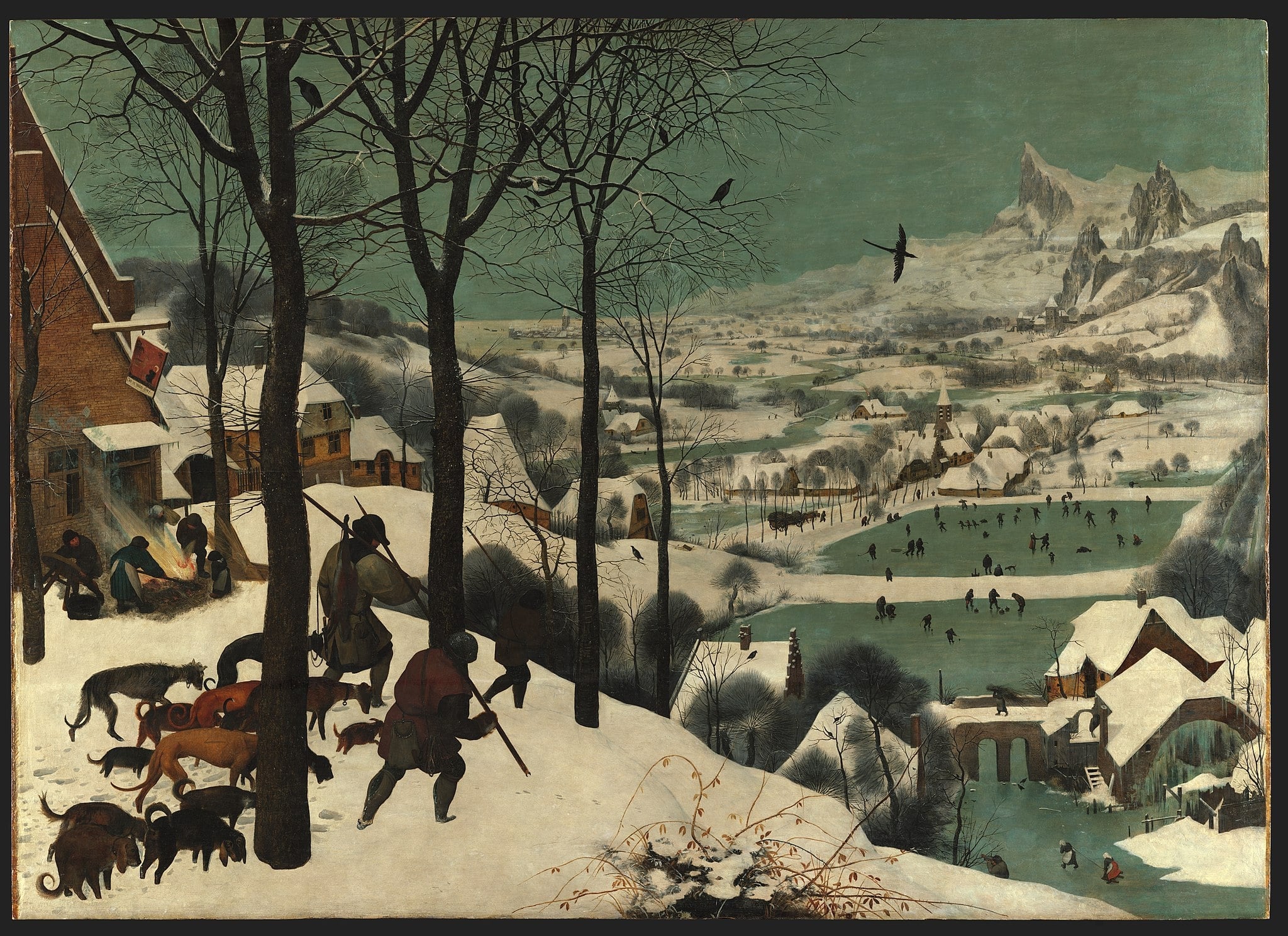
In The Return of the Hunters, Pieter Bruegel the Elder stages a wintry descent where three exhausted hunters and their dogs enter a valley alive with skaters and village chores. The painting forges a panoramic drama of <strong>hardship and resilience</strong>, contrasting scant game with communal play beneath a cold, teal sky <sup>[1]</sup><sup>[2]</sup>.
The Tower of Babel by Pieter Bruegel the Elder

The Tower of Babel

Pieter Bruegel the Elder (1563)

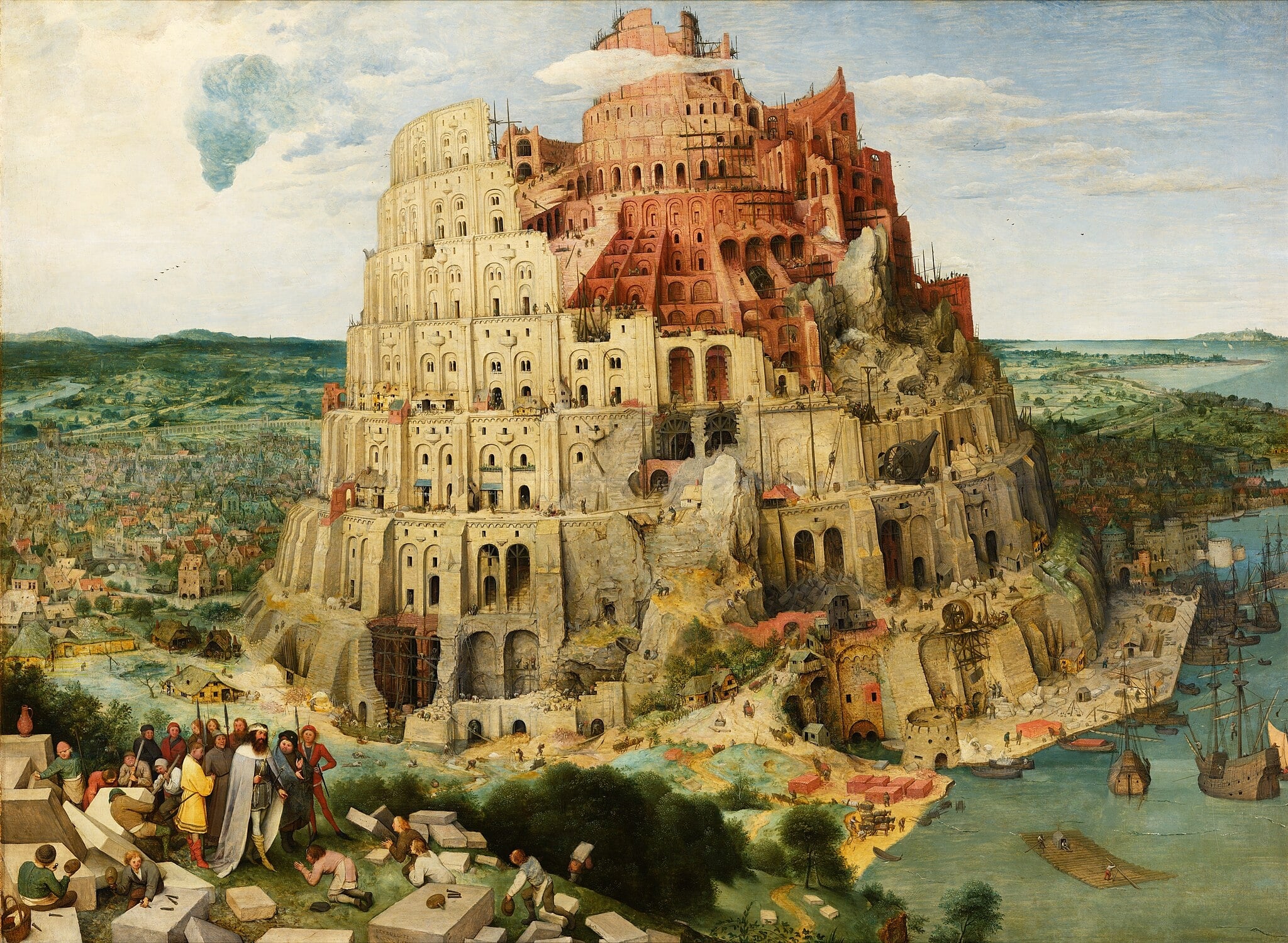
In The Tower of Babel, Pieter Bruegel the Elder stages a spiraling, Roman‑style colossus whose arches, cranes, and swarming labor proclaim <strong>human industry</strong> even as cracked foundations and misaligned tiers foretell <strong>collapse</strong>. The pale, orderly left flank opposes the raw red masonry at right, while a ruler (often read as <strong>Nimrod</strong>) inspects kneeling builders before a bustling Flemish harbor—an image of ambition already undermined from within <sup>[1]</sup>.
The Peasant Wedding by Pieter Bruegel the Elder

The Peasant Wedding

Pieter Bruegel the Elder (1568)

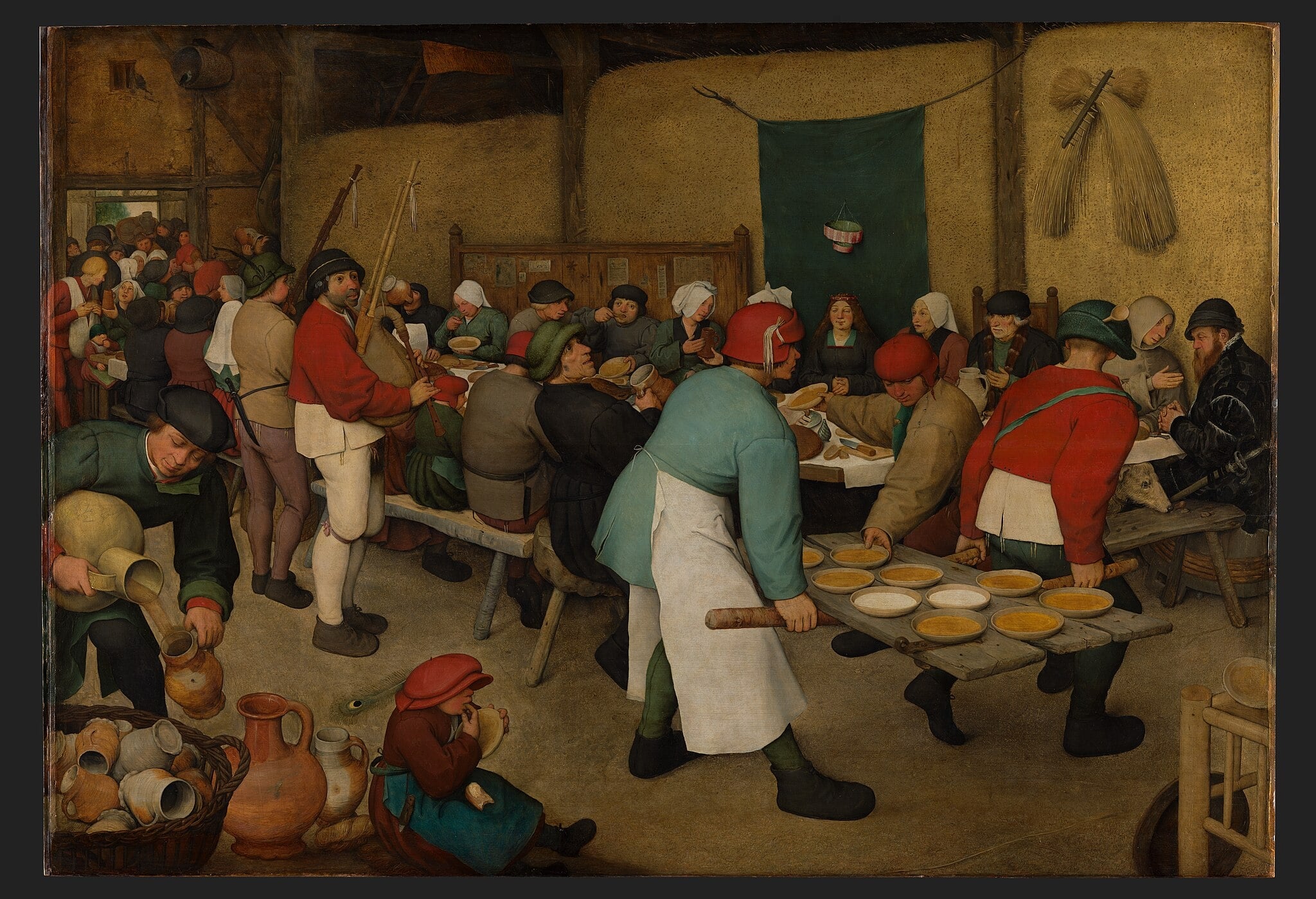
In The Peasant Wedding, Pieter Bruegel the Elder stages a <strong>communal rite</strong> inside a barn, where humble ingenuity and shared labor become the true spectacle. A bride sits beneath a <strong>green cloth of honor</strong> with a paper crown above, as servers balance bowls of porridge on a <strong>door turned into a tray</strong>, beer flows, and a bagpiper looks on <sup>[1]</sup><sup>[2]</sup>.
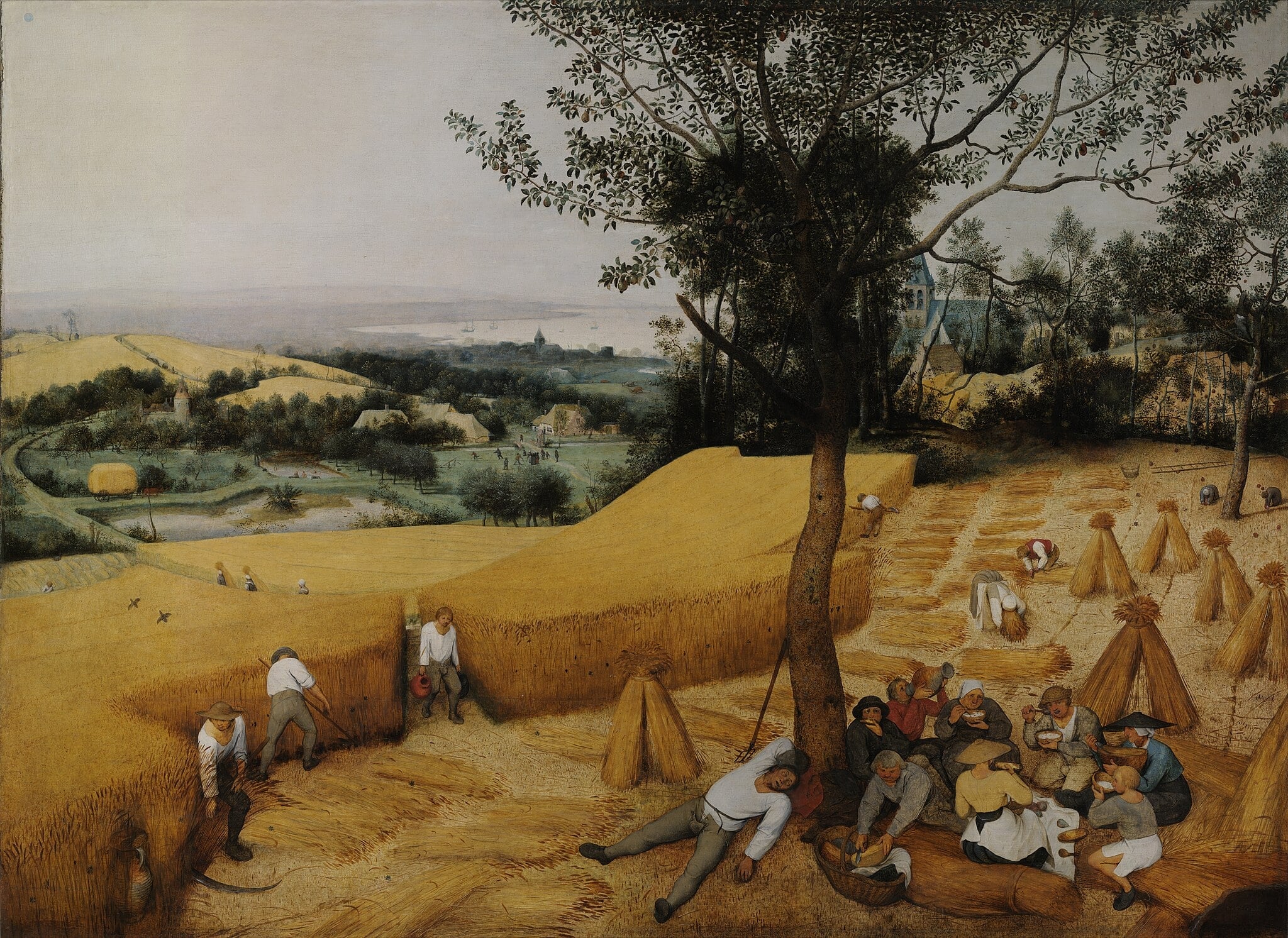
The Harvesters by Pieter Bruegel the Elder

The Harvesters

Pieter Bruegel the Elder (1565)

The Harvesters distills late summer into a seamless weave of <strong>labor and reward</strong>: reapers bend to wheat while others eat and doze beneath a tree, and the world opens to roads, a village, and ships. Bruegel dignifies every action with <strong>even light</strong> and a democratic gaze, turning a specific day’s work into an image of <strong>cyclical time</strong> and shared sustenance <sup>[1]</sup><sup>[4]</sup>.