The Harvesters

by Pieter Bruegel the Elder

The Harvesters distills late summer into a seamless weave of labor and reward: reapers bend to wheat while others eat and doze beneath a tree, and the world opens to roads, a village, and ships. Bruegel dignifies every action with even light and a democratic gaze, turning a specific day’s work into an image of cyclical time and shared sustenance [1][4].

Study Print Studio

Create a personal study print

Build a companion study sheet around the part of this painting that speaks to you most. Choose a detail, shape an interpretation, and walk away with something personal and display-worthy.

Fast Facts

Year
1565
Medium
Oil on wood
Dimensions
116.5 × 159.5 cm (original painted surface); overall 119 × 162 cm
Location
The Metropolitan Museum of Art, New York
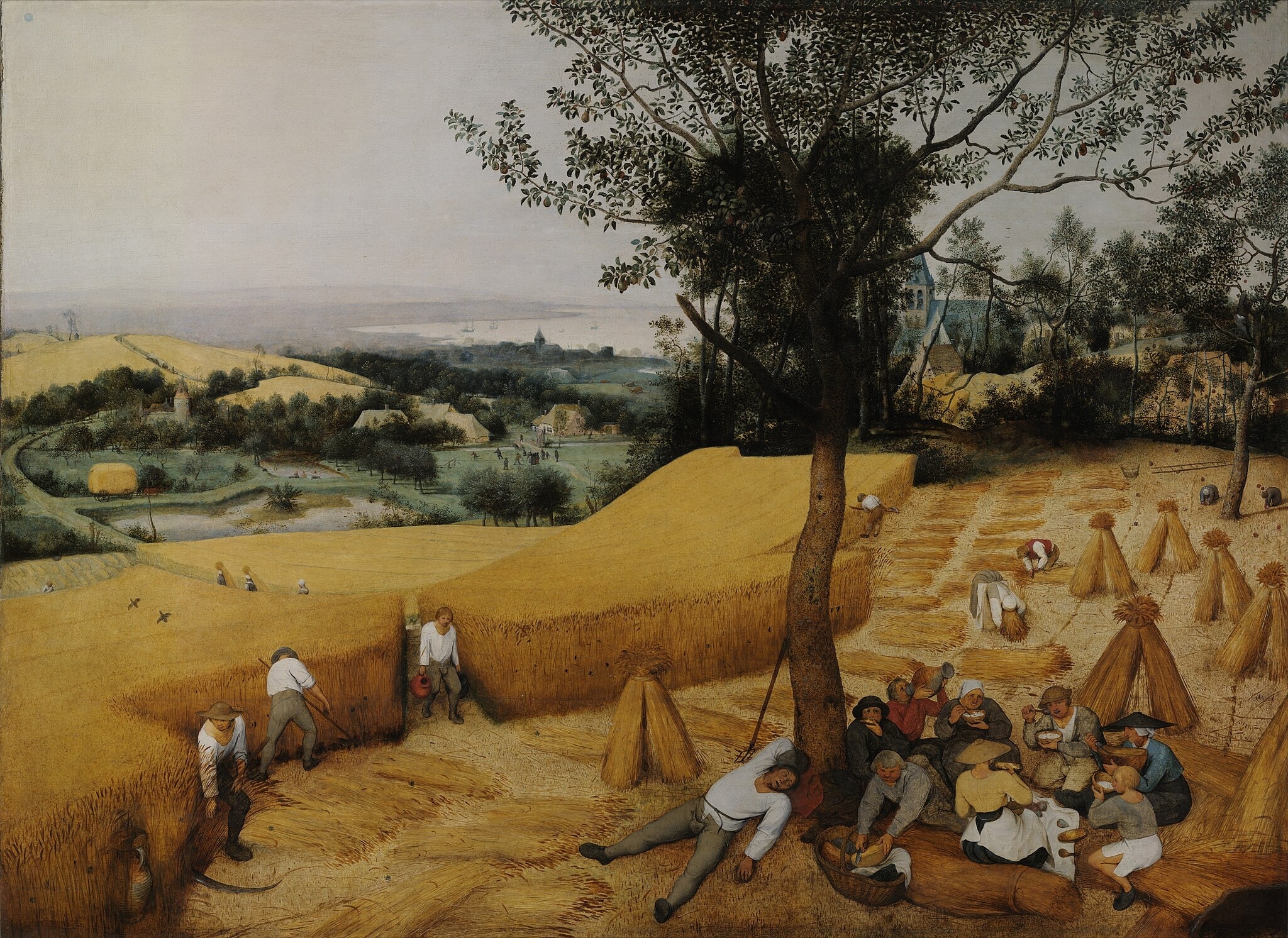
The Harvesters by Pieter Bruegel the Elder (1565) featuring Sickles and reapers, Stooked wheat sheaves, Midday meal (bread, cheese, bowls), Sleeping/drinking workers

Click on any numbered symbol to learn more about its meaning

Meaning & Symbolism

Bruegel constructs a complete system of late-summer life that runs from the blade to the bread. At the right, aligned like musical beats, reapers with sickles move through parallel lanes; stooked sheaves punctuate the field as finished notes, registering progress in orderly intervals 1. Under the central tree, the midday meal—bread, a cut wheel of cheese, bowls of porridge—confirms the chain from grain to nourishment, while a man sleeps and another drinks, asserting sanctioned pause rather than lapse 24. A figure at the right climbs a fruit tree—often identified as pears, though the Met notes apples—marking the season’s ripeness and the vanishing present tense of plenty 15. Bruegel’s broad, honeyed yellows counter the cooler greens and grays beyond, fusing heat and distance into a calm, equitable light that gives every gesture the same moral weight. Nothing is privileged; everything belongs. That compositional democracy scales outward into a social map. Paths braid through orchards toward a church spire and a waterside where ships idle, binding subsistence farming to trade, parish, and market 14. The harvest is not an isolated toil but the hinge of an economy: grain becomes bread at the tree, then surplus becomes movement down the road, onto water, into exchange. Bruegel’s patron—an Antwerp merchant—could dine before this panel and see his world naturalized as seasonal law: the field’s order mirrors mercantile order; the workers’ sequence mirrors supply chains; the balanced alternation of effort and rest mirrors prudent governance of time and bodies 1. In that sense, The Harvesters is not a genre anecdote but a calendar of power rendered humane. It reframes the medieval Labours of the Months as a panoramic, secular ethics in which time is measured less by saints’ days than by coordinated labor and its just intervals of relief 46. Formally, Bruegel pioneers a landscape that is not backdrop but argument. The high horizon opens a long, legible procession of micro-narratives—bathers at the pond left of center, an oxcart on the road, children straggling along a ridge—yet the painting resists any single climax, fulfilling what scholars call a “fantasy of visibility” that still eludes total capture 27. That refusal to culminate is the logic of cyclical time: in harvest, as in the year, no act is final; cutting implies binding, binding implies carrying, eating implies returning to the row. The work’s ethical center is its tempo—a just cadence of collective effort—and its theology, if any, is immanent in weather, daylight, and the common meal. By elevating such ordinary rites to the scale of history painting, Bruegel helps inaugurate the independent northern landscape and a modern subject: society synchronized by the seasons, dignified in its labor, and seen with unhierarchical clarity 34.

Explore Deeper with AI

Ask questions about The Harvesters

Popular questions:

Powered by AI • Get instant insights about this artwork

💬 Ask questions about this artwork!

Interpretations

Patronage and Domestic Ideology

Commissioned for Niclaes Jonghelinck’s dining room, The Harvesters stages a pictorial "calendar" that dovetails with elite domestic ritual: the meal under the tree mirrors the patron’s own table, while the field’s orderly progression validates mercantile planning and storage. This is pictorial ideology naturalized—where the harmonious rotation of tasks stands as a model for prudent governance of labor, time, and surplus. The lack of overt religious narrative further suits an urban collector’s taste, turning seasonal plenty into a visualization of good management. In this sense the panel performs soft power: it embeds the merchant’s world in the neutral light of seasonal law, making commerce feel as inevitable as ripening grain 134.

Source: The Metropolitan Museum of Art (object record; Perspectives); Met Heilbrunn

Visual Epistemology: The ‘Fantasy of Visibility’

Bruegel offers an apparently knowable world—a high horizon and serial vignettes that invite surveying, counting, and moral comparison—yet the image frustrates mastery. As Joseph Leo Koerner notes, these panoramas "escape our grasp": multiple micro-narratives proceed without a single culmination, compelling perpetual scanning and re-interpretation. Patrick Bringley likewise emphasizes the democratic gaze that refuses hierarchies of attention. The work thus becomes a lesson in epistemic humility: a modern, secular landscape that seems transparent but withholds closure. Bruegel fuses empirical detail with systemic unreadability, aligning the pleasures of close-looking with the limits of surveillance and control in a complex social field 47.

Source: Washington Post (Koerner cited); The Metropolitan Museum of Art (Perspectives)

Color, Season, and Phenology

The painting’s cereal yellow world is not mere description; it is a phenomenological code that situates viewers in late summer. Bruegel’s Seasons panels often deploy dominant chroma as temporal signposts; here honeyed ochres meet cooler greens and distant grays to register heat, glare, and the optical flattening of noon. This calibrated palette sutures touch and taste to sight—the bread, cheese, and porridge resonate chromatically with the fields that produced them, visualizing an edible landscape. Color thus operates as both index and argument: it claims that seasonality is a sensory regime that orders bodies, work, and appetite as surely as any calendar 15.

Source: Web Gallery of Art; The Metropolitan Museum of Art (object record)

Time-Discipline and the Ethics of Rest

The sleeper and drinker beneath the tree exemplify sanctioned leisure embedded within agricultural cadence. Rather than moralizing indolence, Bruegel plots rest as a functional interval in a system of reaping, binding, carrying, and eating. Read alongside the urban patron’s interests, the scene encodes early modern time-discipline: a choreography of work/rest that preserves productivity while humanizing routine. The bathers at mid-distance extend this logic, suggesting bodily relief synchronized to the day’s heat and the year’s demands. The picture’s ethics is temporal: justice appears as a fair tempo that gives each gesture—cutting, eating, sleeping—"the same moral weight" within a shared economy of effort 124.

Source: The Metropolitan Museum of Art (object record; audio); Met Perspectives

From Sacred Calendar to Secular Ethics

Bruegel translates the medieval Labours of the Months into a sweeping secular landscape argument. Stripped of saints’ days and liturgical anchors, time is organized by coordinated labor and communal meals—an immanent theology of weather and daylight. This shift aligns with the rise of independent landscape in the Low Countries, where collectors prized observed life over devotional tableau. The panel thus exemplifies a broader art-historical realignment: narrative cedes to system, and allegory to social choreography visible in roads, orchards, and shipping lanes. The result is a humane ethics of seasonality that reconceives "history painting" around ordinary rites and common goods 136.

Source: The Metropolitan Museum of Art (object record; Heilbrunn essay); Smarthistory/Khan Academy

Related Themes

About Pieter Bruegel the Elder

Pieter Bruegel the Elder (c. 1525/30–1569) trained in the Netherlandish tradition, traveled through the Alps to Italy, and became the leading painter of large-scale scenes of peasant life and panoramic landscapes. His fusion of close social observation with moral and spiritual undercurrents shaped Northern art for generations [3].
View all works by Pieter Bruegel the Elder

More by Pieter Bruegel the Elder
The Return of the Hunters by Pieter Bruegel the Elder

The Return of the Hunters

Pieter Bruegel the Elder (1565)

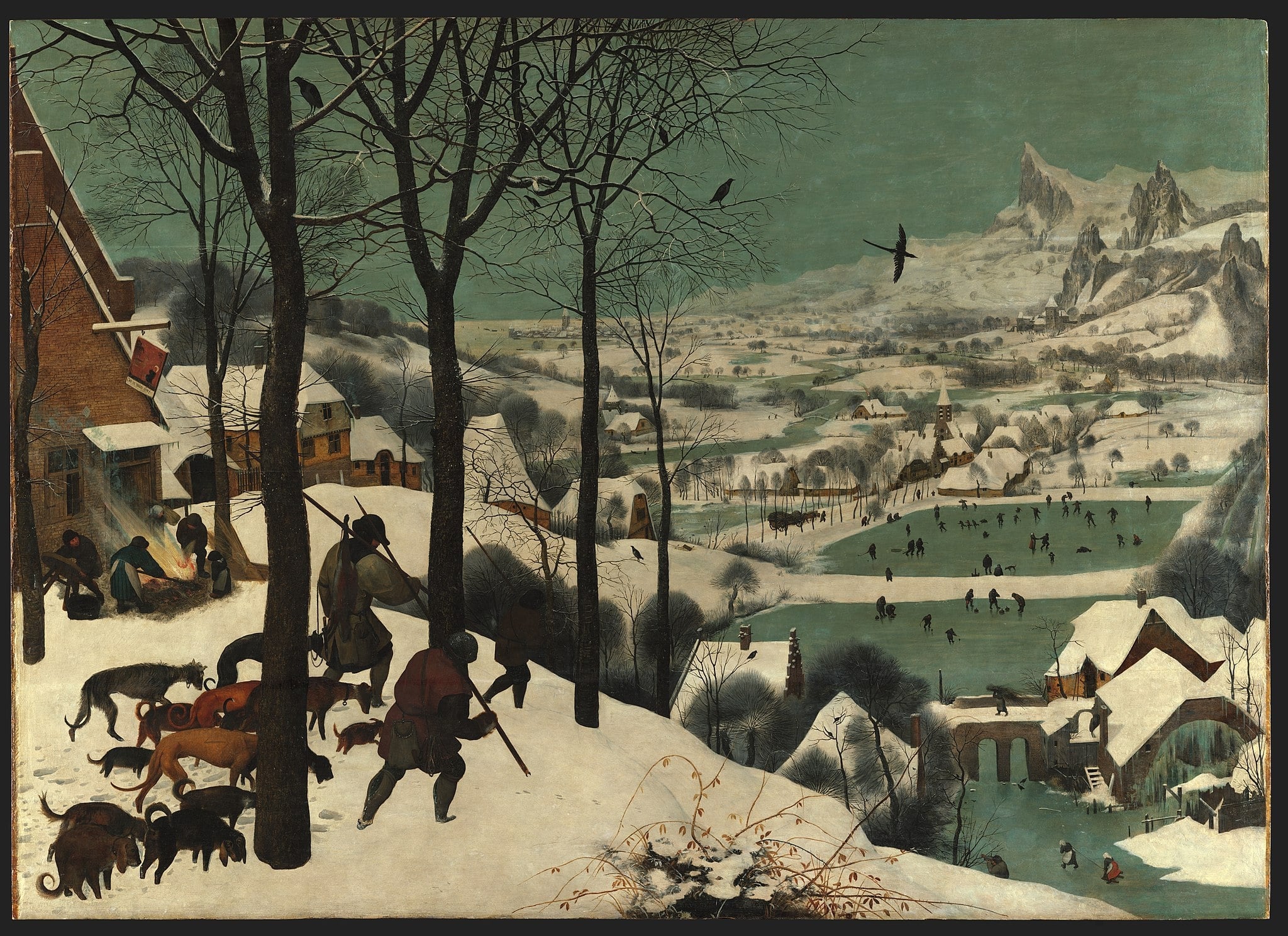
In The Return of the Hunters, Pieter Bruegel the Elder stages a wintry descent where three exhausted hunters and their dogs enter a valley alive with skaters and village chores. The painting forges a panoramic drama of <strong>hardship and resilience</strong>, contrasting scant game with communal play beneath a cold, teal sky <sup>[1]</sup><sup>[2]</sup>.
The Tower of Babel by Pieter Bruegel the Elder

The Tower of Babel

Pieter Bruegel the Elder (1563)

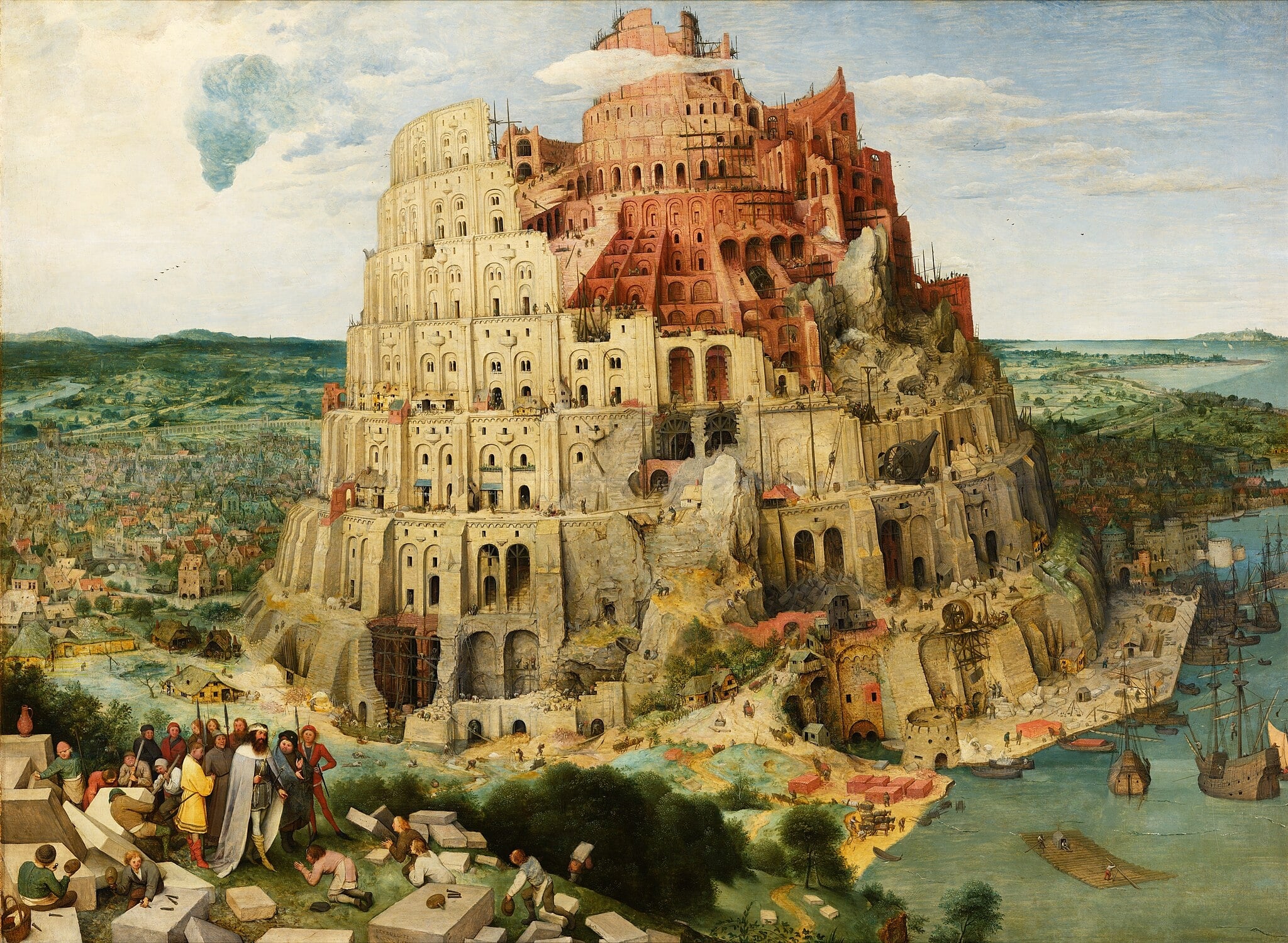
In The Tower of Babel, Pieter Bruegel the Elder stages a spiraling, Roman‑style colossus whose arches, cranes, and swarming labor proclaim <strong>human industry</strong> even as cracked foundations and misaligned tiers foretell <strong>collapse</strong>. The pale, orderly left flank opposes the raw red masonry at right, while a ruler (often read as <strong>Nimrod</strong>) inspects kneeling builders before a bustling Flemish harbor—an image of ambition already undermined from within <sup>[1]</sup>.
The Peasant Wedding by Pieter Bruegel the Elder

The Peasant Wedding

Pieter Bruegel the Elder (1568)

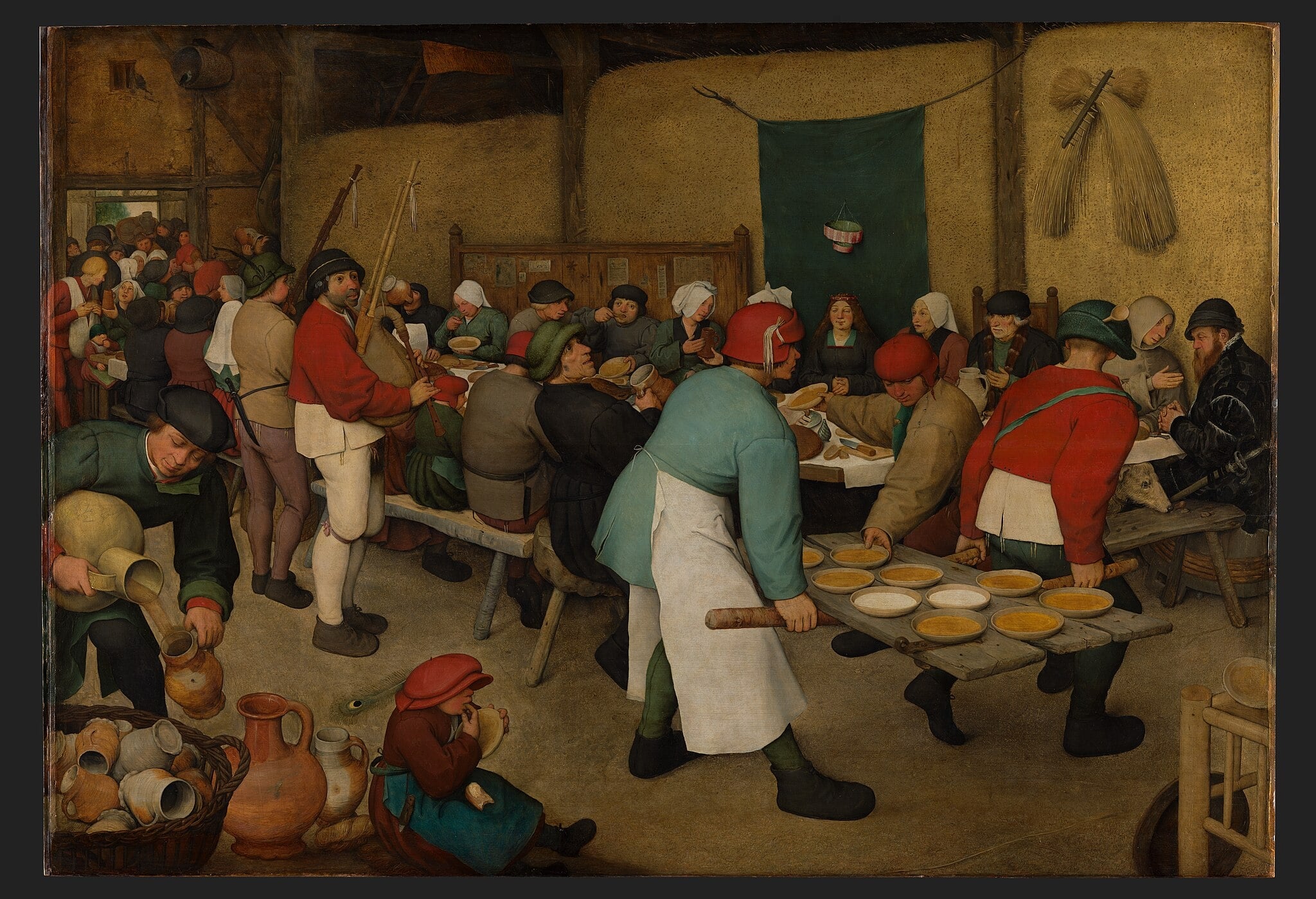
In The Peasant Wedding, Pieter Bruegel the Elder stages a <strong>communal rite</strong> inside a barn, where humble ingenuity and shared labor become the true spectacle. A bride sits beneath a <strong>green cloth of honor</strong> with a paper crown above, as servers balance bowls of porridge on a <strong>door turned into a tray</strong>, beer flows, and a bagpiper looks on <sup>[1]</sup><sup>[2]</sup>.
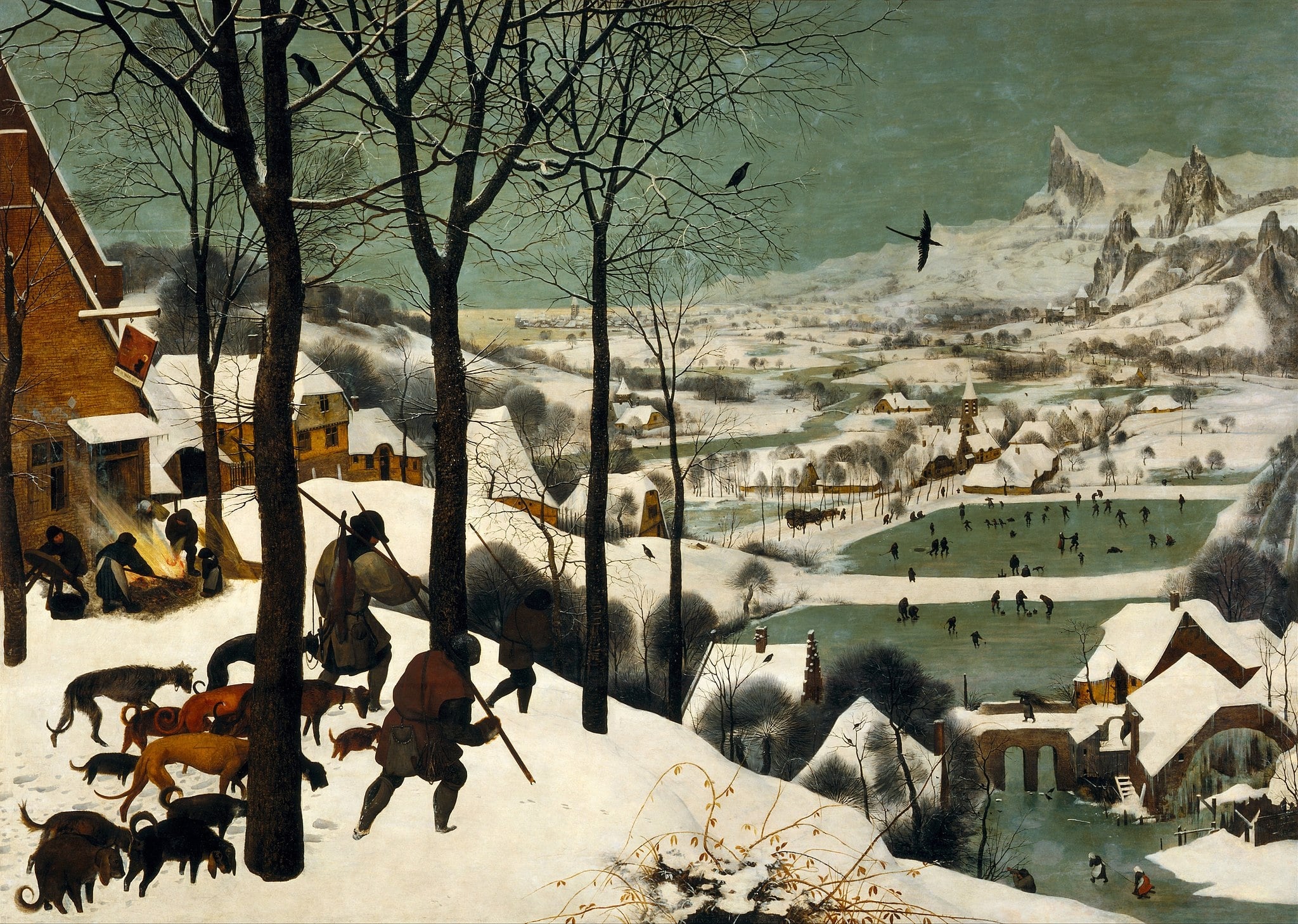
Hunters in the Snow by Pieter Bruegel the Elder

Hunters in the Snow

Pieter Bruegel the Elder (1565)

In Pieter Bruegel the Elder’s <strong>Hunters in the Snow</strong> (1565), a trio of tired hunters and <strong>gaunt dogs</strong> descend past an inn toward a vast frozen valley where villagers <strong>work, play, and endure</strong>. Bruegel fuses <strong>winter scarcity</strong> (a single fox, bare trees, crows) with <strong>communal resilience</strong> (pig-singeing fire, skaters, mill smoke) to stage a world ordered by the season’s cycle.