How Much Is A Bearded Man in a Cap Worth?
Last updated: August 25, 2026
Quick Facts
- Methodology
- comparable analysis
We estimate a hypothetical fair‑market value of $16–24 million for Rembrandt’s A Bearded Man in a Cap (late 1650s), assuming secure autograph status, strong condition, and top‑tier sale presentation. The range is anchored to recent public results for autograph Rembrandt paintings in the low‑to‑mid teens and scaled below the artist’s late portrait trophies but above smaller or more tentative works.
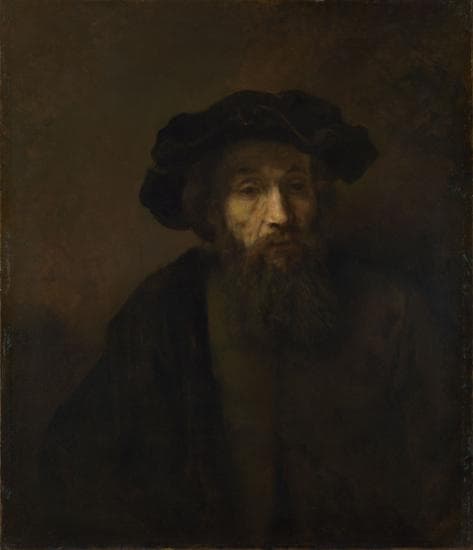
A Bearded Man in a Cap
Rembrandt van Rijn, late 1650s (probably 1657) • Oil on canvas
Read full analysis of A Bearded Man in a Cap →Valuation Analysis
Work and standing. A Bearded Man in a Cap (National Gallery, London; oil on canvas, 78 × 66.7 cm) is catalogued by the museum as a late Rembrandt tronie (head study), probably 1657. As a late, expressive head on a substantial scale with century‑plus museum provenance, it occupies a desirable but not top‑trophy slot within the oeuvre—valued below major named portraits and iconic narratives, yet well above workshop material and modest studio heads [1].
Market anchors and comps. Public, modern‑era auction datapoints for autograph Rembrandt paintings have clustered in the low‑to‑mid teens for strong but non‑trophy works. In December 2023, Sotheby’s London sold the rediscovered The Adoration of the Kings for about £10.9–11.0m (≈$13.8m) against a £10–15m estimate, providing a fresh, transparent benchmark for an autograph panel of modest size [2]. In July 2023, Christie’s London sold the pendant Portrait of Jan Willemsz. van der Pluym and Portrait of Jaapgen Carels for $14.27m, showing current appetite for intimate autograph heads/half‑lengths with rediscovery cachet [3]. At the upper public bound, the late Portrait of a Man, Half‑length, with His Arms Akimbo realized $33.2m in 2009—an emphatically ‘trophy’ late portrait that sets a ceiling for male half‑lengths in this period [4]. A late single‑saint half‑length, Saint James the Greater, brought $25.8m in 2007, underlining what the market has historically paid for late gravitas in head/half‑length format [7].
Positioning this picture. This painting’s tronie category (anonymous sitter) typically prices below named portraits and star narratives. However, its late date, expressive handling, substantial dimensions, and the National Gallery’s long, unimpeachable provenance support a premium over smaller or earlier heads. We therefore place the work in a $16–24 million band under ideal selling conditions (secure autograph status per current scholarship; strong, well‑documented condition; top evening‑sale placement; clear title/export). The upper end assumes clean technicals (stable support, sensitive past restorations, no major condition compromises) and a marketing narrative that emphasizes the rarity of museum‑grade, late Rembrandt heads [1][2][3].
Why not higher? While private‑treaty prices for marquee portraits (e.g., The Standard Bearer at €175m in 2022) show the apex of demand for museum‑caliber Rembrandts, those are not like‑for‑like comparables: full‑length or emblematic works with national‑symbol status command a different market tier [5]. Conversely, mid‑single‑digit millions for secondary material or works with attribution/condition questions are not applicable here. The selected range balances category reality (tronie vs. named portrait) with scarcity, late style appeal, and blue‑chip provenance. Should new scholarship or conservation elevate the picture’s standing further, competitive bidding could test above the midpoint; any material condition issues would pull it toward the lower bound [1][2][4].
Key Valuation Factors
Art Historical Significance
High ImpactAs a late Rembrandt tronie (head study), probably 1657, the painting embodies the artist’s mature style—economical, expressive brushwork and a psychologically charged presence. While tronies sit below named portraits and canonical narratives in market hierarchy, late heads remain important to understanding Rembrandt’s final decades and are actively sought by top collectors. The work’s substantial scale (78 × 66.7 cm) heightens wall impact relative to smaller cabinet heads. It is not as culturally emblematic as self‑portraits or masterpieces like The Night Watch, but within the tronie category it is strongly positioned by date, handling, and quality indicators, warranting a significant valuation premium over earlier or more modest studio heads.
Attribution and Scholarly Consensus
High ImpactThe National Gallery catalogs the painting as a late Rembrandt tronie, which provides robust institutional endorsement. In today’s Old Master market, secure attribution underpinned by technical imaging (X‑ray/IRR) and leading scholarship is paramount to price formation. Any reconfirmation by the latest corpus scholarship would support the upper band of the estimate, while a divided scholarly view would compress value. The tronie genre, often entangled historically with workshop practice, makes clear, current consensus even more critical. Assuming present institutional acceptance and absent red flags, the autograph status is a major price driver that situates the picture well above studio variants or circle works.
Condition and Technical State
High ImpactCondition can shift outcomes by many millions in this category. The estimate presumes a sound support, stable paint layers, and restorations consistent with a well‑preserved, 17th‑century canvas in a national collection. High‑resolution imaging and a recent conservation report—addressing lining, overpaint, abrasion in dark passages, and any structural issues—would be essential for bidders. Clean surface presentation that preserves the nuanced late handling typically commands competitive bidding and could pull the result toward the upper teens or low‑20s. Conversely, significant wear, flattened impasto, or intrusive retouching would invite caution from seasoned buyers and likely anchor the price near the lower bound.
Provenance, Exhibition, and Literature
Medium ImpactThe work’s 18th–19th‑century provenance culminating in its 1844 acquisition by the National Gallery, London, provides exemplary title history and museum‑grade credibility. Long holding by a leading institution reduces transactional risk and enhances desirability, particularly for buyers prioritizing proven, published works. While museum ownership also means the picture is not currently available, a hypothetical deaccession under rigorous governance—paired with comprehensive literature and exhibition history—would be compelling to both private collectors and institutions. Provenance of this caliber does not transform a tronie into a trophy portrait, but it does justify a substantial premium over similar works with thinner or more opaque histories.
Sale History
Jeremiah Harman sale, London (lot 23)
Hammer 410 guineas (≈£430.50). Purchased by Henry Farrer for the National Gallery.
Rembrandt van Rijn's Market
Rembrandt’s market is extraordinarily deep but supply‑constrained for securely autograph paintings. The public auction record for a painting stands at $33.2 million (Christie’s London, 2009) for a commanding late portrait, while top private‑treaty acquisitions—The Standard Bearer at €175 million (2022) and the Maerten Soolmans/Oopjen Coppit pendants at €160 million (2016)—demonstrate the heights reachable for emblematic, museum‑caliber works. In recent seasons, credible autograph paintings have sold in the low‑to‑mid teens, reflecting strong but selective demand. Buyers prize late style power, impeccable provenance, and bulletproof scholarship; works with attribution or condition headwinds sell at meaningful discounts. Overall, Rembrandt remains a blue‑chip Old Master with a polarized pricing ladder tied to subject, scale, and scholarly certainty.
Comparable Sales
The Adoration of the Kings
Rembrandt van Rijn
Same artist; cabinet-size biblical scene (early 1630s) that set a fresh, public benchmark for an autograph Rembrandt painting in 2023. While a narrative subject (not a tronie), it is a strong market datapoint for autograph but smaller-scale Rembrandts.
$13.8M
2023, Sotheby's London
~$14.8M adjusted
Portrait of Jan Willemsz. van der Pluym and Portrait of Jaapgen Carels (pendant pair)
Rembrandt van Rijn
Same artist; intimate formal portraits with strong rediscovery story and fresh-to-market appeal. Not tronies, but close in scale and market tier; demonstrate current pricing for desirable autograph Rembrandt heads/half-lengths.
$14.3M
2023, Christie's London
~$15.3M adjusted
Portrait of a Man, Half-length, with His Arms Akimbo (1658)
Rembrandt van Rijn
Same artist and very close in date (1658 vs. c.1657); late Rembrandt handling in a commanding half-length. Serves as an upper-bound auction anchor for late autograph male heads/half-lengths.
$33.2M
2009, Christie's London
~$48.8M adjusted
Saint James the Greater (1661)
Rembrandt van Rijn
Same artist; late single-saint half-length. Although a religious subject (not a tronie), it’s the closest high-profile auction analogue to a late head study in terms of format and late style gravitas.
$25.8M
2007, Sotheby's New York
~$39.2M adjusted
Saint John on Patmos (half-length)
Rembrandt van Rijn
Same artist; late half-length saint with a high-profile technical dossier and reattribution narrative. A useful, very recent datapoint for autograph late Rembrandt heads outside the portrait category.
$9.0M
2025, Sotheby's London
Let the Little Children Come Unto Me
Rembrandt van Rijn
Same artist; early narrative composition that sold in 2026 with selective bidding. Not a tronie, but corroborates the current, liquid price band for autograph Rembrandt paintings below the major-portrait tier.
$10.6M
2026, Sotheby's London
~$10.4M adjusted
Current Market Trends
The Old Masters segment is highly supply‑driven and polarized. When A‑plus, well‑vetted pictures appear—particularly by brand‑name artists—competition is robust and pricing resilient. 2023 London results for Rembrandt underscored liquidity for strong, autograph pictures in the low‑to‑mid teens, while older benchmarks establish a higher ceiling for late, named portraits. Meanwhile, lesser material and works with attribution or condition questions face selective bidding. For Rembrandt specifically, the combination of extreme scarcity, continuing institutional focus, and recent rediscoveries keeps demand active, but outcomes are acutely sensitive to technical state, scholarly consensus, and the narrative crafted around each work’s art‑historical significance and provenance.
Study print
Study this painting as a print
Pair the full artwork with a museum-style study sheet focused on one meaningful detail.
Sources
- National Gallery, London – A Bearded Man in a Cap (NG190) catalogue entry
- Sotheby’s London – The Adoration of the Kings (6 Dec 2023) sale page/result
- Christie’s London – Rediscovered pendant portraits result (6 Jul 2023) press release
- Christie’s – Rembrandt van Rijn artist page (includes 2009 record)
- Rijksmuseum/Dutch State – The Standard Bearer acquisition (€175m, 2022)
- The Art Newspaper – Rembrandt’s Abraham and the Angels withdrawn and sold privately within estimate (2021)
- Sotheby’s – Rembrandt overview (includes Saint James the Greater, $25.8m, 2007)