How Much Is Self-Portrait in a Black Cap Worth?
Last updated: September 1, 2026
Quick Facts
- Methodology
- comparable analysis
Hypothetical fair‑market value for Rembrandt’s Self-Portrait in a Black Cap (c.1637, Wallace Collection) is $55–85 million. The range reflects its prime date, autograph self-portrait status, substantial scale, and museum quality, positioned well above small early panels but below the handful of nine‑figure, national‑treasure masterpieces.
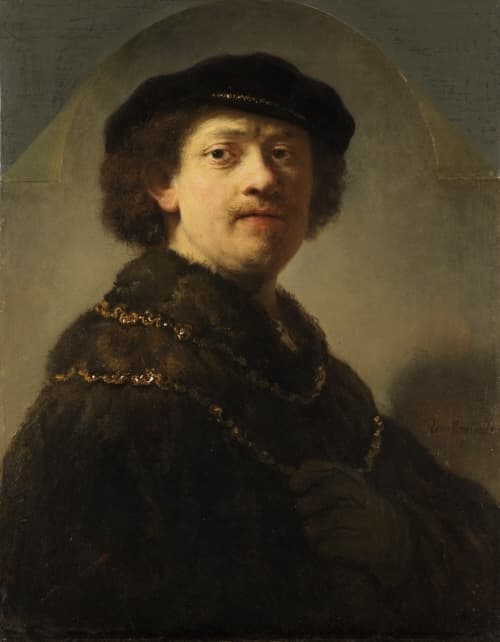
Self-Portrait in a Black Cap
Rembrandt van Rijn, 1637 • Oil on oak panel
Read full analysis of Self-Portrait in a Black Cap →Valuation Analysis
Conclusion. We estimate a hypothetical fair‑market value of $55–85 million for Rembrandt van Rijn’s Self‑Portrait in a Black Cap (c.1637; oil on oak panel, 63 × 50.7 cm; Wallace Collection, inv. P52). The work is currently regarded as an autograph painting and belongs to one of the most coveted categories in Old Master art: Rembrandt’s 1630s self‑portraits [1].
How the estimate was derived. The primary anchor is the recent market for autograph Rembrandt oils, adjusted for subject, date, scale, and quality. The closest direct comp is the small, early Self‑Portrait, wearing a ruff and black hat (1632), which sold at Sotheby’s London on 28 July 2020 for £14.55m (~$18.8m with fees). That panel is materially smaller and earlier; a mid‑1630s, larger, more mature self‑portrait like the Wallace would command a significant premium over that benchmark [2]. Additional calibration comes from Rembrandt’s portrait auction record—Portrait of a Man, Half‑Length, with His Arms Akimbo (Christie’s London, 8 Dec 2009) at £20.2m (~$33.2m at the time)—a large, formal portrait that, in today’s dollars, implies c.$45–50m for a top‑tier single figure portrait outside the self‑portrait category [3]. Recent public sales of small autograph oils, such as The Adoration of the Kings (Sotheby’s London, 6 Dec 2023) at £10.9m (~$13.7m), further indicate a robust mid‑teens base for small‑scale Rembrandt paintings, from which a substantial self‑portrait should scale materially higher [4].
Positioning and upper bound checks. At the absolute top of the private/state market, the Netherlands’ €175m acquisition of The Standard Bearer (1636)—a full‑length self‑portrait variant—demonstrates the premium for national‑treasure status and apex iconography [5]. While those nine‑figure outliers are not direct price targets for the Wallace panel, they help define a ceiling and underscore the scarcity value of Rembrandt self‑portraits. The Wallace painting’s prime mid‑1630s date, established autograph consensus, and compelling presence place it well above the small early panels that trade in the high‑teens of millions and credibly in a range that exceeds historic public portrait records for the artist.
Key factors and assumptions. The range assumes the Wallace’s current scholarly attribution as autograph Rembrandt, stable condition consistent with its age, and the documented size and date [1]. Autograph self‑portraits attract disproportionate global demand relative to other Old Master portraits and would likely draw institutional interest were they available. Although the Wallace Collection is a UK national museum and the painting is effectively inalienable, this valuation is intended for hypothetical fair‑market (insurance/indemnity) purposes, reflecting what comparable buyers would reasonably pay if an equivalent work were to trade.
Bottom line. Synthesizing recent self‑portrait and portrait comps, inflation‑adjusted historic benchmarks, and the premium for an autograph, mid‑1630s Rembrandt self‑portrait of substantial scale, a $55–85 million range is well supported. It sits safely above small‑format results and below the rarefied national‑treasure tier, aligning with the work’s stature as a strong, second‑tier masterpiece within Rembrandt’s self‑portrait corpus.
Key Valuation Factors
Art Historical Significance
High ImpactThis is a mid‑1630s self‑portrait by Rembrandt—one of the most studied and desirable categories in Old Master painting. The 1630s mark a leap in the artist’s expressive acuity and handling of light, with self‑portraits serving both as vehicles for technical experimentation and as defining statements of artistic identity. The Wallace panel’s date (c.1637) situates it just after key breakthroughs in Amsterdam, aligning it with an intensely creative phase that collectors and institutions prize. Within Rembrandt’s oeuvre, autograph self‑portraits carry exceptional cultural capital, anchoring museum narratives and commanding a market premium over most other subjects. That art‑historical weight materially elevates the value.
Rarity and Demand
High ImpactFully autograph Rembrandt oils are extremely scarce at auction; self‑portraits are rarer still. When they appear, they attract global bidding, and at the top end, institutional competition. The recent £14.55m ($18.8m) price for a much smaller, early self‑portrait (2020) demonstrates durable demand even for modest formats, implying substantial headroom for a larger, later example. Scarcity across the category—evidenced by thin supply and long intervals between comparable offerings—supports a pricing premium, especially for high‑quality, mid‑1630s works with clear authorship. This dynamic is a primary driver of the $55–85 million valuation band.
Authorship, Date, and Condition
High ImpactThe Wallace catalogue affirms current consensus that the painting is again regarded as autograph Rembrandt, a decisive value determinant. The c.1637 dating places it in a prime period, closer to the fully mature manner than the earlier Leiden style. Our estimate presumes condition consistent with well‑preserved oak‑panel works of the era and no material doubts around authorship. Any significant condition compromises (e.g., overcleaning, structural panel issues) or renewed attribution debate would compress the range; conversely, exceptional technical reports (X‑ray/IRR) and a strong conservation history would support the upper half. As with all Old Masters, technical due diligence is pivotal to price realization.
Scale and Aesthetic Presence
Medium ImpactAt approximately 63 × 50.7 cm, the work presents a substantial half‑length presence—materially larger than the 2020 small panel self‑portrait. Scale enhances wall power and marketability, particularly for portraiture, and it tends to correlate with higher prices in this segment. Beyond dimensions, the composition’s psychological intensity and chiaroscuro are consonant with collector preferences for Rembrandt’s more mature self‑portraits. While not a full‑length, the size is ample for museum display and private settings alike, justifying a meaningful premium over the small‑format panels that have traded in the mid‑ to high‑teens of millions.
Provenance and Institutional Status
Medium ImpactThe painting forms part of the Wallace Collection, a UK national museum, where it entered via the 1897 bequest. This confers unimpeachable provenance and scholarly visibility, elevating perceived quality and importance. Practically, the work is inalienable, so the estimate functions as a hypothetical fair‑market value for insurance/indemnity benchmarking rather than a disposal price. Even so, the institutional cachet—and a literature/exhibition presence consistent with a major museum object—bolster confidence and would likely amplify competitive tension were an equivalent work to surface, supporting the upper mid‑eight‑figure bracket.
Sale History
Self-Portrait in a Black Cap has never been sold at public auction.
Rembrandt van Rijn's Market
Rembrandt sits among the most sought‑after Old Masters, with an exceptionally thin supply of autograph paintings. The artist’s public auction record for a painting stands at ~$33.2m (Christie’s London, 2009) for a major half‑length portrait, with other historic benchmarks including $25.8m (Sotheby’s New York, 2007). More recently, a small 1632 self‑portrait brought about $18.8m (Sotheby’s London, 2020), while a rediscovered small monochrome oil achieved ~$13.7m (Sotheby’s London, 2023). At the very top, state/private acquisitions have far exceeded auction levels—e.g., The Standard Bearer at €175m (2022) and the Soolmans/Coppit pair at €160m (2016)—underscoring the premium for apex, nationally significant works and the enduring depth of institutional demand.
Comparable Sales
Self-portrait, wearing a ruff and black hat (1632)
Rembrandt van Rijn
Directly comparable: autograph self-portrait on panel, early 1630s. Smaller in scale than the Wallace canvas but same subject category and high quality.
$18.8M
2020, Sotheby's London
~$23.4M adjusted
The Adoration of the Kings
Rembrandt van Rijn
Recent public auction of a rediscovered autograph painting; small monochrome oil on panel. Establishes current demand/price level for small-scale Rembrandt oils.
$13.7M
2023, Sotheby's London
~$14.4M adjusted
Head of a Young Man with Clasped Hands: Study of the Figure of Christ (c.1648–56)
Rembrandt van Rijn
Autograph oil study head with intense psychological presence; though smaller and a study, it’s a strong indicator of market appetite for prime-quality Rembrandt heads.
$12.1M
2018, Sotheby's London
~$15.4M adjusted
Portrait of a Man, Half-Length, with His Arms Akimbo
Rembrandt van Rijn
Artist’s public auction record for a painting; large, formal portrait in exceptional condition. Useful upper-bound benchmark for major Rembrandt portraiture.
$33.2M
2009, Christie's London
~$49.5M adjusted
Saint James the Greater (1661)
Rembrandt van Rijn
Monumental single-figure religious painting from the mature period. Demonstrates pricing for significant, museum-caliber Rembrandt half-lengths.
$25.8M
2007, Sotheby's New York
~$39.8M adjusted
Pair of rediscovered pendant portraits (1635)
Rembrandt van Rijn
Mid-1630s autograph portraits—very close in date to the Wallace self-portrait. Indicate current market for mid-1630s portraiture outside the self-portrait category.
$14.3M
2023, Christie's London
~$15.0M adjusted
Current Market Trends
Old Masters have rebounded meaningfully since 2024, with improving sell‑through and renewed cross‑category participation. Supply remains the primary constraint for autograph paintings by top Dutch Golden Age masters, keeping pricing resilient at the high end. Recent records in Rembrandt’s works on paper (a $17.86m drawing and a $4.1m print) signal broad, deep demand across media and reinforce buyer confidence. Within this context, prime‑period Rembrandt oils—especially self‑portraits—command significant premiums over small studies and secondary subjects. The $55–85 million range reflects current appetite for best‑in‑class works, while acknowledging a clear gap between public auction benchmarks and the nine‑figure, national‑treasure tier established by recent state acquisitions.
Study print
Study this painting as a print
Pair the full artwork with a museum-style study sheet focused on one meaningful detail.
Sources
- Wallace Collection – Self-Portrait in a Black Cap (object entry, inv. P52)
- Sotheby’s – Rembrandt to Richter sale highlights (includes 2020 self-portrait result)
- Christie’s – Old Masters & 19th Century Art Evening Sale Press Release (8 Dec 2009)
- The Art Newspaper – London Old Master sales report (Dec 2023)
- Government of the Netherlands – Acquisition of Rembrandt’s The Standard Bearer (2022)