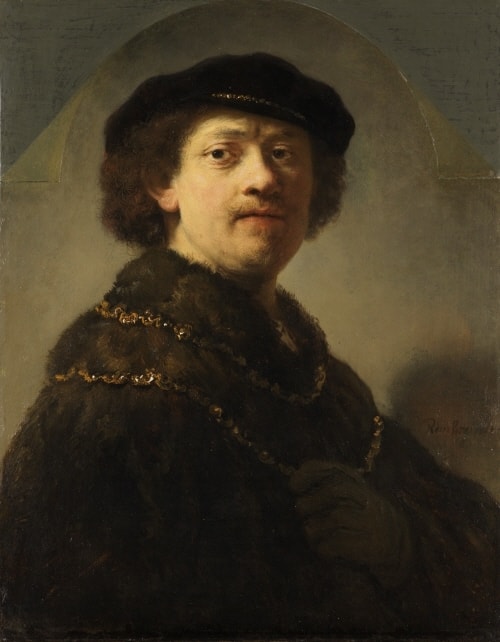
Self-Portrait in a Black Cap

by Rembrandt van Rijn

In Self-Portrait in a Black Cap, Rembrandt van Rijn stages himself in sumptuous fur, a black cap, and a glinting gold chain, then cuts the figure from dusk with incisive light. The steady gaze and slightly parted lips meet the viewer while a gloved hand lifts the chain, redirecting status back to the artist’s own hand. Painted c. 1637 in oil on oak, the work now has an arched top from a later reshaping of the panel [1].

Study Print Studio

Create a personal study print

Build a companion study sheet around the part of this painting that speaks to you most. Choose a detail, shape an interpretation, and walk away with something personal and display-worthy.

Fast Facts

Year
1637
Medium
Oil on oak panel
Dimensions
63 × 50.7 cm
Location
The Wallace Collection, London
See all Rembrandt van Rijn paintings in London
Self-Portrait in a Black Cap by Rembrandt van Rijn (1637) featuring Black cap, Gold chain, Gloved hand lifting the chain, Fur mantle

Click on any numbered symbol to learn more about its meaning

Meaning & Symbolism

Rembrandt builds authority through oppositions of texture and light. The black cap compresses value around the head, while a directional beam cleaves cheekbone, nose, and lip with emphatic chiaroscuro, vaulting intellect (the lit face) above material splendor (the pelt’s deep browns). Across the chest, the gold chain sparks in broken touches; when his gloved right hand lifts it, the gesture converts an emblem of bestowed honor into a sign of agency—the chain’s weight is literally measured by the artist’s hand. In seventeenth‑century portrait codes, such chains signified favor and learned distinction; by staging himself with one, Rembrandt aligns painting with the liberal arts and with the honors of intellect rather than mere commerce 4. The glove itself—an accessory of rank and refined conduct—tightens this claim to gentility while quietly pointing to the creative instrument of authorship: the hand 5. This performance of identity is not vanity but method. Throughout his career, Rembrandt used costume as a theater of roles, crafting the image of a learned painter whose dignity derives from thought and craft as much as from wealth 3. Here, the fur’s thick, absorbent surface swallows light, setting off the crisp glints of metal and the living warmth of skin; the contrast dramatizes how art—embodied in light and touch—both adorns and reveals the self. His gaze is calm and appraising, the lips faintly parted, the skin ruddy and mortal: authority without aloofness. Even the present arched silhouette intensifies the bust-length, sculptural presence, though scholarship clarifies that this effect results from a nineteenth‑century reshaping of the panel rather than a painted niche, reminding us that artworks acquire new frames—literal and interpretive—over time 12. Technically linked to his 1630s production and now affirmed as autograph (with a likely studio-added signature), the portrait anchors Rembrandt’s mid‑career project: to claim, through light, gesture, and material wit, the modern prestige of the artist as thinking maker 1234.

Explore Deeper with AI

Ask questions about Self-Portrait in a Black Cap

Popular questions:

Powered by AI • Get instant insights about this artwork

💬 Ask questions about this artwork!

Interpretations

Technical Art History: Object Biography and the Arched Top

The picture’s current arched silhouette is not a pictorial conceit but a 19th‑century reshaping of a once‑rectangular oak panel, a change that compresses the field and intensifies the bust‑length, sculptural presence of the head and shoulders 1. Technical study also shows Rembrandt painted over an unfinished half‑length portrait of a lady, a studio economy that complicates notions of singular authorship and reveals a dynamic material life for the support 12. Dendrochronology links the oak to a tree used for a 1634 self‑portrait (Berlin), reinforcing the Wallace date around c. 1637 and tying this work to his Amsterdam prime 1. Such findings reframe interpretation: what looks like a niche is a later cut; what reads as seamless identity is built atop earlier intention—an artwork literally stratified in time.

Source: Wallace Collection; National Gallery, London (Wieseman)

Self-Fashioning: The Learned Painter in Amsterdam

Rembrandt’s studio stock of caps, furs, and chains underpins a sustained project of self-fashioning. Rather than documentary dress, these are rhetorical costumes that align him with the liberal arts and the dignified, thinking artist—an identity he sharpened throughout the 1630s–50s 36. The pared background and targeted light frame the head as a seat of intellect, while the sumptuous mantle advertises virtuoso handling of texture—vision and craft in concert. This is not mere vanity but a claim about painting’s rank: it belongs with letters and philosophy, not with trade alone. By adopting and adapting elite portrait codes, Rembrandt performs a scholarly persona that his brushwork substantiates—an image of authority without aloofness, where social aspiration and painterly intelligence meet.

Source: National Gallery of Art, Washington; National Gallery, London

Emblems of Honor: Chain and Glove as Visual Rhetoric

The gold chain functions in early modern portraiture as a portable emblem of favor and learned distinction; Rembrandt elsewhere makes this symbolism explicit (e.g., Aristotle with a Bust of Homer) 4. Here, he animates the emblem: a gloved hand delicately lifts the chain, converting conferred honor into enacted agency. In period codes, gloves signify civility and rank; handled thus, they also point to the artist’s operative tool—the hand—bridging status and making 5. The chain’s broken glints and the glove’s soft matte set off competing registers of value: bestowed metal versus embodied craft. This choreography of touch argues that honor is not worn but weighed, tested, and, crucially, authored by the painter’s own instrument.

Source: Journal of Historians of Netherlandish Art (JHNA); The Metropolitan Museum of Art

Authorship vs. Workshop: The Signature Problem

Attribution has seesawed, but current consensus restores the painting as autograph Rembrandt, with a signature likely added by a studio hand—a small detail with large interpretive stakes 1. The workshop context was not a threat to authorship but its ecosystem; signatures, replicas, and variants circulated within it. Recognizing a non-characteristic signature while affirming Rembrandt’s execution clarifies where to locate the picture’s authority: in handling, structure, and light, not in inked letters. This distinction mirrors the image’s own message: authorship resides in the thinking, acting hand more than in external tokens. The painting thus stages a double claim—within the picture (hand vs. chain) and within its history (brush vs. signature)—for the primacy of making over mere inscription 1.

Source: Wallace Collection

Light as Thought: Chiaroscuro and Sculptural Intellect

Rembrandt’s directional illumination cleaves cheek, nose, and lip with emphatic chiaroscuro, a strategy he used across self‑portraits to forge a tactile, almost sculptural presence and to index interior life 3. The black cap compresses surrounding values, amplifying the lit forehead and brow as a theater of cognition; the fur’s absorbent darks mute ostentation so that light, not luxury, does the persuading. In this rhetoric, light is the painter’s thinking medium—modeling form while modeling character. The result is a face that reads as considered rather than merely seen, where the distribution of light and shade becomes a map of self‑possession and discipline, a visual corollary to the artist’s claim to the liberal arts 3.

Source: National Gallery of Art, Washington

Related Themes

About Rembrandt van Rijn

Rembrandt van Rijn (1606–1669) was a leading Dutch Golden Age painter and printmaker whose Amsterdam years (from 1631) produced virtuosic portraits and ambitious history paintings. In the early 1630s he favored polished finishes, saturated color, and theatrical staging—qualities on display in this 1633 canvas. Although prolific, this is his only known painted seascape [2][4].
View all works by Rembrandt van Rijn

More by Rembrandt van Rijn
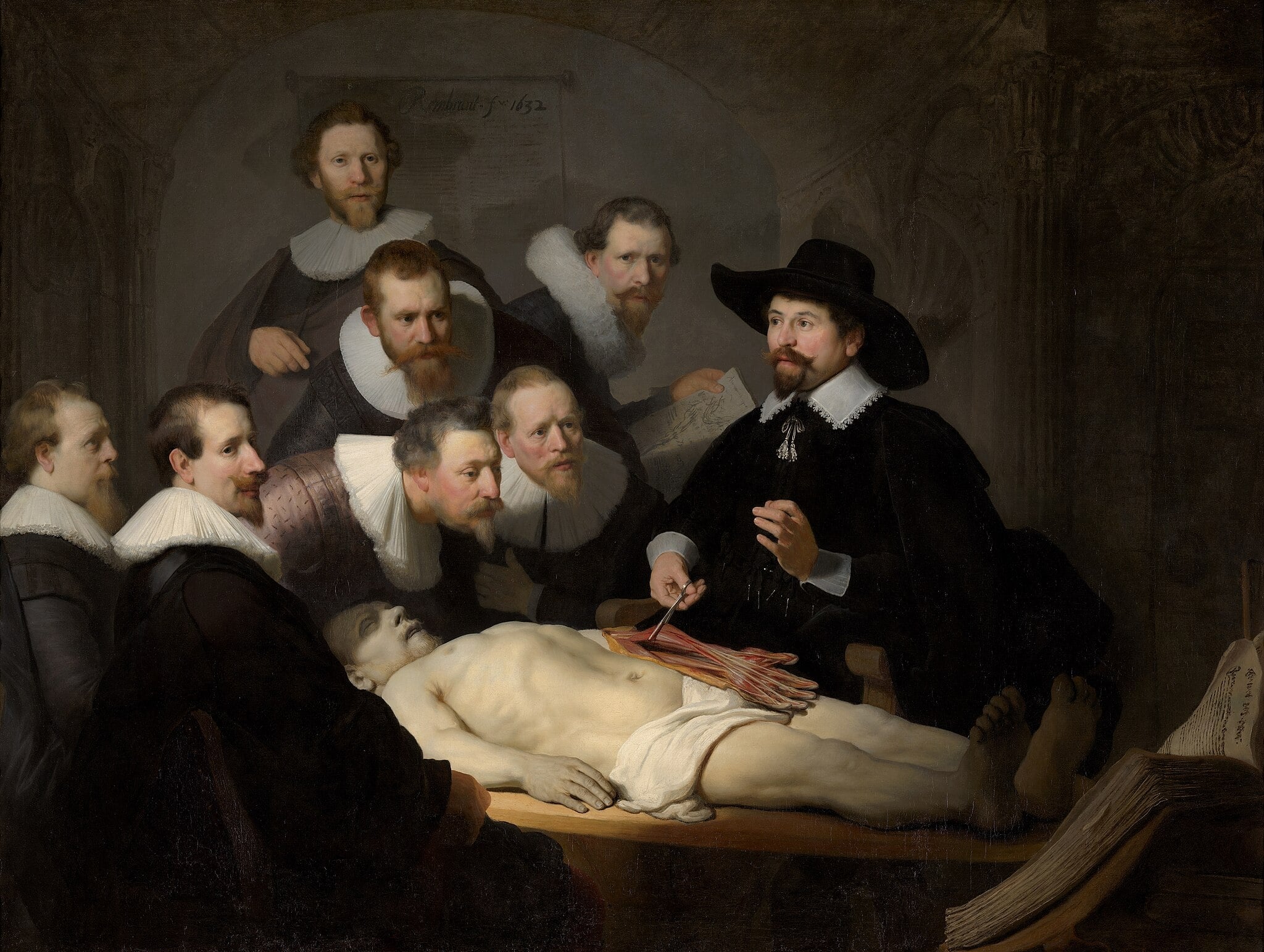
The Anatomy Lesson of Dr. Nicolaes Tulp by Rembrandt van Rijn

The Anatomy Lesson of Dr. Nicolaes Tulp

Rembrandt van Rijn (1632)

Rembrandt van Rijn turns a civic commission into a drama of <strong>knowledge made visible</strong>. A cone of light binds the ruff‑collared surgeons, the pale cadaver, and Dr. Tulp’s forceps as he raises the <strong>forearm tendons</strong> to explain the hand. Book and body face each other across the table, staging the tension—and alliance—between <strong>textual authority</strong> and <strong>empirical observation</strong> <sup>[1]</sup><sup>[2]</sup>.
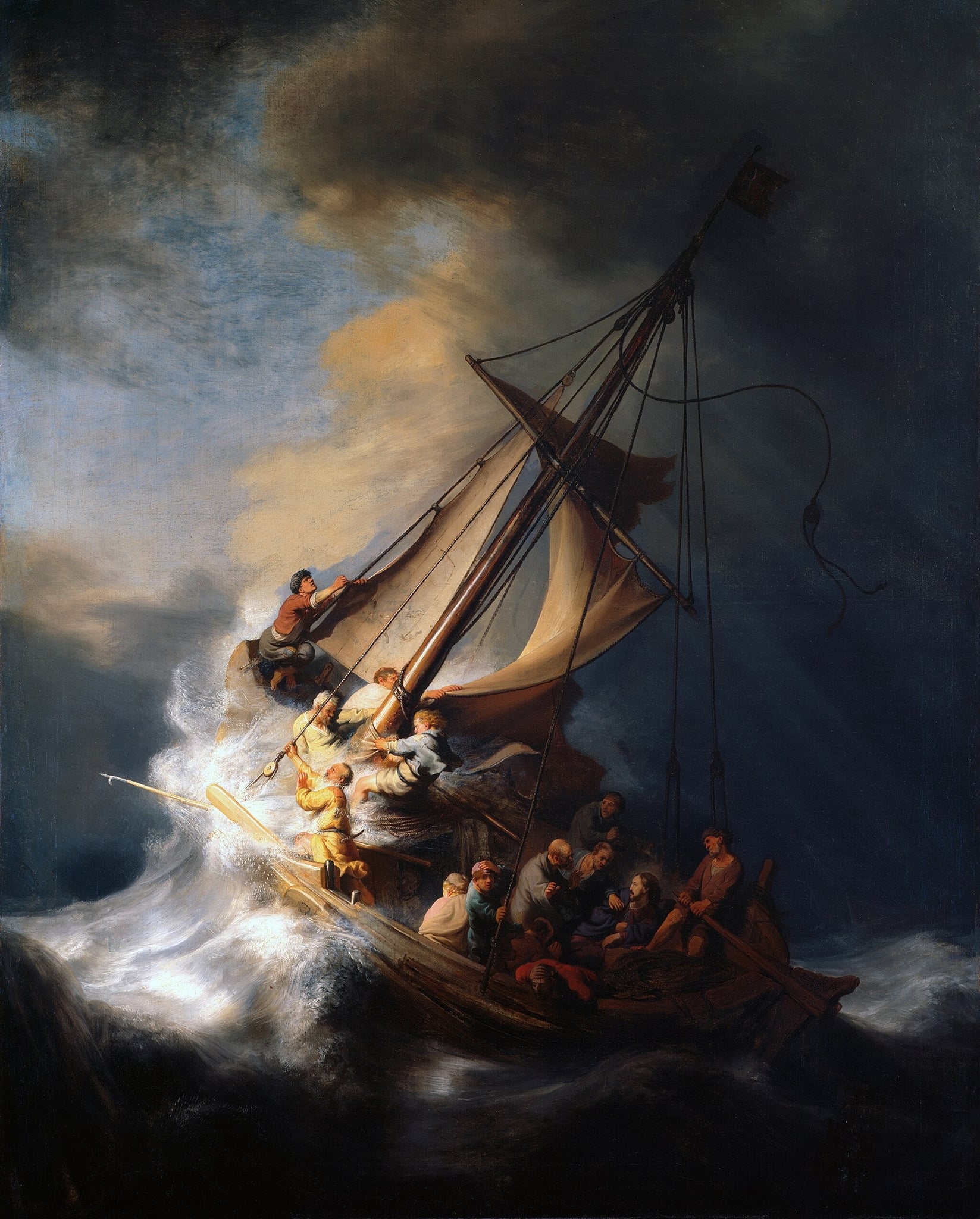
The Storm on the Sea of Galilee by Rembrandt van Rijn

The Storm on the Sea of Galilee

Rembrandt van Rijn (1633)

Rembrandt van Rijn’s The Storm on the Sea of Galilee stages a clash of <strong>human panic</strong> and <strong>divine composure</strong> at the instant before the miracle. A torn mainsail whips across a steeply tilted boat as terrified disciples scramble, while a <strong>serenely lit Christ</strong> anchors a pocket of calm—an image of faith holding within chaos <sup>[1]</sup><sup>[3]</sup>. It is Rembrandt’s only painted seascape, intensifying its dramatic singularity in his oeuvre <sup>[2]</sup>.
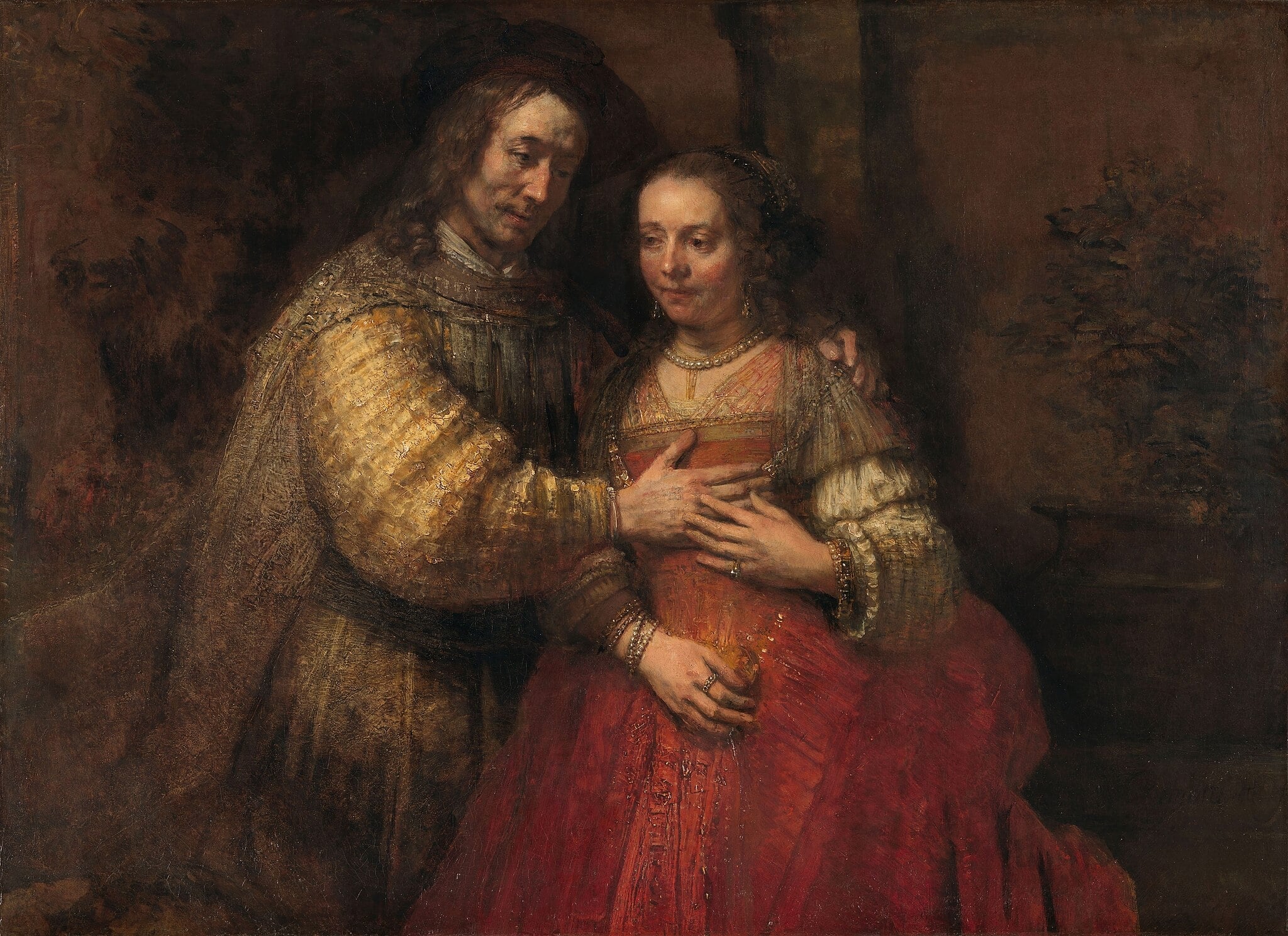
The Jewish Bride by Rembrandt van Rijn

The Jewish Bride

Rembrandt van Rijn (c. 1665–1669)

The Jewish Bride by Rembrandt van Rijn stages an intimate covenant: two figures, read today as <strong>Isaac and Rebecca</strong>, seal their union through touch rather than spectacle. Light concentrates on faces and hands, while the man’s glittering <strong>gold sleeve</strong> and the woman’s <strong>coral-red gown</strong> turn paint itself into a metaphor for fidelity and tenderness <sup>[1]</sup><sup>[3]</sup>. This late masterpiece embodies Rembrandt’s <strong>material eloquence</strong>—impasto as feeling—within a hushed, dark setting <sup>[1]</sup><sup>[2]</sup>.
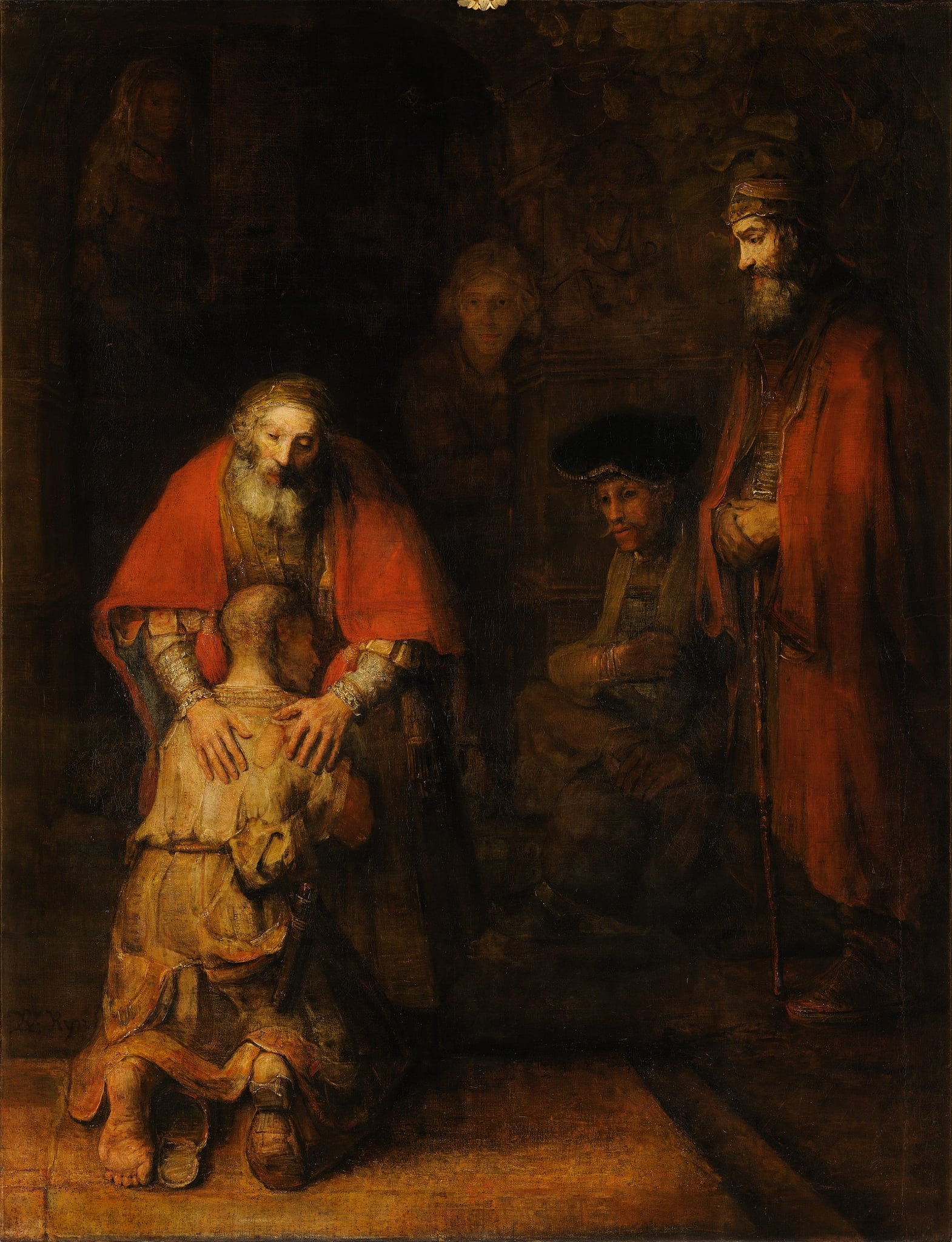
The Return of the Prodigal Son by Rembrandt van Rijn

The Return of the Prodigal Son

Rembrandt van Rijn (c. 1661–1669 (probably completed by 1669))

Rembrandt van Rijn’s The Return of the Prodigal Son is a late-life meditation on <strong>mercy</strong>, <strong>homecoming</strong>, and <strong>restored dignity</strong>. In a hush of dusk-like light, a ragged son kneels into his father’s <strong>embrace</strong>, while an upright elder brother holds back in shadow. The image concentrates meaning in illuminated <strong>faces, hands, and feet</strong>, turning a parable into a timeless human reckoning. <sup>[1]</sup><sup>[2]</sup>
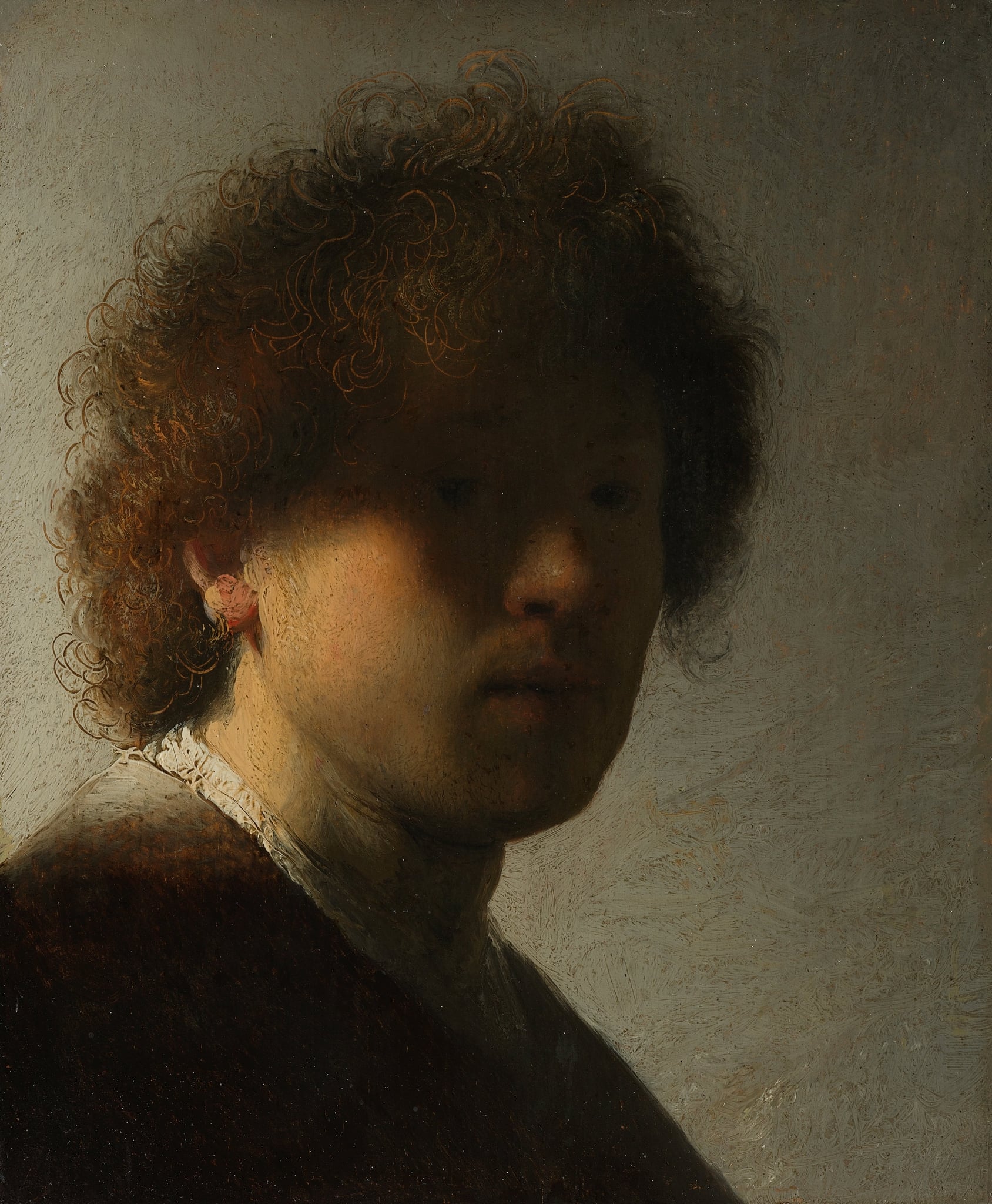
Self-portrait (with tousled hair) by Rembrandt van Rijn

Self-portrait (with tousled hair)

Rembrandt van Rijn (c. 1628)

A young Rembrandt van Rijn tests how <strong>light both reveals and withholds</strong> by letting his face emerge from darkness while his <strong>scratched, backlit curls</strong> flare like a rough halo. The small oak panel makes <strong>process itself the subject</strong>, turning hair, stubble, and a raking highlight into a statement of identity-in-formation <sup>[1]</sup><sup>[5]</sup>.
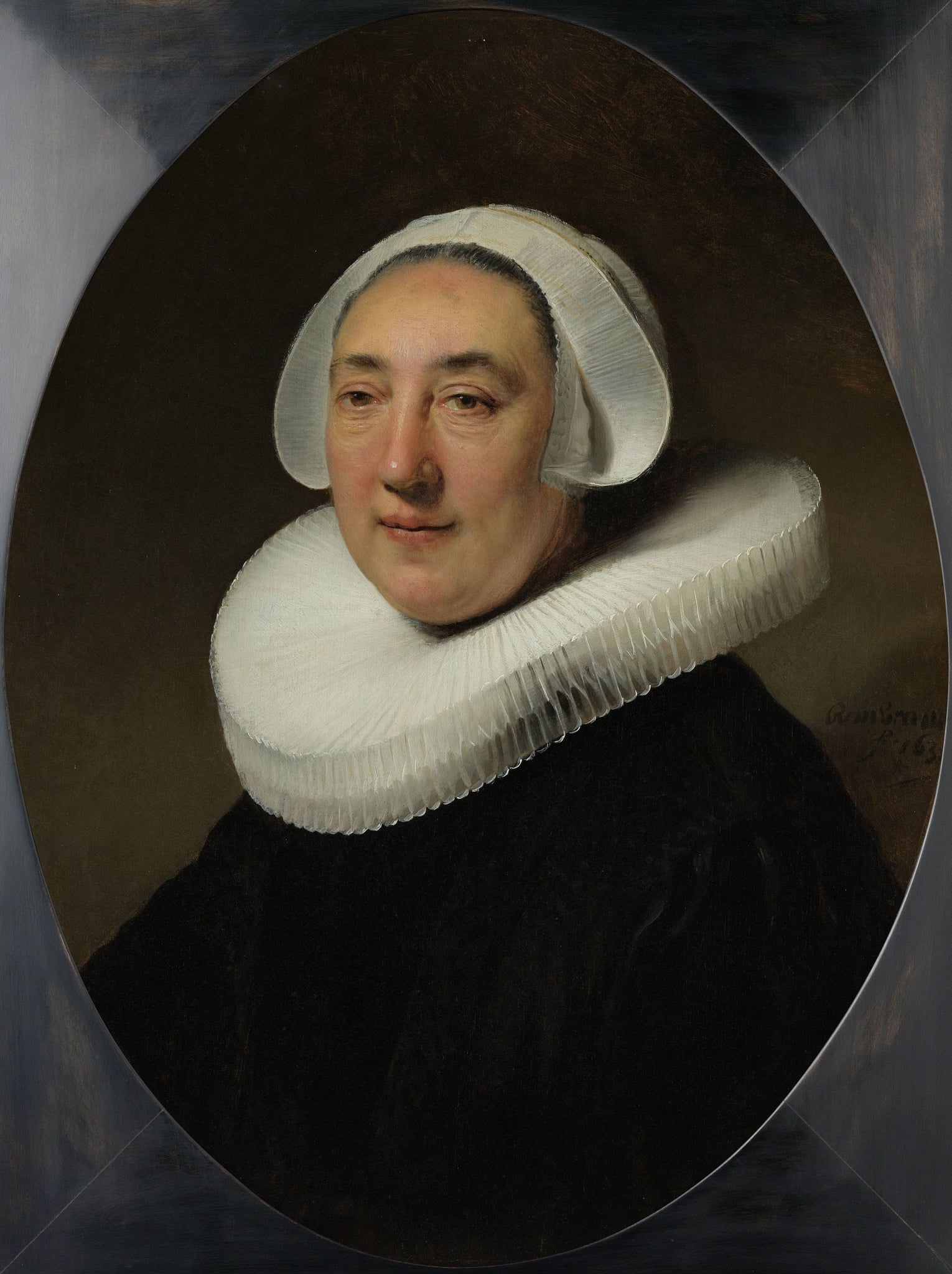
Portrait of Haesje Jacobsdr van Cleyburg by Rembrandt van Rijn

Portrait of Haesje Jacobsdr van Cleyburg

Rembrandt van Rijn (1634)

Rembrandt’s 1634 Portrait of Haesje Jacobsdr van Cleyburg stages a Dutch burgher within a feigned <strong>oval</strong> opening, illuminated by selective <strong>chiaroscuro</strong> that models warm skin against brilliant <strong>millstone ruff</strong> and sober black dress. The painting balances <strong>modesty and status</strong>, making virtue visible while quietly declaring prosperity through immaculate linen and craft <sup>[1]</sup><sup>[4]</sup>.