How Much Is A Woman bathing in a Stream (Hendrickje Stoffels?) Worth?
Last updated: August 25, 2026
Quick Facts
- Methodology
- comparable analysis
Hypothetical valuation for Rembrandt’s A Woman bathing in a Stream (1654) is $140–200 million. The range is anchored by recent nine‑figure private acquisitions of top Rembrandt paintings and the work’s status as a late, museum‑grade masterpiece held by the National Gallery, London.
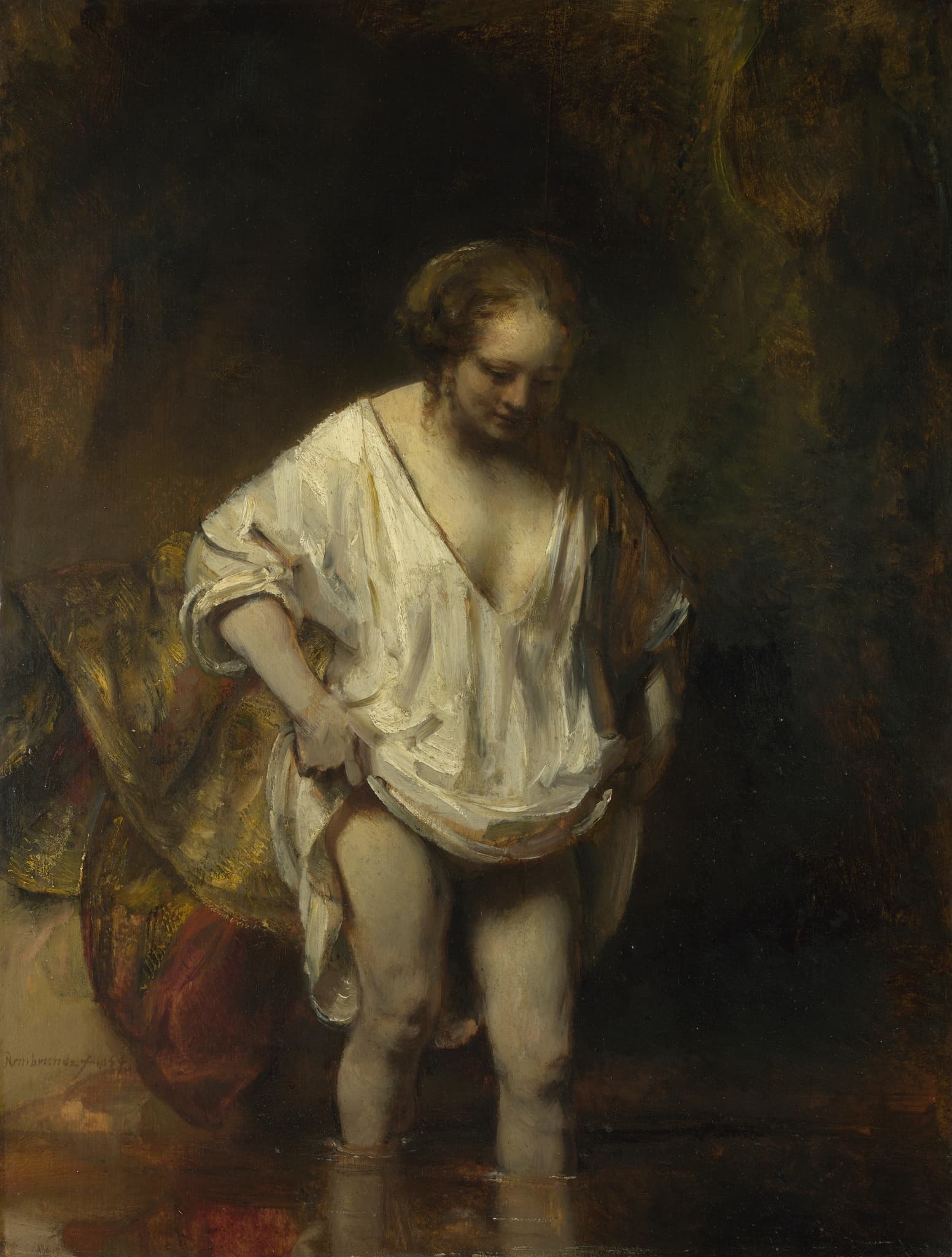
A Woman bathing in a Stream (Hendrickje Stoffels?)
Rembrandt van Rijn, 1654 • Oil on oak panel
Read full analysis of A Woman bathing in a Stream (Hendrickje Stoffels?) →Valuation Analysis
Conclusion: On a hypothetical, insurance‑style basis, Rembrandt’s A Woman bathing in a Stream (Hendrickje Stoffels?), 1654 (National Gallery, London), merits a valuation of $140–200 million. This reflects its consensus autograph status, canonical importance within Rembrandt’s late oeuvre, and the contemporary price environment for trophy‑level Rembrandt paintings, which has been established through nine‑figure private acquisitions by leading institutions and states [2][3].
Artwork stature and acceptance: The painting is signed and dated 1654 and is widely regarded as a landmark of Rembrandt’s late style—an intensely intimate figure (very plausibly Hendrickje Stoffels) rendered with extraordinary immediacy and painterly economy. It has been a cornerstone of the National Gallery’s collection since 1831 and is frequently reproduced in scholarship and exhibitions—clear signals of high curatorial esteem and stable attribution [1].
Benchmarking and market evidence: For true, museum‑caliber Rembrandts, the relevant price signals are private, state‑backed acquisitions rather than public auction records. The Netherlands/Rijksmuseum’s 2022 acquisition of The Standard Bearer at €175 million (≈$198m at the time) and the Louvre/Rijksmuseum’s 2016 joint purchase of the Maerten Soolmans and Oopjen Coppit pendants at €160 million demonstrate current institutional willingness to pay nine figures for prime works by the artist [2][3]. By contrast, the public auction arena, limited by scarcity of masterpieces and condition/attribution caution, shows lower—but not comparable—signals: a rediscovered pair of small portraits brought $14.27m in 2023, and the standing auction record from 2009 is roughly $28.5m for a late portrait [4][5]. Broader Old Master peaks, such as Botticelli’s $92.2m portrait in 2021, confirm that exceptional historic pictures can exceed $100m at auction when quality and demand align [6].
Positioning this work: Within Rembrandt’s canon, A Woman bathing in a Stream ranks as a late masterpiece with outsized art‑historical resonance. While it is modest in scale relative to full‑length state portraits, its intimacy, virtuosity, and iconic subject association give it desirability that rivals larger works. Qualitatively, it aligns with the nine‑figure private‑treaty cohort (Standard Bearer; Soolmans/Coppit), rather than with smaller, recently auctioned portraits. The proposed range places the low end ($140m) comfortably above major public auction benchmarks for Old Masters and Rembrandt paintings, and the high end ($200m) in line with recent private Rembrandt acquisitions when adjusted for current market dynamics, currency, and the work’s esteem.
Key sensitivities: As with all Old Masters, condition and technical acceptance can materially affect value. The National Gallery’s acceptance and the presence of signature/date mitigate attribution risk, but a current technical/condition dossier would be required to support the upper end of the range in a transactional context. Practical note: as a UK national collection object with long‑standing institutional ownership, any valuation functions as a hypothetical or indemnity/insurance figure rather than an actionable market price [1].
Key Valuation Factors
Art Historical Significance
High ImpactPainted in 1654 and signed and dated, this work is a touchstone of Rembrandt’s late style: radical economy of means, psychological immediacy, and a powerful sense of presence. The likely identification of the model as Hendrickje Stoffels adds biographical resonance, making it one of the most discussed intimate figure studies in his oeuvre. Its consistent inclusion in scholarship and exhibitions and its long-standing place in the National Gallery, London, reinforce its canonical status. Among late Rembrandts of intimate scale, few works carry comparable name recognition and art‑historical weight, amplifying demand in any hypothetical sale and justifying a valuation consonant with nine‑figure museum‑level comparables.
Scarcity and Market Liquidity
High ImpactSecurely attributed, prime-quality Rembrandt paintings in private hands are exceptionally scarce; most reside in museums. When masterpieces trade, they frequently do so via private treaty with institutional or state buyers, bypassing the public auction arena. Recent nine‑figure private acquisitions (e.g., The Standard Bearer; the Soolmans/Coppit pendants) set a clear price context. Public auction results, while informative, underrepresent the achievable prices for museum‑caliber works because such pictures almost never appear at auction. This extreme supply constraint creates a rarity premium for any late, undisputed Rembrandt of textbook status, supporting a valuation framework comfortably in the nine‑figure range.
Condition and Technical Acceptance
High ImpactFor Old Masters, subtle condition differences and technical consensus materially influence price. This picture is signed and dated and is firmly accepted by the National Gallery—key positives that reduce attribution risk. Nonetheless, a current technical dossier (IRR, X-radiography, panel support assessment, conservation history) would be required to confirm surface quality and stability for a transaction or loan. If condition is strong and confirms the surface character celebrated in scholarship, the work merits the upper half of the proposed range; meaningful condition compromises would bias valuation toward the lower half. The institutional stewardship suggests responsible care, further supporting confidence.
Scale and Format
Medium ImpactThe painting’s intimate scale distinguishes it from grand, full‑length state portraits. While smaller size can temper absolute price versus large pendants or monumental works, the format here is integral to the subject’s immediacy and is a celebrated feature of Rembrandt’s late manner. In the top tier of collecting, intimate but iconic Rembrandts can compete on desirability with larger works because of their art‑historical profile and quality. Accordingly, scale moderates—but does not negate—the nine‑figure comparables; it helps anchor the valuation toward a $140–200 million band rather than beyond the highest recent Rembrandt private purchases.
Provenance and Institutional Ownership
Medium ImpactThe work’s 19th‑century acquisition and continuous holding by the National Gallery, London, confer exemplary provenance and de‑risk attribution history. However, as a UK national collection object, it is effectively non‑marketable; deaccession is highly unlikely and any practical valuation is insurance/indemnity‑type. This context does not diminish intrinsic market value; rather, it frames the estimate as an evidence‑based, hypothetical figure grounded in comparable transactions. Institutional ownership, strong provenance, and decades of scholarly visibility add confidence to the estimate, though they also mean realized market testing is improbable.
Sale History
[Blackwood] sale, London (Day 1, lot 60)
Original price £19 8s 6d; CPI-based 2026 USD ≈ $7,400. Conversion for orientation only; original currency was GBP. Buyer recorded as “Raymond.” Source: National Gallery online catalogue.
Lord Gwydyr sale, London (Day 2, lot 72)
Original price 165 guineas (=£173.25); CPI-based 2026 USD ≈ $33,000. Purchased by Rev. William Holwell Carr; bequeathed to the National Gallery in 1831. Source: National Gallery online catalogue.
Rembrandt van Rijn's Market
Rembrandt van Rijn sits at the apex of the Old Masters market. Secure, prime paintings are vanishingly scarce in private hands, and when they trade, they often do so via private treaty with institutional or state partners. Recent headline benchmarks include The Standard Bearer, acquired by the Netherlands/Rijksmuseum for about $198 million in 2022, and the Louvre/Rijksmuseum’s €160 million joint purchase of the Maerten Soolmans and Oopjen Coppit pendants in 2016. In the public auction arena, supply constraints keep prices lower: a rediscovered pair of small portraits sold for $14.27m in 2023, and the auction record (2009) is c.$28.5m. Collectors pursue works across media, with strong demand for drawings and rare prints, but top-tier oils remain the pinnacle.
Comparable Sales
The Standard Bearer
Rembrandt van Rijn
Same artist; museum‑grade trophy painting establishing a contemporary nine‑figure benchmark for prime Rembrandt works. While subject/scale differ (full‑length male figure), it anchors top‑end private pricing for canonical Rembrandts.
$198.0M
2022, Private treaty; acquired by the Dutch State for the Rijksmuseum
~$220.0M adjusted
Portraits of Maerten Soolmans and Oopjen Coppit (pendant portraits)
Rembrandt van Rijn
Same artist; rare, museum‑level full‑length pendant portraits bought jointly by two national museums. Confirms sustained institutional willingness to pay nine figures for top‑tier Rembrandts.
$176.0M
2016, Private treaty; joint acquisition by the Louvre and Rijksmuseum
~$238.0M adjusted
Portraits of Jan Willemsz. van der Pluym and Jaapgen Carels
Rembrandt van Rijn
Same artist; small, autograph oil portraits sold publicly in 2023—useful for gauging current auction demand for smaller‑scale Rembrandt paintings in the 2020s.
$14.3M
2023, Christie's London
~$15.1M adjusted
Self-portrait (1632)
Rembrandt van Rijn
Same artist; recent auction sale of an autograph painting. Though earlier in date and different in subject from the 1654 Hendrickje picture, it sets a modern auction reference for signed Rembrandt oils.
$18.7M
2020, Sotheby's London
~$23.4M adjusted
Portrait of a Man, Half-length, With His Arms Akimbo (1658)
Rembrandt van Rijn
Same artist; late masterpiece and the artist’s public auction record. Close in period to 1654 and indicative of what major late Rembrandt portraits can command at auction (before scarcity pushed more trading to private treaty).
$28.5M
2009, Christie's London
~$42.8M adjusted
Current Market Trends
Old Masters have shown steady resilience, with a pronounced flight to quality and renewed institutional/private focus on canonical names. The very top of the segment is supply‑driven: a handful of trophies can swing annual totals, and when museum‑grade works appear, competition is intense. Private treaty activity and state-backed acquisitions have set the clearest benchmarks for masterpieces, while public auctions continue to perform for smaller or less canonical works. Post‑2020, confidence has been reinforced by high‑profile nine‑figure Rembrandt acquisitions and a $92.2m Botticelli at auction, signaling headroom above $100m when rarity, condition, and cultural significance align.
Study print
Study this painting as a print
Pair the full artwork with a museum-style study sheet focused on one meaningful detail.
Sources
- National Gallery, London — A Woman bathing in a Stream (Hendrickje Stoffels?)
- The Standard Bearer (Rembrandt, 1636) — acquisition details
- The Art Newspaper — France and Netherlands finalise €160m Rembrandt treaty
- Christie’s Press Release — Classic Week (includes 2023 Rembrandt portrait pair result)
- Christie’s — Rembrandt van Rijn (artist page with auction results, incl. 2009 record)
- The Art Newspaper — Botticelli portrait sells for $92.2m at Sotheby’s (2021)