How Much Is An Elderly Man as Saint Paul Worth?
Last updated: August 11, 2026
Quick Facts
- Methodology
- comparable analysis
If privately available, Rembrandt’s An Elderly Man as Saint Paul (c.1659, National Gallery, London) would command roughly $100–150 million. This late, signed, psychologically charged half‑length belongs to one of the scarcest and most coveted categories in the Old Masters market. The range is anchored by recent nine‑figure private‑treaty benchmarks for top Rembrandt paintings and bracketing late single‑figure auction records.
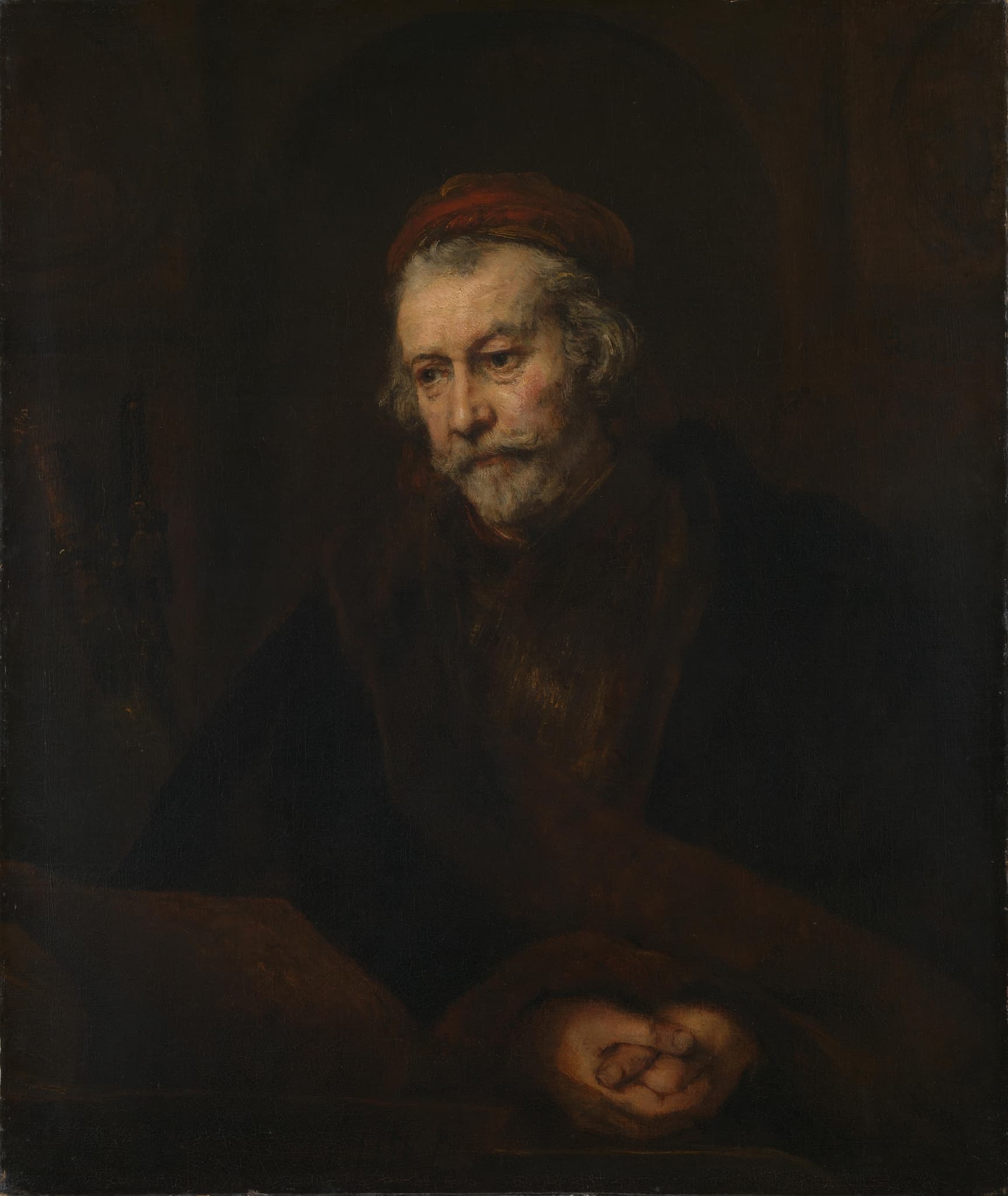
An Elderly Man as Saint Paul
Rembrandt van Rijn, 1659 (probably) • Oil on canvas
Read full analysis of An Elderly Man as Saint Paul →Valuation Analysis
Conclusion: We estimate fair‑market value for Rembrandt’s An Elderly Man as Saint Paul at $100–150 million in a private‑sale context. The work is a signed, late (prob. 1659) half‑length apostle/elderly man—a core subject of Rembrandt’s final period—measuring 102 × 85.5 cm and held by the National Gallery, London (NG243) [1]. Its late date, autograph acceptance, and profound psychological character place it among the most sought‑after Rembrandt types still conceivable in private hands.
Benchmarking and scarcity premium: Recent state‑backed and institutional private purchases establish the nine‑figure ceiling for top Rembrandt paintings: The Standard Bearer sold to the Dutch state in 2022 for €175 million [2], and the Louvre/Rijksmuseum jointly acquired the full‑length portraits of Maerten Soolmans and Oopjen Coppit in 2016 for €160 million [3]. While NG243 is not a monumental full‑length or nationally iconic self‑representation, it sits squarely within the elite late oeuvre that attracts intense institutional and top‑tier private demand, warranting a valuation tier below but proximate to these benchmarks.
Auction context (floor and visibility): Public auctions rarely surface late, first‑rank Rembrandt paintings. The standing auction record for a Rembrandt painting remains £20.2 million (Portrait of a Man with Arms Akimbo, 2009) [4]. More recently, Sotheby’s London sold the rediscovered early panel The Adoration of the Kings in December 2023 for about $14 million including fees, essentially to the guarantor—an outcome that underscores both scholarly excitement and market selectivity when major Rembrandts do appear at auction [5]. These figures demonstrate that the most important Rembrandts typically avoid auction and change hands privately at substantially higher levels.
Deriving the $100–150 million range: Within Rembrandt’s late single‑figure canon, apostle/elderly‑saint images are exceptionally scarce, intensely psychological, and celebrated for their painterly freedom—attributes strongly present in NG243 [1]. Adjusting from auction floors (c.$40–50 million in today’s terms for late single‑figure benchmarks) to a private‑sale setting, and giving weight to late date, autograph acceptance, scale, and museum‑level quality, we assign a central private‑treaty value band of $100–150 million. The upper half of the range reflects the demonstrated readiness of institutions and a handful of private collectors to transact major Rembrandts in the nine figures when quality and significance align [2][3].
Important notes: The work resides in the National Gallery, London; deaccession is highly unlikely, so this valuation is necessarily hypothetical and intended for market‑context and insurance‑analogous purposes. As with all Old Masters, condition and technical findings are price‑critical; our range presumes strong, typical museum conservation state. Should new technical scholarship or conservation data materially enhance or diminish perceived quality, the estimate would be adjusted accordingly [1].
Key Valuation Factors
Art Historical Significance
High ImpactThis work epitomizes late Rembrandt’s psychological intensity: a meditative, half‑length apostle/elderly man painted with the master’s unparalleled control of light, atmosphere, and impasto. Dated by the National Gallery to around 1659 and signed, it belongs to the period that cements Rembrandt’s status as the greatest portraitist of the Baroque era. These late single‑figure images are foundational to our understanding of the artist’s exploration of human character and spiritual interiority. As a result, they occupy a privileged position in museum narratives, monographs, and major exhibitions, sustaining demand among top collectors and institutions. Within Rembrandt’s oeuvre, this category sits just beneath the most iconic full‑lengths and self‑portraits but remains unequivocally “major,” supporting a nine‑figure private valuation baseline.
Rarity and Market Scarcity
High ImpactAutograph Rembrandt paintings are extraordinarily scarce on the market, and late works of this specific apostle/elderly-saint type are scarcer still. Over the last decade, the most important Rembrandts have transacted via private treaty to institutions at nine‑figure levels, not at public auction. This thin supply dynamic creates a scarcity premium: when a work of comparable quality, date, and presence becomes hypothetically available, only a handful of global museums and ultra‑prime private buyers compete, driving outcomes disproportionate to auction benchmarks. The 2022 Standard Bearer purchase (€175m) and the 2016 Maerten & Oopjen pair (€160m) illustrate the price environment for top‑tier Rembrandts, validating a nine‑figure framework for a late, museum‑caliber single‑figure painting even if it is not a full‑length or national icon.
Attribution and Condition
High ImpactThe National Gallery catalogs the painting as a signed, autograph Rembrandt, probably 1659, with extensive scholarship and technical documentation. In Old Masters, small shifts in attribution or the discovery of extensive overpaint can move value bands dramatically. While NG stewardship suggests a high conservation standard, true pricing power assumes well‑preserved surface, intact impasto in passages of highlight, and minimal intrusive restoration. Late Rembrandts thrive on materiality—where the paint’s physical presence conveys depth of character—and losses here can be disproportionately penalized. Our $100–150m estimate presumes strong structural and surface condition consistent with long‑term museum care; were that assumption to be refined by new technical data, the range would be recalibrated to reflect any change in perceived autograph quality or visual impact.
Subject Matter and Cross-Segment Appeal
Medium ImpactWhile not a named society portrait or a fully iconic self‑portrait, the apostle/elderly man type has broad resonance across religious, portraiture, and tronie‑collecting audiences. Its gravitas suits civic and encyclopedic museums and also resonates with private collectors who prioritize psychological depth over social status. The work’s contemplative power and Rembrandt’s hallmark handling align it closely with the late master’s core strengths, supporting institutional loan desirability and curatorial placement. This breadth of appeal increases the size and quality of the buyer pool relative to specialized biblical narratives and mitigates the absence of a famous sitter. In valuation terms, it commands a significant premium over earlier tronies and smaller portraits, though it prices below the very top tier of full‑lengths and iconic self‑portraits.
Provenance and Museum Standing
Medium ImpactThe painting has an early 19th‑century British provenance and entered the National Gallery, London, via the Colborne bequest in 1854, where it has remained ever since. Long museum tenure and frequent publication/exhibition confer reputational assurance that enhances market confidence and reduces due‑diligence friction if hypothetically offered. Although deaccession is highly unlikely, the museum imprimatur itself is value‑positive, signaling quality, stability of attribution, and scholarly integration. For valuation purposes, we treat its National Gallery context as a quality signal rather than a liquidity path. If such a work emerged from private hands with similarly strong provenance and literature, the market would accord a comparable premium, supporting the assigned nine‑figure range in a discreet private‑treaty negotiation.
Sale History
An Elderly Man as Saint Paul has never been sold at public auction.
Rembrandt van Rijn's Market
Rembrandt van Rijn is among the most liquid and brand‑defining names in Old Masters. The top end of his painting market is dominated by private treaties to institutions, evidenced by the Dutch state’s €175m purchase of The Standard Bearer in 2022 and the Louvre/Rijksmuseum’s €160m joint acquisition of Maerten Soolmans and Oopjen Coppit in 2016. Public auction benchmarks are materially lower due to supply: the standing auction record is £20.2m (2009), and a widely covered rediscovery, The Adoration of the Kings (2023), realized about $14m with fees. This bifurcation underscores that iconic, late autograph paintings are effectively a private‑sale asset class, while auctions reflect smaller, earlier, or rediscovered works. Demand from leading museums and a handful of global collectors remains exceptionally strong.
Comparable Sales
Saint James the Greater
Rembrandt van Rijn
Closest subject and period match: a late apostle/saint half-length (1661), autograph and psychologically intense—very close in type to An Elderly Man as Saint Paul (1659).
$25.8M
2007, Sotheby's New York
~$39.7M adjusted
Portrait of a Man with Arms Akimbo
Rembrandt van Rijn
Late-period (1658) half-length male portrait, autograph and museum-caliber; it is the standing auction record for a Rembrandt painting and strong for bracketing late single-figure valuations.
$33.2M
2009, Christie's London
~$49.5M adjusted
Self-portrait, wearing a ruff and black hat
Rembrandt van Rijn
Autograph single-figure but earlier (1632) and smaller; still a key benchmark for recent public appetite and pricing of Rembrandt paintings exposed at auction.
$18.7M
2020, Sotheby's London
~$23.2M adjusted
The Adoration of the Kings
Rembrandt van Rijn
Early (c.1628) rediscovered panel—different subject and period—but a recent, widely reported Rembrandt painting sale that shows depth of demand and pricing at auction in 2023.
$13.8M
2023, Sotheby's London
~$14.5M adjusted
Portraits of Jan Willemsz. van der Pluym and Jaapgen Carels (pair)
Rembrandt van Rijn
Autograph portraits (1635) sold together as a single lot; earlier and smaller but useful as a fresh-to-market portrait benchmark for pricing of Rembrandt paintings in 2023.
$14.3M
2023, Christie's London
~$15.0M adjusted
Current Market Trends
Old Masters auctions softened in 2024 but rebounded in 2025, with demand concentrating on best‑in‑class, fresh, and well‑documented works. For Rembrandt specifically, painting supply remains extremely thin, keeping private‑treaty prices elevated while auction results cluster in the mid‑eight figures and below for earlier or smaller works. Institutional acquisitions continue to set the bar for the very top tier. Meanwhile, Rembrandt’s print market has seen record‑setting depth, reinforcing the brand’s vigor across categories. In this environment, a late, museum‑caliber Rembrandt painting would likely sell privately, attracting competition from institutions and top collectors and achieving a significant scarcity premium over auction comparables.
Study print
Study this painting as a print
Pair the full artwork with a museum-style study sheet focused on one meaningful detail.
Sources
- National Gallery, London – Rembrandt: An Elderly Man as Saint Paul (NG243)
- Rijksmuseum – Rembrandt’s The Standard Bearer acquired for the Netherlands (€175m, 2022)
- The Art Newspaper – France and Netherlands finalise €160m Rembrandt treaty (Maerten & Oopjen, 2016)
- Christie’s – Rembrandt van Rijn (artist page; auction record reference)
- The Art Newspaper – Rediscovered paintings by Rembrandt and Canaletto fail to turbocharge London Old Master sales (Dec 8, 2023)