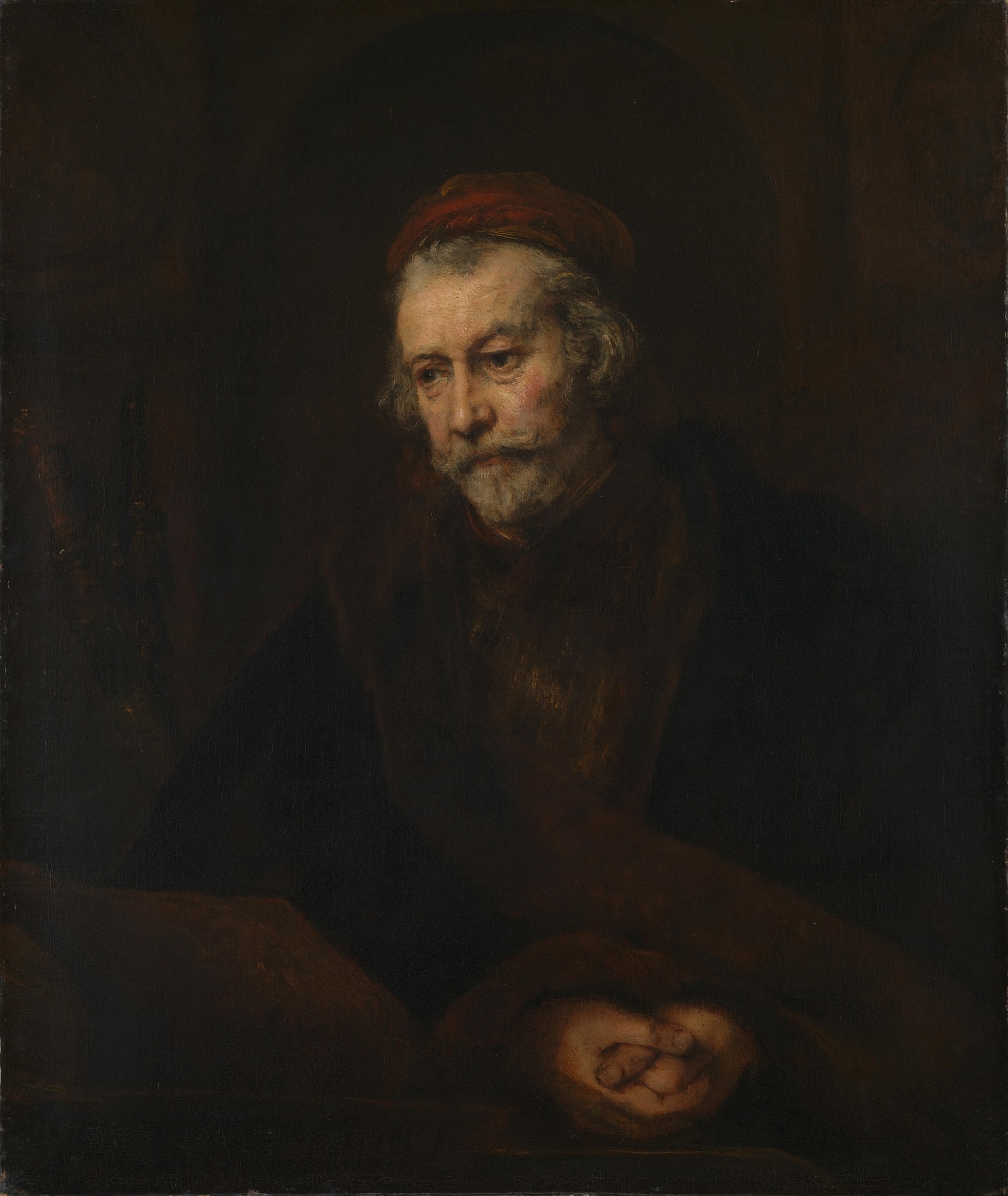
An Elderly Man as Saint Paul

by Rembrandt van Rijn

Rembrandt’s An Elderly Man as Saint Paul stages a profound meditation on thought joined to faith, cupping light around a weathered face and folded hands that hover above a scholar’s book. A veiled sword and faint roundel of the Sacrifice of Isaac deepen the painting’s argument that conviction, text, and trial cohere in Pauline wisdom [1][2].

Study Print Studio

Create a personal study print

Build a companion study sheet around the part of this painting that speaks to you most. Choose a detail, shape an interpretation, and walk away with something personal and display-worthy.

Fast Facts

Year
1659 (probably)
Medium
Oil on canvas
Dimensions
102 × 85.5 cm
Location
National Gallery, London
See all Rembrandt van Rijn paintings in London
An Elderly Man as Saint Paul by Rembrandt van Rijn (1659 (probably)) featuring Sword, Roundel of the Sacrifice of Isaac, Folded/prayerful hands

Click on any numbered symbol to learn more about its meaning

Meaning & Symbolism

Rembrandt builds meaning through a choreography of light and restraint. The face, softly rimmed by a red cap, leans into a narrow beam that also grazes the joined hands; both emerge from a brown atmosphere whose density reads as the weight of memory. The open folio at lower left provides a diagonal buttress against which the figure’s thought seems to press, asserting that belief is articulated through text—the epistles that carry Paul’s voice across time. Yet the mouth is fractionally parted and the eyes fall away from the page, as if thought has tipped from reading into prayer. Rembrandt insists that intellect fulfills itself in humility: the hands, not the sword, are brightest. The brush shifts accordingly—tactile, woolly strokes for the cloak give way to minute, tender modeling in the cheeks and fingers—so the very paint calibrates the passage from the material to the contemplative 12. In the left gloom the sword’s hilt flickers, the apostle’s attribute that, in Pauline terms, is the “sword of the Spirit,” that is, the Word of God (Eph. 6:17). Rembrandt buries it in shadow to relocate heroism from outward force to inward obedience; the instrument of martyrdom is present, but it does not command the eye. Above it, a low-relief roundel stages Abraham’s halted sacrifice of Isaac, the typological scene Paul praises as paradigmatic faith (Hebrews 11). Cleaned back into visibility in the twentieth century, this stone medallion acts as a theological footnote in the image: Scripture interprets Scripture, and the apostle’s meditation is framed by the very exemplum he preached. The book, the sword, and the roundel form a subtle triad—Word, Spirit, and Witnesswithin which the aged hands perform consent. Through this network of signs, Rembrandt argues that conviction is not noise but endurance: a quiet, steadied will under trial 12. The painting also recasts the saint through the late Rembrandt’s practice of the historicized portrait. The sitter is palpably a contemporary elder dressed “as” Paul, not an apparition of antiquity—a choice that translates apostolic sanctity into the register of recognizable human age, where wisdom accumulates as scar and patience. In mid‑seventeenth‑century Dutch Protestant culture, Paul stood as chief exegete of grace; Rembrandt’s late cluster of half‑length apostles, including his own role‑playing self‑portrait as Paul, testifies to a sustained engagement with this theological core. Here, the emptied setting and monochrome tonality concentrate the drama into the threshold between reading and prayer, letter and spirit. The painting’s argument is therefore ethical as much as religious: truth is not merely learned; it is borne. In this sense, the glow that gathers around brow and knuckles is not decorative but propositional—the image proposes that illumination is given to the lowly and the persevering, and that the Church’s teacher is first its penitent. That is why An Elderly Man as Saint Paul remains a touchstone of Rembrandt’s late art: it demonstrates how pictorial austerity can carry an expansive theology of grace, memory, and resolve without raising its voice 123.

Explore Deeper with AI

Ask questions about An Elderly Man as Saint Paul

Popular questions:

Powered by AI • Get instant insights about this artwork

💬 Ask questions about this artwork!

Interpretations

Iconographic Typology: Word, Spirit, Witness

Rembrandt’s background roundel of Abraham and Isaac operates as a theological “gloss” on Paul’s attributes, forging a typological chain from Old to New. Set above the half-veiled sword, the relief literalizes Hebrews 11’s praise of Abraham while re-reading Paul’s blade as the “sword of the Spirit,” that is, the Word of God. The open folio anchors exegesis; the sword intimates both proclamation and death; the roundel supplies the witness that faith acts. This three-part schema compresses a sermon into objects: Scripture (book), Spirit/Word (sword), and Testimony (sacrifice). By burying the sword in shadow, Rembrandt subordinates outward heroics to obedient contemplation, turning iconography into doctrine about how grace is recognized—through endurance more than display 123.

Source: National Gallery, London; Arthur K. Wheelock Jr., National Gallery of Art (Washington); Perlove & Silver

Late Style as Ethics of Seeing

The picture’s near-monochrome range and broken, tactile facture are not merely stylistic trademarks of late Rembrandt; they articulate an ethics: illumination belongs to the humble. Coarse, scumbled passages in the cloak yield to exquisitely modeled flesh so that paint itself narrates a crossing from matter to inwardness. The most radiant forms are not the blade or costume but the softly parted lips and joined hands, relocating significance from status to prayerful consent. This is consistent with Rembrandt’s late half-length saints, where setting recedes and psychological density thickens; the economy of means heightens spiritual legibility—an austere theater of light that disciplines attention toward what endures 1.

Source: National Gallery, London

Reformation Lens: Paul as Theologian of Grace

Seventeenth-century Dutch Protestant culture revered Paul as the chief expositor of grace, a status that helps explain Rembrandt’s sustained return to the apostle—including a self-portrait role-play as Paul (1661). In this canvas, the turn from reading to prayer stages the Reformational movement from letter to spirit, while the sword cites Ephesians 6:17 to redefine power as the Word’s piercing rather than coercive force. Wheelock links Rembrandt’s mid-1650s trials to the intensified inwardness of these half-lengths, reading the apostolic focus as both cultural and personal—an image of theology tested under duress. The result is not polemic but devotional phenomenology: how grace is borne, not brandished 24.

Source: Arthur K. Wheelock Jr., National Gallery of Art (Washington); Rijksmuseum

Historicized Portraiture and Role-Play

The work exemplifies the portrait historié: a contemporary elder “as” Paul. Rather than chase antiquarian accuracy, Rembrandt courts recognition—wrinkles, cap, and modernized garb—so sanctity reads through lived, local experience. This strategy—also visible in his Self-Portrait as the Apostle Paul—collapses distance between spectator and saint, inviting identification over veneration. It tests the boundary between likeness and persona, exploring how an actorly guise can disclose durable character: patience, penitence, endurance. By minimizing anecdotal setting, Rembrandt frames the sitter’s psychology as the true “costume,” letting hands, mouth, and gaze carry the role. Theological meaning thus arrives via social reading of a face we might meet in Amsterdam, not a relic from Tarsus 14.

Source: National Gallery, London; Rijksmuseum

Conservation Revelation: Recovered Program

The painting’s twentieth-century cleaning uncovered the low-relief roundels—crucial evidence that Rembrandt conceived a more articulate iconographic program than the pre-cleaned darkness suggested. The newly legible Abraham–Isaac scene clarifies the image’s exegetical structure, functioning as an embedded citation that frames Paul’s meditation. The discovery also sharpens readings of the sword: no longer a generic attribute in shadow, it converses with the sacrificial relief above it, turning the left gloom into a vertical register of faith under trial. This conservation history reminds us how condition mediates interpretation; in Rembrandt’s restrained syntax, even faint motifs carry theological weight when brought back into view 1.

Source: National Gallery, London

Related Themes

About Rembrandt van Rijn

Rembrandt van Rijn (1606–1669) was a leading Dutch Golden Age painter and printmaker whose Amsterdam years (from 1631) produced virtuosic portraits and ambitious history paintings. In the early 1630s he favored polished finishes, saturated color, and theatrical staging—qualities on display in this 1633 canvas. Although prolific, this is his only known painted seascape [2][4].
View all works by Rembrandt van Rijn

More by Rembrandt van Rijn
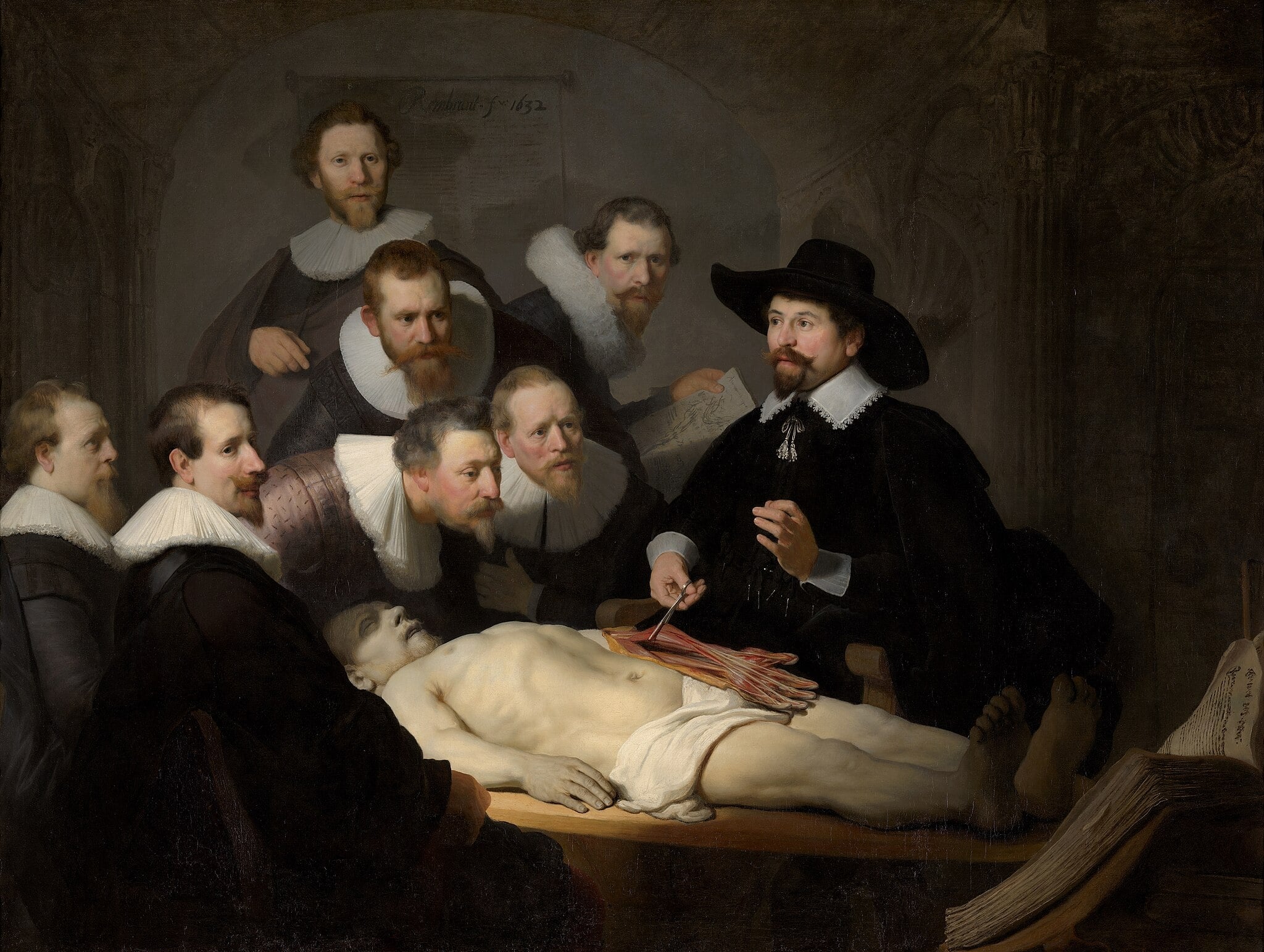
The Anatomy Lesson of Dr. Nicolaes Tulp by Rembrandt van Rijn

The Anatomy Lesson of Dr. Nicolaes Tulp

Rembrandt van Rijn (1632)

Rembrandt van Rijn turns a civic commission into a drama of <strong>knowledge made visible</strong>. A cone of light binds the ruff‑collared surgeons, the pale cadaver, and Dr. Tulp’s forceps as he raises the <strong>forearm tendons</strong> to explain the hand. Book and body face each other across the table, staging the tension—and alliance—between <strong>textual authority</strong> and <strong>empirical observation</strong> <sup>[1]</sup><sup>[2]</sup>.
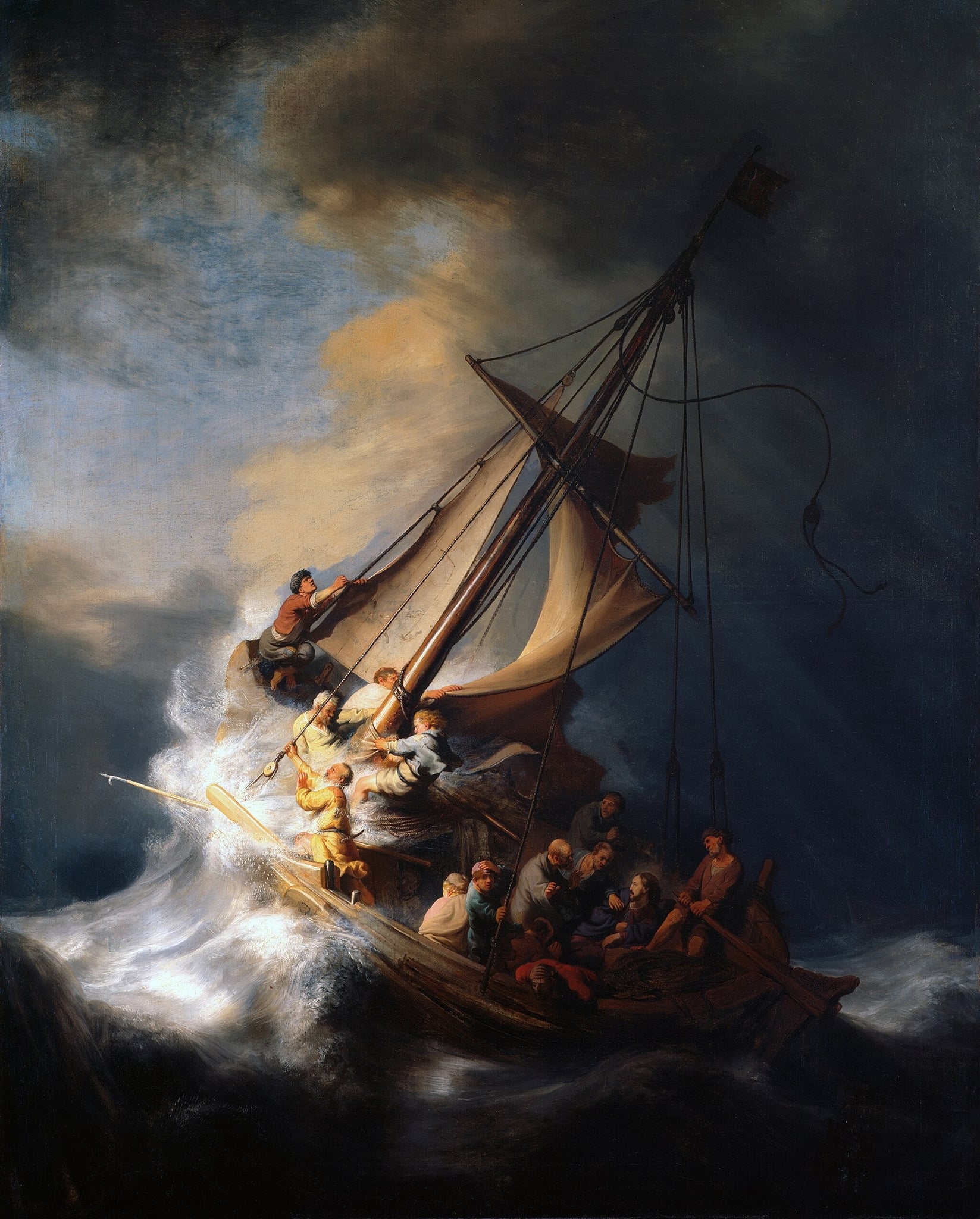
The Storm on the Sea of Galilee by Rembrandt van Rijn

The Storm on the Sea of Galilee

Rembrandt van Rijn (1633)

Rembrandt van Rijn’s The Storm on the Sea of Galilee stages a clash of <strong>human panic</strong> and <strong>divine composure</strong> at the instant before the miracle. A torn mainsail whips across a steeply tilted boat as terrified disciples scramble, while a <strong>serenely lit Christ</strong> anchors a pocket of calm—an image of faith holding within chaos <sup>[1]</sup><sup>[3]</sup>. It is Rembrandt’s only painted seascape, intensifying its dramatic singularity in his oeuvre <sup>[2]</sup>.
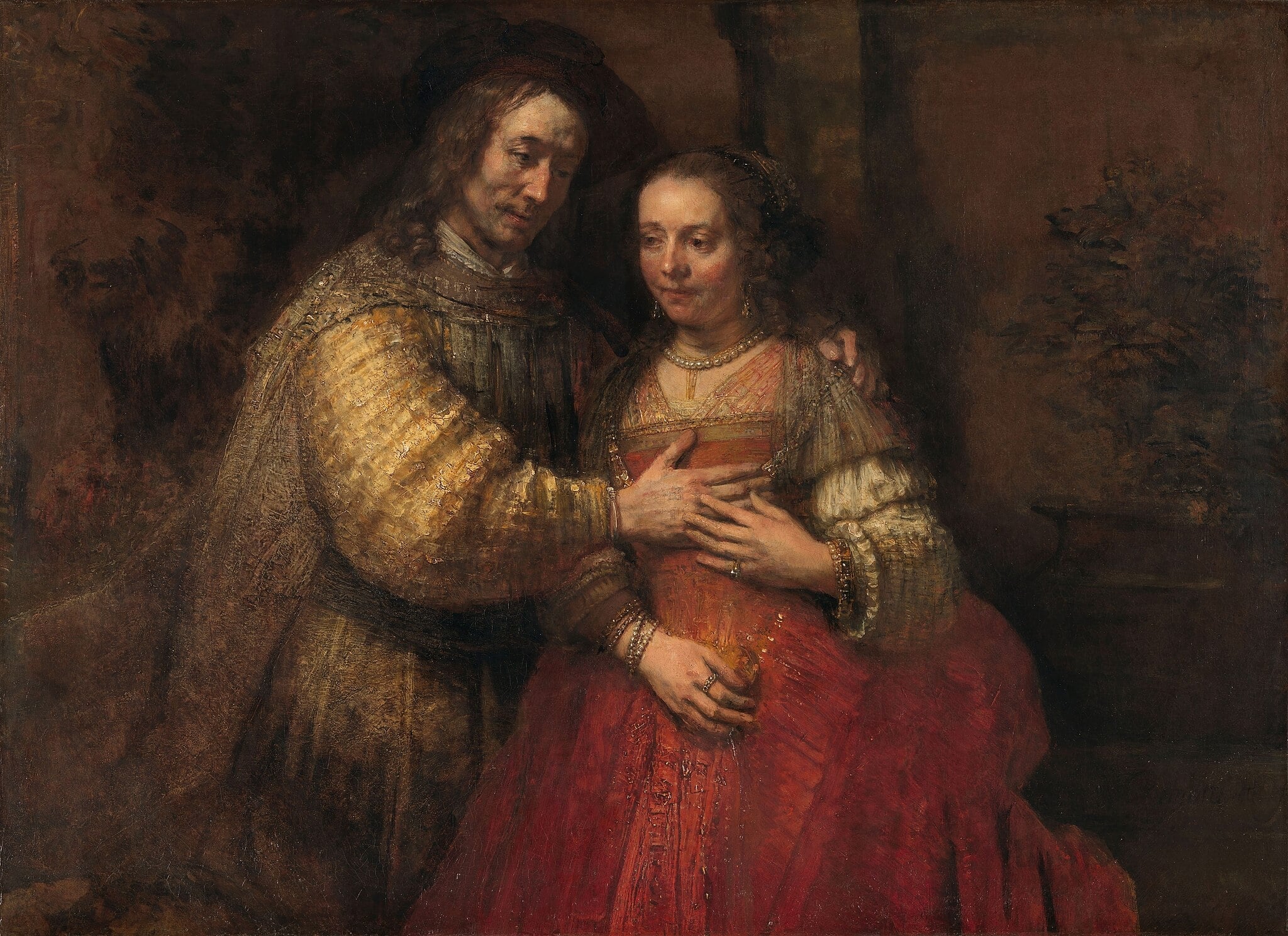
The Jewish Bride by Rembrandt van Rijn

The Jewish Bride

Rembrandt van Rijn (c. 1665–1669)

The Jewish Bride by Rembrandt van Rijn stages an intimate covenant: two figures, read today as <strong>Isaac and Rebecca</strong>, seal their union through touch rather than spectacle. Light concentrates on faces and hands, while the man’s glittering <strong>gold sleeve</strong> and the woman’s <strong>coral-red gown</strong> turn paint itself into a metaphor for fidelity and tenderness <sup>[1]</sup><sup>[3]</sup>. This late masterpiece embodies Rembrandt’s <strong>material eloquence</strong>—impasto as feeling—within a hushed, dark setting <sup>[1]</sup><sup>[2]</sup>.
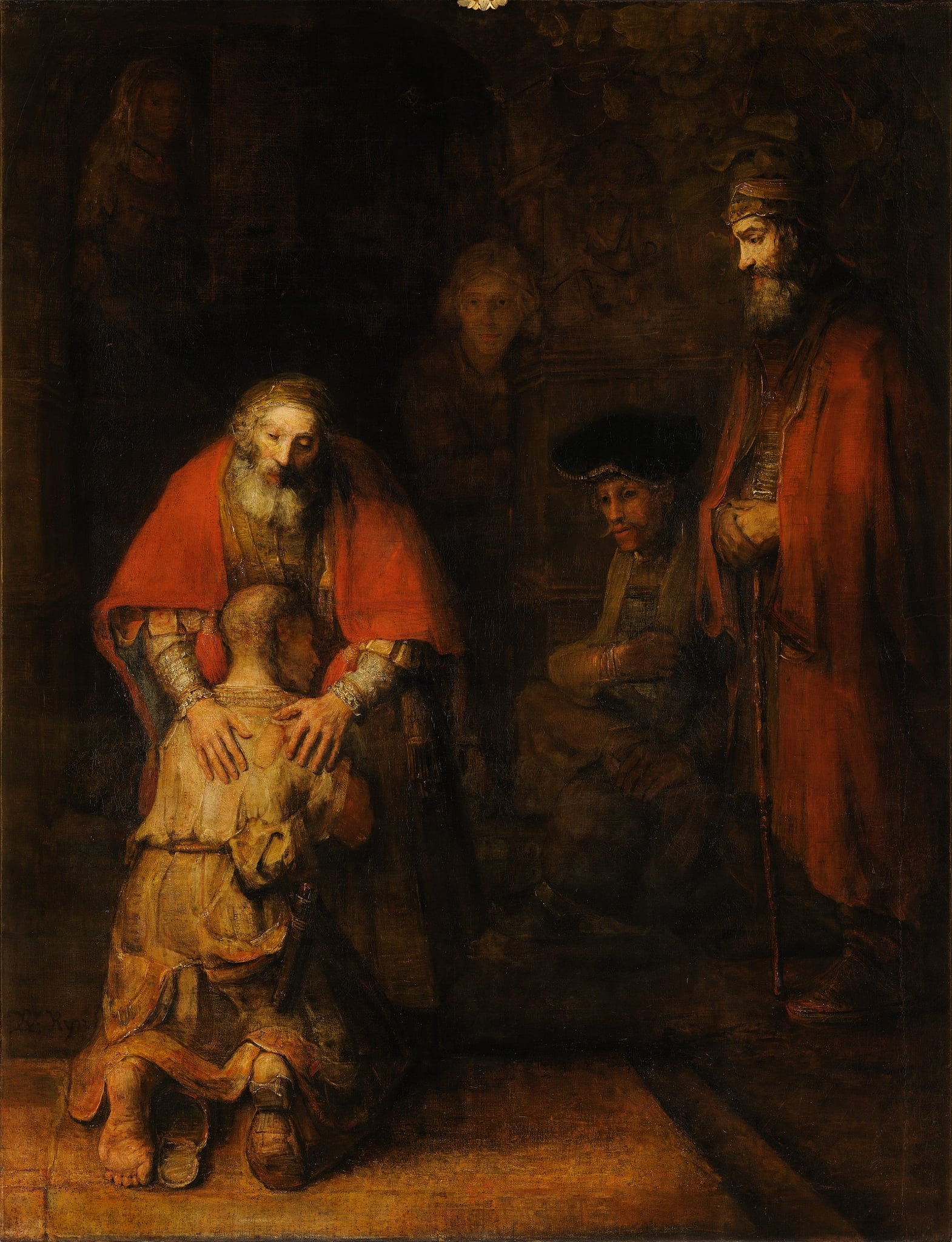
The Return of the Prodigal Son by Rembrandt van Rijn

The Return of the Prodigal Son

Rembrandt van Rijn (c. 1661–1669 (probably completed by 1669))

Rembrandt van Rijn’s The Return of the Prodigal Son is a late-life meditation on <strong>mercy</strong>, <strong>homecoming</strong>, and <strong>restored dignity</strong>. In a hush of dusk-like light, a ragged son kneels into his father’s <strong>embrace</strong>, while an upright elder brother holds back in shadow. The image concentrates meaning in illuminated <strong>faces, hands, and feet</strong>, turning a parable into a timeless human reckoning. <sup>[1]</sup><sup>[2]</sup>
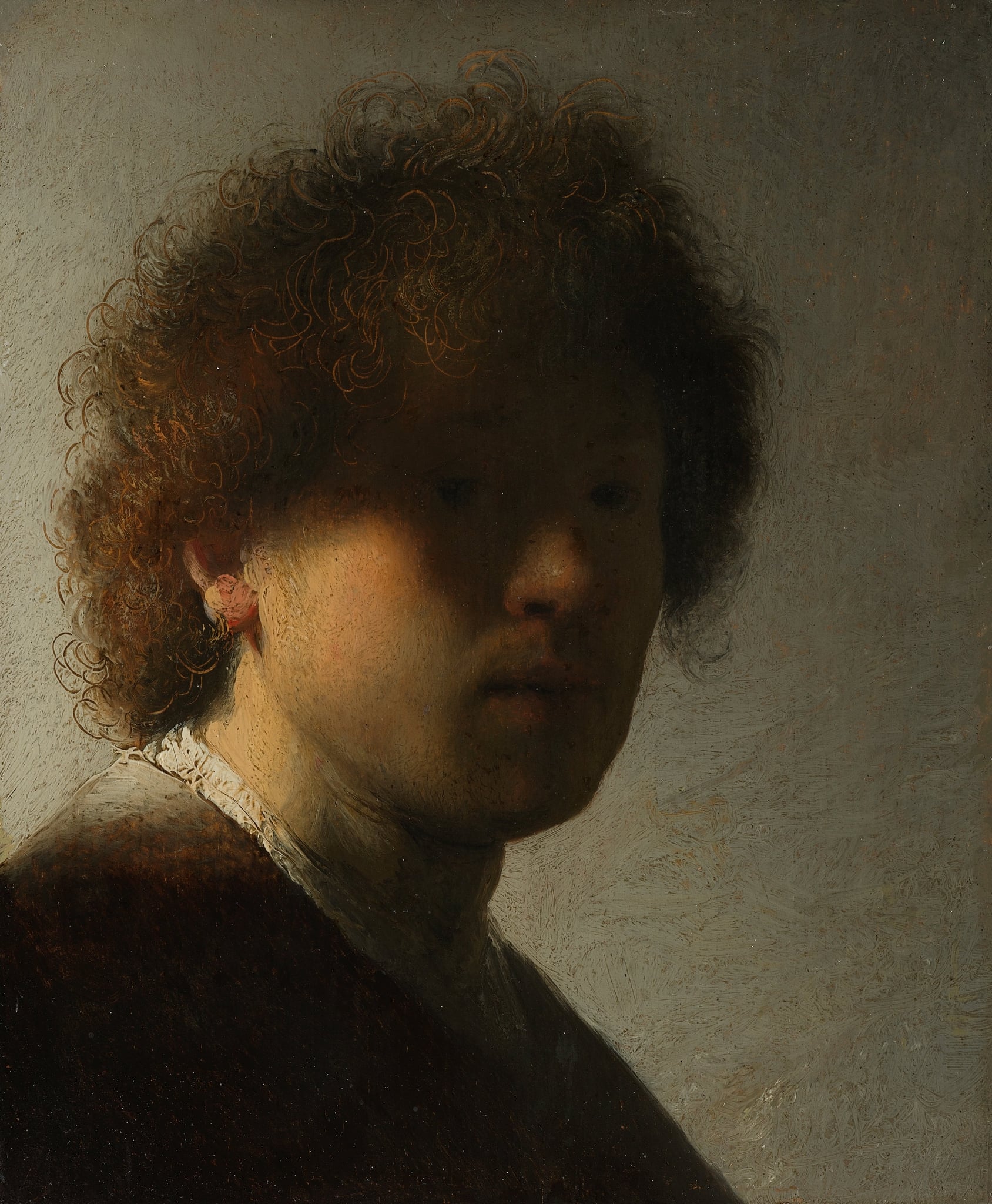
Self-portrait (with tousled hair) by Rembrandt van Rijn

Self-portrait (with tousled hair)

Rembrandt van Rijn (c. 1628)

A young Rembrandt van Rijn tests how <strong>light both reveals and withholds</strong> by letting his face emerge from darkness while his <strong>scratched, backlit curls</strong> flare like a rough halo. The small oak panel makes <strong>process itself the subject</strong>, turning hair, stubble, and a raking highlight into a statement of identity-in-formation <sup>[1]</sup><sup>[5]</sup>.
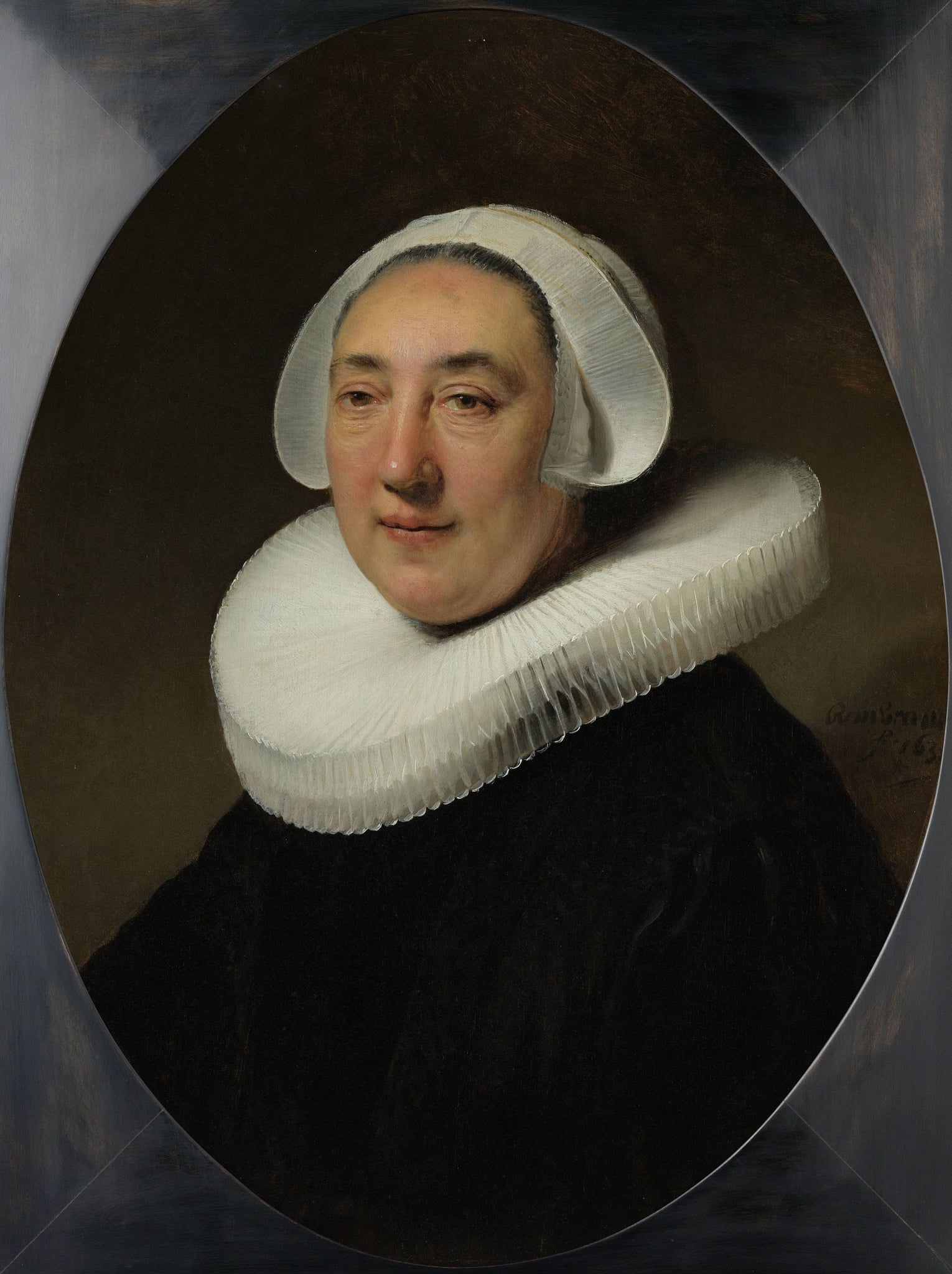
Portrait of Haesje Jacobsdr van Cleyburg by Rembrandt van Rijn

Portrait of Haesje Jacobsdr van Cleyburg

Rembrandt van Rijn (1634)

Rembrandt’s 1634 Portrait of Haesje Jacobsdr van Cleyburg stages a Dutch burgher within a feigned <strong>oval</strong> opening, illuminated by selective <strong>chiaroscuro</strong> that models warm skin against brilliant <strong>millstone ruff</strong> and sober black dress. The painting balances <strong>modesty and status</strong>, making virtue visible while quietly declaring prosperity through immaculate linen and craft <sup>[1]</sup><sup>[4]</sup>.