How Much Is Anna and the Blind Tobit Worth?
Last updated: August 11, 2026
Quick Facts
- Methodology
- comparable analysis
Hypothetical fair-market value for Rembrandt’s Anna and the Blind Tobit (c. 1630, National Gallery, London) is $20–35 million. This range is anchored by recent auction results for small autograph Rembrandt biblical panels around $9–14m and a closely related private sale in the $20–30m band, scaled for this work’s larger size, date, and quality.
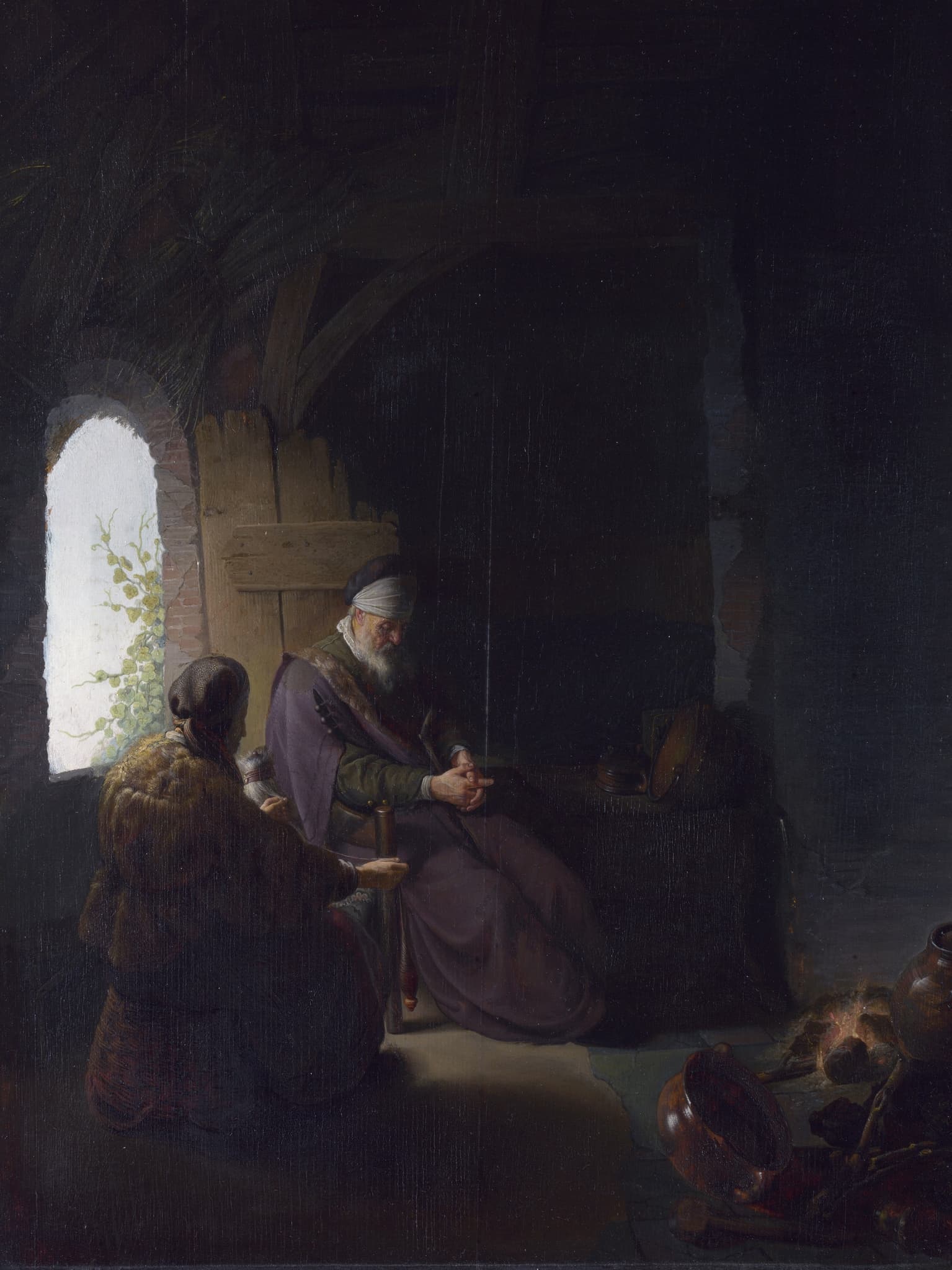
Anna and the Blind Tobit
Rembrandt van Rijn, about 1630 • Oil on wood (probably oak)
Read full analysis of Anna and the Blind Tobit →Valuation Analysis
Conclusion: Based on directly comparable sales of early Rembrandt biblical panels and the artist’s current market tone, a realistic fair‑market estimate for Anna and the Blind Tobit is $20–35 million. The painting (oil on oak, 63.8 × 47.7 cm) is catalogued by the National Gallery, London, as an autograph work of about 1630—squarely within Rembrandt’s sought‑after Leiden period, when small, dramatic narratives command strong demand [1].
Comparable sales and scaling: The nearest public benchmark is the rediscovered early panel The Adoration of the Kings (c. 1628), which sold at Sotheby’s London on 6 December 2023 for £10.9m with fees (≈$13.7m). That work is considerably smaller (24.5 × 18.5 cm), but shares date, medium, and narrative type with the National Gallery picture, providing a highly instructive floor for fully accepted early panels [2]. Subsequent results have clustered in a similar band, including Saint John on Patmos at £6.75m (≈$9.0m) in December 2025 and the unfinished, reattributed Let the Little Children Come Unto Me at £8.0m (≈$10.8m) in July 2026, the latter selling to its guarantor—useful as a discounted reference for works with complexities [3][5].
Private‑treaty anchor: In January 2021, Sotheby’s withdrew the small autograph panel Abraham and the Angels (1646) from auction and subsequently placed it privately within its $20–30m estimate range. That transaction, widely reported though undisclosed, establishes that prime small Rembrandt narratives can achieve the mid‑to‑high‑twenties in private settings when condition, autograph status, and narrative appeal align [6]. Given Anna and the Blind Tobit’s larger scale and tight Leiden dating, a $20–35m range is consistent with these comps and the scarcity of top‑tier early panels.
Market context and ceiling checks: At the top of the artist’s market, the Dutch state’s 2022 purchase of The Standard Bearer for €175m underscores the ultra‑prime, national‑treasure pricing context, while the standing auction record for a Rembrandt painting remains Christie’s London 2009 at about $33.2m—more indicative of public‑auction ceilings for smaller works than of private‑treaty potential for masterpieces [4][7]. Against this backdrop, $20–35m appropriately positions Anna and the Blind Tobit below iconic portraits and late monuments but well above recent auction norms for smaller or more complex panels.
Key sensitivities: The estimate assumes broad scholarly acceptance of full autograph status and sound condition. The National Gallery attributes the work to Rembrandt and notes substantial literature and exhibition history; historical mentions of possible studio participation (e.g., Gerrit Dou) should be addressed by up‑to‑date technical imaging and consensus, as any sustained doubts would exert material discounts [1]. Likewise, panel integrity, surface quality, and restoration history are critical value drivers; exceptional technicals would nudge the work toward the upper 30s, while meaningful attribution or condition reservations could compress value toward the teens.
Practical note: As a UK national collection object, the painting is not a practical market candidate; the figures above represent a hypothetical fair‑market context derived from recent, directly comparable evidence and current Old Masters demand dynamics [3][5].
Key Valuation Factors
Art Historical Significance
High ImpactPainted circa 1630, Anna and the Blind Tobit falls within Rembrandt’s formative Leiden years, a period prized for its tightly framed, dramatically lit biblical narratives. The Tobit cycle is a recurrent theme in the artist’s early oeuvre, linking this panel to an important thread of experimentation with mood, light, and domestic piety. Its narrative intimacy and moral charge exemplify Rembrandt’s transition from small cabinet pictures toward more ambitious history painting. Within the broader canon—dominated by later portraits and large history subjects—top Leiden-period narratives are academically coveted, form essential building blocks of Rembrandt’s development, and retain committed collector demand. That significance supports pricing substantially above generic small Old Master panels.
Attribution and Autograph Certainty
High ImpactThe National Gallery attributes the painting to Rembrandt and cites extensive literature and exhibition history. Historic discussions sometimes mention early studio participation (notably Gerrit Dou), a common theme in Leiden-period scholarship. In today’s market, full autograph acceptance—ideally supported by recent technical imaging (IRR, X‑ray), dendrochronology for the panel, and consensus citations—can add tens of percent to value. Conversely, credible indications of collaboration or later studio intervention would compress the range toward the teens. The $20–35m estimate presumes strong current scholarship affirming Rembrandt’s hand throughout the composition and paint surface.
Condition and Technical State
High ImpactPanel paintings of the 1620s–30s can present issues: joins, warping, overcleaning, or discolored varnish. Market-leading results accrue to works with intact panels, minimal structural intervention, preserved impasto, and legible chiaroscuro. Recent conservation that reveals underdrawing or pentimenti consistent with Rembrandt’s practice would further validate authorship and elevate confidence. The proposed range assumes good, stable condition with no material losses to key passages. Significant restoration, abraded passages, or panel instability would downwardly adjust value, aligning outcomes with the high single-digit to low‑teens benchmarks seen for more compromised works.
Scale, Composition, and Subject Appeal
Medium ImpactAt roughly 63.8 × 47.7 cm, this panel is materially larger than certain recent early‑period comps (e.g., the 24.5 × 18.5 cm Adoration of the Kings). Larger format increases wall power and commercial appeal, particularly when the narrative is legible and the lighting dramatic. While the Tobit story is less universally recognized than New Testament subjects, its domestic pathos resonates with connoisseur buyers attuned to Rembrandt’s moral storytelling. On balance, scale and composition positively differentiate the work versus smaller panels, justifying a premium over the $9–14m auction cluster for diminutive or complex examples.
Provenance and Institutional Status
Medium ImpactToday in the National Gallery, London, the painting benefits from blue‑chip institutional provenance and an extensive exhibition/publication record—both strong validators in a private transaction. However, as a UK national collection work, it is effectively off‑market; any hypothetical sale would be extraordinary and subject to strict governance. Institutional association typically enhances confidence and price potential if a work ever re-enters the market (e.g., restitution or deaccession under exceptional circumstances), but logistical constraints and export considerations may also narrow practical buyer pools. The estimate treats these factors as neutral to slightly positive on balance.
Sale History
John Bell sale, Glasgow (auctioneer unspecified)
Sold for 50 guineas (£52.5). USD conversion ≈ $254 at 1881 rates; historical nominal only.
National Gallery, London (acquisition from Denis Elliot Watson)
Acquired by the National Gallery; price not disclosed publicly (0 used here as an undisclosed placeholder).
Rembrandt van Rijn's Market
Rembrandt occupies the apex of the Old Master market, with vanishingly few fully accepted paintings available. At the trophy end, the Dutch state’s 2022 acquisition of The Standard Bearer at €175m underscores national‑treasure pricing in private/government contexts. Public auction ceilings for paintings are lower but robust: Christie’s London set the standing auction record in 2009 at roughly $33.2m. In the last few years, small autograph panels have realized about $9–14m at auction, while a high‑quality biblical panel placed privately in 2021 within a $20–30m range. Overall, demand is deep yet highly selective; scholarship, condition, freshness, and scale are decisive, and guarantees often underpin complex offerings.
Comparable Sales
The Adoration of the Kings
Rembrandt van Rijn
Autograph early Leiden-period biblical scene on panel, close in date and subject-type to Anna and the Blind Tobit; smaller scale but a direct narrative comp.
$13.8M
2023, Sotheby's London (Old Master & 19th Century Paintings Evening Auction)
~$14.5M adjusted
Saint John on Patmos
Rembrandt van Rijn
Autograph oil painting; religious subject, calibrates recent public demand for Rembrandt paintings. Later period and single half-length figure, so less direct in period/format than NG4189.
$8.9M
2025, Sotheby's London (Old Master & 19th Century Paintings Evening Auction)
Let the Little Children Come Unto Me
Rembrandt van Rijn
Early Leiden biblical composition; reattributed after conservation and unfinished—useful as a floor/discounted benchmark for early works with condition/attribution complexity.
$10.8M
2026, Sotheby's London (Old Masters Evening Sale)
~$10.6M adjusted
Abraham and the Angels
Rembrandt van Rijn
Prime small autograph biblical panel reported sold privately within its $20–30m estimate; close subject-type and medium; serves as an upper-anchor for well-accepted, fully autograph small narrative Rembrandts.
$25.0M
2021, Sotheby's (private sale post-withdrawal, New York)
~$29.8M adjusted
Portrait of a Man, Half-length, With his Arms Akimbo
Rembrandt van Rijn
Artist’s auction record; though a portrait (not biblical), it provides a ceiling indicator for Rembrandt pricing in public auction settings.
$33.2M
2009, Christie's London
~$49.8M adjusted
Current Market Trends
Old Masters rebounded in 2025 and remained healthy but selective through mid‑2026. London’s summer 2026 sales saw disciplined bidding, with guarantees steering works with condition or attribution complexities. For Rembrandt specifically, recent painting results concentrated around $9–14m at auction, while a rediscovered early panel reached $10.8m at the guarantee—signaling caution for works with issues and appetite for quality. Private sales continue to unlock higher outcomes for prime material. Meanwhile, Rembrandt’s print market surged to record levels in 2025, drawing younger collectors and reinforcing cross‑category interest. Overall, scarcity and connoisseurship insulate the category, but pricing remains quality‑sensitive.
Study print
Study this painting as a print
Pair the full artwork with a museum-style study sheet focused on one meaningful detail.
Sources
- National Gallery, London – Rembrandt, Anna and the Blind Tobit (NG4189)
- The Art Newspaper – Rediscovered Rembrandt could make £15m at Sotheby’s London (sold for £10.9m with fees, Dec 6, 2023)
- The Art Newspaper – London Old Master auctions (Dec 3–4, 2025) recap with Rembrandt result
- Dutch Parliament documents – Purchase of Rembrandt’s The Standard Bearer for €175m (2022)
- The Art Newspaper – London Old Masters week, July 2, 2026 (includes Rembrandt sale to guarantor)
- The Art Newspaper – Botticelli sells for record; Rembrandt withdrawn then privately placed (Jan 28, 2021)
- Christie’s – Rembrandt van Rijn artist page (includes 2009 auction record reference)