Anna and the Blind Tobit

by Rembrandt van Rijn

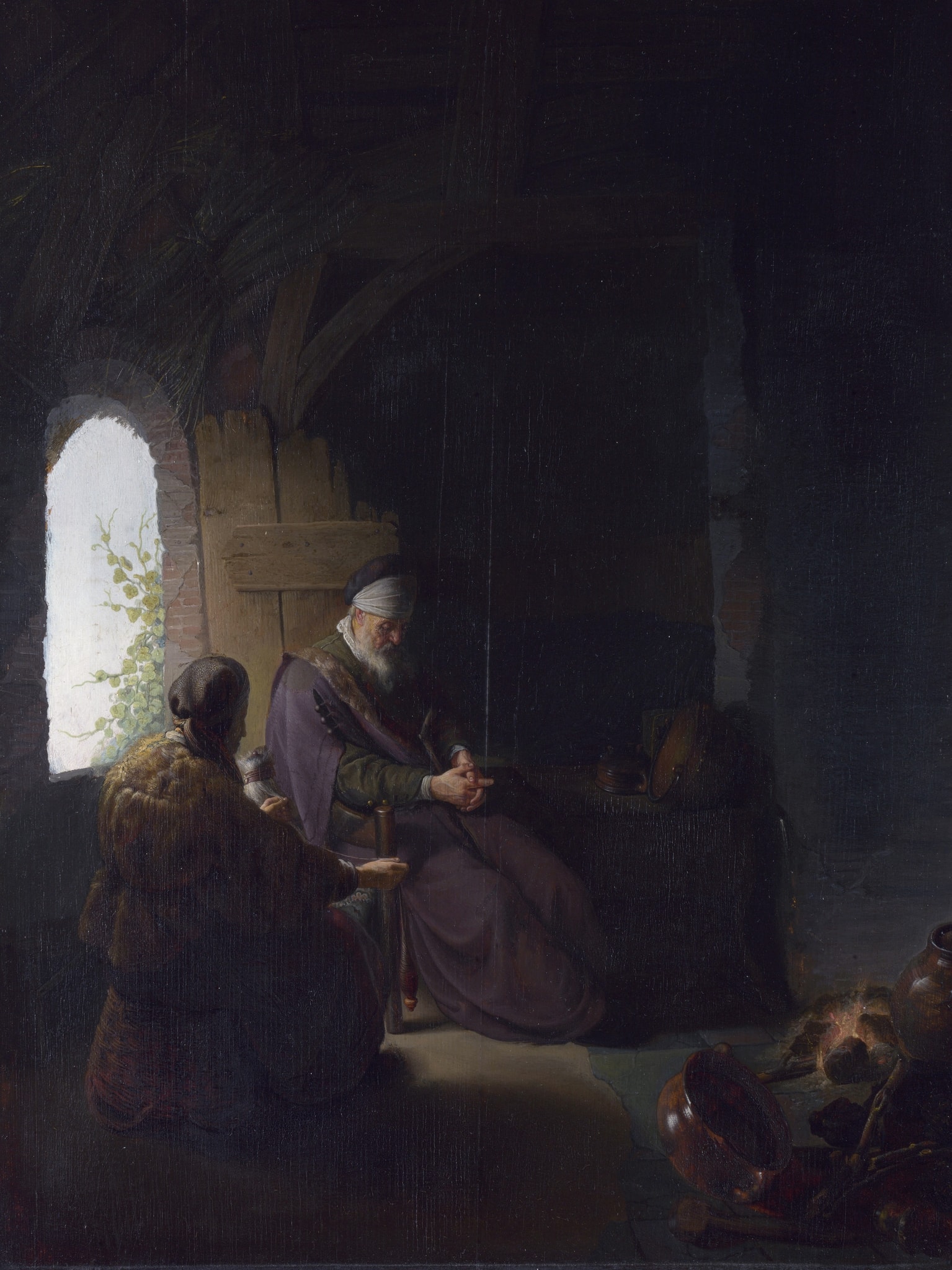
In Rembrandt van Rijn’s Anna and the Blind Tobit, a cool beam from an unglazed window touches two aging figures while the room recedes into shadow. The painting compresses the Tobit story into a moment of patient endurance, where clasped hands, a staff, a smoldering hearth, and ivy at the window do the narrative work of faith under trial [1].

Study Print Studio

Create a personal study print

Build a companion study sheet around the part of this painting that speaks to you most. Choose a detail, shape an interpretation, and walk away with something personal and display-worthy.

Fast Facts

Year
about 1630
Medium
Oil on wood (probably oak)
Dimensions
63.8 × 47.7 cm
Location
National Gallery, London
See all Rembrandt van Rijn paintings in London
Anna and the Blind Tobit by Rembrandt van Rijn (about 1630) featuring Open, unglazed window and raking daylight

Click on any numbered symbol to learn more about its meaning

Meaning & Symbolism

Rembrandt constructs the narrative by tying specific objects and poses to a single moral theme. The open, unglazed window on the left admits a pale, raking light that lands on Tobit’s bound headcloth, his folded hands, and the staff angled to his knee; these elements fix him as blind, dependent, and praying. Across from him, Anna bends slightly forward, her sleeves bunched from labor, guiding yarn on a wool‑winding frame that catches the same light. At their feet the hearth breathes a low fire, and a tipped earthenware pot glints near the embers; both stress scarcity rather than comfort. Ivy climbs at the window jamb—a period emblem of endurance—quietly translating the couple’s waiting into a visual ethic of “holding on” 1. Nothing moves quickly; everything—light, posture, props—presses the scene into stillness, so that the household itself becomes an icon of perseverance. This refusal of climax is principled. Instead of showing Tobias’s homecoming or the angel’s intervention, Rembrandt narrates the interval of expectation and makes illumination itself the bearer of meaning. The beam that grazes fur, wool, and aged skin is not revelatory theater but a measured register of time; it marks how the day passes while faith persists. The scattered, workaday details—the patched floor near Tobit’s foot, the dented pots, the heavy shutter propped in the wall—shape a theology of the commonplace: salvation belongs to those who maintain fidelity within need 1. Anna’s quiet industry counters Tobit’s immobility; together they form a duet of action and contemplation, a household economy of care. In this balance the painting explains why Anna and the Blind Tobit is important: it relocates the sacred from angelic action to human steadfastness, from miracle to character 17. Placed early in Rembrandt’s career, around 1630, the picture also announces a method. The concentrated chiaroscuro—cool daylight from the side opposed by hearth‑glow at the lower right—creates a chamber of introspection rather than spectacle, a hallmark of Rembrandt’s evolving Baroque language tuned to Dutch interiors 12. The Tobit subject became one of his touchstones: in an earlier Leiden painting, Tobit and Anna with the Kid, he explored domestic strain; in later etchings such as The Blindness of Tobit, he stages more eventful moments 345. Read against those, this canvas is the still center of the cycle. Here, symbolism is exact and legible: ivy means endurance; the staff and wrapped eyes mean trial; the meager fire means persistence without plenty; the wool frame means sustaining labor. Together they deliver a narrative without motion, where light is hope’s measure and the couple’s poise is the miracle. The painting thus condenses the Book of Tobit into a single claim: holiness resides in how one waits 16.

Explore Deeper with AI

Ask questions about Anna and the Blind Tobit

Popular questions:

Powered by AI • Get instant insights about this artwork

💬 Ask questions about this artwork!

Interpretations

Formal Analysis

Rembrandt engineers a two-source illumination—cool window light opposed by the hearth’s ember-glow—to create a chambered chiaroscuro that suppresses spectacle and cultivates introspection. The raking beam models textures (fur, wool, aged skin) while withholding climax, so value contrasts stage time, not event. Pictorial vectors are quiet but exact: the staff’s oblique sets a counter to Anna’s forward bend; the open, unglazed window forms a latent vanishing plane that anchors the couple in a sparse architecture. These effects align with early-1630s Dutch Caravaggism adapted to interior scale, a hallmark of Rembrandt’s emerging style as he moved from Leiden toward Amsterdam. The small format on oak furthers the intimate register, drawing the viewer into a proximate, near-audible stillness that replaces narrative thunder with tonal conviction 12.

Source: National Gallery, London (object entry; artist biography)

Symbolic Reading

Iconography is legible and tightly keyed to ethics. The climbing ivy at the jamb carries period meaning of endurance; the wool‑winding frame translates patience into task; the tipped earthenware pot and wan hearth narrate scarcity without melodrama. Tobit’s bound headcloth and clasped hands condense blindness, dependence, and prayer into a single, centered pose—an inward devotio made visible. Crucially, these signs do not anticipate spectacle; they naturalize it. The room’s very old fabric (unglazed window, heavy shutter) situates virtue in lack, making perseverance a property of things as much as bodies. The picture thus functions as a domestic catechism in objects: to “hold on” is to keep house, to keep faith, and to keep time, each reiterated by humble props meticulously staged in light 1.

Source: National Gallery, London (object entry)

Comparative Oeuvre (The Tobit Cycle)

Set against Rembrandt’s earlier Tobit and Anna with the Kid (1626) and later etchings of The Blindness of Tobit, this canvas marks the cycle’s still center. The 1626 painting externalizes conflict (domestic strain over the kid), while the etchings often heighten incident; here, incident is recessed so that waiting becomes subject. The comparison tracks a career-long experiment: how to compress narrative into posture, light, and object rhetoric. The National Gallery’s work solves it by recoding miracle as character—what later prints will re-dramatize. Reading across media clarifies method: painting offers slow, saturating tone for inward states; etching supplies linear bite for episodic turns. The NG picture, consequently, is the most stringent in its ethics of the ordinary, the moment where Rembrandt’s Tobit theme becomes a study of duration itself 1356.

Source: Rijksmuseum; The Metropolitan Museum of Art; National Gallery of Art, Washington; National Gallery, London

Historiography & Attribution

Long-shadowed by attributions to Gerrit Dou or to a Rembrandt–Dou collaboration, the painting’s meticulous finish and interior hush were once read through fijnschilder optics. Current NG scholarship restores full authorship to Rembrandt (c. 1630), reframing finesse not as Dou’s signature but as part of Rembrandt’s early Leiden/Amsterdam idiom. This matters interpretively: qualities previously filed as “Dou-like domesticity” become evidence of Rembrandt’s own program to spiritualize the ordinary. The historiographic swing also cautions against style-based certitude in workshop milieus where techniques circulated. Rather than settling for a binary (Rembrandt vs. Dou), the picture demonstrates how early Rembrandt could operate with minute, inward description while aiming at history painting’s moral charge—a synthesis that this panel epitomizes 17.

Source: National Gallery, London; The Guardian (historical review context)

Technical/Material Perspective

Executed in oil on oak (63.8 × 47.7 cm), the work’s support and scale foster an intimate, absorptive viewing distance. National Gallery technical studies, including infrared reflectography, have clarified compositional emphases—especially the open window and the spatial logic of the hearth—supporting the reading that illumination structures meaning rather than dramatic action. The paint handling alternates between soft, absorbent passages (skin, wool) and tighter descriptive touches (metallic glints on pots), using material contrast to echo thematic contrast (inertia vs. industry). The restrained palette and subdued highlights prefer value orchestration over chroma, a strategy consistent with early Rembrandt interiors where mood is built through light’s gradation, not coloristic flourish 14.

Source: National Gallery, London (object entry; Rembrandt Now technical abstracts)

Devotional Context & Reception

In seventeenth-century Dutch culture, the Book of Tobit offered an exemplary narrative of piety in adversity; images of Raphael and Tobias often served as thanksgiving or protective motifs. The NG proposes that, while such functions hovered, Rembrandt deliberately chooses the interval—older bodies, small fire, work in hand—to celebrate patience rather than apparition. Julius S. Held’s broader account of Rembrandt’s Tobit interest corroborates this inward turn: the sacred is relocated to habit, to the cadence of a day lived faithfully. The painting thus resonates with domestic devotion in a Protestant milieu, but without polemic, building theology from things at hand and from a couple who persist—less a miracle picture than a manual of endurance 18.

Source: National Gallery, London; Julius S. Held

Related Themes

About Rembrandt van Rijn

Rembrandt van Rijn (1606–1669) was a leading Dutch Golden Age painter and printmaker whose Amsterdam years (from 1631) produced virtuosic portraits and ambitious history paintings. In the early 1630s he favored polished finishes, saturated color, and theatrical staging—qualities on display in this 1633 canvas. Although prolific, this is his only known painted seascape [2][4].
View all works by Rembrandt van Rijn

More by Rembrandt van Rijn
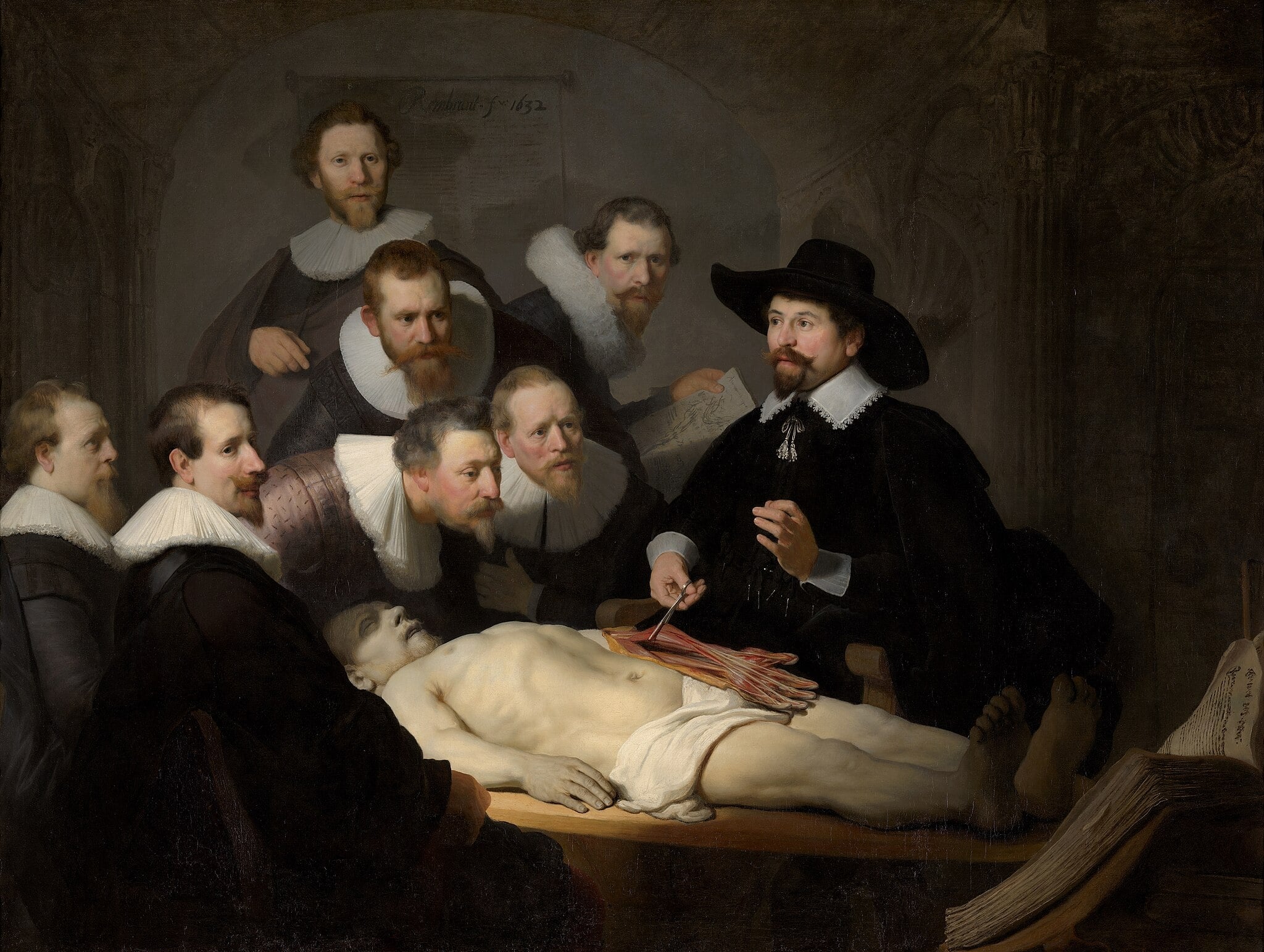
The Anatomy Lesson of Dr. Nicolaes Tulp by Rembrandt van Rijn

The Anatomy Lesson of Dr. Nicolaes Tulp

Rembrandt van Rijn (1632)

Rembrandt van Rijn turns a civic commission into a drama of <strong>knowledge made visible</strong>. A cone of light binds the ruff‑collared surgeons, the pale cadaver, and Dr. Tulp’s forceps as he raises the <strong>forearm tendons</strong> to explain the hand. Book and body face each other across the table, staging the tension—and alliance—between <strong>textual authority</strong> and <strong>empirical observation</strong> <sup>[1]</sup><sup>[2]</sup>.
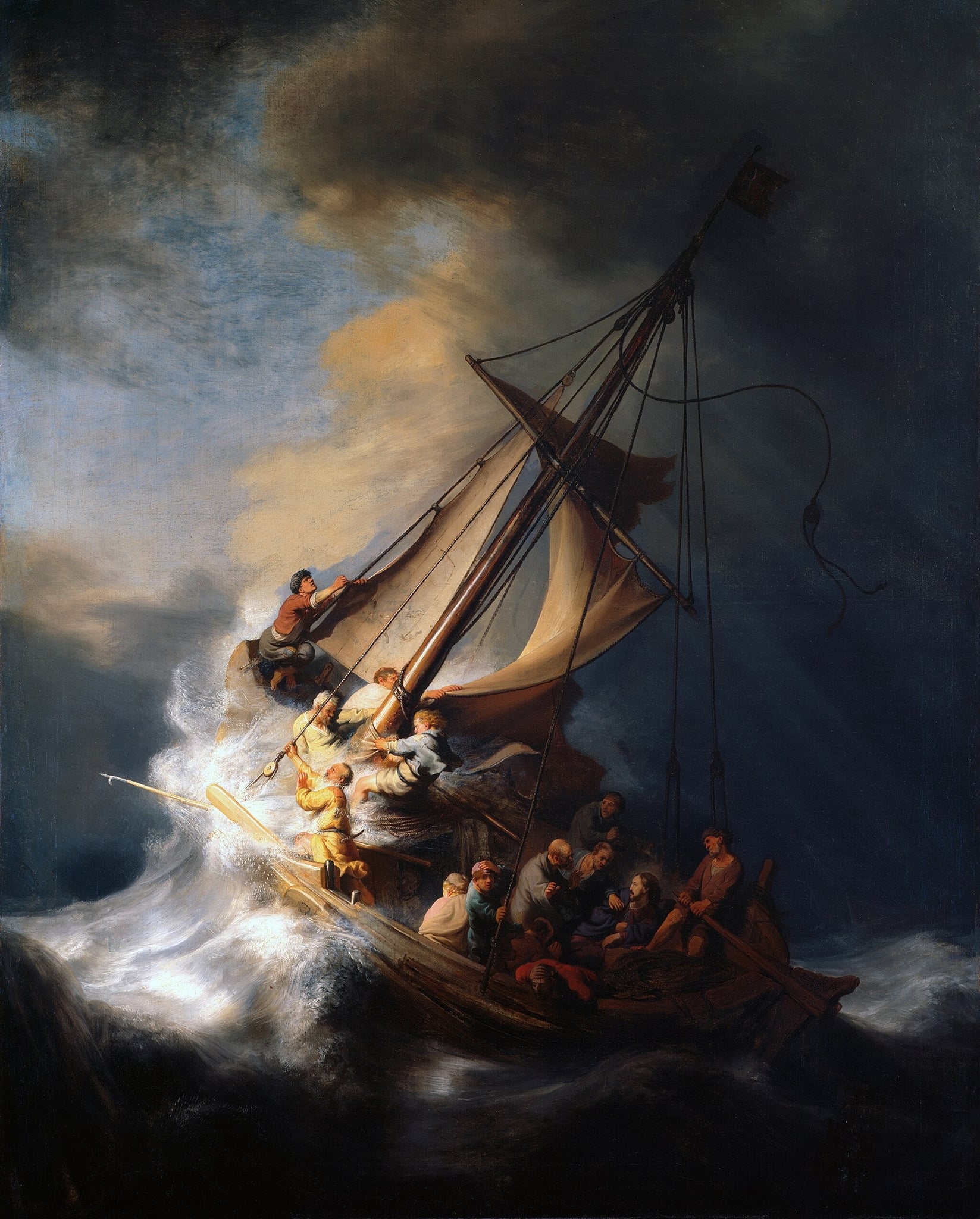
The Storm on the Sea of Galilee by Rembrandt van Rijn

The Storm on the Sea of Galilee

Rembrandt van Rijn (1633)

Rembrandt van Rijn’s The Storm on the Sea of Galilee stages a clash of <strong>human panic</strong> and <strong>divine composure</strong> at the instant before the miracle. A torn mainsail whips across a steeply tilted boat as terrified disciples scramble, while a <strong>serenely lit Christ</strong> anchors a pocket of calm—an image of faith holding within chaos <sup>[1]</sup><sup>[3]</sup>. It is Rembrandt’s only painted seascape, intensifying its dramatic singularity in his oeuvre <sup>[2]</sup>.
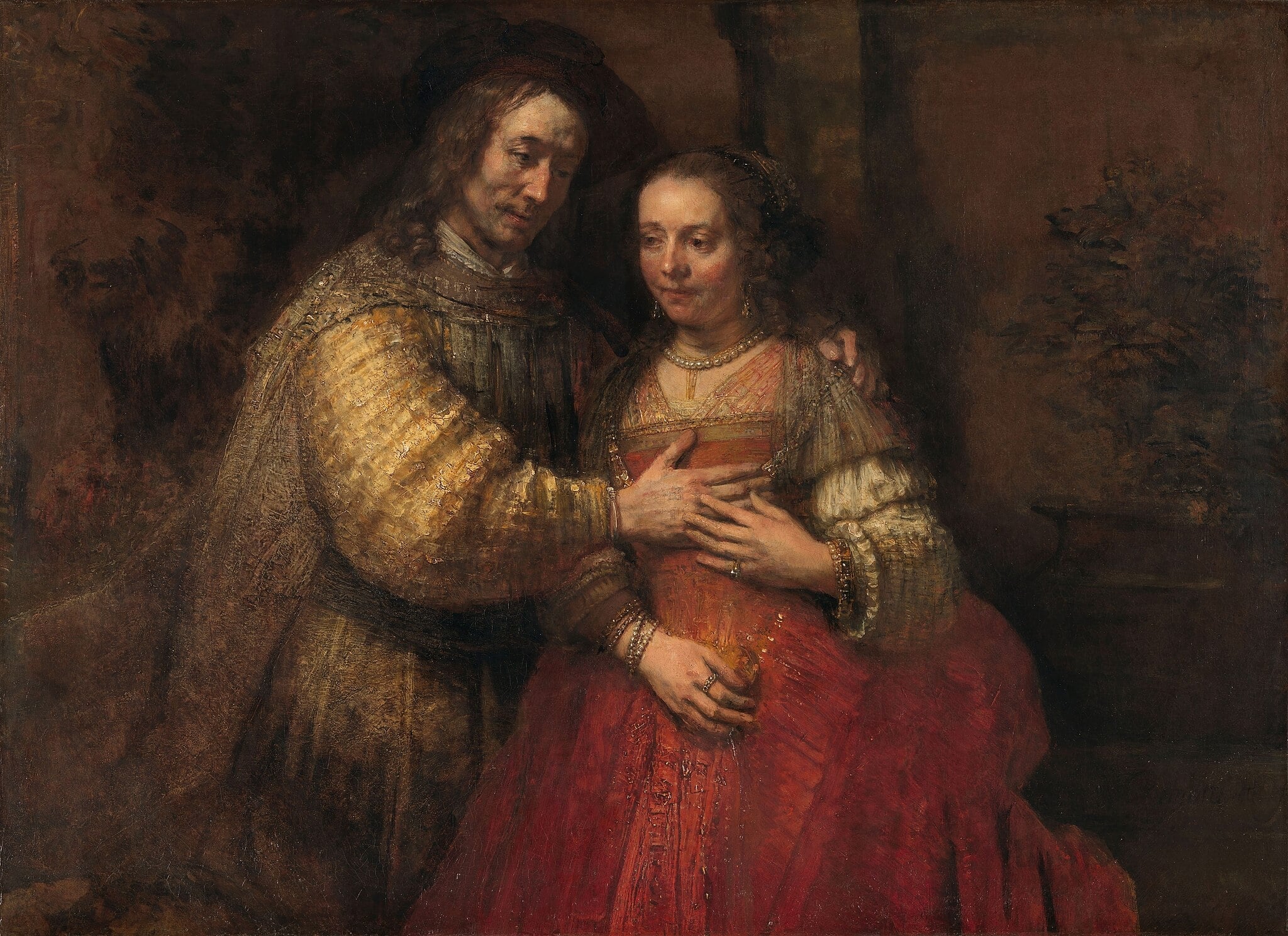
The Jewish Bride by Rembrandt van Rijn

The Jewish Bride

Rembrandt van Rijn (c. 1665–1669)

The Jewish Bride by Rembrandt van Rijn stages an intimate covenant: two figures, read today as <strong>Isaac and Rebecca</strong>, seal their union through touch rather than spectacle. Light concentrates on faces and hands, while the man’s glittering <strong>gold sleeve</strong> and the woman’s <strong>coral-red gown</strong> turn paint itself into a metaphor for fidelity and tenderness <sup>[1]</sup><sup>[3]</sup>. This late masterpiece embodies Rembrandt’s <strong>material eloquence</strong>—impasto as feeling—within a hushed, dark setting <sup>[1]</sup><sup>[2]</sup>.
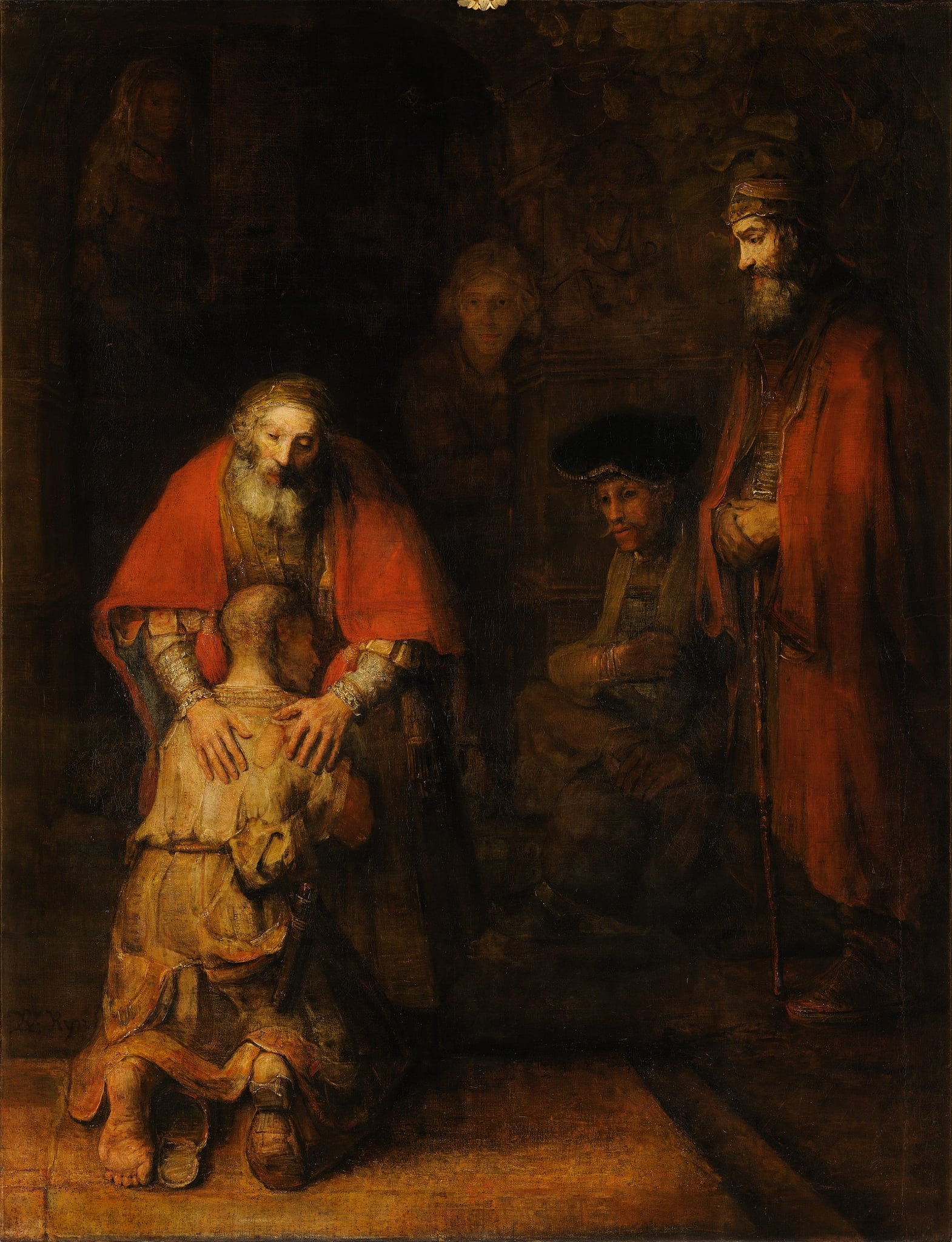
The Return of the Prodigal Son by Rembrandt van Rijn

The Return of the Prodigal Son

Rembrandt van Rijn (c. 1661–1669 (probably completed by 1669))

Rembrandt van Rijn’s The Return of the Prodigal Son is a late-life meditation on <strong>mercy</strong>, <strong>homecoming</strong>, and <strong>restored dignity</strong>. In a hush of dusk-like light, a ragged son kneels into his father’s <strong>embrace</strong>, while an upright elder brother holds back in shadow. The image concentrates meaning in illuminated <strong>faces, hands, and feet</strong>, turning a parable into a timeless human reckoning. <sup>[1]</sup><sup>[2]</sup>
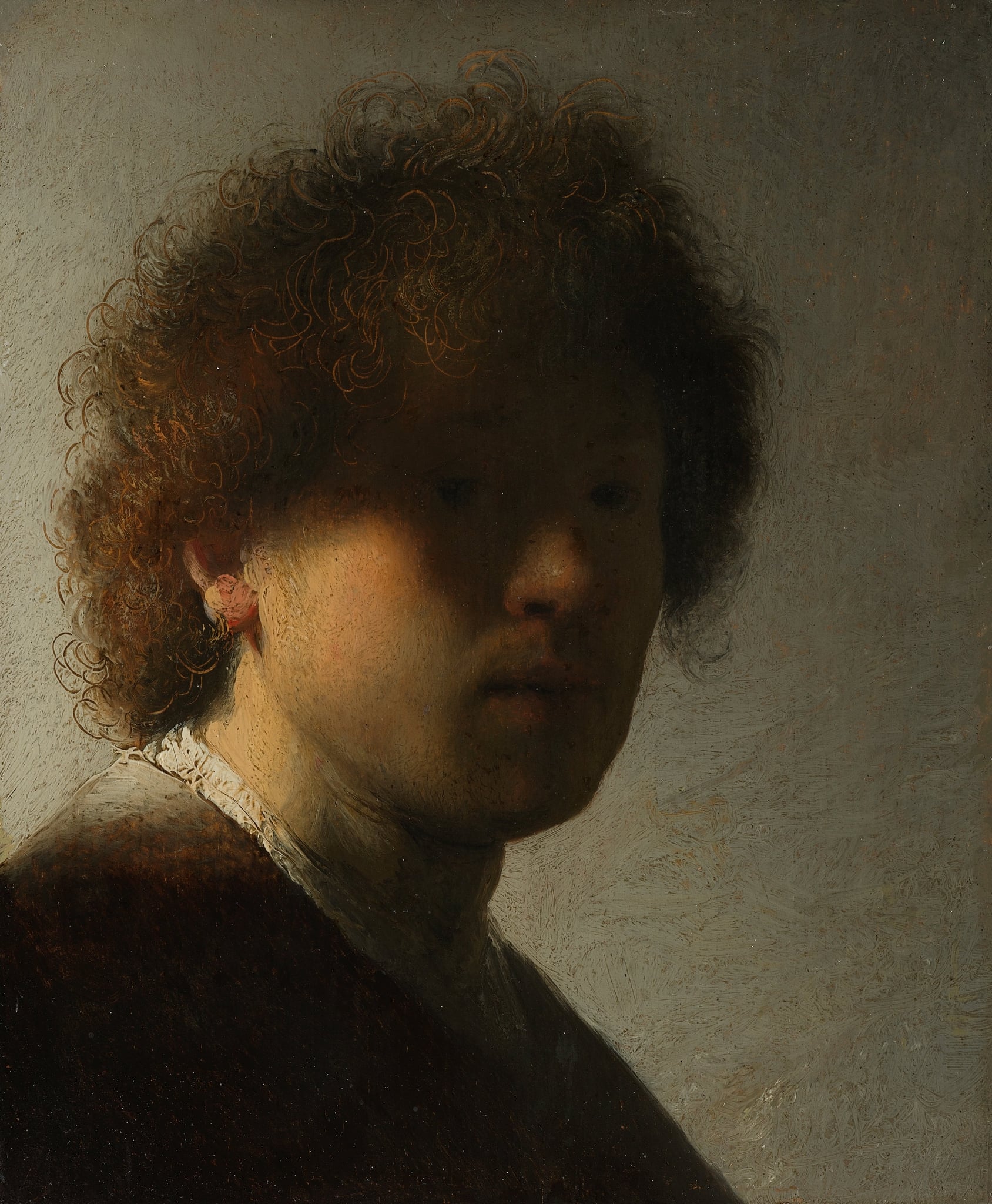
Self-portrait (with tousled hair) by Rembrandt van Rijn

Self-portrait (with tousled hair)

Rembrandt van Rijn (c. 1628)

A young Rembrandt van Rijn tests how <strong>light both reveals and withholds</strong> by letting his face emerge from darkness while his <strong>scratched, backlit curls</strong> flare like a rough halo. The small oak panel makes <strong>process itself the subject</strong>, turning hair, stubble, and a raking highlight into a statement of identity-in-formation <sup>[1]</sup><sup>[5]</sup>.
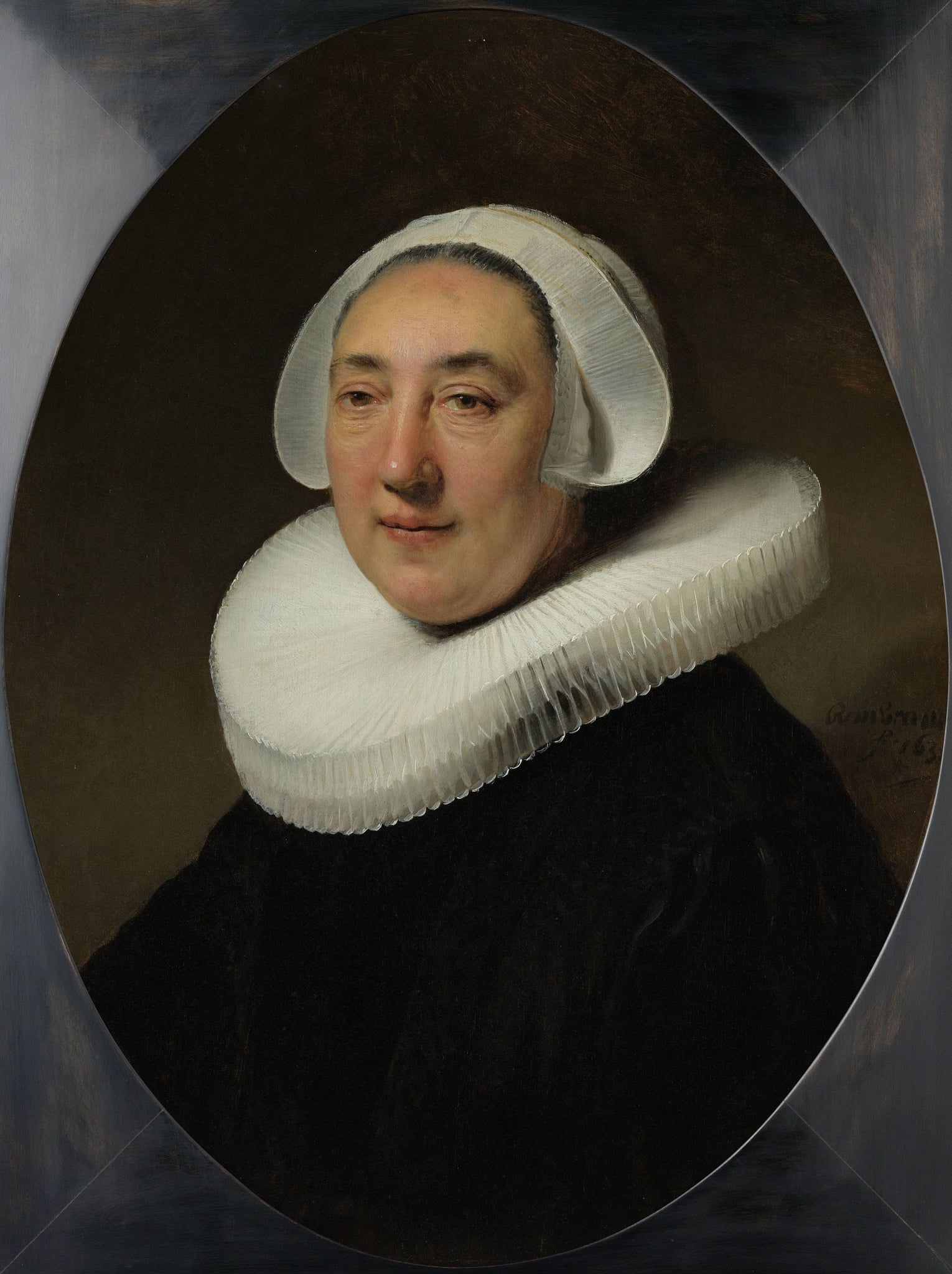
Portrait of Haesje Jacobsdr van Cleyburg by Rembrandt van Rijn

Portrait of Haesje Jacobsdr van Cleyburg

Rembrandt van Rijn (1634)

Rembrandt’s 1634 Portrait of Haesje Jacobsdr van Cleyburg stages a Dutch burgher within a feigned <strong>oval</strong> opening, illuminated by selective <strong>chiaroscuro</strong> that models warm skin against brilliant <strong>millstone ruff</strong> and sober black dress. The painting balances <strong>modesty and status</strong>, making virtue visible while quietly declaring prosperity through immaculate linen and craft <sup>[1]</sup><sup>[4]</sup>.