How Much Is Ecce Homo Worth?
Last updated: August 4, 2026
Quick Facts
- Methodology
- comparable analysis
If hypothetically offered today, Rembrandt’s 1634 Ecce Homo (grisaille oil modello; National Gallery, London) would be expected to sell for $25–45 million. Its prime-period date, full autograph status, and unique function as the only known full-scale oil study for one of Rembrandt’s prints support a price well above head studies, while its preparatory, monochrome character keeps it below the tier of finished multi-figure paintings and major portraits.
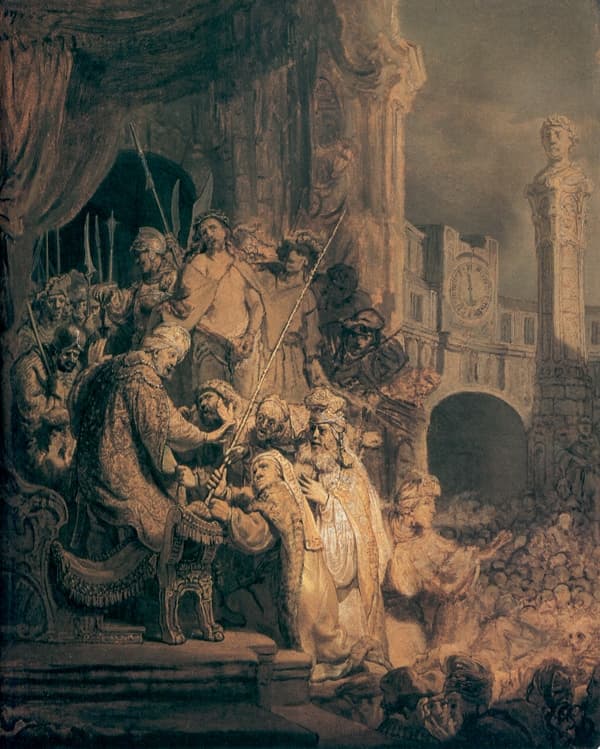
Ecce Homo
Rembrandt van Rijn, 1634 • Oil on paper mounted on canvas (grisaille study for a print)
Read full analysis of Ecce Homo →Valuation Analysis
Opinion of value: $25–45 million. Rembrandt’s Ecce Homo (1634; oil in grisaille on paper laid to canvas) is a prime-period, signed and dated modello made as a full-scale preparatory study for the etching Christ Presented to the People. The National Gallery notes it is the only known full-scale oil study for a print in the artist’s oeuvre—an exceptional distinction that significantly elevates its scholarly and market importance [1]. Although a sale is highly improbable given its status in a UK national collection, this estimate reflects likely fair-market behavior if an equivalent work appeared at auction.
Method and key comparables: The range is anchored by recent, fully accepted Rembrandt oils of intimate scale. A small devotional study, Study of the Head and Clasped Hands of a Young Man as Christ in Prayer, made £9.48m (~$12.1m) in 2018 [2]. A prime-period small Self-portrait (1632) realized £14.5m (~$18.7m) in 2020 amid strong cross-category bidding [3], and the 2023 sale of the early portrait pair of Jan Willemsz. van der Pluym and Jaapgen Carels achieved $14.27m, underscoring depth of demand for well-documented early works even at modest scale [4]. Ecce Homo’s uniqueness within Rembrandt’s practice and its multi-figure biblical subject place it substantively above head-studies and many small portraits, justifying a step-up into the high eight figures.
Ceiling and context: Monumental, fully finished Rembrandt masterpieces can transact privately at vastly higher levels (e.g., the Dutch state’s 2022 purchase of The Standard Bearer for €175m), establishing a wide ceiling that this work prudently sits beneath due to its function as a grisaille modello rather than a polished, polychrome painting [5]. Nevertheless, extreme scarcity of uncontested Rembrandt paintings on the market, coupled with the work’s singular role in the artist’s printmaking practice, supports competition well beyond the $10–20m band typical of smaller studies.
Swing factors: The high end of the range presumes impeccable condition of the delicate paper support and its mounting, clean surface preservation, and reaffirmed consensus scholarship. Any qualification of attribution (e.g., “Rembrandt and studio”) or meaningful condition compromises would materially compress value. Provenance is long and public, with the National Gallery holding the picture since 1894; any corroborating technical studies and exhibition history would further underwrite confidence [1].
Conclusion: On balance, Ecce Homo’s prime date, autograph status, and unique function within Rembrandt’s oeuvre warrant a $25–45 million estimate today, positioning it above comparably sized studies and below finished, multi-figure or marquee portraits. Strong bidding from connoisseur collectors and institutions could plausibly push the result toward the upper 30s to low 40s under favorable conditions [2–4].
Key Valuation Factors
Art Historical Significance
High ImpactEcce Homo is a signed and dated 1634 work—a prime period for Rembrandt—and uniquely serves as the only known full-scale oil study for one of his etchings (Christ Presented to the People). This singular role within Rembrandt’s practice materially elevates the painting’s scholarly and cultural importance. The subject—Christ before Pilate—connects the painting to the most celebrated vein of Rembrandt’s biblical imagery, while its function reveals his iterative process across media. Works that illuminate an artist’s method at scale, particularly when unique within the oeuvre, carry a premium not only for private collectors but also for institutions seeking to represent the full spectrum of Rembrandt’s artistry.
Attribution and Scholarship
High ImpactThe National Gallery’s attribution to Rembrandt and the work’s longstanding publication and exhibition history underpin its acceptance. For Old Masters, consensus attribution is the single largest value driver; any downgrading (e.g., “Rembrandt and studio”) would reduce value dramatically. Conversely, affirmation by leading scholars and technical analysis—dendrochronology is not applicable here, but paint/ground analysis, micro-sampling, and comparative study with the etching—bolster confidence. The presence of signature and date in 1634 further supports direct authorship and situates the painting in a highly desirable moment in Rembrandt’s career, where market competition has historically been most intense.
Medium and Status (Grisaille Modello)
Medium ImpactAs a monochrome oil study on paper mounted to canvas, the work’s preparatory status tempers its ceiling vis-à-vis finished, polychrome portraits or history paintings. Collectors often pay premiums for fully realized color compositions and for works conceived as independent pictorial endpoints. That said, modelli can command strong prices when they are exceptionally rare, well-preserved, and central to an artist’s creative process—conditions met here. The grisaille palette highlights Rembrandt’s handling of light, structure, and grouping, attributes that connoisseurs seek, while the painting’s direct linkage to a major etching enhances its desirability within cross-media collecting strategies.
Condition, Support, and Scale
Medium ImpactThe work’s support—oil on paper laid to canvas—introduces sensitivities absent in panel or pure canvas works. Planarity, past mount interventions, any staining, abrasions, or retouch would influence bidding. Clean, legible surface quality with minimal restoration, secure mounting, and stable media will allow the composition’s subtleties to read. At approximately 54.5 × 44.5 cm, the scale is intimate yet substantial for a modello, enabling multi-figure complexity without sacrificing wall power. In this category, even modest conservation concerns can translate into multi‑million‑dollar swings; conversely, excellent condition would credibly justify results near the top of the estimate range.
Market Scarcity and Liquidity
High ImpactUnquestioned Rembrandt paintings surface exceedingly rarely, and when they do, they draw cross-border, cross-category demand. Recent results for small autograph oils in the $12–19 million range demonstrate sustained depth, while unique, historically resonant subjects can attract competitive bidding that steps beyond head-study pricing. This scarcity premium is amplified here by the work’s unique function in Rembrandt’s oeuvre. Although institutional ownership (National Gallery, London) makes an actual sale unlikely, a hypothetical offering would benefit from pent‑up demand among top private collectors and institutions, particularly those focused on Old Masters or on the dialogue between painting and printmaking.
Sale History
Christie, Manson & Woods, London
Jeremiah Harman sale, lot 92; sold to John Smith for 112 guineas (£117.6). Approx. $572 using gold-par $4.8665/£1.
London auction (George Blamire sale)
Lot 57; sold to 'Mulvaney' for 16 guineas (£16.8). Approx. $82 at gold par; Civil War spot would imply ~$120–$128.
Rembrandt van Rijn's Market
Rembrandt remains a top-tier Old Master with exceptionally deep global demand and vanishingly scarce supply. At auction, prime small oils have realized $12.1 million (2018 devotional head study) and $18.7 million (2020 early self‑portrait), with an early portrait pair bringing $14.3 million in 2023. Major, fully finished portraits and history paintings can exceed these levels substantially in private transactions. The 2022 Dutch state acquisition of The Standard Bearer for €175 million reaffirmed the artist’s blue‑chip status at the very top of the market, while consistent strength in prints and drawings has broadened the collector base. Overall, competition is intense for fully accepted paintings with strong dates, subjects, and condition.
Comparable Sales
Study of the Head and Clasped Hands of a Young Man as Christ in Prayer
Rembrandt van Rijn
Autograph small oil study with a devotional Christ subject; closest market proxy for a study/modello rather than a grand polychrome painting.
$12.1M
2018, Sotheby's London
~$15.2M adjusted
Self-portrait, half-length, wearing a ruff and black hat (1632)
Rembrandt van Rijn
Small early-1630s autograph oil; establishes pricing for intimate, prime-period Rembrandt paintings with impeccable attribution.
$18.7M
2020, Sotheby's London
~$22.3M adjusted
Portraits of Jan Willemsz. van der Pluym and Jaapgen Carels (pair)
Rembrandt van Rijn
Autograph early Rembrandt portraits of modest size; recent benchmark for small-scale, prime-period works entering the market.
$14.3M
2023, Christie's London
~$15.1M adjusted
Saint James the Greater
Rembrandt van Rijn
Religious single-figure portrait (finished, polychrome) providing a high benchmark for sacred-subject Rembrandts at auction.
$25.8M
2007, Sotheby's New York
~$39.2M adjusted
Portrait of a Man, Half-length, with his Arms Akimbo
Rembrandt van Rijn
Auction record for a Rembrandt painting; functions as a market ceiling reference relative to a study/grisaille like Ecce Homo.
$28.5M
2009, Christie's London
~$41.3M adjusted
Current Market Trends
Old Masters have proven resilient relative to Contemporary in recent cycles, with 2025–2026 seeing renewed strength at the top end. Trophy-quality works with pristine scholarship and condition continue to outperform estimates, while the Rembrandt prints market set record territory, signaling expanding demand for the artist across media. Selectivity remains high: works with attribution or condition caveats can underperform, but correctly priced, museum-quality lots attract diverse global bidding. Against this backdrop, a unique, prime-period Rembrandt oil with clear scholarly significance—such as Ecce Homo—would likely elicit competitive interest from both private collectors and institutions, supporting a fair‑market range firmly in the high eight figures.
Study print
Study this painting as a print
Pair the full artwork with a museum-style study sheet focused on one meaningful detail.
Sources
- National Gallery, London: Rembrandt – Ecce Homo
- Sotheby’s: A Rare Masterpiece by Rembrandt (2018 sale of devotional head study)
- Sotheby’s: Record-Breaking ‘Rembrandt to Richter’ Sale (2020 self-portrait result)
- Christie’s: Portraits of Jan Willemsz. van der Pluym and Jaapgen Carels (2023 sale result)
- The Art Newspaper: Dutch government agrees to buy Rembrandt’s The Standard Bearer for €175m (2022)