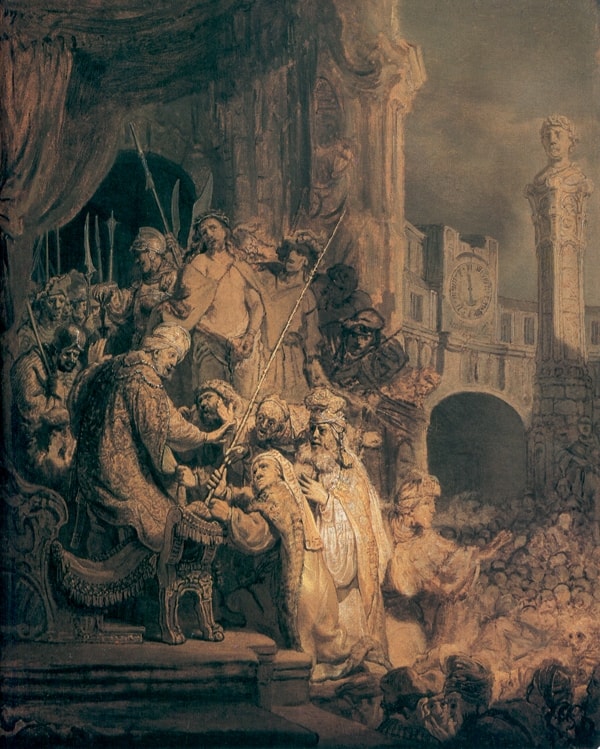
Ecce Homo

by Rembrandt van Rijn

Rembrandt van Rijn’s Ecce Homo turns a Gospel episode into a public ritual of power. Under a heavy canopy, Pilate elevates himself above a seething crowd and gestures toward the bound Christ, while civic architecture and antique statuary proclaim earthly authority over innocent suffering [1][2]. Light isolates the principals and treats the rest as a turbulent mass, converting a show trial into a meditation on refusal of mercy.

Study Print Studio

Create a personal study print

Build a companion study sheet around the part of this painting that speaks to you most. Choose a detail, shape an interpretation, and walk away with something personal and display-worthy.

Fast Facts

Year
1634
Medium
Oil on paper mounted on canvas (grisaille study for a print)
Dimensions
54.5 × 44.5 cm
Location
National Gallery, London
See all Rembrandt van Rijn paintings in London
Ecce Homo by Rembrandt van Rijn (1634) featuring Canopy and elevated dais, Pilate’s reed/rod, Bound, illuminated Christ, Clock showing the sixth hour

Click on any numbered symbol to learn more about its meaning

Meaning & Symbolism

Rembrandt composes the scene as a tribunal-stage. Pilate occupies an elevated dais beneath rich drapery, his gesture and the long reed he wields converting judgment into theater. Below and before him, priests and courtiers press forward in sumptuous dress, their textures catching the light as proof of status, not of righteousness. Christ stands nearly bare and bound among soldiers, his body the only unclad surface fully surrendered to the light; he is displayed, not heard. The surrounding architecture—arched balcony, clock, and monumental bust—brands the space as juridical: time is kept, records will be made, and the edifice of law endures, whatever it decides. In Rembrandt’s design for this subject, the clock’s hand points to the sixth hour, a precise Johannine time code that turns the tableau into an argument about fated judgment and human responsibility 1. Power advertises itself through apparatus. The canopy and dais certify rank; the notary and attendants imply that due process is “observed,” even as the verdict has been rehearsed in crowd sentiment. In related treatments of this subject, a valet readies the ewer and basin for Pilate’s hand-washing—visual shorthand for the abdication to come 3. Here, the reed in Pilate’s grasp acts as a prop of borrowed kingship, mirroring the mock regalia associated with Christ and making the governor a participant in the charade of sovereignty. Rembrandt’s chiaroscuro underwrites the moral reading: light gathers on Pilate, the priests, and Christ, while the multitude dissolves into a churning penumbra—a sea of will rather than a chorus of persons. This is not crowd portraiture; it is the optics of complicity. The antique bust and civic facade echo the program of contemporary town halls that paired allegories like Justice and Fortitude with the architecture of governance, a resonance curators have noted to stress how Rembrandt localizes a Gospel trial within the recognizable codes of Dutch civic life 4. The result is a drama of scapegoating. Pilate’s gesture routes the viewer’s eye to the isolated figure who cannot plead, while the dignitaries’ brocades and the soldiers’ spearheads glitter with the credibility of force. Rembrandt’s print of 1655 would expand this staging onto a vast architectural set and, in late states, even strip away the foreground crowd to sharpen the ethical confrontation 2. The through-line—from this painted study to the monumental drypoint—is Rembrandt’s insistence that law, ritual, and public opinion can combine to authenticate injustice. By binding scriptural time to civic imagery, and by pitting the glitter of worldly power against the quiet dignity of suffering, Ecce Homo declares that legitimacy without conscience is only spectacle—a judgment the image renders undeniable in the very language of light and space 125.

Explore Deeper with AI

Ask questions about Ecce Homo

Popular questions:

Powered by AI • Get instant insights about this artwork

💬 Ask questions about this artwork!

Interpretations

Formal-Technical Analysis: Drypoint as Ethics

Rembrandt executes the plate entirely in drypoint, courting the medium’s fragile burr to produce atmospheric blacks and velvety half‑tones that read like moral weather. The soft, wearing line forces continual reworking—eight states—so the image’s ethics are literally worked through over time 12. Early impressions on Japanese paper warm the light, heightening the rift between glittering authority and Christ’s pallor 14. By the late states, selective burnishing and rebiting recalibrate emphasis across the stage. This is not virtuosity for its own sake: the medium’s evanescence mirrors the precariousness of justice on view. Technique becomes argument—burr, paper tone, and inking choices function as a visual rhetoric of judgment, complicity, and erasure 13.

Source: Metropolitan Museum of Art; British Museum; Morgan Library & Museum; Rijksmuseum

Civic Architecture & Dutch Justice

The great facade, balcony, and antique statuary align the Gospel trial with Dutch civic architecture, inviting viewers to read Ecce Homo as a 17th‑century public hearing 5. Curators link the sculptural program to Amsterdam’s Town Hall allegories—Justice and Fortitude—so that the building performs as a didactic machine of secular authority even as it miscarries divine justice 5. In this transposition, Rembrandt localizes Scripture: the tribunal is not a remote Roman scene but a recognizable, urban forum. The print thereby critiques how bureaucratic grandeur can legitimate ethical failure, recoding biblical time in the language of municipal governance. The result is a pointed conflation of civic pride and moral risk, a Baroque theatre where architecture itself becomes ideology in stone 51.

Source: National Galleries of Scotland; Metropolitan Museum of Art

Iconographic Revision and the Politics of Regalia

Contrary to expectation, the final print shifts the reed‑scepter to Pilate and omits the crown of thorns, redistributing the tokens of mock kingship to the agent of imperial process 32. This deliberate iconographic pivot reframes the scene: the governor not only judges but also performs borrowed sovereignty, enacting a parody of rule that mirrors the soldiers’ earlier mockery of Christ. Such transfer intensifies the charge that legitimacy here is costume, not conscience. The scribe and the boy with ewer and basin—preparing for the public absolution ritual—extend the politics of props, converting legal signs into a language of avoidance 2. Rembrandt thus disarticulates medieval conventions to make a new claim about authority as theatre 321.

Source: Rijksmuseum; British Museum; Metropolitan Museum of Art

Compositional Ethics: Erasing the Crowd

Between early and final states, Rembrandt performs a radical operation: he burnishes out much of the foreground crowd, opening the space into austere arches and void 51. This revision refuses the viewer the comfort of anecdotal spectators; without a mediating throng, the encounter with the bound Christ becomes direct and unshielded. Curators read this as an ethical turn—an insistence that spectatorship is not neutral. The deletion is a visual homily: where gossiping faces once buffered our gaze, now the architectural cavity stages our own judgment, returning complicity to the beholder 5. Statecraft remains intact on the dais, but the civic audience is withdrawn, as if the print itself withholds alibis for looking 51.

Source: National Galleries of Scotland; Metropolitan Museum of Art

Print Culture Dialogue: Lucas van Leyden Recast

Rembrandt engages and supersizes the Lucas van Leyden Ecce Homo (1510), a print he likely owned, translating its motif into a monumental urban theatre shot through with Dutch legal-realism 4. Where Lucas emphasizes patterned crowding and late Gothic linearity, Rembrandt expands the architecture, deepens chiaroscuro, and complicates spectatorship. The dialogue is not imitation but critical appropriation: he absorbs a northern model to interrogate modern institutions of seeing and judging. By choosing drypoint and Japanese papers, he also updates the tactile and tonal register of the scene, proving how the early-modern print could function as public thought about law, time, and moral agency 41.

Source: Morgan Library & Museum; Metropolitan Museum of Art

Scriptural Time and Moral Agency

The preparatory grisaille fixes the clock at the sixth hour (John 19:14), a precise chronometric cue that sutures text and image 6. In the print’s expanded theatre, that Johannine timing persists as a logic of fated judgment set against the contingent actions of officials and crowd. The valet with ewer, the recording scribe, and Pilate’s gestural rhetoric instantiate procedural time—moments ticked and notarized—while the Christian narrative presses toward Passion-time and sacrifice 26. Rembrandt’s staging thus braids destiny with choice: scripture governs the hour, but humans author the verdict. The work’s temporality—scriptural, civic, and theatrical—becomes an ethical pressure chamber where accountability cannot hide behind chronology 61.

Source: National Gallery, London; British Museum; Metropolitan Museum of Art

Related Themes

About Rembrandt van Rijn

Rembrandt van Rijn (1606–1669) was a leading Dutch Golden Age painter and printmaker whose Amsterdam years (from 1631) produced virtuosic portraits and ambitious history paintings. In the early 1630s he favored polished finishes, saturated color, and theatrical staging—qualities on display in this 1633 canvas. Although prolific, this is his only known painted seascape [2][4].
View all works by Rembrandt van Rijn

More by Rembrandt van Rijn
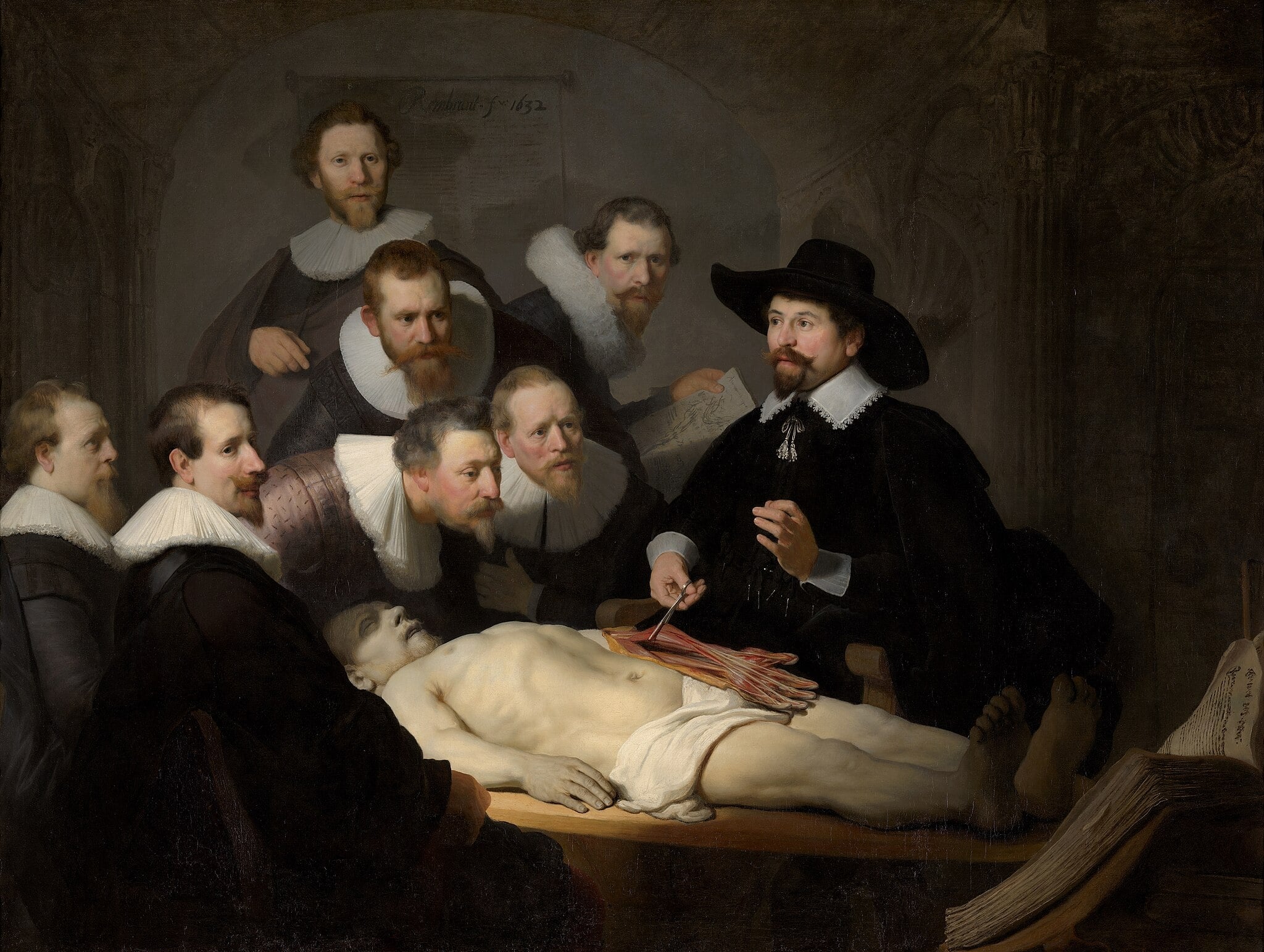
The Anatomy Lesson of Dr. Nicolaes Tulp by Rembrandt van Rijn

The Anatomy Lesson of Dr. Nicolaes Tulp

Rembrandt van Rijn (1632)

Rembrandt van Rijn turns a civic commission into a drama of <strong>knowledge made visible</strong>. A cone of light binds the ruff‑collared surgeons, the pale cadaver, and Dr. Tulp’s forceps as he raises the <strong>forearm tendons</strong> to explain the hand. Book and body face each other across the table, staging the tension—and alliance—between <strong>textual authority</strong> and <strong>empirical observation</strong> <sup>[1]</sup><sup>[2]</sup>.
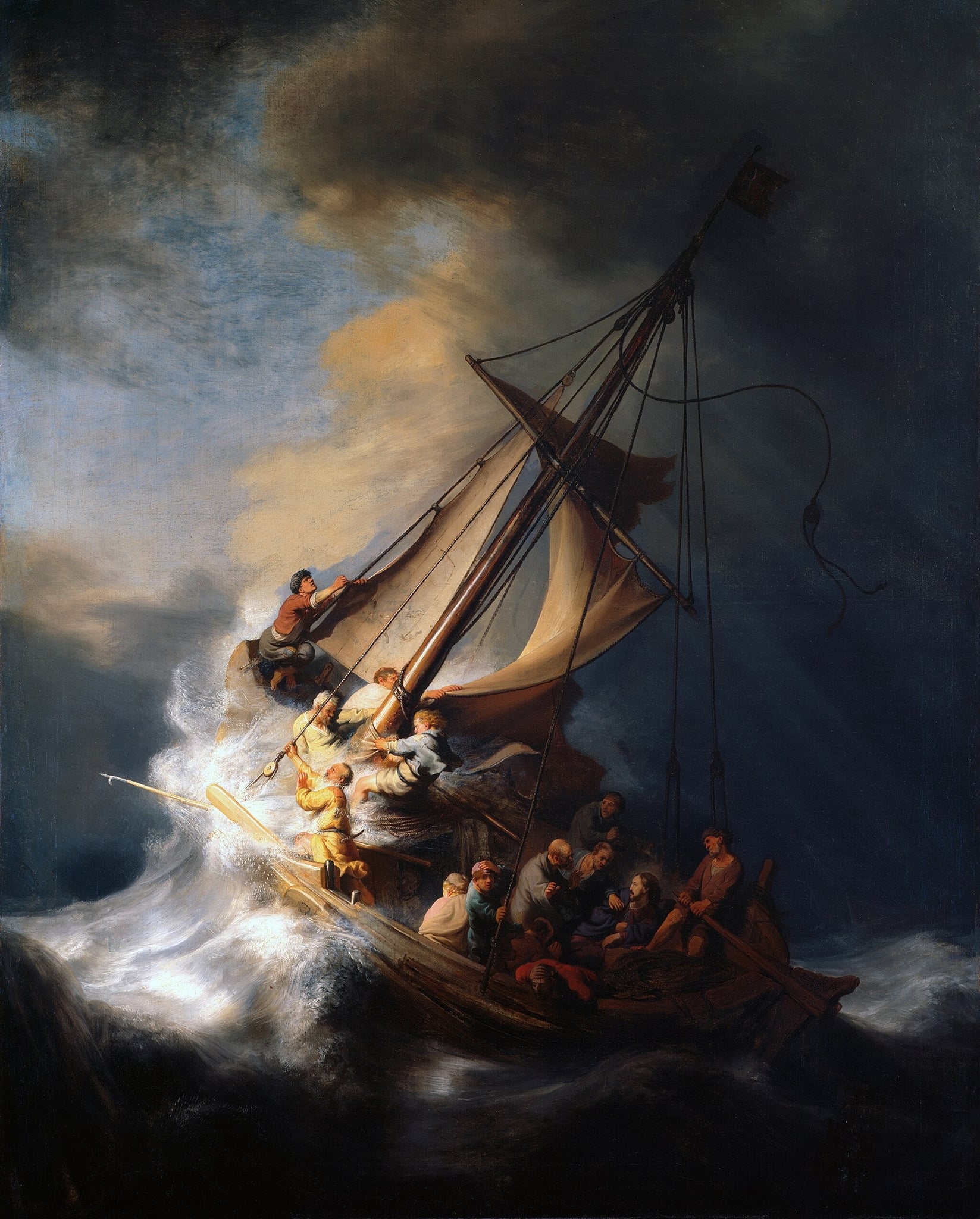
The Storm on the Sea of Galilee by Rembrandt van Rijn

The Storm on the Sea of Galilee

Rembrandt van Rijn (1633)

Rembrandt van Rijn’s The Storm on the Sea of Galilee stages a clash of <strong>human panic</strong> and <strong>divine composure</strong> at the instant before the miracle. A torn mainsail whips across a steeply tilted boat as terrified disciples scramble, while a <strong>serenely lit Christ</strong> anchors a pocket of calm—an image of faith holding within chaos <sup>[1]</sup><sup>[3]</sup>. It is Rembrandt’s only painted seascape, intensifying its dramatic singularity in his oeuvre <sup>[2]</sup>.
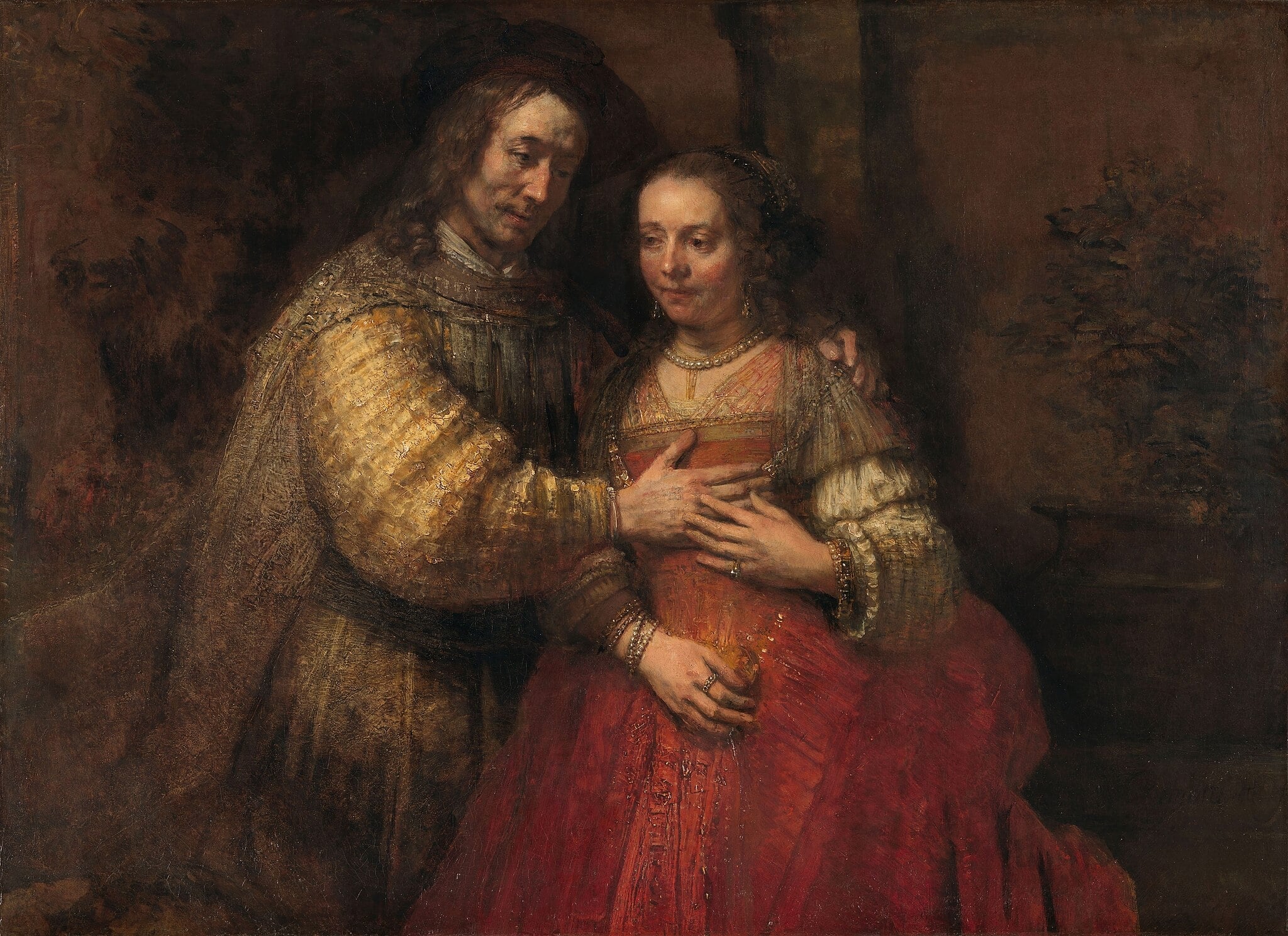
The Jewish Bride by Rembrandt van Rijn

The Jewish Bride

Rembrandt van Rijn (c. 1665–1669)

The Jewish Bride by Rembrandt van Rijn stages an intimate covenant: two figures, read today as <strong>Isaac and Rebecca</strong>, seal their union through touch rather than spectacle. Light concentrates on faces and hands, while the man’s glittering <strong>gold sleeve</strong> and the woman’s <strong>coral-red gown</strong> turn paint itself into a metaphor for fidelity and tenderness <sup>[1]</sup><sup>[3]</sup>. This late masterpiece embodies Rembrandt’s <strong>material eloquence</strong>—impasto as feeling—within a hushed, dark setting <sup>[1]</sup><sup>[2]</sup>.
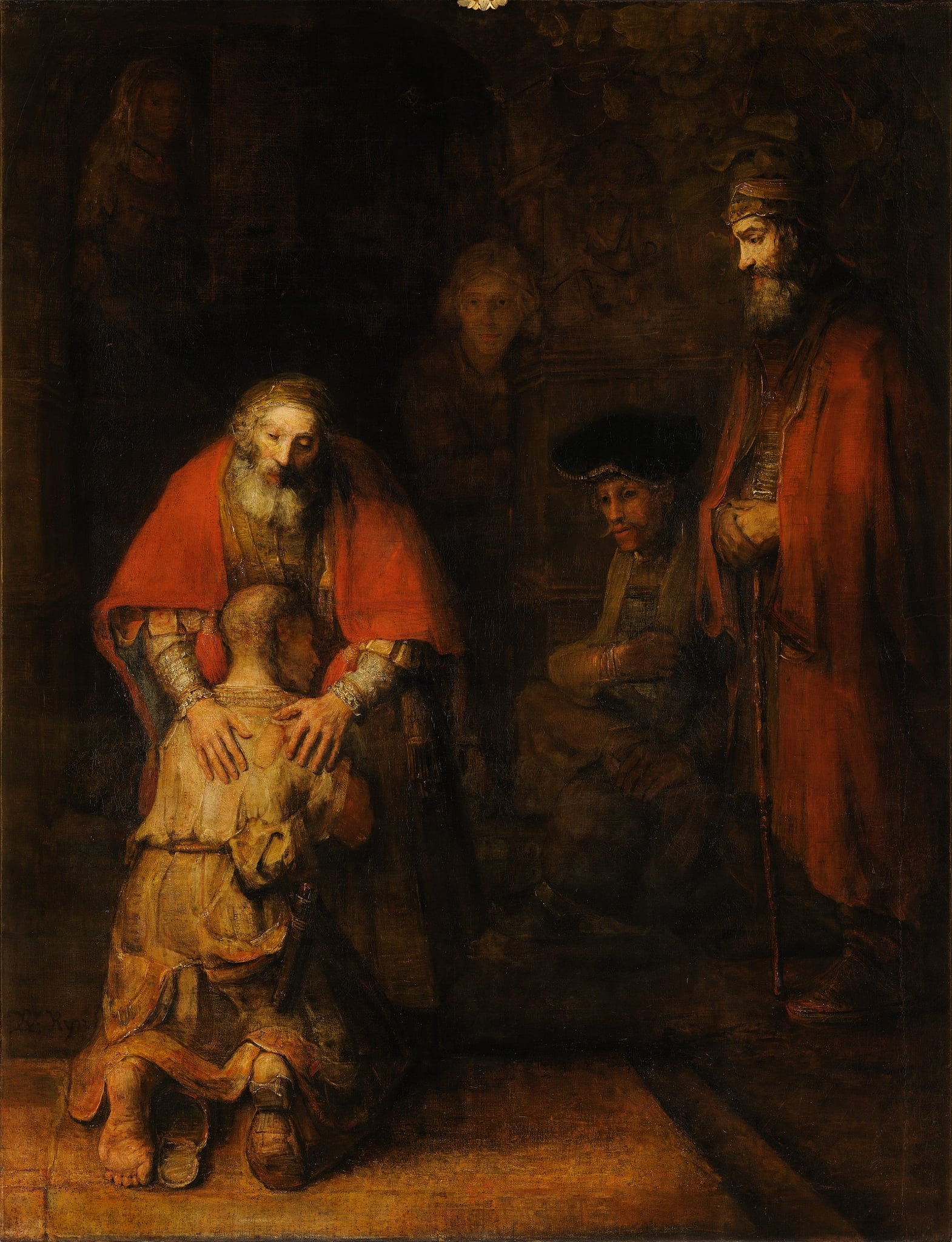
The Return of the Prodigal Son by Rembrandt van Rijn

The Return of the Prodigal Son

Rembrandt van Rijn (c. 1661–1669 (probably completed by 1669))

Rembrandt van Rijn’s The Return of the Prodigal Son is a late-life meditation on <strong>mercy</strong>, <strong>homecoming</strong>, and <strong>restored dignity</strong>. In a hush of dusk-like light, a ragged son kneels into his father’s <strong>embrace</strong>, while an upright elder brother holds back in shadow. The image concentrates meaning in illuminated <strong>faces, hands, and feet</strong>, turning a parable into a timeless human reckoning. <sup>[1]</sup><sup>[2]</sup>
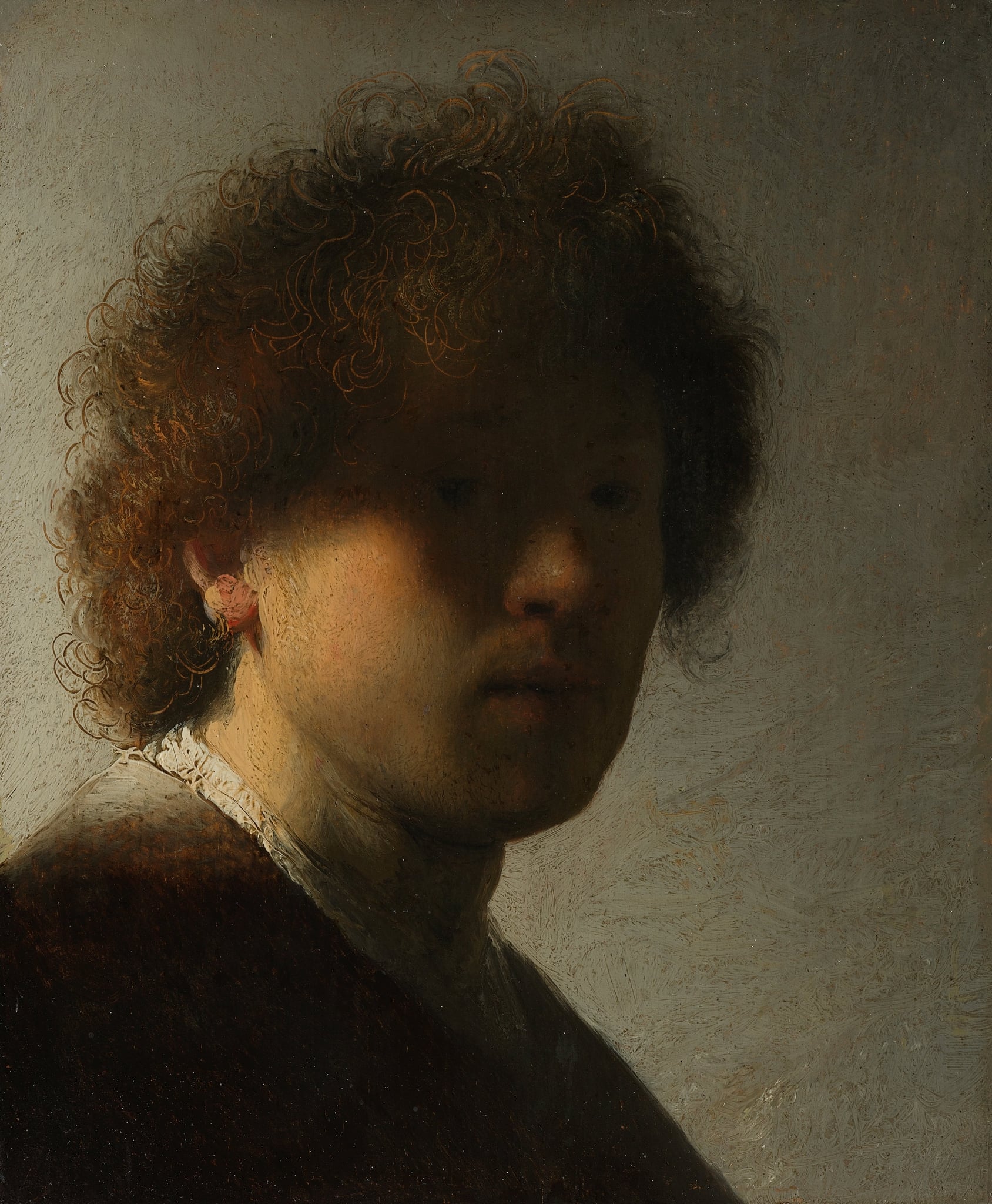
Self-portrait (with tousled hair) by Rembrandt van Rijn

Self-portrait (with tousled hair)

Rembrandt van Rijn (c. 1628)

A young Rembrandt van Rijn tests how <strong>light both reveals and withholds</strong> by letting his face emerge from darkness while his <strong>scratched, backlit curls</strong> flare like a rough halo. The small oak panel makes <strong>process itself the subject</strong>, turning hair, stubble, and a raking highlight into a statement of identity-in-formation <sup>[1]</sup><sup>[5]</sup>.
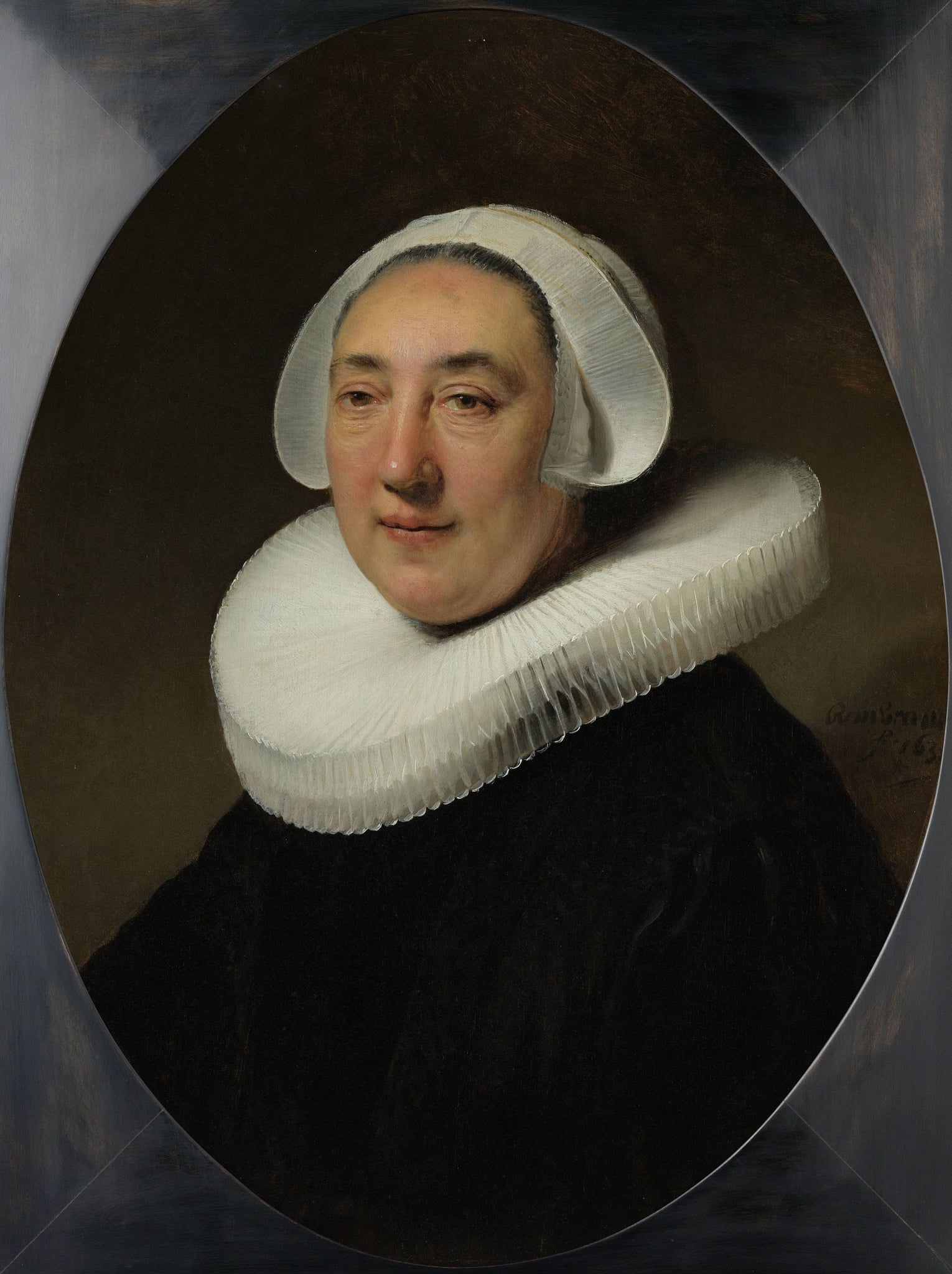
Portrait of Haesje Jacobsdr van Cleyburg by Rembrandt van Rijn

Portrait of Haesje Jacobsdr van Cleyburg

Rembrandt van Rijn (1634)

Rembrandt’s 1634 Portrait of Haesje Jacobsdr van Cleyburg stages a Dutch burgher within a feigned <strong>oval</strong> opening, illuminated by selective <strong>chiaroscuro</strong> that models warm skin against brilliant <strong>millstone ruff</strong> and sober black dress. The painting balances <strong>modesty and status</strong>, making virtue visible while quietly declaring prosperity through immaculate linen and craft <sup>[1]</sup><sup>[4]</sup>.