How Much Is Old Woman Reading, Probably the Prophetess Anna Worth?
Last updated: July 21, 2026
Quick Facts
- Last Sale
- $40K (1928, Vereniging Rembrandt to Rijksmuseum, Amsterdam)
- Insurance Value
- $88.0M (Internal appraisal model (hypothetical underwriting))
- Methodology
- comparable analysis
Based on recent benchmarks for early autograph Rembrandt oils and the work’s caliber, Old Woman Reading, Probably the Prophetess Anna (1631) is estimated at $50–80 million. The painting’s autograph status, finish, early date, and museum‑level renown support a value materially above small early panels sold in 2023, yet below the nine‑figure ceiling set by national‑icon masterpieces.
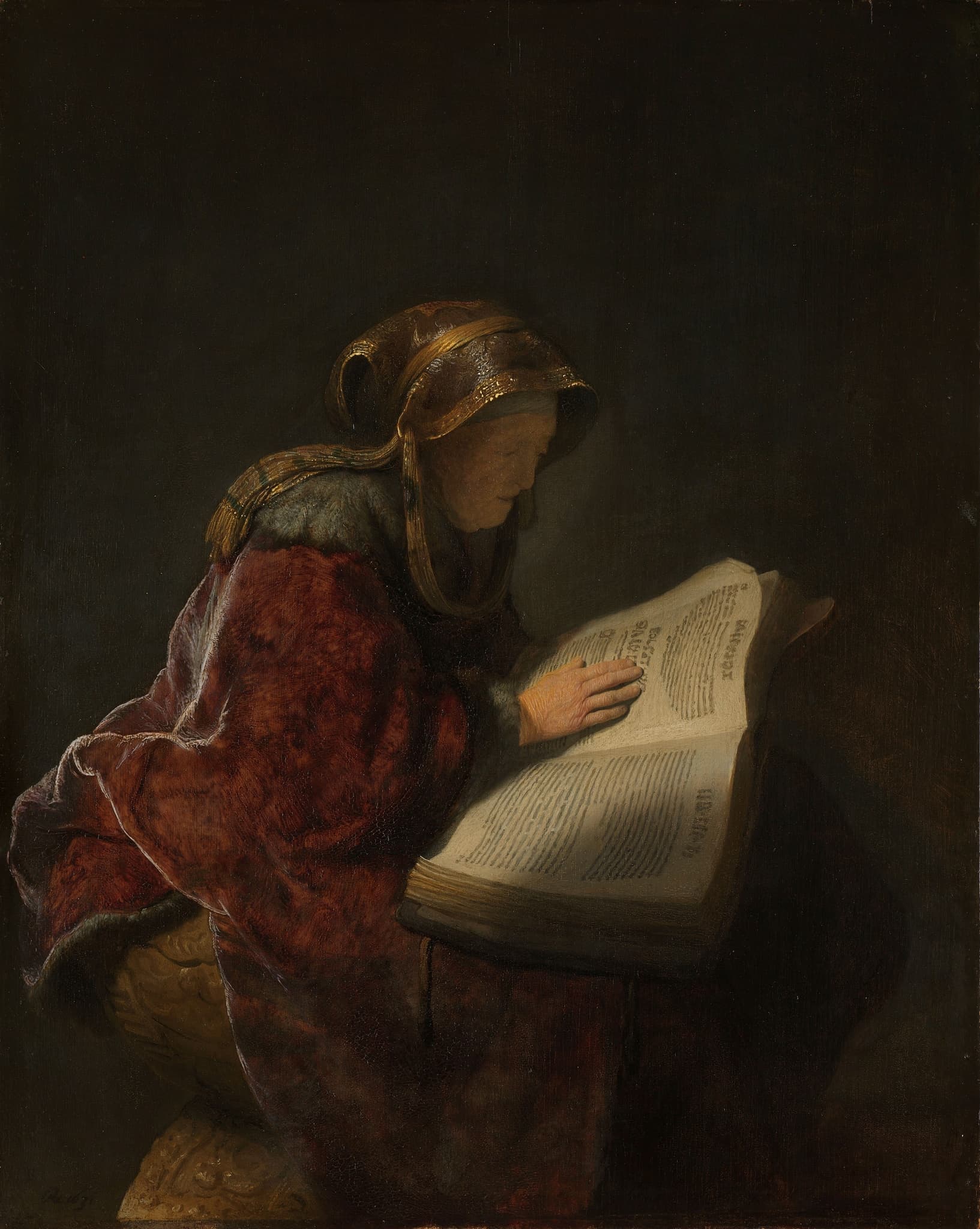
Old Woman Reading, Probably the Prophetess Anna
Rembrandt van Rijn, 1631 • Oil on panel
Read full analysis of Old Woman Reading, Probably the Prophetess Anna →Valuation Analysis
Conclusion: A measured, market-grounded estimate for Rembrandt’s Old Woman Reading, Probably the Prophetess Anna (1631) is $50–80 million. This reflects its status as a highly finished, autograph early oil—signed “RHL 1631,” panel, 60 × 48 cm—long held by the Rijksmuseum and widely cited in the literature on Rembrandt’s Leiden/early Amsterdam period and his “old woman” subjects [1].
Comparables and positioning: The most relevant public benchmarks for autograph early Rembrandt oils in the current cycle are the rediscovered The Adoration of the Kings (c.1628), which realized £10.9m (about $13.7m with fees) at Sotheby’s London on 6 December 2023, and the small 1635 oval portraits sold as a pair for £11.235m ($14.27m) at Christie’s London on 6 July 2023 [2][5]. These results indicate a present-day floor for small, securely attributed early oils. At the other end, the artist’s public-auction record for a painting—Portrait of a Man, Half‑length, with His Arms Akimbo (1658)—stands at about $33.2m (Christie’s London, 2009), a benchmark that in today’s dollars sits around the high‑forties and frames what the auction market has historically absorbed for major autograph canvases [3]. A modern ceiling was set in 2022 when the Dutch State acquired The Standard Bearer (1636) for €175m in a private treaty—an exceptional, nationally symbolic work not directly comparable in category, but a valid indicator of current top‑end appetite for blue‑chip Rembrandts [4].
Why this work sits above the 2023 results yet below the nine‑figure tier: Old Woman Reading is a more developed, psychologically concentrated single-figure biblical tronie than the small early panels that traded in 2023, with superior finish, presence, and art-historical currency. Its 1631 date places it at a sweet spot in Rembrandt’s early evolution, and the autograph signature (“RHL 1631”) and long-standing scholarly consensus further de‑risk attribution—conditions that consistently command premiums. While it is not a grand public commission or self‑portrait of national symbolism, its intimacy, light effects, and devotional focus make it among the most admired early single‑figure studies, warranting a valuation above the mid‑teens achieved by smaller works and plausibly exceeding the historical auction record threshold for Rembrandt oils.
Other value drivers and calibration: Museum-grade provenance (Rijksmuseum since 1928) and continual scholarly visibility add a trophy premium [1]. The current Old Masters market shows renewed depth at the apex, rewarding fresh, securely attributed, and high‑quality works—dynamics that support this range. A current technical dossier (condition, panel stability, varnish, IRR/X‑ray) would fine-tune the midpoint but, given the painting’s status and presentation, nothing in the public record suggests material condition impediments. On balance, $50–80 million is the realistic range for insurance or a hypothetical arms‑length transaction today, appropriately bridging the gap between the 2023 early-panel results and the exceptional, nationally iconic outliers [2][3][4][5].
Key Valuation Factors
Art Historical Significance
High ImpactPainted in 1631 and signed “RHL 1631,” Old Woman Reading sits at a pivotal moment as Rembrandt transitions from Leiden to early Amsterdam, refining the luminous, psychologically probing style that would define his mature work. Within the oeuvre, it represents the apex of his intimate, single-figure biblical tronies—works prized for their spiritual intensity and virtuoso rendering of light, skin, and textile. The picture is frequently reproduced in scholarship, anchors discussions of Rembrandt’s “old woman” types, and is a highlight of the Rijksmuseum’s Dutch Golden Age galleries. Its combination of date, finish, and subject places it above study-heads and below grand history or commissioned portrait masterpieces, a niche that commands scarce, trophy-level attention.
Attribution and Scholarship
High ImpactThe Rijksmuseum catalogs the painting as autograph Rembrandt with a painted signature and secure early dating, supported by longstanding scholarly acceptance [1]. Works with unequivocal authorship, strong technical evidence, and coherent provenance command substantial premiums in the Old Masters market. The signature, the coherent handling of light and impasto, and the painting’s deep literature trail reduce attribution risk relative to contested or workshop-involved examples. This certainty—rare for 17th-century oils—supports a level materially above rediscovered or recently upgraded works and helps explain why the estimate can sit comfortably above the mid‑teens outcomes achieved for smaller panels in 2023.
Subject and Category Desirability
High ImpactSingle-figure biblical tronies by Rembrandt, when highly finished and of substantial size, occupy a sweet spot for collectors who value psychological presence over heraldry or civic pomp. This painting’s devotional focus, intimate scale, and masterful chiaroscuro make it exceptionally displayable and emotionally resonant. While not a grand commissioned portrait, it surpasses head studies and fragments in narrative depth and painterly complexity. Recent market evidence shows healthy demand for early autograph oils—e.g., The Adoration of the Kings (c.1628) at $13.7m and the 1635 portrait ovals at $14.27m—supporting a significant premium for a superior, iconic early tronie of this quality [2][5].
Provenance and Institutional Prestige
Medium ImpactThe work’s long residence at the Rijksmuseum (acquired in 1928) confers exceptional credibility and visibility [1]. That standing tends to elevate perceived quality and reduce due‑diligence frictions, both of which translate to pricing power in hypothetical transactions or insurance contexts. Although institution-held status limits real market testing, it simultaneously signals top-tier curatorial endorsement and consistent conservation care. In valuation terms, the museum pedigree adds a trophy premium relative to otherwise similar examples circulating privately, while recognizing that national-collection considerations and export constraints may also constrain liquidity—factors captured in the upper-mid eight‑figure range rather than an attempt at a nine‑figure valuation.
Sale History
Paris (C. Pillet sale), lot 97
La Prophétesse Anne; realized FRF 12,500; purchased by Peter II, Grand Duke of Oldenburg. USD shown at contemporaneous mint-par conversion.
Private sale via A.W.M. Mensing
Group purchase of 40 paintings from Grand Duke August II of Oldenburg to Mari Paul Voûte and Ernst Heldring for FL 600,000 total; USD shown at mint-par. Allocation per object not specified.
Vereniging Rembrandt to Rijksmuseum, Amsterdam
Acquired for FL 100,000 and purchased for the Rijksmuseum; USD shown at mint-par.
Rembrandt van Rijn's Market
Rembrandt van Rijn is one of the most in-demand Old Masters, with an exceptionally thin supply of securely autograph oils. Public auction records for his paintings peak at about $33.2 million (2009), while private-treaty acquisitions for nationally iconic works, such as The Standard Bearer (1636), have reached €175 million, underscoring the extreme ceiling for masterpieces of singular cultural status. After a quiet period for paintings, 2023 saw renewed activity with early autograph oils achieving ~$13–14 million, demonstrating strong depth for high-quality entries. Works on paper have also set new records, signaling broad, cross-category demand. In this context, prime autograph oils with strong scholarship sit firmly in the global trophy arena.
Comparable Sales
The Adoration of the Kings (c.1628)
Rembrandt van Rijn
Autograph early oil on panel, biblical subject, and close in date to 1631. Smaller and a multi-figure narrative, but a clear, recent public benchmark for early Rembrandt autograph oils.
$13.7M
2023, Sotheby's London
~$14.3M adjusted
Portraits of Jan Willemsz. van der Pluym and Jaapgen Carels (pair, 1635)
Rembrandt van Rijn
Two small early single-figure portraits sold together; same artist and medium, near‑period to 1631, indicating current demand for early, securely attributed Rembrandt oils.
$14.3M
2023, Christie's London
~$14.8M adjusted
Portrait of a Man, Half-length, with His Arms Akimbo (1658)
Rembrandt van Rijn
Artist’s auction record for a painting; major autograph oil. Later period and a grand portrait rather than an early single‑figure tronie, but an essential market benchmark for Rembrandt oils at auction.
$33.2M
2009, Christie's London
~$49.1M adjusted
The Standard Bearer (1636)
Rembrandt van Rijn
Autograph oil from the 1630s; an icon of national significance. Not like‑for‑like in subject or scale, but establishes a modern, top‑of‑market ceiling for Rembrandt paintings.
$198.0M
2022, Private treaty (Dutch State/Rijksmuseum)
~$215.8M adjusted
Study of the Head and Clasped Hands of a Young Man as Christ in Prayer (c.1655)
Rembrandt van Rijn
Autograph single‑figure devotional oil on panel; smaller and later than 1631 but a strong indicator of pricing for intimate autograph studies.
$12.2M
2018, Sotheby's London
~$15.4M adjusted
Current Market Trends
The Old Masters segment has strengthened recently, with selective but vigorous bidding for blue‑chip names and best‑in‑class works. High-profile museum acquisitions and fresh attributions have kept Rembrandt top‑of‑mind, while 2023–2026 auction cycles delivered notable results for early autograph oils and record highs for works on paper. The market remains quality‑driven: securely attributed, well‑documented paintings with compelling subjects outperform, while lesser or compromised works face resistance. Against this backdrop, a museum-caliber early Rembrandt oil of finished quality reasonably commands an upper‑eight‑figure valuation in a hypothetical arms‑length context, with insurance values set at or modestly above the high estimate.
Study print
Study this painting as a print
Pair the full artwork with a museum-style study sheet focused on one meaningful detail.
Sources
- Rijksmuseum collection record: Old Woman Reading, Probably the Prophetess Anna (SK-A-3066)
- Sotheby’s: The Adoration of the Kings (c.1628) sale result, 6 Dec 2023
- Christie’s: Rembrandt auction results and 2009 record reference
- Rijksmuseum press release: The Standard Bearer acquired by the Dutch State (2022, €175m)
- Christie’s press: Pair of 1635 oval portraits by Rembrandt sold for £11.235m (6 July 2023)