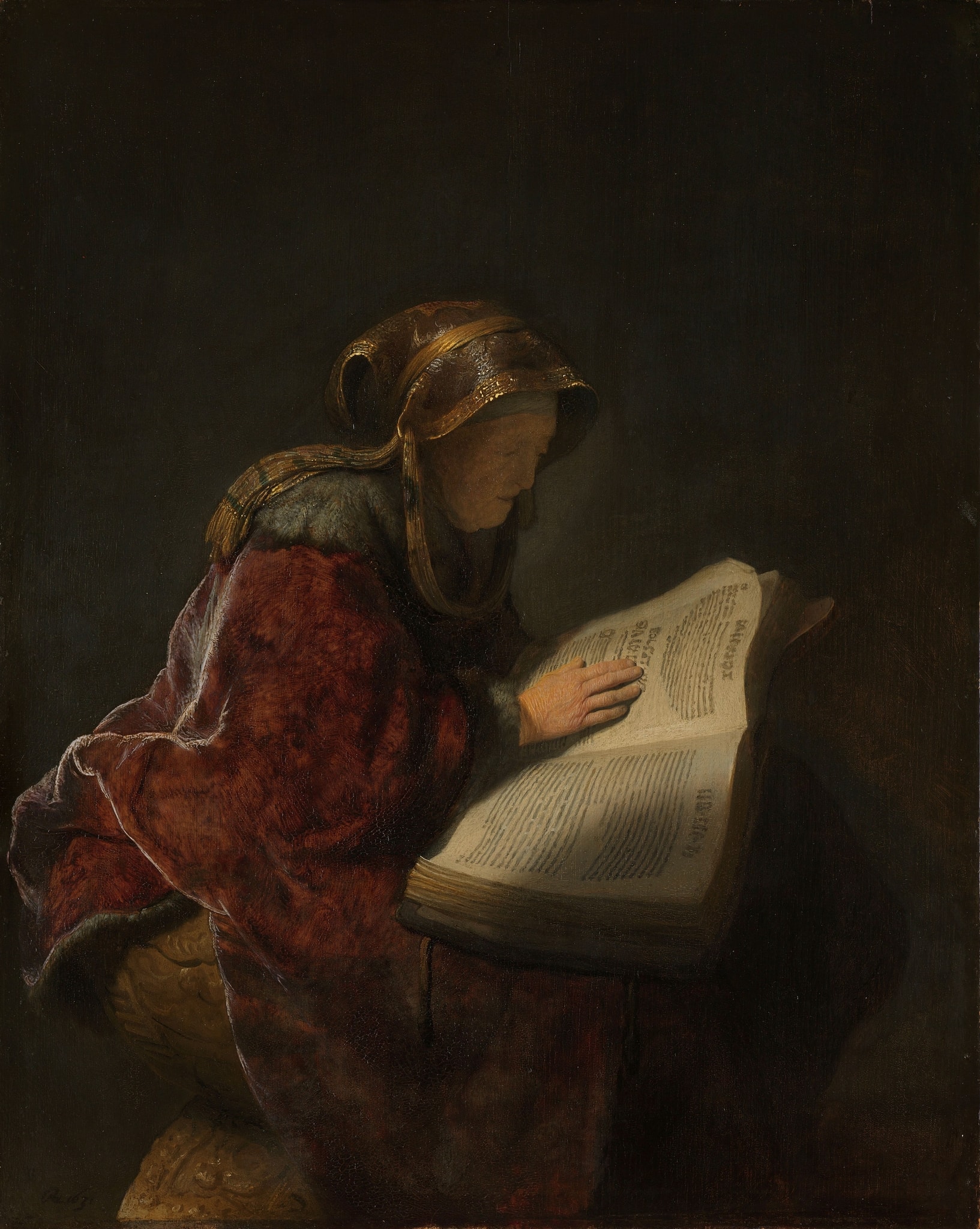
Old Woman Reading, Probably the Prophetess Anna

by Rembrandt van Rijn

A solitary reader bends over a monumental book, its pages and her guiding finger catching the only concentrated light. Rembrandt van Rijn turns this quiet act into a scene of revelation, proposing the sitter as Anna the prophetess, whose lifelong devotion is embodied in the weight and glow of Scripture [1][4].

Study Print Studio

Create a personal study print

Build a companion study sheet around the part of this painting that speaks to you most. Choose a detail, shape an interpretation, and walk away with something personal and display-worthy.

Fast Facts

Year
1631
Medium
Oil on panel
Dimensions
60 x 48 cm
Location
Rijksmuseum, Amsterdam
See all Rembrandt van Rijn paintings in Amsterdam
Old Woman Reading, Probably the Prophetess Anna by Rembrandt van Rijn (1631) featuring Illuminated folio (Scripture/Word), Guiding index finger, Directed light/hidden lamp, Bowed posture

Click on any numbered symbol to learn more about its meaning

Meaning & Symbolism

Rembrandt constructs a theology of sight by routing light through the Word. In the painting, the broad folio tilts up like a lectern, its columns of type rendered in thick, tactile strokes. The most forceful illumination settles not on the reader’s face but on the paper and the knuckles of the tracing hand; the face remains in half‑shadow under a structured headdress. This reversal—book bright, visage dim—declares that the source of understanding lies beyond the self. The bowed posture doubles as a prayer gesture, and the slow, line‑by‑line movement of the index finger renders reading as devotion, not scholarship. If the woman is Anna, the elderly widow of Luke 2 who “did not depart from the temple,” the oversized tome signifies Scripture and the hidden lamp becomes a sign of divine disclosure: revelation arrives quietly, by faithful attention over time 14. Rembrandt’s brushwork reinforces this claim. The furred cloak absorbs light, its dense reds and browns dampening reflection, while the vellum‑like pages throw back a pale radiance; the material contrast literalizes the difference between worldly substance and spiritual weight. Even the book’s swollen spine and layered edges convey the gravity of wisdom, the physical heft mirroring the burden and consolation of a lifetime’s meditation 13. The work also declares Rembrandt’s early‑career program. Painted in 1631 as he shifted operations from Leiden to Amsterdam, it belongs to a series of half‑length figures engaged in reading or prayer that helped position him within a competitive market for intimate, psychologically charged scenes 16. The image’s immediate circulation in a reproductive print by Jan Gillisz. van Vliet—crediting Rembrandt as “inventor”—confirms a strategy to broadcast this devotional prototype and to fix its authorship in the public eye 2. Within that milieu, Rembrandt’s version distinguishes itself from contemporaries such as Gerrit Dou: instead of flaunting legible typography and miniaturist finish, he stages inner attention through directed light and atmospheric shadow, trading literal clarity for spiritual resonance 3. The headdress and sober costume, recurring props in his early studio, code the figure as a biblical tronie rather than a specific portrait, a choice consistent with period practice and with museum cautions against reading the sitter as the artist’s mother 1. In effect, Rembrandt merges market acumen with visual theology: a reproducible, instantly legible silhouette—a humble elder, a massive book, a cone of light—communicates the virtues of patience, memory, and hope to a broad audience. That clarity is not simplistic. The dark field surrounding the figure is not empty but expectant; it pushes the subject forward while withholding narrative incident, so time seems to stall at the brink of understanding. Such suspension grants viewers a share in Anna’s vigil, making the painting a portable chapel of watchful faith. The meaning of Old Woman Reading, Probably the Prophetess Anna, then, is the sanctification of attention; why Old Woman Reading, Probably the Prophetess Anna is important is that it crystallizes Rembrandt’s signature union of pictorial drama and inward piety at the very moment he steps onto Amsterdam’s stage, setting a template for Northern Baroque spirituality in paint 156.

Explore Deeper with AI

Ask questions about Old Woman Reading, Probably the Prophetess Anna

Popular questions:

Powered by AI • Get instant insights about this artwork

💬 Ask questions about this artwork!

Interpretations

Print Culture & Branding

The swift appearance of Jan Gillisz. van Vliet’s reproductive print after this composition—explicitly crediting Rembrandt as “inventor”—reveals a strategic use of print to stabilize authorship and amplify market reach during the Amsterdam move. In a competitive milieu, such inscriptions asserted both priority over a pictorial idea and the portability of Rembrandt’s devotional prototype. The reverse orientation of the print underscores its reproductive status while standardizing the image’s silhouette (elder, folio, light cone) for broad circulation. This is not merely promotion: the print translates the painting’s theology of sight into a medium built for dissemination, aligning spiritual subject with the era’s republic of images. In early‑career terms, authorship becomes a pledge of invention, tethering piety to professional identity 21.

Source: Princeton University Art Museum; Rijksmuseum

Tronie, Guise, and Biblical Persona

While tradition long named the sitter as Rembrandt’s mother, the Rijksmuseum rightly reframes the figure as a biblical tronie—a character study in costume that stages typology over biography. The headdress and sober garments code “elderly widow” in keeping with Luke’s Anna, separating persona from portrait likeness. This guisa di practice allowed Rembrandt to mine the expressive range of age, fabric, and light without binding meaning to an individual sitter. Read this way, identity is performative and theological: the model serves as vessel for a scriptural role, not a social self. Such indirection suits Rembrandt’s aim to foreground inner attention rather than descriptive verisimilitude, and cautions viewers against anecdotal readings rooted in family lore 13.

Source: Rijksmuseum object record and catalogue

Material Theology: Paint, Page, and Light

Rembrandt’s facture builds doctrine from matter. Thick, dragged strokes articulate the book’s vellum‑like surface, catching light so the page throws back a cool radiance, while the furred cloak drinks illumination in matte reds and browns. This material contrast externalizes the painting’s claim: worldly substance absorbs and dims; the Word reflects and reveals. Compared to Dou’s miniaturist precision, Rembrandt subordinates textual legibility to tactile luminosity, crafting a phenomenology of reading where comprehension is felt before it is read. The knuckled hand—modeled with impasto highlights—closes the circuit: touch becomes a conduit between matter and meaning. Form thus performs content, making chiaroscuro a means of revelation, not just a Baroque effect 14.

Source: Rijksmuseum; National Gallery of Art (Washington)

Iconographic Lineage & Reinvention

Rijksmuseum research links this image to Maerten de Vos’s late sixteenth‑century engraving of Anna, suggesting Rembrandt retools an established iconography. He condenses setting, drops narrative accessories, and intensifies the light–text–hand triad, shifting emphasis from typological identification to the act of scriptural encounter. The result is a prototype for later Leiden fijnschilders while retaining an affective breadth alien to strict miniaturism. This is appropriation as renewal: de Vos supplies the canonical figure; Rembrandt supplies the sensory theology of reading. The afterlife of the composition in van Vliet’s print confirms its success as a devotional template that balances recognizability with inwardness, recalibrating Renaissance precedent for a seventeenth‑century market hungry for intimate sacred subjects 32.

Source: Rijksmuseum catalogue; Princeton University Art Museum

Aging, Memory, and Embodied Reading

The painting treats old age not as decline but as epistemic method. The lowered head, narrowed focus, and guiding index finger model a temporality of attention—slow, iterative, mnemonic. Comparative entries on Rembrandt and his circle note how elderly readers often signal piety; here, however, cognition is made visible: the hand paces the eye, the page paces the mind. This choreography contrasts with scenes flaunting legible type; instead, Rembrandt privileges the habit-memory of devotion accrued over decades. The effect is psychological without portrait specificity: age becomes a vessel for constancy, a technology for holding the line between text and self until meaning discloses itself. In this sense, Anna’s vigil is less event than practice, perfected across a lifetime 41.

Source: National Gallery of Art (Washington); Rijksmuseum

Theology of Quiet Revelation

Biblical commentary on Luke 2:36–38 casts Anna as emblem of watchful faith, a model of recognition born of long fidelity rather than sudden vision. Rembrandt’s staging—face in half‑shadow, book and hand aglow—visualizes this hermeneutic: revelation is not spectacle but quiet attestation emerging through the Word. The tilted folio functions like a lectern and an altar, while the unseen lamp figures divine initiative—grace that meets human attention. By withholding incident and surrounding the figure with a charged dark, the image suspends narrative time so viewers share in Anna’s expectancy. The painting thus becomes a portable chapel, inviting the same posture of patience it depicts, translating exegesis into light and touch 51.

Source: Visual Commentary on Scripture; Rijksmuseum

Related Themes

About Rembrandt van Rijn

Rembrandt van Rijn (1606–1669) was a leading Dutch Golden Age painter and printmaker whose Amsterdam years (from 1631) produced virtuosic portraits and ambitious history paintings. In the early 1630s he favored polished finishes, saturated color, and theatrical staging—qualities on display in this 1633 canvas. Although prolific, this is his only known painted seascape [2][4].
View all works by Rembrandt van Rijn

More by Rembrandt van Rijn
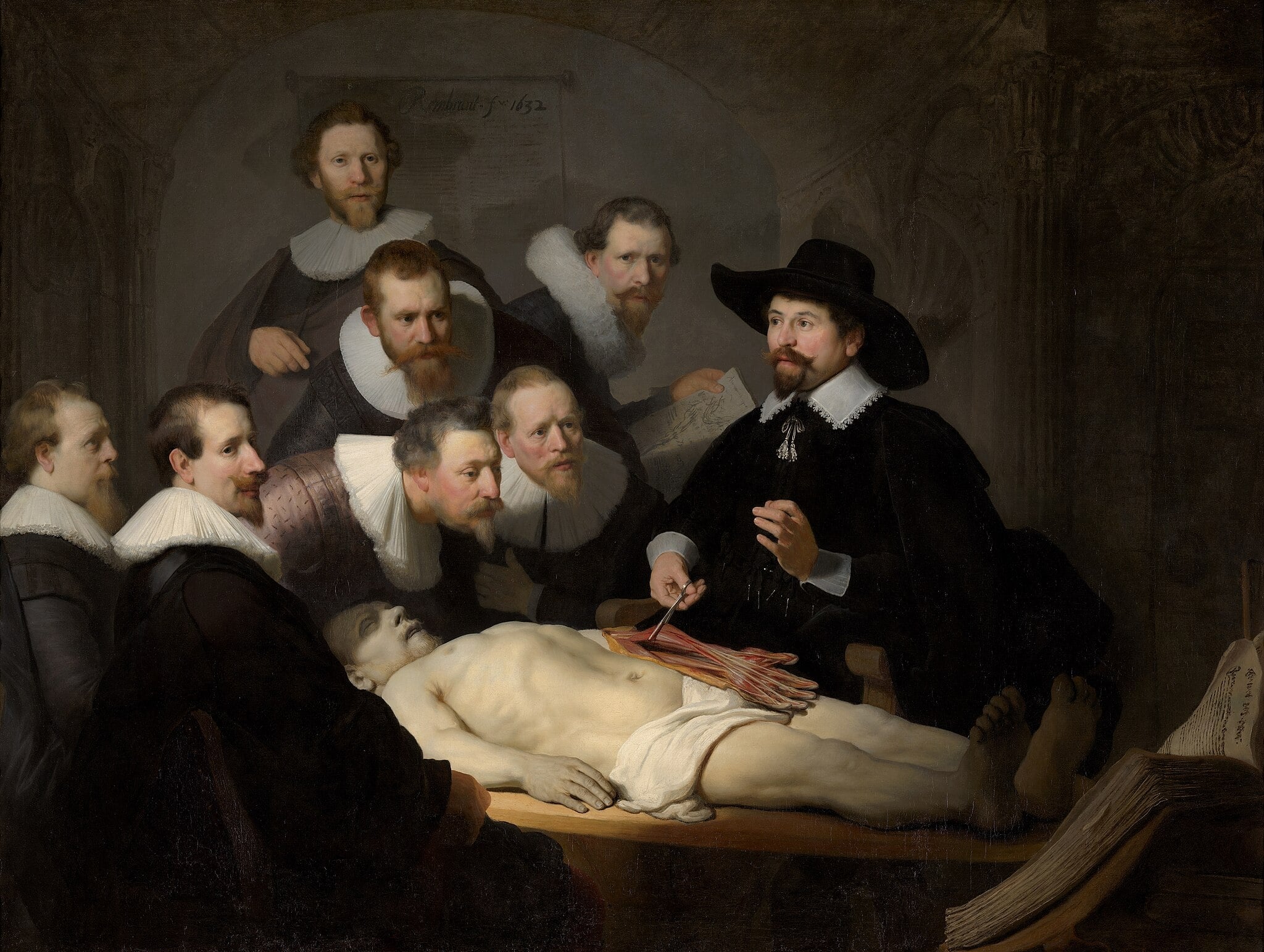
The Anatomy Lesson of Dr. Nicolaes Tulp by Rembrandt van Rijn

The Anatomy Lesson of Dr. Nicolaes Tulp

Rembrandt van Rijn (1632)

Rembrandt van Rijn turns a civic commission into a drama of <strong>knowledge made visible</strong>. A cone of light binds the ruff‑collared surgeons, the pale cadaver, and Dr. Tulp’s forceps as he raises the <strong>forearm tendons</strong> to explain the hand. Book and body face each other across the table, staging the tension—and alliance—between <strong>textual authority</strong> and <strong>empirical observation</strong> <sup>[1]</sup><sup>[2]</sup>.
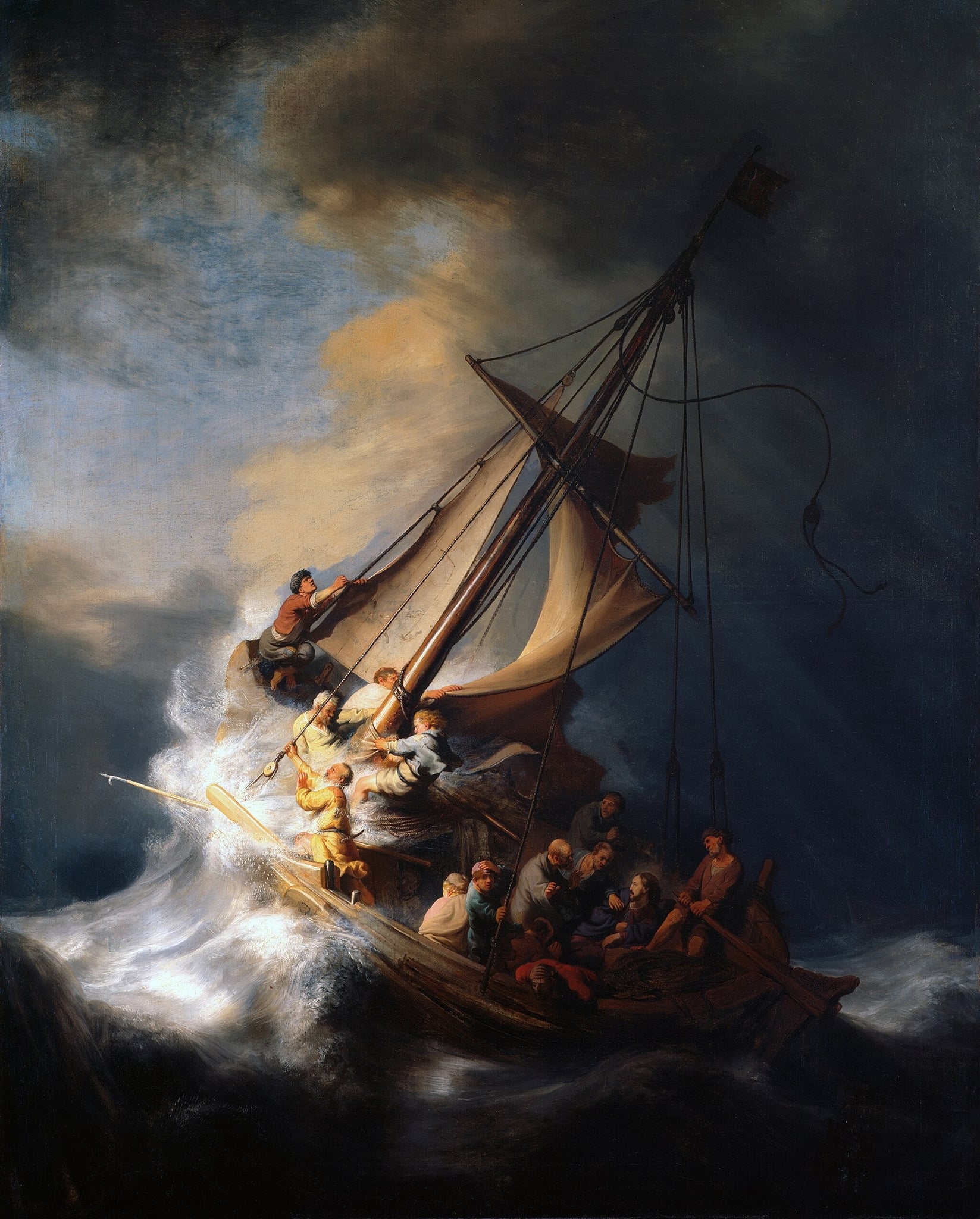
The Storm on the Sea of Galilee by Rembrandt van Rijn

The Storm on the Sea of Galilee

Rembrandt van Rijn (1633)

Rembrandt van Rijn’s The Storm on the Sea of Galilee stages a clash of <strong>human panic</strong> and <strong>divine composure</strong> at the instant before the miracle. A torn mainsail whips across a steeply tilted boat as terrified disciples scramble, while a <strong>serenely lit Christ</strong> anchors a pocket of calm—an image of faith holding within chaos <sup>[1]</sup><sup>[3]</sup>. It is Rembrandt’s only painted seascape, intensifying its dramatic singularity in his oeuvre <sup>[2]</sup>.
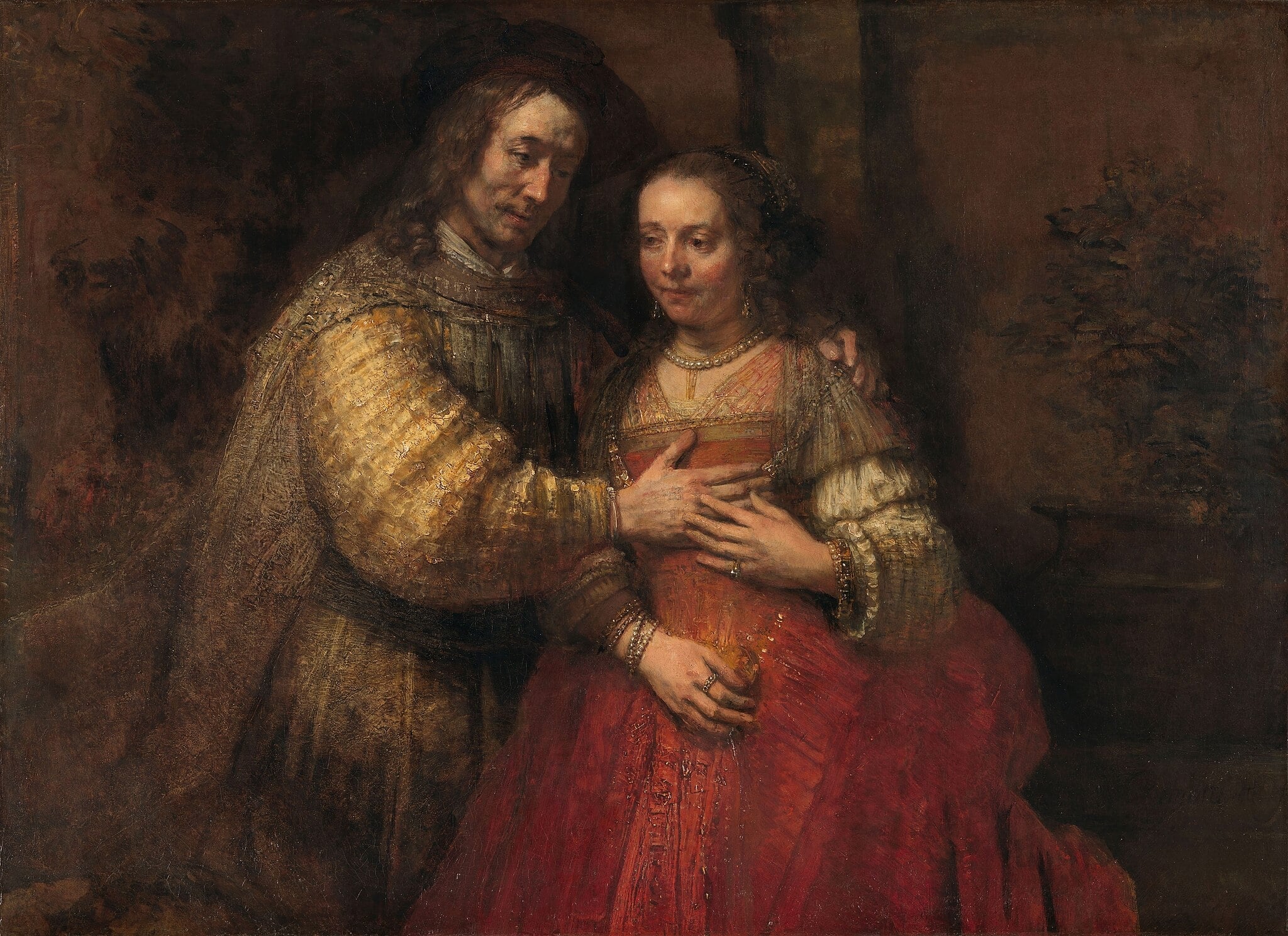
The Jewish Bride by Rembrandt van Rijn

The Jewish Bride

Rembrandt van Rijn (c. 1665–1669)

The Jewish Bride by Rembrandt van Rijn stages an intimate covenant: two figures, read today as <strong>Isaac and Rebecca</strong>, seal their union through touch rather than spectacle. Light concentrates on faces and hands, while the man’s glittering <strong>gold sleeve</strong> and the woman’s <strong>coral-red gown</strong> turn paint itself into a metaphor for fidelity and tenderness <sup>[1]</sup><sup>[3]</sup>. This late masterpiece embodies Rembrandt’s <strong>material eloquence</strong>—impasto as feeling—within a hushed, dark setting <sup>[1]</sup><sup>[2]</sup>.
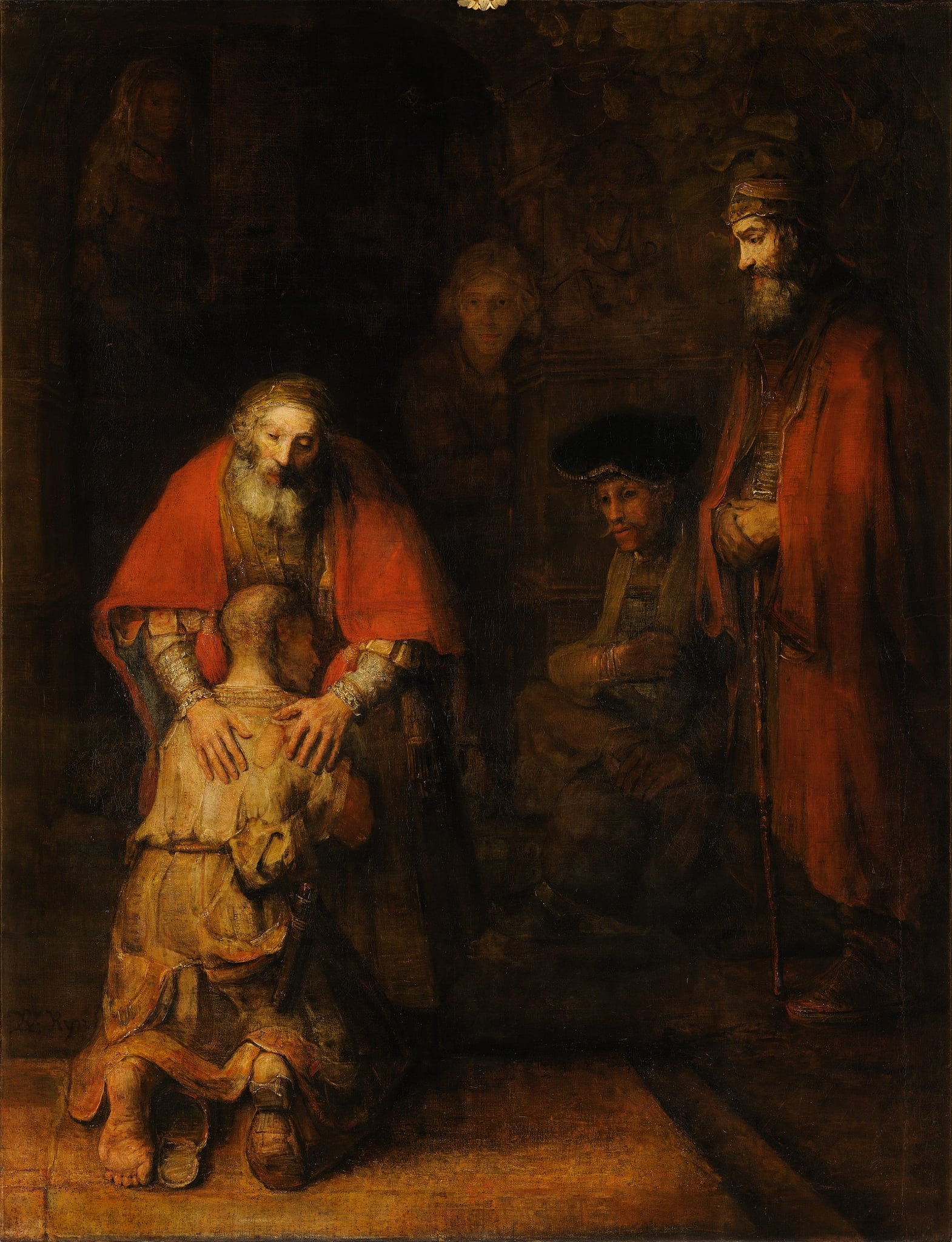
The Return of the Prodigal Son by Rembrandt van Rijn

The Return of the Prodigal Son

Rembrandt van Rijn (c. 1661–1669 (probably completed by 1669))

Rembrandt van Rijn’s The Return of the Prodigal Son is a late-life meditation on <strong>mercy</strong>, <strong>homecoming</strong>, and <strong>restored dignity</strong>. In a hush of dusk-like light, a ragged son kneels into his father’s <strong>embrace</strong>, while an upright elder brother holds back in shadow. The image concentrates meaning in illuminated <strong>faces, hands, and feet</strong>, turning a parable into a timeless human reckoning. <sup>[1]</sup><sup>[2]</sup>
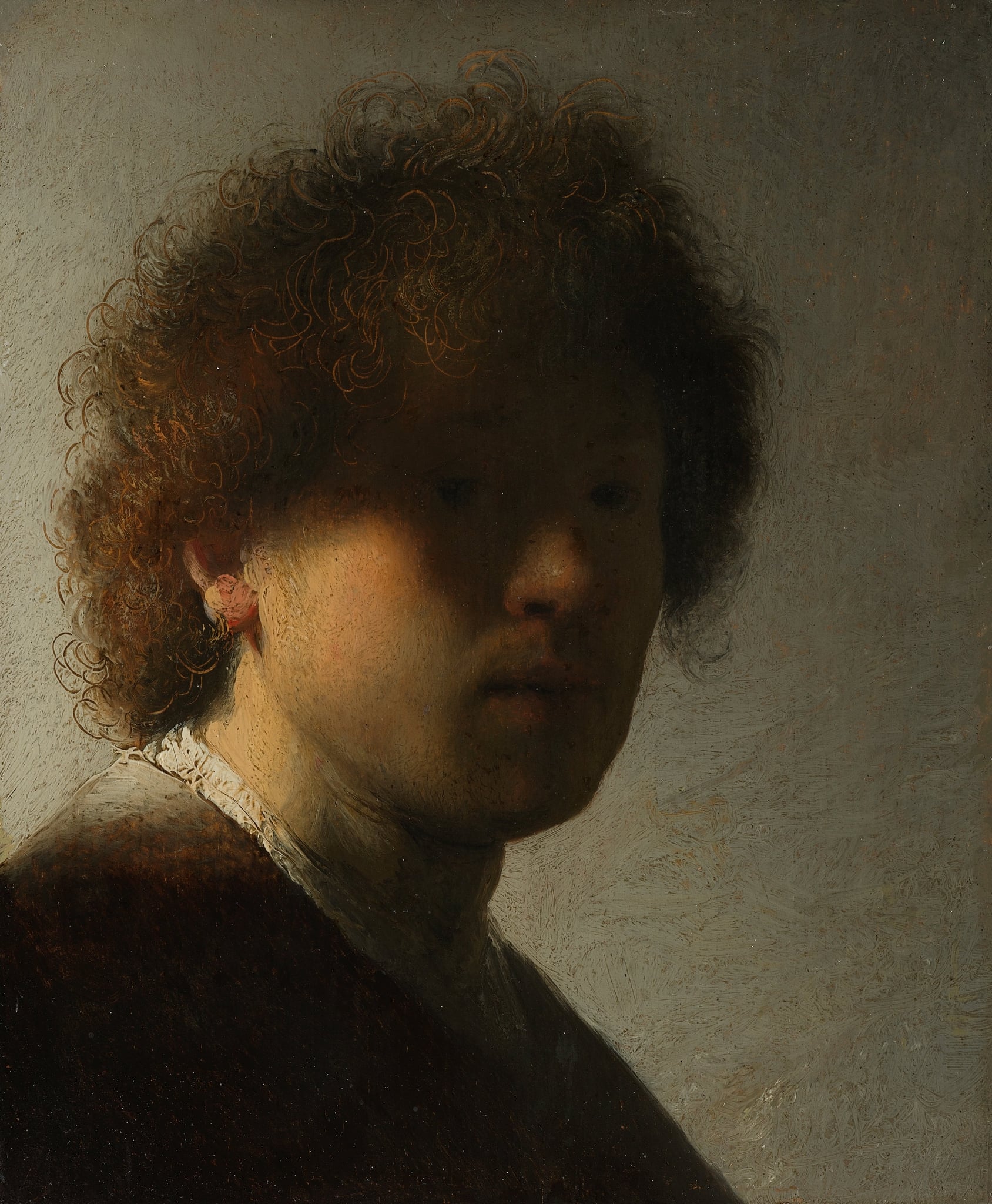
Self-portrait (with tousled hair) by Rembrandt van Rijn

Self-portrait (with tousled hair)

Rembrandt van Rijn (c. 1628)

A young Rembrandt van Rijn tests how <strong>light both reveals and withholds</strong> by letting his face emerge from darkness while his <strong>scratched, backlit curls</strong> flare like a rough halo. The small oak panel makes <strong>process itself the subject</strong>, turning hair, stubble, and a raking highlight into a statement of identity-in-formation <sup>[1]</sup><sup>[5]</sup>.
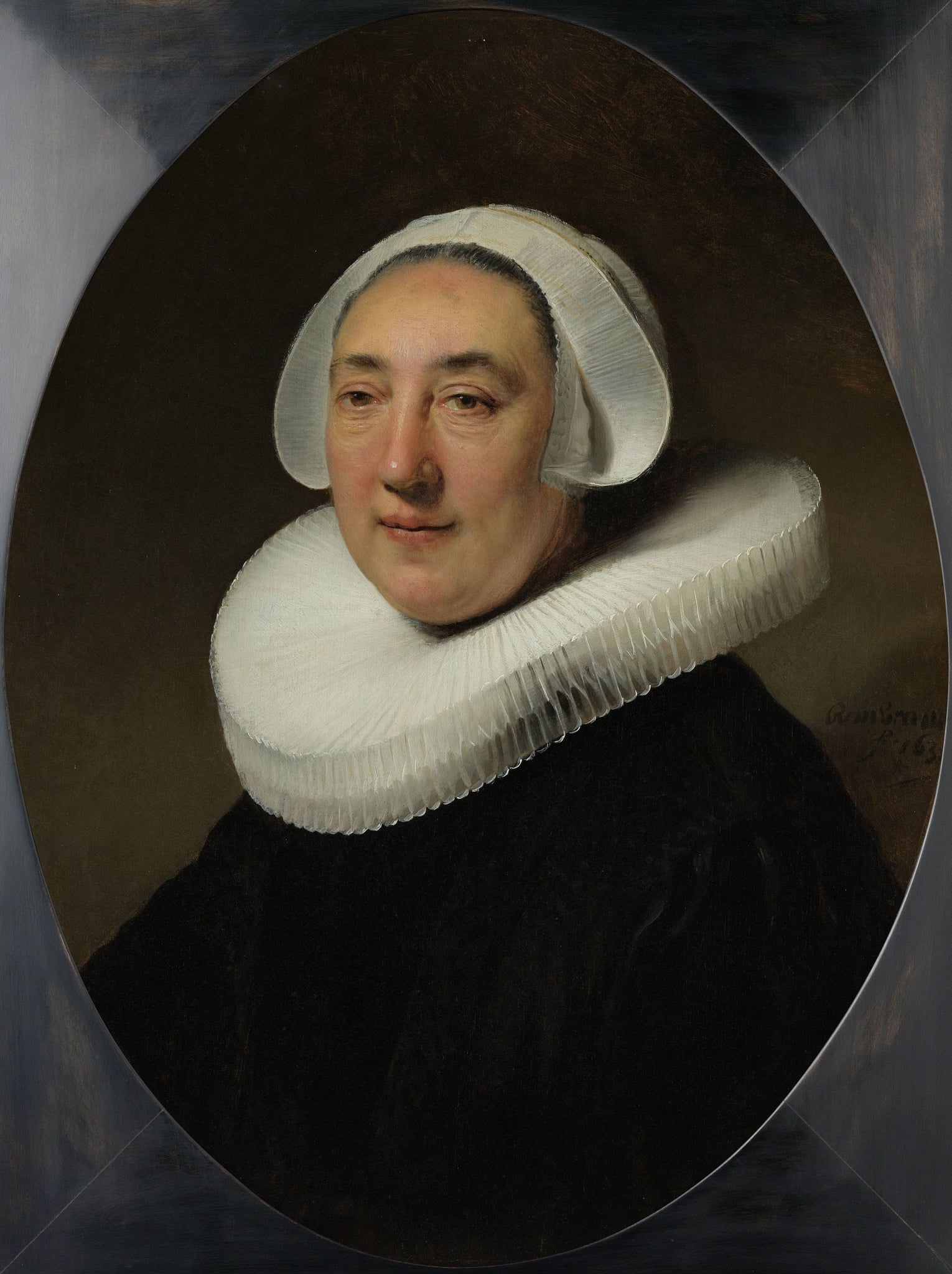
Portrait of Haesje Jacobsdr van Cleyburg by Rembrandt van Rijn

Portrait of Haesje Jacobsdr van Cleyburg

Rembrandt van Rijn (1634)

Rembrandt’s 1634 Portrait of Haesje Jacobsdr van Cleyburg stages a Dutch burgher within a feigned <strong>oval</strong> opening, illuminated by selective <strong>chiaroscuro</strong> that models warm skin against brilliant <strong>millstone ruff</strong> and sober black dress. The painting balances <strong>modesty and status</strong>, making virtue visible while quietly declaring prosperity through immaculate linen and craft <sup>[1]</sup><sup>[4]</sup>.