How Much Is Portrait of a Woman, Probably Maria Trip Worth?
Last updated: July 21, 2026
Quick Facts
- Methodology
- comparable analysis
Portrait of a Woman, Probably Maria Trip (1639) is a prime-period, fully accepted Rembrandt portrait on long-term loan to the Rijksmuseum from the Familie Van Weede Stichting. Based on scarcity, quality, and recent market benchmarks for Rembrandt portraits, we estimate a current market value of $60–100 million, subject to condition and any heritage/export constraints.
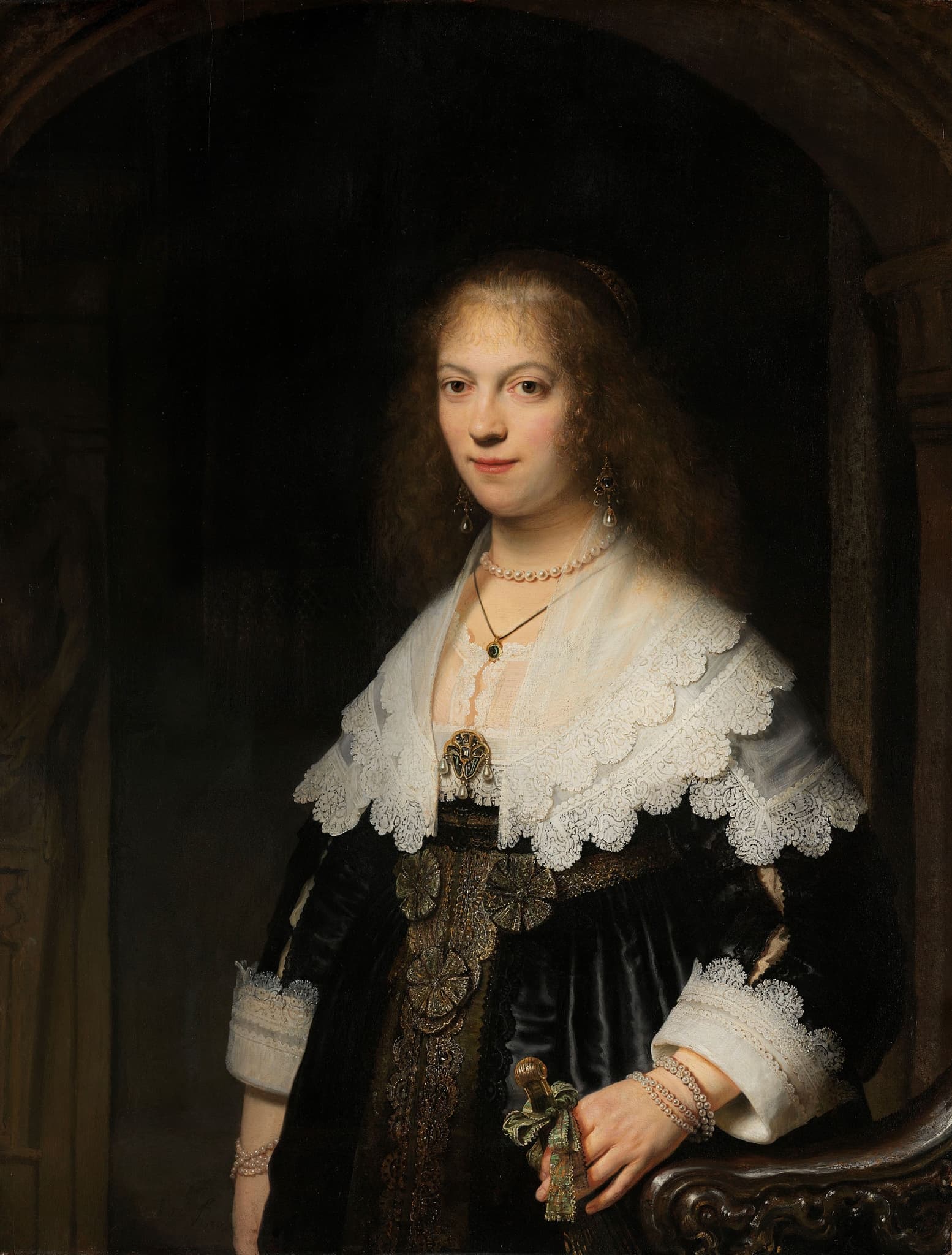
Portrait of a Woman, Probably Maria Trip
Rembrandt van Rijn, 1639 • Oil on panel (wood)
Read full analysis of Portrait of a Woman, Probably Maria Trip →Valuation Analysis
Work and status. Rembrandt’s Portrait of a Woman, Probably Maria Trip (1639) is a mature-period Amsterdam society portrait, oil on panel (c. 107 × 82 cm), signed and dated, and long catalogued as an autograph work. It is on loan to the Rijksmuseum from the Familie Van Weede Stichting (object SK‑C‑597), with documentation indicating a continuous loan since 1897 and extensive scholarly visibility [1][2]. A related preparatory drawing in the British Museum further anchors the attribution and dating, and notes that the painting was subsequently cut down from its original format [3].
Method and headline estimate. Using a comparable-analysis approach, we bracket value against: (i) the top auction benchmark for a Rembrandt painting, Christie's London 2009 Portrait of a Man, Half-Length, with His Arms Akimbo at $33.2m (≈$49m inflation-adjusted to mid‑2020s) [4]; (ii) smaller 1630s portraits that have recently sold in the $14–23m zone; and (iii) ceiling-setting private acquisitions for apex works—the 1634 full-length Soolmans/Oopjen pendants at €160m and the 1636 full-length Standard Bearer at €175m, both museum-priority outliers that are not like-for-like but demonstrate demand at the very top [5][6]. On quality, scale, date, and desirability, Maria Trip sits well above the small-format portrait comparables and plausibly above the inflation-adjusted 2009 auction record, but materially below the unique full-length trophies. This supports an estimated range of $60–100 million.
Key drivers. First, scarcity: fully accepted, prime-decade Rembrandt portraits of substantive scale seldom reach the market. The work’s autograph status, maturity of handling, and subject-type (a patrician portrait with rich costume and surface) align with persistent global demand for cross-category “trophy” Old Masters [1]. Second, market positioning: while Old Master paintings rarely match the peak prices of Modern/Contemporary art publicly, best-in-class Rembrandts continue to set category benchmarks, and recent years have seen renewed depth at the high end alongside record prices for drawings and prints that reflect broad enthusiasm for the artist’s oeuvre [4][5][6].
Condition, format, and risk. Value is contingent on a current, independent condition assessment. The British Museum notes the panel has been cut down—a factor to underwrite in any sale, though not uncommon in 17th‑century portraiture and often mitigated if the painted surface is stable, legible, and attractively presented [3]. As the work is in the Netherlands and on long-term public display, any sale could encounter Dutch/EU cultural‑property review or retention efforts, which may shape timing and buyer pool but do not negate demand; in some precedents, national-interest processes have culminated in high-value state or joint acquisitions [6].
Conclusion. Balancing autograph quality, prime date, substantial scale, scholarship, and extreme scarcity against format adjustments and potential heritage constraints, we value Rembrandt’s Portrait of a Woman, Probably Maria Trip at $60–100 million today. This positioning is above recent small-format portrait results and near-to-above the inflation-adjusted public auction benchmark for a Rembrandt painting, while remaining well below unique full-length, museum-priority trophies [4][5][6].
Key Valuation Factors
Art Historical Significance
High ImpactPainted in 1639, this portrait belongs to Rembrandt’s prime Amsterdam decade, when his portraiture combined psychological acuity with dazzling surface effects. The sitter—traditionally linked to Maria Trip—represents the city’s patrician milieu, and the work is signed and dated, with a related preparatory drawing in the British Museum supporting the attribution and design. It has been extensively published and exhibited through its long tenure at the Rijksmuseum, cementing its place in the canon. While not a monumental full-length like the Soolmans/Oopjen pair, it stands as a major, mature work within Rembrandt’s portrait output, with the scale, finish, and date that top-tier buyers prioritize.
Rarity and Market Supply
High ImpactAutograph Rembrandt portraits of this caliber and period almost never reach the open market. The painting has not appeared at modern auction and has been on public loan since the 19th century, indicating long-standing private or foundation stewardship rather than market circulation. Given the very limited supply of prime 1630s Rembrandt portraits and intense museum and private demand, scarcity exerts a strong upward pull on value. When comparable-quality works do surface, they attract competition from cross-category collectors, with results that often push above historical benchmarks for Old Masters.
Condition and Technical State
High ImpactThe British Museum notes that the portrait has been cut down from its original format, a not-uncommon history for 17th-century panels but a factor that appraisers underwrite carefully. Current panel stability, surface preservation, legibility of passages (costume, lace, hands), and quality of past restorations are decisive value drivers. A recent, independent technical report (X-ray/IRR, varnish condition, retouch mapping) could shift the estimate within the proposed range. If the paint surface is fresh, coherent, and well-presented, the market typically looks past moderate format reductions; if structural issues or heavy repaint are present, value can be materially affected.
Provenance and Visibility
Medium-high ImpactThe work’s long-term loan to the Rijksmuseum from the Familie Van Weede Stichting provides exceptional visibility and scholarly endorsement. Museum display over decades reinforces attributional confidence and cultural prominence. A clear, continuous provenance and exhibition history reduce transactional risk and appeal to institutions and top private buyers. While museum exposure does not automatically raise price, it often correlates with superior demand when such works are (rarely) considered for sale, as the due diligence and literature footprint are already robust.
Legal/Heritage and Sale Mechanics
Medium ImpactAs a major Dutch cultural asset long on loan to a national museum, any prospective sale may face export review or a national-importance designation. Such processes can affect timing, buyer pool, and negotiation dynamics. Pre-emption or government-facilitated acquisitions—seen in recent Rembrandt transactions—can set high, negotiated prices but also limit competitive auction scenarios. These factors do not depress intrinsic value but can influence liquidity and the optimal route to market, favoring carefully structured private treaties with institutional partners.
Sale History
Portrait of a Woman, Probably Maria Trip has never been sold at public auction.
Rembrandt van Rijn's Market
Rembrandt van Rijn sits at the apex of the Old Masters market. Public auction prices for paintings peak at $33.2m (Christie’s London, 2009), while private, state-backed acquisitions of singular full-length portraits have reached €160m (Soolmans/Oopjen, 2016) and €175m (The Standard Bearer, 2022), underscoring museum-level demand. Recent auctions confirm depth across media: rediscovered paintings in the eight-figure range, a record $17.86m for a drawing, and a ~$4.1m record for an Old Master print. Supply of top-quality, prime-period paintings is exceptionally thin; when they appear, cross-category trophy collectors and institutions compete, often transcending typical Old Master price ceilings.
Comparable Sales
Portrait of a Man, Half-Length, with His Arms Akimbo
Rembrandt van Rijn
Same artist; major autograph portrait (half-length), broadly comparable in type and prestige to a prime-period society portrait; long-standing auction benchmark for Rembrandt paintings.
$33.2M
2009, Christie's London
~$49.5M adjusted
Self-Portrait, wearing a ruff and black hat
Rembrandt van Rijn
Same artist; 1630s autograph portrait (small bust-length) that confirms current demand for prime-decade Rembrandt portraits; useful lower-bound indicator versus a larger 1639 society portrait.
$18.7M
2020, Sotheby's London
~$23.2M adjusted
Portraits of Jan Willemsz. van der Pluym and Jaapgen Carels (pair)
Rembrandt van Rijn
Same artist; 1635 pendant portraits (bust-length, small panels). Fresh-to-market 1630s portraits that show current pricing for authenticated, smaller-format private commissions.
$14.3M
2023, Christie's London
~$15.0M adjusted
Pendant Portraits of Maerten Soolmans and Oopjen Coppit (pair)
Rembrandt van Rijn
Same artist; 1634 full-length wedding pendants, the apex of Rembrandt society portraiture. Establishes an upper ceiling for elite Rembrandt portraits against which a three-quarter/half-length like Maria Trip can be gauged.
$176.0M
2016, Private sale (joint acquisition by Rijksmuseum and Louvre)
~$234.1M adjusted
The Standard Bearer
Rembrandt van Rijn
Same artist; 1636 iconic full-length self-portrait acquired as a work of national importance. Serves as a market ceiling reference for singular, museum-priority Rembrandt portraits.
$192.5M
2022, Private sale (acquired by Dutch State/Rijksmuseum from Rothschild family)
~$209.8M adjusted
Current Market Trends
The Old Masters segment has strengthened since 2024, with a pronounced flight to quality. Buyers are selective, but best-in-class, freshly researched works outperform estimates. Rembrandt remains a bellwether: record-setting sales in prints and drawings signal broad-based demand, while rediscoveries and prime 1630s portraits have sold strongly when well-presented. Category totals in recent “Classic Week” cycles reflect steady growth, with institutional participation remaining a key force at the high end. Against this backdrop, a prime Rembrandt portrait of substantial scale would be expected to command a premium, provided condition is strong and sale logistics address heritage considerations.
Study print
Study this painting as a print
Pair the full artwork with a museum-style study sheet focused on one meaningful detail.
Sources
- Rijksmuseum object record SK-C-597
- Getty CONA: Rembrandt, Portrait of a Woman (loan since 1897)
- British Museum: Study related to Rembrandt’s Maria Trip portrait
- Christie’s: Rembrandt artist page and 2009 painting auction record
- The Art Newspaper: Soolmans & Oopjen €160m joint acquisition
- The Art Newspaper: Dutch State buys Rembrandt’s The Standard Bearer for €175m