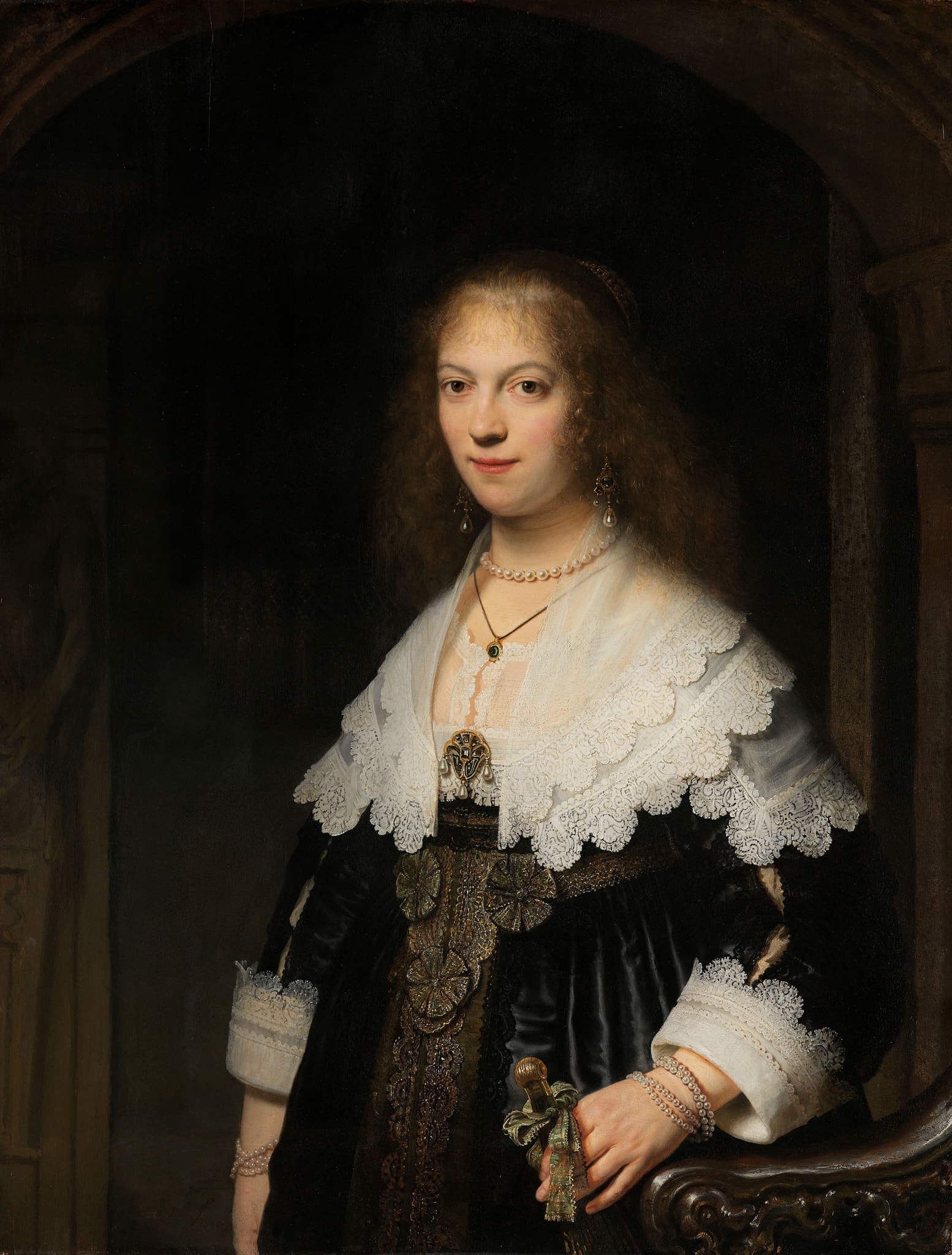
Portrait of a Woman, Probably Maria Trip

by Rembrandt van Rijn

Portrait of a Woman, Probably Maria Trip crystallizes Rembrandt’s power to bind status and psyche: a young patrician steps from a dark stone recess into a clarifying beam, her face and hands carrying the drama. Black satin, sculpted lace, and glowing pearls register wealth, but the picture’s gravitational center is the sitter’s poised inner life [1].

Study Print Studio

Create a personal study print

Build a companion study sheet around the part of this painting that speaks to you most. Choose a detail, shape an interpretation, and walk away with something personal and display-worthy.

Fast Facts

Year
1639
Medium
Oil on panel (wood)
Dimensions
107 × 82 cm
Location
Rijksmuseum, Amsterdam (on loan from the Familie Van Weede Stichting)
See all Rembrandt van Rijn paintings in Amsterdam
Portrait of a Woman, Probably Maria Trip by Rembrandt van Rijn (1639)

Click on any numbered symbol to learn more about its meaning

Meaning & Symbolism

Rembrandt engineers a theatrical entrance. Framed by a stone arch and balustrade, the sitter emerges from a dark niche whose carved figure dissolves into shadow, while a concentrated light isolates her face, throat, and hands. The right hand grounds itself on a deeply carved chair rail; the left, ringless but bracelet-laden, presents a slim folding fan tied with a green ribbon. The black satin gown—optically alive with ridges of reflected light—carries an intricate cascade of white lace that Rembrandt paints with crisp edges and gauzy translucency. A jeweled bow brooch pins the collar; tiered strings of pearls accumulate at ear, neck, and wrist. These details are not decoration but argument. In the visual language of 17th‑century Amsterdam, black was expensive, formal, and morally correct; lace and pearls were the calibrated signals of means. Rembrandt renders each material with forensic exactitude, inviting the eye to audit value, even as the chiaroscuro insists that worth finally resides in the illuminated, self-possessed face 169. The painting stakes a public claim for a private person—likely a twenty-year-old member of the arms-wealthy Trip dynasty—at a pivotal life moment. The Rijksmuseum notes the Chinese folding fan as “still very rare and therefore precious” in 1639; its presence folds the global market into the sitter’s body language, advertising access to exotic imports and the family’s mercantile reach 18. The bow-form jewel likewise tracks elite fashion, updating tradition without violating civic restraint 7. Together with pearls—primarily status goods in Dutch secular portraiture—the ensemble articulates prosperity while avoiding overt spectacle; Rembrandt anchors it in tranquillitas, the poised stillness prized in patrician self-presentation 69. The architecture amplifies that claim. The arch operates as a civic proscenium, a stone signature of stability; yet Rembrandt’s light denies it priority, pushing masonry back so that the living presence addresses us first. He calibrates psychology with minute asymmetries: the near-smile kept in check, the forward weight of the right arm, the slightly elevated left wrist that turns the fan into a token of control. The result is a portrait that reads as a contract between wealth and virtue—luxury acknowledged, character adjudicated by light. This balance also registers Rembrandt’s Amsterdam network. In 1639 he paints other Trip relations, and later he will portray the formidable Jacob Trip and Margaretha de Geer; sustained patronage explains the grandeur of format and the unblinking scrutiny applied to costly surfaces 45. But the higher ambition is pictorial ethics. By staging the sitter’s emergence from shadow into clarity, Rembrandt equates social standing with moral lucidity. He refuses anecdote—no vanitas skull, no domestic bustle—because the point is not sermonizing but judgment: do the materials and manner cohere into dignity? In his hands they do. That is why Portrait of a Woman, Probably Maria Trip is important: it codifies the Dutch Golden Age’s ideal of respectable magnificence and shows, with unmatched authority, how painting can weigh wealth against inner measure—and make both shine 19.

Explore Deeper with AI

Ask questions about Portrait of a Woman, Probably Maria Trip

Popular questions:

Powered by AI • Get instant insights about this artwork

💬 Ask questions about this artwork!

Interpretations

Global Luxury and the Amsterdam Trade Imagination

The sitter’s small, Chinese folding fan does more than accessorize; it is a portable emblem of Amsterdam’s 17th‑century trade system. The Rijksmuseum underscores that such fans were “still very rare and therefore precious” in 1639, marking access to elite import channels and the Trips’ arms‑wealth milieu 1. Folding fans’ East Asian origins and their gradual European diffusion further heighten the object’s novelty, converting global exchange into embodied display 8. In Rembrandt’s hands the fan becomes a hinge between body and world: a tactile proof of mercantile connection, but also a tool of comportment that regulates gesture and gaze. The accessory thus literalizes how Dutch portraiture could materialize the empire of goods while preserving a surface of civic restraint.

Source: Rijksmuseum

Costume Semiotics: Black Satin, Lace, and Pearls

Early modern Dutch viewers read fabrics fluently. In Amsterdam, deep black satin announced expense and formality; the collar’s high‑grade lace and the crisp rendering of its picots and scallops functioned as calibrated signals of rank 14. The layered pearls add a secular status code—more ledger than sermon—matching National Gallery and NGA cautions against over‑moralizing jewelry in such portraits 46. Rembrandt’s facture intensifies these signs: raked highlights over satin’s warp and weft, impasted lace edges, and differentiated pearl lustres create a taxonomy of materials that viewers could “audit.” The result is a social script written in texture, where sober tonality satisfies civic propriety even as every thread proclaims cost.

Source: National Gallery (London)

Patronage Ecology: The Trip Network and Pictorial Grandeur

This portrait sits within a sustained Trip patronage web. In 1639 Rembrandt also painted Maria’s mother, Aletta Adriaensdr. (Boijmans), and decades later her uncle and aunt, Jacob Trip and Margaretha de Geer, in imposing London pendants 29. Such continuity explains the work’s ambitious half‑length scale, architectural staging, and meticulous attention to costly surfaces: a portrait calibrated for a dynasty whose civic capital derived from arms and trade. A related drawing in the British Museum supports the identification and date, suggesting a deliberate program of representation across family members 3. Patronage here shapes not only finish and grandeur but also the image’s ethos—a cultivated blend of sobriety and magnificence designed to endure across generations and inventories.

Source: Museum Boijmans Van Beuningen / National Gallery (London)

Tranquillitas and the Ethics of Bearing

Seventeenth‑century portrait theory prized tranquillitas—controlled affect, poised stillness—as a visible index of inner governance. Adams’s framework clarifies how Rembrandt composes that ethic through asymmetries: the forward‑weighted right arm, the hovered left wrist with fan, the near‑smile checked at the lips 10. The architecture recedes while a disciplined chiaroscuro advances the face and hands as sites of self‑command 1. This is not anecdote but adjudication: do demeanor and material concord? The picture’s authority comes from that fusion—virtuoso texture yoked to measured carriage—so that social standing appears as the outward sign of inward composure. In this lens, light reads as character evidence, not mere illumination.

Source: CAA Reviews (Ann Jensen Adams)

Courtship Codes: The Fan and the Marriage Market

Fashion historians have read the handheld fan as a courtship device—an instrument of codified gesture and flirtation. The sitter’s age and her documented 1641 marriage make a pre‑marital context plausible, with the fan signaling availability within strict propriety 7. Yet the Rijksmuseum stresses rarity and value rather than erotics, reminding us that in Amsterdam’s sober portrait culture, status display often subsumed overt love symbolism 1. A nuanced reading holds both: the fan mediates between public respectability and private intent, its green ribbon and delicate folds turning global luxury into a socially legible token of readiness, while remaining anchored in the rhetoric of wealth and decorum.

Source: Fashion History Timeline (FIT)

Related Themes

About Rembrandt van Rijn

Rembrandt van Rijn (1606–1669) was a leading Dutch Golden Age painter and printmaker whose Amsterdam years (from 1631) produced virtuosic portraits and ambitious history paintings. In the early 1630s he favored polished finishes, saturated color, and theatrical staging—qualities on display in this 1633 canvas. Although prolific, this is his only known painted seascape [2][4].
View all works by Rembrandt van Rijn

More by Rembrandt van Rijn
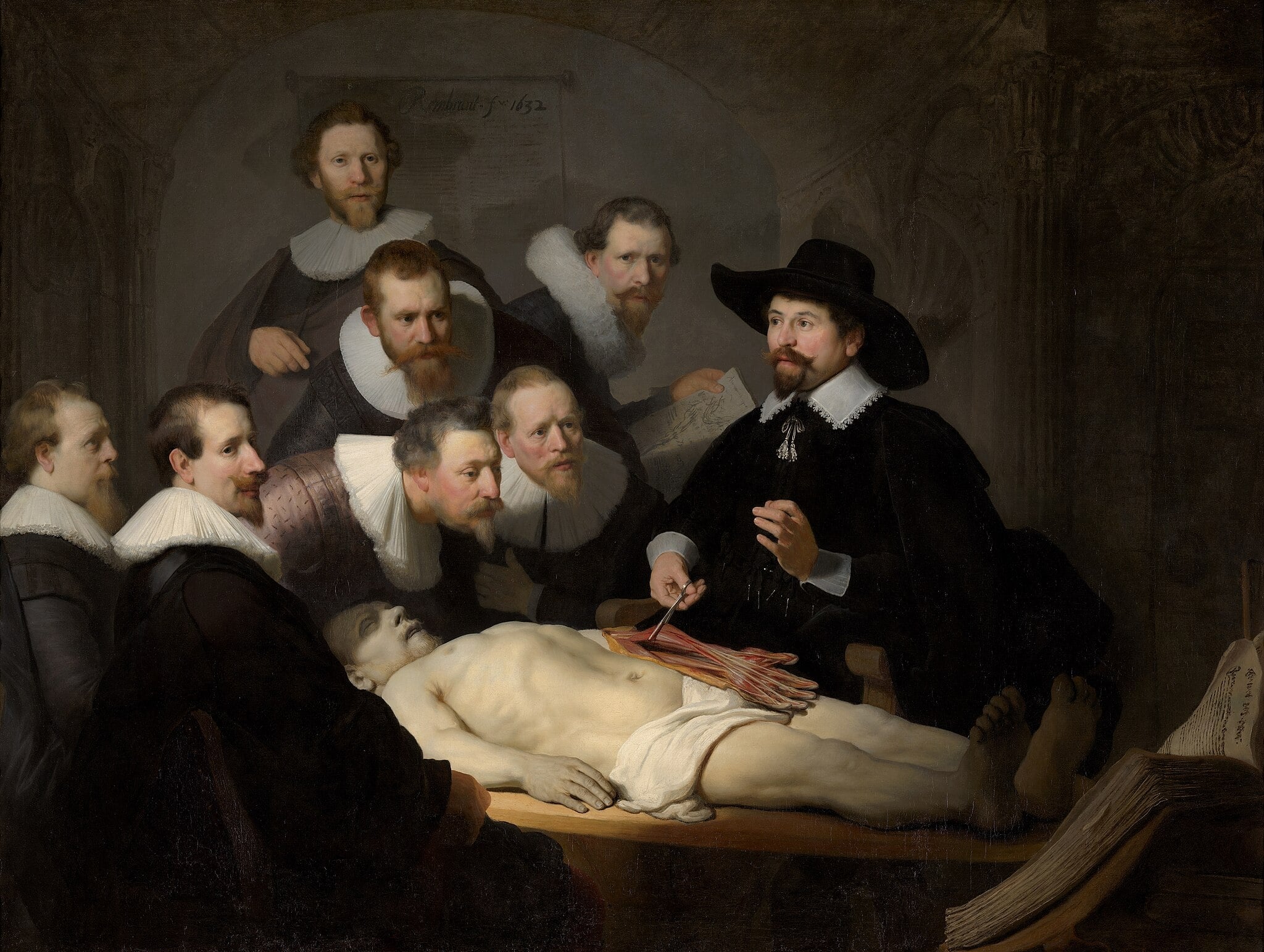
The Anatomy Lesson of Dr. Nicolaes Tulp by Rembrandt van Rijn

The Anatomy Lesson of Dr. Nicolaes Tulp

Rembrandt van Rijn (1632)

Rembrandt van Rijn turns a civic commission into a drama of <strong>knowledge made visible</strong>. A cone of light binds the ruff‑collared surgeons, the pale cadaver, and Dr. Tulp’s forceps as he raises the <strong>forearm tendons</strong> to explain the hand. Book and body face each other across the table, staging the tension—and alliance—between <strong>textual authority</strong> and <strong>empirical observation</strong> <sup>[1]</sup><sup>[2]</sup>.
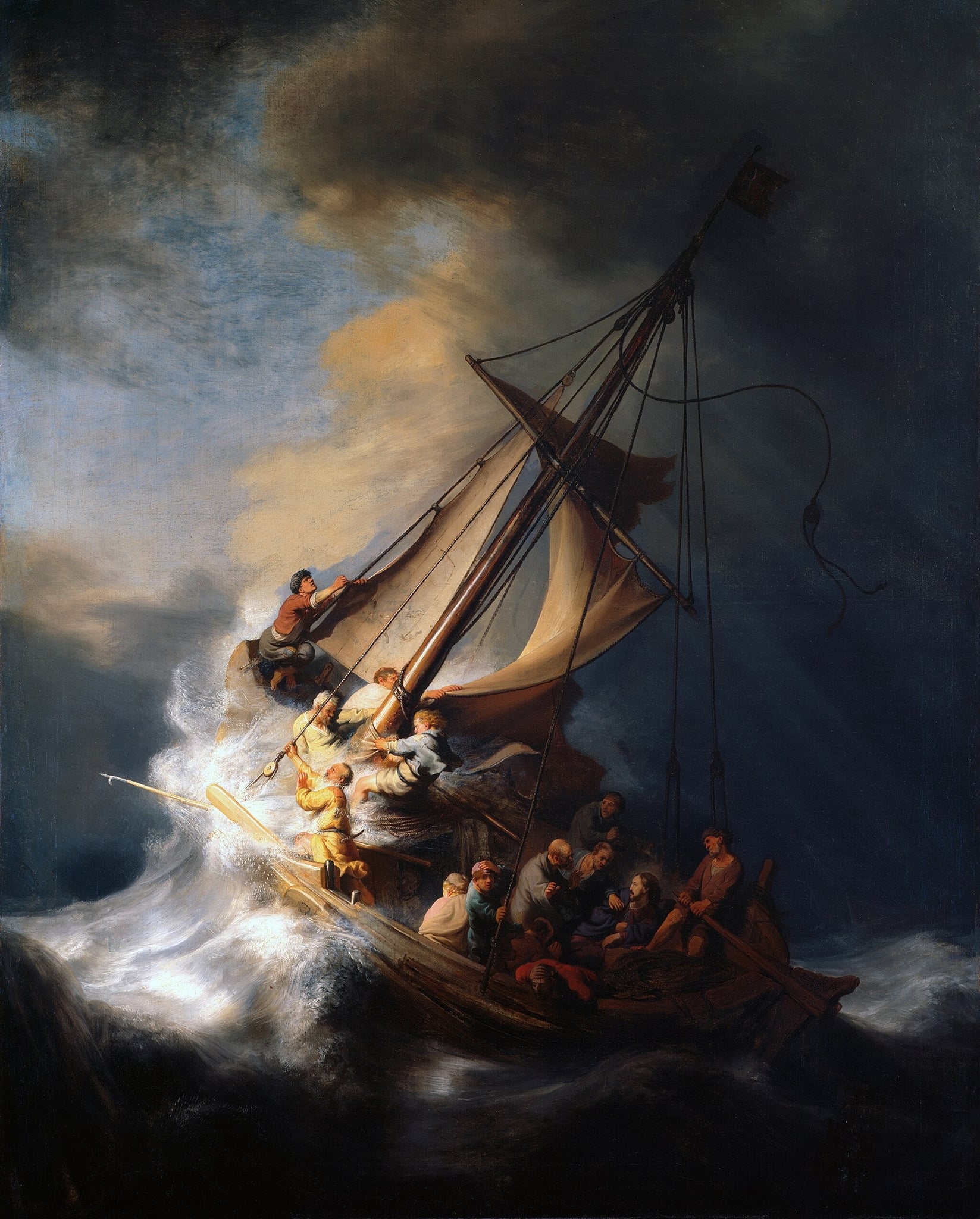
The Storm on the Sea of Galilee by Rembrandt van Rijn

The Storm on the Sea of Galilee

Rembrandt van Rijn (1633)

Rembrandt van Rijn’s The Storm on the Sea of Galilee stages a clash of <strong>human panic</strong> and <strong>divine composure</strong> at the instant before the miracle. A torn mainsail whips across a steeply tilted boat as terrified disciples scramble, while a <strong>serenely lit Christ</strong> anchors a pocket of calm—an image of faith holding within chaos <sup>[1]</sup><sup>[3]</sup>. It is Rembrandt’s only painted seascape, intensifying its dramatic singularity in his oeuvre <sup>[2]</sup>.
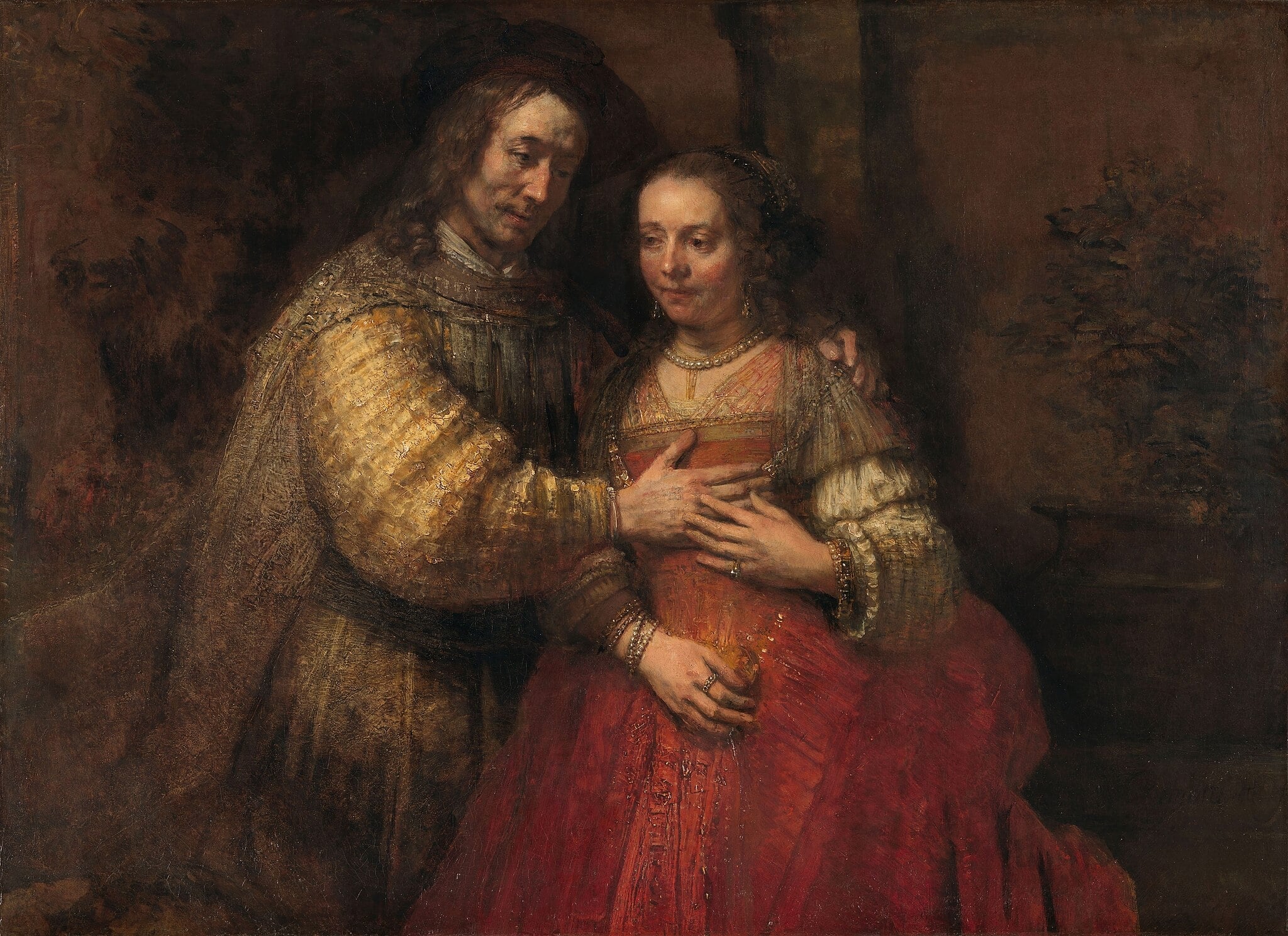
The Jewish Bride by Rembrandt van Rijn

The Jewish Bride

Rembrandt van Rijn (c. 1665–1669)

The Jewish Bride by Rembrandt van Rijn stages an intimate covenant: two figures, read today as <strong>Isaac and Rebecca</strong>, seal their union through touch rather than spectacle. Light concentrates on faces and hands, while the man’s glittering <strong>gold sleeve</strong> and the woman’s <strong>coral-red gown</strong> turn paint itself into a metaphor for fidelity and tenderness <sup>[1]</sup><sup>[3]</sup>. This late masterpiece embodies Rembrandt’s <strong>material eloquence</strong>—impasto as feeling—within a hushed, dark setting <sup>[1]</sup><sup>[2]</sup>.
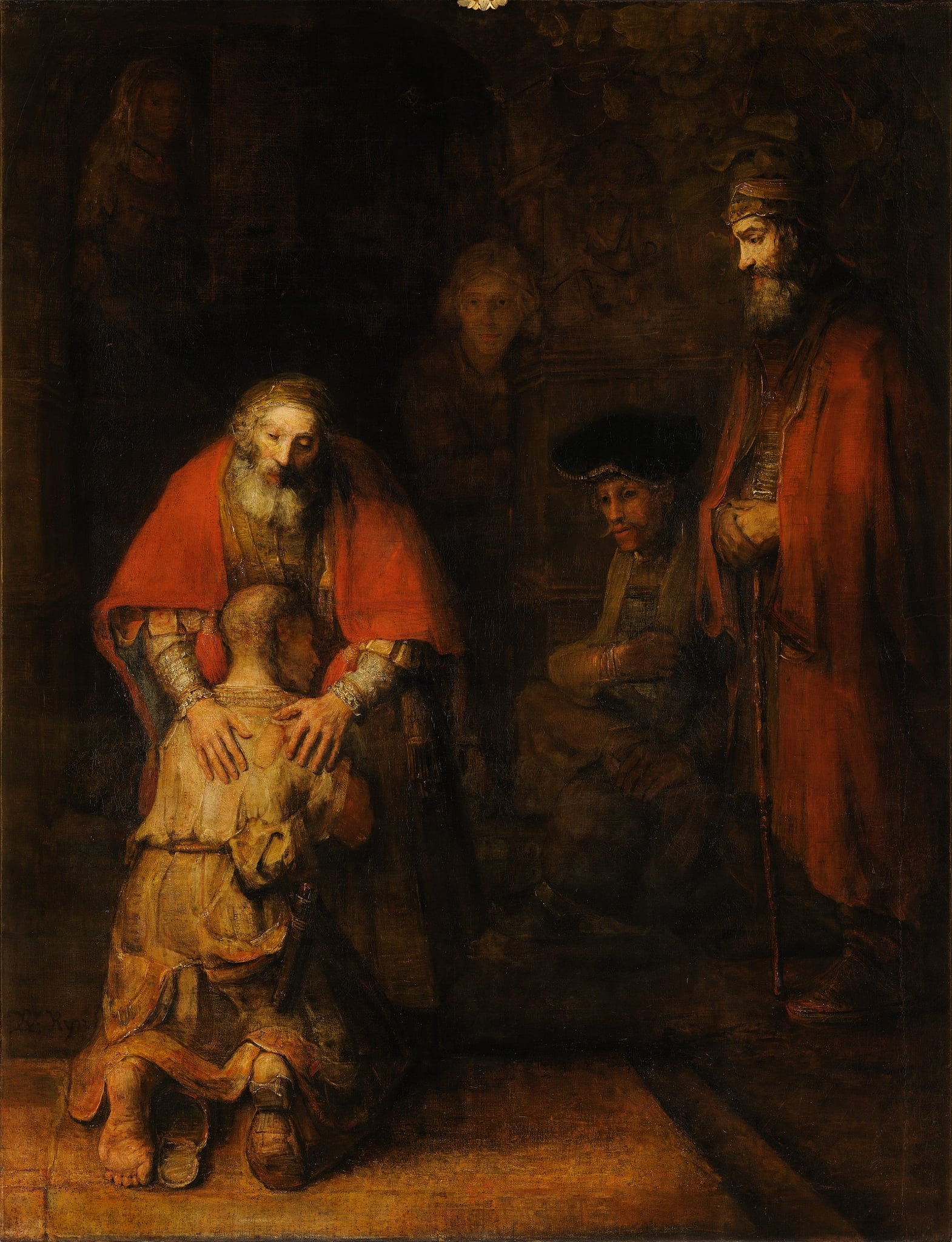
The Return of the Prodigal Son by Rembrandt van Rijn

The Return of the Prodigal Son

Rembrandt van Rijn (c. 1661–1669 (probably completed by 1669))

Rembrandt van Rijn’s The Return of the Prodigal Son is a late-life meditation on <strong>mercy</strong>, <strong>homecoming</strong>, and <strong>restored dignity</strong>. In a hush of dusk-like light, a ragged son kneels into his father’s <strong>embrace</strong>, while an upright elder brother holds back in shadow. The image concentrates meaning in illuminated <strong>faces, hands, and feet</strong>, turning a parable into a timeless human reckoning. <sup>[1]</sup><sup>[2]</sup>
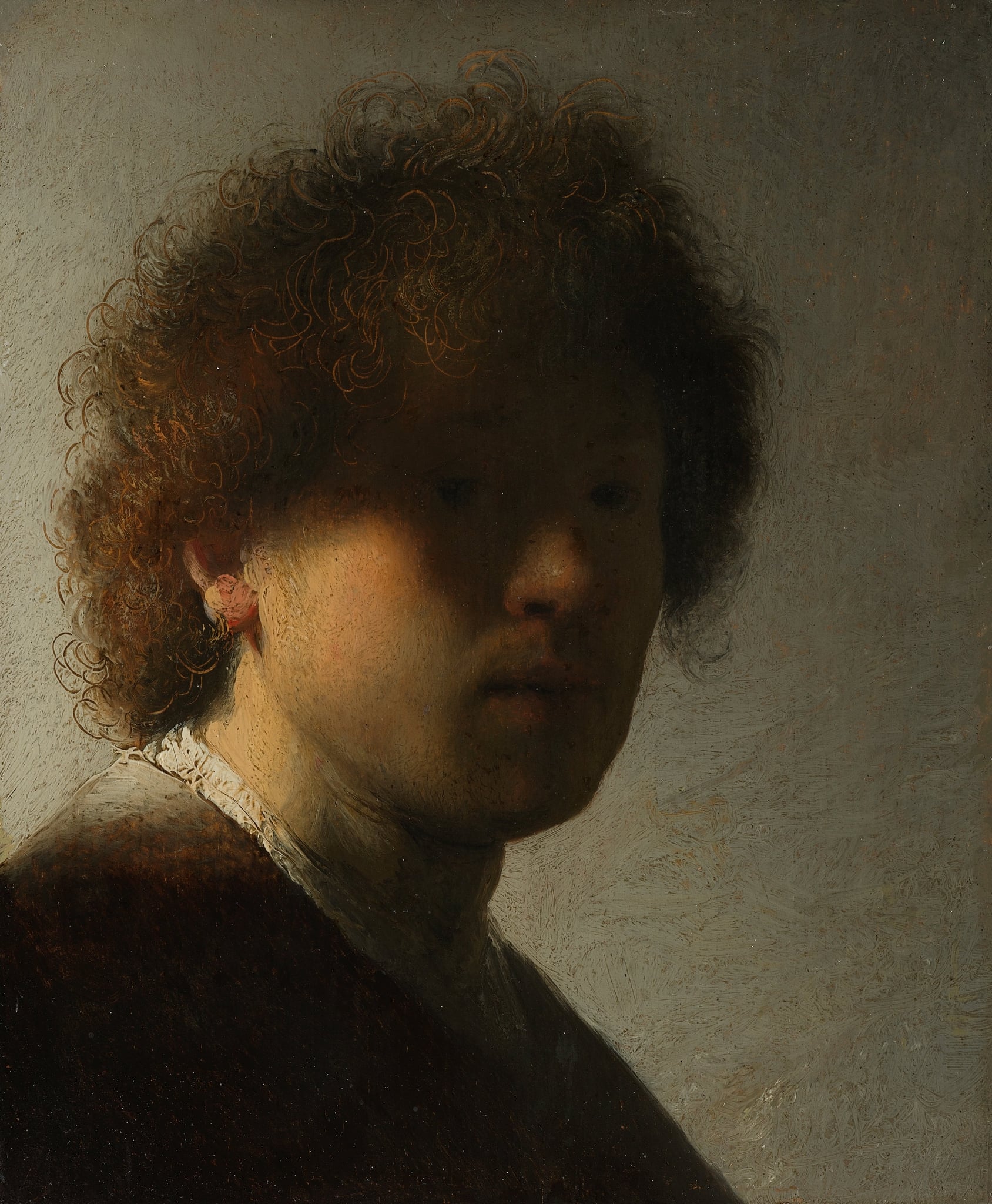
Self-portrait (with tousled hair) by Rembrandt van Rijn

Self-portrait (with tousled hair)

Rembrandt van Rijn (c. 1628)

A young Rembrandt van Rijn tests how <strong>light both reveals and withholds</strong> by letting his face emerge from darkness while his <strong>scratched, backlit curls</strong> flare like a rough halo. The small oak panel makes <strong>process itself the subject</strong>, turning hair, stubble, and a raking highlight into a statement of identity-in-formation <sup>[1]</sup><sup>[5]</sup>.
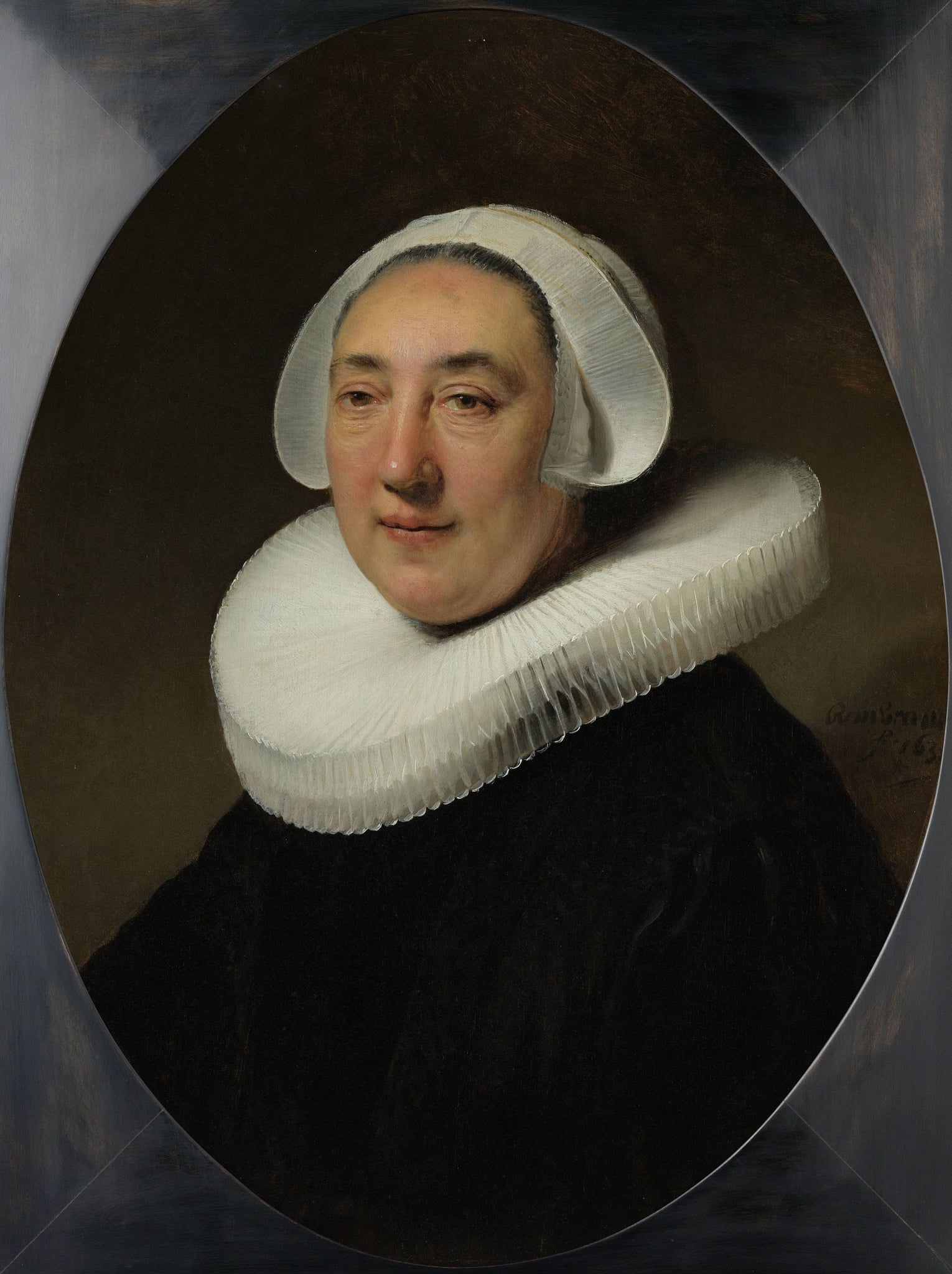
Portrait of Haesje Jacobsdr van Cleyburg by Rembrandt van Rijn

Portrait of Haesje Jacobsdr van Cleyburg

Rembrandt van Rijn (1634)

Rembrandt’s 1634 Portrait of Haesje Jacobsdr van Cleyburg stages a Dutch burgher within a feigned <strong>oval</strong> opening, illuminated by selective <strong>chiaroscuro</strong> that models warm skin against brilliant <strong>millstone ruff</strong> and sober black dress. The painting balances <strong>modesty and status</strong>, making virtue visible while quietly declaring prosperity through immaculate linen and craft <sup>[1]</sup><sup>[4]</sup>.