How Much Is Portrait of Aechje Claesdr. Worth?
Last updated: August 25, 2026
Quick Facts
- Methodology
- comparable analysis
Based on prime date (1634), autograph status, and museum-grade provenance, Rembrandt’s Portrait of Aechje Claesdr. would likely command $32–48 million if hypothetically offered today. The range triangulates public-auction benchmarks for Rembrandt portraits, tempered by format and boosted by scarcity and institutional pedigree.
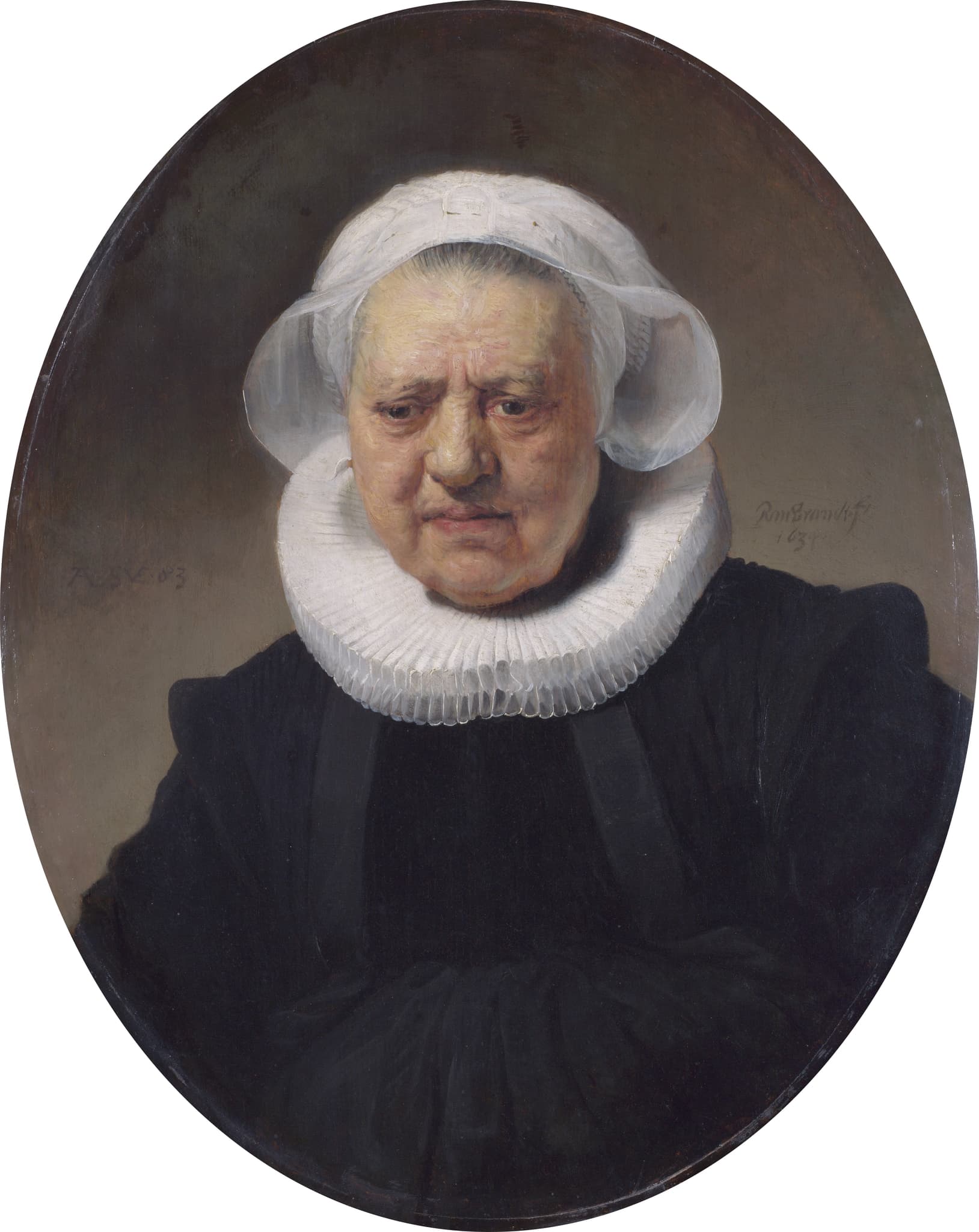
Portrait of Aechje Claesdr.
Rembrandt van Rijn, 1634 • Oil on oak panel
Read full analysis of Portrait of Aechje Claesdr. →Valuation Analysis
Conclusion: A prudent current-market valuation for Rembrandt’s Portrait of Aechje Claesdr. (1634) is $32–48 million. This synthesis rests on public auction benchmarks for Rembrandt portraits, the painting’s prime early Amsterdam date, autograph standing per the National Gallery’s catalogue, and the powerful confidence signal of century-and-a-half museum stewardship [1].
How the estimate was derived: Public auction pricing for Rembrandt portraits has historically clustered in the high seven to mid-eight figures, with the standing auction record at £20.2m (approx. $33m at the time) for Portrait of a Man, Half-length, with his Arms Akimbo (Christie’s London, 2009) [2]. More recently, Sotheby’s London sold the rediscovered early panel The Adoration of the Kings for £10.97m ($13.8m) in December 2023, underscoring robust demand for authenticated, well-presented early works even at modest scale [5]. Exceptional private/state acquisitions—such as the 1634 full-length pendants of Maerten Soolmans and Oopjen Coppit (c. €160m for the pair) and the Dutch state’s 2022 purchase of The Standard Bearer (1636) for €175m—set an absolute ceiling for rare, emblematic trophies but are not direct format/importance comparables for Aechje [3][4].
Work-specific positioning: Aechje Claesdr. is a single-figure oil-on-panel from 1634, a highly desirable moment in Rembrandt’s portrait practice. The scale (c. 71 × 56 cm), classic oval framing, and dignified characterization align it with the market’s most liquid Rembrandt portrait typologies. Its museum-grade provenance (National Gallery, London, since 1867) enhances buyer confidence and would likely widen the bidder base if hypothetically deaccessioned [1]. While not a life-size full-length or a culturally iconic image on the order of The Standard Bearer, it is a refined, attractive example of the artist’s early Amsterdam portraiture, a segment with persistent depth.
Adjustments and sensitivities: The midpoint of this range assumes: (1) broad scholarly consensus on autograph status; (2) strong, stable panel condition with no material structural issues; and (3) an appealing, legible surface free from extensive overpaint or abrasion. Perfect condition and consensus could push competition toward the upper 40s; meaningful condition or attributional caveats would compress the result toward the low 30s. Private treaty could plausibly exceed a public auction outcome, given extreme scarcity and reduced execution risk for buyers at this level.
Market context: Supply of undisputed Rembrandt paintings is exceptionally thin, and high-quality portraits seldom appear. The 2009 record and the 2023 early-panel sale provide practical anchors for today’s auction environment, while the 2016 and 2022 state acquisitions confirm the extraordinary headroom reserved for singular, emblematic works [2][3][4][5]. Against that backdrop, Aechje Claesdr. prices credibly into the mid–high eight figures, below the outlier “national treasure” tier yet well above typical early-panel narratives, reflecting its quality, date, and institutional pedigree [1].
Key Valuation Factors
Art Historical Significance
High ImpactPainted in 1634, the work belongs to Rembrandt’s prime early Amsterdam portrait period, when he developed the nuanced psychology and masterful handling that define his maturity. The sitter’s presence, the sober elegance of the oval, and the assured lighting align the painting with the high-demand segment of Rembrandt’s portrait oeuvre. While not a universally iconic image, it stands as a refined, authoritative example of his early 1630s portrait style, making it both institutionally and privately desirable.
Rarity and Supply Dynamics
High ImpactAutograph Rembrandt paintings are acutely scarce in private hands; most top-tier examples reside in museums. Fresh supply of high-quality portraits is infrequent, meaning any securely attributed, well-preserved example can catalyze deep bidding. This structural scarcity supports sustained pricing power and provides a natural floor for credible works, particularly from sought-after periods like the early-to-mid 1630s.
Provenance and Institutional Pedigree
High ImpactContinuous museum ownership by the National Gallery, London, since 1867 confers exceptional credibility. Such provenance mitigates concerns over authenticity, title, and conservation history, and it widens the audience of qualified buyers (private and institutional) in any hypothetical sale scenario. Museum pedigree typically translates into stronger participation and firmer pricing, especially for Old Masters.
Format/Scale and Marketability
Medium ImpactAs a single-figure, mid-scale portrait on panel, the work sits in a highly tradable format for Rembrandt. While it lacks the spectacle—and price tier—of life-size full-lengths or nationally emblematic images, it benefits from display versatility and broad collector appeal. This supports liquidity at the high end but caps the upside below the ‘trophy’ tier achieved by rare full-lengths and culturally iconic works.
Condition and Technical Integrity
Medium ImpactPanel stability, absence of significant splits/joins, minimal overpaint, and an attractive varnish surface are critical value drivers. The indicated range assumes sound structural condition and an appealing surface consistent with National Gallery standards. Any disclosed structural issues or extensive restorations would compress the estimate; conversely, excellent condition would enhance competitive tension and support the upper band.
Sale History
Christie & Manson, London
William Wells (Redleaf) sale, lot 115; bought by Sir Charles Eastlake for £252. Subsequently acquired by the National Gallery from Lady Eastlake in 1867 (price not published).
Rembrandt van Rijn's Market
Rembrandt van Rijn occupies the apex of the Old Master market: blue-chip, globally collected, and exceptionally scarce in top-quality paintings. The standing public-auction record for a Rembrandt painting is the 2009 Christie’s London result of £20.2m (c.$33m at the time) for Portrait of a Man, Half-length, with his Arms Akimbo. Private/state acquisitions for singular works have reached far higher levels, notably the €160m Louvre/Rijksmuseum joint purchase of the 1634 full-length pendants of Maerten Soolmans and Oopjen Coppit, and the Dutch state’s €175m acquisition of The Standard Bearer (1636). Demand is selective but deep; consensus-quality works with strong provenance reliably draw competition, while compromised or routine material is penalized.
Comparable Sales
Portrait of a Lady, aged 62 (1632)
Rembrandt van Rijn
Closest direct comparable: early Amsterdam-period Rembrandt portrait of an older woman (female sitter), half-length on panel, 1632 vs. Aechje’s 1634; very similar subject/format/period.
$28.7M
2000, Christie's London
~$52.5M adjusted
Portrait of a Man, Half-length, with his Arms Akimbo (1658)
Rembrandt van Rijn
Same artist; authoritative single-figure portrait that still stands as the artist’s auction record. Serves as an upper-bound benchmark for public auction pricing of Rembrandt portraits.
$33.0M
2009, Christie's London
~$48.5M adjusted
Self-portrait (1632)
Rembrandt van Rijn
Early-1630s half-length on panel; while a self-portrait (which carries a rarity premium), it anchors pricing for strong, compact early portraits close in date to Aechje (1634).
$18.7M
2020, Sotheby's London
~$22.8M adjusted
The Adoration of the Kings (c. 1628)
Rembrandt van Rijn
Same artist; small early panel painting with fresh scholarship, giving a very recent market datapoint for autograph works. Narrative subject (not a portrait), so used as a conservative lower anchor.
$13.8M
2023, Sotheby's London
~$14.2M adjusted
Portrait of Maerten Soolmans (1634) — per-painting share of joint purchase
Rembrandt van Rijn
Same year as Aechje (1634) and among the most coveted full-length portraits by Rembrandt. Not directly comparable in format/scale (life-size, full-length trophy), but defines the 1634 portrait ‘blue-chip’ ceiling in private deals.
$88.0M
2016, Private sale (Louvre/Rijksmuseum joint acquisition of the pair at €160m total; ≈€80m each)
~$115.3M adjusted
The Standard Bearer (De Vaandeldrager) (1636)
Rembrandt van Rijn
Iconic single-figure half-length acquired by the Dutch State; close in date and format scale, but an outlier ‘national treasure’ with unique cultural weight. Serves as an absolute high watermark for Rembrandt single-figure works.
$198.9M
2022, Private sale to Dutch State/Rijksmuseum
~$214.8M adjusted
Current Market Trends
Old Masters remain a selective, quality-led market with constrained supply at the top. Recent results confirm that authenticated, well-presented Rembrandts—particularly from the early 1630s—attract vigorous bidding, as seen with Sotheby’s 2023 sale of an early panel. Meanwhile, museum and state purchases for culturally emblematic works demonstrate substantial private-treaty headroom. Net: scarcity, institutional confidence, and period appeal continue to underpin firm pricing for blue-chip Dutch Golden Age portraits, with condition and scholarly consensus the decisive swing factors.
Study print
Study this painting as a print
Pair the full artwork with a museum-style study sheet focused on one meaningful detail.
Sources
- National Gallery (London) – Object record: Portrait of Aechje Claesdr.
- ABC News (2009) – Rembrandt breaks auction records (Christie’s London, £20.2m)
- Musée du Louvre – Press on Maerten Soolmans and Oopjen Coppit restoration/acquisition (pair, €160m)
- Dutch Government – Purchase of Rembrandt’s The Standard Bearer (€175m)
- Sotheby’s – The Adoration of the Kings (c.1628) sale result, London, 6 Dec 2023