How Much Is Portrait of Margaretha de Geer, Wife of Jacob Trip Worth?
Last updated: August 18, 2026
Quick Facts
- Methodology
- comparable analysis
Hypothetical fair‑market value for Rembrandt’s Portrait of Margaretha de Geer, Wife of Jacob Trip is estimated at $140–180 million. The range is anchored by recent nine‑figure private/state acquisitions of masterpiece‑level Rembrandt portraits and the work’s status as a major late, autograph pendant in pristine institutional standing. Scarcity of comparable late portraits and pendant significance support a firm nine‑figure outcome if the work were tradable.
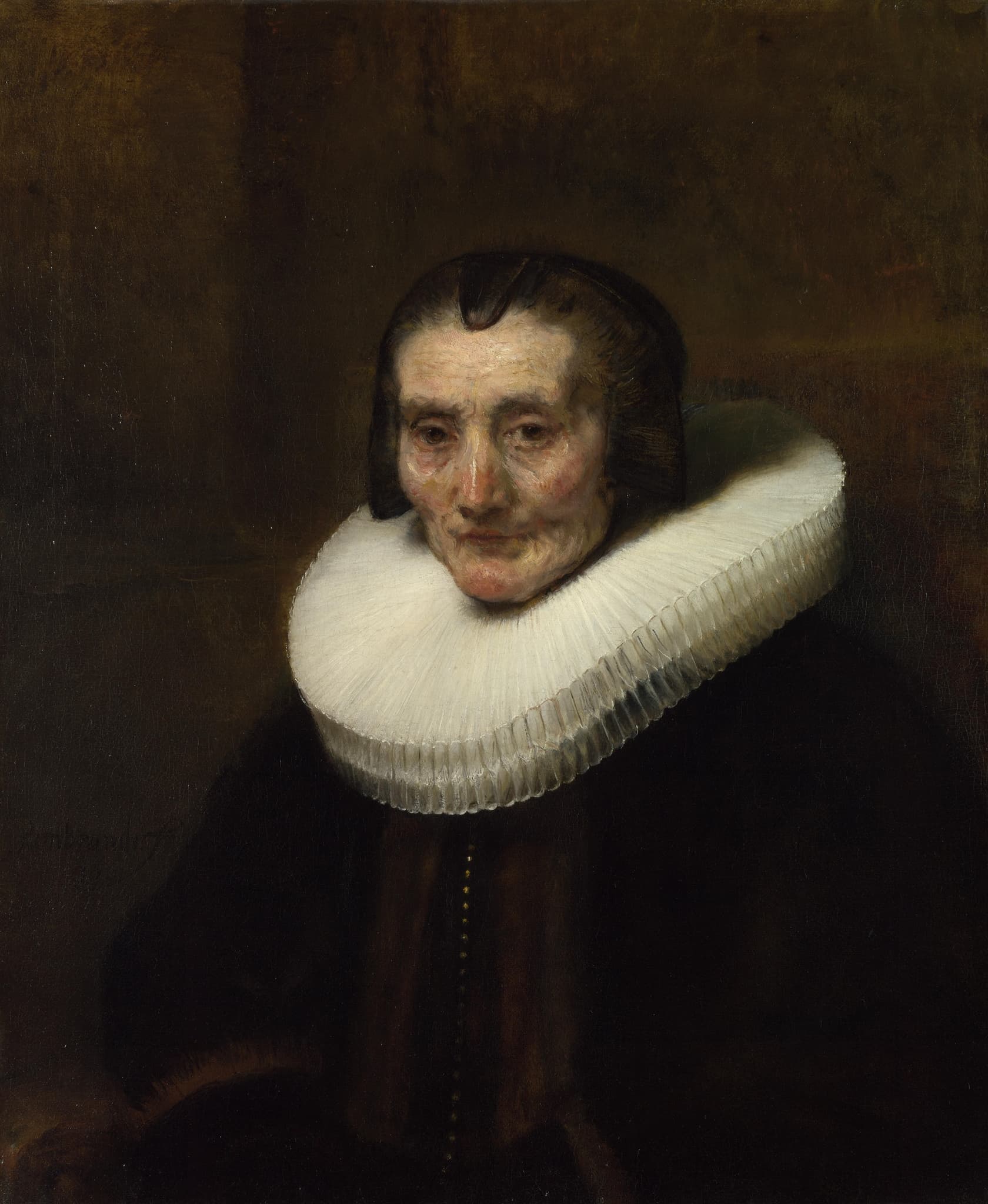
Portrait of Margaretha de Geer, Wife of Jacob Trip
Rembrandt van Rijn, about 1661 • Oil on canvas
Read full analysis of Portrait of Margaretha de Geer, Wife of Jacob Trip →Valuation Analysis
Overview. Portrait of Margaretha de Geer, Wife of Jacob Trip (c.1661) is a late, fully accepted Rembrandt of exceptional quality, long held by the National Gallery, London (NG1675) as the pendant to Portrait of Jacob Trip. It exemplifies Rembrandt’s late portrait style—probing characterization, restrained palette, and masterly brushwork—and is widely regarded as a touchstone within his late female portraits [1].
Method and comparables. The estimate is derived from cross‑checking top‑tier Rembrandt portrait benchmarks with recent Old Master price signals. Two modern nine‑figure transactions define the ceiling for masterpiece‑level Rembrandt portraiture: the 2016 private sale of the full‑length pendant pair Maerten Soolmans and Oopjen Coppit for €160m (~$180m at the time) [2], and the Dutch State’s 2022 acquisition of Rembrandt’s The Standard Bearer for €175m (~$198m) [3]. By contrast, auction benchmarks for Rembrandt paintings sit far lower due to the rarity of truly apex portraits at public sale; the standing auction record remains Portrait of a Man, Half‑Length, with His Arms Akimbo (1658) at ~$33.2m (2009) [4], while vetted but smaller/earlier works such as The Adoration of the Kings achieved ~$13.8m in 2023 [5].
Positioning this work. Margaretha de Geer is a late, three‑quarter‑length pendant portrait of museum caliber with unimpeachable authorship and historic visibility [1]. It stands below the unique, nationally symbolic Standard Bearer and the once‑in‑a‑generation full‑length Soolmans/Oopjen pair in terms of scale, spectacle, and national‑icon status, but above recent auction comparables in rarity, period, and quality. This justifies a value significantly above auction records and within the nine‑figure bracket set by modern private/state acquisitions, yet conservatively below the topmost two benchmarks.
Deriving the range. On this basis, a fair‑market value of $140–180 million is appropriate today, assuming excellent condition, uncontested autograph status, and normal market liquidity. The lower bound reflects a cautious discount to Standard Bearer and the Soolmans/Oopjen pair for differences in scale and the absence of national‑treasure dynamics; the upper bound recognizes the work’s late period, pendant significance, and extreme scarcity of comparable late Rembrandt portraits in private hands. Reuniting the pendant, securing pre‑sale institutional interest, or presenting fresh technical scholarship could plausibly drive outcomes toward or above the top of this range. The National Gallery acquired the pair in 1899 via a £12,500 Treasury‑funded private treaty [6], and the painting has had no modern public sale; this valuation is therefore hypothetical but grounded in current market evidence.
Key Valuation Factors
Art Historical Significance
High ImpactThis is a premier example of Rembrandt’s late portraiture—one of the most celebrated female likenesses of his mature period and a fixture in the National Gallery’s Dutch holdings. Its deep psychological insight, restrained tonality, and highly worked surface embody the qualities that define Rembrandt’s late style and underpin his enduring critical stature. The painting’s long scholarly and exhibition history, together with extensive reproduction in the literature, position it among the most important late portraits outside Amsterdam. Such canonical status materially elevates market value by aligning the work with blue‑chip, academically established masterpieces that attract cross‑category trophy collectors and institutions.
Quality, Period, and Autograph Status
High ImpactExecuted circa 1661, the portrait belongs to Rembrandt’s late period, when his handling became broader and more expressive and his characterization most profound. The work is fully accepted as autograph and has benefited from decades of institutional care and research, minimizing attribution or condition risk relative to privately held works. Late, autograph Rembrandt portraits of this scale and authority are exceptionally scarce. In today’s market, this combination—late date, major subject category, and secure attribution—commands a substantial premium versus earlier or workshop‑involved portraits, and sits within the narrow pool of objects that can legitimately support nine‑figure pricing.
Scarcity and Market Supply
High ImpactMasterpiece‑level Rembrandt portraits almost never appear at auction; the most relevant modern signals have been nine‑figure private or state acquisitions. The 2016 sale of the Soolmans/Oopjen pair and the 2022 acquisition of The Standard Bearer demonstrate deep, global willingness to pay at this level when truly great Rembrandts surface. By contrast, public‑auction records remain far lower, reflecting supply constraints rather than demand weakness. This supply imbalance enhances the value of any late, museum‑caliber Rembrandt portrait hypothetically released to the market, as a small cohort of buyers—major institutions and top‑tier private collectors—would likely compete intensely.
Pendant Relationship and Ensemble Value
Medium ImpactAs the pendant to Portrait of Jacob Trip, the work benefits from the intellectual and historical gravitas of a complete marital pair. Pendants can command ensemble premiums when kept or marketed together. Even as a standalone, Margaretha’s identity, narrative context, and match to the companion picture add depth and prestige that support the upper end of the valuation range. If the two works were ever reunited in a coordinated transaction, the resulting narrative power, press interest, and curatorial enthusiasm would likely produce incremental price uplift above the single‑picture baseline.
Sale History
National Gallery, London (UK Treasury transfer/private treaty)
Acquired together with the pendant Portrait of Jacob Trip from Lord de Saumarez for £12,500; approximate USD shown at 1899 gold‑parity; pair price covering NG1674 & NG1675.
Rembrandt van Rijn's Market
Rembrandt van Rijn occupies the pinnacle of the Old Masters market, with demand concentrated on unassailable, museum‑grade works. While his auction record for a painting stands at ~$33.2m (2009), modern market leadership is defined by nine‑figure private or state acquisitions for apex portraits and iconic single figures. The 2016 €160m private sale of the Soolmans/Oopjen pendants and the Netherlands’ €175m purchase of The Standard Bearer in 2022 attest to contemporary depth for masterpiece‑level Rembrandts. Recent sales of vetted but smaller works at auction, typically in the teens of millions, reinforce the scarcity—and pricing power—of late, autograph portraits. Collectors prize impeccable authorship, condition, and distinguished provenance, with institutions remaining decisive buyers at the top.
Comparable Sales
Portraits of Maerten Soolmans and Oopjen Coppit (pair)
Rembrandt van Rijn
Same artist; apex-level pendant portraits of a married couple at grand scale. The pendant dynamic mirrors Margaretha’s role as a pair with Jacob Trip. Establishes a modern, nine‑figure benchmark for top Rembrandt portraiture.
$180.6M
2016, Christie's Private Sales (to Rijksmuseum/Louvre partnership)
~$234.8M adjusted
The Standard Bearer
Rembrandt van Rijn
Same artist; iconic single‑figure, grand-scale portrait acquired as a national treasure. Demonstrates contemporary nine‑figure appetite for masterpiece‑level Rembrandt portraiture.
$198.0M
2022, Dutch State/Rijksmuseum (private acquisition)
~$212.3M adjusted
Portrait of a Man, Half-Length, with His Arms Akimbo
Rembrandt van Rijn
Same artist; late-period (1658) male portrait of imposing character. Remains the auction record for a Rembrandt painting and is a key auction benchmark for late portraits.
$33.2M
2009, Christie's London
~$48.5M adjusted
Self‑Portrait (with ruff and black hat)
Rembrandt van Rijn
Same artist; portrait category with unimpeachable authorship and strong market visibility. Smaller early work, but a recent signal for pricing of autograph Rembrandt portraits at auction.
$18.7M
2020, Sotheby's London
~$22.6M adjusted
Portrait of Jan Willemsz. van der Pluym and Jaapgen Carels (pendant busts, sold together)
Rembrandt van Rijn
Same artist; pendant portraits of a couple, offering a pendant‑pair analogue to Margaretha and Jacob Trip. Smaller bust-lengths and earlier in date, but a fresh, vetted portrait pair with strong press and demand.
$14.3M
2023, Christie's London
~$14.6M adjusted
Portrait of a Young Man Holding a Roundel
Sandro Botticelli
Cross‑artist Old Master portrait benchmark at auction. Confirms nine‑figure capacity for iconic pre‑modern portraiture, relevant to ceiling setting for a masterpiece‑level Rembrandt portrait.
$92.2M
2021, Sotheby's New York
~$106.9M adjusted
Current Market Trends
The Old Masters segment remains polarized: routine material faces selectivity, while best‑in‑class works elicit fierce competition. Since 2021, headline results have clustered around rare, blue‑chip names and compelling narratives, with Rembrandt at the forefront. Nine‑figure private/state acquisitions set the segment’s ceiling, while public‑auction comparables are constrained by limited supply of truly great pictures. Against a backdrop of variable macro conditions, top‑tier objects—with secure attribution, strong exhibition histories, and institutional visibility—continue to clear at robust prices. Within this context, a late, autograph Rembrandt portrait of the quality of Margaretha de Geer would confidently transact in the nine figures if hypothetically available.
Study print
Study this painting as a print
Pair the full artwork with a museum-style study sheet focused on one meaningful detail.
Sources
- National Gallery, London – Object page (NG1675)
- The Art Newspaper – France and the Netherlands finalise €160m Rembrandt treaty (2016)
- Rijksmuseum – Rembrandt’s The Standard Bearer acquisition announcement (2022)
- Christie’s – Post‑sale release: 8 December 2009 (Rembrandt auction record)
- Artnet News – London Old Masters Week results (Dec 2023)
- National Gallery Archive – 28 Jan 1899 Treasury transfer for purchase