How Much Is Portrait of Philips Lucasz. Worth?
Last updated: August 11, 2026
Quick Facts
- Methodology
- comparable analysis
Hypothetical fair‑market value for Rembrandt’s Portrait of Philips Lucasz. (1635) is $50–80 million. This range reflects its prime date, strong authorship standing within a major museum collection, and scarcity of autograph Rembrandt portraits, tempered by noted assistant participation in limited passages.
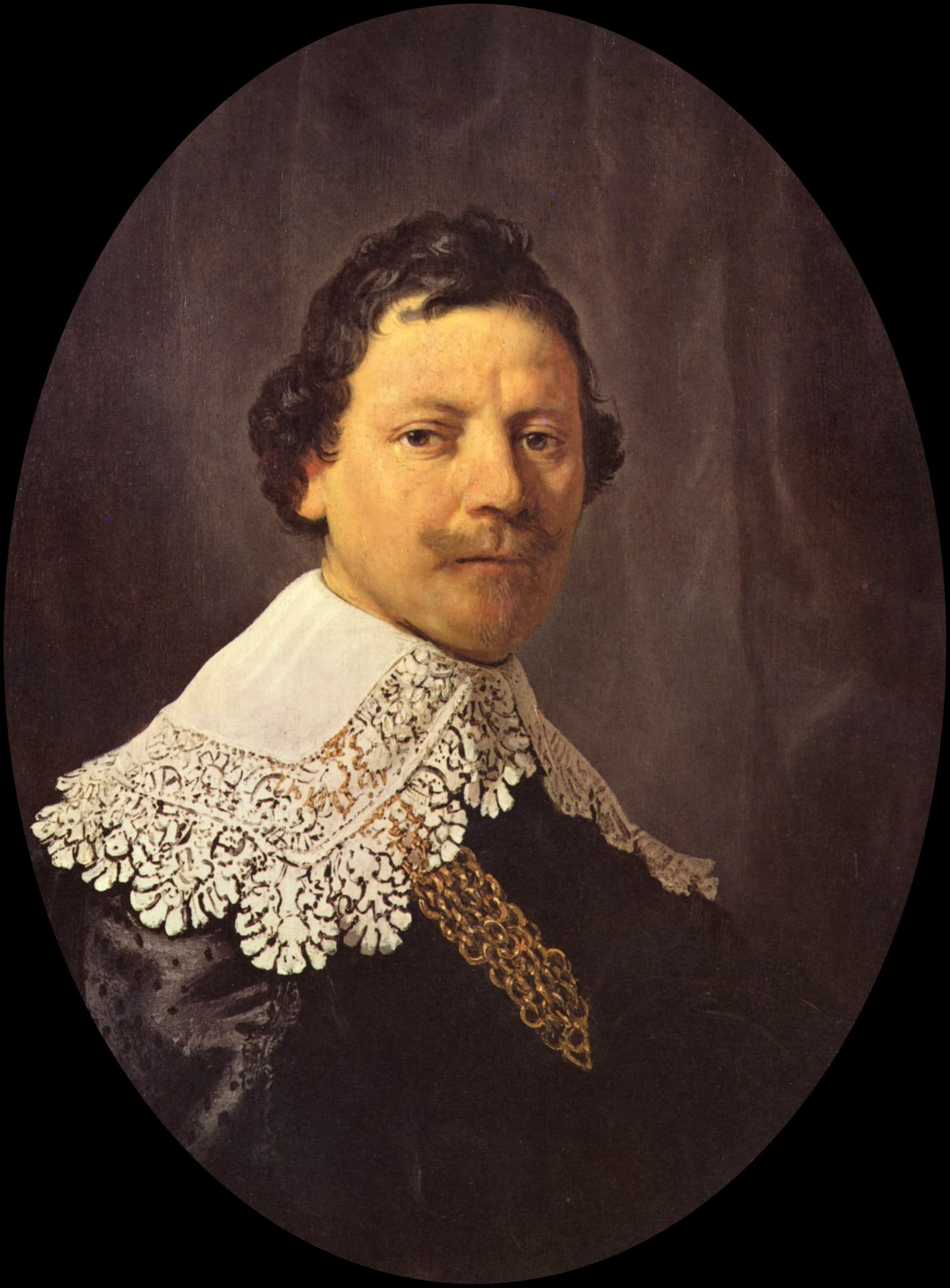
Portrait of Philips Lucasz.
Rembrandt van Rijn, 1635 • Oil on oak panel
Read full analysis of Portrait of Philips Lucasz. →Valuation Analysis
Conclusion: Based on prime-period authorship, format, scarcity and recent benchmarks, a disciplined hypothetical fair‑market value for Rembrandt’s Portrait of Philips Lucasz. is $50–80 million. The work is signed and dated 1635—an especially desirable Amsterdam portrait phase—long accepted and held by the National Gallery, London, which also notes likely assistant participation in localized passages such as the collar and the shadow at the mouth [1].
Comparables and bracketing: Public-auction benchmarks for major Rembrandt portraits have reached £20.2m ($33.2m) with premium for Portrait of a Man, Half-Length, with His Arms Akimbo (Christie’s, 2009), which in today’s money sits near the high‑forties (USD) and provides a critical floor for a top half‑length portrait appearing at scale on the open market [2]. At the apex of private treaty, the full‑length wedding pendants of Maerten Soolmans and Oopjen Coppit sold jointly to the Louvre and Rijksmuseum for €160m (≈€80m each), establishing the modern ceiling for Rembrandt portraiture of this period and underscoring how format and grandeur leverage price [3]. Lucasz., as an authoritative but half‑length panel, properly values below those once‑in‑a‑generation full‑lengths. The direct pendant to this commission, Petronella Buys, realized £3.37m in 2017 at Christie’s; however, that price reflected its separate handling, attribution debate and market context, and it is not determinative for Lucasz. in a modern, blue‑chip setting [4].
Positioning and adjustments: The $50–80m range situates Portrait of Philips Lucasz. materially above rediscovered or smaller‑scale works and in line with the current scarcity premium for prime 1630s Rembrandt portraits, while applying a prudent discount for the National Gallery’s note of assistant participation [1]. Importantly, the market has demonstrated a willingness to pay well in excess of prior public auction records for apex Rembrandts in private settings, as seen with The Standard Bearer (Dutch State/Rijksmuseum, €175m in 2022) [5]. Lucasz. is not equivalent in subject or format to that picture, but these acquisitions confirm the depth of demand at the very top and help anchor the upper bound of our bracket.
Practical considerations: The work resides in a UK national collection and is unlikely to be deaccessioned; this valuation is therefore hypothetical and calibrated to a fair‑market context. Should the portrait be reunited and marketed with its pendant, fully endorsed as autograph and in optimal condition, strategic pairing dynamics could lift the outcome within or modestly above this range. Conversely, any adverse condition findings would compress it. On balance, the $50–80m estimate best reflects today’s quality‑driven Old Masters market for a museum‑grade, prime‑period Rembrandt portrait.
Key Valuation Factors
Art Historical Significance
High ImpactPainted in 1635, Portrait of Philips Lucasz. belongs to Rembrandt’s early Amsterdam prime, when his portrait commissions were at a high artistic and commercial level. The work is representative of his mature handling of light, psychology, and status projection at a moment central to his oeuvre. While not as public‑facing or monumental as the iconic full‑lengths or civic group portraits, it is a fully credible, signed period portrait of a known sitter. Within Rembrandt’s production, such works are scarce, institutionally coveted, and academically well documented—factors that confer substantial art‑historical weight and support strong valuation.
Authorship and Condition
Medium ImpactThe National Gallery recognizes the painting as a signed 1635 Rembrandt and notes likely assistant participation in limited passages (collar, mouth shadow). This nuance is important: any perception of appreciable workshop execution typically moderates price relative to fully autograph peaks. Conversely, the authoritative signature, institutional acceptance, and long scholarly citation mitigate risk and underpin market confidence. A current technical file (panel health, imaging, restoration history) would be decisive in tightening the estimate, but on publicly available information the authorship merits a high valuation with a prudent discount for the assistant elements.
Format, Scale, and Scarcity
High ImpactAs a half‑length oil on panel, the portrait sits one tier below Rembrandt’s life‑size full‑lengths in market hierarchy, which have commanded the highest private prices. However, the supply of fully accepted Rembrandt portraits of any format is exceedingly thin. When such works surface, competition is intense, particularly for prime 1630s examples with compelling sitters and strong condition. This combination of desirable period and extreme scarcity justifies a significant premium over smaller studies or rediscoveries and supports the $50–80 million range despite the more modest format relative to the full‑length apex.
Provenance and Institutional Validation
High ImpactThe painting’s early provenance, its inclusion in the eminent Peel Collection, and its acquisition by the National Gallery (1871) provide exceptional pedigree and curatorial validation. Long institutional stewardship tends to solidify attribution and scholarship, reduce transactional risk, and enhance buyer confidence. While museum ownership also makes an actual sale unlikely, the same qualities—clean title, deep literature, and public visibility—would be rewarded in any hypothetical market scenario. This provenance profile is a key reason the painting should trade well above lesser‑documented Rembrandts if it ever reached the open market.
Sale History
Portrait of Philips Lucasz. has never been sold at public auction.
Rembrandt van Rijn's Market
Rembrandt van Rijn is among the most coveted Old Masters. Public auction prices for autograph paintings have historically clustered in the mid‑ to high‑eight figures, with the standing auction record at £20.2m ($33.2m with premium) for a major portrait in 2009. Private‑treaty prices for exceptional works have advanced far beyond that: the Louvre/Rijksmuseum jointly acquired the full‑length pendants of Maerten Soolmans and Oopjen Coppit for €160m (≈€80m each), and the Dutch State/Rijksmuseum purchased The Standard Bearer for €175m. Supply of top‑quality oils is extremely limited; when they surface, global demand is deep and institutional interest strong. The market rewards prime period, unambiguous attribution, condition, and compelling format, with significant premiums for landmark works.
Comparable Sales
Portrait of Petronella Buys (pendant to Philips Lucasz.)
Rembrandt van Rijn
Direct pendant to Philips Lucasz., same year (1635) and nearly identical size/format; strongest like-for-like market datapoint (price realized incl. premium; Christie’s provided USD).
$4.5M
2017, Christie's London, Old Masters Evening Sale
~$5.9M adjusted
Portraits of Jan Willemsz. van der Pluym and Jaapgen Carels (pendant pair)
Rembrandt van Rijn
Autograph pendant portraits (1632) from Rembrandt’s early Amsterdam period; similar genre/scale to Philips Lucasz. Sold together (price for the pair; per work ≈ half), anchoring current market appetite for Rembrandt portrait pairs.
$14.3M
2023, Christie's London, Old Masters Part I
~$15.0M adjusted
Portrait of a Man, Half-Length, with His Arms Akimbo
Rembrandt van Rijn
Major single male portrait by Rembrandt (auction record for the artist). While later in date and of grander presence than Philips Lucasz., it benchmarks the upper public-auction range for a top-tier Rembrandt portrait.
$33.2M
2009, Christie's London
~$49.5M adjusted
Portrait of Maerten Soolmans (pendant to Oopjen Coppit)
Rembrandt van Rijn
Monumental full-length marriage portrait (1634), same broad period; establishes the modern ceiling for Rembrandt portraiture in private treaty. Serves as a high-end benchmark rather than a like-for-like comparison of format.
$88.8M
2016, Private sale (joint acquisition by Rijksmuseum and Louvre)
~$118.3M adjusted
The Standard Bearer
Rembrandt van Rijn
Iconic full-length figure work (1636; near in date), widely treated as an apex Rembrandt painting. While not a commissioned portrait, it provides an upper-bound reference for prime-period, museum-caliber oils.
$198.0M
2022, Private acquisition by the Dutch State for the Rijksmuseum
~$216.4M adjusted
Current Market Trends
The Old Masters segment remains selective and quality‑driven. While broader market volatility has made buyers more discerning, apex works by brand‑name artists continue to draw intense competition and can reset price levels in private transactions. Recent high‑profile acquisitions of Rembrandts by major institutions demonstrate ample liquidity at the top, even as public auction offerings of comparable caliber remain scarce. For strong, well‑documented portraiture from the 1630s, the scarcity premium is pronounced; conversely, any ambiguity in attribution or condition is penalized. Against this backdrop, a prime, museum‑grade Rembrandt portrait commands substantial value.
Study print
Study this painting as a print
Pair the full artwork with a museum-style study sheet focused on one meaningful detail.
Sources
- National Gallery, London – Rembrandt, Portrait of Philips Lucasz.
- Christie’s press release – Rembrandt auction record (Portrait of a Man, Half-Length, with His Arms Akimbo), 8 Dec 2009
- Louvre press – Joint acquisition of Maerten Soolmans and Oopjen Coppit (total €160m)
- Christie’s – Price realized for Portrait of Petronella Buys (7 Dec 2017)
- The Art Newspaper – Dutch government agrees to buy Rembrandt’s The Standard Bearer for €175m (2022)