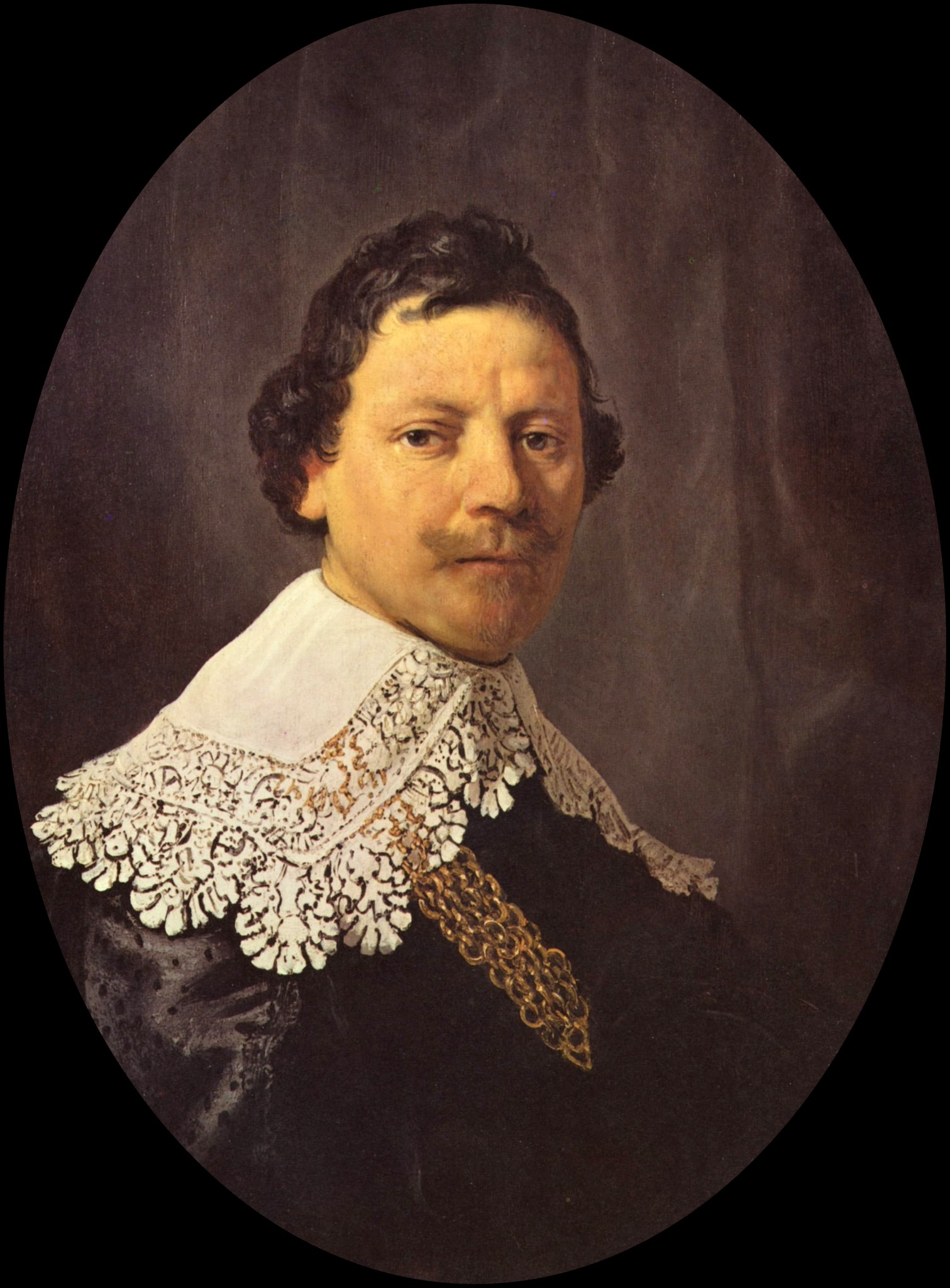
Portrait of Philips Lucasz.

by Rembrandt van Rijn

Rembrandt van Rijn’s Portrait of Philips Lucasz. distills wealth and restraint into a poised, three-quarter likeness framed by an oval field. Raking light clarifies the sitter’s steady gaze, the crisp white lace and the diagonally falling gold chain, while the deep black costume absorbs attention back to character over display [1].

Study Print Studio

Create a personal study print

Build a companion study sheet around the part of this painting that speaks to you most. Choose a detail, shape an interpretation, and walk away with something personal and display-worthy.

Fast Facts

Year
1635
Medium
Oil on oak panel
Dimensions
79.5 × 58.9 cm
Location
The National Gallery, London
See all Rembrandt van Rijn paintings in London
Portrait of Philips Lucasz. by Rembrandt van Rijn (1635) featuring Gold chain, Lace collar, Black costume, Chiaroscuro (raking light)

Click on any numbered symbol to learn more about its meaning

Meaning & Symbolism

Rembrandt engineers a precise rhetoric of virtue and achievement through a few highly legible cues. The black costume—luxurious yet visually restrained—anchors the sitter in the decorum expected of prosperous burghers; in 17th‑century Dutch portraiture, such sober dress signified dignity as much as it did the costliness of dye and cloth. The immaculate, elaborately worked lace collar and cuffs, modeled with quick, articulate touches and even outlined over a laid‑in white mass, advertise expense and cleanliness, markers of reliability and order. Against these pale accents, the diagonally draped gold chain reads as an emblem rather than jewelry: contemporary practice linked such chains to VOC commendations for successful fleet command, aligning with Philips Lucasz.’s recorded role. Importantly, Rembrandt concentrates light on the head and collar so that the chain glints but never eclipses the face; character is staged as the true locus of value, with honors subordinate to personhood 123. The composition’s oval field and neutral, brown‑gray ground press the figure forward, isolating a psychologically alert presence. Close looking reveals a measured tautness in the mouth and a steady, appraising gaze—traits Rembrandt sharpens with chiaroscuro that graduates from the lit forehead to the shaded cheek. Technical evidence shows the sitter’s left hand originally touched the chain, an overt gesture toward honor later painted out; removing that cue softens bravado into reserve and intensifies the introspective register we now perceive 1. The portrait’s probable pairing with that of Petronella Buys moves it from individual likeness to social document, proclaiming household status within Amsterdam’s VOC‑driven economy while conforming to Calvinist civic ideals of modest presentation. Questions raised by execution—passages of unusual handling in the lace and chain that may betray haste or limited workshop aid—do not diminish authorship so much as illuminate the commission’s tempo just before Lucasz.’s departure in 1635. Rather than a flaw, this brisk facture contributes to the work’s vitality: the flickering edges of lace and the summary yet convincing chain become signs of painterly intelligence under deadline, fusing speed with exact social legibility 124. In sum, Portrait of Philips Lucasz. is a compact engine of meaning. It translates mercantile honor into a visual grammar of black cloth, white linen, and a single gold vector; it stages public credit while claiming inner gravity; and it exemplifies Rembrandt’s early‑Amsterdam practice—an art of psychological presence calibrated to the codes of a self‑governing, commercial republic. The painting’s light does more than model form: it argues that esteem, like illumination, should fall first on character, and only then on the emblems earned by service 13.

Explore Deeper with AI

Ask questions about Portrait of Philips Lucasz.

Popular questions:

Powered by AI • Get instant insights about this artwork

💬 Ask questions about this artwork!

Interpretations

Imperial Commerce Lens

The chain’s prominence is not simple adornment but an instrument of imperial legitimation: a VOC honor that converts maritime risk—fleet command, navigation of Asian trade routes—into a metropolitan sign of trust and profit. Read within 1630s Amsterdam, the medal-like chain is an index of colonial extraction folded into civic portrait codes, where modest black fabric tempers conspicuous reward with Calvinist restraint. The now-lost gesture of the left hand touching the chain (revealed by x‑ray) once amplified this imperial citation, before later repainting muted the boast, aligning with a cultural desire to model public virtue without ostentation. In this sense, the portrait performs a balance: it both announces the VOC’s reach and domesticates it as civic credit, legible to Amsterdam’s burgher elite 124.

Source: National Gallery, London; The Leiden Collection; Royal Collection Trust

Conjugal Diplomacy (Pendant Logic)

As a likely pendant to Petronella Buys, the painting transforms likeness into domestic statecraft: two images staged as a unit of property, piety, and social continuity. The pair’s early documentation in the VOC-connected Specx household suggests portraits functioned as networked commodities, circulating within kinship and company patronage. Conjugal pairing stabilizes identity across absence—crucial for a sitter departing again in 1635—while projecting creditworthiness to partners and in-laws. The pendants’ shared scale, tonality, and sober décorum operate as a visual contract, affirming household probity and readiness to steward VOC-derived wealth. Thus marriage here is more than sentiment; it is a public-facing infrastructure of trust, welded to commerce and reputation 12.

Source: National Gallery, London; The Leiden Collection

Technical Time Signature

NG technical notes highlight an expedient sequence: lace laid in as a white mass then sharply outlined, and yellow brushed over white where the chain slips beneath the collar—procedures atypical for Rembrandt’s most deliberated passages. Some see this as workshop touch; others read it as the master’s accelerated facture under deadline before the sitter’s May 1635 departure. The x‑rayed, painted‑out hand corroborates a living, revisable surface, where social emphasis could be recalibrated post hoc. Rather than diminishing authorship, these brisk, articulate touches become a signature of decision-making under pressure, fusing legibility (status cues) with present-tense vitality—an aesthetic of speed that still preserves psychological depth 1.

Source: National Gallery, London

Civic Modesty as Ideology

The portrait maps a doctrine of Calvinist civic ideals onto luxury goods: expensively dyed black, pristine lace, and a gleaming chain are disciplined by restrained pose and neutral ground. Institutional overviews of Dutch portraiture stress how black attire functioned as a code of respectability, its austerity paradoxically advertising wealth through maintenance and dye cost. Here, Rembrandt’s light scripts an ethical hierarchy—face and linen first, then the chain—so that honor is shown to follow virtue, not lead it. This is less mere fashion than ideology: a social technology teaching viewers how to read wealth as moral order, a visual catechism for a self-governing, mercantile republic 145.

Source: National Gallery, London; Royal Collection Trust; Mauritshuis

Authorship as Social Contract

The tension between autograph status and suspected studio participation opens a second narrative: authorship as a negotiated promise between patron, workshop, and market. In early‑Amsterdam Rembrandt, signatures guaranteed a threshold of invention while delegated execution absorbed tight schedules and demand. NG’s noted “clumsiness” around lips and lace can signal collaboration—or the master’s triage of labor to spotlight the face’s psychological presence and the chain’s emblematic clarity. Such unevenness is historically meaningful: it records how value formed at the intersection of brand (Rembrandt), bureaucracy (VOC timetables), and display (pendant presentation), making the painting an archive of both art and enterprise 13.

Source: National Gallery, London; Museum Het Rembrandthuis

Related Themes

About Rembrandt van Rijn

Rembrandt van Rijn (1606–1669) was a leading Dutch Golden Age painter and printmaker whose Amsterdam years (from 1631) produced virtuosic portraits and ambitious history paintings. In the early 1630s he favored polished finishes, saturated color, and theatrical staging—qualities on display in this 1633 canvas. Although prolific, this is his only known painted seascape [2][4].
View all works by Rembrandt van Rijn

More by Rembrandt van Rijn
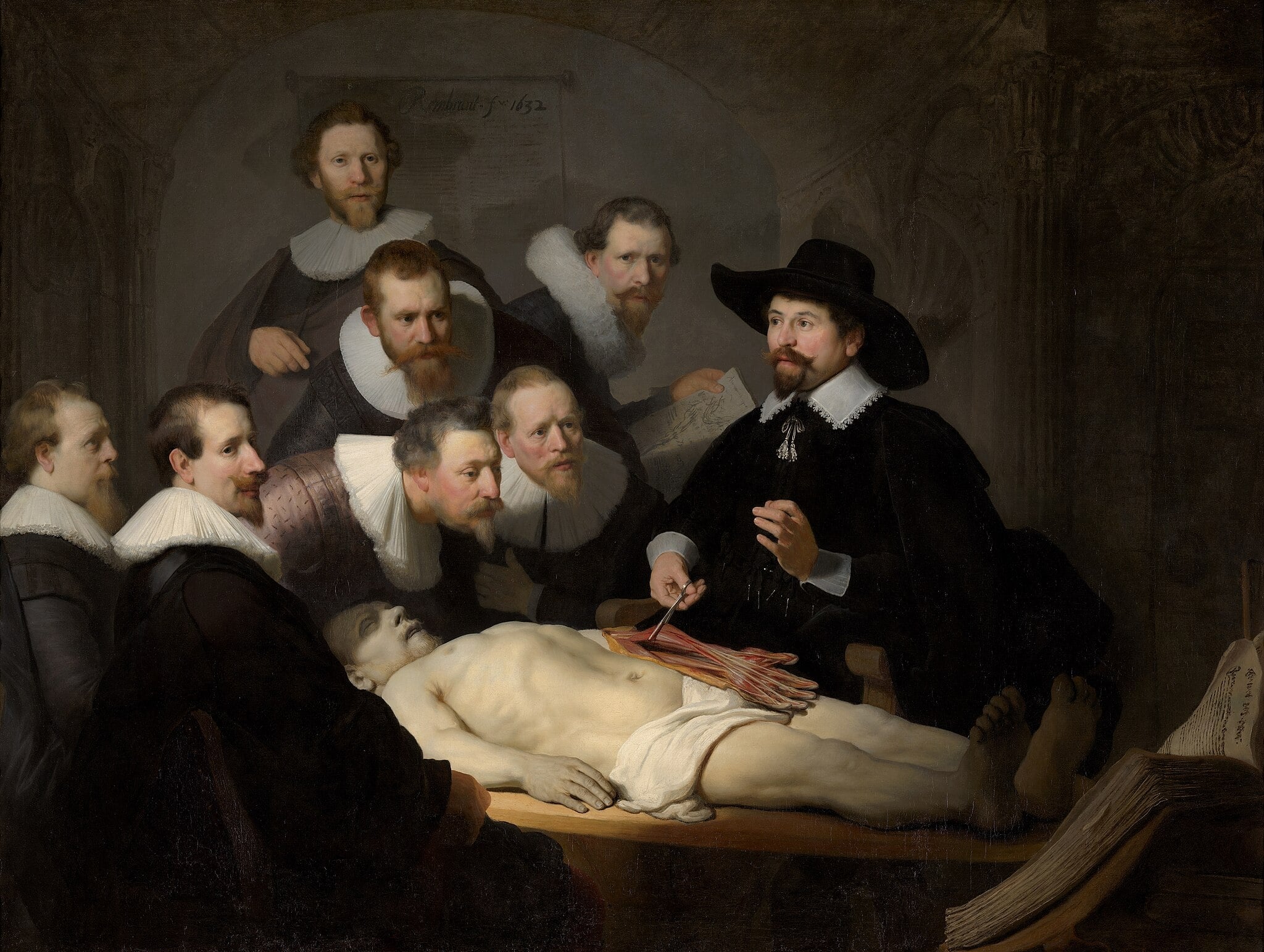
The Anatomy Lesson of Dr. Nicolaes Tulp by Rembrandt van Rijn

The Anatomy Lesson of Dr. Nicolaes Tulp

Rembrandt van Rijn (1632)

Rembrandt van Rijn turns a civic commission into a drama of <strong>knowledge made visible</strong>. A cone of light binds the ruff‑collared surgeons, the pale cadaver, and Dr. Tulp’s forceps as he raises the <strong>forearm tendons</strong> to explain the hand. Book and body face each other across the table, staging the tension—and alliance—between <strong>textual authority</strong> and <strong>empirical observation</strong> <sup>[1]</sup><sup>[2]</sup>.
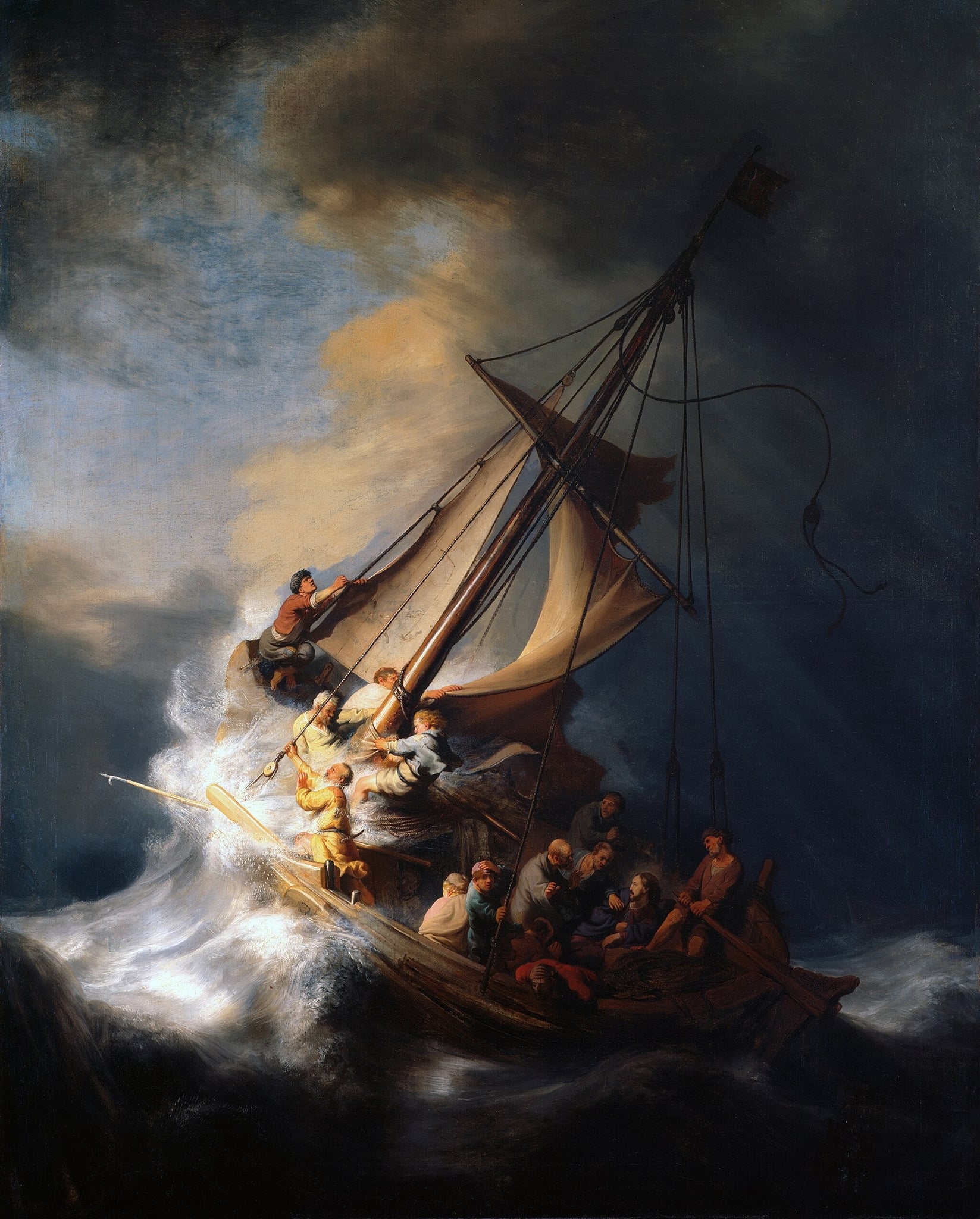
The Storm on the Sea of Galilee by Rembrandt van Rijn

The Storm on the Sea of Galilee

Rembrandt van Rijn (1633)

Rembrandt van Rijn’s The Storm on the Sea of Galilee stages a clash of <strong>human panic</strong> and <strong>divine composure</strong> at the instant before the miracle. A torn mainsail whips across a steeply tilted boat as terrified disciples scramble, while a <strong>serenely lit Christ</strong> anchors a pocket of calm—an image of faith holding within chaos <sup>[1]</sup><sup>[3]</sup>. It is Rembrandt’s only painted seascape, intensifying its dramatic singularity in his oeuvre <sup>[2]</sup>.
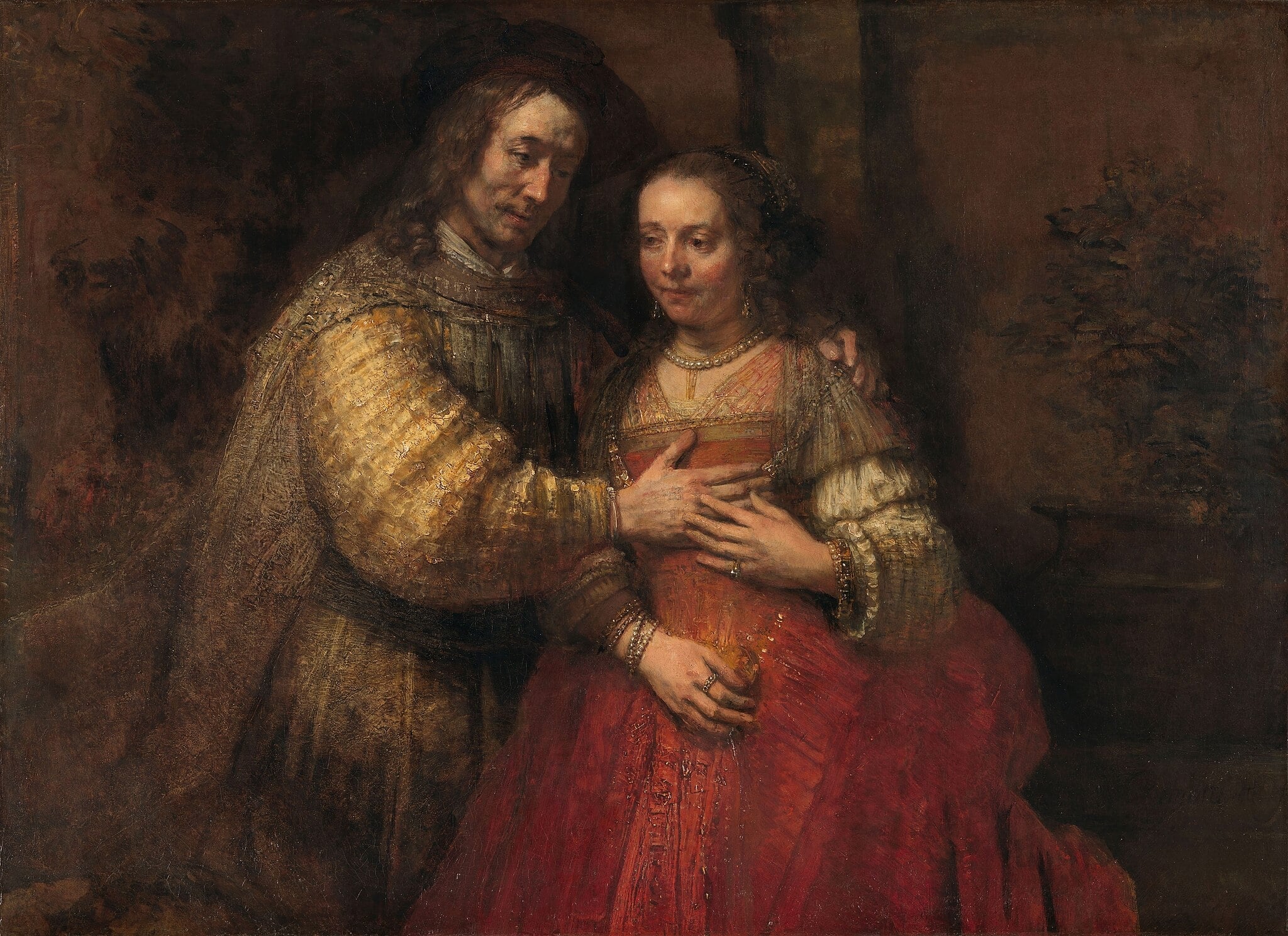
The Jewish Bride by Rembrandt van Rijn

The Jewish Bride

Rembrandt van Rijn (c. 1665–1669)

The Jewish Bride by Rembrandt van Rijn stages an intimate covenant: two figures, read today as <strong>Isaac and Rebecca</strong>, seal their union through touch rather than spectacle. Light concentrates on faces and hands, while the man’s glittering <strong>gold sleeve</strong> and the woman’s <strong>coral-red gown</strong> turn paint itself into a metaphor for fidelity and tenderness <sup>[1]</sup><sup>[3]</sup>. This late masterpiece embodies Rembrandt’s <strong>material eloquence</strong>—impasto as feeling—within a hushed, dark setting <sup>[1]</sup><sup>[2]</sup>.
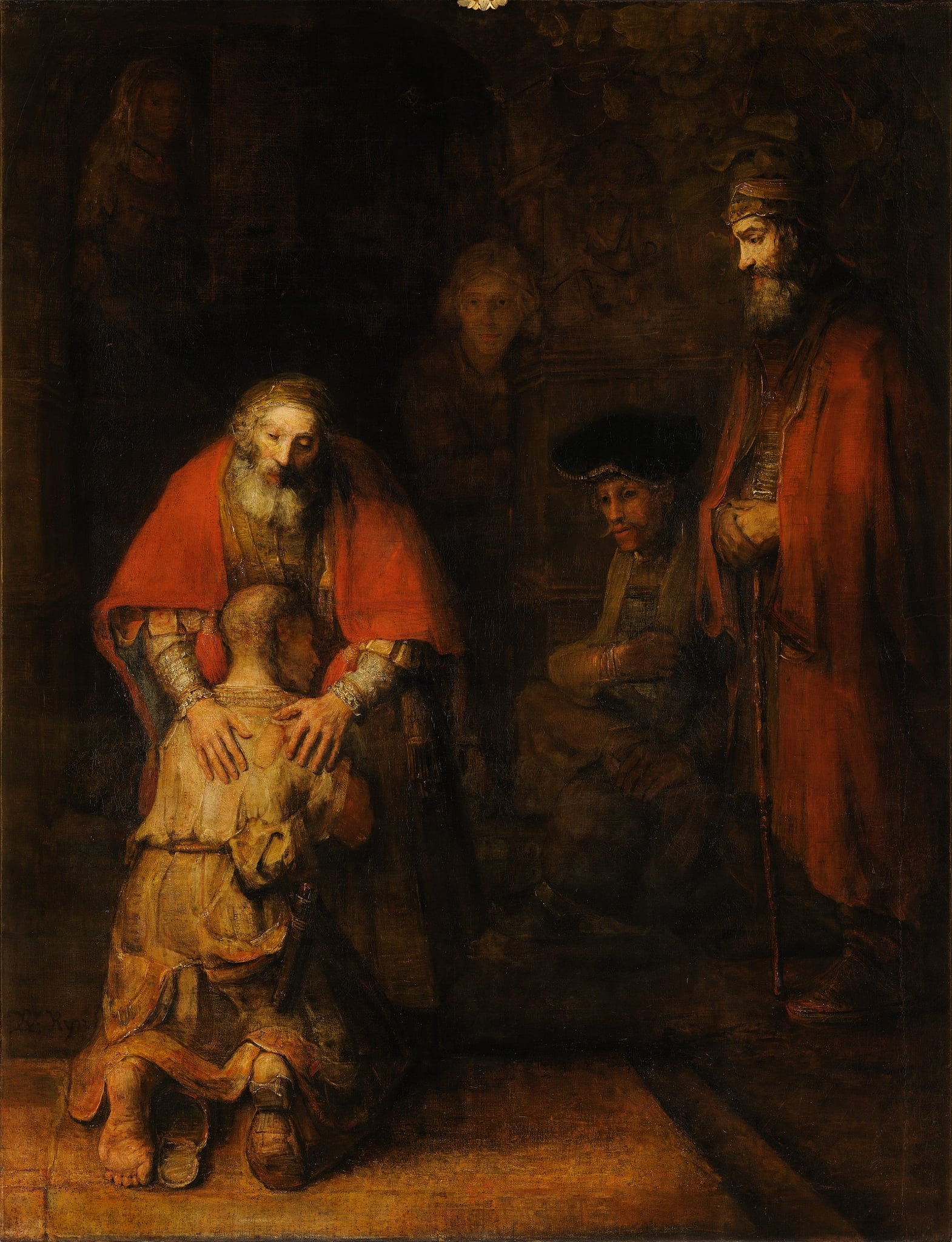
The Return of the Prodigal Son by Rembrandt van Rijn

The Return of the Prodigal Son

Rembrandt van Rijn (c. 1661–1669 (probably completed by 1669))

Rembrandt van Rijn’s The Return of the Prodigal Son is a late-life meditation on <strong>mercy</strong>, <strong>homecoming</strong>, and <strong>restored dignity</strong>. In a hush of dusk-like light, a ragged son kneels into his father’s <strong>embrace</strong>, while an upright elder brother holds back in shadow. The image concentrates meaning in illuminated <strong>faces, hands, and feet</strong>, turning a parable into a timeless human reckoning. <sup>[1]</sup><sup>[2]</sup>
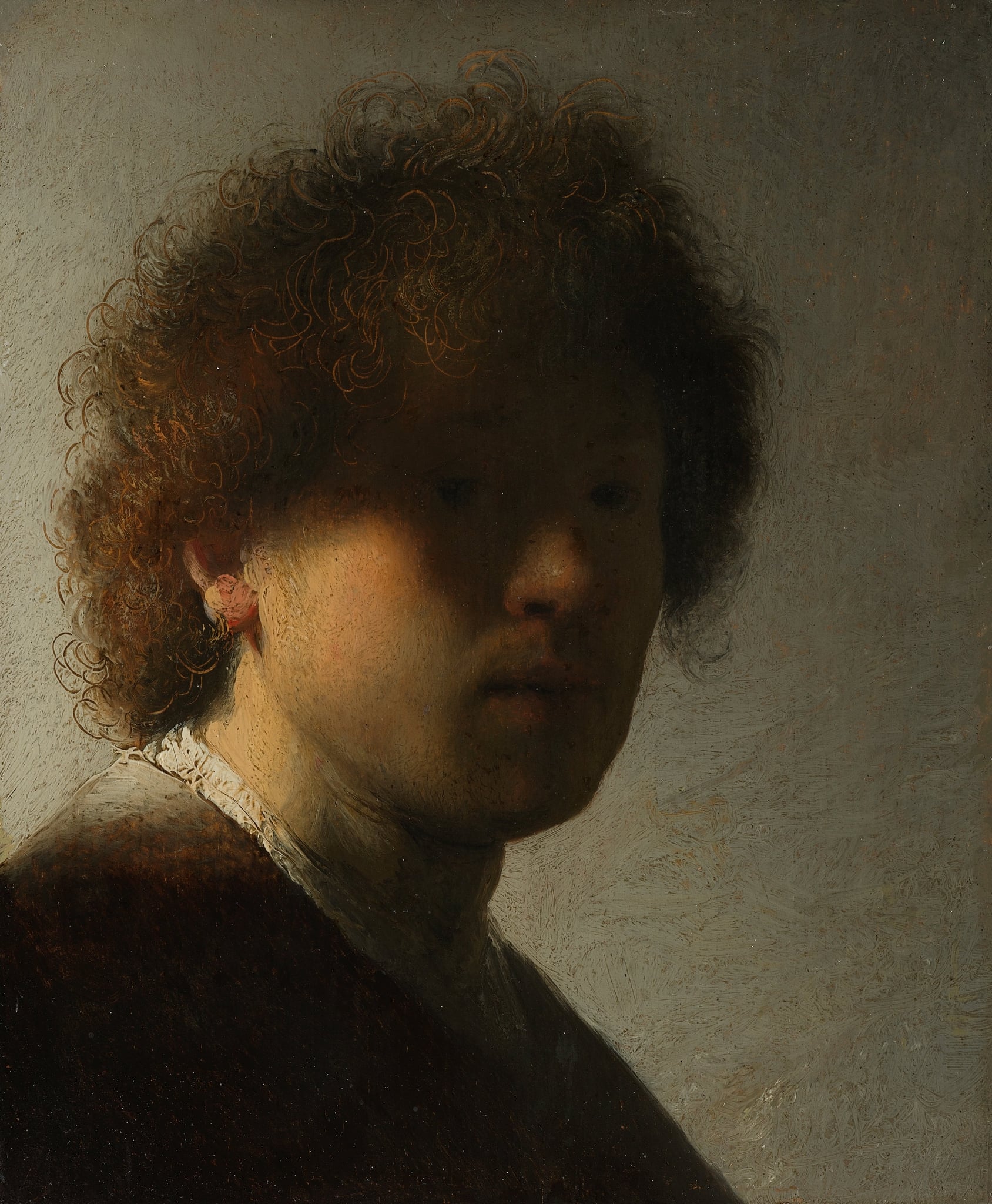
Self-portrait (with tousled hair) by Rembrandt van Rijn

Self-portrait (with tousled hair)

Rembrandt van Rijn (c. 1628)

A young Rembrandt van Rijn tests how <strong>light both reveals and withholds</strong> by letting his face emerge from darkness while his <strong>scratched, backlit curls</strong> flare like a rough halo. The small oak panel makes <strong>process itself the subject</strong>, turning hair, stubble, and a raking highlight into a statement of identity-in-formation <sup>[1]</sup><sup>[5]</sup>.
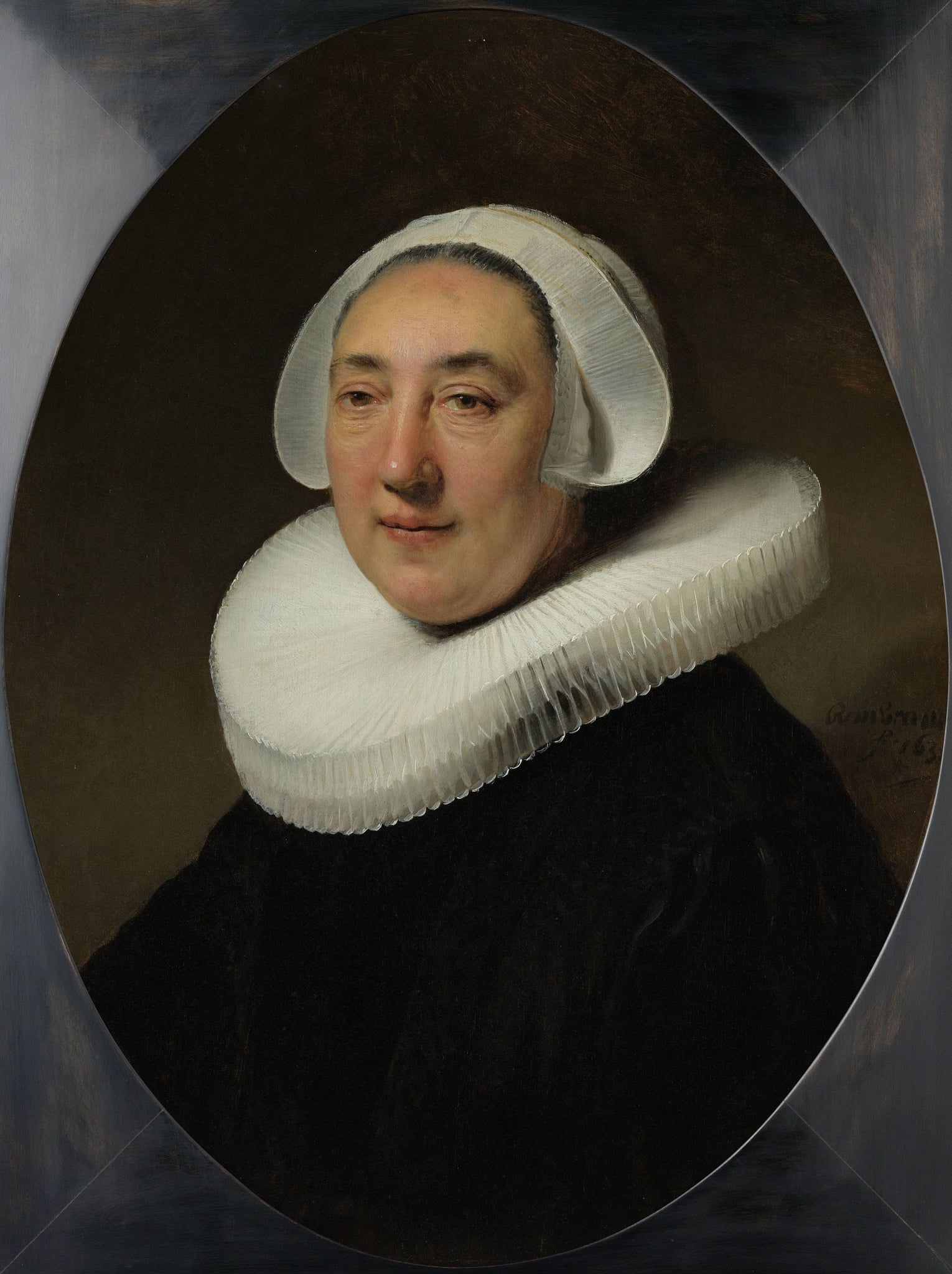
Portrait of Haesje Jacobsdr van Cleyburg by Rembrandt van Rijn

Portrait of Haesje Jacobsdr van Cleyburg

Rembrandt van Rijn (1634)

Rembrandt’s 1634 Portrait of Haesje Jacobsdr van Cleyburg stages a Dutch burgher within a feigned <strong>oval</strong> opening, illuminated by selective <strong>chiaroscuro</strong> that models warm skin against brilliant <strong>millstone ruff</strong> and sober black dress. The painting balances <strong>modesty and status</strong>, making virtue visible while quietly declaring prosperity through immaculate linen and craft <sup>[1]</sup><sup>[4]</sup>.