How Much Is Saskia van Uylenburgh in Arcadian Costume Worth?
Last updated: August 25, 2026
Quick Facts
- Methodology
- comparable analysis
Hypothetical fair‑market private‑treaty value for Rembrandt’s Saskia van Uylenburgh in Arcadian Costume is $110–170 million. The estimate is anchored to nine‑figure private benchmarks for prime 1630s Rembrandts and positioned well above recent auction comparables for smaller or less iconic works. Museum-held status makes an actual sale improbable, but if freely transferable, this is where market demand would likely clear.
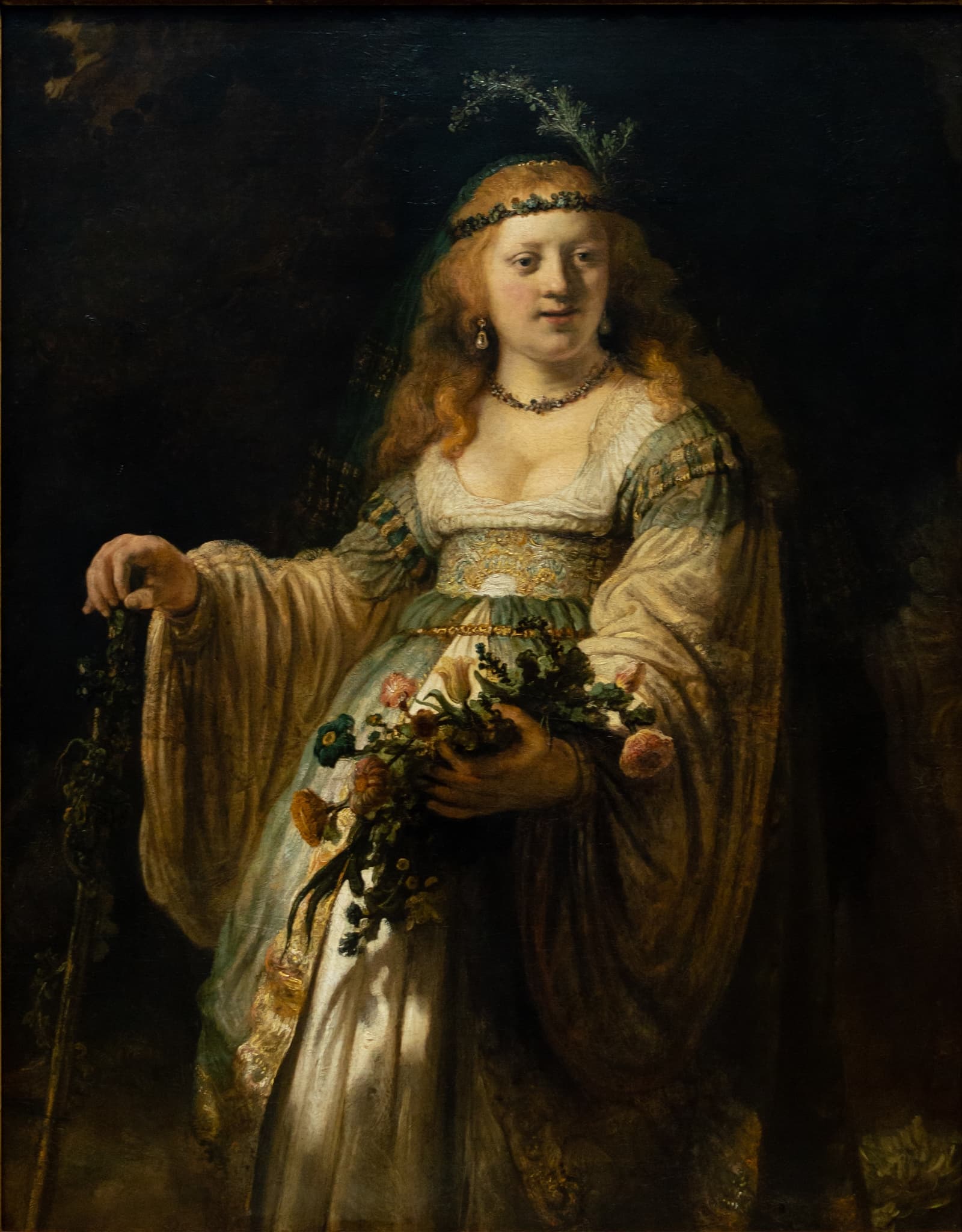
Saskia van Uylenburgh in Arcadian Costume
Rembrandt van Rijn, 1635 • Oil on canvas
Read full analysis of Saskia van Uylenburgh in Arcadian Costume →Valuation Analysis
Conclusion and approach. A reasonable present‑day, private‑treaty fair‑market value for Rembrandt’s Saskia van Uylenburgh in Arcadian Costume (1635) is $110–170 million. This synthesis relies on direct artist comparables for prime early‑Amsterdam, life‑size single‑figure portraits—most notably the Dutch State’s 2022 purchase of The Standard‑Bearer (1636) for €175 million and the 2016 joint Rijksmuseum/Louvre acquisition of the pendant portraits of Maerten Soolmans and Oopjen Coppit for €160 million (pair)—calibrated against the public‑auction ceiling for Rembrandt paintings and recent early‑period results [2][3][4][5].
Positioning within the oeuvre. The painting is a large (c. 123.5 × 97.5 cm), signature early‑Amsterdam portrait of Rembrandt’s wife Saskia, rendered in an Arcadian/fancy‑dress idiom that showcases his 1630s virtuosity and taste for theatricality. It is widely published, frequently exhibited, and forms a cornerstone of the National Gallery’s Dutch collection, factors that drive desirability and signal “trophy” status in private negotiations [1]. While not as nationally symbolic as The Standard‑Bearer nor as singular as the full‑length Soolmans/Oopjen pair, it sits clearly above typical bust‑length portraits in both art‑historical standing and market appeal.
Market evidence and banding. At the top end, recent nine‑figure private transactions for prime 1630s Rembrandts frame the ceiling: Standard‑Bearer at €175m (state purchase) and Soolmans/Oopjen at €160m (pair). At the public‑auction end, the all‑time record for a Rembrandt painting is £20.2m ($33.3m at the time) for Portrait of a Man with Arms Akimbo (2009), and a rediscovered early painting, The Adoration of the Kings, realized about £10.9m ($13.8m) in 2023—useful but significantly lower‑tier comparables by format, scale, and renown [4][5]. These tiers imply that a museum‑famous, life‑size early portrait with a named, resonant sitter would transact privately at a substantial premium to auction benchmarks yet below the very top state/museum acquisitions—hence the $110–170m band.
Key drivers and sensitivities. Demand premia accrue from: prime 1635 date; scale and condition (assumed strong given the National Gallery’s long stewardship and recent loans); elite provenance from Tallard to Montagu/Buccleuch to the National Gallery; and the widely recognized image of Saskia [1]. Principal swing factors are a current, in‑depth technical/condition review (IRR, X‑ray, restoration history), and practical transferability (UK deaccession/export constraints). Were a real transaction possible, cross‑category trophy buyers and potential institutional/consortium interest would likely ensure deep competition.
Bottom line. Calibrated to nine‑figure private Rembrandt benchmarks and tempered by relative icon status vis‑à‑vis Standard‑Bearer and the full‑length pendants, $110–170 million is a defensible, current hypothetical value for Saskia van Uylenburgh in Arcadian Costume [1][2][3][4][5].
Key Valuation Factors
Art Historical Significance
High ImpactPainted in 1635, this is a prime‑period portrait by Rembrandt, depicting his wife Saskia in Arcadian costume—a subject that unites personal intimacy with theatrical invention. The scale, painterly bravura, and the sitter’s identity place it among the most celebrated early portraits in Rembrandt’s oeuvre. The work is a pillar of the National Gallery’s Dutch collection, is widely illustrated, and has enjoyed a prominent exhibition and loan life, amplifying its cultural visibility and demand premium. Within the hierarchy of Rembrandt portraits, it stands below nation‑defining icons (e.g., The Standard‑Bearer) and the unique full‑length pendants, but clearly above typical bust‑length likenesses in market appeal.
Subject, Period, and Scale
High ImpactEarly Amsterdam portraits of the mid‑1630s represent Rembrandt at a peak of stylistic refinement and psychological nuance. The near life‑size, single‑figure format with lavish costume has strong buyer resonance across Old Master and cross‑category trophy collectors. Saskia’s named identity adds narrative power and intimate biographical appeal. At approximately 123.5 × 97.5 cm, the painting’s commanding presence outstrips the smaller bust‑length works that dominate the public auction record, aligning it more closely with the nine‑figure private benchmarks for major 1630s single figures—albeit with appropriate discounts to the unique status of full‑length pendants or a nationally symbolic image like The Standard‑Bearer.
Provenance and Exhibition History
High ImpactThe painting’s pedigree—from the 1756 Duc de Tallard sale in Paris, into the Montagu and Buccleuch collections, and ultimately to the National Gallery in 1938—confers blue‑chip provenance. Decades on public view, frequent publication, and recent loans (including the National Gallery’s Masterpiece Tour and the Kunsthistorisches Museum in 2024–25) reinforce curatorial endorsement and sustained public recognition. Such visibility reduces uncertainty and typically commands a pricing premium in private negotiations. The long institutional stewardship also implies stable conservation care, a positive signal for condition‑sensitive Old Master buyers.
Condition and Technical State
High ImpactFinal pricing would be most sensitive to a current conservation dossier: structural soundness of the canvas and stretcher, lining history, state of varnish, presence of past overpaint, and the clarity of original passages under IRR/X‑ray. The painting’s active loan history suggests a condition robust enough for travel, which is supportive. Nonetheless, even localized issues (e.g., abrasion in darks or toning in flesh passages) can move the needle materially at this value level. A recent, independent technical report would be requisite to land at the upper half of the proposed range.
Market Scarcity and Transaction Constraints
Medium ImpactAutograph, museum‑caliber Rembrandt portraits almost never reach public auction; nine‑figure private transactions for prime 1630s works set the true market bar. While this scarcity is value‑accretive, the work’s location in a UK national collection makes deaccession/export exceptionally unlikely. In a hypothetical sale—e.g., if legally transferable and exportable—competition would span private collectors and institutional consortia, likely favoring a private‑treaty process. Any legal/ethical constraints or export deferrals would factor into pricing mechanics and timing, but given trophy‑level demand, they are more likely to influence deal structure than the ultimate value conclusion.
Sale History
Duc de Tallard sale, Paris (lot 156)
Sold for 602 francs to Remy (likely bidding for the Duke of Montagu). Historical denomination; no reliable modern USD equivalent.
National Gallery, London (acquired from the 8th Duke of Buccleuch)
Purchase price not published; acquisition supported by National Gallery funds and the National Art Collections Fund (Art Fund).
Rembrandt van Rijn's Market
Rembrandt remains one of the most coveted Old Masters, with ultra‑scarce supply and deep cross‑category demand. The public‑auction record for a Rembrandt painting stands at £20.2 million ($33.3m at the time) for Portrait of a Man with Arms Akimbo (Christie’s, 2009), underscoring the limited availability of top works in open salerooms. True masterpiece‑level pictures have traded privately at far higher levels, including the Rijksmuseum/Louvre’s 2016 purchase of the Maerten Soolmans and Oopjen Coppit full‑length pendants for €160 million (pair) and the Dutch State’s 2022 acquisition of The Standard‑Bearer for €175 million. Recent early‑period paintings at auction (e.g., The Adoration of the Kings in 2023) confirm steady liquidity in the low‑to‑mid eight figures, while prints have enjoyed renewed record‑setting attention.
Comparable Sales
The Standard-Bearer (De Vaandeldrager)
Rembrandt van Rijn
Same artist; prime early 1630s; life-size single-figure in elaborate costume (fancy dress), closely analogous to Saskia’s Arcadian-role portrait; top-tier museum-caliber work.
$198.0M
2022, Private sale to the Dutch State (Rijksmuseum/Ministry of Culture)
~$221.8M adjusted
Portraits of Maerten Soolmans and Oopjen Coppit (pendant pair)
Rembrandt van Rijn
Same artist; immediately contemporary (1634) portraiture at the absolute masterpiece level; large full-length pendants showing peak early-Amsterdam style and status—key benchmark for prime Rembrandt portraits.
$174.0M
2016, Christie's Private Sales (jointly acquired by the Rijksmuseum and the Louvre)
~$226.2M adjusted
Portrait of a Man with Arms Akimbo
Rembrandt van Rijn
Same artist; large half-length portrait (though late, 1658). This is the public-auction record for a Rembrandt painting and serves as the primary open-market ceiling reference.
$33.3M
2009, Christie's London
~$50.0M adjusted
Self‑Portrait, half‑length, wearing a ruff and a black hat
Rembrandt van Rijn
Same artist; early Amsterdam period (1632) portrait. Much smaller scale but strong brand subject (self‑portrait) and clean modern market signal for prime-period portraits.
$20.0M
2020, Sotheby's London (Rembrandt to Richter Evening Sale)
~$24.6M adjusted
Portraits of Jan Willemsz. van der Pluym and Jaapgen Carels (pendant pair)
Rembrandt van Rijn
Same artist; rediscovered pendant portraits (early/mid‑1630s). Much smaller bust‑length format; useful for gauging recent demand for fresh‑to‑market Rembrandt portraits.
$14.3M
2023, Christie's London (Old Masters Part I)
~$15.0M adjusted
The Adoration of the Kings (c. 1628)
Rembrandt van Rijn
Same artist; early work with strong scholarly narrative and recent restoration/rediscovery momentum; though not a portrait, it anchors current auction appetite for significant early Rembrandt paintings.
$13.8M
2023, Sotheby's London (Old Master & 19th Century Paintings Evening Auction)
~$14.5M adjusted
Current Market Trends
Old Masters remain a supply‑driven market with selective, quality‑led demand. Classic Week results in London over the past two seasons showed modest growth and strong sell‑through at the top, propelled by rediscoveries and blue‑chip provenance. The gap between masterpieces and merely good works has widened: top lots draw global, often younger, cross‑category buyers, while mid‑tier material clears near estimates and often relies on guarantees. For Rembrandt specifically, private‑treaty channels dominate for paintings of consequence, with public auctions providing price discovery primarily for smaller or less iconic works. Prints have been a bright spot, with recent state and subject records expanding the buyer base.
Study print
Study this painting as a print
Pair the full artwork with a museum-style study sheet focused on one meaningful detail.
Sources
- National Gallery, London – Object page: Rembrandt, Saskia van Uylenburgh in Arcadian Costume
- Christie’s – My highlight of 2016: Two Rembrandt masterpieces (Soolmans and Oopjen)
- Rijksmuseum – Press release: The Dutch State to acquire Rembrandt’s The Standard-Bearer
- Christie’s – Artist page noting the 2009 auction record for Rembrandt
- The Art Newspaper – Rediscovered Rembrandt could make £15m at Sotheby’s London (Adoration of the Kings)