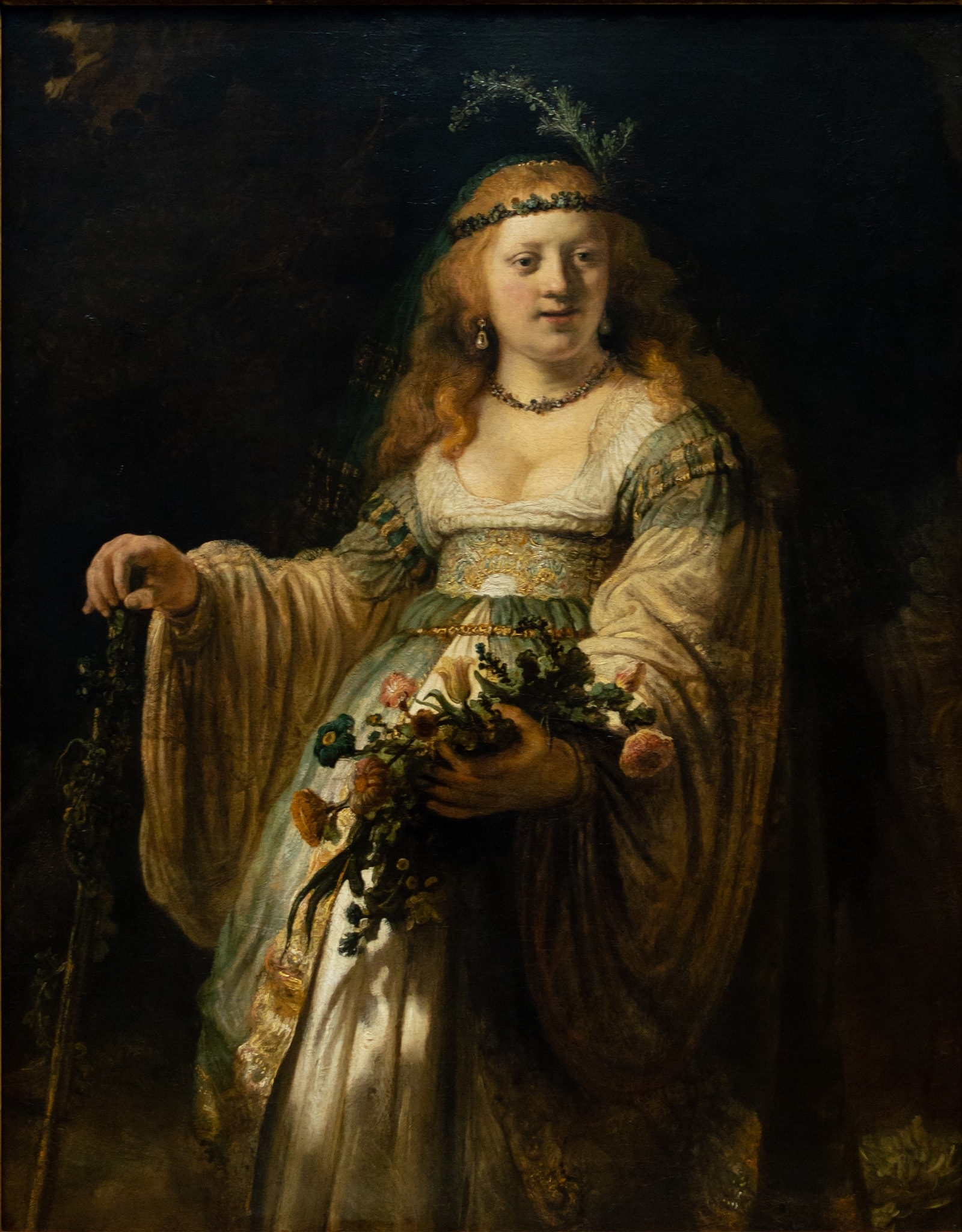
Saskia van Uylenburgh in Arcadian Costume

by Rembrandt van Rijn

Rembrandt van Rijn’s 1635 portrait of his wife, Saskia, appears as a luminous shepherdess in Arcadian costume, her face and hands caught in a warm cone of light while the world around her recedes into shadow. The wreath, foliage‑twined staff, and armful of blossoms transform a private likeness into an emblem of fertility, prosperity, and renewal [1].

Study Print Studio

Create a personal study print

Build a companion study sheet around the part of this painting that speaks to you most. Choose a detail, shape an interpretation, and walk away with something personal and display-worthy.

Fast Facts

Year
1635
Medium
Oil on canvas
Dimensions
123.5 × 97.5 cm
Location
National Gallery, London
See all Rembrandt van Rijn paintings in London
Saskia van Uylenburgh in Arcadian Costume by Rembrandt van Rijn (1635) featuring Floral wreath (garland crown), Juniper sprig, Shepherd’s staff wreathed with foliage

Click on any numbered symbol to learn more about its meaning

Meaning & Symbolism

Rembrandt builds the Arcadian fiction through a precise ensemble of attributes, then lets light sanctify them. A green wreath circles Saskia’s hair and a sprig—identified by the National Gallery as juniper—flickers above her veil; her left hand steadies a staff wreathed in leaves; her right gathers a heavy bouquet whose identifiable blooms include primulas, tulips, roses, and small pinks (dianthus) 1. These are not casual props: in northern imagery, spring flowers and garlands index seasonality, budding love, and fecund abundance, while the shepherdess’s staff fixes her inside the pastoral code of Arcadia—an ideal countryside outside urban time 12. Yet Rembrandt resists pure pageant. He places Saskia three‑quarter‑length against depthless shadow and concentrates the light on her hands, face, and the satin swell of her bodice and sleeves, so that material richness—pearls, metal thread, the bloom of petals—reads as experiential evidence of prosperity and blessing rather than costume spectacle 1. The painter’s “Renaissance‑style” fancy dress is pivotal. As Marieke de Winkel has shown, Rembrandt’s studio kept such garments to engineer meaning; here the jeweled bodice, voluminous sleeves, and chain set low across the abdomen create a rhetorical emphasis on fruitful womanhood 14. The National Gallery notes the possibility that Saskia posed while pregnant—her slight lean on the staff, the chain below the waist, and the careful clutching of bouquet and stick support that inference—so Flora’s seasonal promise becomes a pointed, domestic pledge of life to come 1. Alison Kettering’s account of Dutch Arcadia helps explain why this would resonate: pastoral masquerade served urban viewers as a cultivated daydream of innocence and love, a way to frame private bonds in publicly intelligible poetry 23. Within that frame, Rembrandt’s chiaroscuro functions theologically as much as theatrically—the light gathers like a blessing around the beloved while the world withdraws, protecting intimacy inside emblematic grandeur 1. At the same time, the image acknowledges the genre’s historical ambivalence. Julius Held long ago traced Flora’s dual valence—maternal virtue and erotic availability—a tension Rembrandt courts but domesticates here by Saskia’s calm, direct bearing and the sober gravity of the paint surface 1. Svetlana Alpers’s market‑minded lens clarifies the strategy: by casting a recognizable modern sitter in a mythic role, Rembrandt created pictures that satisfied the age’s appetite for history subjects while preserving portrait truth and studio allure 5. Comparison with related Floras—such as the Hermitage canvas of 1634—shows Rembrandt repeatedly refining this balance of allegory and likeness; in London, the juniper sprig’s chaste resonance, the chastened smile, and the almost tactile bouquet push the meaning toward marriage, virtue, and renewal rather than courtesan display 16. Ultimately, the narrative enacted is simple and exalted: a woman steps out of darkness holding the signs of spring, and light names her as their source. By wedding Arcadian symbols to the particularity of Saskia’s features and the felt weight of cloth and flowers, Rembrandt turns a private homage into a public emblem of flourishing—an image that still reads, across centuries, as a love poem in paint 134.

Explore Deeper with AI

Ask questions about Saskia van Uylenburgh in Arcadian Costume

Popular questions:

Powered by AI • Get instant insights about this artwork

💬 Ask questions about this artwork!

Interpretations

Market/Studio Strategy (Economic and Performative Lens)

Seen through a market lens, the picture is a premium “portrait historié” engineered to satisfy demand for history painting without forfeiting the draw of a recognizable sitter. Rembrandt’s studio stock—costumes, props, and floral attributes—enabled modular storytelling: by recasting Saskia as a pastoral heroine, he folds private affection into a commodity calibrated for public taste. The Arcadian code advertises cultural literacy; the tactile bouquet and costly fabrics advertise material allure. This dual address—myth for connoisseurs, likeness for patrons—exemplifies Rembrandt’s entrepreneurial fusion of studio theater and painterly authorship, creating images that performed socially as well as aesthetically. The result is not merely masquerade but a shrewd product positioned between devotion, display, and desire, perfectly tuned to Amsterdam’s competitive art market 14.

Source: Svetlana Alpers, Rembrandt’s Enterprise

Costume Rhetoric and the Body (Dress History/Semiotics)

Marieke de Winkel’s work clarifies how Rembrandt’s wardrobe is an active rhetorical device. Here the jeweled bodice, capacious sleeves, strings of pearls, and the chain dropped below the waist read as coded emphasis on fruitful womanhood rather than mere finery. The costume’s deliberate anachronism (a poetic “Renaissance-style” ensemble) suspends the sitter from modern time and anchors her in allegory, while the low-slung chain draws the eye toward the abdomen, amplifying Flora’s procreative associations. Such “fancy dress” produces meaning by juxtaposing luxury with pastoral simplicity: pearls and satin sanctify the shepherdess role rather than contradict it. In Rembrandt’s hands, textile, trim, and fit become iconographic operators that translate intimacy into shared cultural signs legible to a 17th‑century audience 13.

Source: Marieke de Winkel, Fashion and Fancy

Pastoral Ideology and Urban Desire (Cultural History)

Alison Kettering’s Dutch Arcadia explains how pastoral scenes functioned as cultivated daydreams for urban elites—fictions of innocence, leisure, and erotic play. Saskia’s Arcadian guise thus addresses a city audience seeking ethical and emotional refreshment: a myth of simple love that flatters modern sophistication. The shepherdess’s staff and garlands naturalize intimacy, while the courtly costume reassures viewers that this is artful performance, not rustic fact. In this framework, Rembrandt’s chiaroscuro does ideological work: it clears away the city to produce a private enclave where tenderness and virtue appear effortless and timeless. The painting becomes a machine for conjuring desired affect—civility, abundance, and renewal—under the seal of pastoral poetry 12.

Source: Alison Kettering, The Dutch Arcadia

Flora Mater vs. Meretrix (Iconographic Tension Managed)

Julius Held traced Flora’s split identity—maternal fecundity versus erotic availability—across Renaissance and Baroque art. Rembrandt acknowledges that ambivalence yet tames it here. The heavy bouquet and possible gestural cues to pregnancy pull toward Flora Mater; Saskia’s calm, frontal bearing and sober paint handling dampen courtesan flourish. The juniper sprig’s chaste resonance and the wreath’s measured order assist the moral tilt. Compared with Rembrandt’s earlier Hermitage Flora (1634), London’s variant reins in coquetry and intensifies emblematic gravity through concentrated light and tactile naturalism. The effect is a calibrated iconography that keeps allure in play but resolves toward conjugal virtue and renewal rather than display or seduction 1568.

Source: Julius S. Held; National Gallery, London; The State Hermitage Museum

Materiality, Luxury, and Civic Prosperity (Social-Economic Reading)

The bouquet’s tulips, roses, and primulas are season-markers, but in Amsterdam they also broadcast status: tulips in particular indexed rarity, taste, and expense. Without pressing a vanitas moral, Rembrandt lets the weight of things—satin gleam, pearl sheen, the dense bouquet—speak to household prosperity and the civic abundance that underwrites Arcadian dreaming. This is not a still-life sermon on tulip-mania so much as a gentle world-building: luxury textures ground the pastoral fiction in the lived economy of 1630s Amsterdam. Light turns commodities into gifts, sublimating wealth into blessing while keeping the bouquet’s market-savvy resonances legible to contemporaries attuned to flower culture and display 17.

Source: National Gallery, London; The Met (Northern European Still Life Essay)

Chiaroscuro as Secular Benediction (Theological-Aesthetic Lens)

Rembrandt adapts Baroque light not only for stagecraft but for devotion-by-analogy: illumination pools around Saskia’s face and hands as if conferring grace. The darkness does not menace; it withdraws like a respectful veil, creating a sanctuary for conjugal affection. In this register, Arcadia becomes a liturgy of the everyday—pastoral signs (staff, garlands) are sanctified by light into tokens of providence. The effect aligns with Dutch tastes for private piety: no explicit Christian icon appears, yet the visual rhetoric of blessing translates domestic love into a quietly sacred presence, where material abundance is re-read as favor rather than vanity 1.

Source: National Gallery, London

Related Themes

About Rembrandt van Rijn

Rembrandt van Rijn (1606–1669) was a leading Dutch Golden Age painter and printmaker whose Amsterdam years (from 1631) produced virtuosic portraits and ambitious history paintings. In the early 1630s he favored polished finishes, saturated color, and theatrical staging—qualities on display in this 1633 canvas. Although prolific, this is his only known painted seascape [2][4].
View all works by Rembrandt van Rijn

More by Rembrandt van Rijn
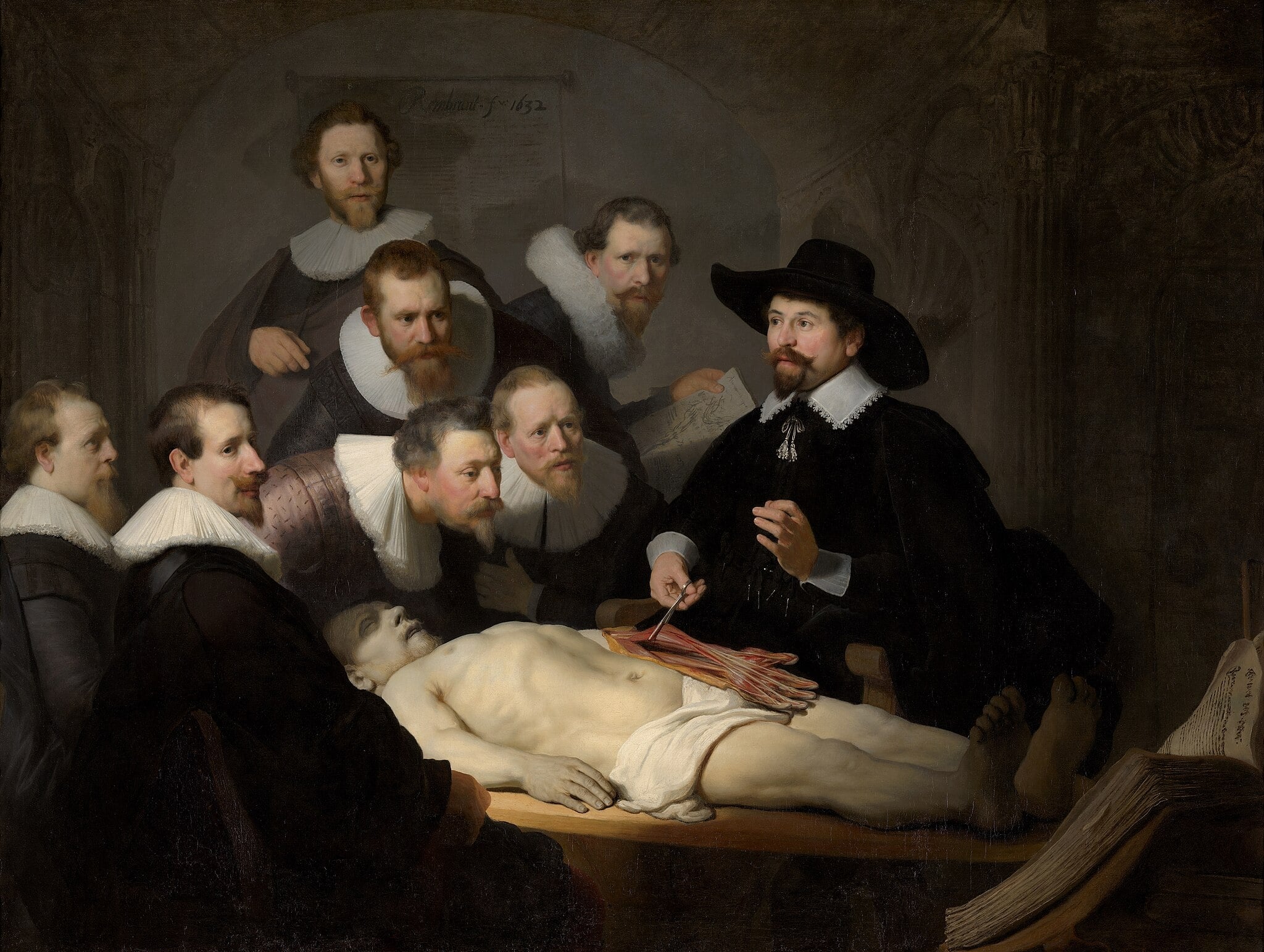
The Anatomy Lesson of Dr. Nicolaes Tulp by Rembrandt van Rijn

The Anatomy Lesson of Dr. Nicolaes Tulp

Rembrandt van Rijn (1632)

Rembrandt van Rijn turns a civic commission into a drama of <strong>knowledge made visible</strong>. A cone of light binds the ruff‑collared surgeons, the pale cadaver, and Dr. Tulp’s forceps as he raises the <strong>forearm tendons</strong> to explain the hand. Book and body face each other across the table, staging the tension—and alliance—between <strong>textual authority</strong> and <strong>empirical observation</strong> <sup>[1]</sup><sup>[2]</sup>.
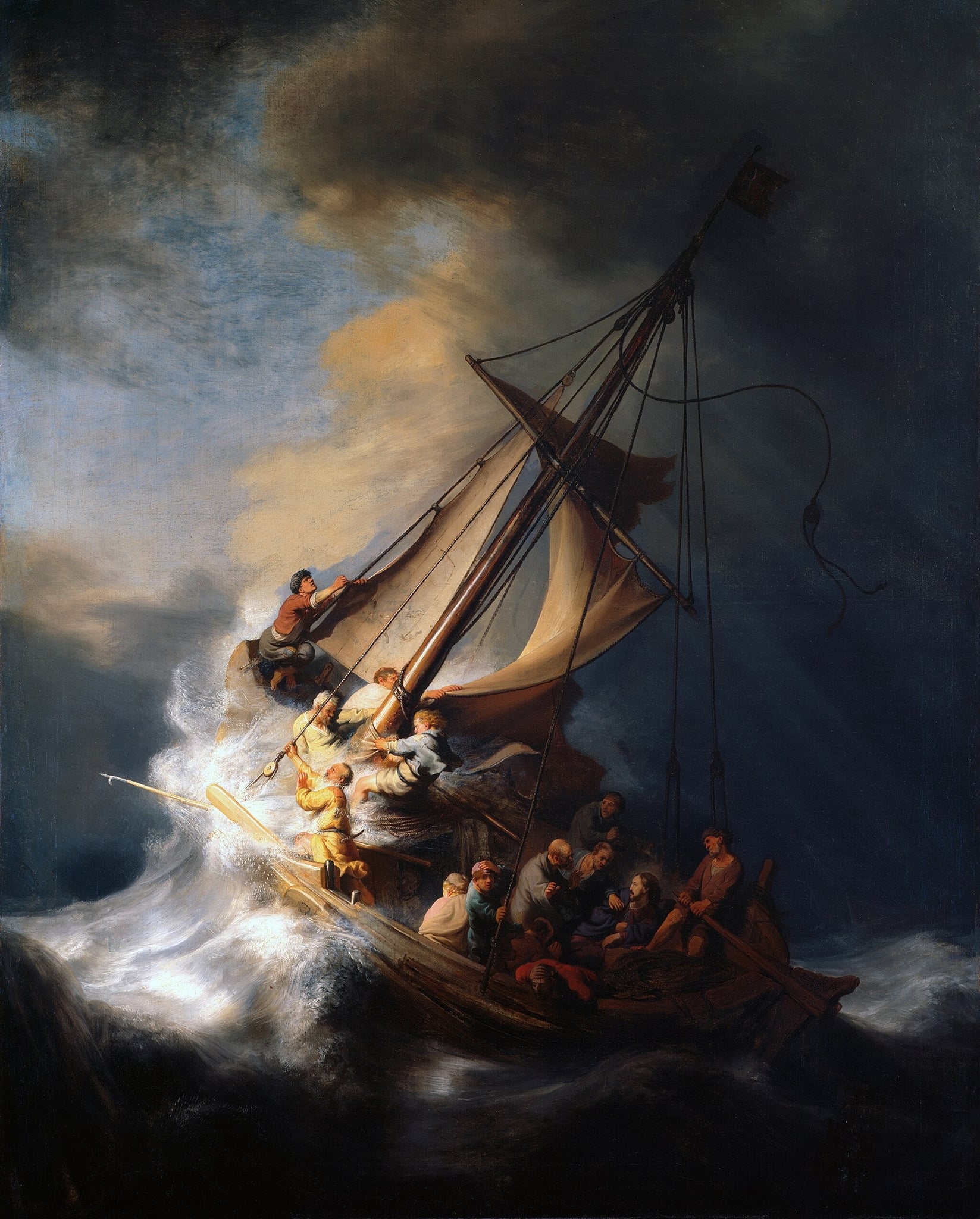
The Storm on the Sea of Galilee by Rembrandt van Rijn

The Storm on the Sea of Galilee

Rembrandt van Rijn (1633)

Rembrandt van Rijn’s The Storm on the Sea of Galilee stages a clash of <strong>human panic</strong> and <strong>divine composure</strong> at the instant before the miracle. A torn mainsail whips across a steeply tilted boat as terrified disciples scramble, while a <strong>serenely lit Christ</strong> anchors a pocket of calm—an image of faith holding within chaos <sup>[1]</sup><sup>[3]</sup>. It is Rembrandt’s only painted seascape, intensifying its dramatic singularity in his oeuvre <sup>[2]</sup>.
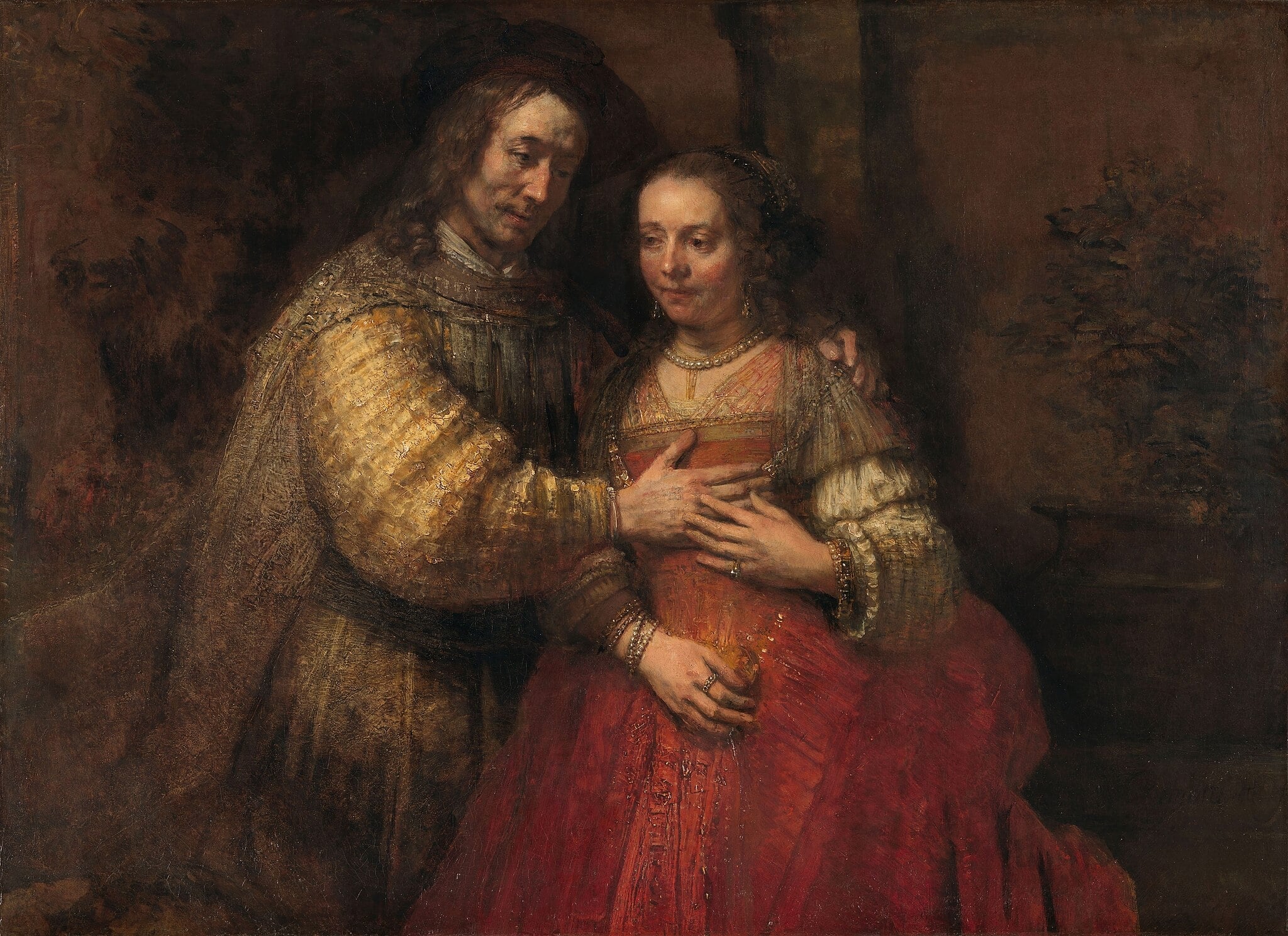
The Jewish Bride by Rembrandt van Rijn

The Jewish Bride

Rembrandt van Rijn (c. 1665–1669)

The Jewish Bride by Rembrandt van Rijn stages an intimate covenant: two figures, read today as <strong>Isaac and Rebecca</strong>, seal their union through touch rather than spectacle. Light concentrates on faces and hands, while the man’s glittering <strong>gold sleeve</strong> and the woman’s <strong>coral-red gown</strong> turn paint itself into a metaphor for fidelity and tenderness <sup>[1]</sup><sup>[3]</sup>. This late masterpiece embodies Rembrandt’s <strong>material eloquence</strong>—impasto as feeling—within a hushed, dark setting <sup>[1]</sup><sup>[2]</sup>.
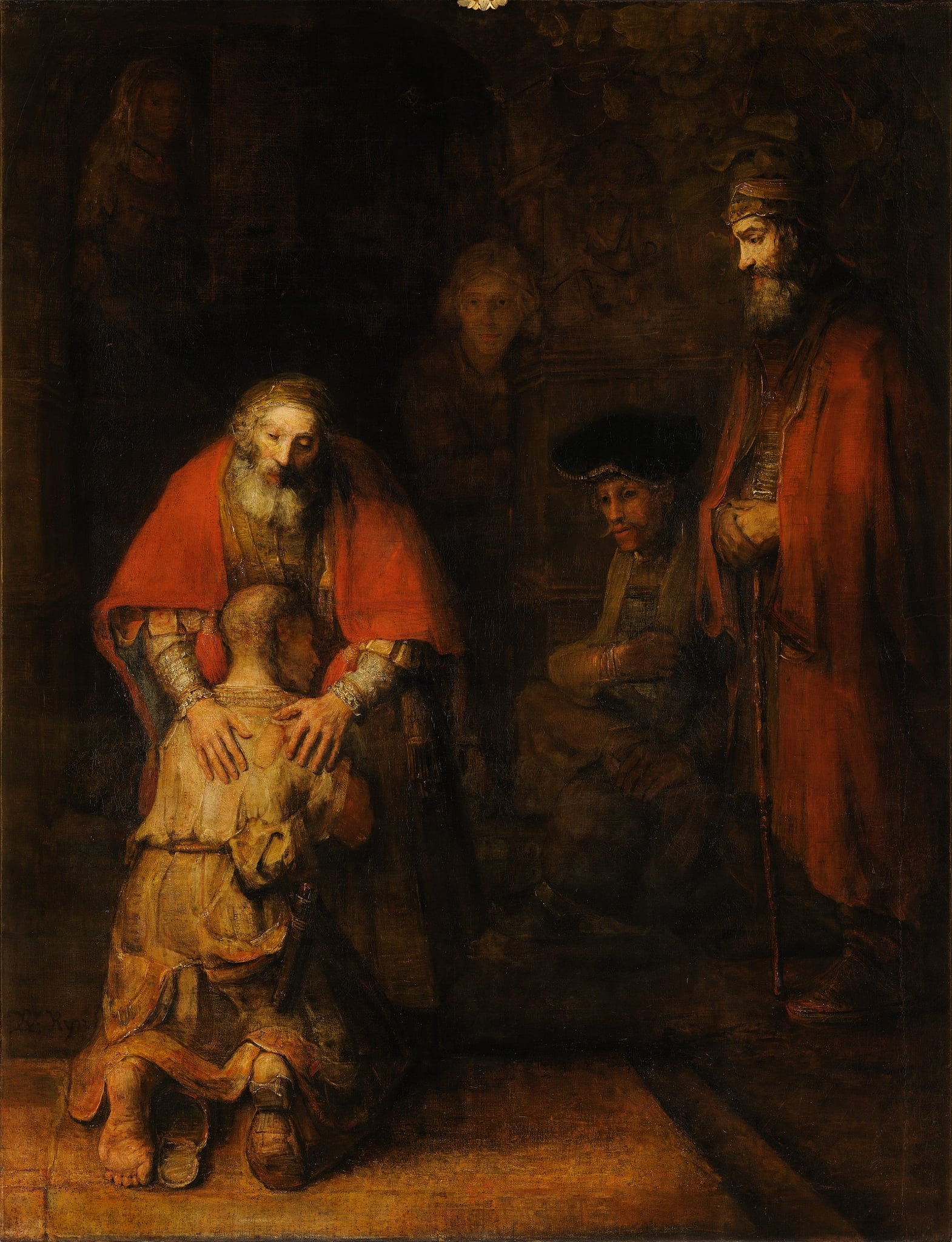
The Return of the Prodigal Son by Rembrandt van Rijn

The Return of the Prodigal Son

Rembrandt van Rijn (c. 1661–1669 (probably completed by 1669))

Rembrandt van Rijn’s The Return of the Prodigal Son is a late-life meditation on <strong>mercy</strong>, <strong>homecoming</strong>, and <strong>restored dignity</strong>. In a hush of dusk-like light, a ragged son kneels into his father’s <strong>embrace</strong>, while an upright elder brother holds back in shadow. The image concentrates meaning in illuminated <strong>faces, hands, and feet</strong>, turning a parable into a timeless human reckoning. <sup>[1]</sup><sup>[2]</sup>
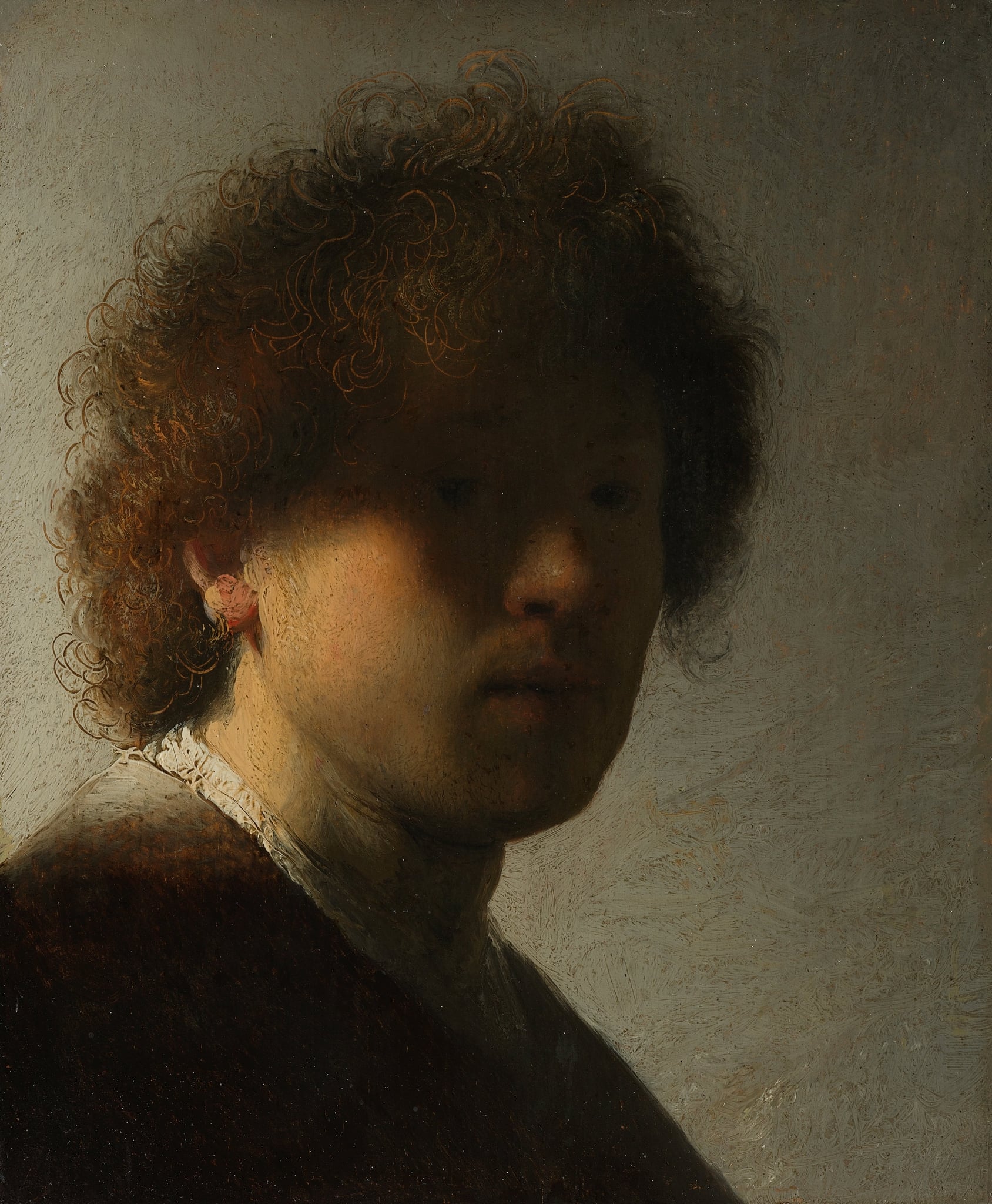
Self-portrait (with tousled hair) by Rembrandt van Rijn

Self-portrait (with tousled hair)

Rembrandt van Rijn (c. 1628)

A young Rembrandt van Rijn tests how <strong>light both reveals and withholds</strong> by letting his face emerge from darkness while his <strong>scratched, backlit curls</strong> flare like a rough halo. The small oak panel makes <strong>process itself the subject</strong>, turning hair, stubble, and a raking highlight into a statement of identity-in-formation <sup>[1]</sup><sup>[5]</sup>.
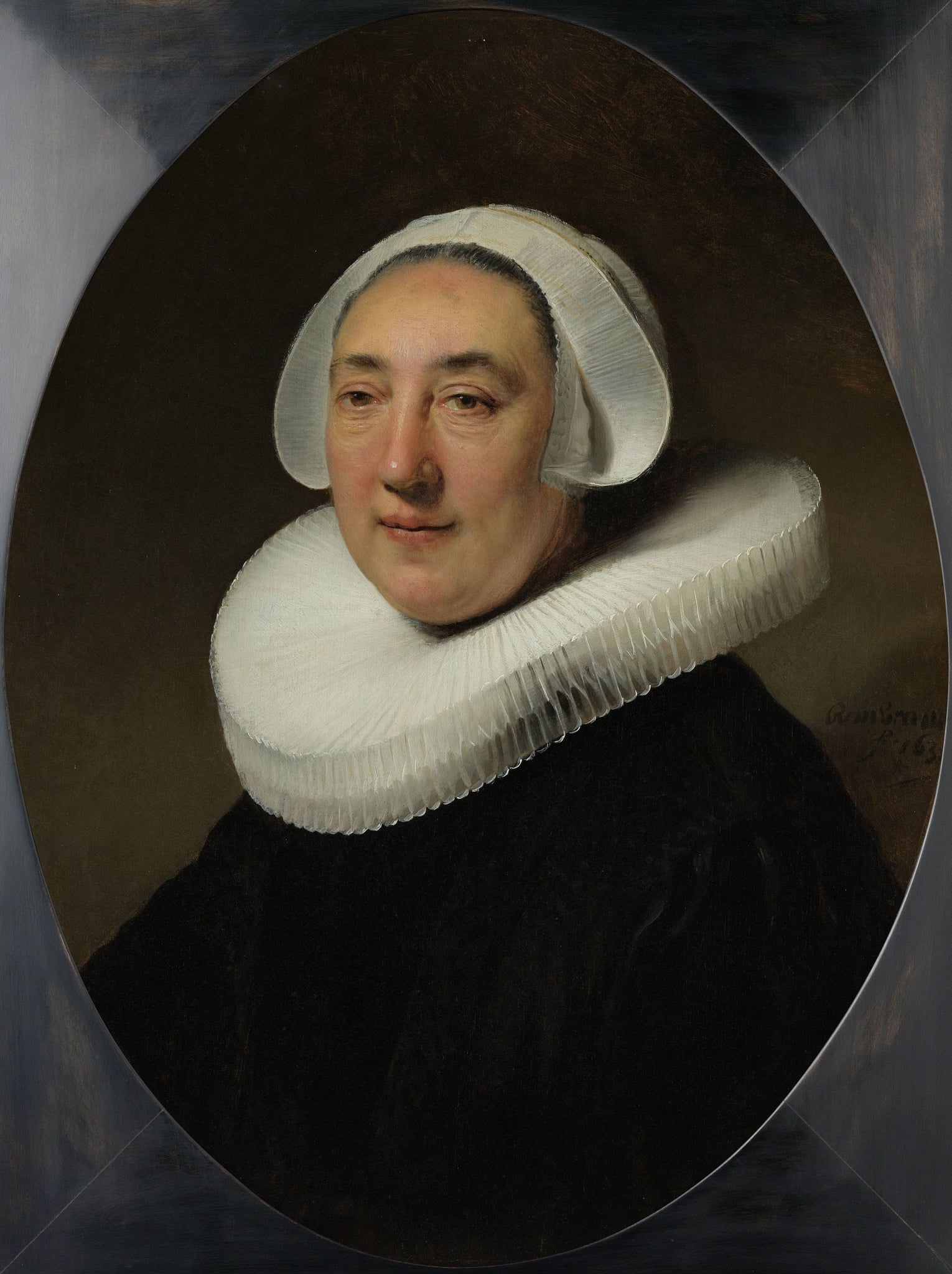
Portrait of Haesje Jacobsdr van Cleyburg by Rembrandt van Rijn

Portrait of Haesje Jacobsdr van Cleyburg

Rembrandt van Rijn (1634)

Rembrandt’s 1634 Portrait of Haesje Jacobsdr van Cleyburg stages a Dutch burgher within a feigned <strong>oval</strong> opening, illuminated by selective <strong>chiaroscuro</strong> that models warm skin against brilliant <strong>millstone ruff</strong> and sober black dress. The painting balances <strong>modesty and status</strong>, making virtue visible while quietly declaring prosperity through immaculate linen and craft <sup>[1]</sup><sup>[4]</sup>.