How Much Is The Lamentation over the Dead Christ Worth?
Last updated: August 18, 2026
Quick Facts
- Methodology
- comparable analysis
We estimate Rembrandt’s The Lamentation over the Dead Christ (c. 1635, National Gallery, London) at $20–35 million in a hypothetical open-market transaction. The range reflects its autograph status, prime 1630s date, and central Passion subject, set against its grisaille, study/modello character and small scale. Recent public results for autograph Rembrandt paintings in the $9–14m band, plus scarcity and museum-grade provenance, justify a premium into the low-to-mid eight figures.
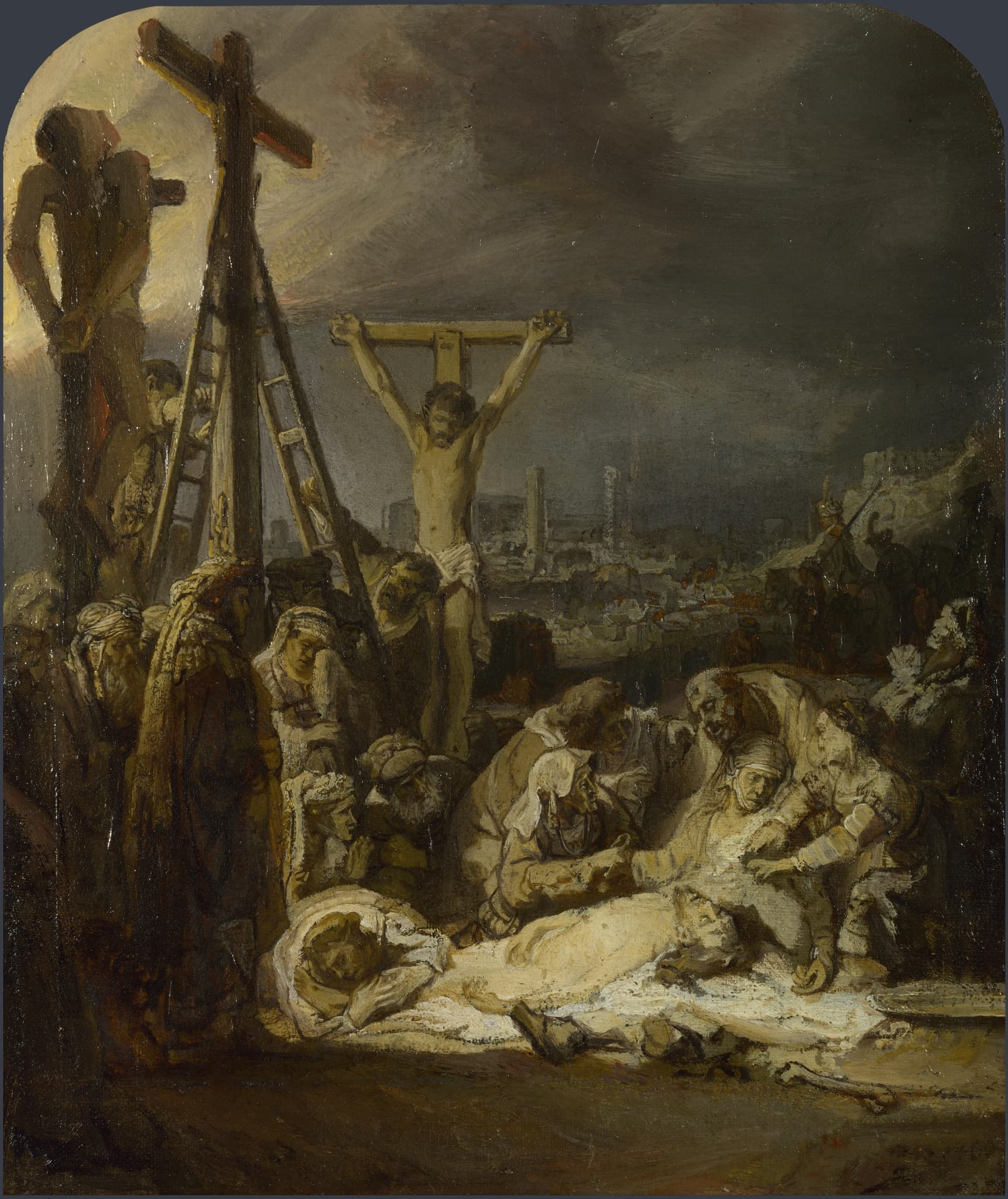
The Lamentation over the Dead Christ
Rembrandt van Rijn, about 1635 • Oil in monochrome (grisaille) on paper and pieces of canvas, mounted on oak
Read full analysis of The Lamentation over the Dead Christ →Valuation Analysis
Conclusion: In a hypothetical open-market sale, Rembrandt’s The Lamentation over the Dead Christ (c. 1635; oil in monochrome on paper and pieces of canvas, mounted on oak; National Gallery, London) would command $20–35 million. This synthesis weighs the work’s autograph status and prime-period date against its grisaille, preparatory character and intimate scale, with positioning anchored to the most relevant recent Rembrandt outcomes.
What the object is: A rare, museum-canonical grisaille from Rembrandt’s Amsterdam 1630s, the painting addresses a core Passion subject with concentrated tonal drama. It is accepted as autograph, with later additions at the top and bottom likely executed under the artist’s supervision. As a modello/study, it illuminates Rembrandt’s compositional process, probably for an unexecuted print—an art-historical asset that augments scholarly value even as it moderates commercial pecking order versus fully finished, large-scale color canvases [1].
How the estimate was derived: We benchmarked to recent, directly comparable public results. The clearest comp is the rediscovered small grisaille The Adoration of the Kings (c. 1628), which brought about $13.8m with fees at Sotheby’s London on 6 Dec 2023 [2]. Two further reference points—an early, unfinished history painting at ~$10.6m (Sotheby’s London, 1 Jul 2026) and a half-length Saint John on Patmos at ~$9.0m (Sotheby’s London, 3 Dec 2025)—reinforce a $9–14m band for small autograph works of mixed finish/format [3][4]. NG43’s prime 1630s dating, central Passion narrative, and blue-chip, published museum provenance merit a premium above those results.
Upper and lower bounds: Our ceiling is disciplined by the artist’s auction record for a painting ($28.5m; Christie’s London, 2009) and by the persistent discount for monochrome modelli relative to full-scale color masterpieces [5]. Nine-figure private/state acquisitions—The Standard-Bearer (1636) at €175m (2022) and the full-length Soolmans/Coppit pendants at €160m (2016)—demonstrate market headroom for singular trophies but are not direct comparables for a small grisaille [6][7]. Accordingly, $20–35m captures realistic fair-market value today: a base comfortably above the $13.8m grisaille comp, with upside into the high twenties/low thirties if multiple institutions or top private collectors compete.
Key sensitivities: Condition of the composite support (paper/canvas laid to oak), the extent and quality of later edge additions, and evidence of abrasion/retouch would move the needle within the band. A robust technical dossier and prominent recent exhibition/literature presence would support the upper quartile. Conversely, structural or surface concerns would cluster the outcome nearer the low-to-mid $20 millions. On balance, we would expect a well-marketed evening-sale appearance to hammer in the low-to-mid $20 millions, while a private-treaty process with institutional interest could credibly clear $30 million.
Key Valuation Factors
Art Historical Significance
High ImpactThis is a prime-period Rembrandt on a central Passion theme, rendered as a grisaille that exposes the artist’s tonal architecture and narrative staging. The Lamentation motif recurs across Rembrandt’s oeuvre and is core to his meditation on human empathy and the body. As a modello/study likely related to printmaking practice, the work offers unique insight into process, placing it squarely in scholarly discourse. While less publicly iconic than his largest finished canvases, its importance within Rembrandt’s 1630s development is well recognized, enhancing desirability among museums and connoisseur collectors who prize works that illuminate method as well as subject.
Authorship and Scholarship
High ImpactThe work is accepted as autograph and long published by a leading institution, with provenance stretching back to the 18th century and early ownership by Sir Joshua Reynolds and Sir George Beaumont. This level of scholarly consensus, documentation, and museum stewardship reduces attribution risk and supports confidence at the top end of the Old Masters market. Technical literature (e.g., on the composite support and later additions under probable supervision) furthers the object’s instructional value. In a selective category, clear authorship and deep publication history are decisive price drivers that can add multiples compared to workshop or contested material.
Medium, Scale, and Condition
Medium ImpactAs a small, monochrome oil study (grisaille) on paper and pieces of canvas mounted to oak, the picture trades at a discount to Rembrandt’s large, fully finished color canvases. The composite support and later top/bottom additions are typical of working materials but elevate condition sensitivity: panel movement, joins, or abrasion can be value-critical. Assuming a stable structure and judicious historic restoration, the work remains highly desirable for its concentrated drama and finesse. However, any structural or surface issues would compress the outcome toward the lower 40% of the estimate band; pristine condition would support the upper quartile.
Provenance and Museum Pedigree
High ImpactDocumented ownership includes Consul Joseph Smith, the circle of George III, Sir Joshua Reynolds, and Sir George Beaumont, before entering the National Gallery in 1828. Such an illustrious chain confers cultural prestige and minimizes the legal/reputational risks that sometimes shadow Old Masters. Continuous publication and display by the National Gallery enhance brand equity. While UK export/pre-emption regimes would shape transaction logistics, they do not diminish intrinsic value; instead, the museum pedigree acts as a quality signal that reliably commands premiums when comparable works do appear on the market.
Sale History
Richard Dalton sale, London
Sold for 24 guineas (approx. £25.2 nominal in 1791); purchased by “Grosier” for Sir Joshua Reynolds.
Sir Joshua Reynolds sale, London
Sold for 41 guineas; purchased by Sir George Beaumont. Presented to the National Gallery (1823/1828).
Rembrandt van Rijn's Market
Rembrandt occupies the apex of the Old Masters market, with exceptionally scarce supply of autograph paintings and globally diversified demand from institutions and elite private collectors. At auction, small autograph paintings have clustered around $9–14 million in recent years, while the artist’s auction record remains $28.5 million (Christie’s London, 2009). The very top tier for full-scale masterpieces has been established via private/state purchases: The Standard-Bearer sold to the Dutch State for €175 million in 2022, and the Louvre/Rijksmuseum jointly acquired the pendant portraits of Maerten Soolmans and Oopjen Coppit for €160 million in 2016. Robust results for drawings and prints in 2025–2026 also underscore broad appetite for best-in-class Rembrandt across media.
Comparable Sales
The Adoration of the Kings (grisaille)
Rembrandt van Rijn
Autograph small-scale grisaille biblical narrative by Rembrandt; close in medium, intimacy, and function to NG43.
$13.8M
2023, Sotheby's London
~$14.6M adjusted
Saint John on Patmos
Rembrandt van Rijn
Autograph Rembrandt painting sold recently; small, devotional/sacred subject and portrait-like format offer a conservative floor vs. a complex history grisaille.
$9.0M
2025, Sotheby's London
Let the Little Children Come Unto Me (early, unfinished history painting)
Rembrandt van Rijn
Autograph Rembrandt history subject sold recently; narrative theme aligns with NG43 though this example is early and unfinished, making it a lower-bound comp.
$10.6M
2026, Sotheby's London
~$10.3M adjusted
Portrait of a Man, Half-length, With His Arms Akimbo
Rembrandt van Rijn
Artist’s auction record for a painting; establishes upper-market appetite for top-tier, fully finished Rembrandt oils though subject/format differ from NG43.
$28.5M
2009, Christie's London
~$42.5M adjusted
Current Market Trends
Old Masters have enjoyed renewed momentum since 2025, with stronger evening totals, new artist records, and deeper cross-category bidding. Best-in-class works with impeccable provenance and scholarship are seeing competitive outcomes, while middling material remains selective—a familiar bifurcation. Recent Rembrandt sales confirm dependable liquidity for autograph pictures in the high single- to low-double-digit millions, and headline private/state deals demonstrate enduring institutional commitment at the summit. Against this backdrop, a prime 1630s Rembrandt grisaille with museum pedigree justifies a confident low-to-mid eight-figure valuation, especially when supported by clean condition and a strong technical dossier.
Study print
Study this painting as a print
Pair the full artwork with a museum-style study sheet focused on one meaningful detail.
Sources
- National Gallery, London – Object page for NG43
- Artnet News – London Old Masters Week 2023 results (incl. Rembrandt grisaille)
- Observer – Sotheby’s London Old Masters Evening Auction, July 1, 2026
- Sotheby’s – Unmissable Highlights from London’s Old Masters Week (Dec 2025)
- Christie’s – Rembrandt van Rijn artist page and auction record reference
- Rijksmuseum – Dutch State purchase of The Standard-Bearer (2022)
- Musée du Louvre – Acquisition of the Soolmans/Coppit pendants (2016)