The Lamentation over the Dead Christ

by Rembrandt van Rijn

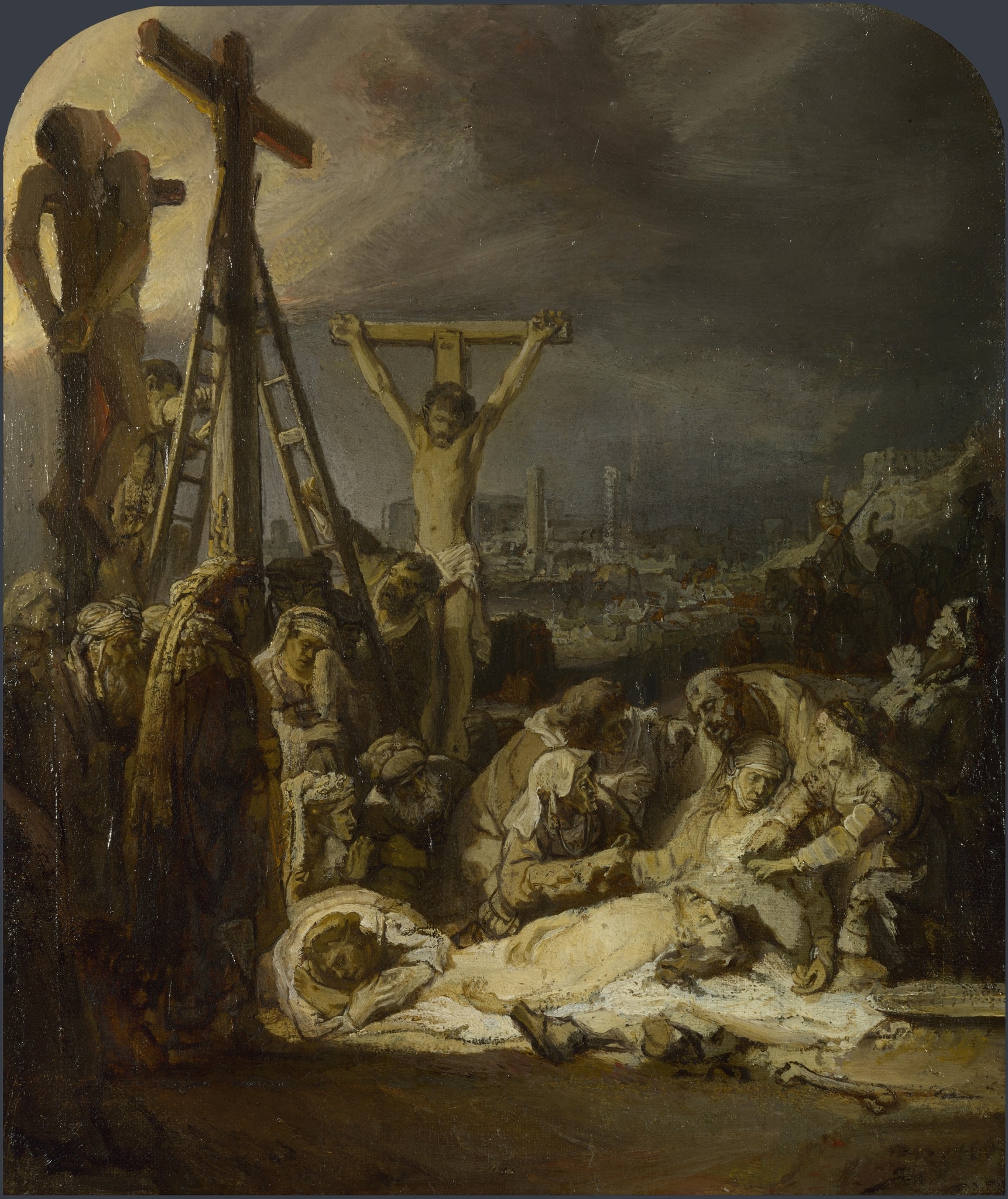
In The Lamentation over the Dead Christ, Rembrandt van Rijn gathers grief and hope into a single grisaille blaze of light. Christ’s diagonal, pallid body on a white shroud draws mourners into a tight arc, while ladders, crosses, and the silhouetted thieves still crown the hill under a storming sky [1].

Study Print Studio

Create a personal study print

Build a companion study sheet around the part of this painting that speaks to you most. Choose a detail, shape an interpretation, and walk away with something personal and display-worthy.

Fast Facts

Year
about 1635
Medium
Oil in monochrome (grisaille) on paper and pieces of canvas, mounted on oak
Dimensions
31.9 × 26.7 cm
Location
National Gallery, London
See all Rembrandt van Rijn paintings in London
The Lamentation over the Dead Christ by Rembrandt van Rijn (about 1635) featuring White shroud and blaze of light, Christ’s lifeless body, Ladders and upright crosses, The two thieves on their crosses

Click on any numbered symbol to learn more about its meaning

Meaning & Symbolism

Rembrandt constructs the scene as a theology of nearness. In the pool of light that spills across the white shroud, Christ’s body lies on a steep diagonal that magnetizes every gaze and hand. The mourners gather as a ring—heads bent, fingers extended, shoulders leaning—so that grief is not a pose but a chain of touch. At the right, the fainting Virgin echoes her son’s limp form as supporters brace her from behind; at the lower edge, a woman reaches toward Christ’s feet in a gesture of penitential devotion. These choreographies are not mere description: they define the work’s core claim that salvation is enacted through proximity—hands that bear, anoint, console. Rembrandt’s chiaroscuro makes that claim legible. Faces are carved from darkness by lamplike highlights, giving sorrow the weight of topography. The austere grisaille, with its compressed blacks, whites, and stone grays, strips away coloristic distraction to intensify spiritual focus, a strategy Rembrandt repeatedly adopted for Passion subjects in this period 14. Around the bright center, the hill of execution remains stubbornly present. Two ladders lean against the upright beams; the thieves persist on their crosses, one starkly silhouetted at the left margin while the other stands to Christ’s right—an inversion of traditional placement that signals the artist’s printmaking logic. If transferred to a plate, left and right would reverse, aligning the scene with convention; that reversal evidence undergirds the consensus that this panel is a study for an etching never realized, parallel to the demonstrable print‑study Ecce Homo 13. The city recedes under a bruised sky, its distant towers reduced to faint verticals, so that history itself seems dim beside the near blaze of compassion. A bone at the lower edge, beside the shroud, evokes Golgotha’s etymology—the place of the skull—folding human mortality into the picture’s foreground. The meaning of The Lamentation over the Dead Christ therefore turns on paradox. The brightest thing in the painting is a dead body; yet that brightness reads as promise, not horror. Rembrandt’s dramaturgy routs spectacle in favor of participation: the viewer’s eye is pulled along the corpse’s diagonal into the circle of mourners, enlisted in their shared labor of carrying and consoling. The swooning Virgin, visually twinned with her son, models co‑suffering; the figure clutching the feet embodies ardent devotion; the varied expressions—from shock to tender concentration—map a spectrum of response through which the viewer can move 12. Even the background thieves extend the moral horizon. In Rembrandt’s Crucifixion imagery, contrasts among the thieves often mark repentance versus rejection; here their lingering silhouettes frame the lament as a choice-laden aftermath, a threshold between judgment and mercy 4. Why The Lamentation over the Dead Christ is important is thus twofold. Formally, it encapsulates Rembrandt’s innovative practice in the mid‑1630s: a patchwork support and monochrome handling used as a laboratory for print-bound composition, with left/right inversion intentionally built in 1. Spiritually and psychologically, it exemplifies his Protestant‑inflected focus on Christ’s human suffering and on viewers’ empathetic response. Light becomes doctrine; staging becomes devotion. Within a panel scarcely 32 by 27 centimeters, Rembrandt compresses Passion time—from cross to tomb—into a single, luminous argument for sacrifice, empathy, and resurrection 14.

Explore Deeper with AI

Ask questions about The Lamentation over the Dead Christ

Popular questions:

Powered by AI • Get instant insights about this artwork

💬 Ask questions about this artwork!

Interpretations

Object-as-Process: Patchwork and Workshop

The panel’s make—oil on paper, torn and mounted onto canvas, then extended by added canvas strips before final mounting on oak—renders the picture a visible palimpsest of decisions. The National Gallery notes those extensions are by another hand, likely under Rembrandt’s supervision, while a British Museum drawing of the same subject shows parallel splices and reworkings. Together they document a studio ecology of trial, addition, and revision, where narrative and format evolved concurrently. This material stratigraphy reframes the Lamentation as a collaborative, iterative artifact: its devotional clarity arises from a scaffold of tests and corrections, aligning theological refinement (who stands where; how light falls) with the literal stitching‑together of supports 13.

Source: National Gallery, London; British Museum

Medium/Process: Print Logic on Panel

Rembrandt builds the composition like a printmaker. The thieves’ “reversed” placement functions as a built‑in cue for plate reversal, aligning the painting with conventions once transferred to copper. The austere grisaille heightens sculptural legibility and matches his workflow for print‑bound designs, paralleling the National Gallery’s Ecce Homo—the only painted grisaille demonstrably traced to an etching. Here, the Lamentation’s patchwork construction reads as a laboratory: value masses are blocked as if for bite‑resistant contrasts, while figure groupings test how light can deliver doctrine as much as form. The result is not just a study of grief but an object about its own reproducibility—an image rehearsing its future as an impression that was, intriguingly, never pulled 12.

Source: National Gallery, London (object entries for NG43 and NG1400)

Devotional Tactility: Protestant Empathy

Rembrandt turns touch into theology. The Magdalene’s embrace of Christ’s feet and the swooning Virgin supported by companions anchor a Protestant‑inflected focus on Christ’s humanity and on viewers’ empathetic participation. The ring of mourners invites the beholder into a practice of affective piety—to “handle” the body with the eyes—while the moderated tonal scale funnels attention toward acts of bearing, anointing, and consolation. Scholarship on Baroque Passion imagery underscores how such dramaturgy cultivates interior response over spectacle. Here, chiaroscuro does catechetical work: light singles out gestures of mercy so that looking becomes a rehearsal for compassion 16.

Source: National Gallery, London; Oxford Academic (The Pathos of the Cross: The Baroque Era)

Moral Horizon: Thieves as Frame

Although the Crucifixion has passed, the thieves remain, bracketing the lament with a dialogue of judgment and mercy. In Rembrandt’s Crucifixion imagery (e.g., The Three Crosses), contrasts between the penitent and impenitent thief are staged through light and spatial emphasis. By keeping their silhouettes in view here, he extends that moral chiaroscuro into the aftermath: grief is not isolated feeling but a field of decision. The unusual thief placement, likely anticipating print reversal, doubles as iconographic commentary—reminding viewers that repentance and rejection remain the unseen poles against which this communal care is measured 15.

Source: National Gallery, London; Kemper Art Museum (Rembrandt’s The Three Crosses resource)

Austerity and Focus: Grisaille as Devotional Technology

Grisaille’s compressed blacks and greys purge chromatic seduction in favor of concentration. In Rembrandt’s Passion cluster (e.g., the Hunterian Entombment grisaille), the reduced palette functions both practically—clarifying masses for potential print translation—and spiritually, as a discipline of attention. The Lamentation’s lamplike highlights carve faces from gloom so that sorrow reads with topographical weight; the city recedes under a bruised sky, history dim beside compassion’s blaze. Within this ascetic register, the brightest form is a dead body that reads as promise rather than horror—a paradox the medium intensifies by stripping away pictorial noise to leave only value, gesture, and grace 14.

Source: National Gallery, London; Rijksmuseum (context on Passion grisailles)

Related Themes

About Rembrandt van Rijn

Rembrandt van Rijn (1606–1669) was a leading Dutch Golden Age painter and printmaker whose Amsterdam years (from 1631) produced virtuosic portraits and ambitious history paintings. In the early 1630s he favored polished finishes, saturated color, and theatrical staging—qualities on display in this 1633 canvas. Although prolific, this is his only known painted seascape [2][4].
View all works by Rembrandt van Rijn

More by Rembrandt van Rijn
The Anatomy Lesson of Dr. Nicolaes Tulp by Rembrandt van Rijn

The Anatomy Lesson of Dr. Nicolaes Tulp

Rembrandt van Rijn (1632)

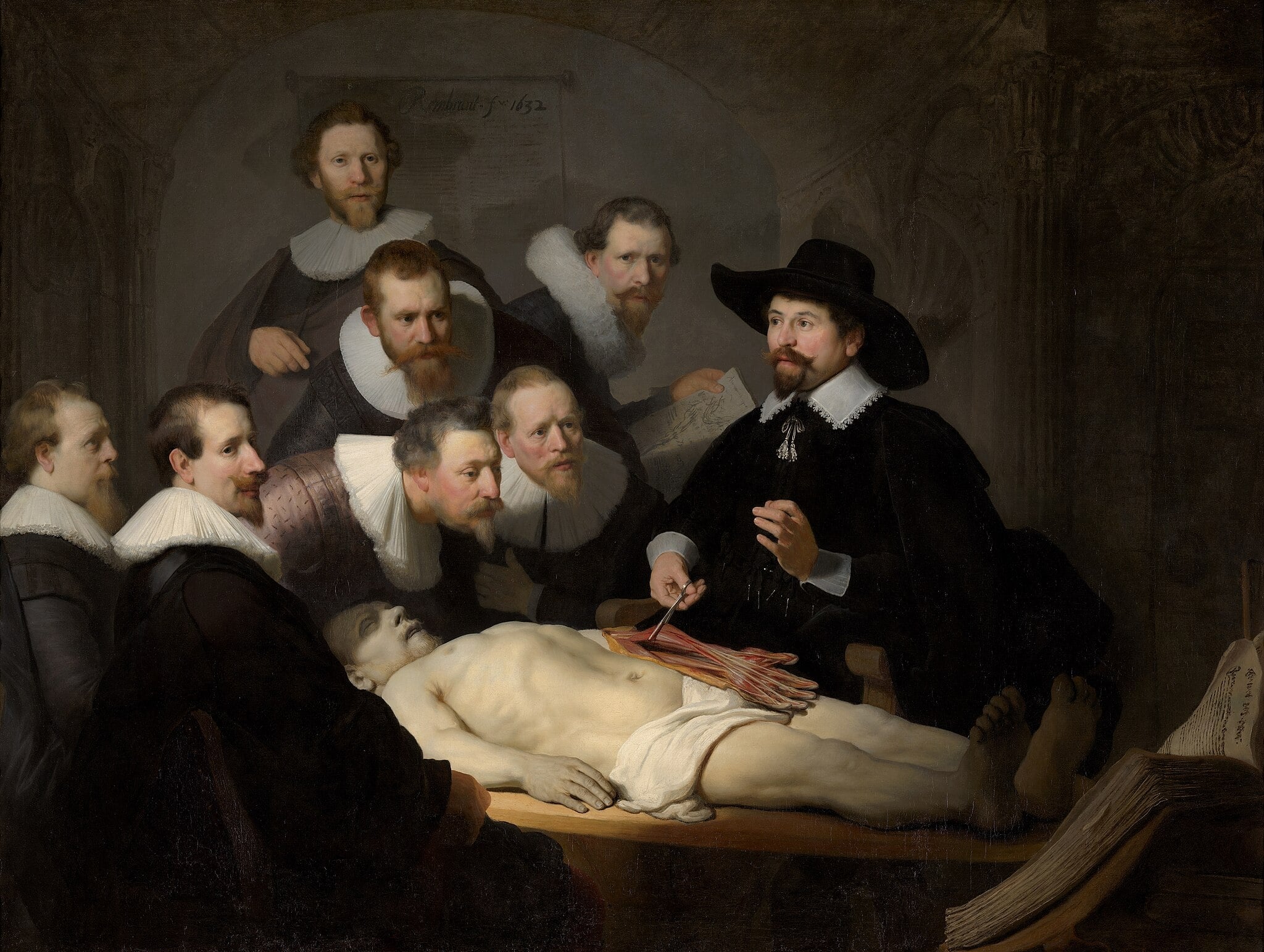
Rembrandt van Rijn turns a civic commission into a drama of <strong>knowledge made visible</strong>. A cone of light binds the ruff‑collared surgeons, the pale cadaver, and Dr. Tulp’s forceps as he raises the <strong>forearm tendons</strong> to explain the hand. Book and body face each other across the table, staging the tension—and alliance—between <strong>textual authority</strong> and <strong>empirical observation</strong> <sup>[1]</sup><sup>[2]</sup>.
The Storm on the Sea of Galilee by Rembrandt van Rijn

The Storm on the Sea of Galilee

Rembrandt van Rijn (1633)

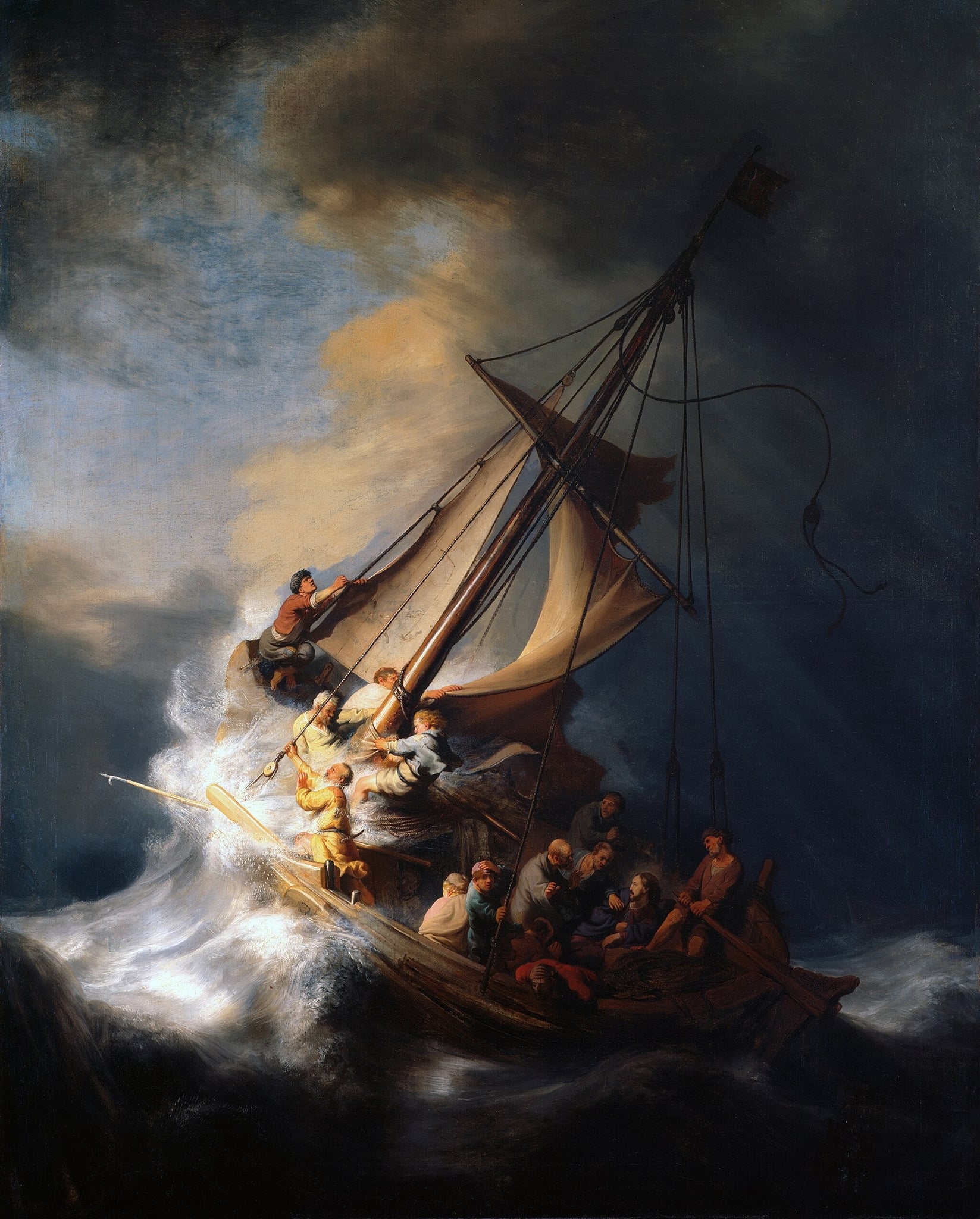
Rembrandt van Rijn’s The Storm on the Sea of Galilee stages a clash of <strong>human panic</strong> and <strong>divine composure</strong> at the instant before the miracle. A torn mainsail whips across a steeply tilted boat as terrified disciples scramble, while a <strong>serenely lit Christ</strong> anchors a pocket of calm—an image of faith holding within chaos <sup>[1]</sup><sup>[3]</sup>. It is Rembrandt’s only painted seascape, intensifying its dramatic singularity in his oeuvre <sup>[2]</sup>.
The Jewish Bride by Rembrandt van Rijn

The Jewish Bride

Rembrandt van Rijn (c. 1665–1669)

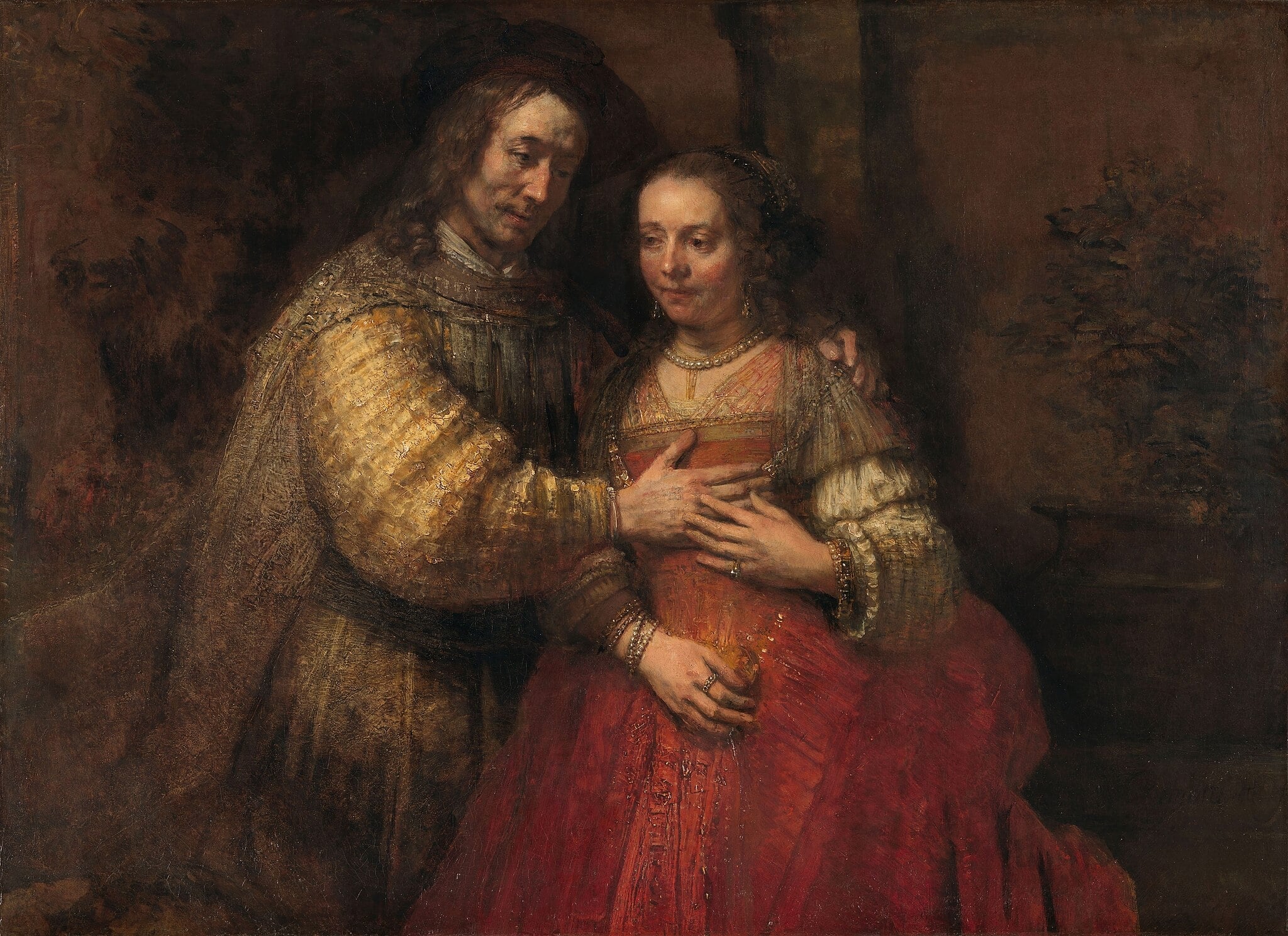
The Jewish Bride by Rembrandt van Rijn stages an intimate covenant: two figures, read today as <strong>Isaac and Rebecca</strong>, seal their union through touch rather than spectacle. Light concentrates on faces and hands, while the man’s glittering <strong>gold sleeve</strong> and the woman’s <strong>coral-red gown</strong> turn paint itself into a metaphor for fidelity and tenderness <sup>[1]</sup><sup>[3]</sup>. This late masterpiece embodies Rembrandt’s <strong>material eloquence</strong>—impasto as feeling—within a hushed, dark setting <sup>[1]</sup><sup>[2]</sup>.
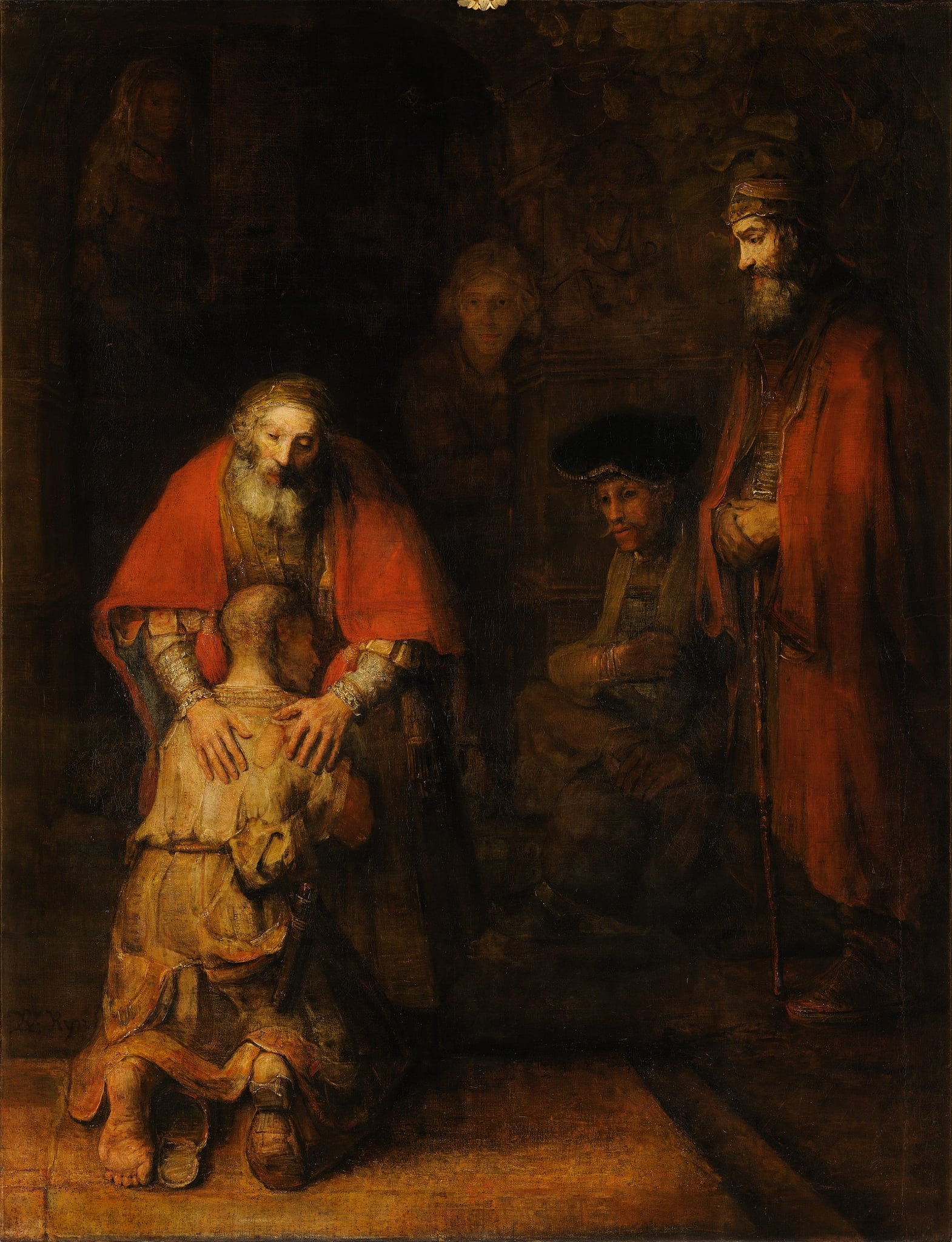
The Return of the Prodigal Son by Rembrandt van Rijn

The Return of the Prodigal Son

Rembrandt van Rijn (c. 1661–1669 (probably completed by 1669))

Rembrandt van Rijn’s The Return of the Prodigal Son is a late-life meditation on <strong>mercy</strong>, <strong>homecoming</strong>, and <strong>restored dignity</strong>. In a hush of dusk-like light, a ragged son kneels into his father’s <strong>embrace</strong>, while an upright elder brother holds back in shadow. The image concentrates meaning in illuminated <strong>faces, hands, and feet</strong>, turning a parable into a timeless human reckoning. <sup>[1]</sup><sup>[2]</sup>
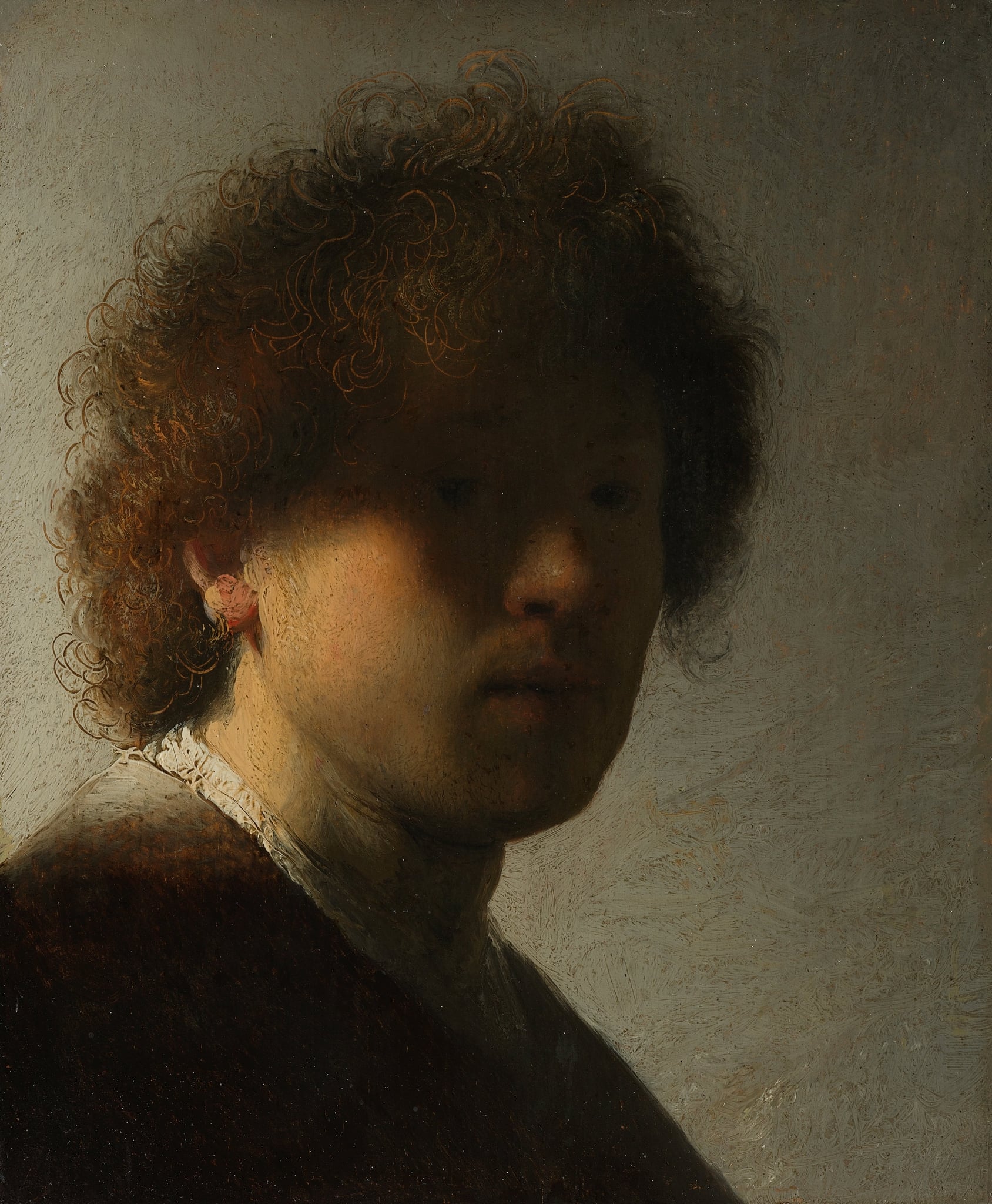
Self-portrait (with tousled hair) by Rembrandt van Rijn

Self-portrait (with tousled hair)

Rembrandt van Rijn (c. 1628)

A young Rembrandt van Rijn tests how <strong>light both reveals and withholds</strong> by letting his face emerge from darkness while his <strong>scratched, backlit curls</strong> flare like a rough halo. The small oak panel makes <strong>process itself the subject</strong>, turning hair, stubble, and a raking highlight into a statement of identity-in-formation <sup>[1]</sup><sup>[5]</sup>.
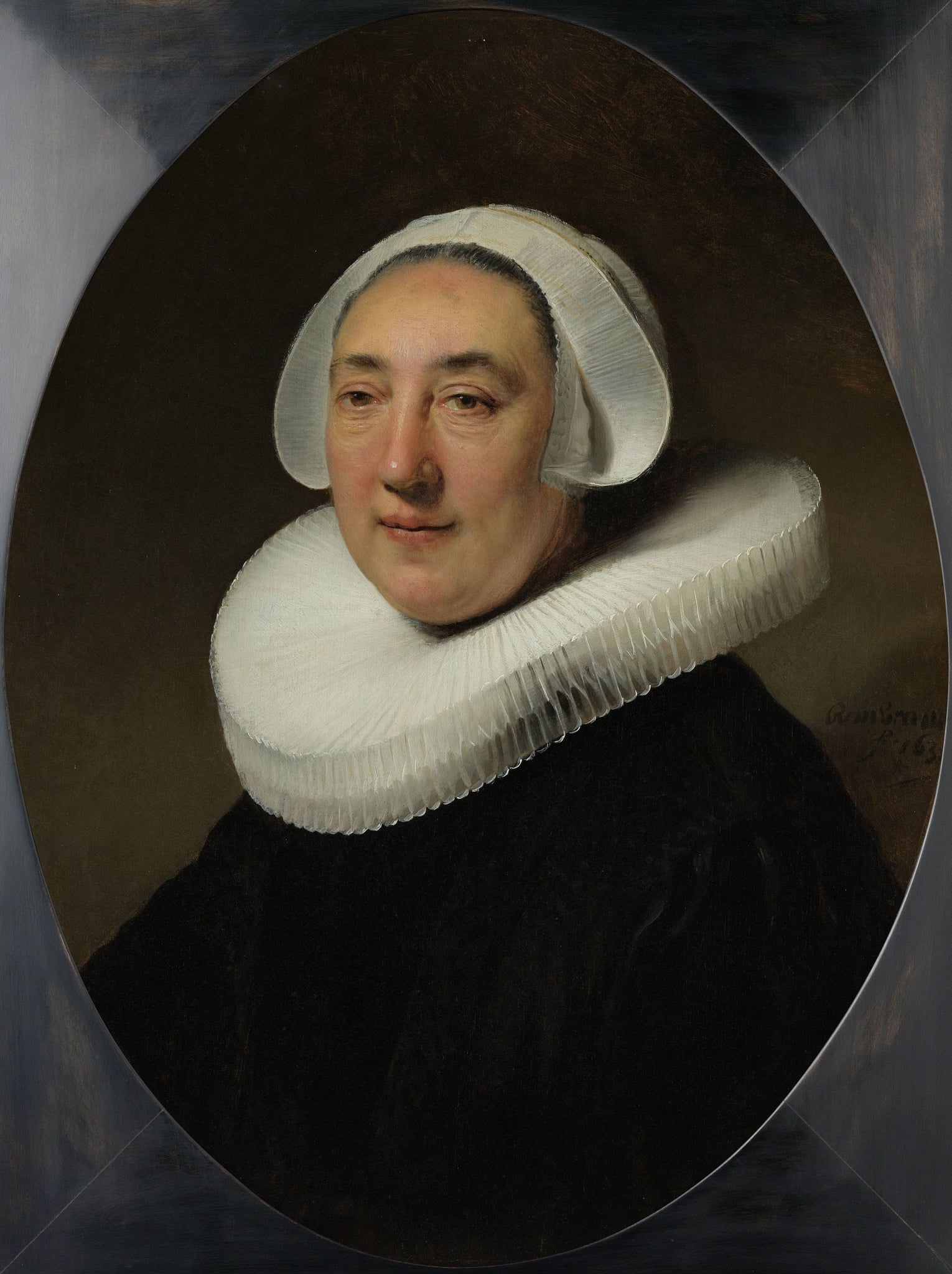
Portrait of Haesje Jacobsdr van Cleyburg by Rembrandt van Rijn

Portrait of Haesje Jacobsdr van Cleyburg

Rembrandt van Rijn (1634)

Rembrandt’s 1634 Portrait of Haesje Jacobsdr van Cleyburg stages a Dutch burgher within a feigned <strong>oval</strong> opening, illuminated by selective <strong>chiaroscuro</strong> that models warm skin against brilliant <strong>millstone ruff</strong> and sober black dress. The painting balances <strong>modesty and status</strong>, making virtue visible while quietly declaring prosperity through immaculate linen and craft <sup>[1]</sup><sup>[4]</sup>.