How Much Is The Woman taken in Adultery Worth?
Last updated: August 4, 2026
Quick Facts
- Methodology
- comparable analysis
Hypothetical private-treaty value for Rembrandt’s The Woman taken in Adultery is $170–220 million. This reflects its status as a mature, autograph biblical masterpiece in the National Gallery, London, and aligns with recent nine‑figure private acquisitions of apex Rembrandt paintings.
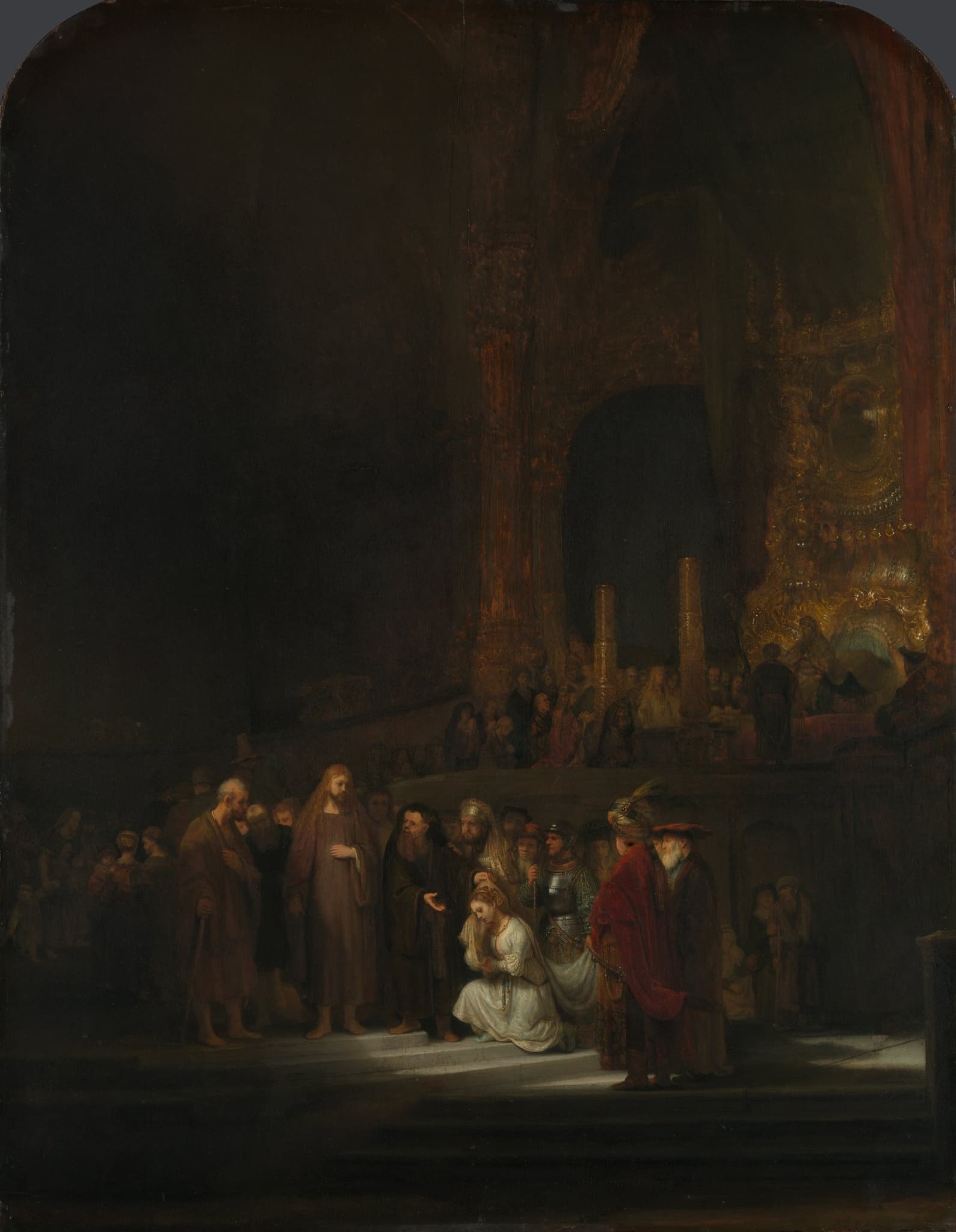
The Woman taken in Adultery
Rembrandt van Rijn, 1644 • Oil on oak panel
Read full analysis of The Woman taken in Adultery →Valuation Analysis
Overview. Rembrandt’s The Woman taken in Adultery (1644; oil on oak panel, National Gallery, London) is widely accepted as a prime, autograph work from the artist’s mature period and is a cornerstone of the museum’s Dutch Baroque holdings [1]. As a complex, dramatic biblical narrative with sophisticated chiaroscuro, it ranks among the most significant Rembrandt history paintings remaining in public view.
Method and positioning. The $170–220 million estimate is derived from a top‑down comparison to the most relevant modern‑era Rembrandt transactions and a bottom‑up adjustment against recent public auction benchmarks for smaller or earlier works. The primary anchor is the Dutch State’s 2022 acquisition of Rembrandt’s The Standard-Bearer for €175 million (c.$198m at the time; ~mid‑$200m in current replacement terms), which demonstrates today’s private pricing for apex, museum‑priority Rembrandts [2]. A second, closely watched benchmark is the 2016 joint acquisition of the full‑length portraits of Maerten Soolmans and Oopjen Coppit by the Louvre and Rijksmuseum for €160 million for the pair (roughly high‑eight to low‑nine figures per picture in 2016 dollars) [3].
Public auction context. By contrast, the public auction market captures smaller or less pivotal Rembrandt paintings. The artist’s painting auction record—£20.2m ($33.2m) set in 2009 for a mature portrait—remains far below private‑treaty levels due to the scarcity of top‑tier material entering the saleroom [5]. Recent narrative panels confirm demand but at a different tier: The Adoration of the Kings (c.1628; small panel) made £10.9m (~$13.7m) in 2023 [4], while an early/unfinished religious scene (Let the Little Children Come Unto Me) realized about $10.6m in 2026 [6]. These results, though strong, are not directly comparable to a celebrated, mid‑1640s, museum‑highlight narrative like The Woman taken in Adultery.
Why this work justifies a nine‑figure value. The subject’s narrative power, the maturity of execution, the painting’s long scholarly acceptance as autograph, and its prominence in a leading national collection position it well above auction‑visible comps and squarely within the nine‑figure outcomes evidenced by recent private/state acquisitions [1][2][3]. Within Rembrandt’s oeuvre, it is not as globally iconic as The Night Watch, but it stands among the finest scriptural dramas of the 1640s, supporting a premium above the per‑picture valuation inferred from the 2016 pair and within range of the 2022 Standard-Bearer benchmark.
Assumptions and constraints. This valuation assumes fully autograph status, stable condition consistent with National Gallery stewardship, and no material condition impairments. The National Gallery’s ownership means a real sale is implausible and would, in practice, face UK deaccession and export restrictions; however, insurance or agreed values for national‑treasure works typically reflect replacement difficulty rather than liquidity, which supports the indicated range [1]. On balance, the data support a $170–220 million hypothetical private‑treaty valuation today.
Key Valuation Factors
Art Historical Significance
High ImpactPainted in 1644, this is a mature-period Rembrandt biblical drama with complex staging, expressive lighting, and a nuanced moral narrative. It has long been catalogued as autograph and is a centerpiece of the National Gallery’s Dutch Baroque collection, appearing widely in the scholarly literature. Its subject—Christ and the adulterous woman—aligns with Rembrandt’s most profound explorations of forgiveness and judgment, enhancing its standing relative to the artist’s narrative works. This combination of date, subject, and execution places it among the most important Rembrandt history paintings in public hands, warranting a valuation tier commensurate with apex works by the artist.
Authorship and Scholarship Certainty
High ImpactThe painting is widely recognized as an autograph Rembrandt and has been studied, published, and exhibited for generations. Acceptance by leading institutions and scholars substantially reduces attribution risk that often depresses Old Master pricing. Technical and provenance research recorded by the National Gallery underpins confidence in date and authorship. In a market where the difference between ‘studio’ and ‘autograph’ can shift value by multiples, this level of scholarly consensus supports placement at the top of the Old Master price spectrum and narrows the valuation band to a nine-figure range.
Rarity and Market Liquidity
High ImpactPrime, museum-caliber Rembrandt paintings are exceptionally scarce on the open market; most are in public collections, and apex private examples trade only rarely and often with state involvement. Recent landmark private acquisitions (e.g., The Standard-Bearer; the Soolmans/Coppit pair) evidence strong institutional and UHNW demand at nine-figure levels despite the thin buyer pool. The rarity premium for a mature, autograph biblical narrative of this quality is therefore substantial, justifying a valuation well above public-auction comparables for smaller or less pivotal works.
Condition and Conservation
Medium ImpactWhile National Gallery stewardship implies responsible care, the valuation assumes structurally sound oak support, stable paint layers, and no disfiguring overpaint or abrasion in critical passages. Any adverse findings—panel movement, significant restoration in focal areas, or losses—would compress the estimate. Conversely, a clean surface with intact impasto and legible chiaroscuro would support the upper bound. Because condition is disproportionately price-sensitive in Old Masters, updated technical imaging and a current condition report would be the single most impactful refinements to this estimate.
Benchmark Comparables
High ImpactThe 2022 €175m Dutch State purchase of The Standard-Bearer and the 2016 €160m Louvre/Rijksmuseum acquisition of the Soolmans/Coppit pair establish the current private-pricing band for apex Rembrandts. Public-auction results for smaller or early works (e.g., The Adoration of the Kings at £10.9m; an early unfinished narrative at c.$10.6m) define a lower tier. Positioned between these poles, The Woman taken in Adultery—mature, autograph, and famous—supports a $170–220m range today, consistent with nine-figure private outcomes for top-quality Rembrandt paintings.
Sale History
Amsterdam (Willem Six sale)
Lot 5; 2,510 guilders; reported bought-in.
London (P.J. Lafontaine sale)
Lot 44; 5,000 guineas; bought-in; sold privately the following day to John Julius Angerstein (price not stated).
UK Government purchase of Angerstein collection (London)
Acquired within 38-picture group for £57,000 (collection-level price).
Rembrandt van Rijn's Market
Rembrandt sits at the apex of the Old Masters market, with a tiny supply of securely autograph paintings and intense institutional demand. The highest-profile modern benchmarks are private/state acquisitions: The Standard-Bearer at €175 million (2022) and the Soolmans/Coppit pair at €160 million (2016). At auction, the artist’s painting record remains £20.2 million ($33.2 million) from 2009, reflecting the scarcity of top-tier works reaching the block rather than demand limits. Recent sales of rediscovered or early panels around $10–14 million, alongside record-setting performance in prints, demonstrate deep connoisseur interest across media. Overall, the Rembrandt market is quality-sensitive, scholarship-driven, and capable of nine-figure outcomes for apex works.
Comparable Sales
The Standard-Bearer (Self-Portrait), 1636
Rembrandt van Rijn
Apex, autograph Rembrandt painting acquired as a national treasure; establishes current nine‑figure private pricing for top‑tier Rembrandts. Not a narrative scene but comparable in authorship, rarity, and museum‑level significance.
$198.0M
2022, Private sale to the Dutch State (for the Rijksmuseum)
~$216.6M adjusted
Portraits of Maerten Soolmans and Oopjen Coppit (pair), 1634
Rembrandt van Rijn
Landmark private acquisition of two full‑length Rembrandt portraits; shows private market willingness to pay near nine figures for each painting. While portraits (not biblical narrative), they are the closest modern benchmark for museum‑grade Rembrandt oils of comparable art‑historical weight. Price shown per painting on a simple 50/50 split.
$89.0M
2016, Private sale arranged by Christie's to the Rijksmuseum and the Louvre
~$118.6M adjusted
Portrait of a Man, Half-Length, With His Arms Akimbo
Rembrandt van Rijn
Artist’s auction record for a painting; confirms the public‑auction ceiling for a single Rembrandt work. A mature portrait (not a narrative) but directly comparable by authorship and market tier.
$33.2M
2009, Christie's London
~$49.5M adjusted
The Adoration of the Kings (c. 1628, small panel)
Rembrandt van Rijn
Autograph early biblical narrative on panel; closest subject category to The Woman taken in Adultery. Demonstrates recent auction appetite for Rembrandt narrative scenes, though much smaller and earlier in style.
$13.8M
2023, Sotheby's London
~$14.5M adjusted
Portraits of Jan Willemsz. van der Pluym and Jaapgen Carels (pair), 1635
Rembrandt van Rijn
Two small autograph Rembrandt oils sold together; fresh, well‑publicized result that anchors current mid‑eight‑figure auction demand for smaller paintings by the artist.
$14.3M
2023, Christie's London
~$15.0M adjusted
Let the Little Children Come Unto Me (early, unfinished)
Rembrandt van Rijn
Religious narrative subject closely aligned with The Woman taken in Adultery, but early and unfinished; confirms pricing for secondary narrative material and condition‑sensitive works.
$10.6M
2026, Sotheby's London
~$10.4M adjusted
Current Market Trends
Old Masters auction turnover softened in 2024 but rebounded in 2025, with the category gaining share amid a broader rebalancing away from ultra-contemporary trophies. Supply remains the defining constraint, particularly for top-tier works by canonical names. In this environment, correctly estimated, well-documented pieces attract selective but potent bidding, while national-treasure caliber works transact privately or via government acquisitions. Recent Rembrandt sales illustrate a two-tier structure: rediscovered or small panels at $10–15 million in public auctions, and landmark museum-priority paintings achieving nine figures privately. For a mature, autograph masterpiece like The Woman taken in Adultery, the relevant pricing signal is the private nine-figure tier.
Study print
Study this painting as a print
Pair the full artwork with a museum-style study sheet focused on one meaningful detail.
Sources
- National Gallery, London – Object page: Rembrandt, The Woman taken in Adultery
- Rijksmuseum – Press release: The Standard-Bearer acquired by the Dutch State
- Louvre – Press: Acquisition of the portraits of Maerten Soolmans and Oopjen Coppit
- The Art Newspaper – Rediscovered Rembrandt: The Adoration of the Kings
- Christie’s – Press release (Dec 2009): Rembrandt auction record
- HENI News – Sotheby’s London Old Masters Evening Sale (July 1, 2026)