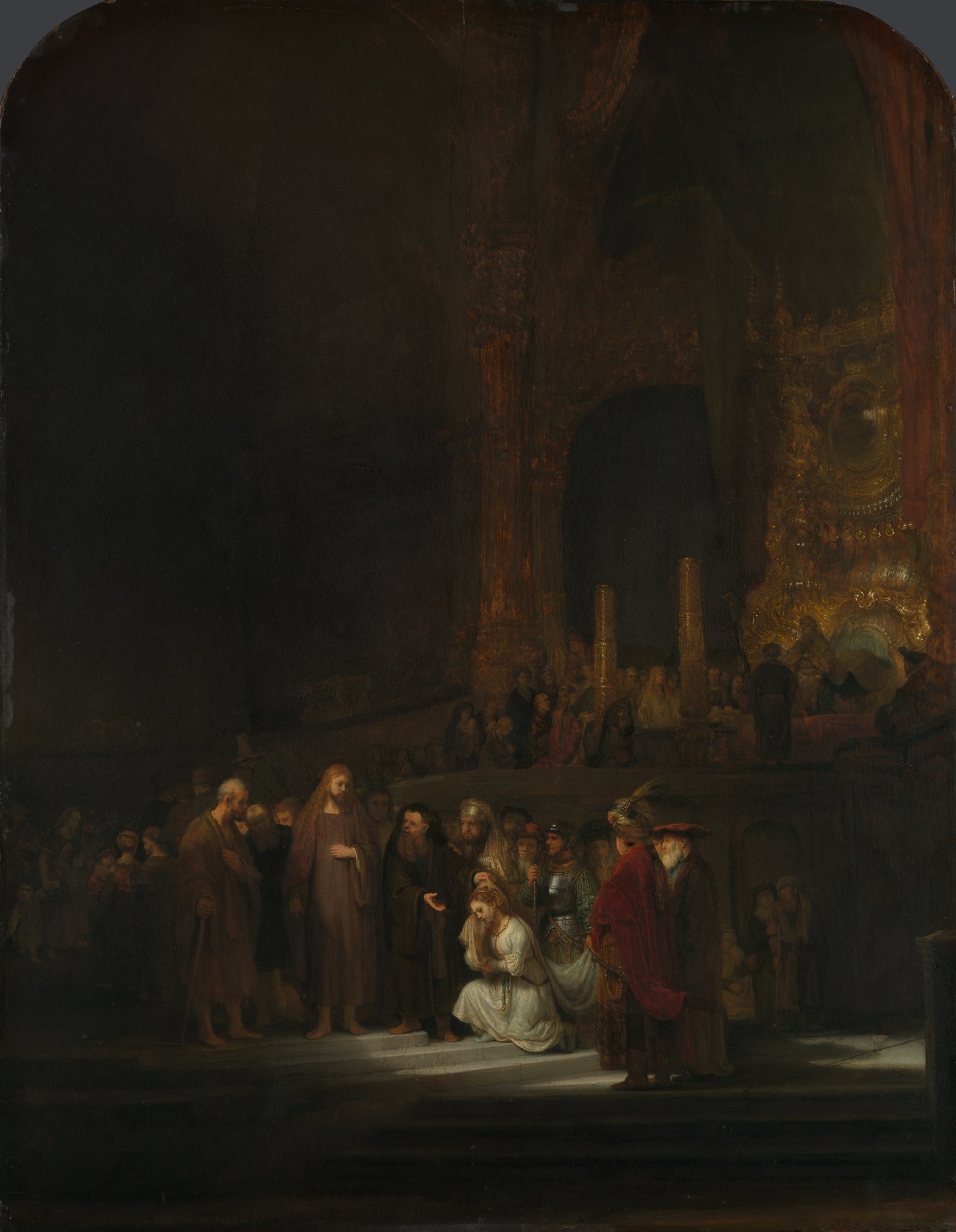
The Woman taken in Adultery

by Rembrandt van Rijn

Rembrandt van Rijn’s The Woman taken in Adultery (1644) stages John 8:3–11 as a tense, ethical pause inside a cavernous, gilded sanctuary. A narrow beam of light singles out the kneeling woman in white while Christ’s composed figure redirects the crowd from retribution toward mercy [1].

Study Print Studio

Create a personal study print

Build a companion study sheet around the part of this painting that speaks to you most. Choose a detail, shape an interpretation, and walk away with something personal and display-worthy.

Fast Facts

Year
1644
Medium
Oil on oak panel
Dimensions
83.8 × 65.4 cm
Location
National Gallery, London
See all Rembrandt van Rijn paintings in London
The Woman taken in Adultery by Rembrandt van Rijn (1644) featuring Beam of light, The woman's white shift and loosened veil, Christ’s directing hand, Accuser’s pointing finger

Click on any numbered symbol to learn more about its meaning

Meaning & Symbolism

Rembrandt engineers a theater of conscience by shrinking the actors against a towering, dusk‑filled apse. The woman, clasping her hands and bowing her head, kneels in a tight pool of brightness, her white shift and loosened veil signaling exposed shame; a soldier’s mailed hand tugs that veil to underscore coercion 1. Two elders flank her—one with a gnarled, accusatory finger, another in a jeweled turban—while a man just behind raises a finger to his lips to hush the assembly. Christ stands slightly apart, calm and frontal, his controlled gesture routing attention away from the clenched cluster of accusers. To the right, armor, plumes, and rich robes mass together in half‑shadow: visible power without inner illumination. Behind them, a tall gilded altar and colossal columns catch stray gleams, but most of the sanctuary dissolves into darkness, making worldly splendor feel weightless before a higher ethic 1. By staging the “moment before the word,” Rembrandt withholds the famous writing on the ground and makes silence itself the drama; as Podro notes, suspense and spectatorship become the subject 5. Light functions here as ethical rhetoric. The single shaft that finds the woman is not vindication but possibility—the site where forgiveness could occur. Christ is set within that same zone of moderated radiance, visually allying compassion with clarity, while the accusers remain layered in gloom. The broad, empty foreground steps—cool, stony, and emphatically unoccupied—operate like a moral proscenium, delaying action and evoking the unthrown stones the story names but the painting withholds 1. Rembrandt’s unusually elaborate architectural setting for the mid‑1640s—a throwback to his grand history manner—magnifies the test’s stakes; the sacred décor and imagined “Eastern” dress distance the scene from daily Dutch life so viewers can read it as timeless law and conscience rather than local scandal 4. Within a Protestant culture that had shifted biblical images from churches to private and civic rooms, this composition transforms scripture into a shared reflective exercise: viewers are placed where a stone might fall, and the decision is theirs 13. What clinches the argument is Rembrandt’s choreography of gesture and gaze. The hush sign stops the crowd; the pointing hand crystallizes accusation; Christ’s steady arm redirects the vector of looking from the woman’s body to the crowd’s hearts. Candle‑pricks around the altar simulate institutional piety, yet their glitter cannot compete with the substantive, shaping beam that defines the scene’s moral horizon. In Drury’s terms, Rembrandt “paints the Word” by compressing doctrine into visible relations—darkness as legalism, light as mercy, interval as conscience 6. Thus the painting is not illustration but judgment suspended: a composition that turns seeing into choosing. This is why The Woman taken in Adultery endures—as a paradigmatic union of Rembrandt’s psychological stagecraft and his theology of light, inviting each generation to decide whether to condemn or be changed by grace 12.

Explore Deeper with AI

Ask questions about The Woman taken in Adultery

Popular questions:

Powered by AI • Get instant insights about this artwork

💬 Ask questions about this artwork!

Interpretations

Formal/Spatial Analysis: Architecture as Moral Engine

Rembrandt revives his earlier grand manner by dwarfing figures under a colossal, recessive architecture, a device that turns space into ethics. The gilded altar, towering columns, and plunging nave create a cavern where scale disciplines behavior: small bodies, vast law. This staging converses with Dutch interest in church‑interior perspectives, where ordered space guides devotion and social conduct. Here, the broad, empty steps operate as a proscenium separating viewers from action while implicating them as potential stone‑throwers. The temple’s glittering surfaces read as institutional prestige that visually thins into darkness, contrasted with the decisive beam that shapes moral attention. Space doesn’t just contain the drama; it produces it, converting architectural depth into deliberative delay and judicial suspense 14.

Source: Sergiusz Michalski, Artibus et Historiae; National Gallery, London

Iconography/Global Lens: Easternizing Distance and Authority

The scene’s imagined “Eastern” dress—turbans, fabrics, and courtly armor—signals temporal and geographic remove, a standard early‑modern strategy to mark biblical time as other. This Easternizing is not ethnography but a rhetorical costume that elevates proceedings into timeless law, distinguishing spiritual adjudication from Dutch daily life. It also amplifies rank: jeweled headgear and martial glitter visualize juridical hierarchy while remaining in half‑shadow, a foil to Christ’s moderated light. Exhibitions on Rembrandt’s “Orient” have shown how such inflections shape sacred history’s tone; here, they construct a courtly stage of power whose theatrical splendor cannot command the painting’s ethical light, thereby questioning the grounds of authority it displays 15.

Source: Kunstmuseum Basel/Museum Barberini (“Rembrandt’s Orient”) via National Gallery; Web Gallery of Art

Spectatorship & Temporality: The Drama of the Pause

Michael Podro reads this painting as an education in looking: suspense and spectatorship become the subject. Rembrandt withholds the writing on the ground and centers the “moment before the word,” using the hush‑gesture, the pointing hand, and Christ’s calm vector to choreograph a temporal bracket. The viewer’s gaze is led from accusation toward introspection, converting narrative climax into a test of self‑recognition. The work thus performs a phenomenology of judgment: seeing is slowed, judgment deferred, and attention redistributed from the woman’s body to the accusers’ hearts. In that interval, the picture makes space for conscience. The scene’s authority emerges not from decree but from the shared act of looking sustained by silence 21.

Source: Michael Podro, Journal of the Warburg and Courtauld Institutes; National Gallery, London

Theology of Light: Painting as Moral Speech

John Drury argues Rembrandt “paints the Word”: doctrine becomes visible through light, shadow, and interval. Here, candle‑pricks near the altar simulate ritual piety, yet their sparkle is decorative beside the shaping beam that articulates the event’s moral horizon. That light is not automatic vindication; it is a site of decision, shared by Christ and the kneeling woman, where judgment can turn into mercy. Darkness accumulates around legalistic fervor—the gnarled finger, bristling armor—without demonizing them as caricature; rather, shadow marks a world awaiting illumination. The result is not illustration but judgment delayed, making the ethics of John 8 experiential: the viewer inhabits the pause where condemnation could be reformed into grace 31.

Source: John Drury, Painting the Word (Yale University Press); National Gallery, London

Gendered Power: Shame, Display, and Legal Violence

Rembrandt codes vulnerability through costume: the woman’s white shift, loosened veil, and bowed posture render sexual exposure as public evidence. A soldier’s mailed hand gripping her veil literalizes the law’s reach over the female body—coercion staged before a male assembly. Yet her clasped hands and the isolating light reframe spectacle as appeal rather than confession, shifting the ethical center from punitive desire to the possibility of intercession. The painting documents how gendered shame circulates as visual currency—displayed, appraised, and threatened—while quietly indicting that economy by aligning clarity and compassion with Christ, not with the accusers’ power. It is a social drama of patriarchy, but one that opens a counter‑script grounded in mercy 16.

Source: National Gallery, London; National Gallery of Art (Washington)

Reception & Setting: From Church Ban to Civic Parlors

In the Dutch Republic, images left churches for private and civic rooms, where biblical narratives became tools for moral conversation. Rembrandt answers this market by crafting a scene that functions as a shared reflective exercise: the empty steps place us where a stone might fall, implicating household or civic viewers in the verdict. Such placement converts spectators into participants, aligning with Rembrandt’s broader tendency to adapt scripture for intimate, psychologically charged settings. The composition’s grandeur—unusual for the mid‑1640s—keeps the stakes high even off the altar, letting domestic audiences rehearse public ethics in private space. The work thus models how painting could act as a civic pedagogy of mercy over retribution 17.

Source: National Gallery, London; The Met Heilbrunn Timeline of Art History

Related Themes

About Rembrandt van Rijn

Rembrandt van Rijn (1606–1669) was a leading Dutch Golden Age painter and printmaker whose Amsterdam years (from 1631) produced virtuosic portraits and ambitious history paintings. In the early 1630s he favored polished finishes, saturated color, and theatrical staging—qualities on display in this 1633 canvas. Although prolific, this is his only known painted seascape [2][4].
View all works by Rembrandt van Rijn

More by Rembrandt van Rijn
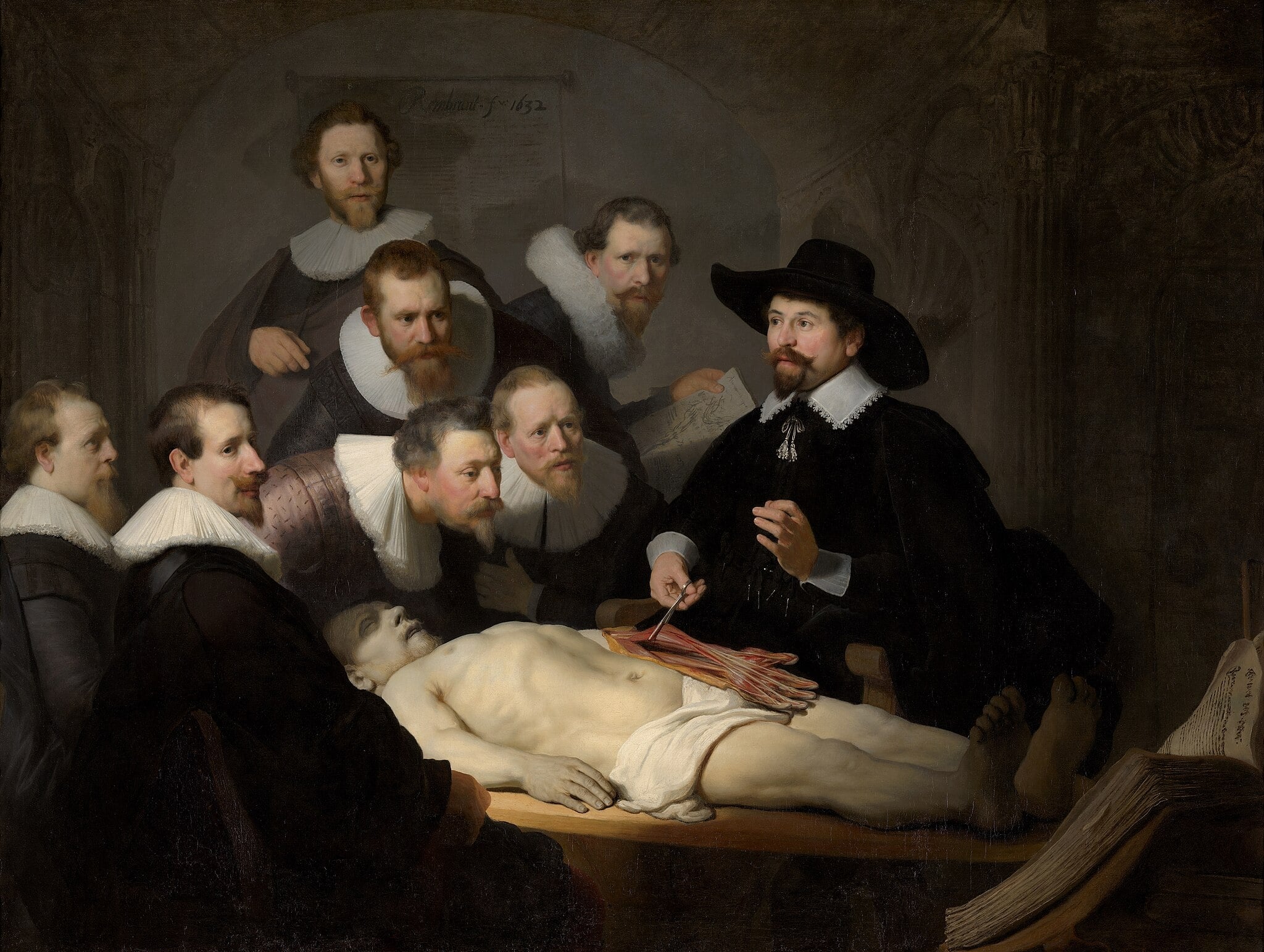
The Anatomy Lesson of Dr. Nicolaes Tulp by Rembrandt van Rijn

The Anatomy Lesson of Dr. Nicolaes Tulp

Rembrandt van Rijn (1632)

Rembrandt van Rijn turns a civic commission into a drama of <strong>knowledge made visible</strong>. A cone of light binds the ruff‑collared surgeons, the pale cadaver, and Dr. Tulp’s forceps as he raises the <strong>forearm tendons</strong> to explain the hand. Book and body face each other across the table, staging the tension—and alliance—between <strong>textual authority</strong> and <strong>empirical observation</strong> <sup>[1]</sup><sup>[2]</sup>.
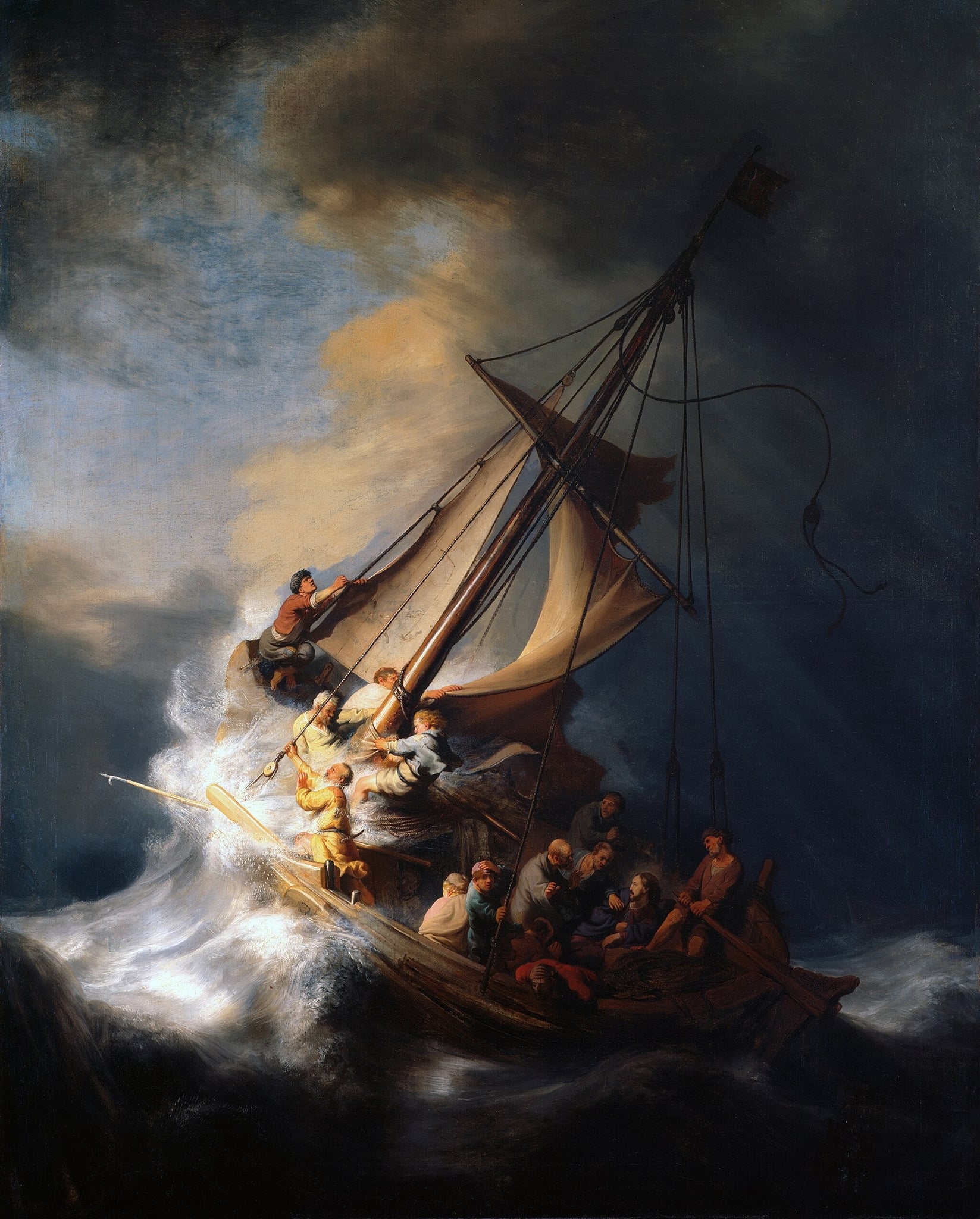
The Storm on the Sea of Galilee by Rembrandt van Rijn

The Storm on the Sea of Galilee

Rembrandt van Rijn (1633)

Rembrandt van Rijn’s The Storm on the Sea of Galilee stages a clash of <strong>human panic</strong> and <strong>divine composure</strong> at the instant before the miracle. A torn mainsail whips across a steeply tilted boat as terrified disciples scramble, while a <strong>serenely lit Christ</strong> anchors a pocket of calm—an image of faith holding within chaos <sup>[1]</sup><sup>[3]</sup>. It is Rembrandt’s only painted seascape, intensifying its dramatic singularity in his oeuvre <sup>[2]</sup>.
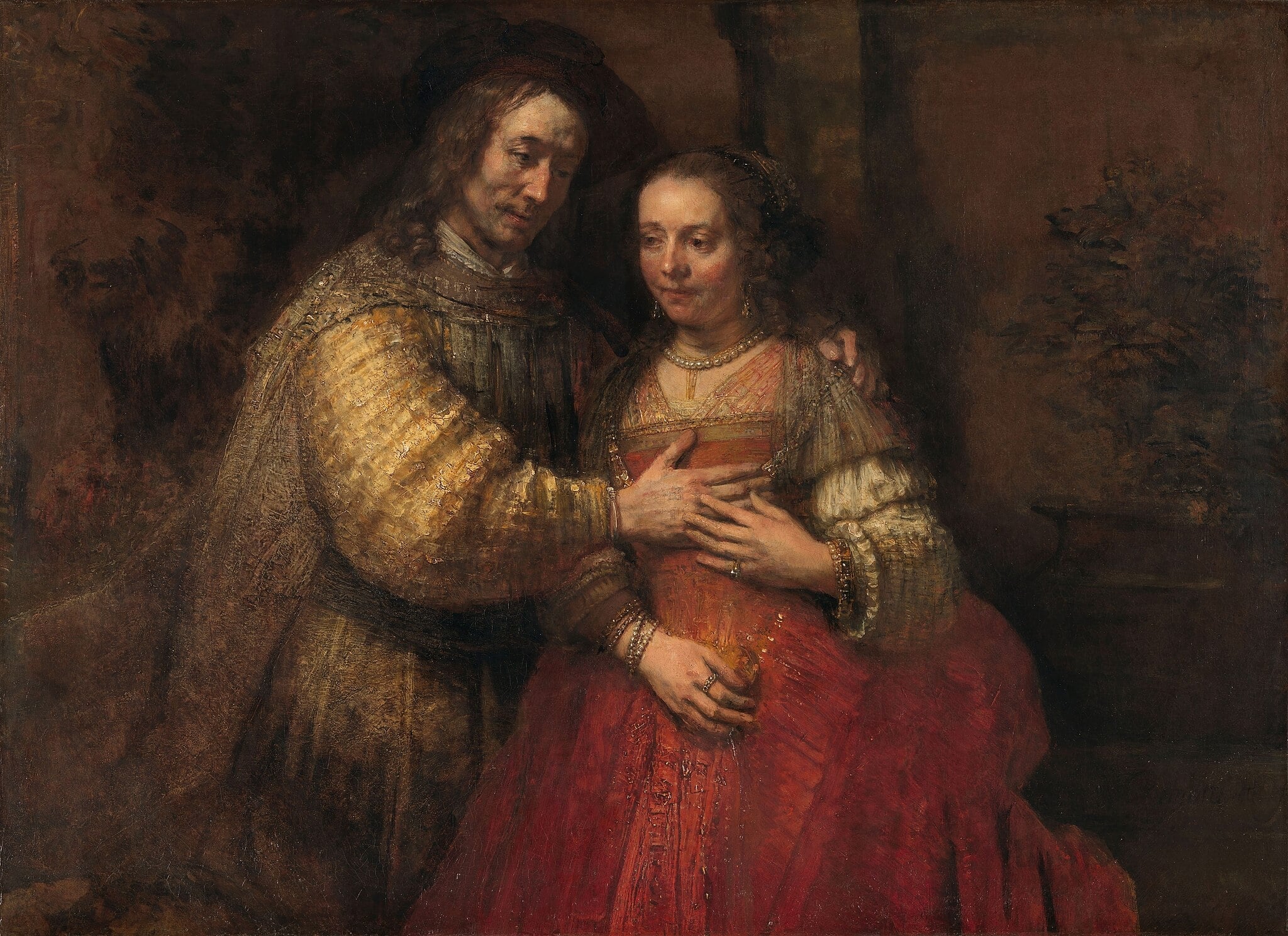
The Jewish Bride by Rembrandt van Rijn

The Jewish Bride

Rembrandt van Rijn (c. 1665–1669)

The Jewish Bride by Rembrandt van Rijn stages an intimate covenant: two figures, read today as <strong>Isaac and Rebecca</strong>, seal their union through touch rather than spectacle. Light concentrates on faces and hands, while the man’s glittering <strong>gold sleeve</strong> and the woman’s <strong>coral-red gown</strong> turn paint itself into a metaphor for fidelity and tenderness <sup>[1]</sup><sup>[3]</sup>. This late masterpiece embodies Rembrandt’s <strong>material eloquence</strong>—impasto as feeling—within a hushed, dark setting <sup>[1]</sup><sup>[2]</sup>.
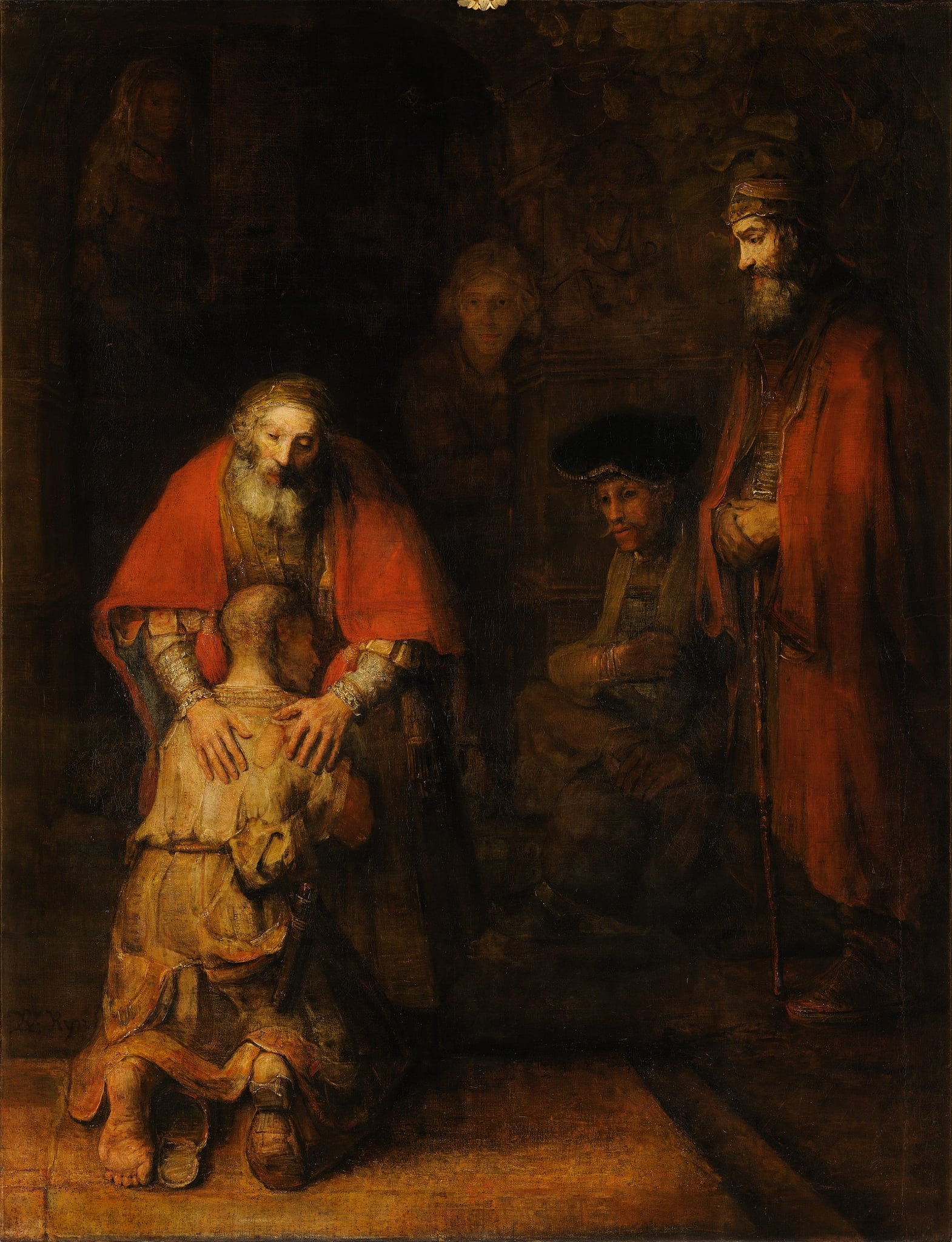
The Return of the Prodigal Son by Rembrandt van Rijn

The Return of the Prodigal Son

Rembrandt van Rijn (c. 1661–1669 (probably completed by 1669))

Rembrandt van Rijn’s The Return of the Prodigal Son is a late-life meditation on <strong>mercy</strong>, <strong>homecoming</strong>, and <strong>restored dignity</strong>. In a hush of dusk-like light, a ragged son kneels into his father’s <strong>embrace</strong>, while an upright elder brother holds back in shadow. The image concentrates meaning in illuminated <strong>faces, hands, and feet</strong>, turning a parable into a timeless human reckoning. <sup>[1]</sup><sup>[2]</sup>
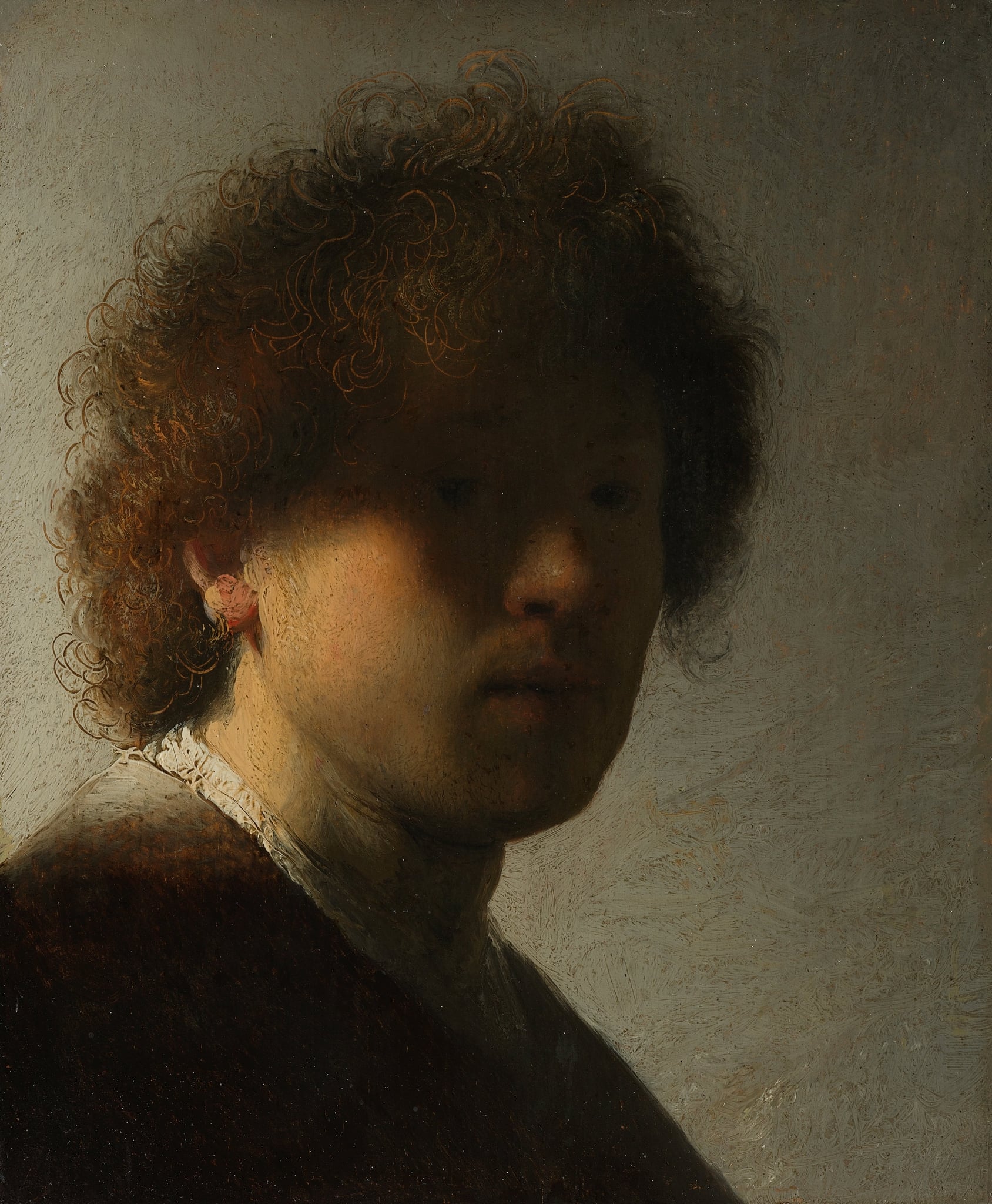
Self-portrait (with tousled hair) by Rembrandt van Rijn

Self-portrait (with tousled hair)

Rembrandt van Rijn (c. 1628)

A young Rembrandt van Rijn tests how <strong>light both reveals and withholds</strong> by letting his face emerge from darkness while his <strong>scratched, backlit curls</strong> flare like a rough halo. The small oak panel makes <strong>process itself the subject</strong>, turning hair, stubble, and a raking highlight into a statement of identity-in-formation <sup>[1]</sup><sup>[5]</sup>.
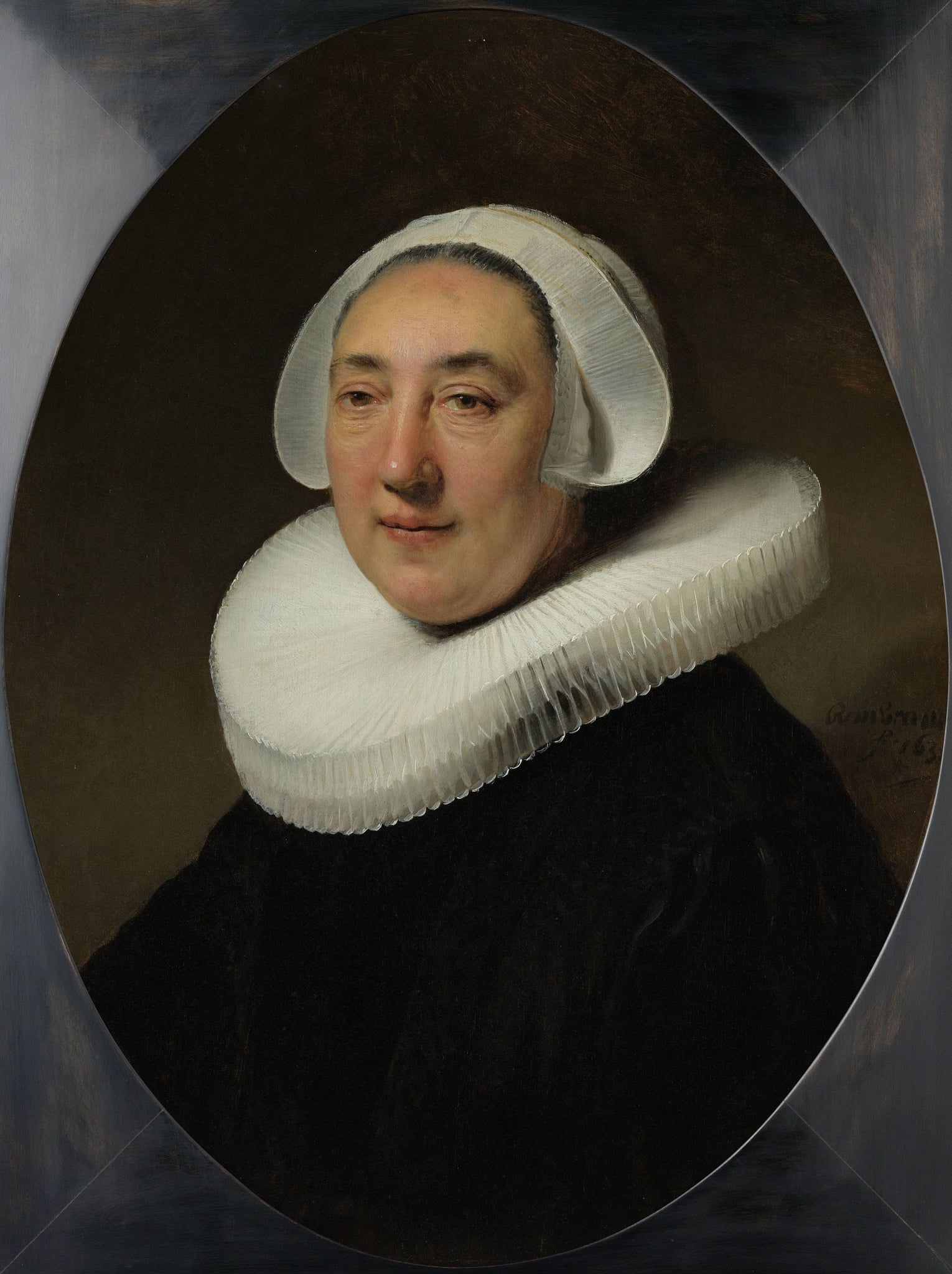
Portrait of Haesje Jacobsdr van Cleyburg by Rembrandt van Rijn

Portrait of Haesje Jacobsdr van Cleyburg

Rembrandt van Rijn (1634)

Rembrandt’s 1634 Portrait of Haesje Jacobsdr van Cleyburg stages a Dutch burgher within a feigned <strong>oval</strong> opening, illuminated by selective <strong>chiaroscuro</strong> that models warm skin against brilliant <strong>millstone ruff</strong> and sober black dress. The painting balances <strong>modesty and status</strong>, making virtue visible while quietly declaring prosperity through immaculate linen and craft <sup>[1]</sup><sup>[4]</sup>.