Figure
Figure symbolism in modern painting turns the human body into a calibrated sign-system in which posture, gesture, and gaze encode shifting relations among desire, labor, authority, and spectatorship.
Member Symbols
Featured Artworks
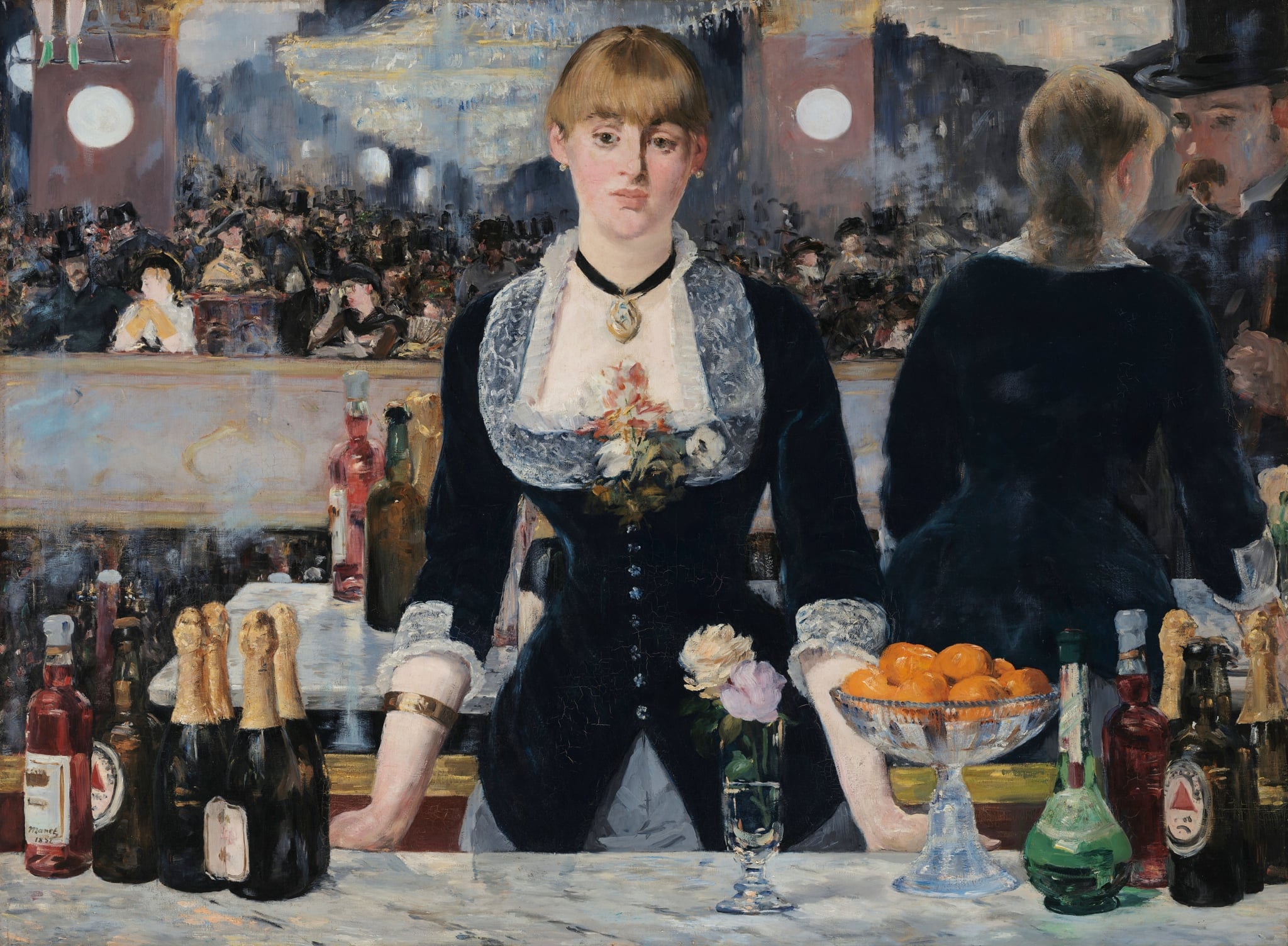
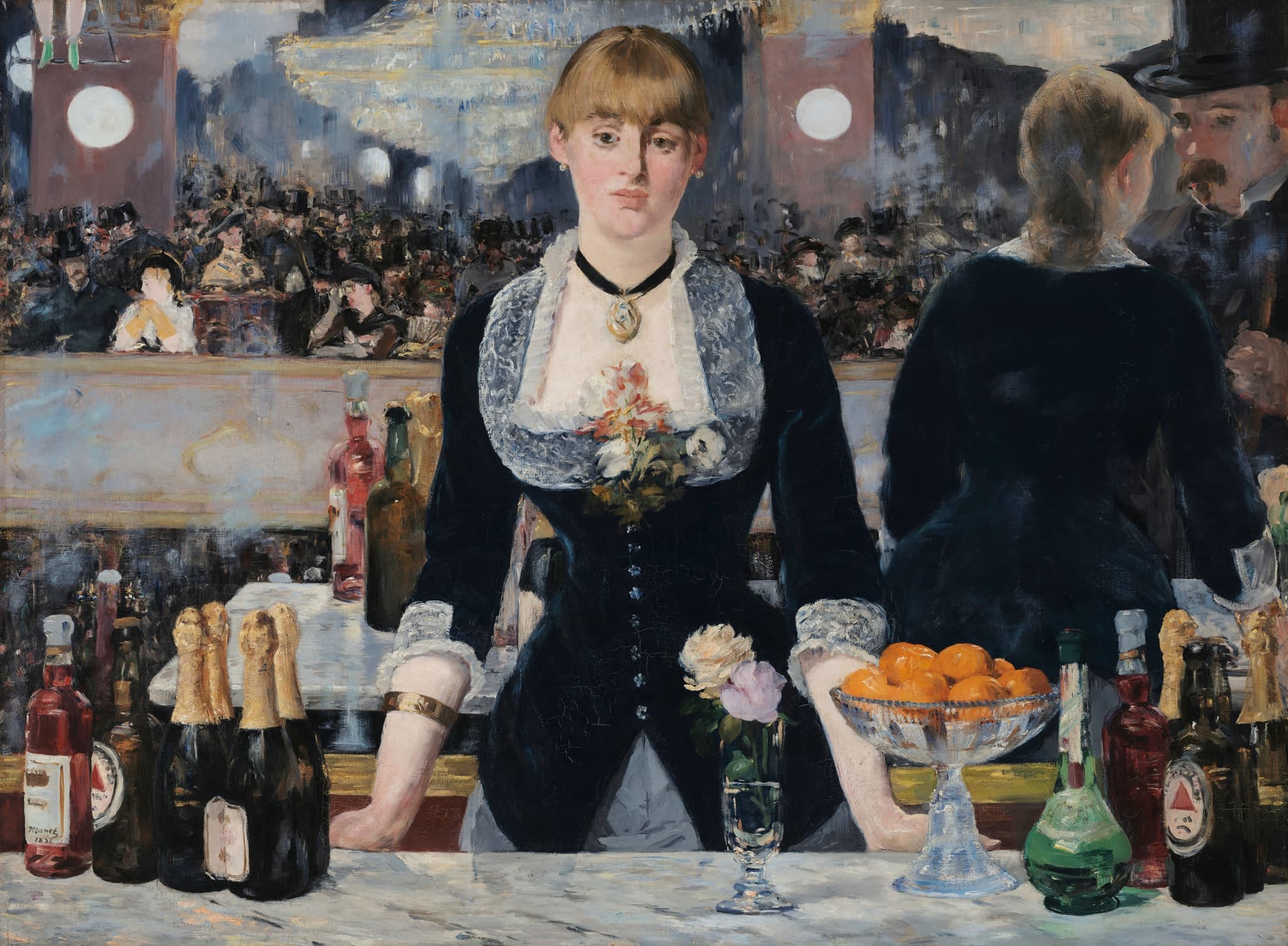
A Bar at the Folies-Bergère
Édouard Manet (1882)
Édouard Manet’s A Bar at the Folies-Bergère stages a face-to-face encounter with modern Paris, where <strong>commerce</strong>, <strong>spectacle</strong>, and <strong>alienation</strong> converge. A composed barmaid fronts a marble counter loaded with branded bottles, flowers, and a brimming bowl of oranges, while a disjunctive <strong>mirror</strong> unravels stable viewing and certainty <sup>[1]</sup><sup>[2]</sup>.
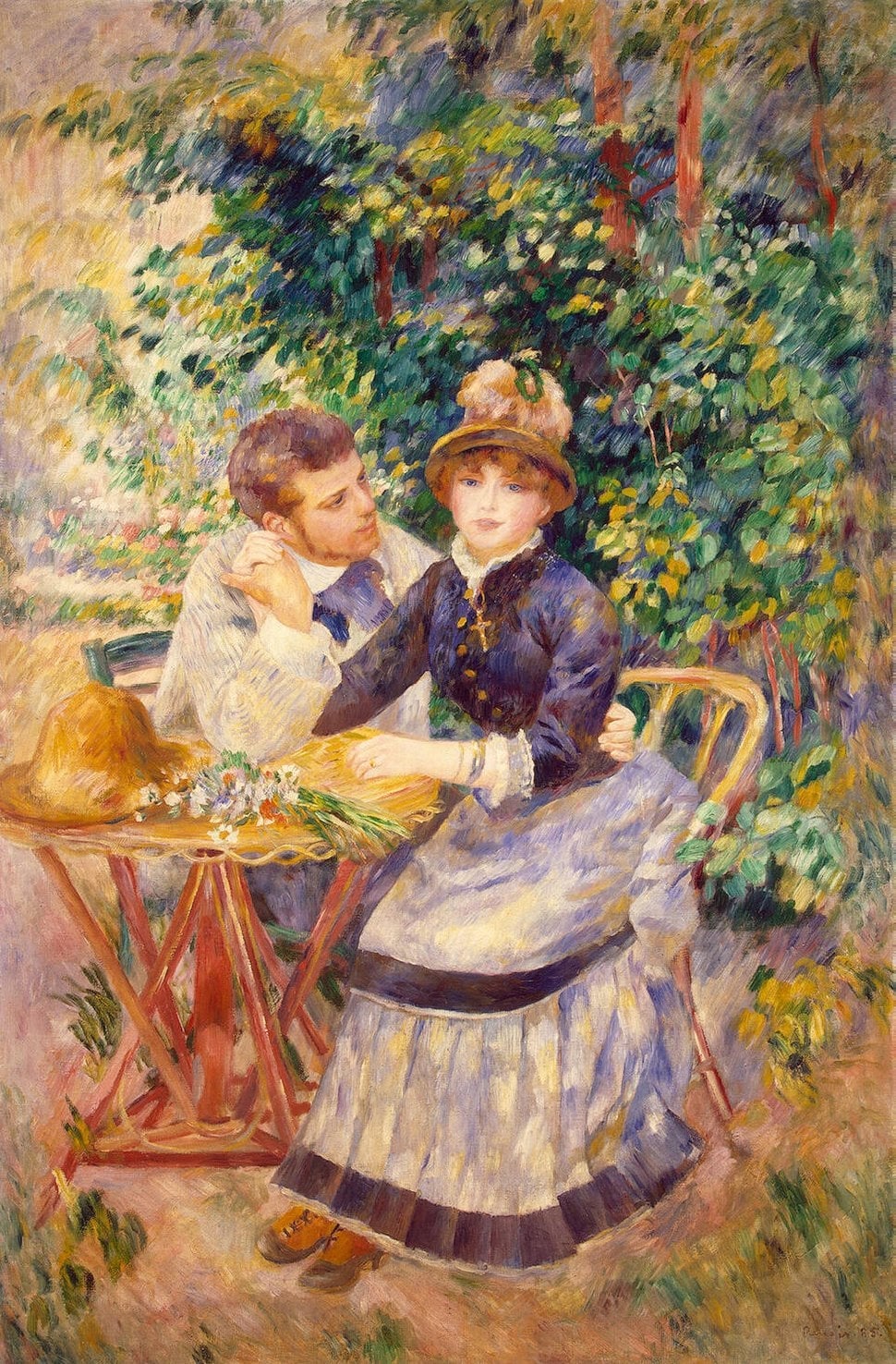
In the Garden
Pierre-Auguste Renoir (1885)
In the Garden presents a charged pause in modern leisure: a young couple at a café table under a living arbor of leaves. Their lightly clasped hands and the bouquet on the tabletop signal courtship, while her calm, front-facing gaze checks his lean. Renoir’s flickering brushwork fuses figures and foliage, rendering love as a <strong>transitory, luminous sensation</strong> <sup>[1]</sup><sup>[3]</sup>.
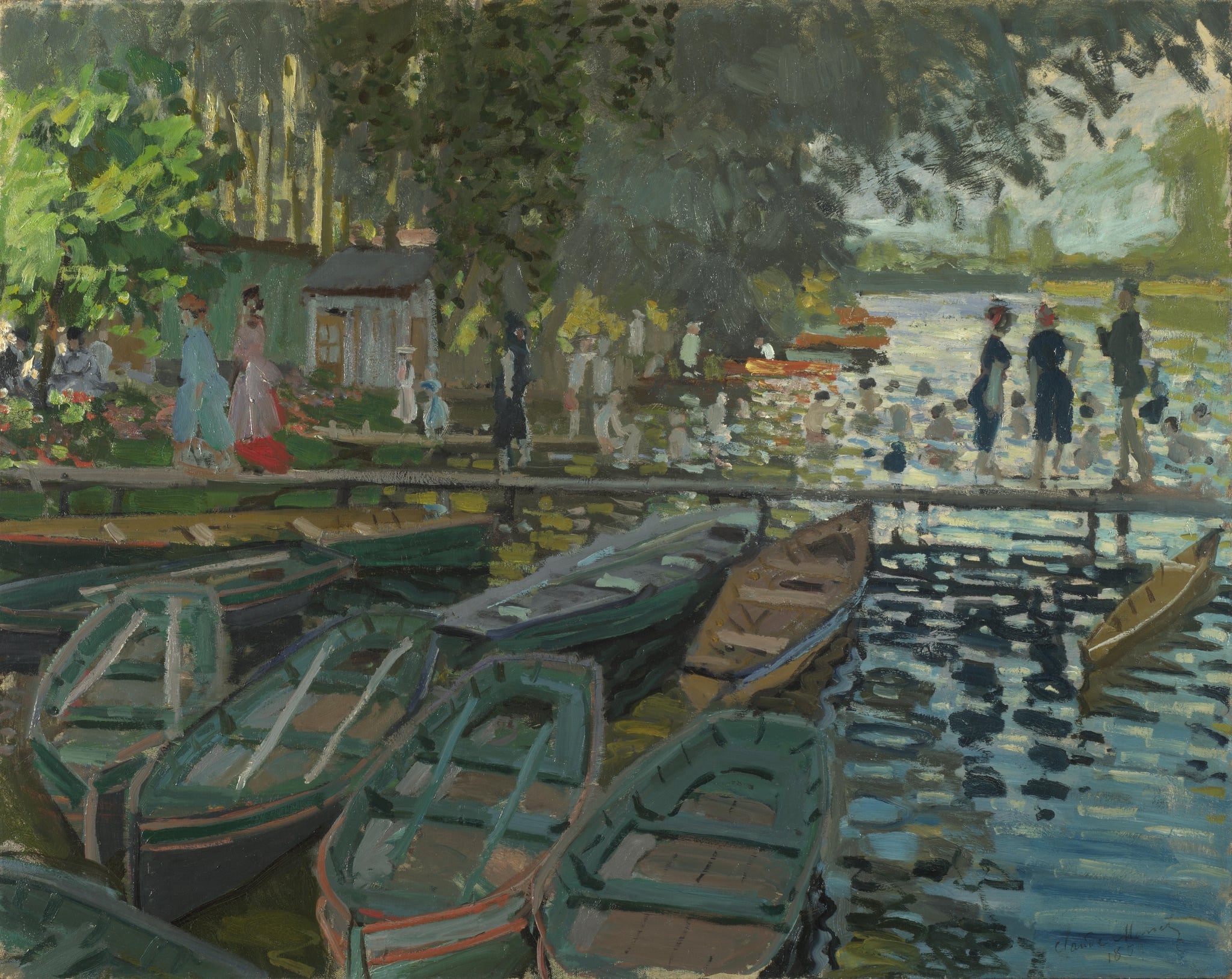
La Grenouillère
Claude Monet (1869)
Monet’s La Grenouillère crystallizes the new culture of <strong>modern leisure</strong> on the Seine: crowded bathers, promenading couples, and rental boats orbit a floating resort. With <strong>flickering brushwork</strong> and a high-key palette, Monet turns water, light, and movement into the true subjects, suspending the scene at the brink of dissolving.
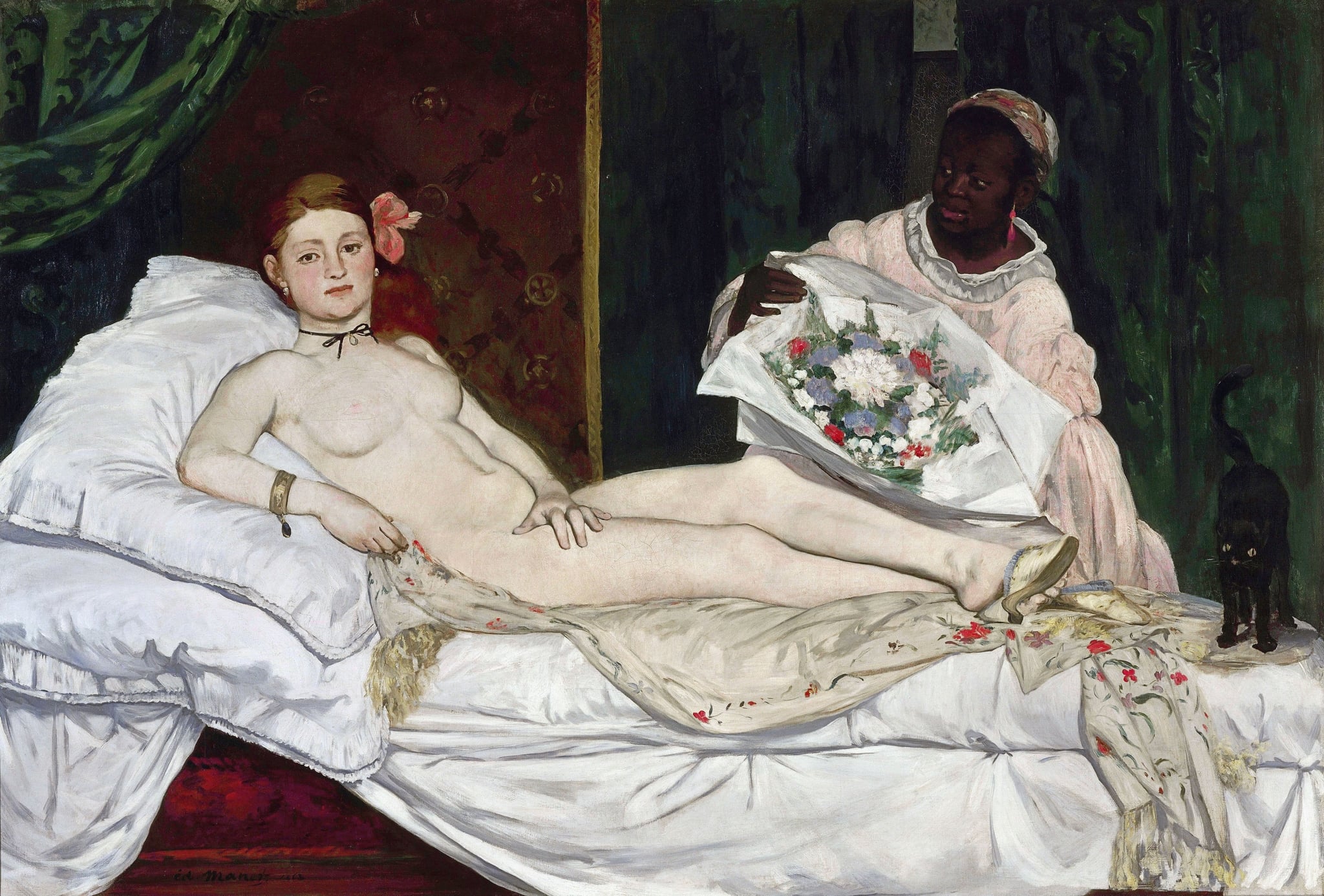
Olympia
Édouard Manet (1863 (Salon 1865))
A defiantly contemporary nude confronts the viewer with a steady gaze and a guarded pose, framed by crisp light and luxury trappings. In Olympia, <strong>Édouard Manet</strong> strips myth from the female nude to expose the <strong>modern economy of desire</strong>, power, and looking <sup>[1]</sup><sup>[3]</sup>.
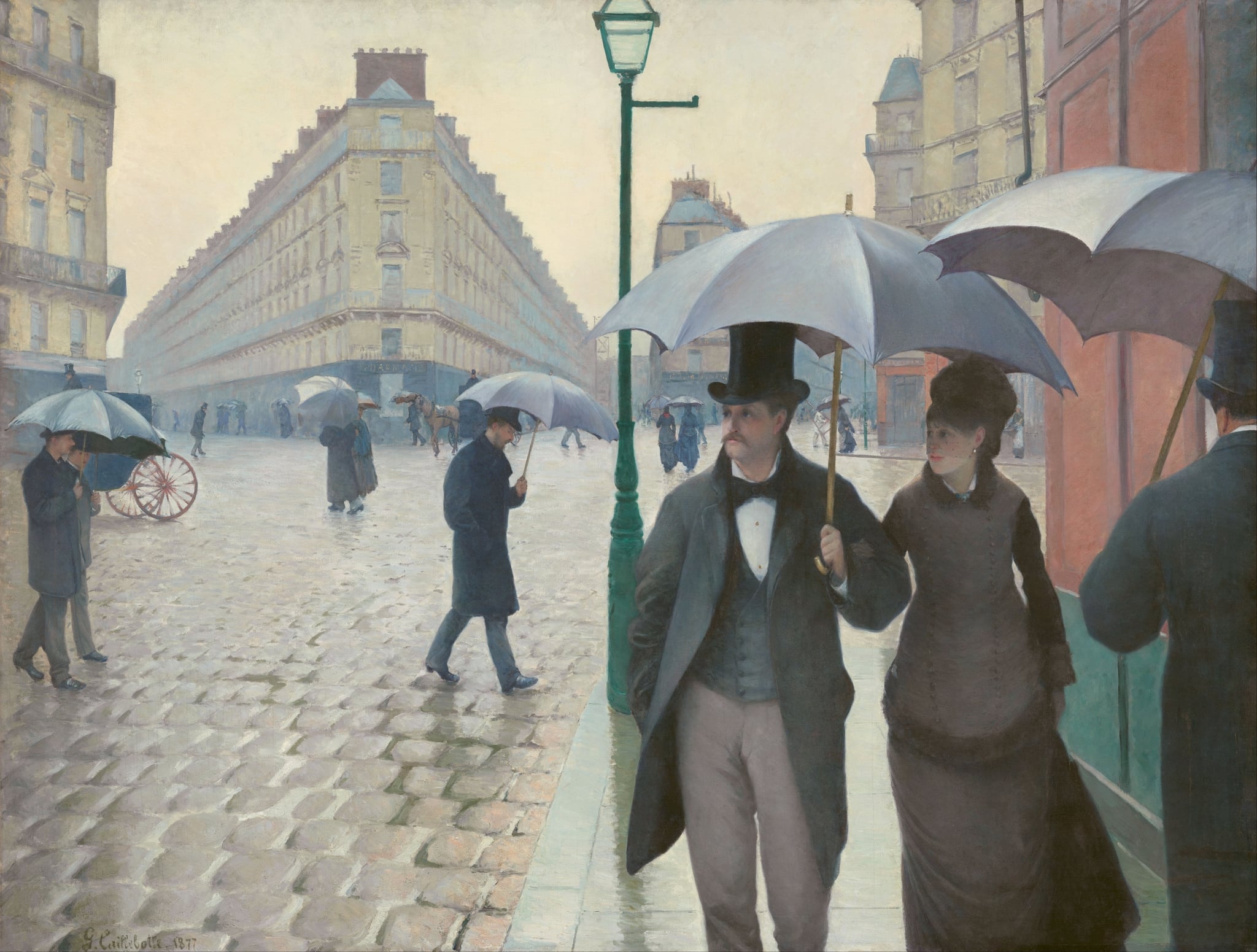
Paris Street; Rainy Day
Gustave Caillebotte (1877)
Gustave Caillebotte’s Paris Street; Rainy Day renders a newly modern Paris where <strong>Haussmann’s geometry</strong> meets the <strong>anonymity of urban life</strong>. Umbrellas punctuate a silvery atmosphere as a <strong>central gas lamp</strong> and knife-sharp façades organize the space into measured planes <sup>[1]</sup><sup>[2]</sup>.
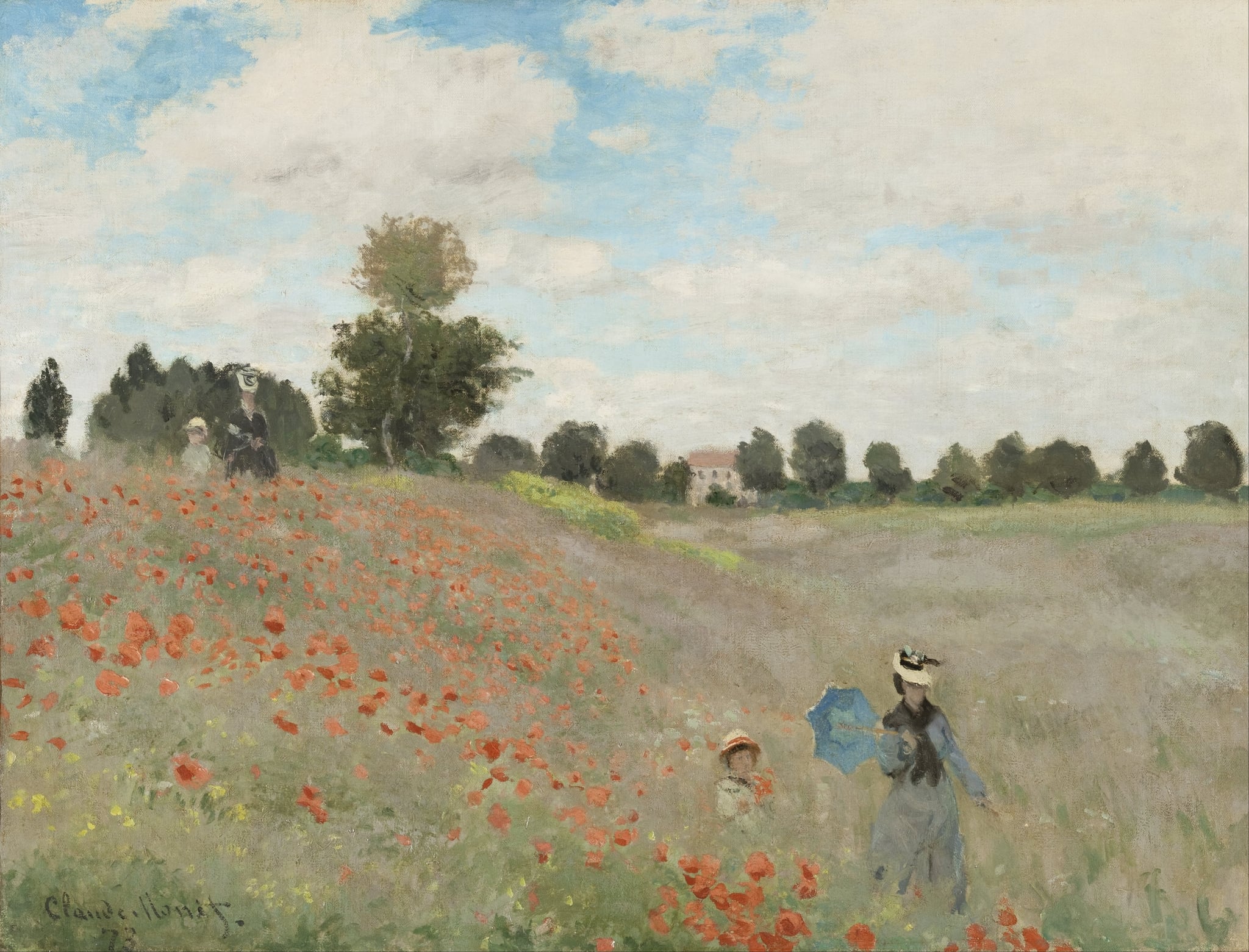
Poppies
Claude Monet (1873)
Claude Monet’s Poppies (1873) turns a suburban hillside into a theater of <strong>light, time, and modern leisure</strong>. A red diagonal of poppies counters cool fields and sky, while a woman with a <strong>blue parasol</strong> and a child appear twice along the slope, staging a gentle <strong>echo of moments</strong> rather than a single event <sup>[1]</sup>. The painting asserts sensation over contour, letting broken touches make the day itself the subject.
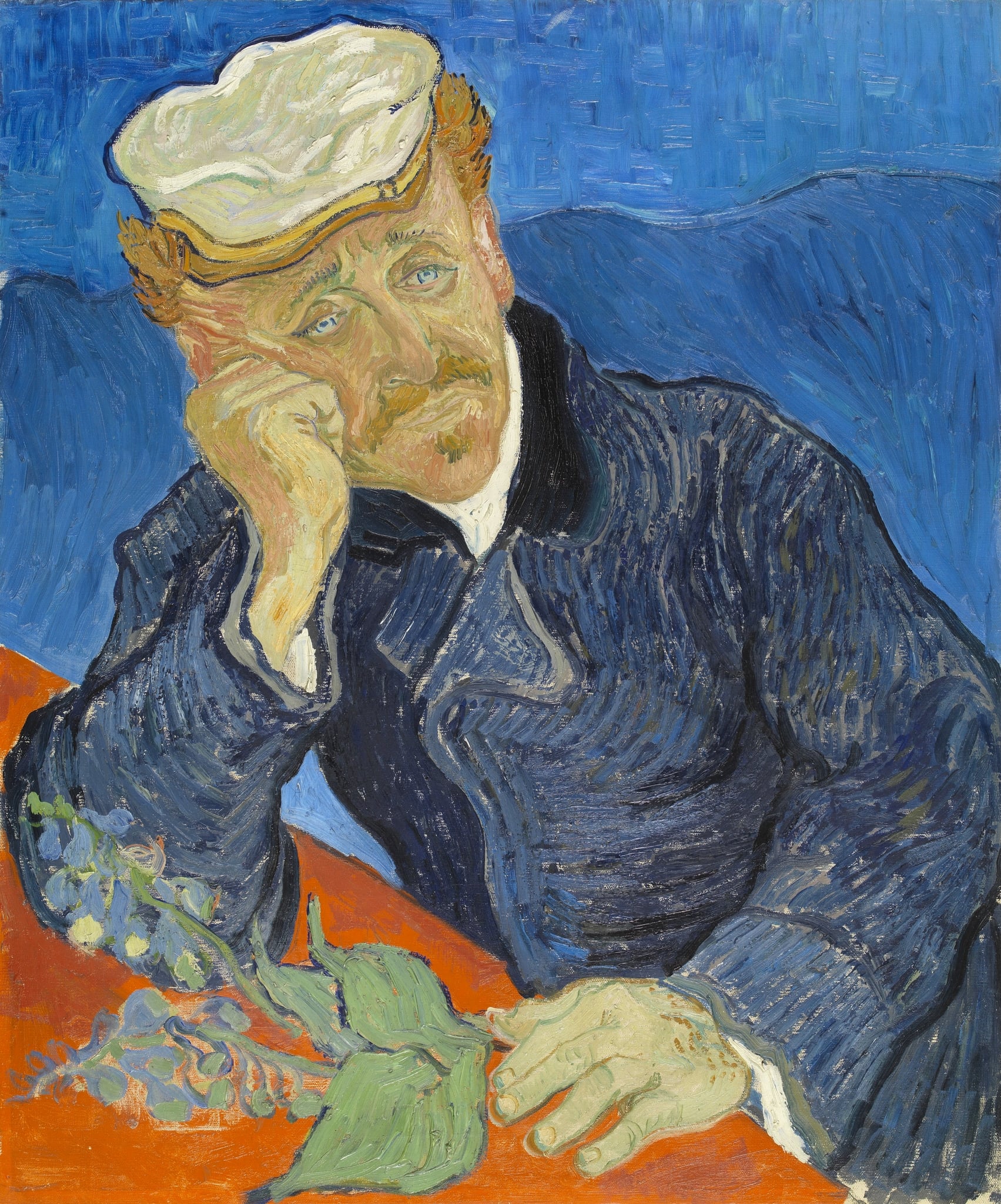
Portrait of Dr. Gachet
Vincent van Gogh (1890)
Portrait of Dr. Gachet distills Van Gogh’s late ambition for a <strong>modern, psychological portrait</strong> into vibrating color and touch. The sitter’s head sinks into a greenish hand above a <strong>blazing orange-red table</strong>, foxglove sprig nearby, while waves of <strong>cobalt and ultramarine</strong> churn through coat and background. The chromatic clash turns a quiet pose into an <strong>empathic image of fragility and care</strong> <sup>[1]</sup><sup>[2]</sup>.
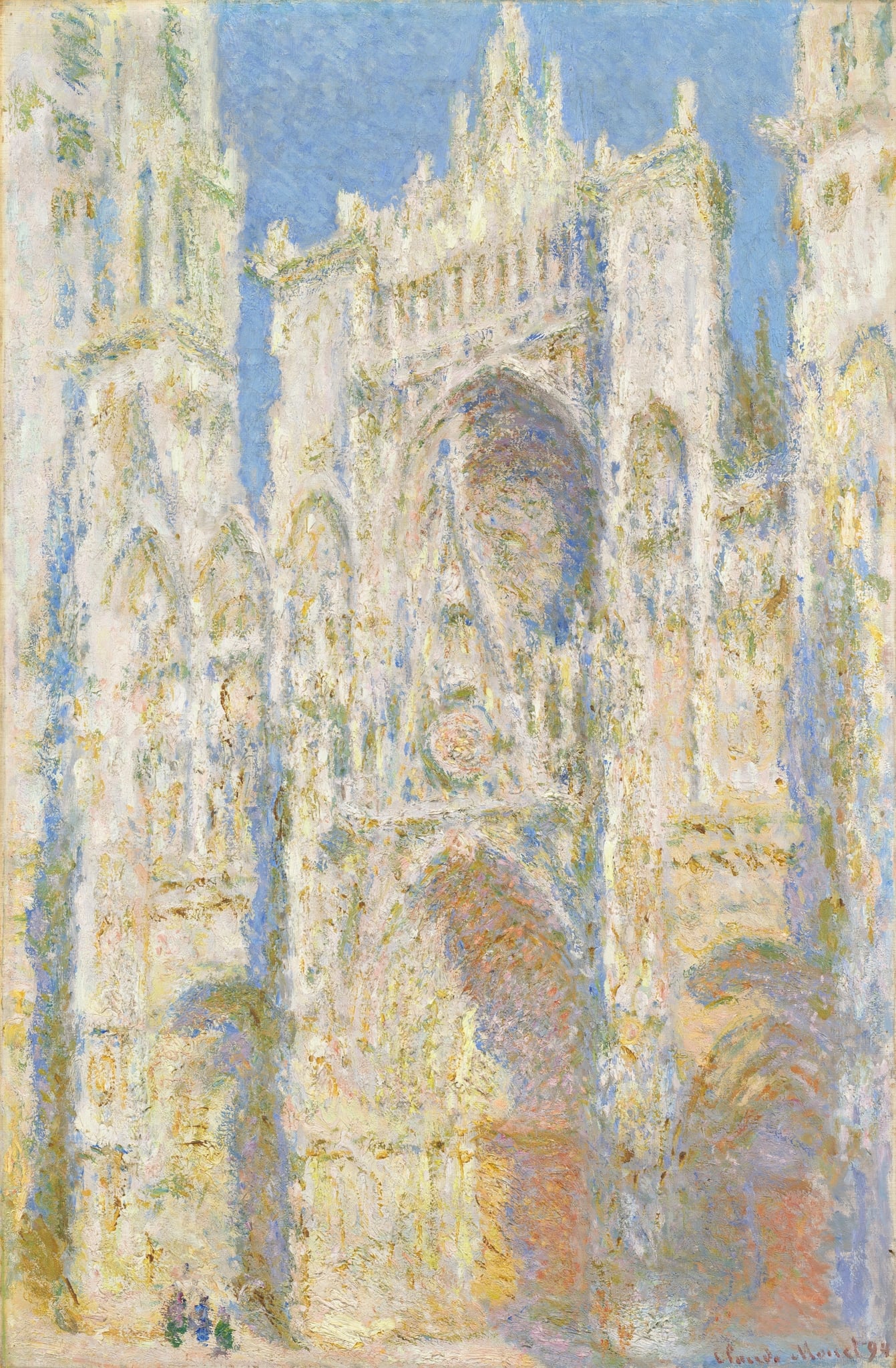
Rouen Cathedral Series
Claude Monet (1894)
Claude Monet’s Rouen Cathedral Series (1892–94) turns a Gothic monument into a laboratory of <strong>light, time, and perception</strong>. In this sunstruck façade, portals, gables, and a warm, orange-tinged rose window flicker in pearly violets and buttery yellows against a crystalline blue sky, while tiny figures at the base anchor the scale. The painting insists that <strong>light—not stone—is the true subject</strong> <sup>[1]</sup><sup>[2]</sup>.
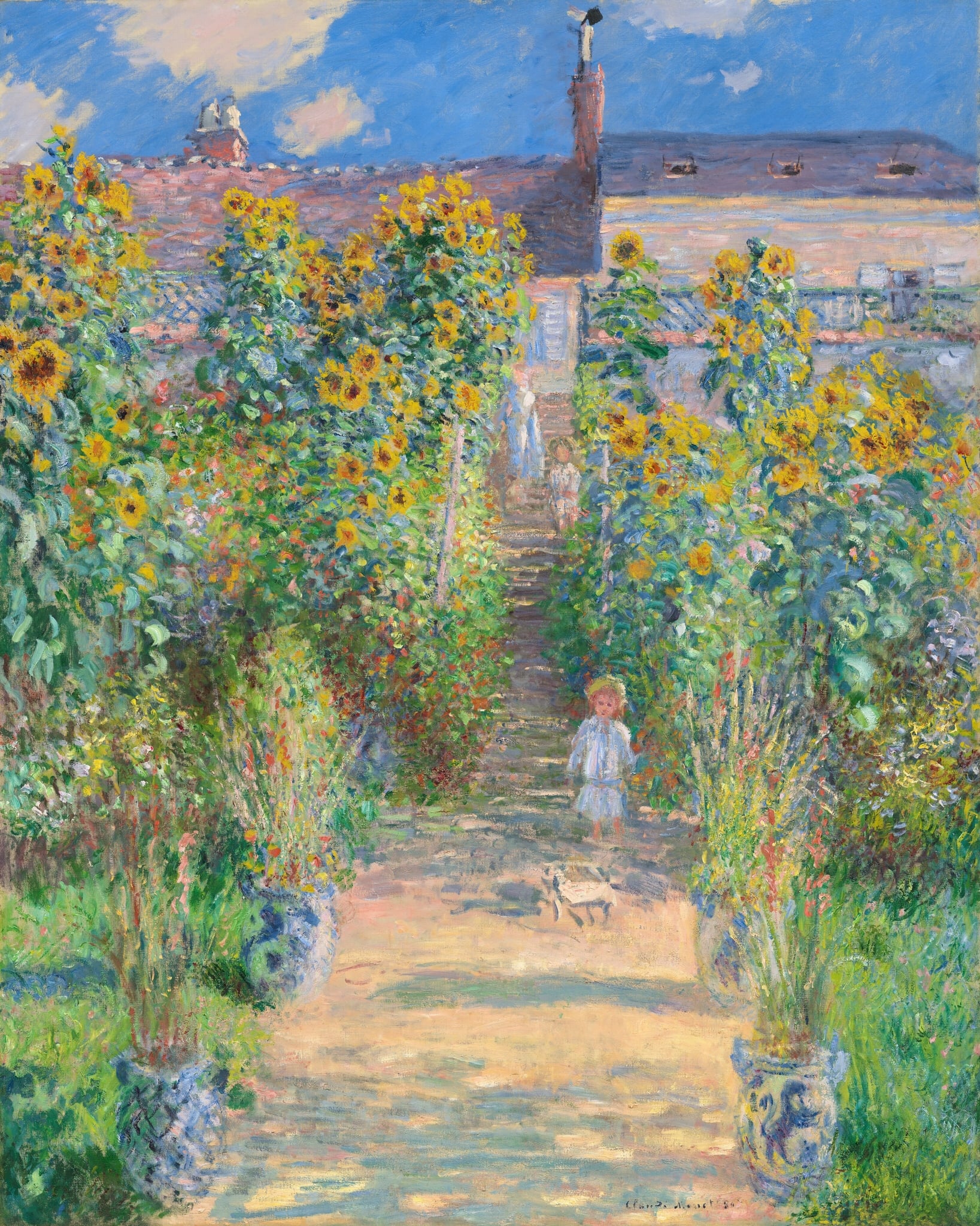
The Artist's Garden at Vétheuil
Claude Monet (1881)
Claude Monet’s The Artist’s Garden at Vétheuil stages a sunlit ascent through a corridor of towering sunflowers toward a modest house, where everyday life meets cultivated nature. Quick, broken strokes make leaves and shadows tremble, asserting <strong>light</strong> and <strong>painterly surface</strong> over linear contour. Blue‑and‑white <strong>jardinieres</strong> anchor the foreground, while a child and dog briefly pause on the path, turning the garden into a <strong>domestic sanctuary</strong> <sup>[1]</sup><sup>[2]</sup>.
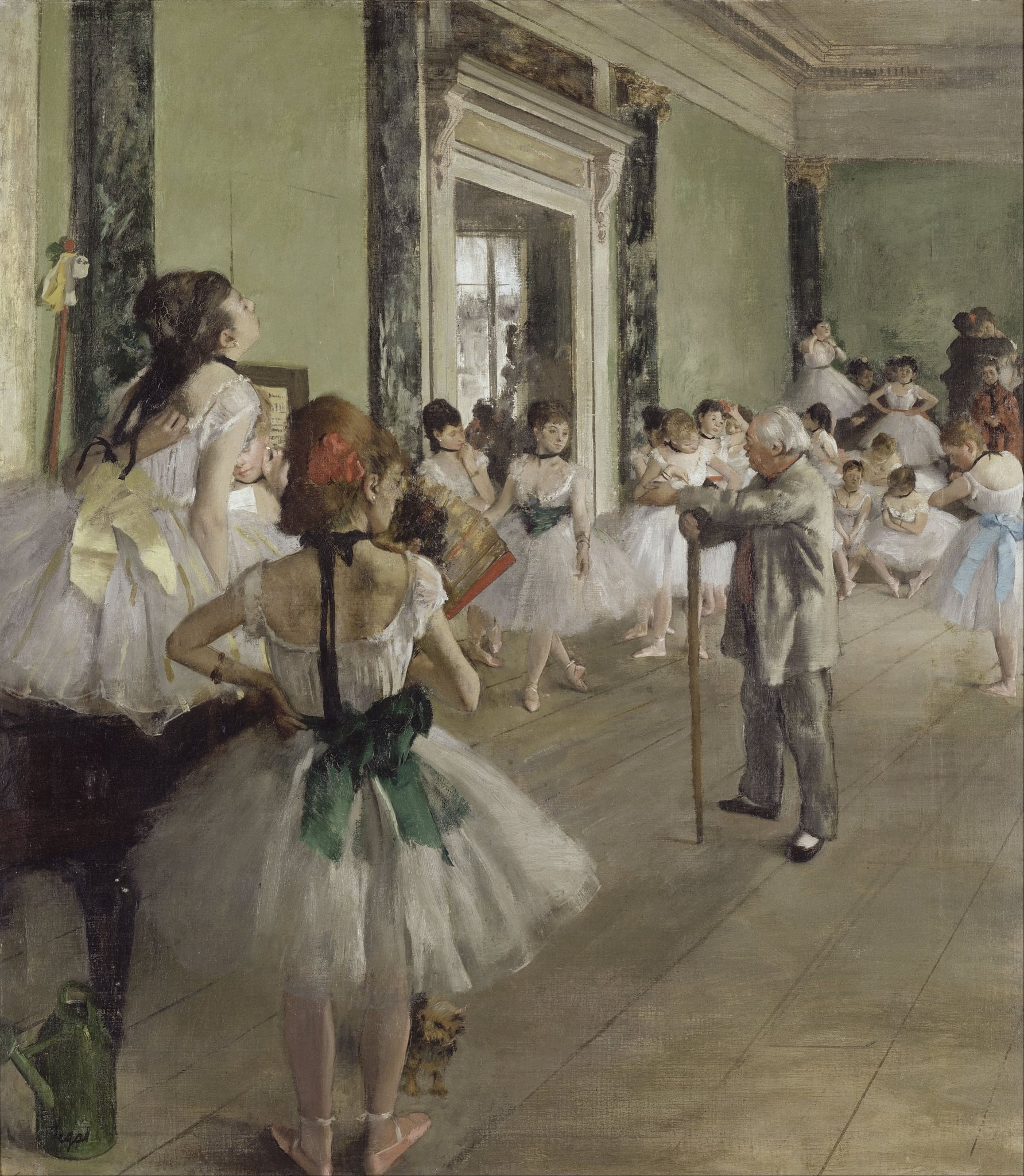
The Ballet Class
Edgar Degas (1873–1876)
<strong>The Ballet Class</strong> shows the work behind grace: a green-walled studio where young dancers in white tutus rest, fidget, and stretch while the gray-suited master stands with his cane. Degas’s diagonal floorboards, cropped viewpoints, and scattered props—a watering can, a music stand, even a tiny dog—stage a candid vision of routine rather than spectacle. The result is a modern image of discipline, hierarchy, and fleeting poise.
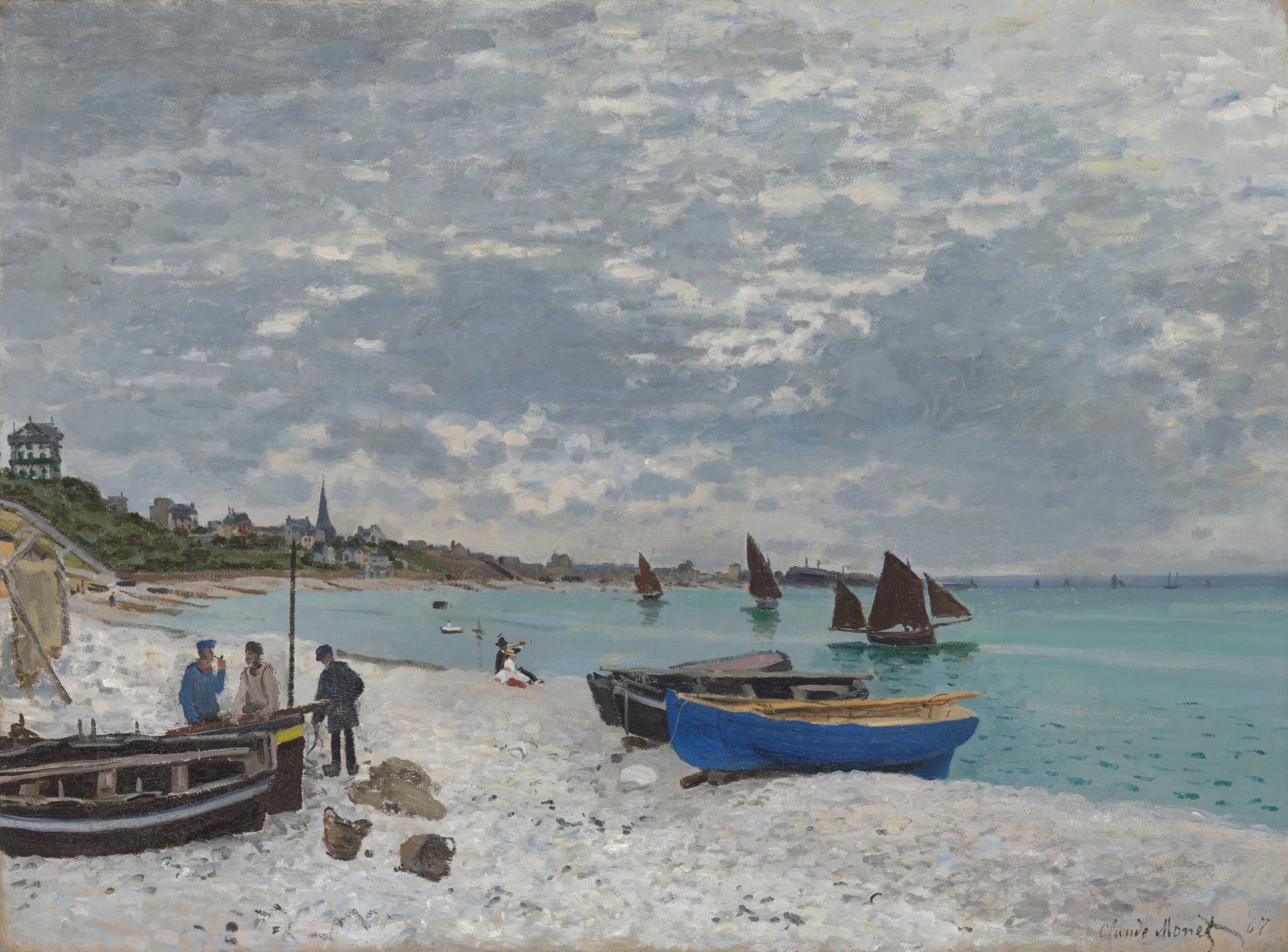
The Beach at Sainte-Adresse
Claude Monet (1867)
In The Beach at Sainte-Adresse, Claude Monet stages a modern shore where <strong>labor and leisure intersect</strong> under a broad, changeable sky. The bright <strong>blue beached boat</strong> and the flotilla of <strong>rust-brown working sails</strong> punctuate a turquoise channel, while a fashionably dressed pair sits mid-beach, spectators to the traffic of the port. Monet’s brisk, broken strokes make the scene feel <strong>caught between tides and weather</strong>, a momentary balance of work, tourism, and atmosphere <sup>[1]</sup><sup>[2]</sup>.
The Boating Party
Mary Cassatt (1893–1894)
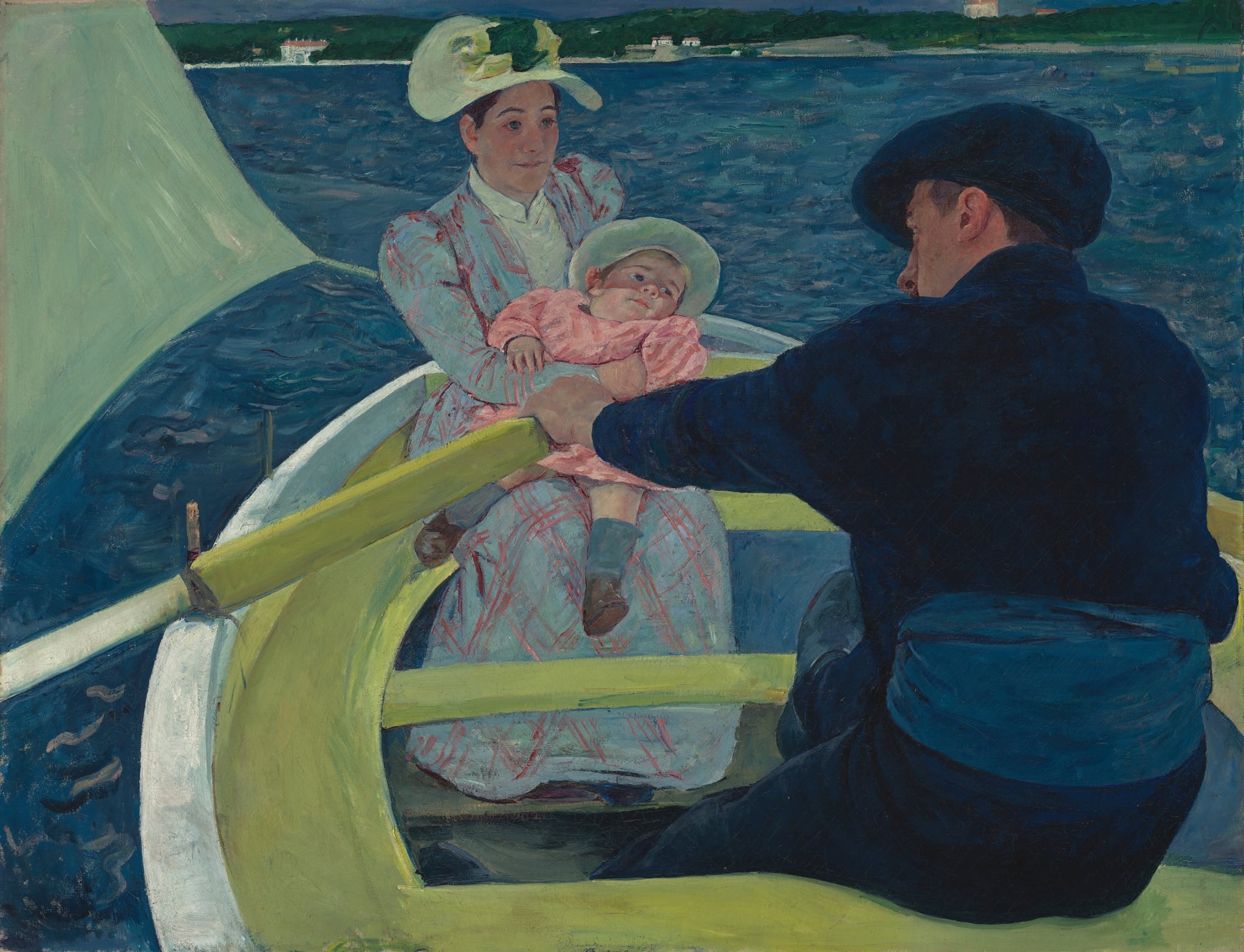
In The Boating Party, Mary Cassatt fuses <strong>intimate caregiving</strong> with <strong>modern mobility</strong>, compressing mother, child, and rower inside a skiff that cuts diagonals across ultramarine water. Bold arcs of citron paint and a high, flattened horizon reveal a deliberate <strong>Japonisme</strong> logic that stabilizes the scene even as motion surges around it <sup>[1]</sup>. The painting asserts domestic life as a public, modern subject while testing the limits of Impressionist space and color.
The Child's Bath
Mary Cassatt (1893)
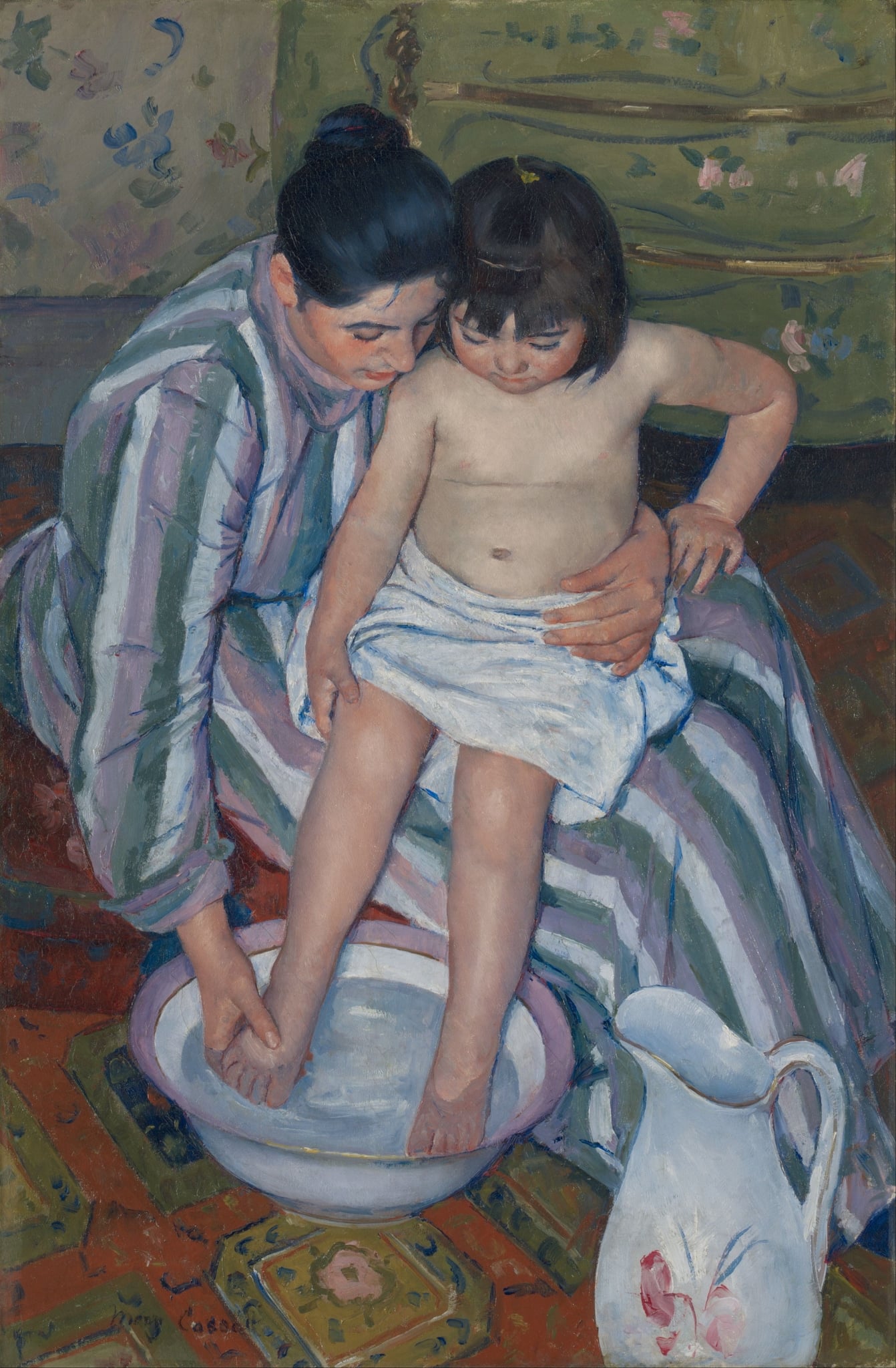
Mary Cassatt’s The Child’s Bath (1893) recasts an ordinary ritual as <strong>modern devotion</strong>. From a steep, print-like vantage, interlocking stripes, circles, and diagonals focus attention on <strong>touch, care, and renewal</strong>, turning domestic labor into a subject of high art <sup>[1]</sup><sup>[3]</sup>. The work synthesizes Impressionist sensitivity with <strong>Japonisme</strong> design to monumentalize the private sphere <sup>[1]</sup><sup>[2]</sup>.
The Cradle
Berthe Morisot (1872)
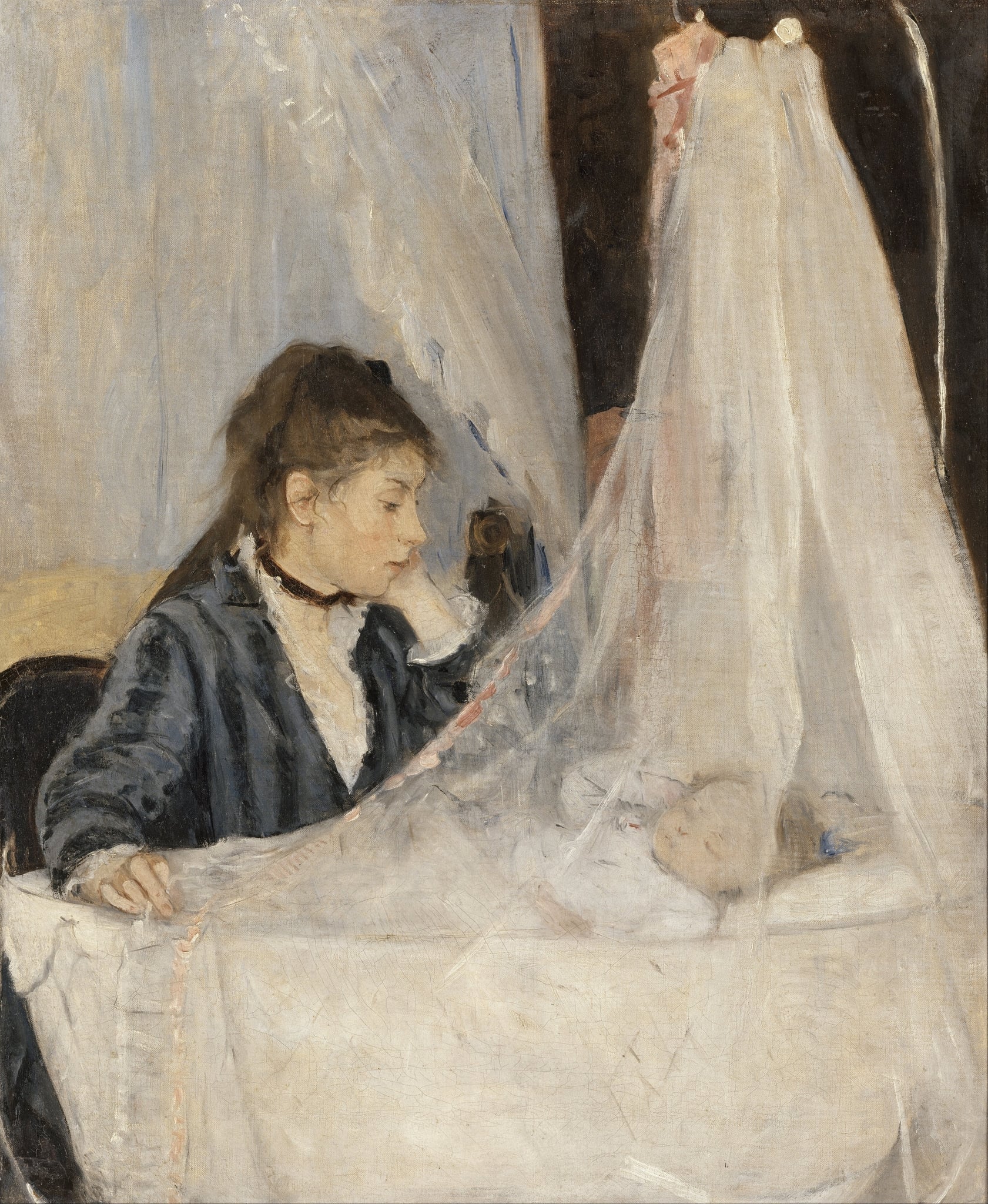
Berthe Morisot’s The Cradle turns a quiet nursery into a scene of <strong>vigilant love</strong>. A gauzy veil, lifted by the watcher’s hand, forms a <strong>protective boundary</strong> that cocoons the sleeping child in light while linking the two figures through a decisive diagonal <sup>[1]</sup><sup>[2]</sup>. The painting crystallizes modern maternity as a form of attentiveness rather than display—an <strong>unsentimental icon</strong> of care.
The Hermitage at Pontoise
Camille Pissarro (ca. 1867)
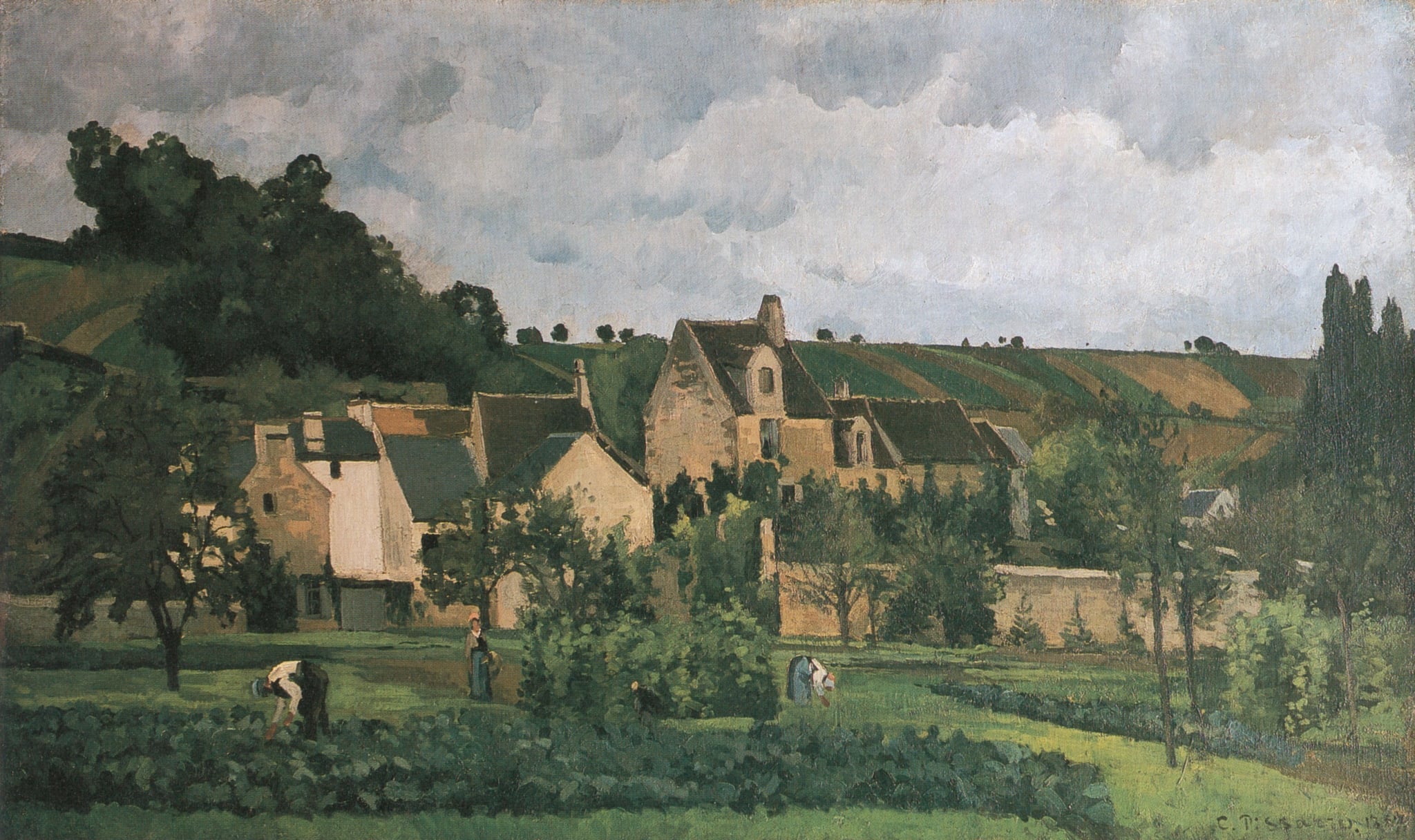
Camille Pissarro’s The Hermitage at Pontoise shows a hillside village interlaced with <strong>kitchen gardens</strong>, stone houses, and workers bent to their tasks under a <strong>low, cloud-laden sky</strong>. The painting binds human labor to place, staging a quiet counterpoint between <strong>architectural permanence</strong> and the <strong>seasonal flux</strong> of fields and weather <sup>[1]</sup><sup>[3]</sup>.
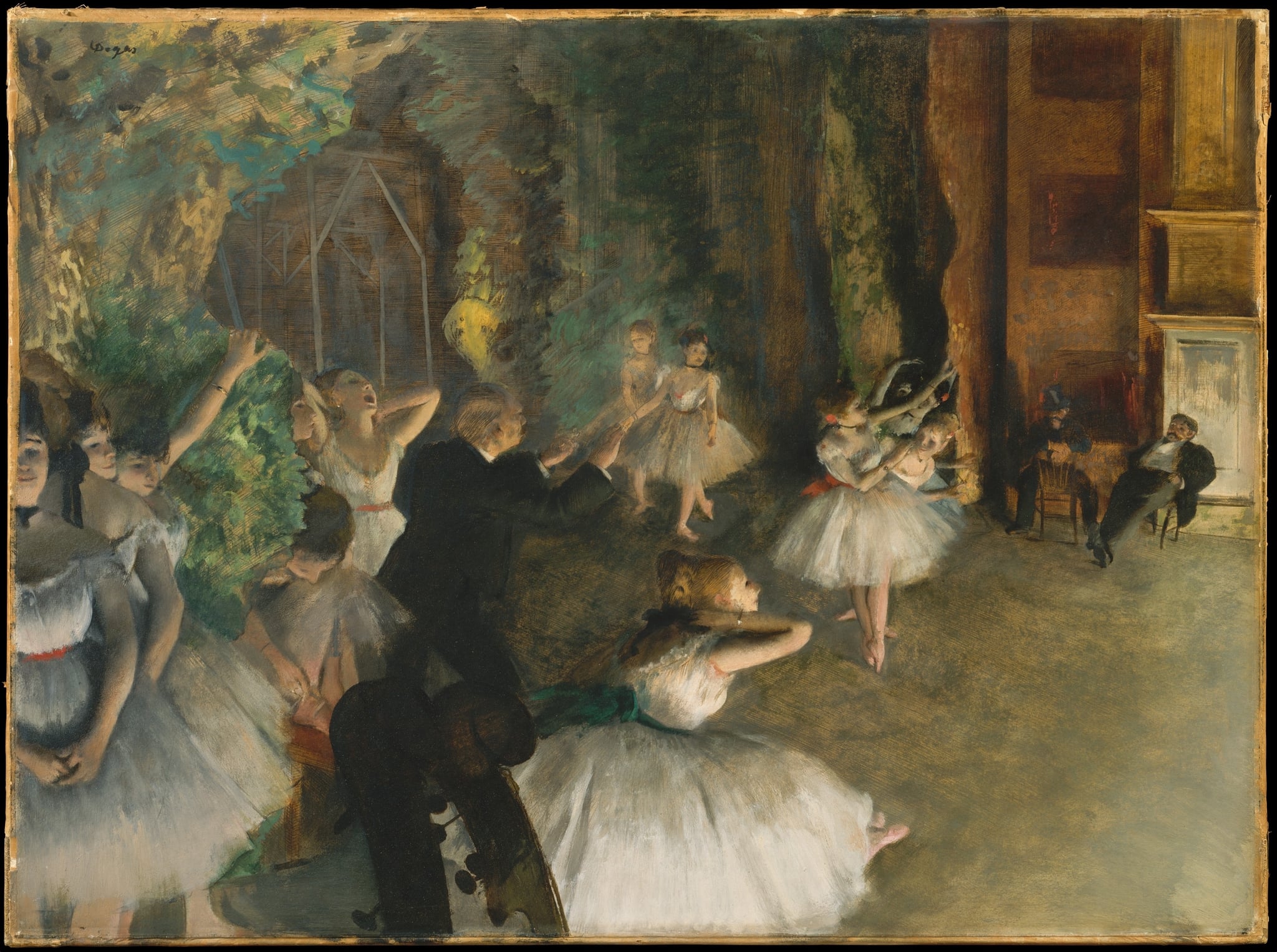
The Rehearsal of the Ballet Onstage
Edgar Degas (ca. 1874)
Degas’s The Rehearsal of the Ballet Onstage turns a moment of practice into a modern drama of work and power. Under <strong>harsh footlights</strong>, clustered ballerinas stretch, yawn, and repeat steps as a <strong>ballet master/conductor</strong> drives the tempo, while <strong>abonnés</strong> lounge in the wings and a looming <strong>double bass</strong> anchors the labor of music <sup>[1]</sup><sup>[3]</sup><sup>[4]</sup>.
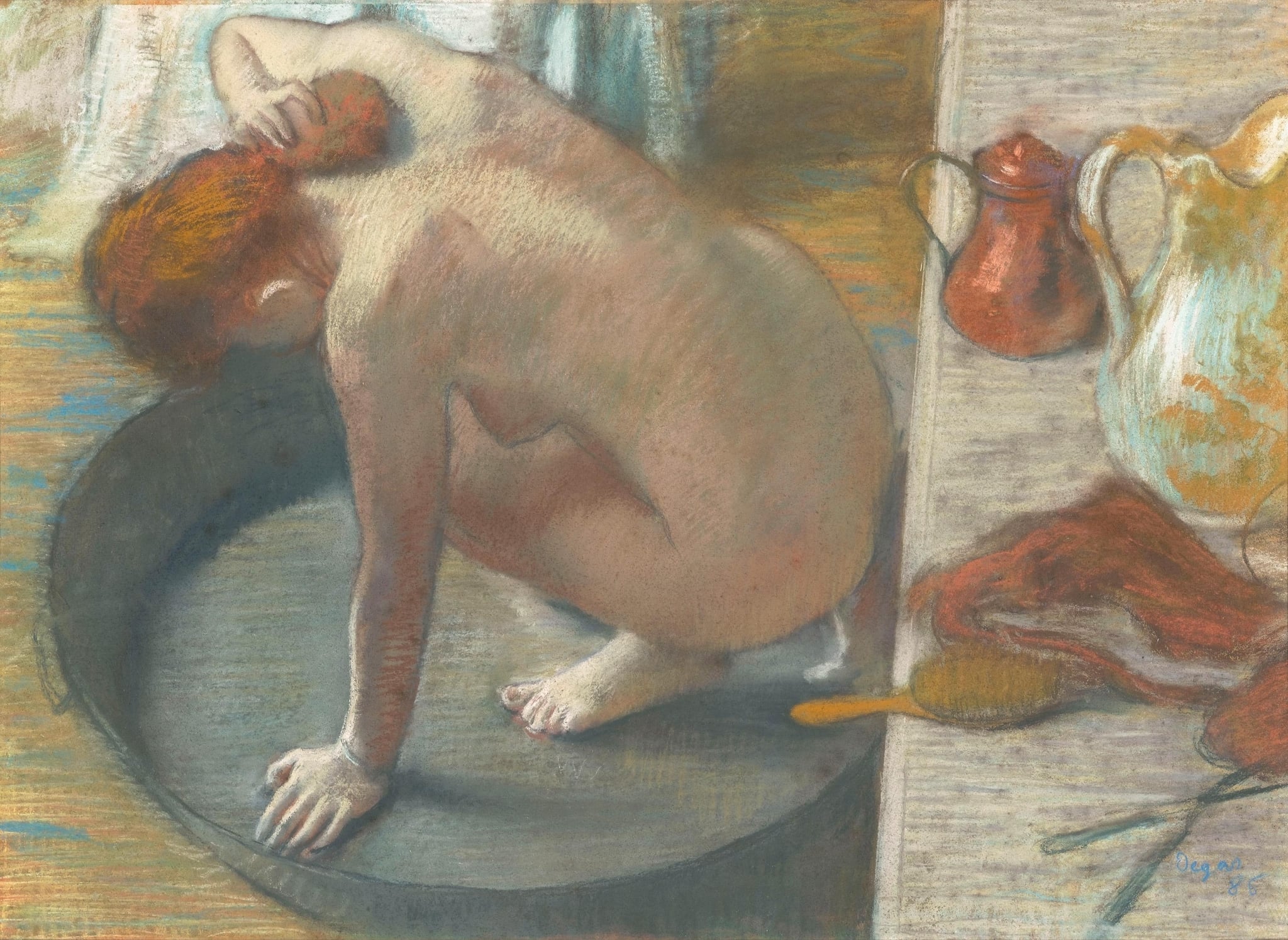
The Tub
Edgar Degas (1886)
In The Tub (1886), Edgar Degas turns a routine bath into a study of <strong>modern solitude</strong> and <strong>embodied labor</strong>. From a steep, overhead angle, a woman kneels within a circular basin, one hand braced on the rim while the other gathers her hair; to the right, a tabletop packs a ewer, copper pot, comb/brush, and cloth. Degas’s layered pastel binds skin, water, and objects into a single, breathing field of <strong>warm flesh tones</strong> and blue‑greys, collapsing distance between body and still life <sup>[1]</sup>.
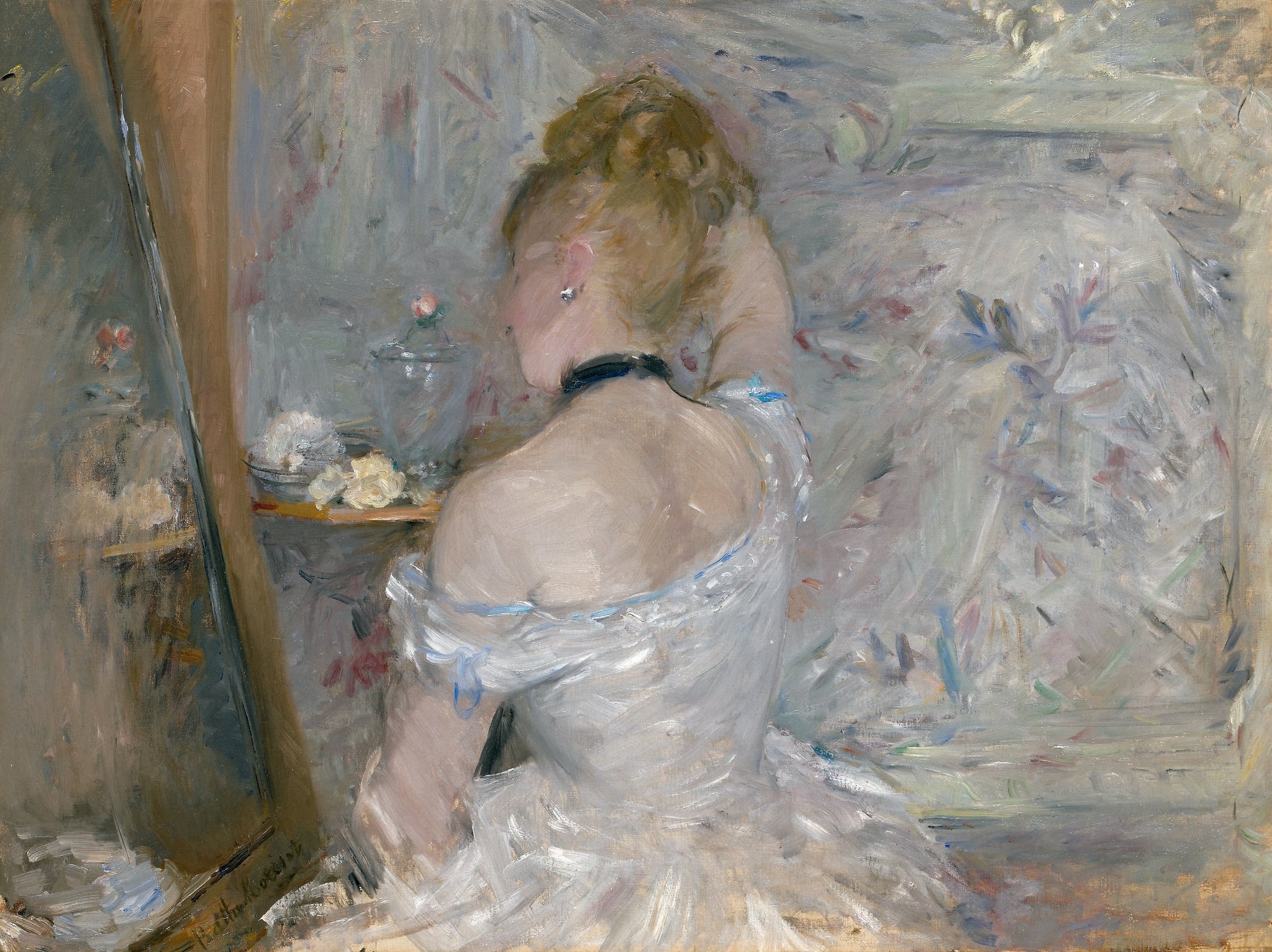
Woman at Her Toilette
Berthe Morisot (1875–1880)
Woman at Her Toilette stages a private ritual of self-fashioning, not a spectacle of vanity. A woman, seen from behind, lifts her arm to adjust her hair as a <strong>black velvet choker</strong> punctuates Morisot’s silvery-violet haze; the <strong>mirror’s blurred reflection</strong> with powders, jars, and a white flower refuses a clear face. Morisot’s <strong>feathery facture</strong> turns a fleeting toilette into modern subjectivity made visible <sup>[1]</sup>.
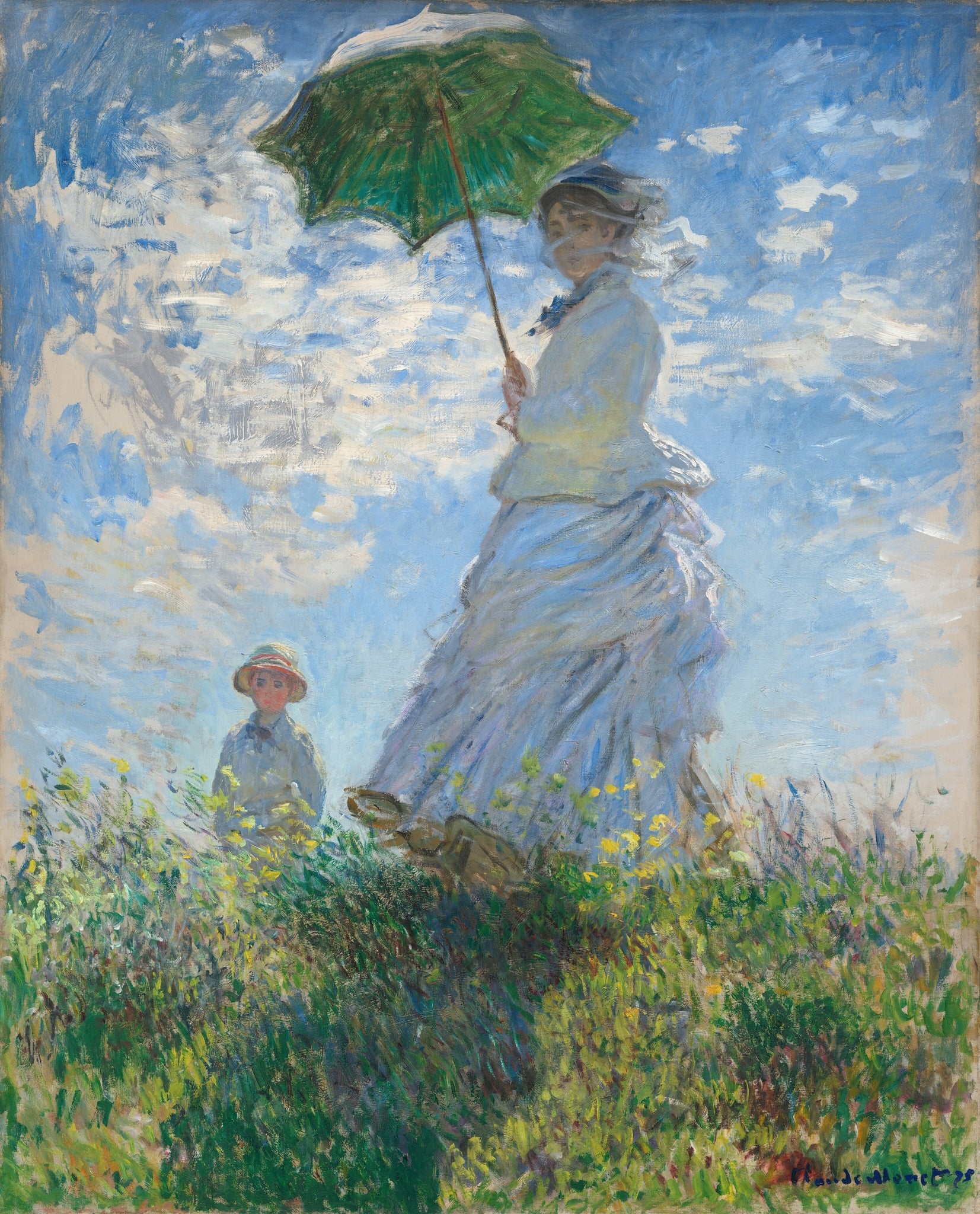
Woman with a Parasol
Claude Monet (1875)
Claude Monet’s Woman with a Parasol fixes a breezy hillside instant in high, shifting light, setting a figure beneath a <strong>green parasol</strong> against a vast, vibrating sky. The low vantage and <strong>broken brushwork</strong> merge dress, clouds, and grasses into one atmosphere, while a child at the rise anchors depth and intimacy <sup>[1]</sup>. It is a manifesto of <strong>plein-air</strong> perception—painting the sensation of air in motion rather than the contours of things <sup>[2]</sup>.
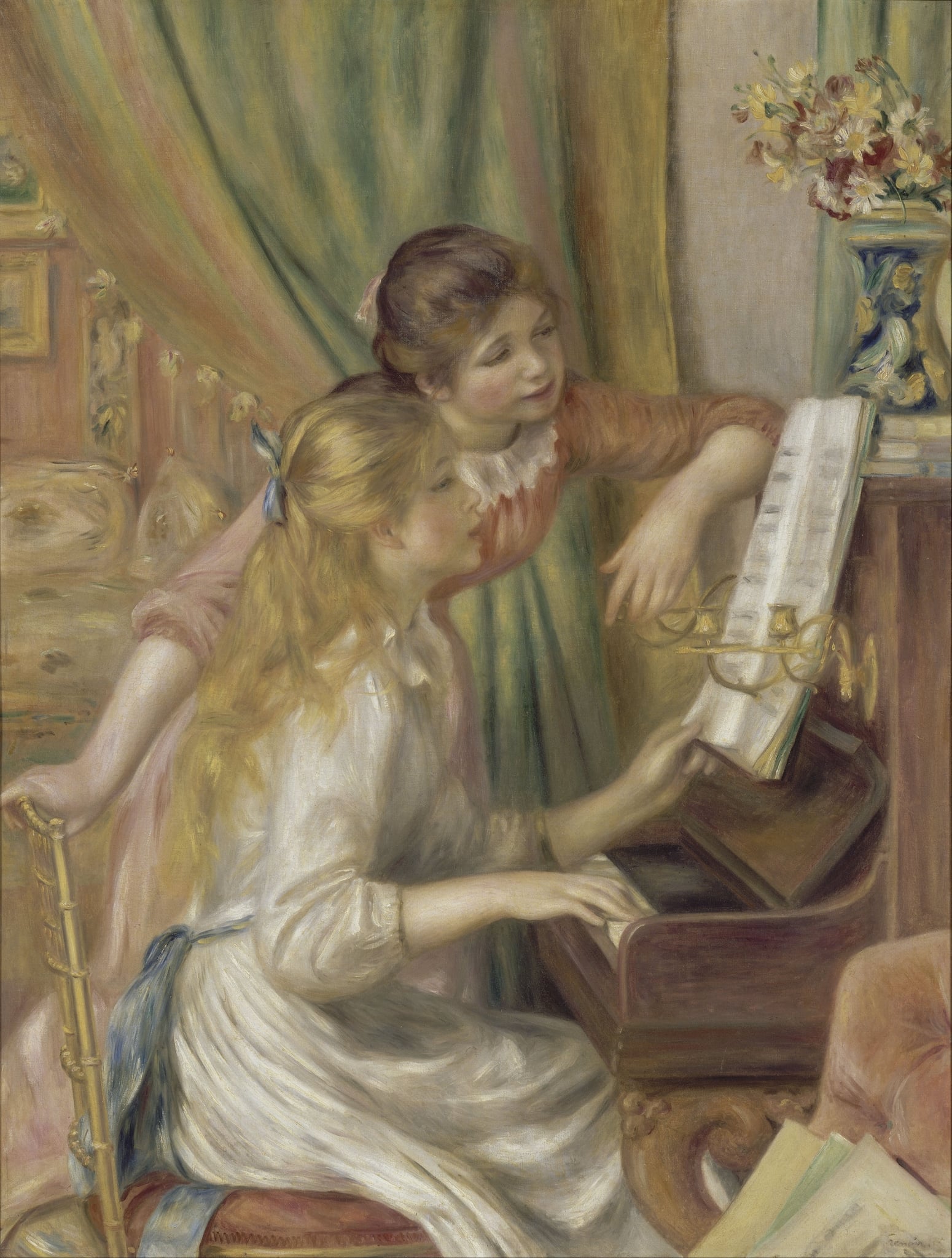
Young Girls at the Piano
Pierre-Auguste Renoir (1892)
Renoir’s Young Girls at the Piano turns a quiet lesson into a scene of <strong>attunement</strong> and <strong>bourgeois grace</strong>. Two adolescents—one seated at the keys, the other leaning to guide the score—embody harmony between discipline and delight, rendered in Renoir’s late, <strong>luminous</strong> touch <sup>[1]</sup><sup>[2]</sup>.
Related Themes
Related Symbolism Categories
Femininity
In late nineteenth‑century painting, femininity is articulated not as an essence but as a mutable ensemble of fashion, gesture, and setting, through which modern artists probe women’s visibility, labor, and agency within emerging urban and suburban worlds.
Ritual
Ritual symbolism in modern and early modern painting transforms repeated social, religious, and corporeal practices into visual structures that regulate time, desire, and collective belief, making habit itself a bearer of meaning.
Interiority
“Interiority” symbols in modern painting transform gesture, gaze, and domestic props into visual indices of inward life, staging psychological depth, self-consciousness, and mediated subjectivity within scenes of everyday modernity.
Across art history, the human figure has operated as a privileged bearer of meaning: not merely a depicted body but a condensed emblem of social order, inner life, and collective fantasy. From classical personifications to the typified workers and bourgeois strollers of the nineteenth century, artists have relied on pose, costume, and relational grouping to convert individuals into legible signs. Within this trajectory, the modern period does not abandon figural symbolism; it retools it. The body becomes a site where commerce, discipline, and modern spectatorship are enacted, questioned, or estranged, even as older iconographic traditions of courtship, pietà-like grief, or maternal care are secularized and redistributed across everyday scenes.
Many of the figures in this corpus work semiotically as types rather than portraits, coding class and economic function through dress and posture. Gustave Caillebotte’s Paris Street; Rainy Day hinges on the Bourgeois Couple (Flâneur and Companion): the man in a top hat and tailored overcoat and his fashionably dressed partner become emblems of middle-class modernity and detached observation. They do not simply inhabit the Haussmannized street; they signify it. Their calibrated distance from other pedestrians, and the echo of their umbrella in the wider field of umbrellas, renders them a structuring unit within an urban typology of passersby. Here, figural symbolism is inseparable from the rationalized geometry of the rebuilt city; the couple’s poised bearing and self-contained bubble of space mirror the impersonal order of façades and paving.
Edouard Manet similarly constructs a social type in the Barmaid (Suzon) of A Bar at the Folies-Bergère. Positioned frontally, she condenses the contradictions of urban commerce: she is the human face of exchange and simultaneously a potential commodity. Her role as mediator between viewer and marketplace is underscored by the commodity-laden counter and the advertising labels that flank her, so that her figure functions as a hinge between spectatorship and purchase. Semiologically, she is the nodal point where various codes—gendered labor, sexual availability, and branded modernity—intersect. The disjunctive mirror behind her doubles and dislocates this sign, stressing that the modern figure is constructed from unstable vantage points rather than secure, unified identity.
Other figures are defined not by class costume but by the specific relational choreography of bodies. Pierre-Auguste Renoir’s In the Garden pivots on Clasped Hands as a figure-symbol of courtship and emotional negotiation. The man’s fingers fold over the woman’s hand in a tentative grip, while the red café table slices diagonally between them, both joining and separating. The gesture’s semiotic charge is heightened by the woman’s confrontational gaze/frontality: she faces outward, meeting the viewer rather than yielding wholly to her suitor, and her braced forearm on the tabletop introduces resistance into what might otherwise read as simple acquiescence. Courtship here is a provisional contract, legible not through narrative but through the minute calibration of touch and gaze.
Manet radicalizes this logic in Olympia, where the nude’s guarding hand and direct, unsparing gaze turn the figure into an explicit site of power and refusal. Olympia’s hand, clamped over her pelvis, is not a modesty gesture in the classical Venus pudica sense; rather than ennobling chastity, it conditions access, converting desire into a transaction she controls. Her eyes, aligned with ours, exemplify confrontational gaze/frontality as an iconographic device that implicates the viewer as participant in the social economy of looking. The Black maid Laure, bouquet in hand, further anchors the scene in contemporary relations of race and labor, extending figure symbolism beyond the singular body to a social dyad in which roles of service and display are unequally distributed but insistently visible.
Where Manet and Renoir stage intimate negotiation, Edgar Degas uses figural types to theorize discipline and institutional power. In The Ballet Class, the gray-suited master with his ballet master’s cane crystallizes authority figures as a structural presence that governs training. The cane, planted like a metronome, and the master’s upright stance embody a regime of timing, correction, and surveillance. Around him, the young dancers’ slouching, stretching, and distracted gestures are equally symbolic: these are bodies in formation, caught between aspiration and fatigue. The studio thus becomes a diagram of hierarchy in which the master’s posture and tool stand in for the abstract systems—schools, companies, patronage—that regulate artistic labor. In this sense, Degas’s figures function semiotically as nodes in a network of power, not as isolated personalities.
A very different inflection of figural symbolism appears in landscapes by Claude Monet, where small, often repeated figures mediate between nature and domesticity. In Poppies, the doubled mother-and-child figures on the hillside trace a visual time-lapse, marking successive moments along the same diagonal path. This doubling symbolically fuses the mother-and-child unit—a secularized descendant of the Madonna and Child—with modern leisure, transforming a walk near Argenteuil into an emblem of continuity and everyday renewal. Similarly, in The Artist’s Garden at Vétheuil, the Child on the path, accompanied by a dog, anchors human scale within the profusion of sunflowers and asserts the persistence of family life at the core of Impressionist optical experimentation. The child’s modest size and central placement quietly insist that the garden is not only an optical laboratory but a lived, protective environment.
These motifs of maternal care and childhood stand in poignant contrast to the stark extremity of the weeping mother with dead child in Picasso’s Guernica. There, the mother-and-child configuration is violently inverted: instead of nurturing continuity, the figure condenses irreparable loss and civilian suffering. The mother’s contorted body and screaming mouth, clutching the limp child, reprise the pietà tradition while stripping it of redemptive overtones. Iconographically, this is the endpoint of a long trajectory in which the maternal figure moves from sacred prototype to secular domesticity (as in Monet) and finally to a modern emblem of political catastrophe. The body remains the vehicle of meaning, but its legibility is now marshaled to indict technological warfare and state violence.
Across these works, one can trace a broader evolution in figural symbolism from stable allegorical personifications toward situational, relational signs embedded in specific social spaces—the boulevard, the music hall, the rehearsal studio, the suburban field. The Bourgeois Couple, the Barmaid, the ballet master, the mother-and-child unit, and the weeping mother with dead child all function as condensed formulas through which artists think about modernity’s central tensions: between spectacle and alienation, discipline and aspiration, continuity and rupture. What distinguishes the late nineteenth- and early twentieth-century redeployments of these figure types is their reflexivity. The barmaid’s and Olympia’s frontal gazes, Caillebotte’s cropped passersby, Degas’s unidealized dancers—all lay bare the conditions under which bodies are seen, trained, and exchanged. In this sense, the evolution of figure symbolism is not a waning of iconography but its modern reorientation: from timeless allegories toward historically specific, critically charged embodiments of social experience.