Femininity
In late nineteenth‑century painting, femininity is articulated not as an essence but as a mutable ensemble of fashion, gesture, and setting, through which modern artists probe women’s visibility, labor, and agency within emerging urban and suburban worlds.
Member Symbols
Featured Artworks
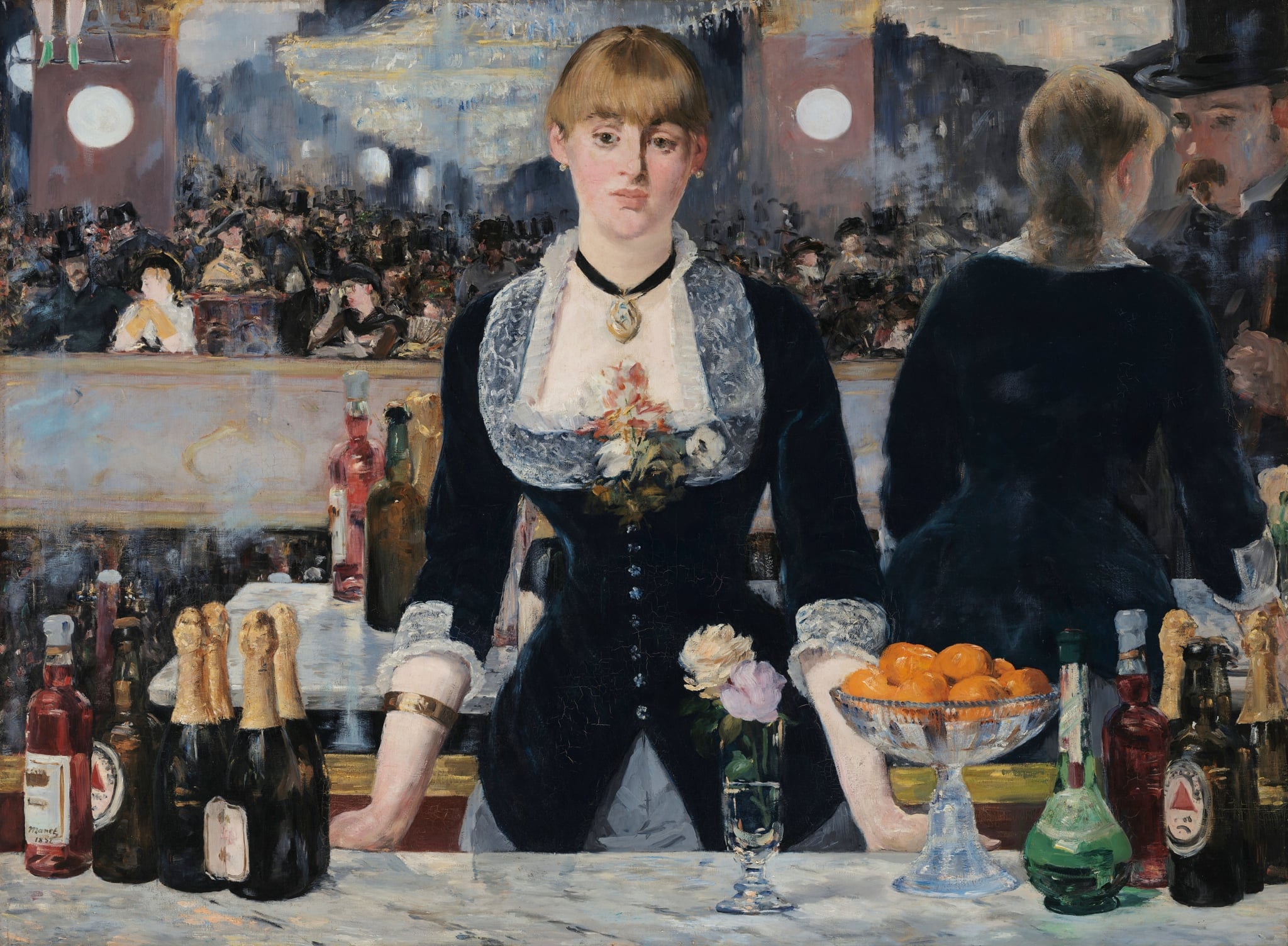
A Bar at the Folies-Bergère
Édouard Manet (1882)
Édouard Manet’s A Bar at the Folies-Bergère stages a face-to-face encounter with modern Paris, where <strong>commerce</strong>, <strong>spectacle</strong>, and <strong>alienation</strong> converge. A composed barmaid fronts a marble counter loaded with branded bottles, flowers, and a brimming bowl of oranges, while a disjunctive <strong>mirror</strong> unravels stable viewing and certainty <sup>[1]</sup><sup>[2]</sup>.
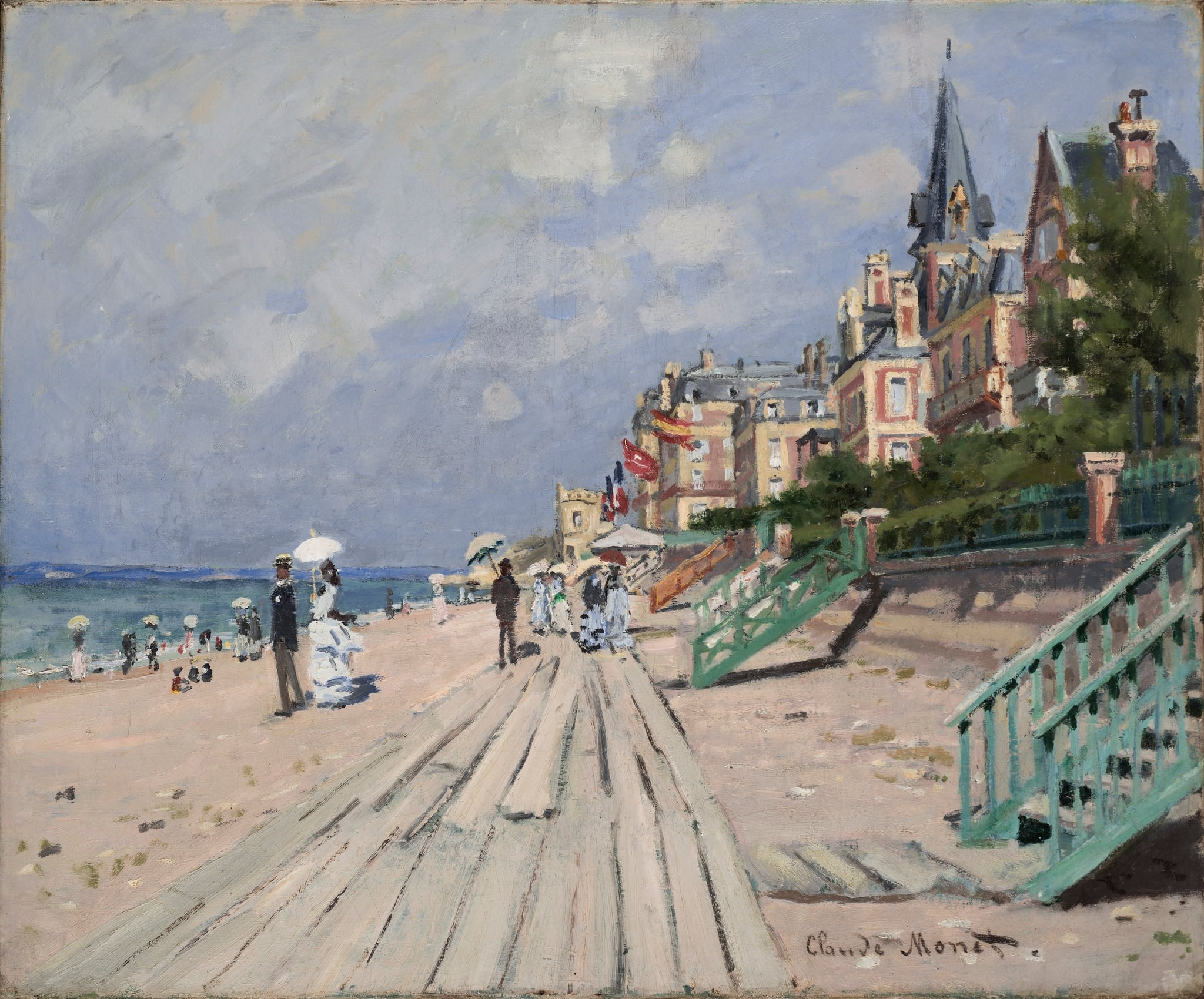
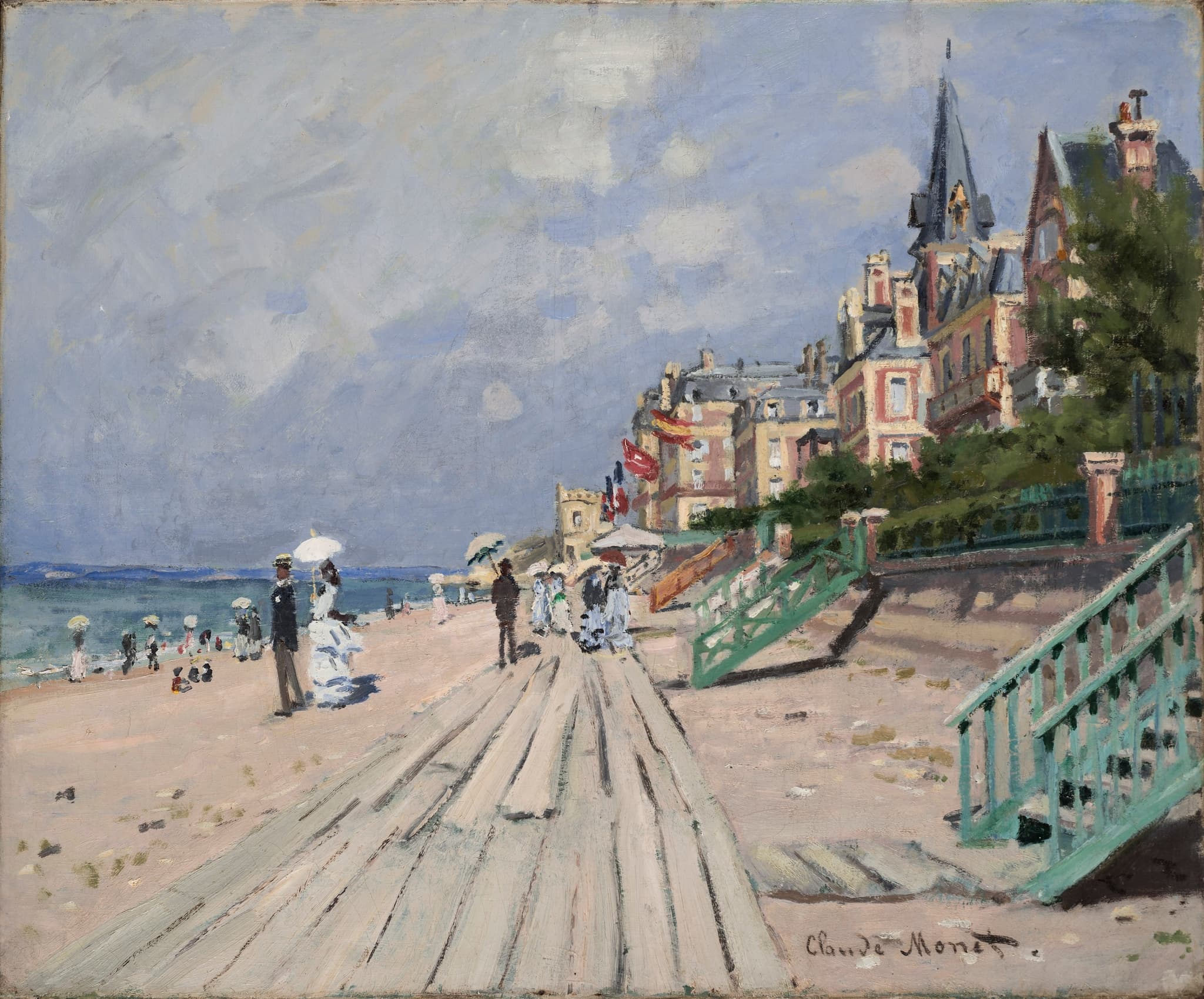
Beach at Trouville
Claude Monet (1870)
Beach at Trouville turns the Normandy resort into a stage where <strong>modern leisure</strong> meets <strong>restless weather</strong>. Monet’s diagonal boardwalk, wind-whipped <strong>red flags</strong>, and white <strong>parasols</strong> marshal the eye through a day animated by light and air rather than by individual stories <sup>[1]</sup><sup>[2]</sup>. The work asserts Impressionism’s claim to immediacy—there is even <strong>sand embedded in the paint</strong> from working on site <sup>[1]</sup>.
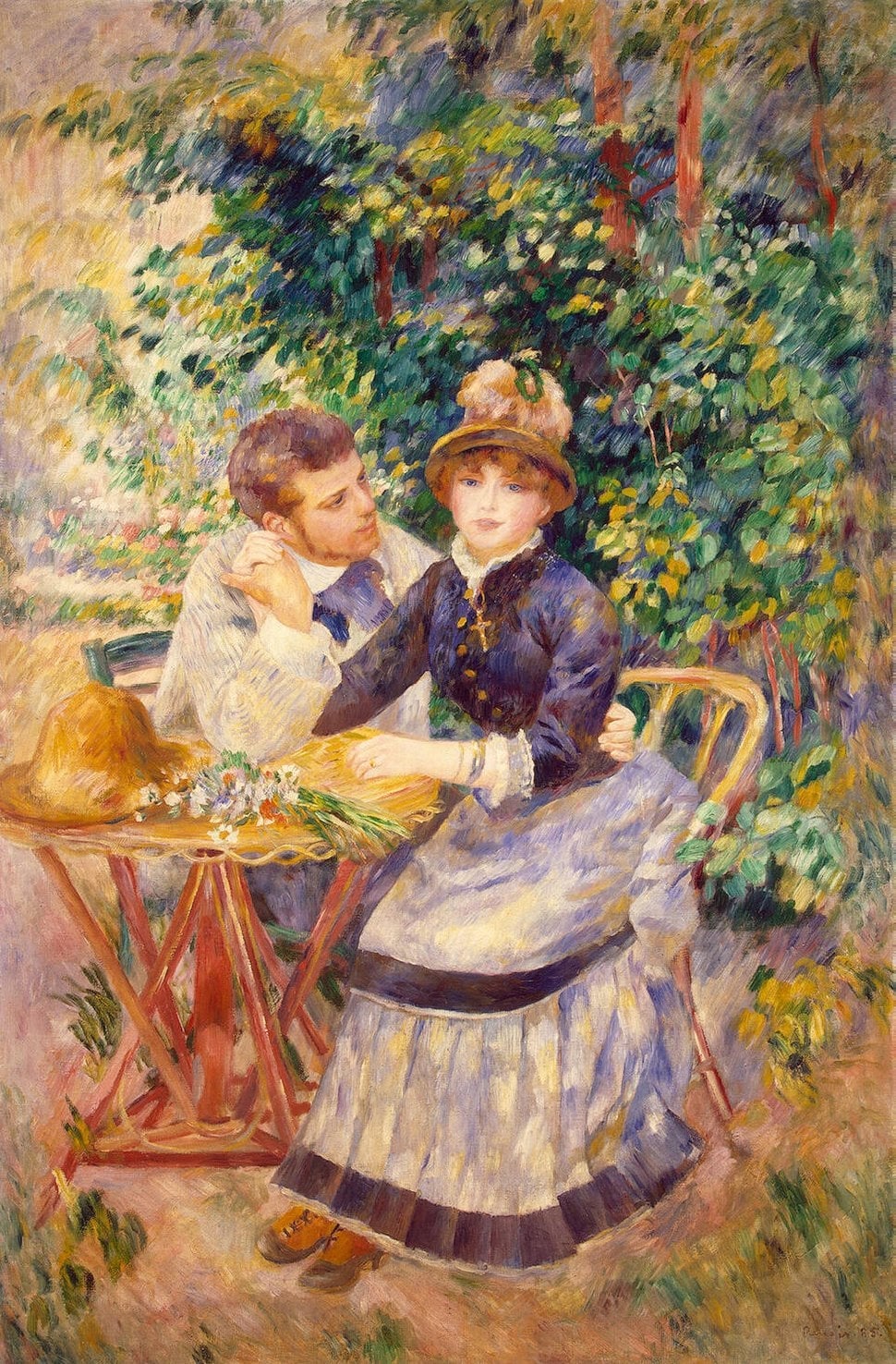
In the Garden
Pierre-Auguste Renoir (1885)
In the Garden presents a charged pause in modern leisure: a young couple at a café table under a living arbor of leaves. Their lightly clasped hands and the bouquet on the tabletop signal courtship, while her calm, front-facing gaze checks his lean. Renoir’s flickering brushwork fuses figures and foliage, rendering love as a <strong>transitory, luminous sensation</strong> <sup>[1]</sup><sup>[3]</sup>.
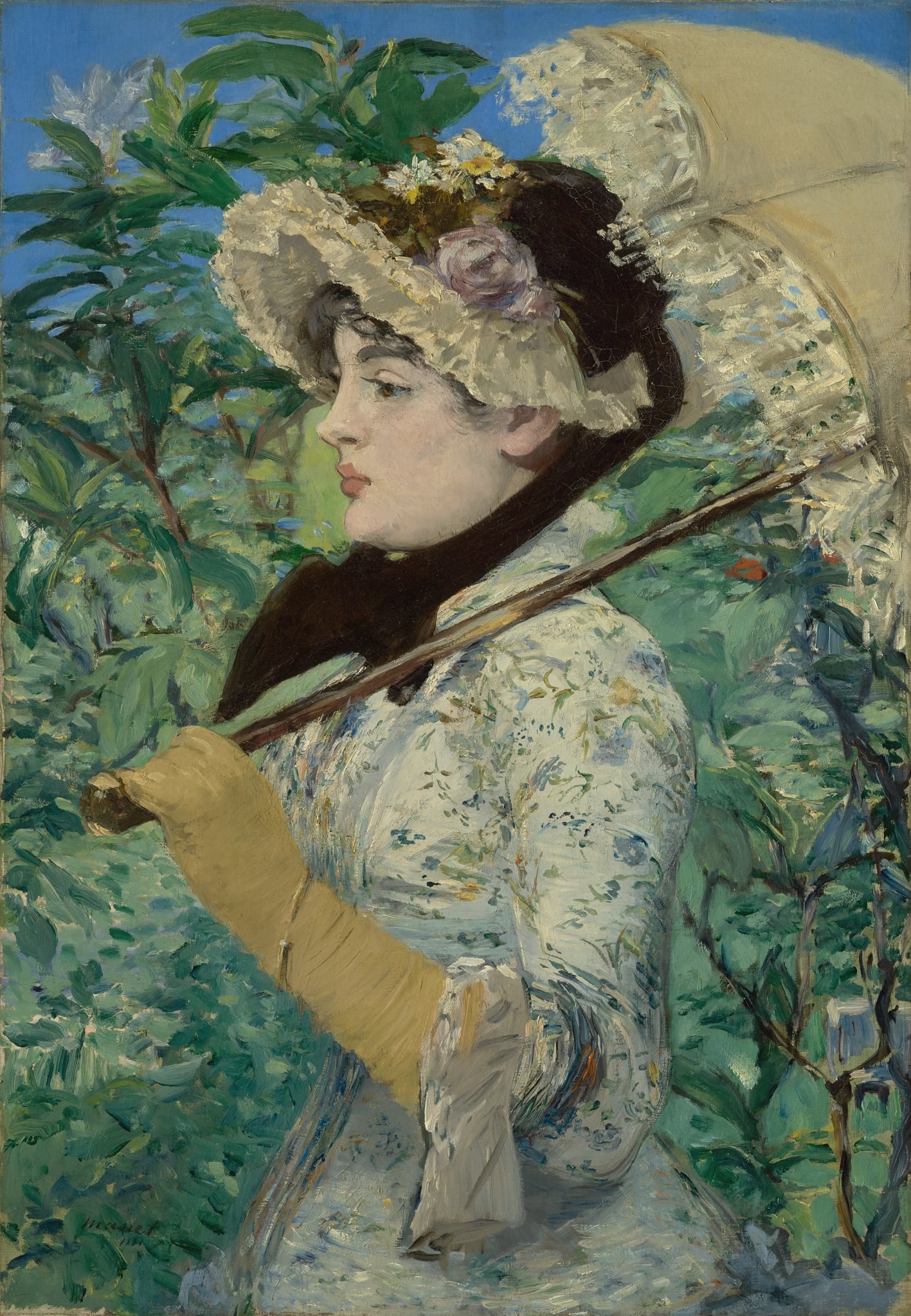
Jeanne (Spring)
Édouard Manet (1881)
Édouard Manet’s Jeanne (Spring) fuses a time-honored allegory with <strong>modern Parisian fashion</strong>: a crisp profile beneath a cream parasol, set against <strong>luminous, leafy greens</strong>. Manet turns couture—hat, glove, parasol—into the language of <strong>renewal and youth</strong>, making spring feel both perennial and up-to-the-minute <sup>[1]</sup><sup>[2]</sup>.
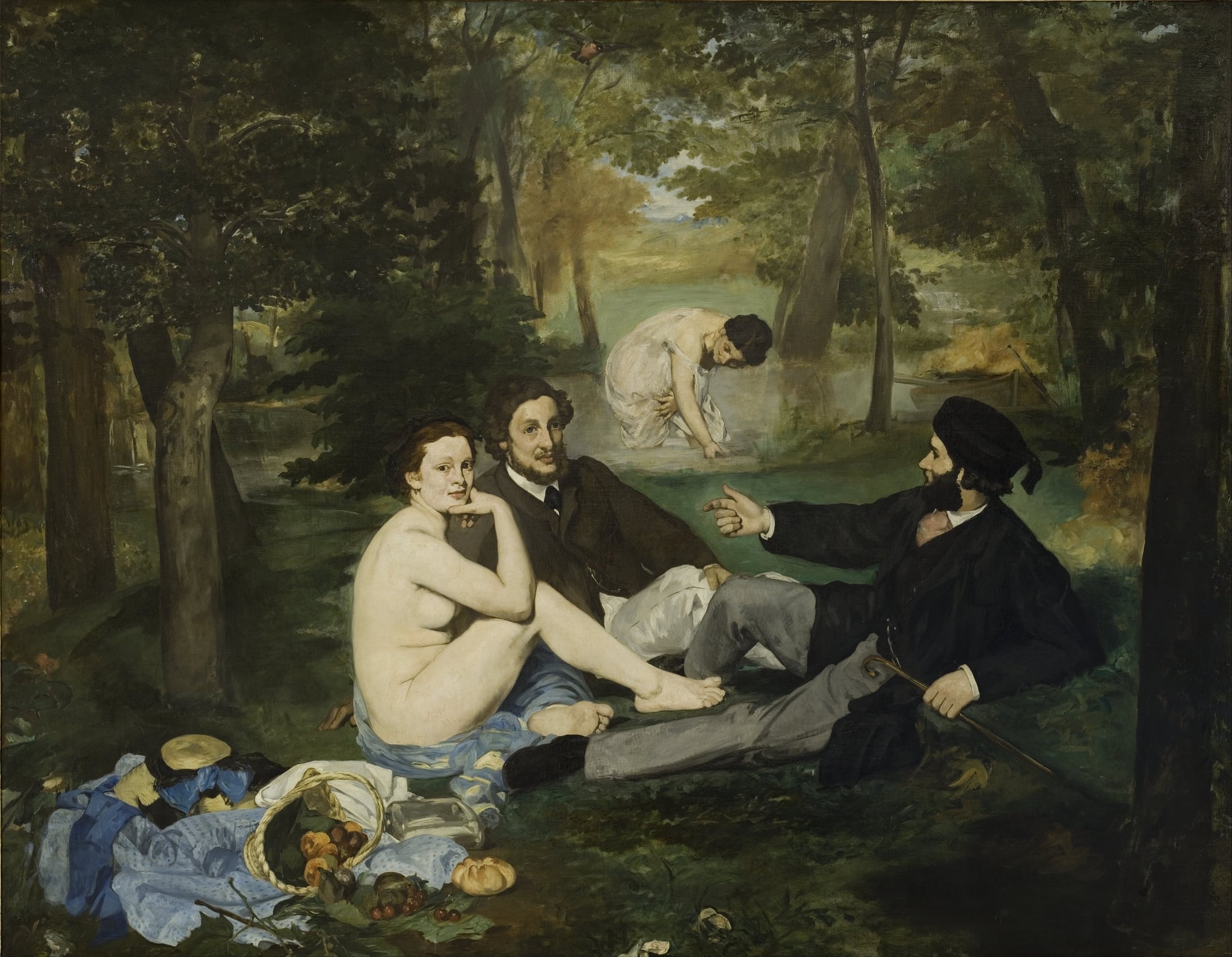
Luncheon on the Grass
Édouard Manet (1863)
Luncheon on the Grass stages a confrontation between <strong>modern Parisian leisure</strong> and <strong>classical precedent</strong>. A nude woman meets our gaze beside two clothed men, while a distant bather and an overturned picnic puncture naturalistic illusion. Manet’s scale and flat, studio-like light convert a park picnic into a manifesto of <strong>modern painting</strong> <sup>[1]</sup><sup>[2]</sup>.
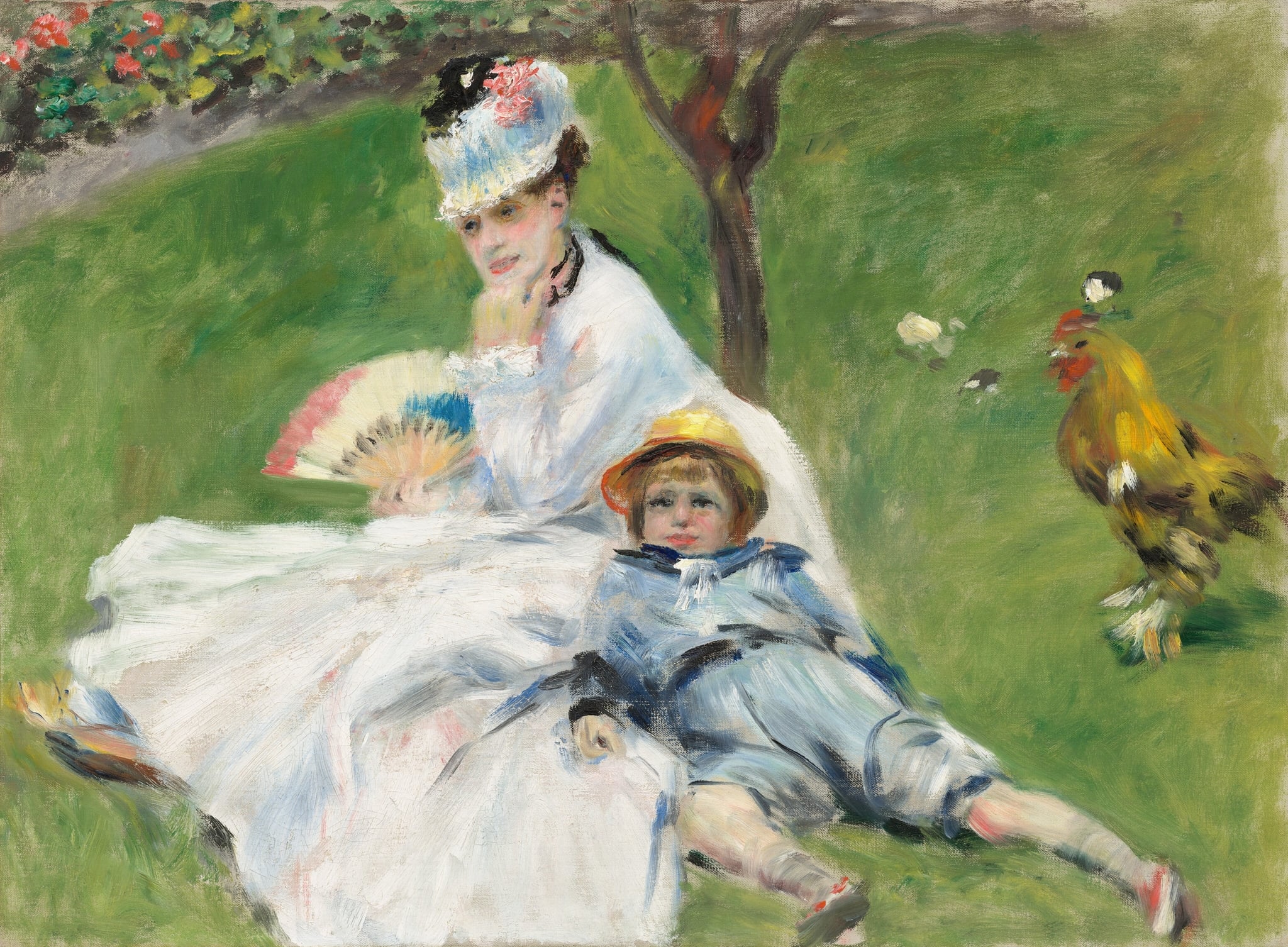
Madame Monet and Her Son
Pierre-Auguste Renoir (1874)
Renoir’s 1874 canvas Madame Monet and Her Son crystallizes <strong>modern domestic leisure</strong> and <strong>plein‑air immediacy</strong> in Argenteuil. A luminous white dress pools into light while a child in a pale‑blue sailor suit reclines diagonally; a strutting rooster punctuates the greens with warm color. The brushwork fuses figure and garden so the moment reads as <strong>lived, not staged</strong> <sup>[1]</sup><sup>[2]</sup><sup>[5]</sup>.
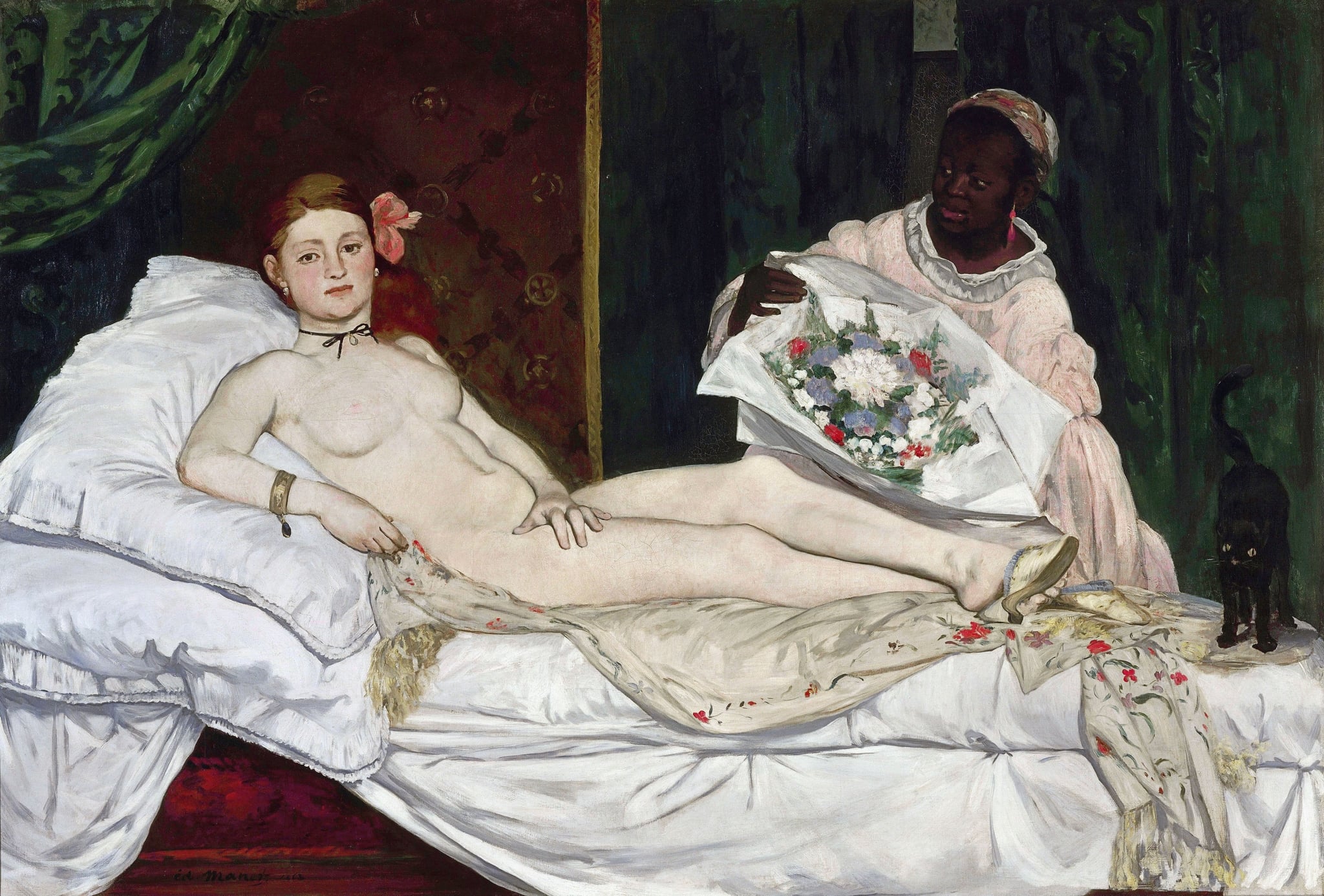
Olympia
Édouard Manet (1863 (Salon 1865))
A defiantly contemporary nude confronts the viewer with a steady gaze and a guarded pose, framed by crisp light and luxury trappings. In Olympia, <strong>Édouard Manet</strong> strips myth from the female nude to expose the <strong>modern economy of desire</strong>, power, and looking <sup>[1]</sup><sup>[3]</sup>.
Poppies
Claude Monet (1873)
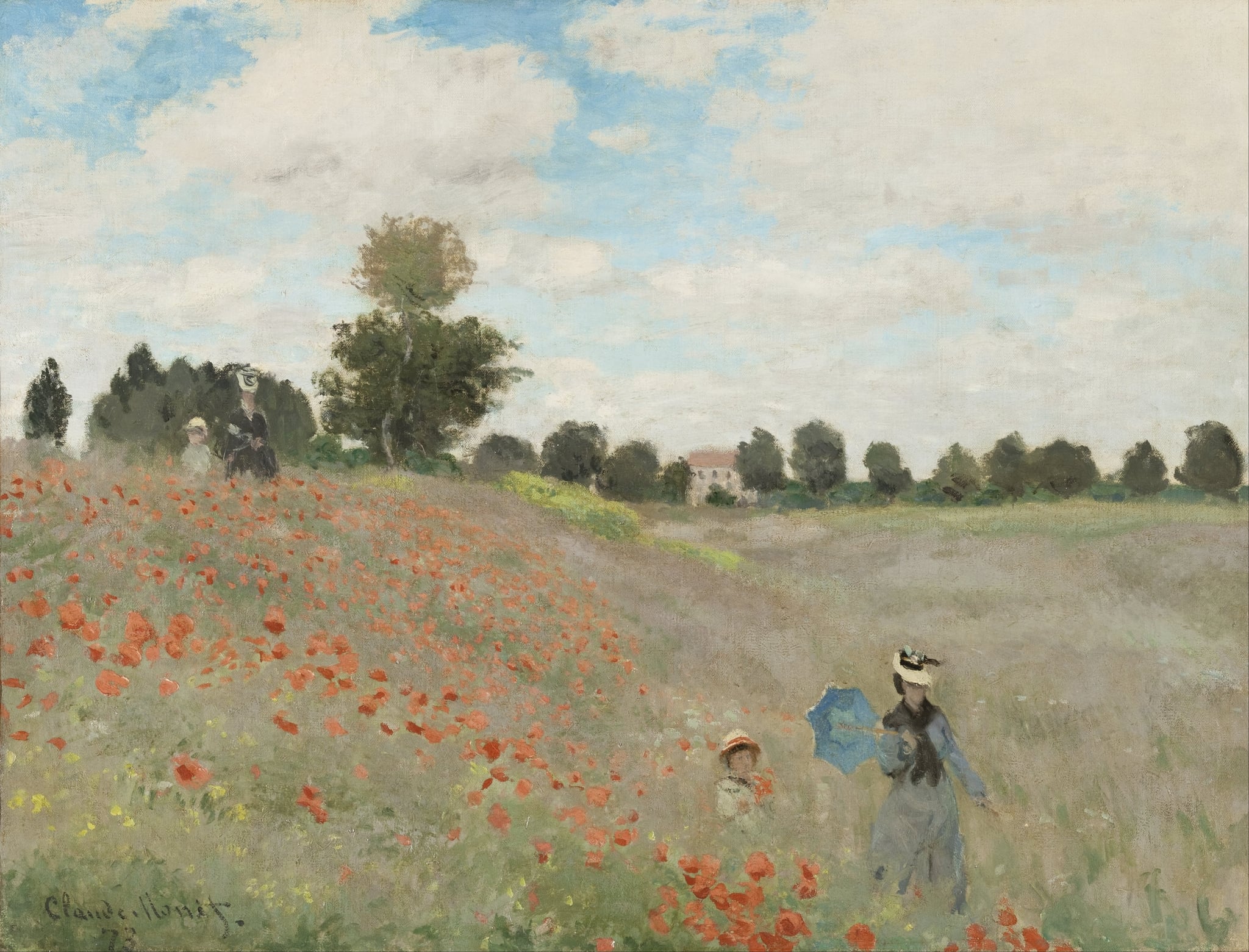
Claude Monet’s Poppies (1873) turns a suburban hillside into a theater of <strong>light, time, and modern leisure</strong>. A red diagonal of poppies counters cool fields and sky, while a woman with a <strong>blue parasol</strong> and a child appear twice along the slope, staging a gentle <strong>echo of moments</strong> rather than a single event <sup>[1]</sup>. The painting asserts sensation over contour, letting broken touches make the day itself the subject.
Summer's Day
Berthe Morisot (about 1879)
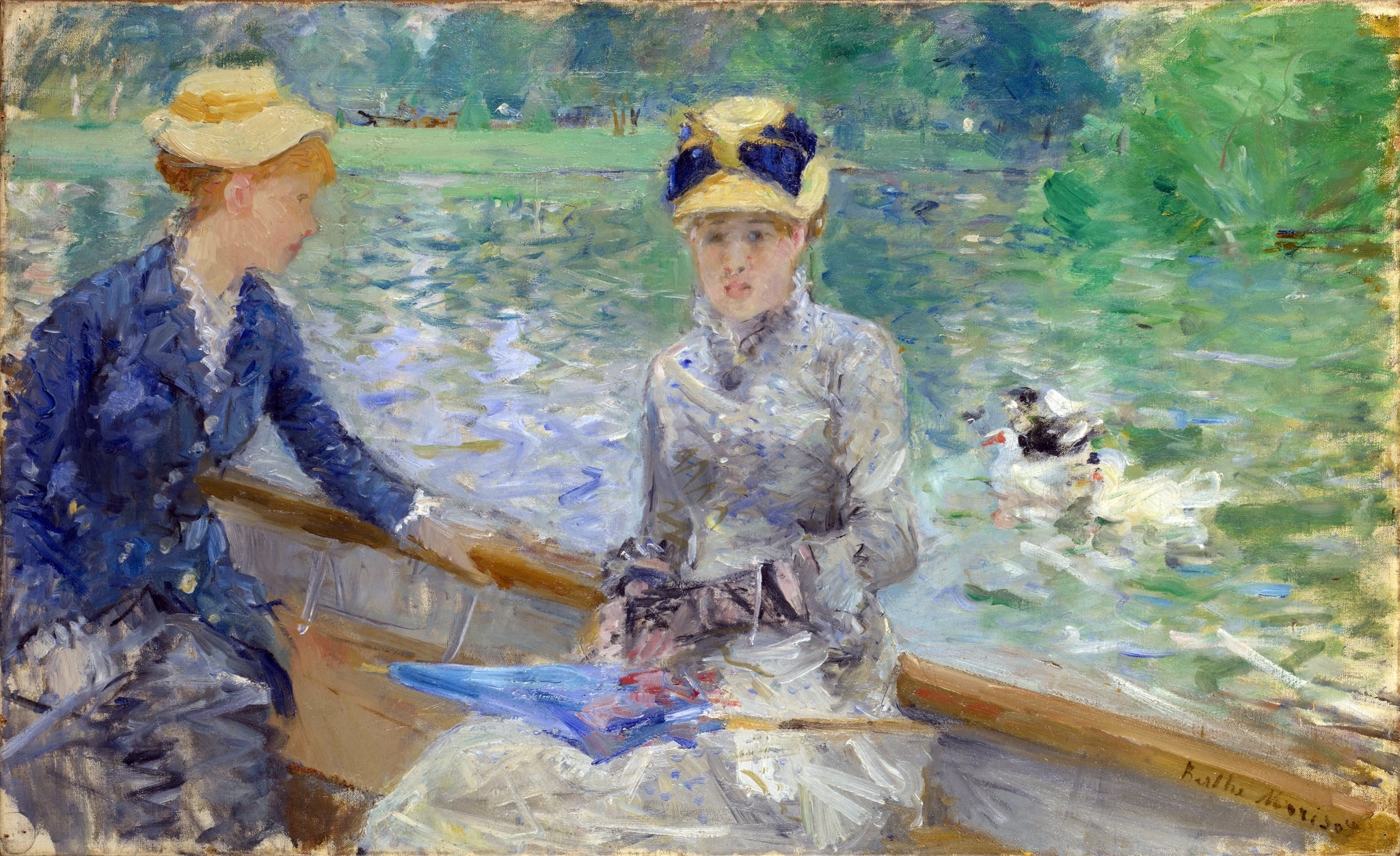
Two women drift on a boat in the Bois de Boulogne, their dresses, hats, and a bright blue parasol fused with the lake’s flicker by Morisot’s swift, <strong>zig‑zag brushwork</strong>. The scene turns a brief outing into a poised study of <strong>modern leisure</strong> and <strong>female companionship</strong> in public space <sup>[1]</sup>.
The Artist's Garden at Giverny
Claude Monet (1900)
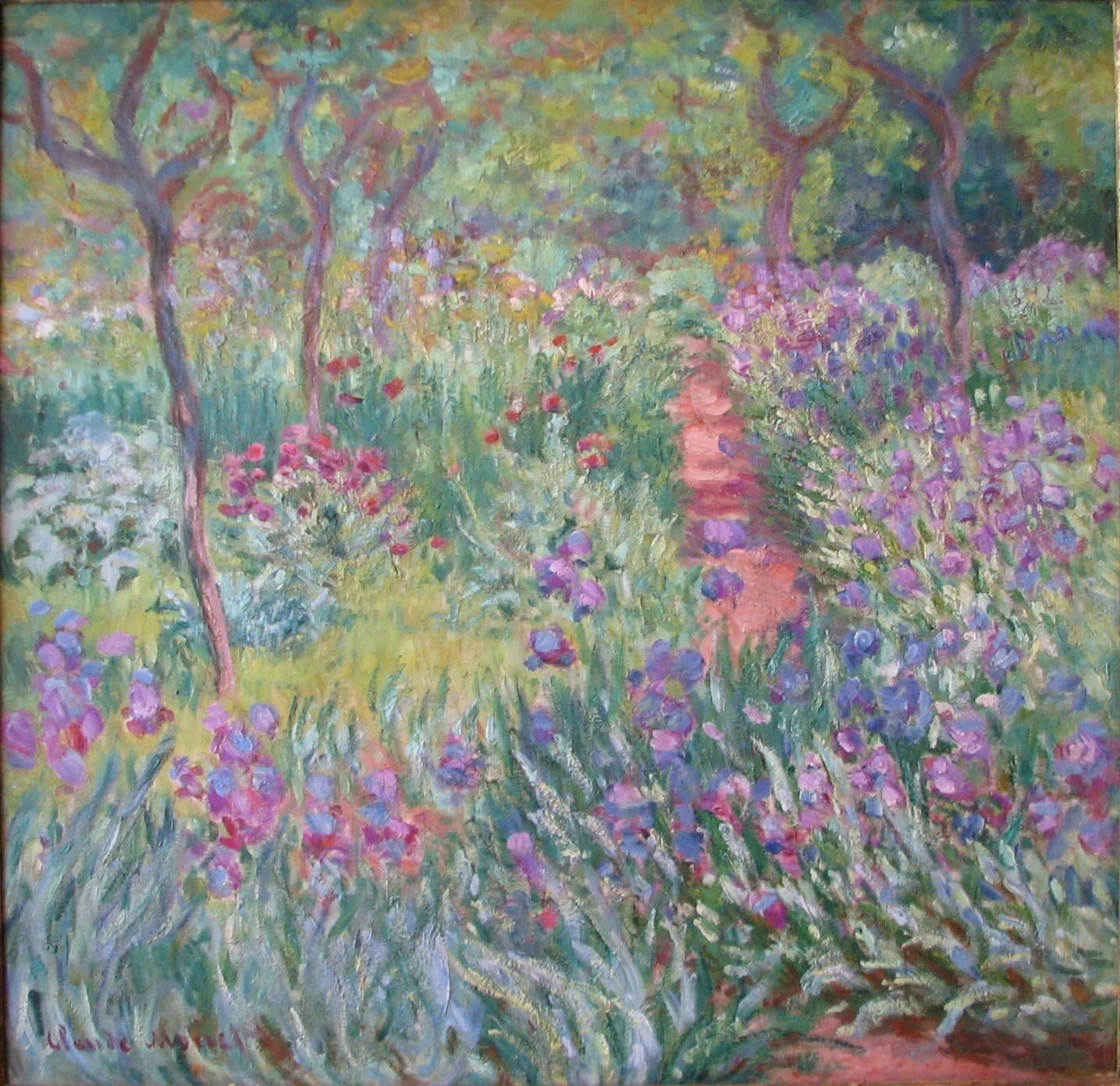
In The Artist's Garden at Giverny, Claude Monet turns his cultivated Clos Normand into a field of living color, where bands of violet <strong>irises</strong> surge toward a narrow, rose‑colored path. Broken, flickering strokes let greens, purples, and pinks mix optically so that light seems to tremble across the scene, while lilac‑toned tree trunks rhythmically guide the gaze inward <sup>[1]</sup><sup>[3]</sup>.
The Boating Party
Mary Cassatt (1893–1894)
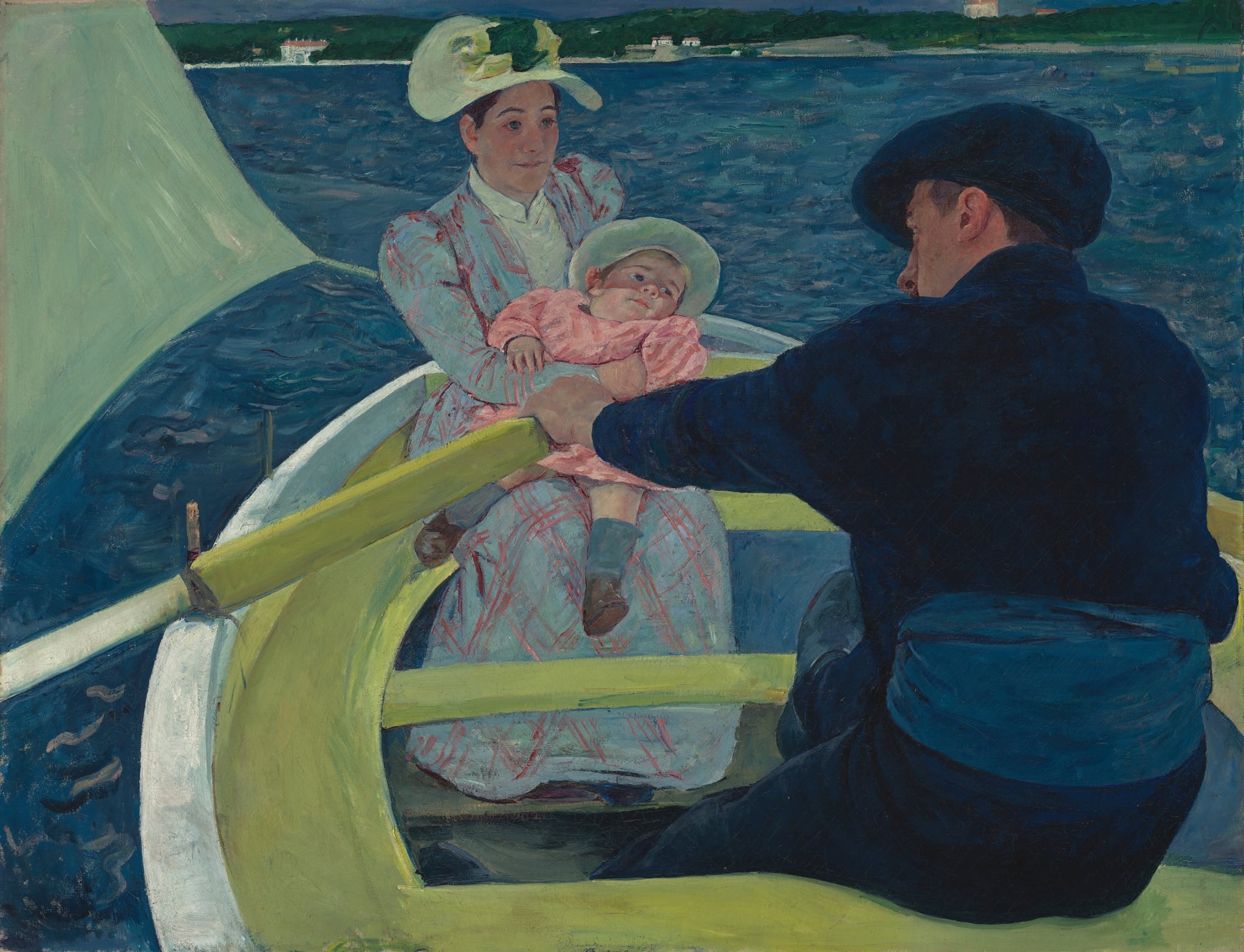
In The Boating Party, Mary Cassatt fuses <strong>intimate caregiving</strong> with <strong>modern mobility</strong>, compressing mother, child, and rower inside a skiff that cuts diagonals across ultramarine water. Bold arcs of citron paint and a high, flattened horizon reveal a deliberate <strong>Japonisme</strong> logic that stabilizes the scene even as motion surges around it <sup>[1]</sup>. The painting asserts domestic life as a public, modern subject while testing the limits of Impressionist space and color.
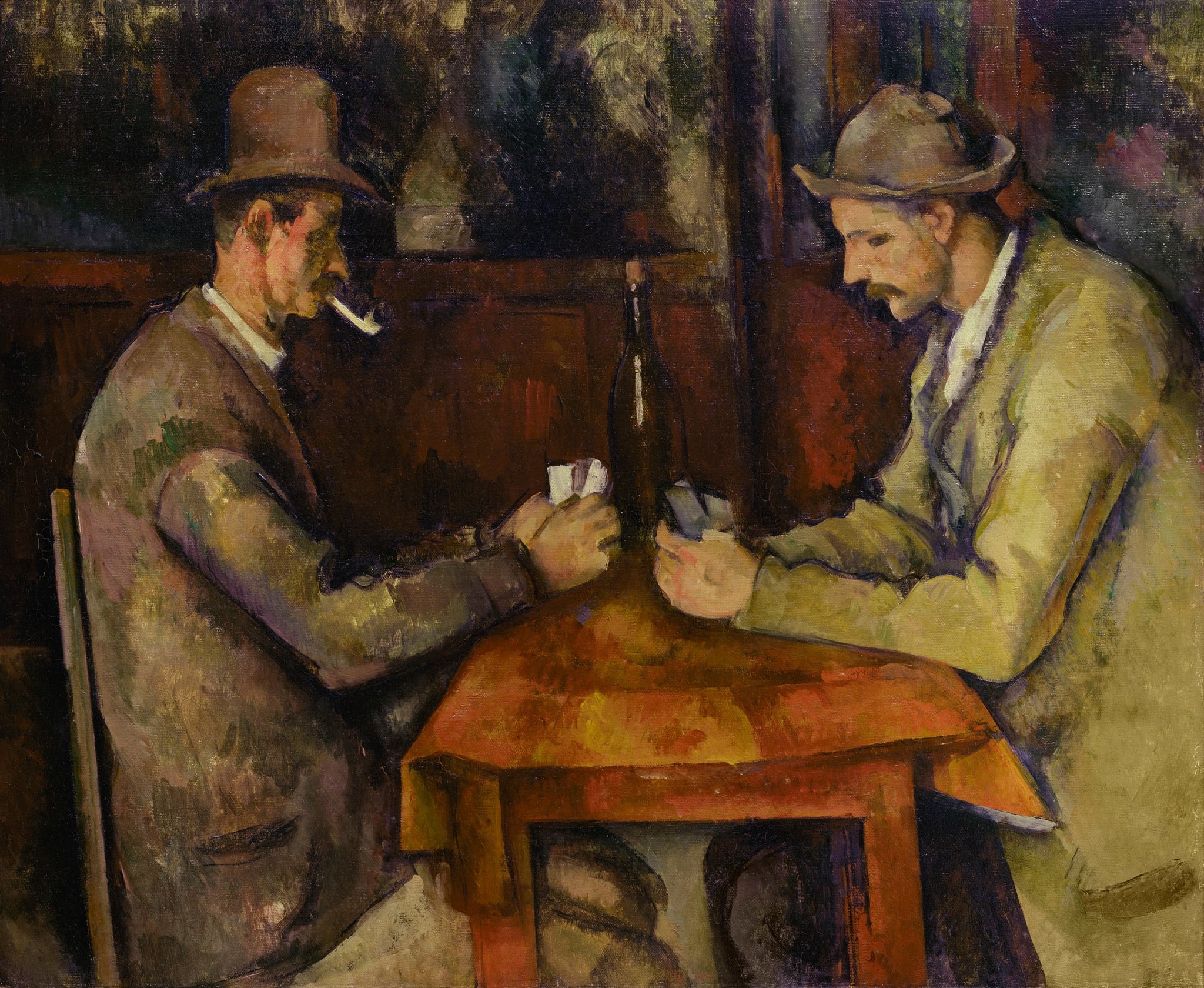
The Card Players by Paul Cézanne | Equilibrium and Form
Paul Cézanne
In The Card Players, Paul Cézanne turns a rural café game into a study of <strong>equilibrium</strong> and <strong>monumentality</strong>. Two hated peasants lean inward across an orange-brown table while a dark bottle stands upright between them, acting as a calm, vertical <strong>axis</strong> that stabilizes their mirrored focus <sup>[2]</sup><sup>[3]</sup>.
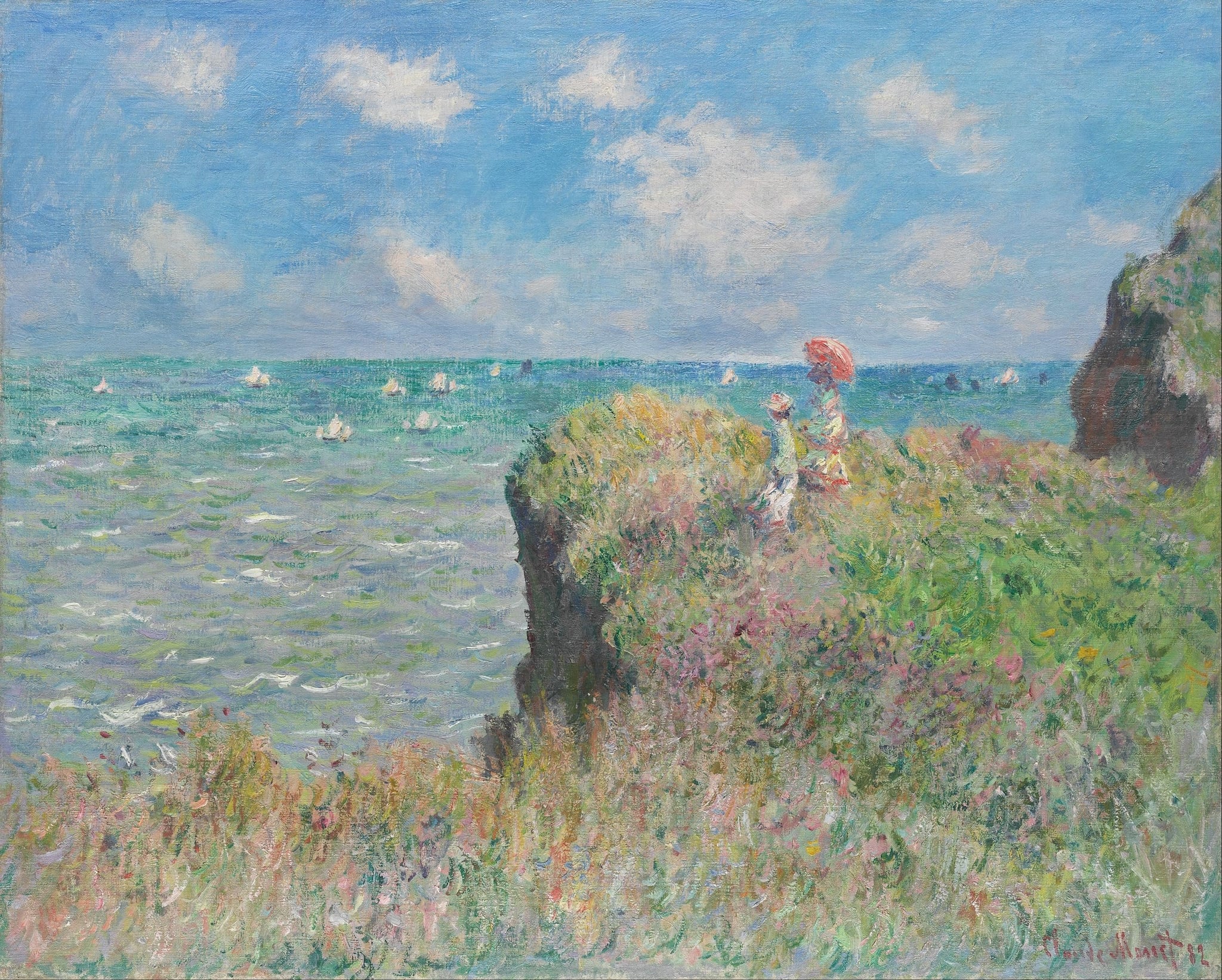
The Cliff Walk at Pourville
Claude Monet (1882)
Claude Monet’s The Cliff Walk at Pourville renders wind, light, and sea as interlocking forces through <strong>shimmering, broken brushwork</strong>. Two small walkers—one beneath a pink parasol—stand near the <strong>precipitous cliff edge</strong>, their presence measuring the vastness of turquoise water and bright sky dotted with white sails. The scene fuses leisure and the <strong>modern sublime</strong>, making perception itself the subject <sup>[1]</sup><sup>[2]</sup>.
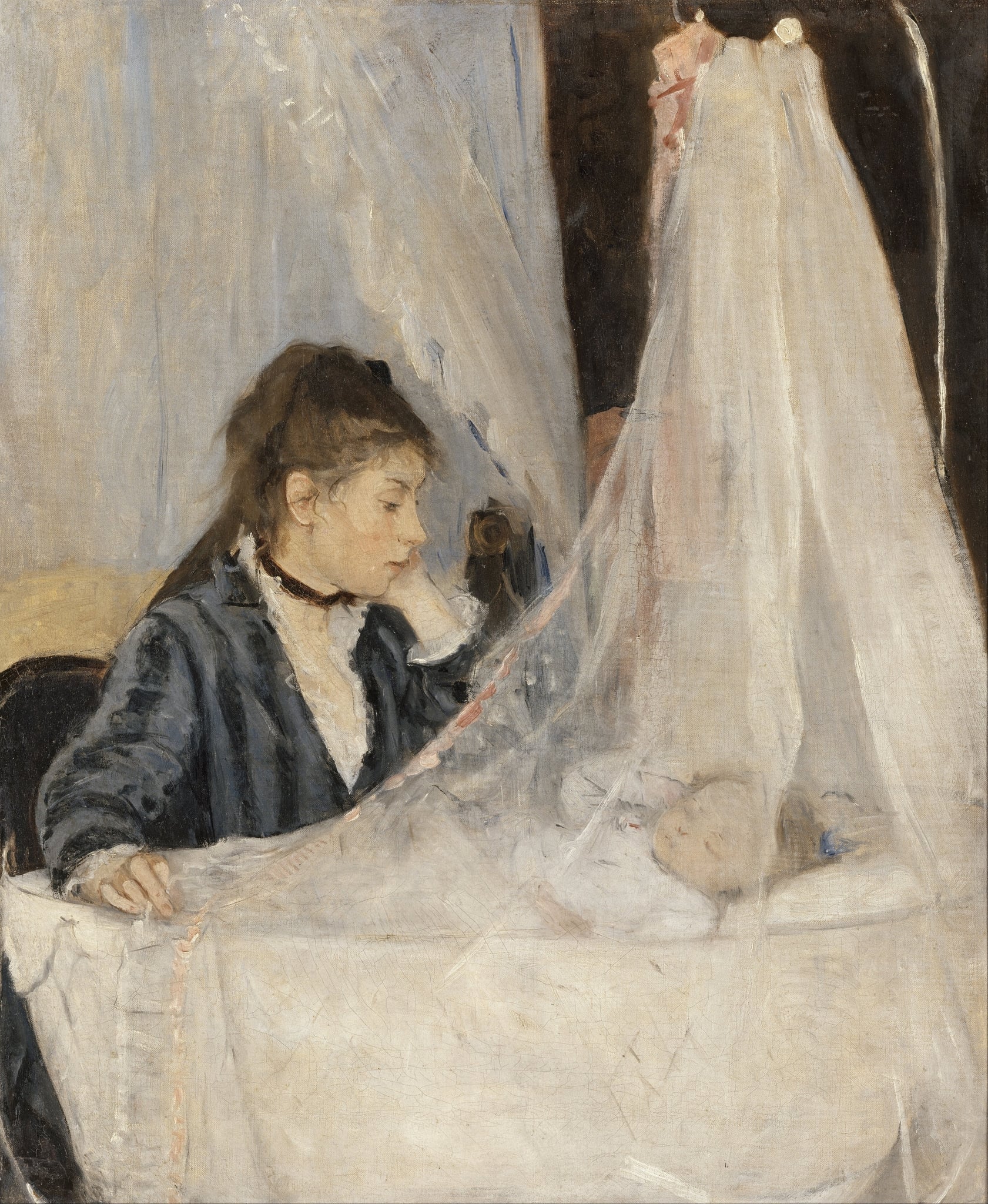
The Cradle
Berthe Morisot (1872)
Berthe Morisot’s The Cradle turns a quiet nursery into a scene of <strong>vigilant love</strong>. A gauzy veil, lifted by the watcher’s hand, forms a <strong>protective boundary</strong> that cocoons the sleeping child in light while linking the two figures through a decisive diagonal <sup>[1]</sup><sup>[2]</sup>. The painting crystallizes modern maternity as a form of attentiveness rather than display—an <strong>unsentimental icon</strong> of care.
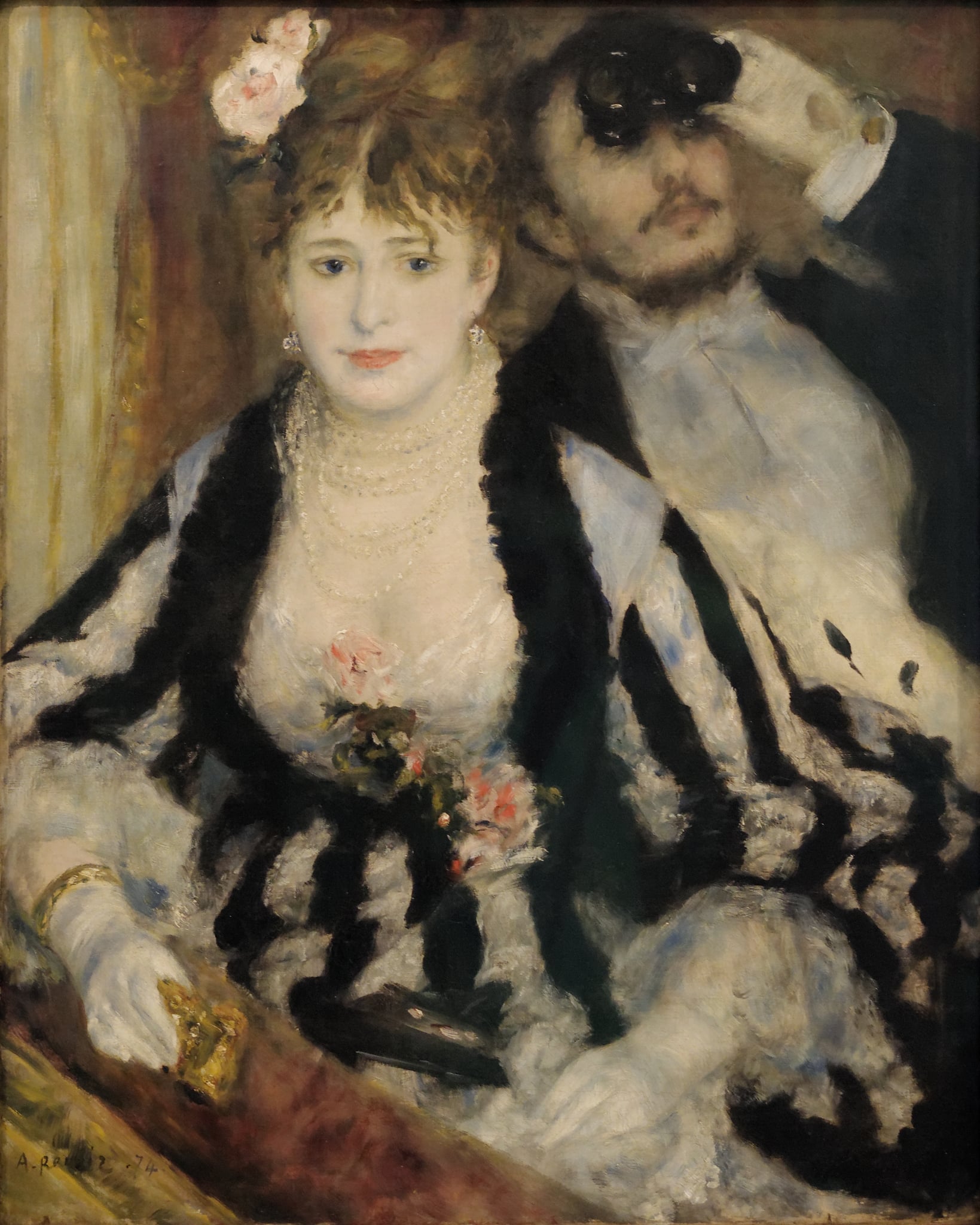
The Loge
Pierre-Auguste Renoir (1874)
Renoir’s The Loge (1874) turns an opera box into a <strong>stage of looking</strong>, where a woman meets our gaze while her companion scans the crowd through binoculars. The painting’s <strong>frame-within-a-frame</strong> and glittering fashion make modern Parisian leisure both alluring and self-conscious, turning spectators into spectacles <sup>[1]</sup><sup>[2]</sup>.
The Railway
Édouard Manet (1873)
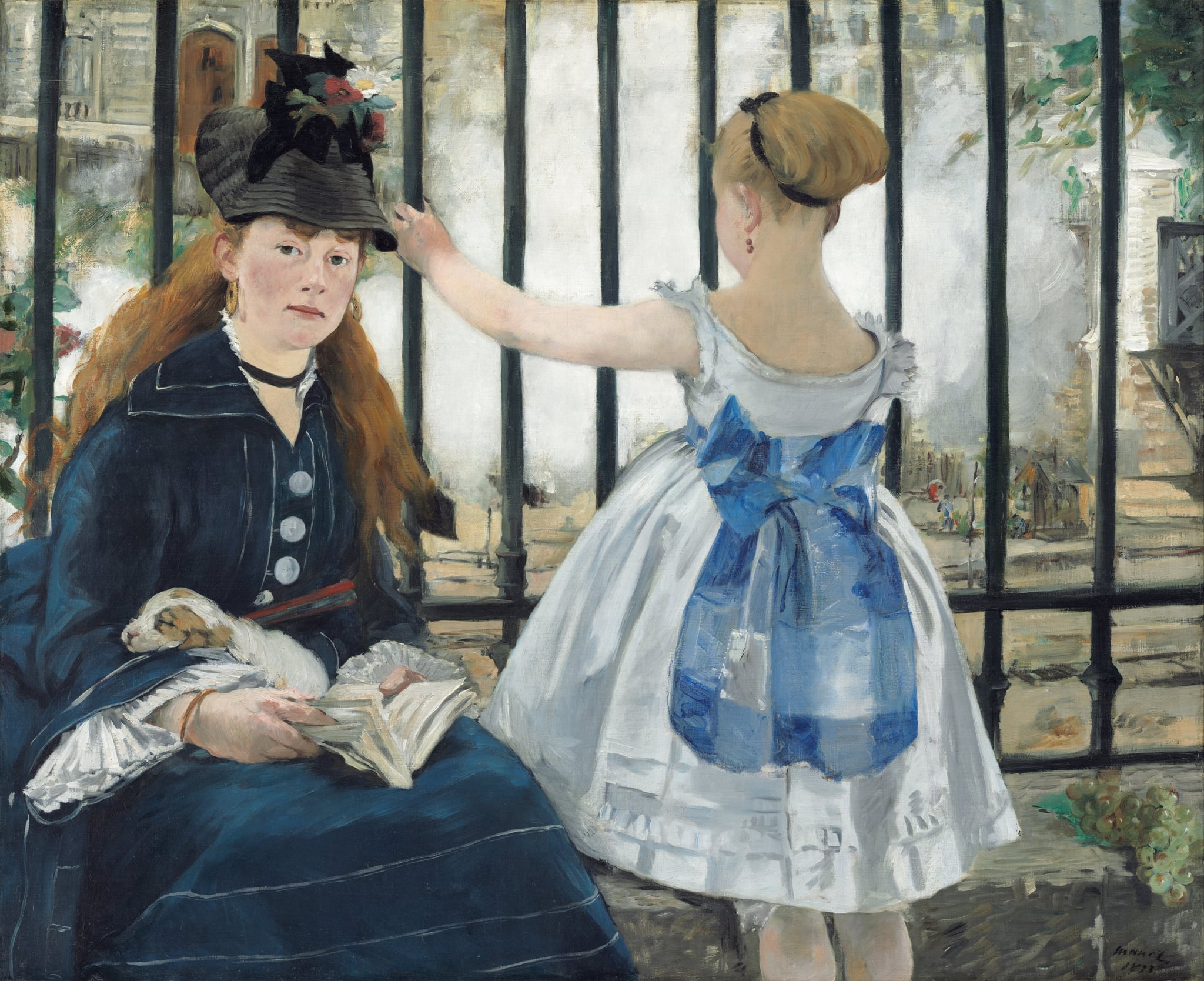
Manet’s The Railway is a charged tableau of <strong>modern life</strong>: a composed woman confronts us while a child, bright in <strong>white and blue</strong>, peers through the iron fence toward a cloud of <strong>steam</strong>. The image turns a casual pause at the Gare Saint‑Lazare into a meditation on <strong>spectatorship, separation, and change</strong> <sup>[1]</sup><sup>[3]</sup>.
The Swing
Pierre-Auguste Renoir (1876)
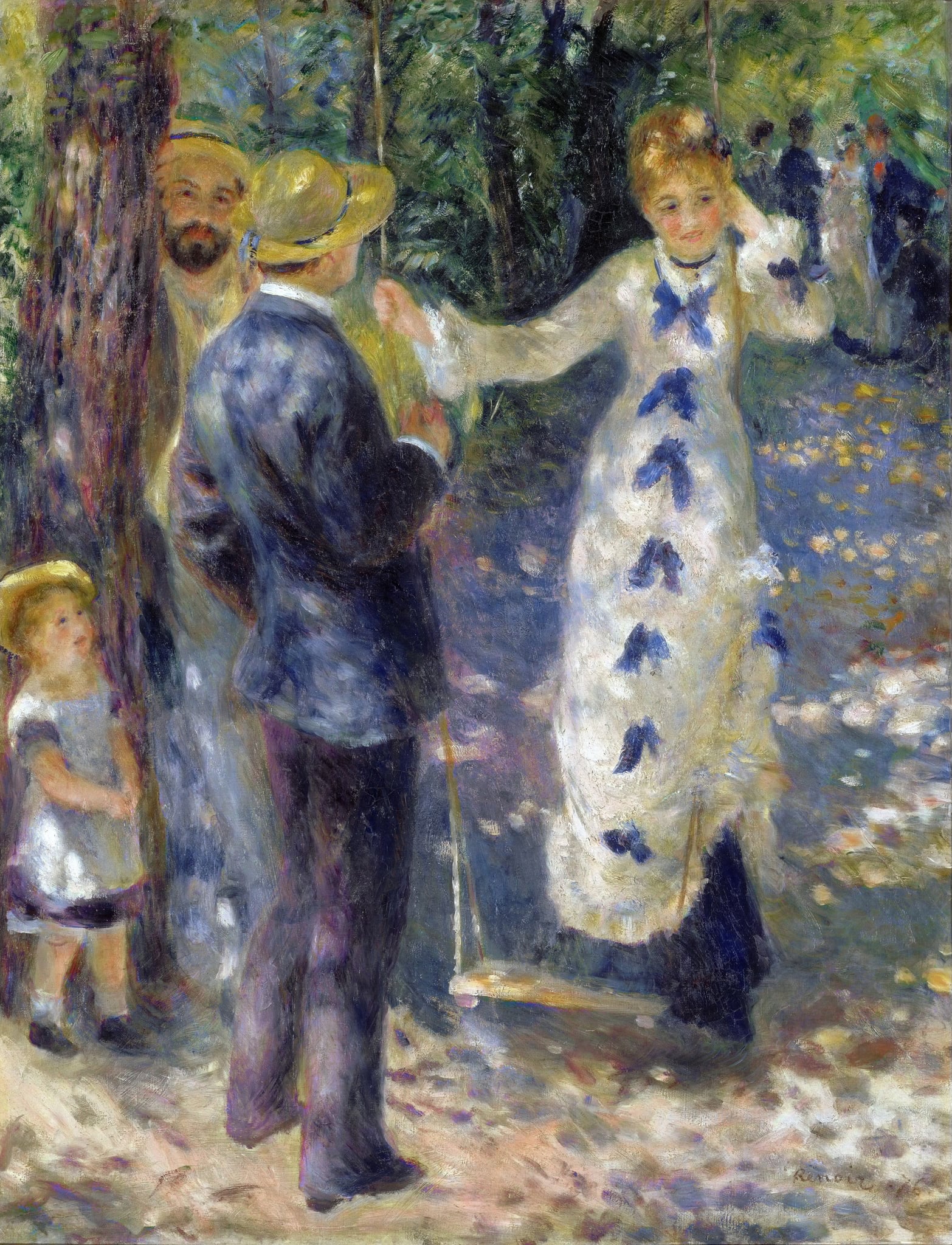
Renoir’s The Swing fixes a fleeting, sun-dappled exchange in a Montmartre garden, where a woman in a white dress with blue bows steadies herself on a swing while a man in a blue jacket addresses her. The scene crystallizes <strong>modern leisure</strong>, <strong>flirtation</strong>, and <strong>optical shimmer</strong>, as broken strokes scatter light over faces, fabric, and ground <sup>[1]</sup><sup>[4]</sup>.
Woman at Her Toilette
Berthe Morisot (1875–1880)
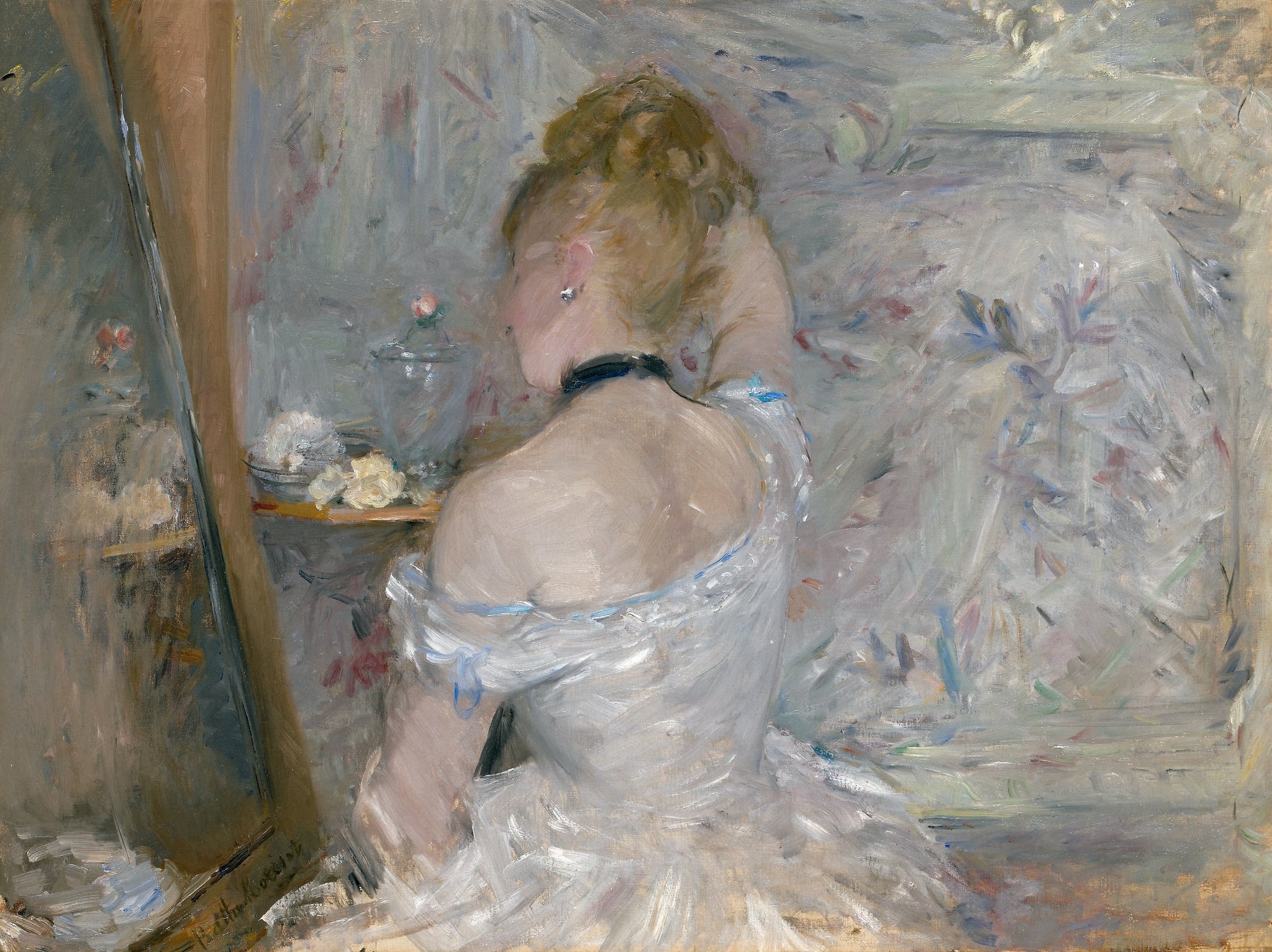
Woman at Her Toilette stages a private ritual of self-fashioning, not a spectacle of vanity. A woman, seen from behind, lifts her arm to adjust her hair as a <strong>black velvet choker</strong> punctuates Morisot’s silvery-violet haze; the <strong>mirror’s blurred reflection</strong> with powders, jars, and a white flower refuses a clear face. Morisot’s <strong>feathery facture</strong> turns a fleeting toilette into modern subjectivity made visible <sup>[1]</sup>.
Woman with a Parasol
Claude Monet (1875)
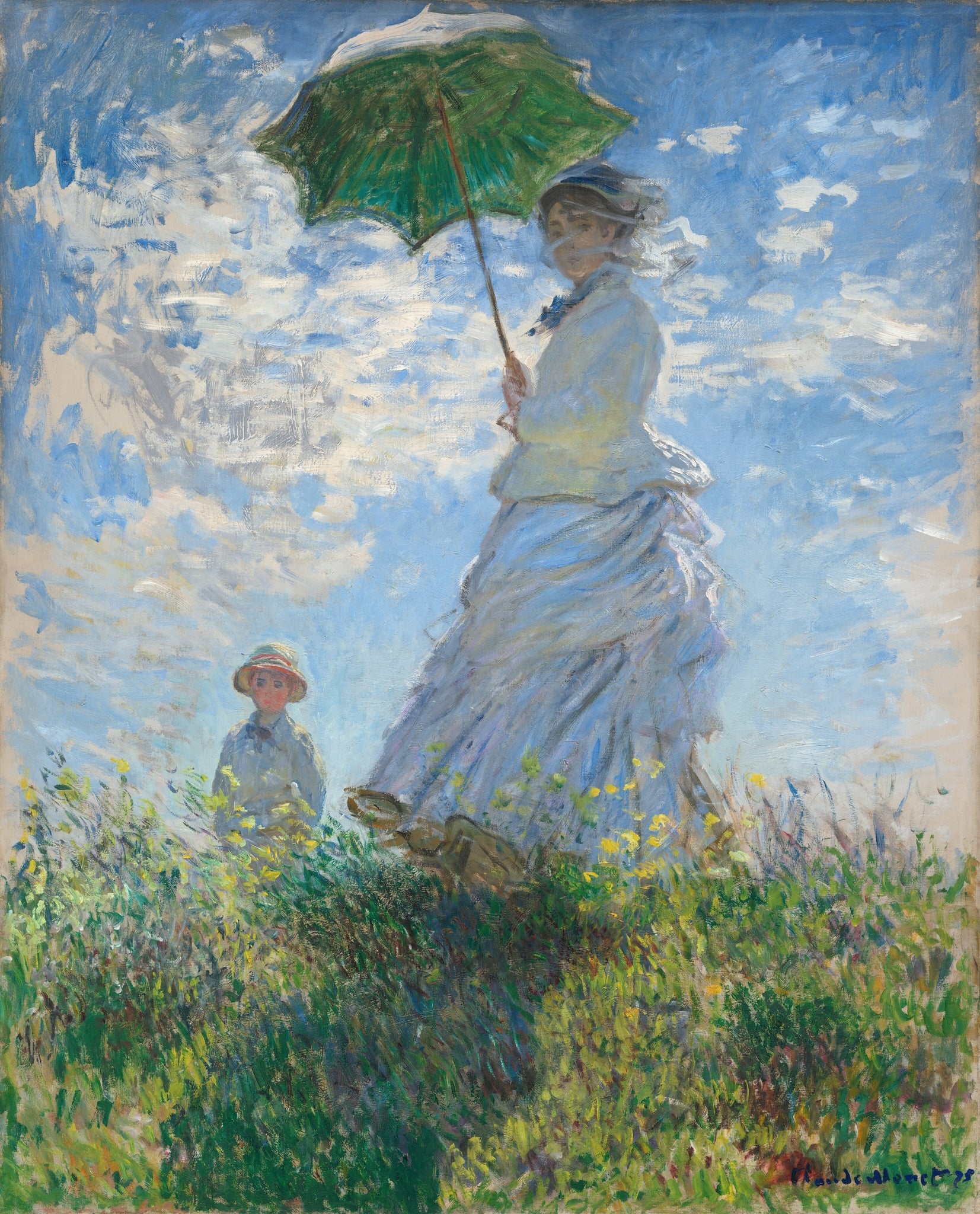
Claude Monet’s Woman with a Parasol fixes a breezy hillside instant in high, shifting light, setting a figure beneath a <strong>green parasol</strong> against a vast, vibrating sky. The low vantage and <strong>broken brushwork</strong> merge dress, clouds, and grasses into one atmosphere, while a child at the rise anchors depth and intimacy <sup>[1]</sup>. It is a manifesto of <strong>plein-air</strong> perception—painting the sensation of air in motion rather than the contours of things <sup>[2]</sup>.
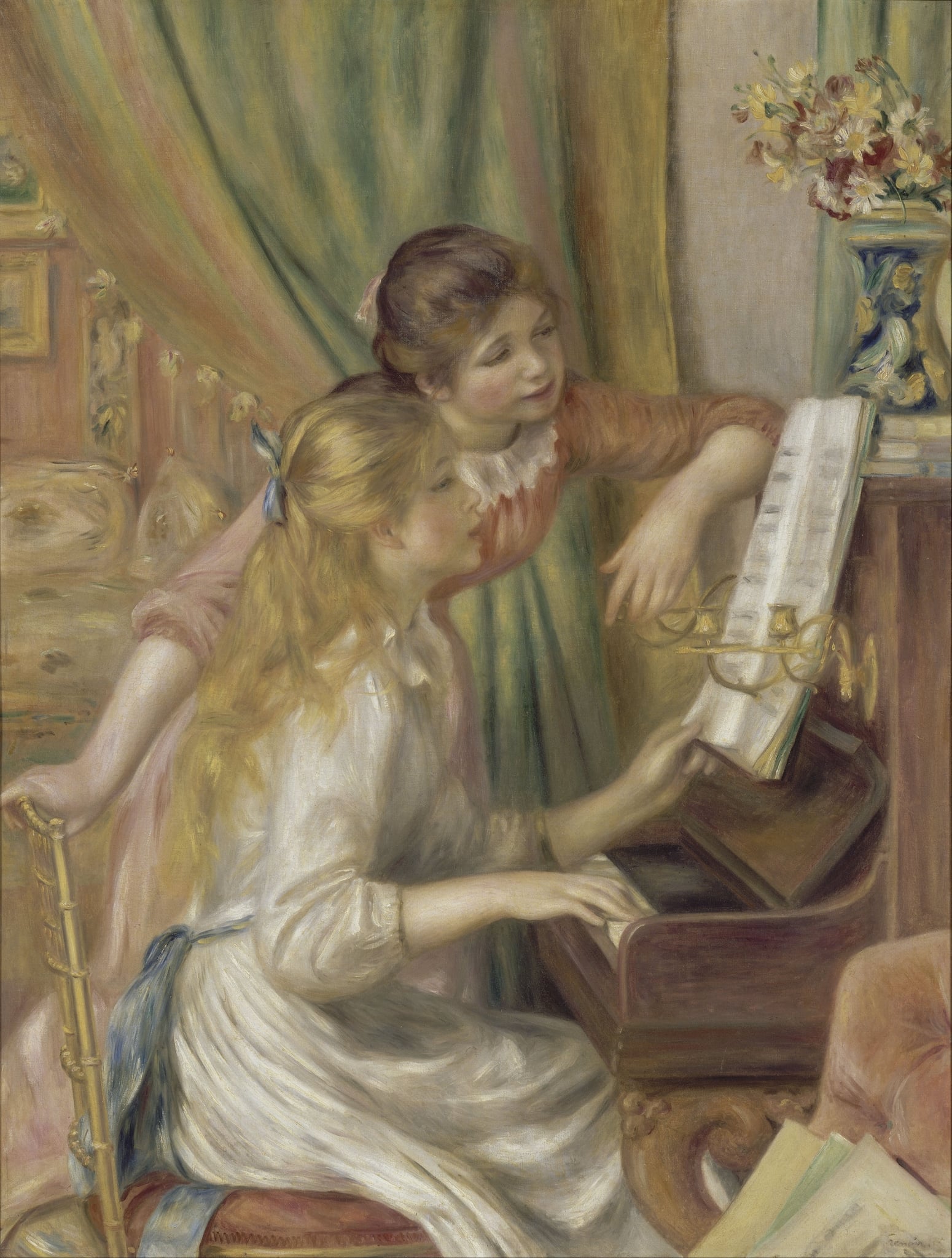
Young Girls at the Piano
Pierre-Auguste Renoir (1892)
Renoir’s Young Girls at the Piano turns a quiet lesson into a scene of <strong>attunement</strong> and <strong>bourgeois grace</strong>. Two adolescents—one seated at the keys, the other leaning to guide the score—embody harmony between discipline and delight, rendered in Renoir’s late, <strong>luminous</strong> touch <sup>[1]</sup><sup>[2]</sup>.
Related Themes
Related Symbolism Categories
Fashion
In Impressionist and related modern painting, fashion functions as a coded system of class, gender, and spectatorship, translating older allegorical and mythic meanings into the language of couture, accessories, and regulated bodily comportment.
Objects
Object symbols in modern and early modern painting transform everyday things—vessels, tools, clocks, mirrors, and branded goods—into compact arguments about labor, desire, time, and spectatorship, updating long iconographic traditions for a modern economy of signs.
Interiority
“Interiority” symbols in modern painting transform gesture, gaze, and domestic props into visual indices of inward life, staging psychological depth, self-consciousness, and mediated subjectivity within scenes of everyday modernity.
Within Western art history, the symbolism of femininity has long oscillated between idealization and regulation: allegorical figures, Madonnas, and odalisques codified gendered virtues while masking the social and economic realities of women’s lives. By the later nineteenth century, however, painters of modern life increasingly relocate femininity from timeless myth to the contingencies of dress, posture, and public space. In this context, accessories such as parasols, hats, gloves, and chokers, together with specific bodily attitudes and relationships—mother-and-child units, backward glances, women before mirrors—operate as a supple semiotic system. They do not merely decorate a pre‑given feminine essence; they actively construct, question, and sometimes fracture it.
Seen semiotically, these motifs function as signs whose meaning depends on context and combination. A white dress, for instance, can signify purity and radiant leisure while simultaneously acting as an Impressionist “screen” for light and atmosphere, as in Pierre‑Auguste Renoir’s Madame Monet and Her Son (1874). There, the woman’s luminous gown gathers blues, violets, and greens, translating bourgeois domestic femininity into a surface on which daylight itself is inscribed. The child’s pale‑blue sailor suit both echoes and interrupts this field: his diagonal body injects play and movement into the maternal mass, making femininity appear as a relational, caregiving role rather than a static emblem. The mother‑and‑child unit thus fuses a secular Madonna motif with up‑to‑date suburban leisure, anchoring feminine identity in continuity and nurture while situating it firmly in the present.
In Claude Monet’s Poppies (1873), the semiotics of femininity unfold across an open hillside rather than a garden enclosure. The woman with a parasol—here a blue parasol—is less an individualized subject than a mobile sign of bourgeois leisure, echoing across the slope as the mother‑and‑child pair is doubled. The parasol marks class position and gendered decorum, but chromatically it also tests color contrasts in outdoor light: its cool blue punctuates and balances the scarlet rhythm of poppies, turning feminine fashion into an optical instrument. The white dress catching color in this field again becomes a receptive membrane, a site where the environment imprints itself. Monet’s repeated figures convert femininity into a temporal pattern—passing, recurring, but never entirely fixed.
For Berthe Morisot, by contrast, femininity often appears at the threshold of self-fashioning, caught between public decorum and private reflection. In Summer’s Day (c. 1879), two women in a boat occupy a shared yet self-contained space. Their fashionable hats, gloves, and the vivid blue parasol unmistakably signal bourgeois status and propriety in a public park, yet Morisot’s quick, zig‑zag facture fuses their dresses with the lake’s shimmer. The parasol, bridging their laps, is both social marker and chromatic hinge: a concentrated node where cool blues, lilacs, and whites collide. Symbolically, the women’s closed postures and averted or soft gazes resist easy legibility; femininity here is companionship and introspection under the cover of respectability, not mere spectacle for others. The boat’s compressed space stages a subtle negotiation between visibility and privacy that recurs, in another key, in Morisot’s Woman at Her Toilette, where a black velvet choker becomes the crispest sign of modern self-definition amid atmospheric blur.
Édouard Manet radicalizes this shift from timeless type to historically specific persona by recoding feminine adornment as the visible infrastructure of modern desire and exchange. In Olympia (1863), the nude’s black ribbon choker, orchid in her hair, and pearls and earrings repudiate the fiction of an innocent, ahistorical Venus. The choker, a purchasable luxury, marks contemporary sexuality rather than mythic beauty; the orchid and jewels function as tokens in a marketplace of desire. Semiologically, these are not neutral ornaments but indices of a transactional economy: they link Olympia’s guarded, frontal nudity to price and choice. Her direct gaze collapses the distance between viewer and model, compelling recognition that “femininity” here is coextensive with labor and negotiation. The Black maid Laure, bearing a life‑cycle bouquet of roses, mediates this economy, her presence insistently binding race, service, and modern Parisian domesticity into the scene.
This transactional logic reaches its most crystalline formulation in A Bar at the Folies‑Bergère (1882), where Suzon, the barmaid, becomes “the human face of urban commerce—both salesperson and potential commodity.” Her direct, gentle gaze confronts us across a marble counter studded with branded bottles and a heap of oranges, while the disjunctive mirror stages spectatorship as an unstable, gendered exchange. Femininity here is professionalized; it is the interface through which commodities, alcohol, and pleasure are sold, and it is simultaneously on offer. The black choker and dark jacket anchor her as a modern, grounded presence, a kind of visual counterweight to the shimmering lights and blurred crowd. If Olympia asserted control through refusal and frontal nudity, Suzon’s femininity is coded by uniform and labor, her individuality threatened with dissolution into what the averted, shadowed faces behind her exemplify: anonymity and typified work.
Not all modern feminine symbolism is urban or overtly transactional. In Manet’s Jeanne (Spring) (1881), couture becomes the primary vehicle of allegory. The floral‑trimmed bonnet, long glove, and cream parasol assemble an allegory of Spring without recourse to nymphs or pastoral nudity. Jeanne’s profile is cut cleanly against a dense screen of foliage, so that femininity here is a carefully constructed silhouette—an idealized yet unmistakably contemporary Parisienne. The bonnet’s blossoms merge fashion with seasonal bloom, while the glove and parasol orchestrate a chain of ochres that harmonize with the greens behind her. If Olympia and Suzon expose the commodification underpinning feminine display, Jeanne demonstrates how that same fashion vocabulary could be re‑mythologized, re‑elevated into a secular, stylish allegory of renewal.
Across these works, a network of recurrent symbols binds together distinct articulations of femininity. White dresses, parasols, hats with floral trims, chokers, and gloves are all portable signs whose meanings shift with pose, gaze, and setting. A mother‑and‑child unit on a garden lawn, a woman with a parasol on a hillside, and a barmaid framed by bottles share a common visual lexicon yet deploy it to strikingly different ends: maternal continuity, leisurely passage, and commodified presence. The move from allegorical, timeless figures to situated individuals—modern mothers, barmaids, tourists, performers—reinscribes femininity as something negotiated in specific spaces of work and leisure. Semiotic density increases as the same accessory (for example, a glove) can indicate propriety and sanctioned touch in Renoir’s social scenes, economic capacity and class in Manet and Morisot, or even, by its absence, the rawness of unfiltered labor.
Historically, the trajectory traced by these symbols charts a broader transformation. Earlier iconography anchored femininity in fixed virtues—chastity, fertility, charity—signaled by relatively stable attributes. By the mid‑ to late nineteenth century, however, artists such as Manet, Monet, Morisot, and Renoir appropriate and fragment that inherited vocabulary. The rose and the life‑cycle bouquet move from Marian or allegorical frames into interiors of paid love or middle‑class gardens; the veil and parasol shift from sacred or courtly spheres to department stores and suburban promenades. In the process, femininity ceases to be a singular, ideal image and becomes a field of competing signs—of labor and leisure, autonomy and objectification, intimacy and spectacle—through which modernity itself is staged and contested.