Objects
Object symbols in modern and early modern painting transform everyday things—vessels, tools, clocks, mirrors, and branded goods—into compact arguments about labor, desire, time, and spectatorship, updating long iconographic traditions for a modern economy of signs.
Member Symbols
Featured Artworks
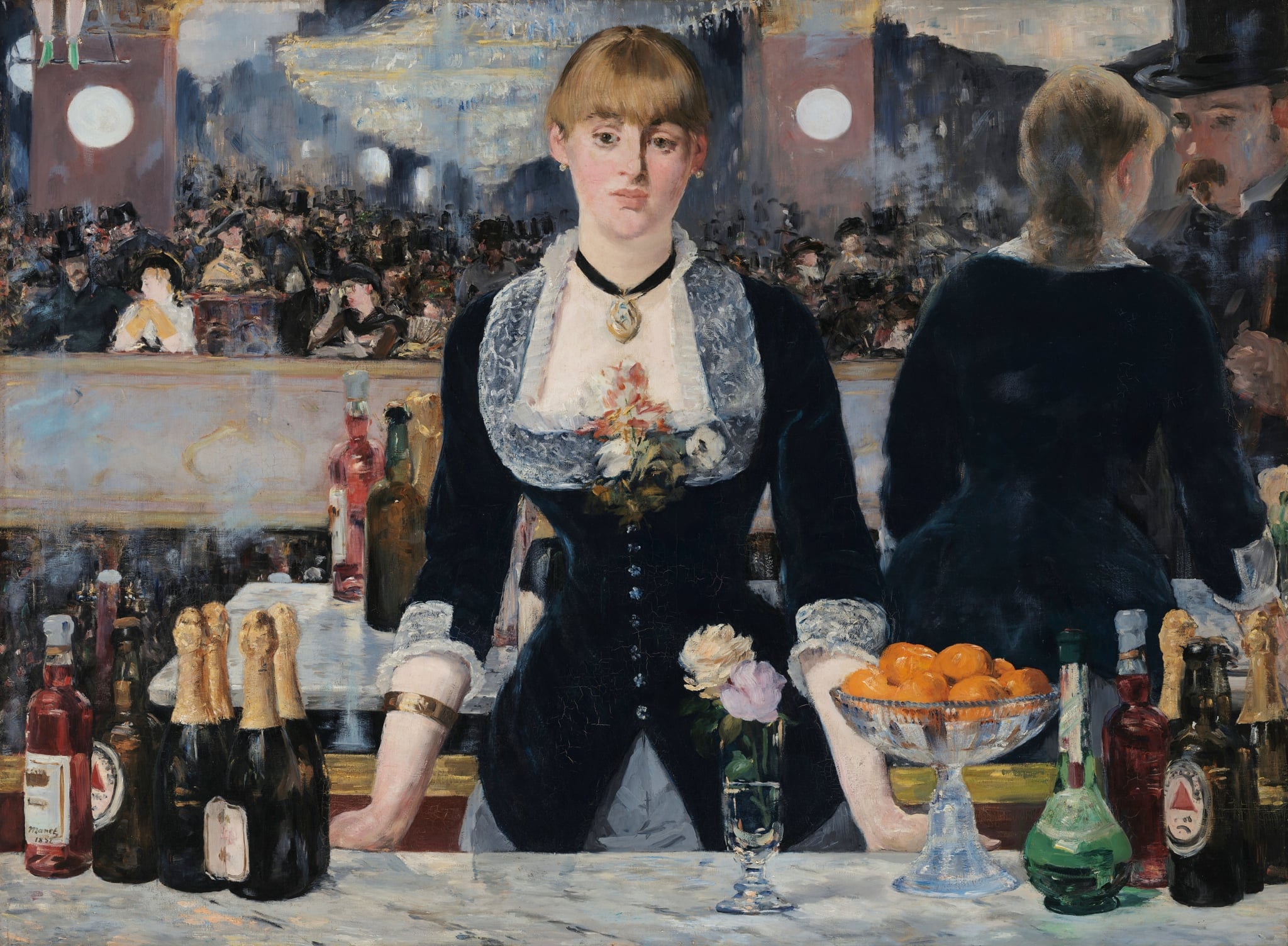
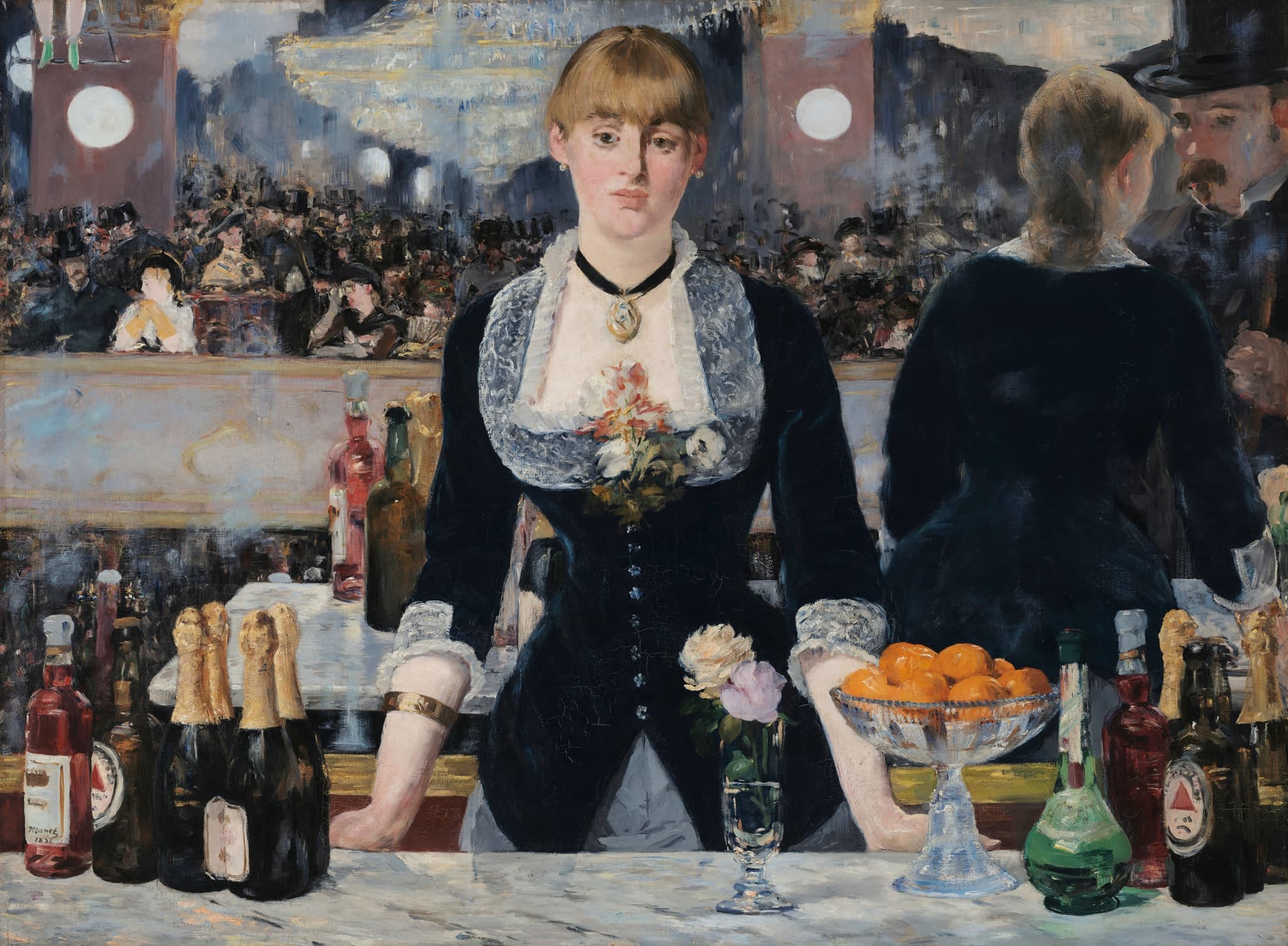
A Bar at the Folies-Bergère
Édouard Manet (1882)
Édouard Manet’s A Bar at the Folies-Bergère stages a face-to-face encounter with modern Paris, where <strong>commerce</strong>, <strong>spectacle</strong>, and <strong>alienation</strong> converge. A composed barmaid fronts a marble counter loaded with branded bottles, flowers, and a brimming bowl of oranges, while a disjunctive <strong>mirror</strong> unravels stable viewing and certainty <sup>[1]</sup><sup>[2]</sup>.
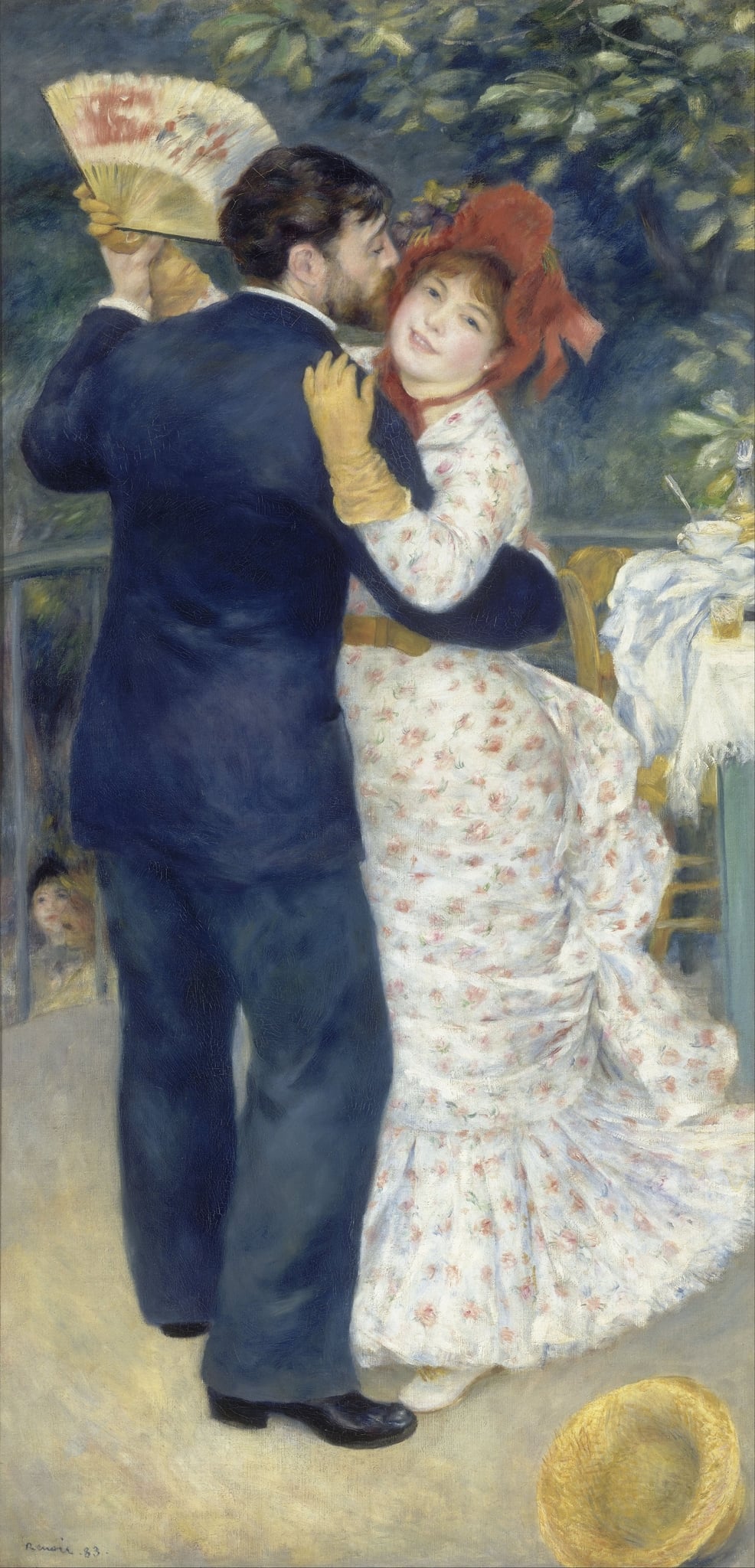
Dance in the Country
Pierre-Auguste Renoir (1883)
Dance in the Country shows a couple swept into a close embrace on a café terrace, their bodies turning in a soft spiral as foliage and sunlight dissolve into <strong>dappled color</strong>. Renoir orchestrates <strong>bourgeois leisure</strong>—the tossed straw boater, a small table with glass and napkin, the woman’s floral dress and red bonnet—to stage a moment where decorum and desire meet. The result is a modern emblem of shared pleasure, poised between Impressionist shimmer and a newly <strong>firm, linear touch</strong>.
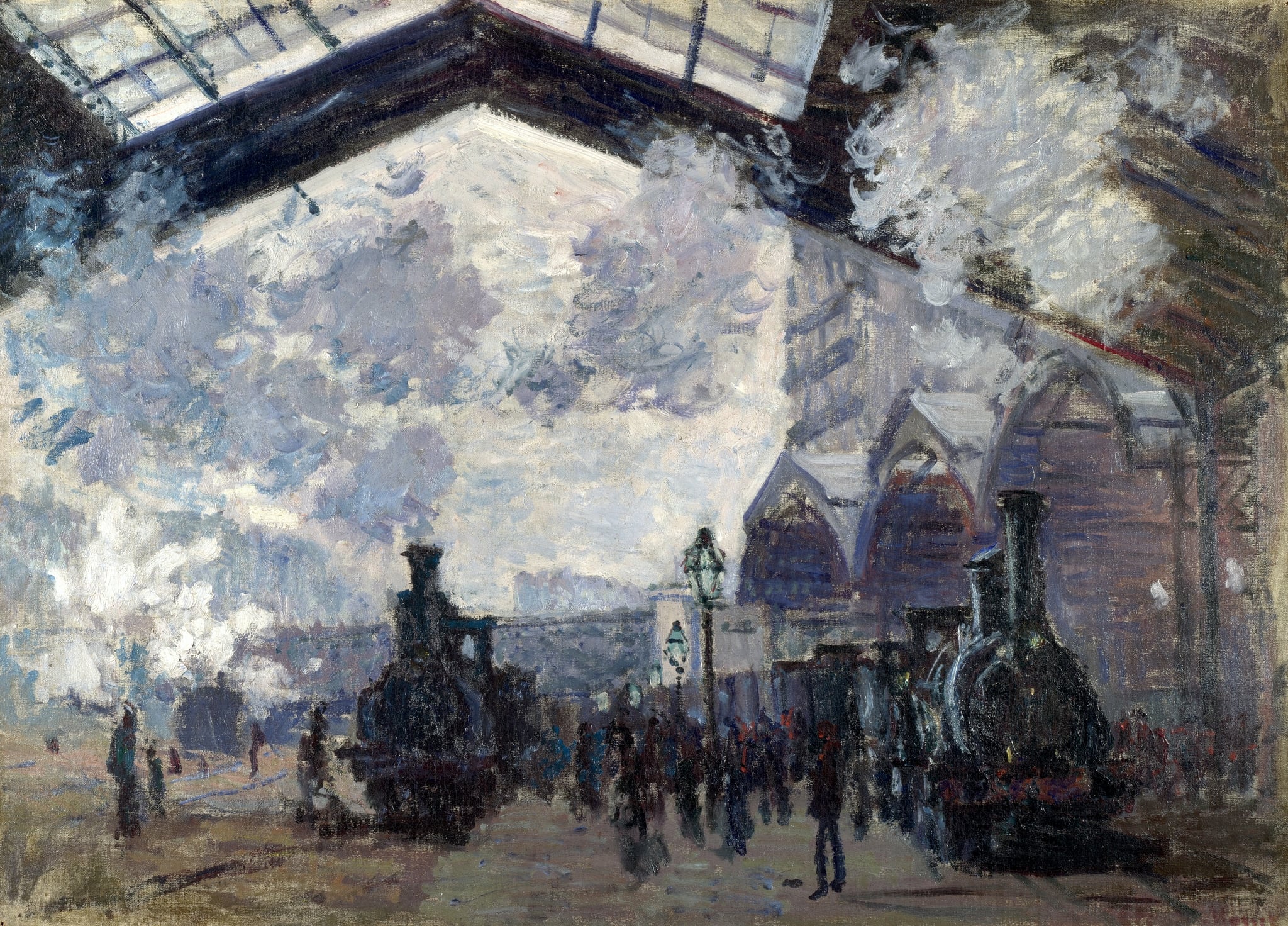
Gare Saint-Lazare
Claude Monet (1877)
Monet’s Gare Saint-Lazare turns an iron-and-glass train shed into a theater of <strong>steam, light, and motion</strong>. Twin locomotives, gas lamps, and a surge of figures dissolve into bluish vapor under the diagonal canopy, recasting industrial smoke as <strong>luminous atmosphere</strong> <sup>[1]</sup><sup>[2]</sup>.
In the Garden
Pierre-Auguste Renoir (1885)
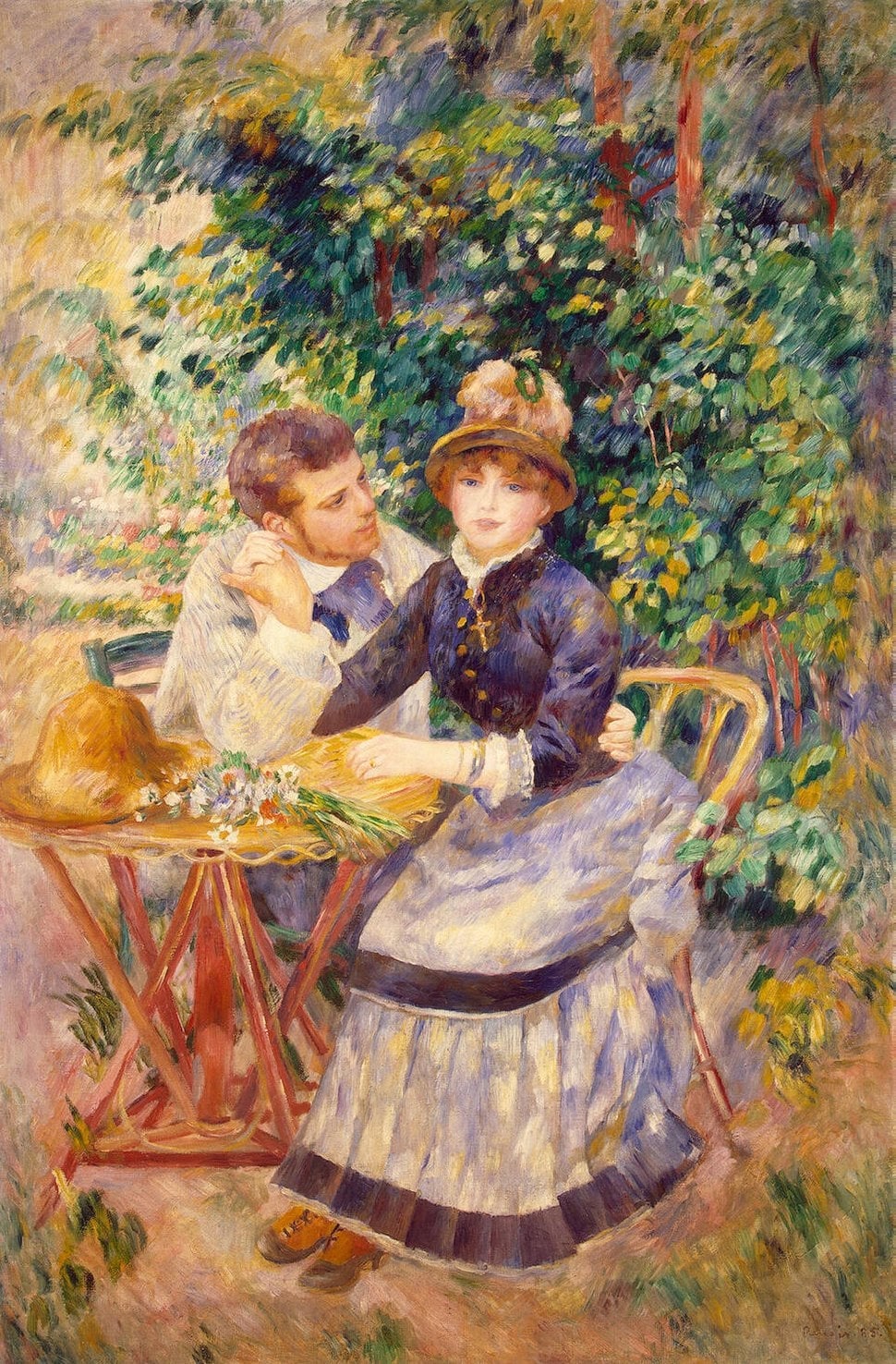
In the Garden presents a charged pause in modern leisure: a young couple at a café table under a living arbor of leaves. Their lightly clasped hands and the bouquet on the tabletop signal courtship, while her calm, front-facing gaze checks his lean. Renoir’s flickering brushwork fuses figures and foliage, rendering love as a <strong>transitory, luminous sensation</strong> <sup>[1]</sup><sup>[3]</sup>.
Olympia
Édouard Manet (1863 (Salon 1865))
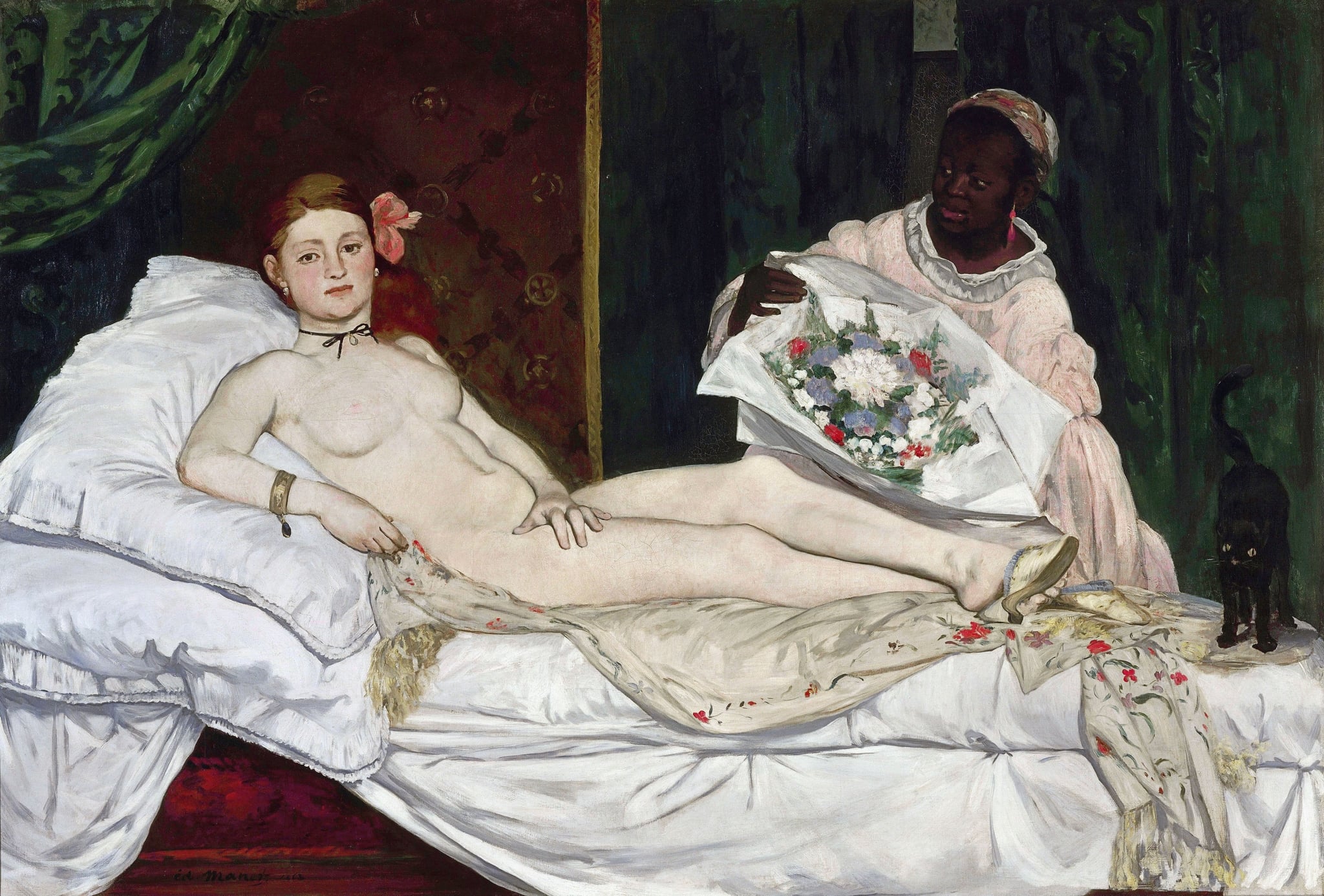
A defiantly contemporary nude confronts the viewer with a steady gaze and a guarded pose, framed by crisp light and luxury trappings. In Olympia, <strong>Édouard Manet</strong> strips myth from the female nude to expose the <strong>modern economy of desire</strong>, power, and looking <sup>[1]</sup><sup>[3]</sup>.
Portrait of Léonie Rose Charbuy-Davy
Vincent van Gogh (1887)
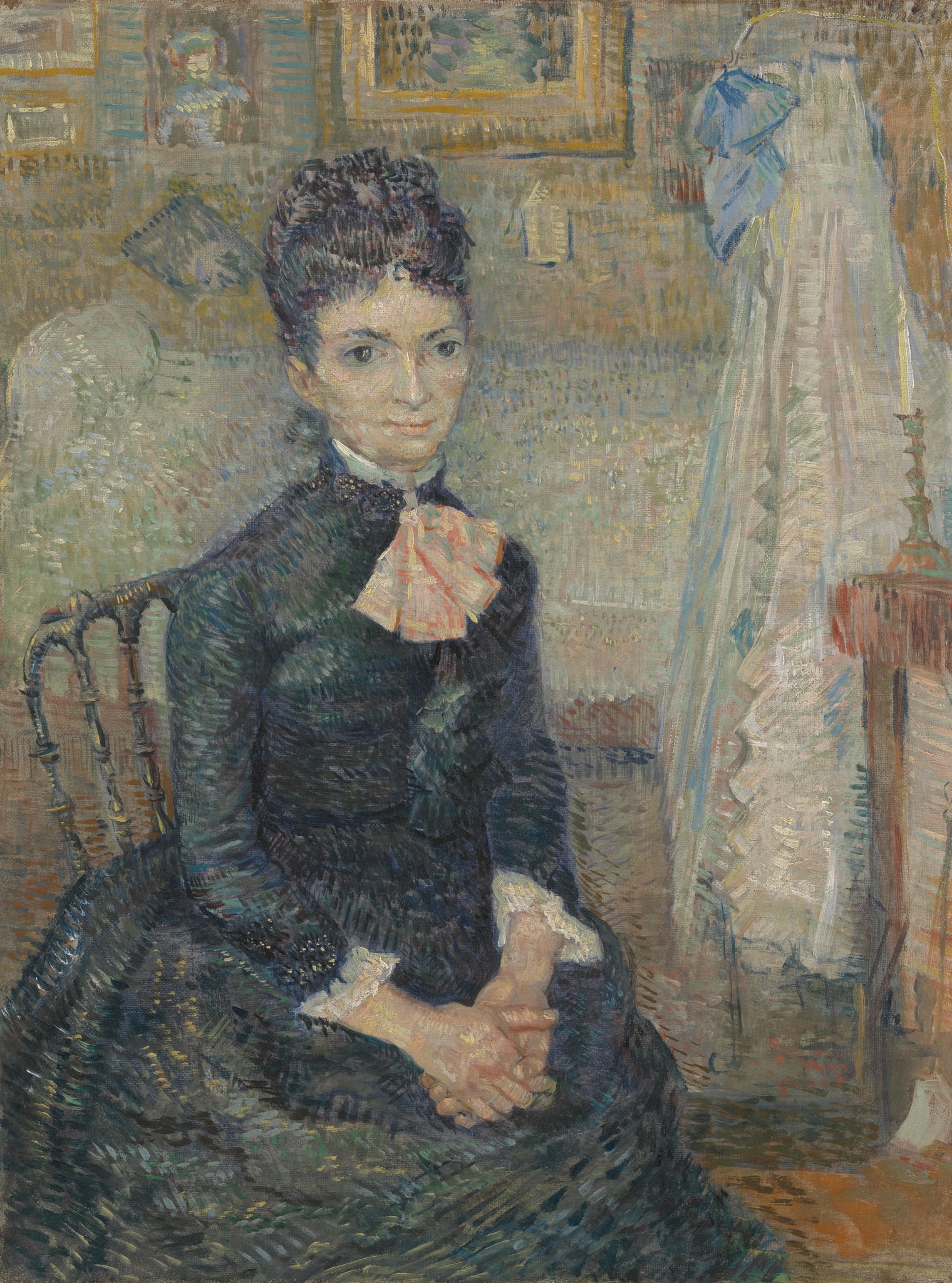
Vincent van Gogh’s Portrait of Léonie Rose Charbuy-Davy stages a composed, middle-class interior where a seated woman’s folded hands and dark blue-green dress meet a tremulous field of short, vibrating strokes. The cradle, fireplace glow, and dotted facture refract her poised exterior through <strong>modern, experimental color and touch</strong> <sup>[1]</sup><sup>[3]</sup>. The result is a portrait of <strong>maternal identity</strong> as much as a likeness, anchored by the hearth and cradle yet unsettled by the flicker of the paint itself <sup>[1]</sup>.
Summer's Day
Berthe Morisot (about 1879)
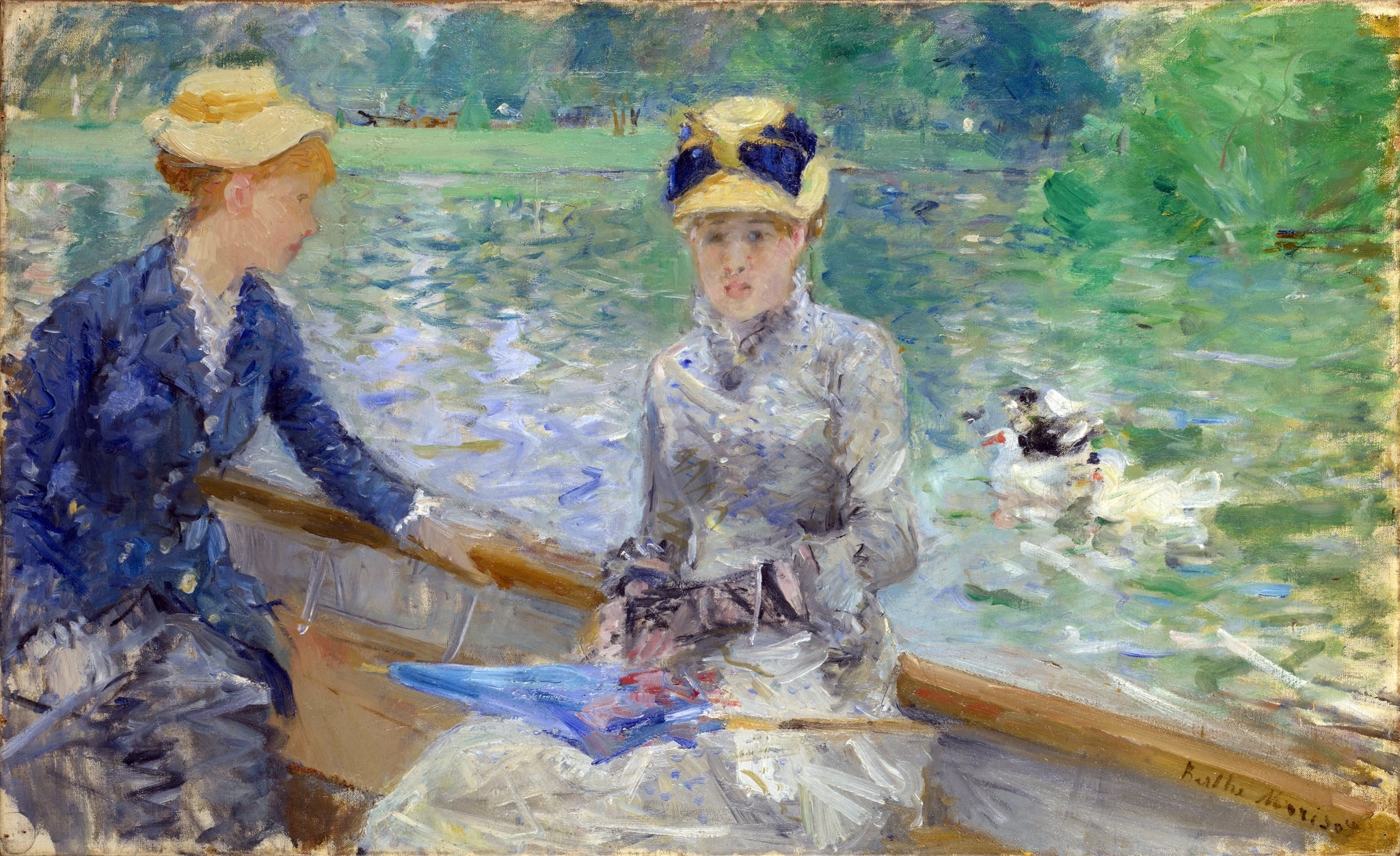
Two women drift on a boat in the Bois de Boulogne, their dresses, hats, and a bright blue parasol fused with the lake’s flicker by Morisot’s swift, <strong>zig‑zag brushwork</strong>. The scene turns a brief outing into a poised study of <strong>modern leisure</strong> and <strong>female companionship</strong> in public space <sup>[1]</sup>.
The Artist's Garden at Vétheuil
Claude Monet (1881)
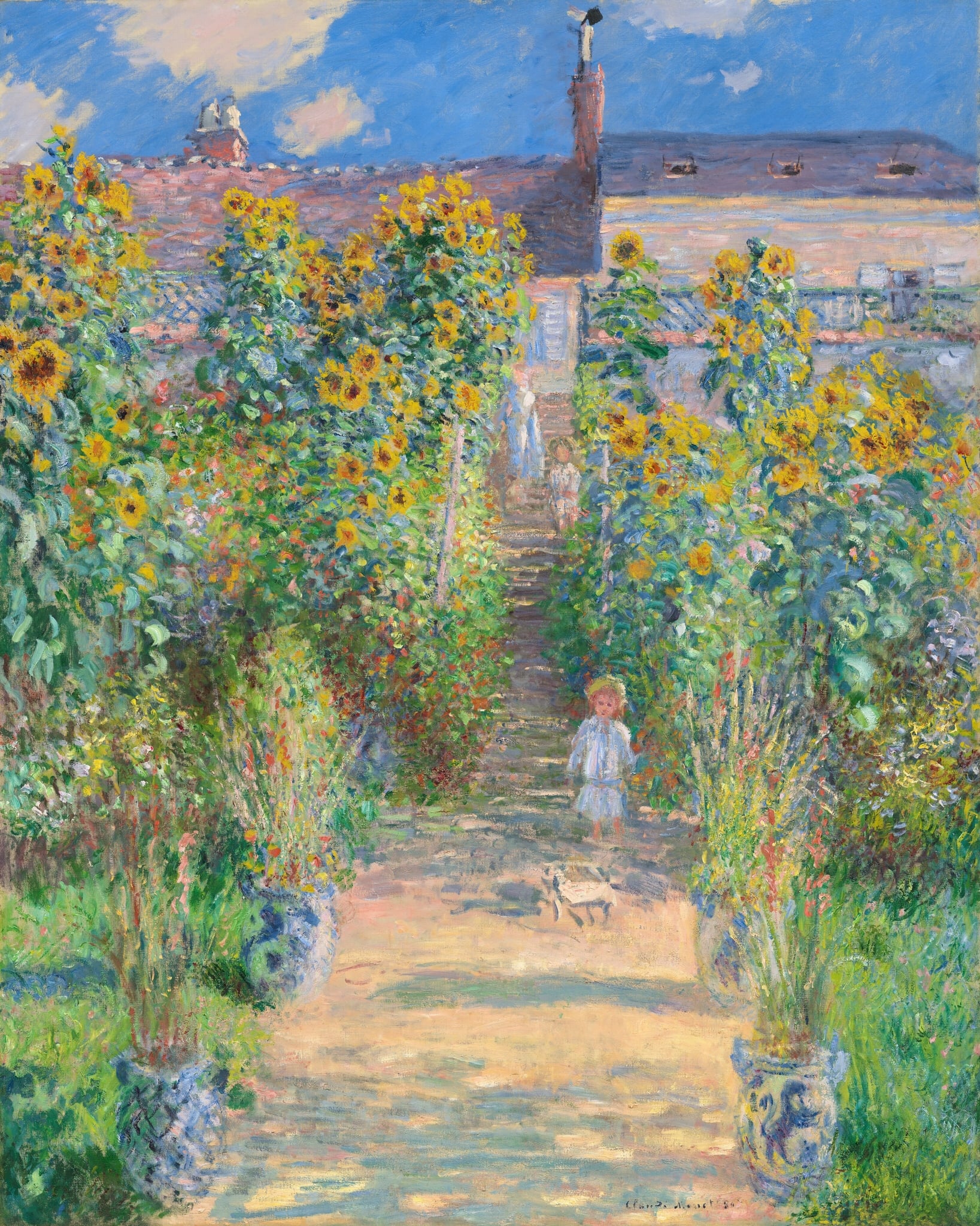
Claude Monet’s The Artist’s Garden at Vétheuil stages a sunlit ascent through a corridor of towering sunflowers toward a modest house, where everyday life meets cultivated nature. Quick, broken strokes make leaves and shadows tremble, asserting <strong>light</strong> and <strong>painterly surface</strong> over linear contour. Blue‑and‑white <strong>jardinieres</strong> anchor the foreground, while a child and dog briefly pause on the path, turning the garden into a <strong>domestic sanctuary</strong> <sup>[1]</sup><sup>[2]</sup>.
The Ballet Class
Edgar Degas (1873–1876)
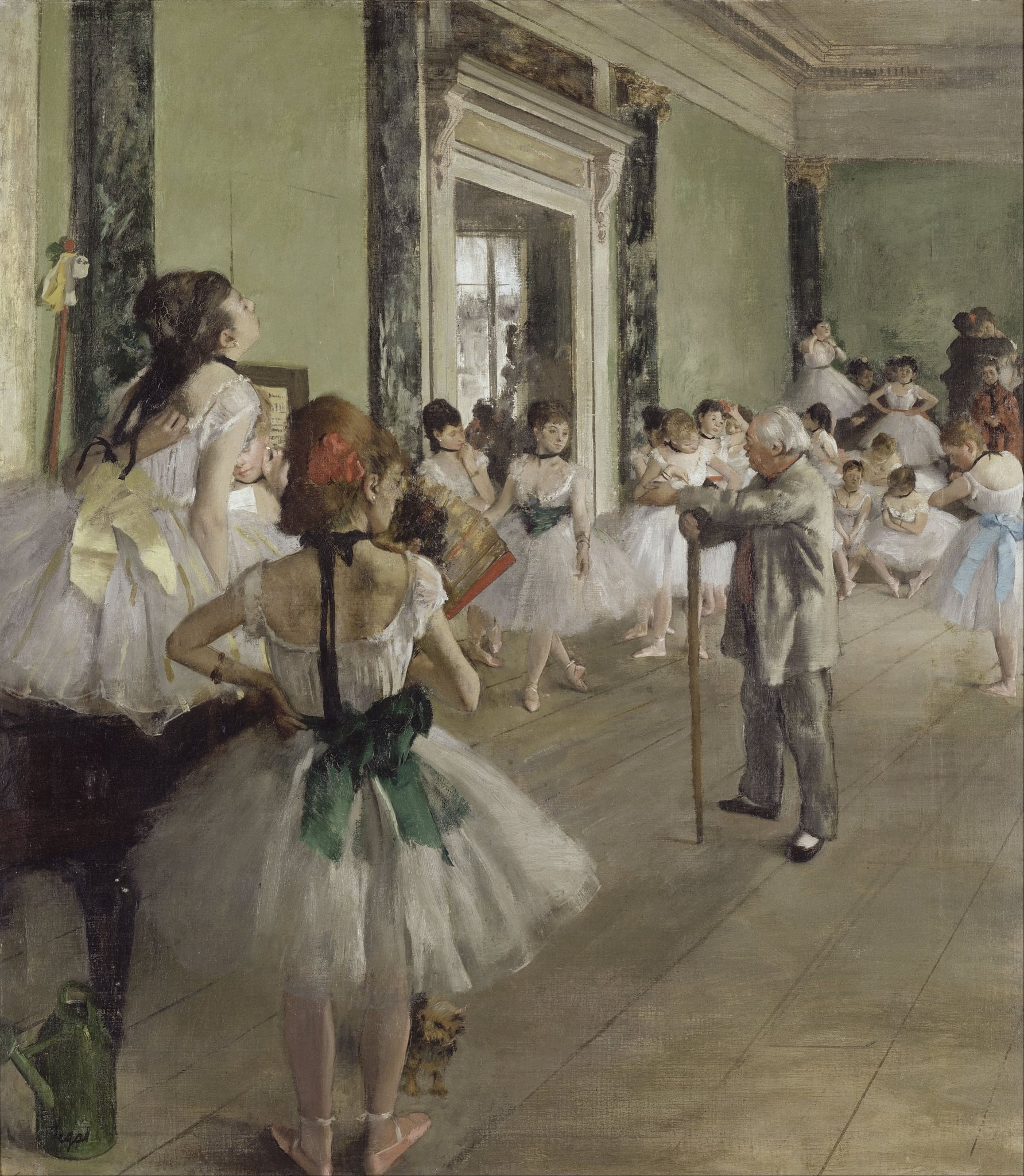
<strong>The Ballet Class</strong> shows the work behind grace: a green-walled studio where young dancers in white tutus rest, fidget, and stretch while the gray-suited master stands with his cane. Degas’s diagonal floorboards, cropped viewpoints, and scattered props—a watering can, a music stand, even a tiny dog—stage a candid vision of routine rather than spectacle. The result is a modern image of discipline, hierarchy, and fleeting poise.
The Bellelli Family
Edgar Degas (1858–1869)
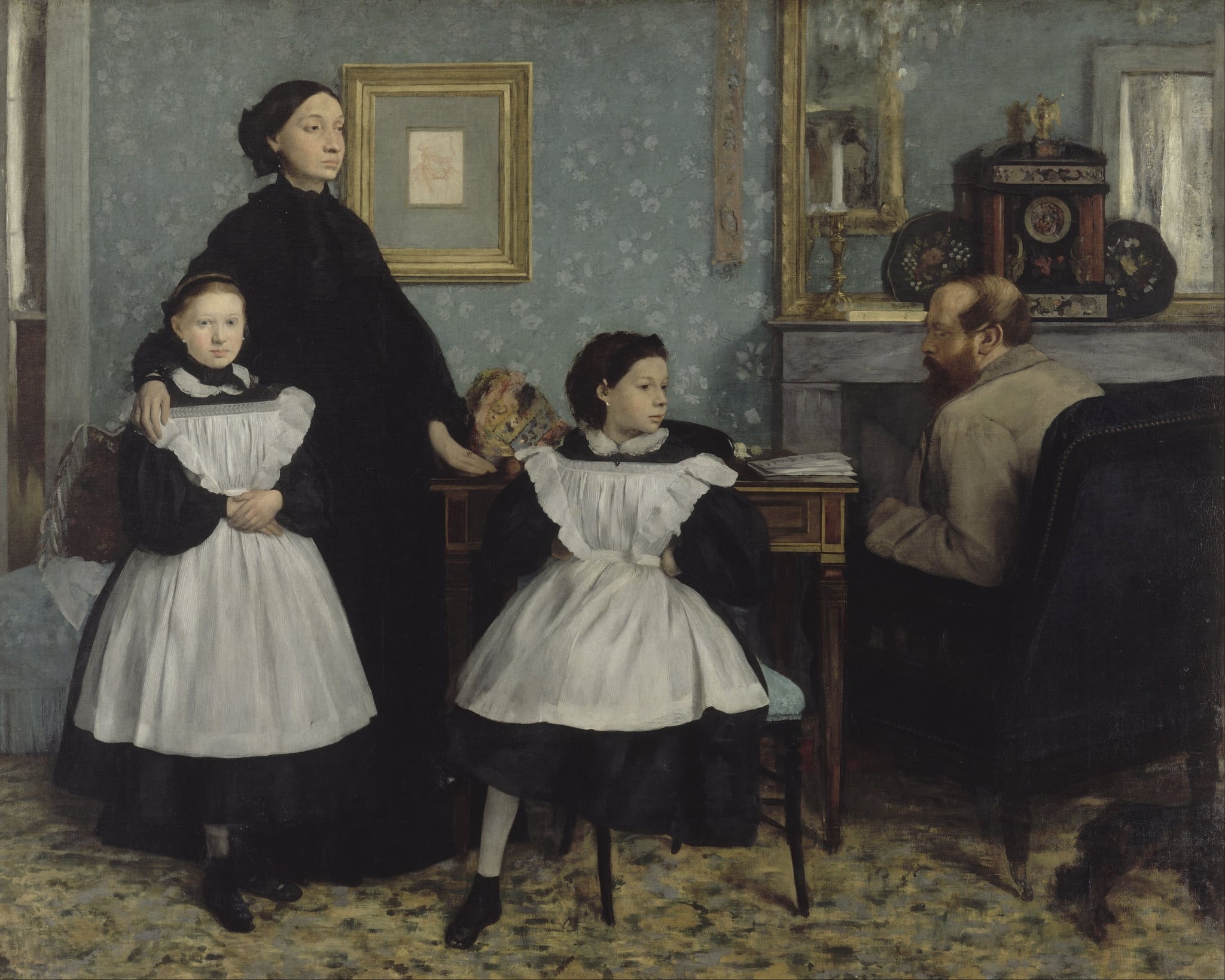
In The Bellelli Family, Edgar Degas orchestrates a poised domestic standoff, using the mother’s column of <strong>mourning black</strong>, the daughters’ <strong>mediating whiteness</strong>, and the father’s turned-away profile to script roles and distance. Rigid furniture lines, a gilt <strong>clock</strong>, and the ancestor’s red-chalk portrait create a stage where time, duty, and inheritance press on a family held in uneasy equilibrium.
The Card Players by Paul Cézanne | Equilibrium and Form
Paul Cézanne
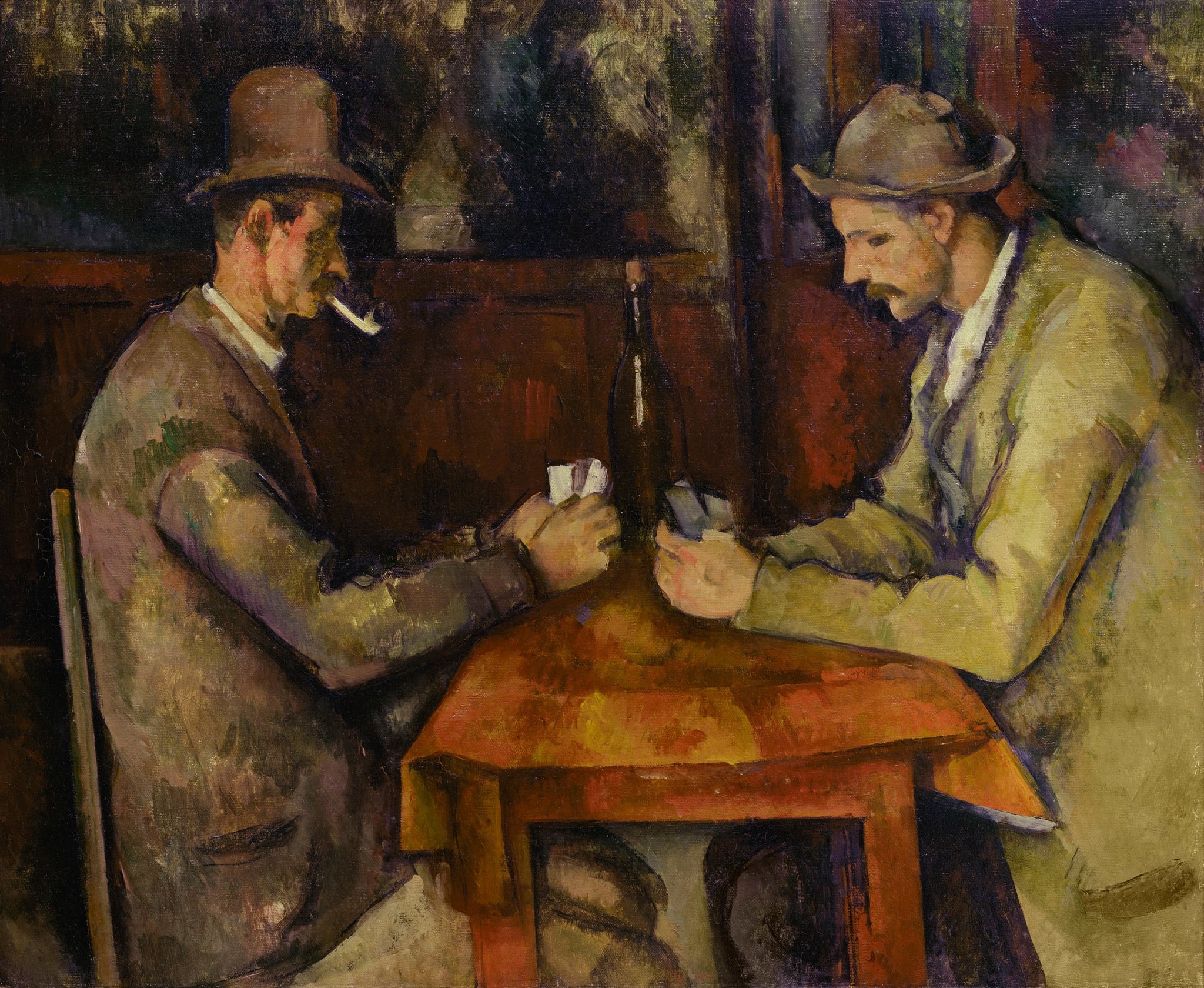
In The Card Players, Paul Cézanne turns a rural café game into a study of <strong>equilibrium</strong> and <strong>monumentality</strong>. Two hated peasants lean inward across an orange-brown table while a dark bottle stands upright between them, acting as a calm, vertical <strong>axis</strong> that stabilizes their mirrored focus <sup>[2]</sup><sup>[3]</sup>.
The Floor Scrapers
Gustave Caillebotte (1875)
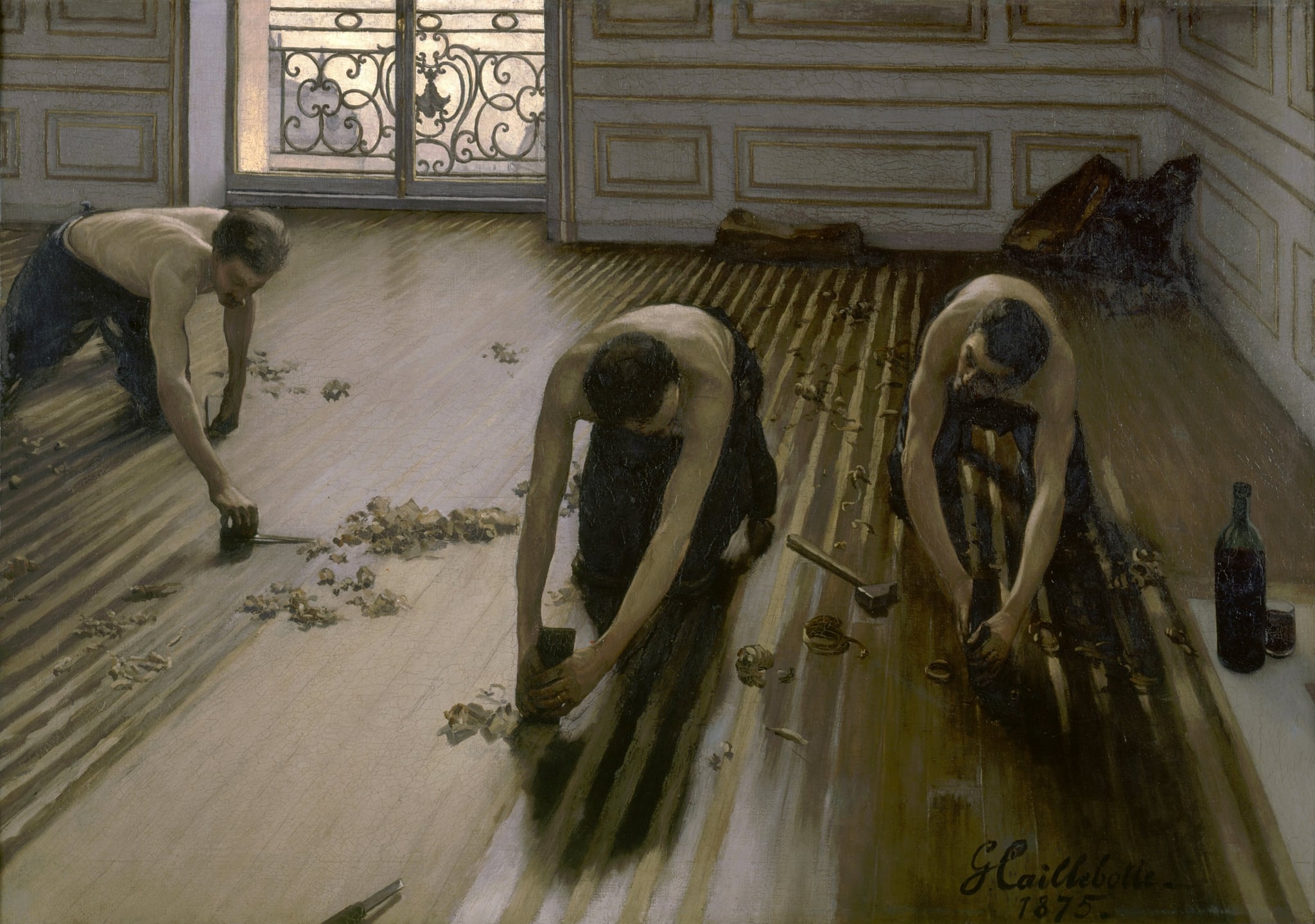
Gustave Caillebotte’s The Floor Scrapers stages three shirtless workers planing a parquet floor as shafts of light pour through an ornate balcony door. The painting fuses <strong>rigorous perspective</strong> with <strong>modern urban labor</strong>, turning curls of wood and raking light into a ledger of time and effort <sup>[1]</sup><sup>[3]</sup>. Its cool, gilded interior makes visible how bourgeois elegance is built on bodily work.
The Loge
Pierre-Auguste Renoir (1874)
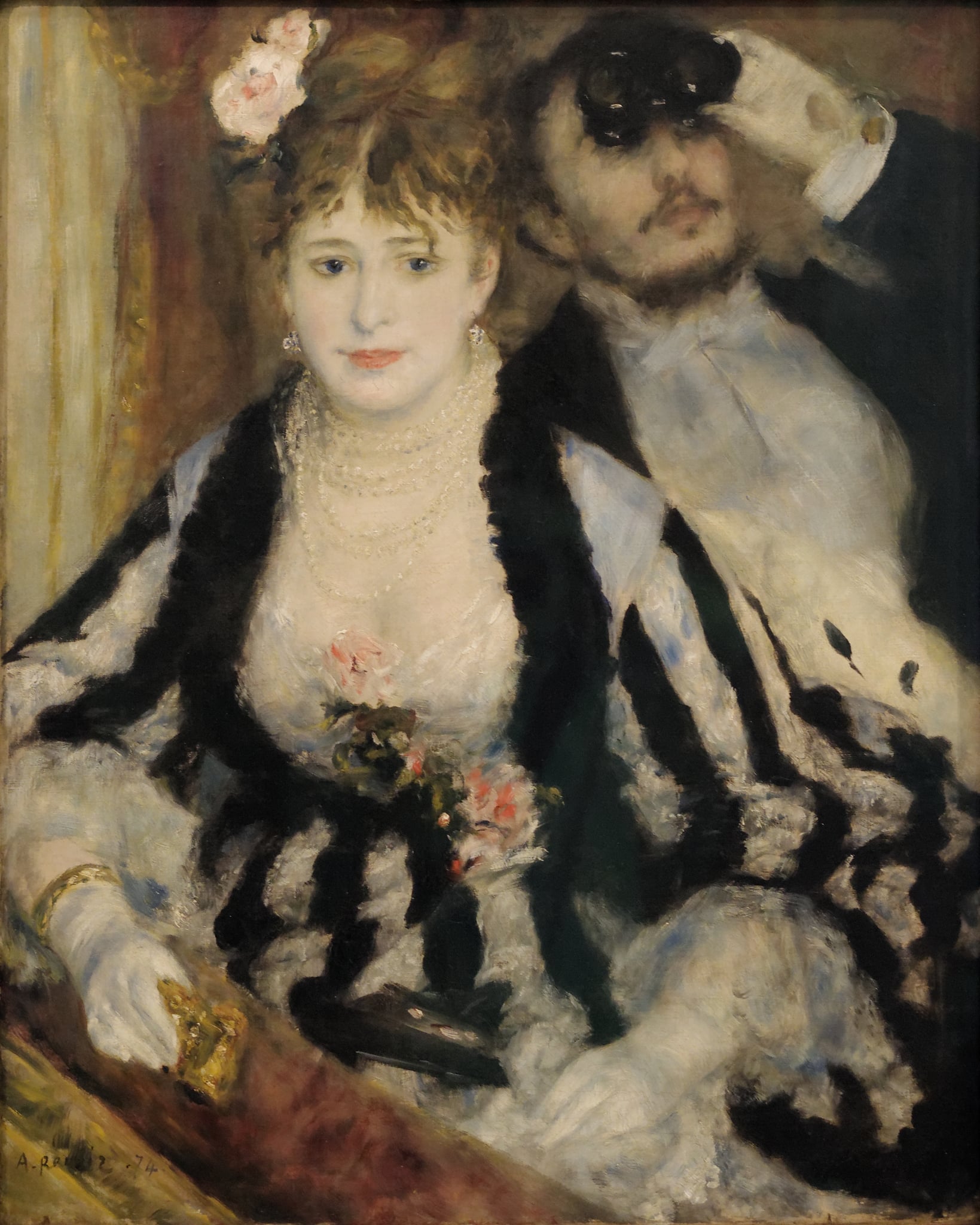
Renoir’s The Loge (1874) turns an opera box into a <strong>stage of looking</strong>, where a woman meets our gaze while her companion scans the crowd through binoculars. The painting’s <strong>frame-within-a-frame</strong> and glittering fashion make modern Parisian leisure both alluring and self-conscious, turning spectators into spectacles <sup>[1]</sup><sup>[2]</sup>.
The Opera Orchestra by Edgar Degas | Analysis
Edgar Degas
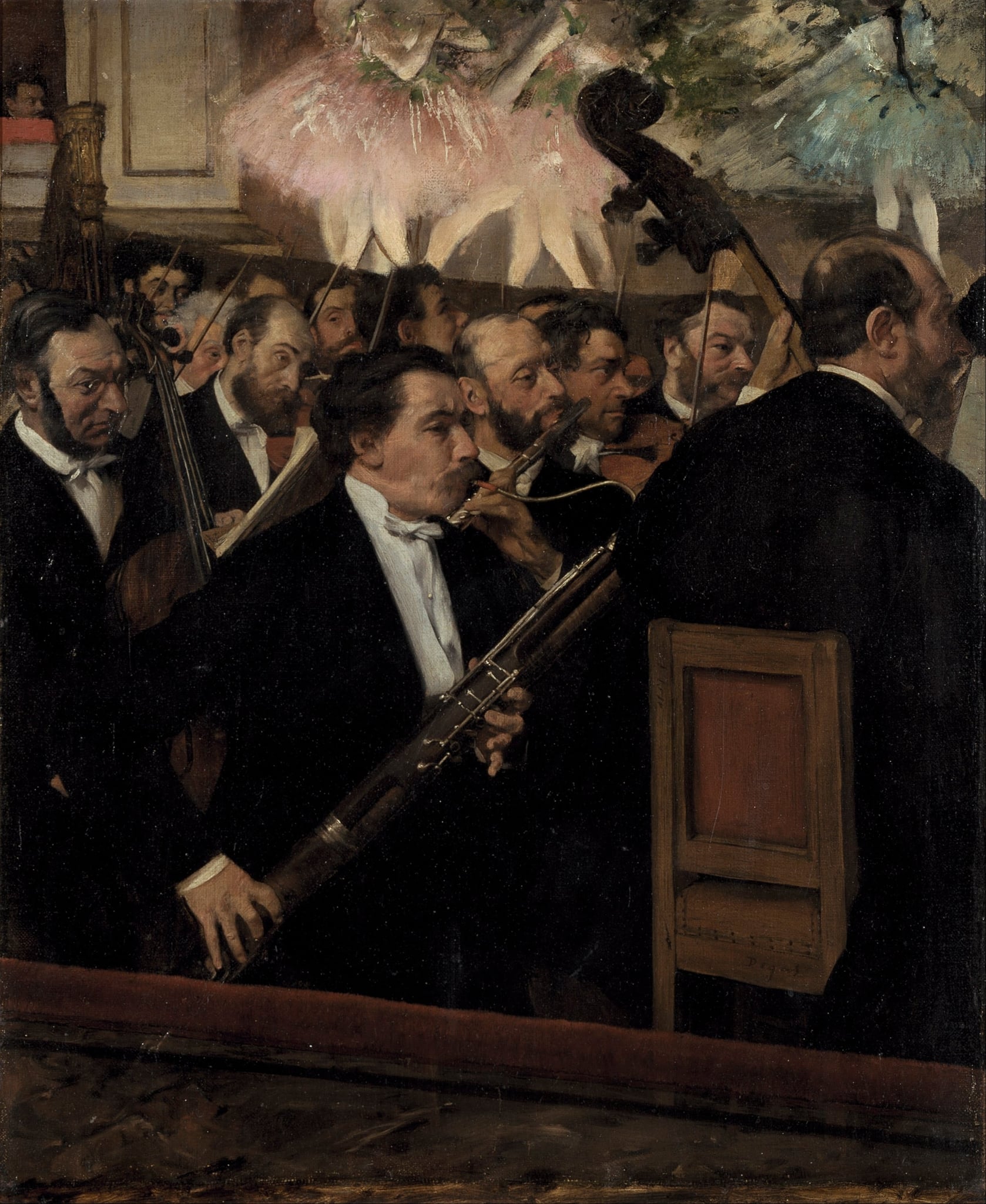
In The Opera Orchestra, Degas flips the theater’s hierarchy: the black-clad pit fills the frame while the ballerinas appear only as cropped tutus and legs, glittering above. The diagonal <strong>bassoon</strong> and looming <strong>double bass</strong> marshal a dense field of faces lit by footlights, turning backstage labor into the subject and spectacle into a fragment <sup>[1]</sup><sup>[2]</sup>.
The Rehearsal of the Ballet Onstage
Edgar Degas (ca. 1874)
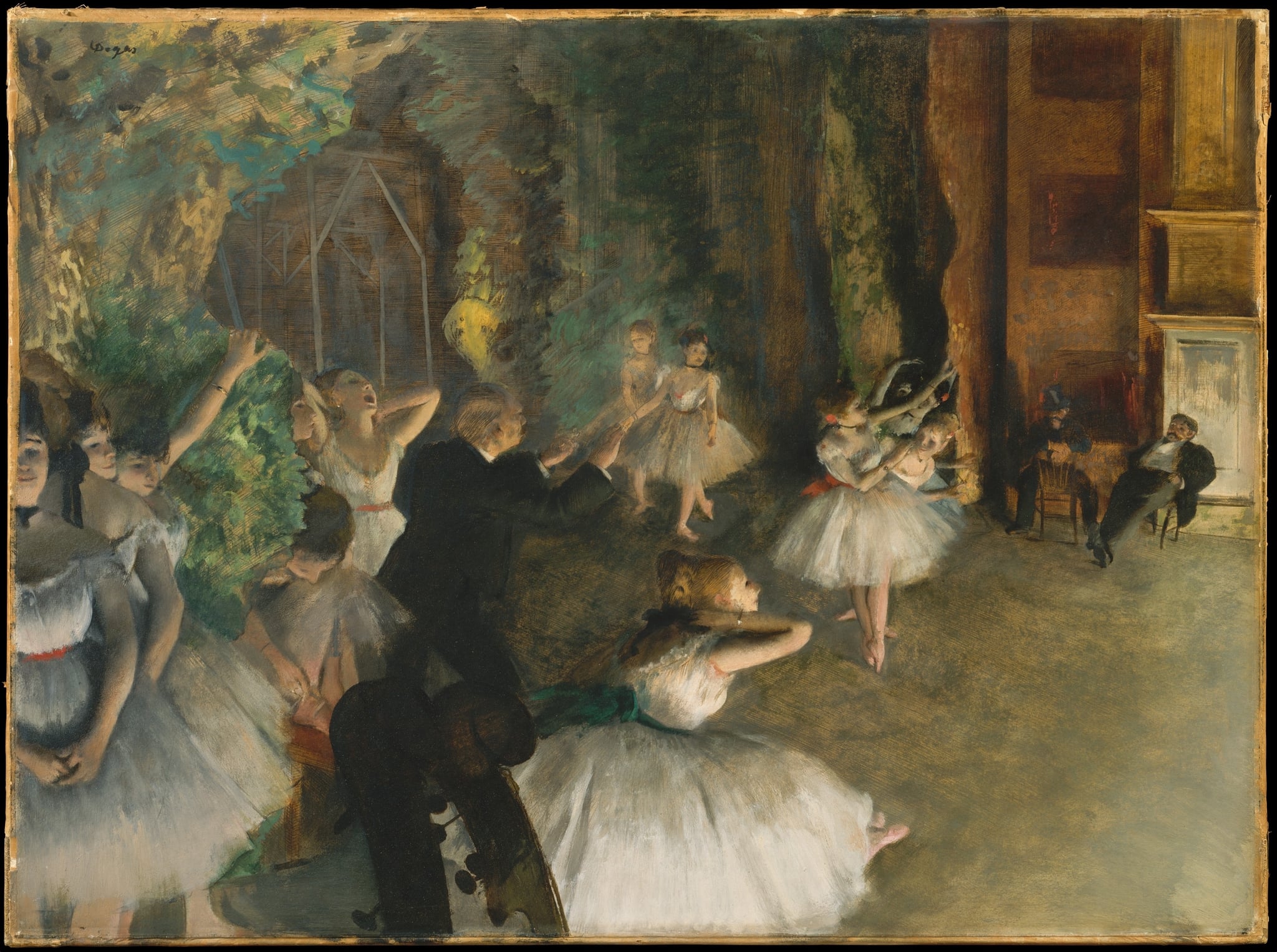
Degas’s The Rehearsal of the Ballet Onstage turns a moment of practice into a modern drama of work and power. Under <strong>harsh footlights</strong>, clustered ballerinas stretch, yawn, and repeat steps as a <strong>ballet master/conductor</strong> drives the tempo, while <strong>abonnés</strong> lounge in the wings and a looming <strong>double bass</strong> anchors the labor of music <sup>[1]</sup><sup>[3]</sup><sup>[4]</sup>.
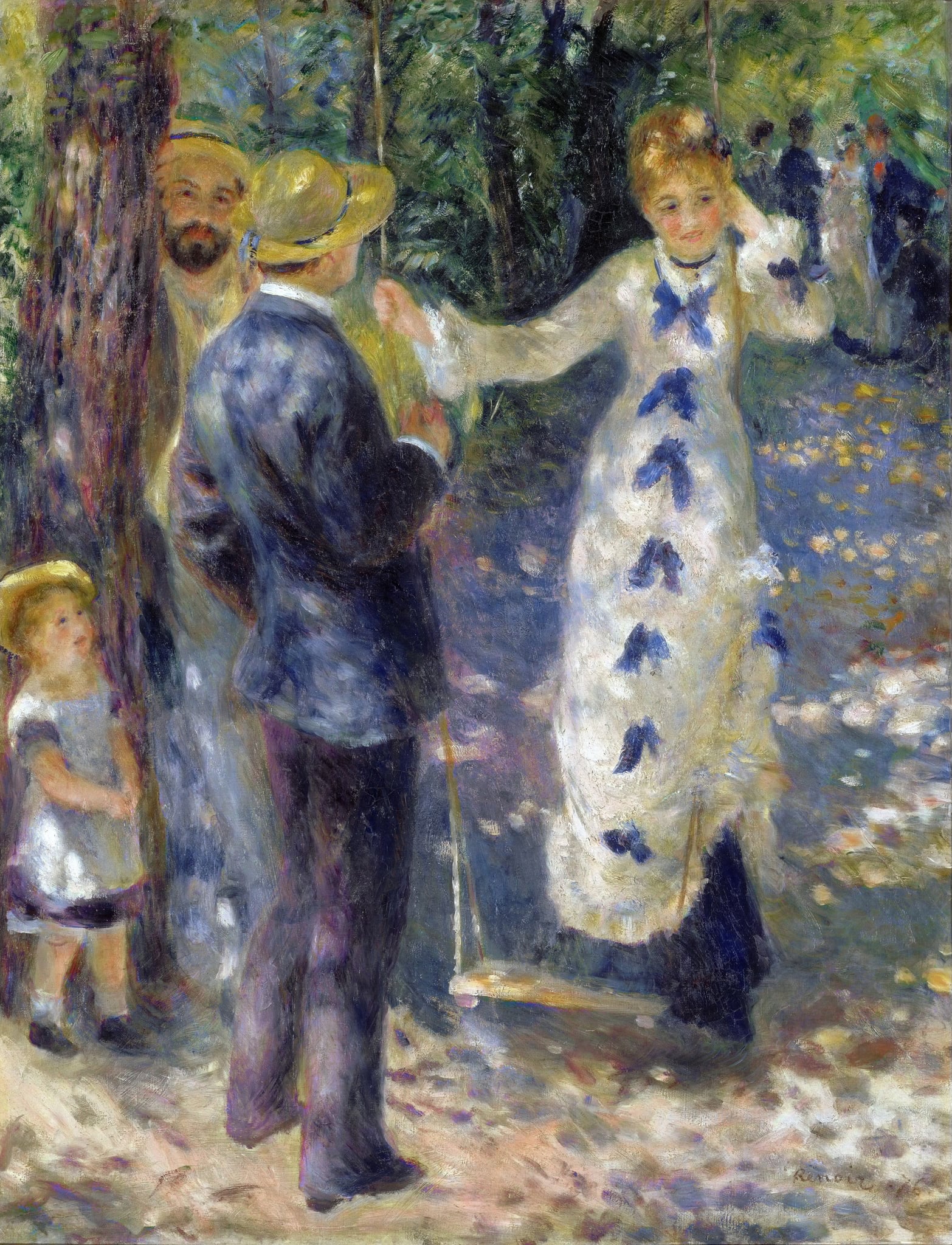
The Swing
Pierre-Auguste Renoir (1876)
Renoir’s The Swing fixes a fleeting, sun-dappled exchange in a Montmartre garden, where a woman in a white dress with blue bows steadies herself on a swing while a man in a blue jacket addresses her. The scene crystallizes <strong>modern leisure</strong>, <strong>flirtation</strong>, and <strong>optical shimmer</strong>, as broken strokes scatter light over faces, fabric, and ground <sup>[1]</sup><sup>[4]</sup>.
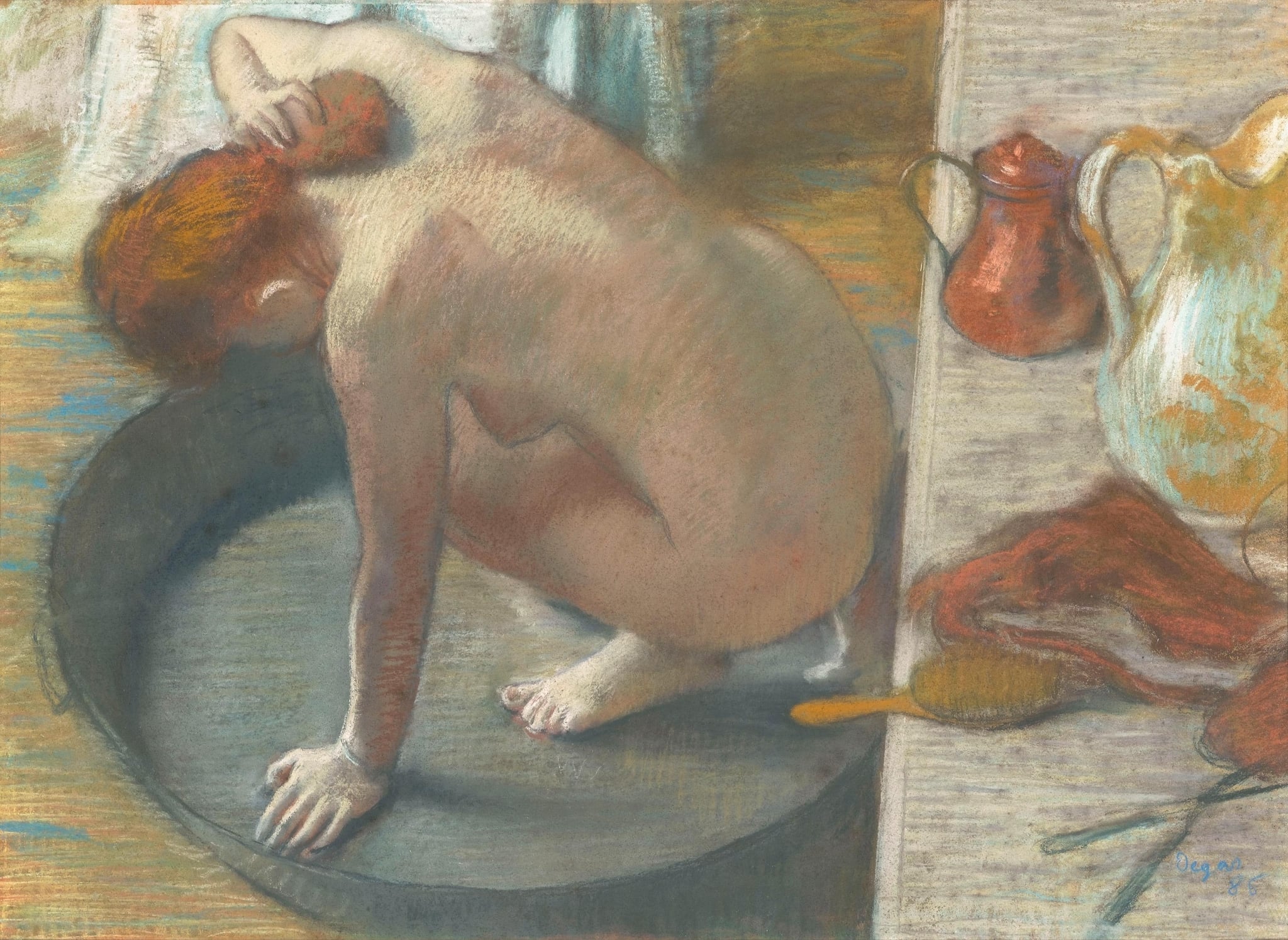
The Tub
Edgar Degas (1886)
In The Tub (1886), Edgar Degas turns a routine bath into a study of <strong>modern solitude</strong> and <strong>embodied labor</strong>. From a steep, overhead angle, a woman kneels within a circular basin, one hand braced on the rim while the other gathers her hair; to the right, a tabletop packs a ewer, copper pot, comb/brush, and cloth. Degas’s layered pastel binds skin, water, and objects into a single, breathing field of <strong>warm flesh tones</strong> and blue‑greys, collapsing distance between body and still life <sup>[1]</sup>.
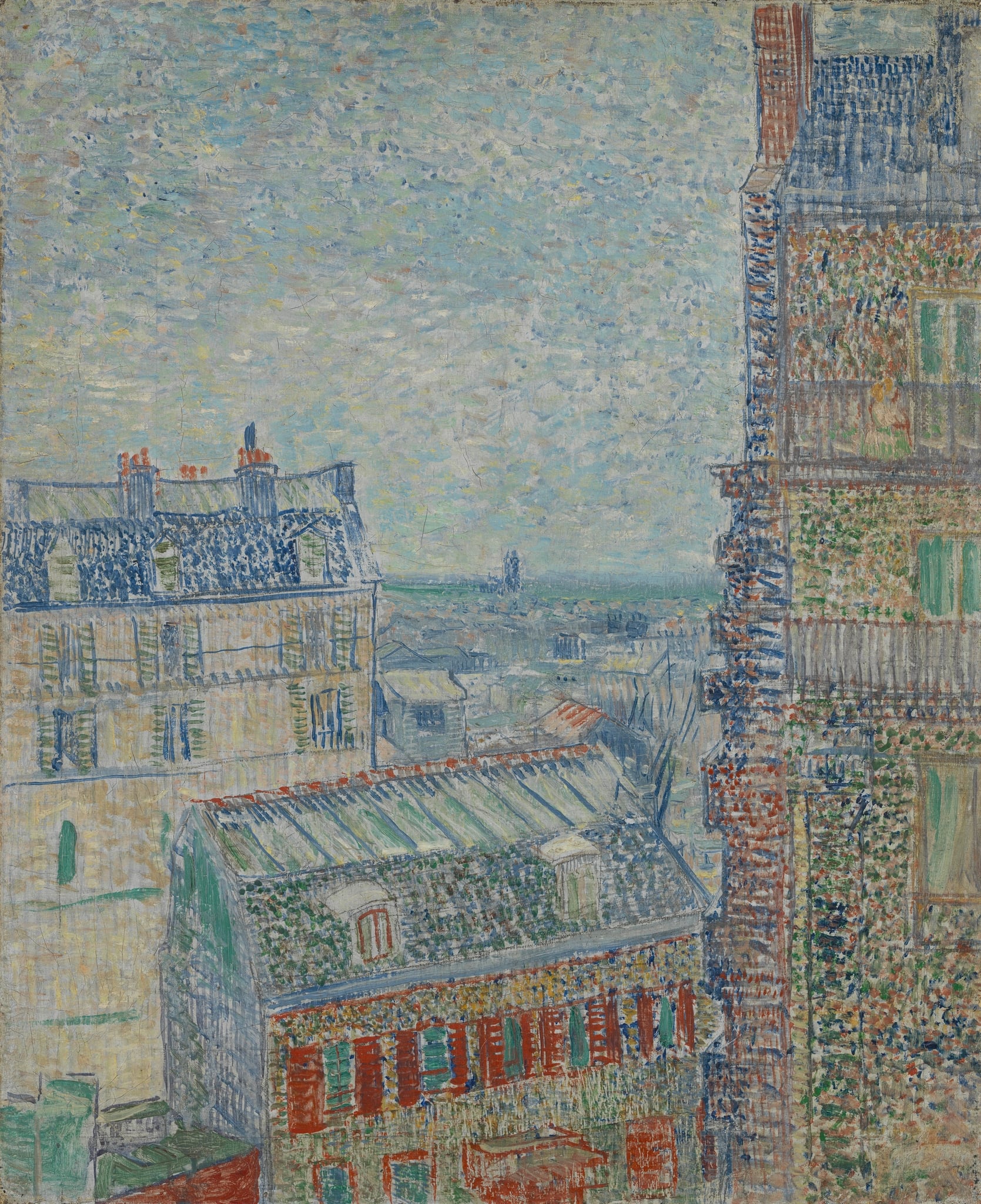
View from Theo's Apartment
Vincent van Gogh (1887)
Van Gogh’s View from Theo’s Apartment compresses Paris into a close tapestry of roofs, windows, and chimneys, then releases the gaze into a pale, stippled sky. The painting fuses loose strokes with Pointillist touches, setting cool slate blues against warm brick reds to make the city surface <strong>quiver with urban energy</strong> <sup>[1]</sup><sup>[5]</sup>. On the far horizon, the vista opens toward Meudon and the Trocadéro, anchoring the scene in a real, breathable distance <sup>[2]</sup>.
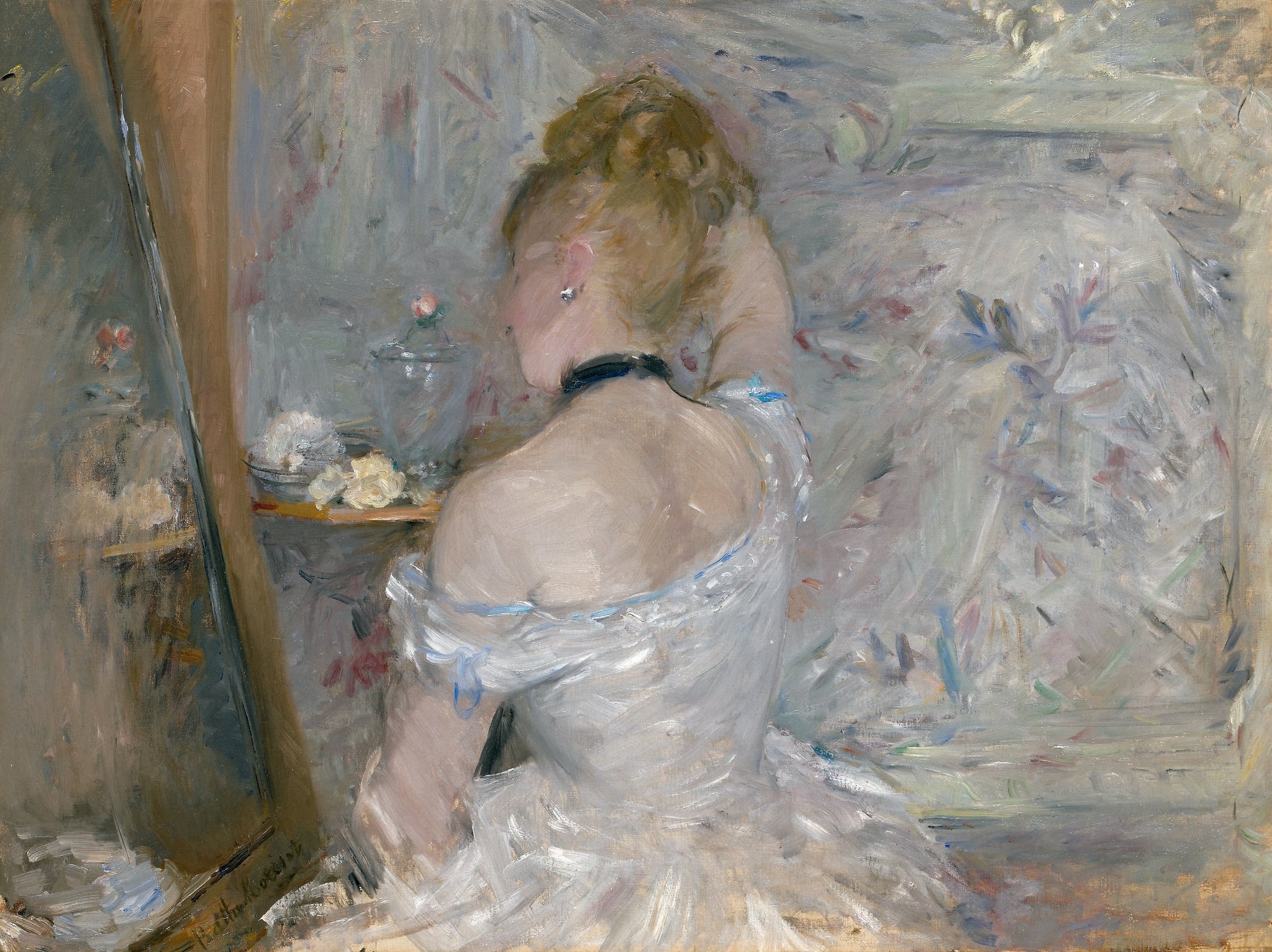
Woman at Her Toilette
Berthe Morisot (1875–1880)
Woman at Her Toilette stages a private ritual of self-fashioning, not a spectacle of vanity. A woman, seen from behind, lifts her arm to adjust her hair as a <strong>black velvet choker</strong> punctuates Morisot’s silvery-violet haze; the <strong>mirror’s blurred reflection</strong> with powders, jars, and a white flower refuses a clear face. Morisot’s <strong>feathery facture</strong> turns a fleeting toilette into modern subjectivity made visible <sup>[1]</sup>.
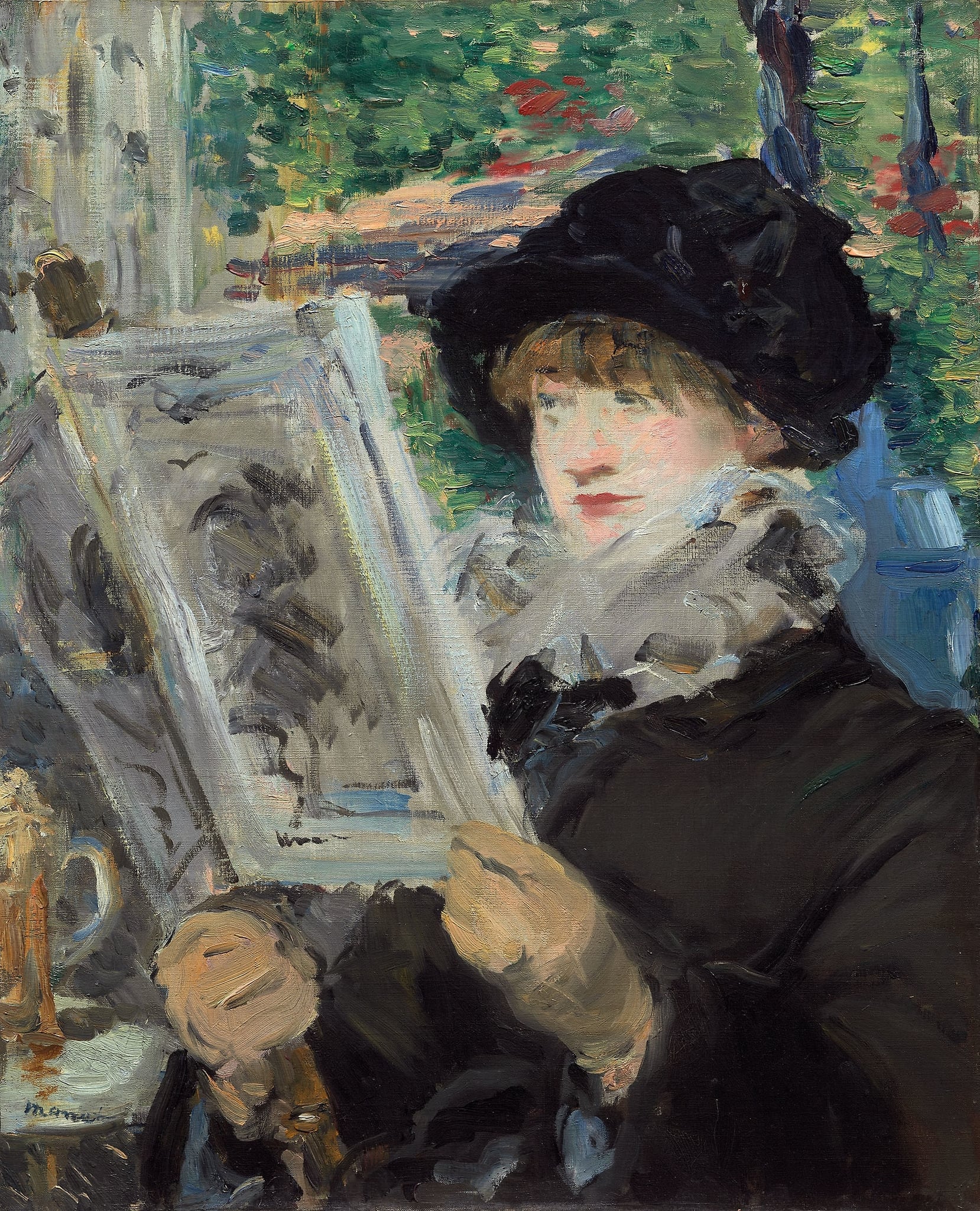
Woman Reading
Édouard Manet (1880–82)
Manet’s Woman Reading distills a fleeting act into an emblem of <strong>modern self-possession</strong>: a bundled figure raises a journal-on-a-stick, her luminous profile set against a brisk mosaic of greens and reds. With quick, loaded strokes and a deliberately cropped <strong>beer glass</strong> and paper, Manet turns perception itself into subject—asserting the drama of a private mind within a public café world <sup>[1]</sup><sup>[2]</sup>.
Related Themes
Related Symbolism Categories
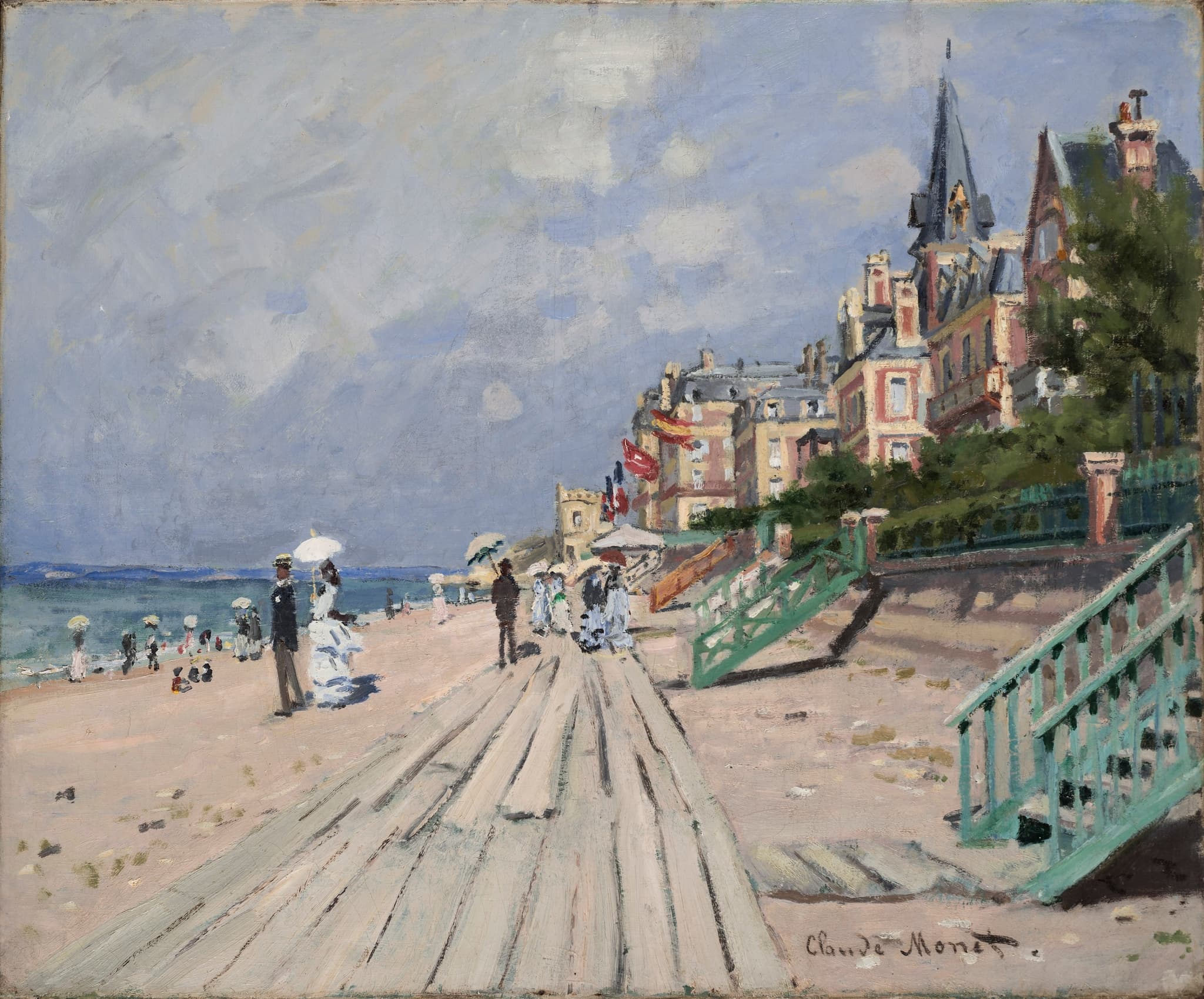
Fashion
In Impressionist and related modern painting, fashion functions as a coded system of class, gender, and spectatorship, translating older allegorical and mythic meanings into the language of couture, accessories, and regulated bodily comportment.
Femininity
In late nineteenth‑century painting, femininity is articulated not as an essence but as a mutable ensemble of fashion, gesture, and setting, through which modern artists probe women’s visibility, labor, and agency within emerging urban and suburban worlds.
Interiority
“Interiority” symbols in modern painting transform gesture, gaze, and domestic props into visual indices of inward life, staging psychological depth, self-consciousness, and mediated subjectivity within scenes of everyday modernity.
Within Western art history, objects have long served as densely coded carriers of meaning—whether as sacramental vessels in religious imagery, vanitas props in Dutch still life, or luxury goods in nineteenth‑century interiors. This symbolic category foregrounds things not merely as accessories to narrative but as semiotic actors in their own right. From copper vases and gilt clocks to café glassware and branded bottles, these items condense social, economic, and emotional structures into material form. Their iconographic force lies in the tension between utility and signification: a cup is both a drinking vessel and a marker of sociability; a clock both a timekeeping device and an emblem of routine, status, or mortality. In modern painting especially, such objects organize the picture’s argument about modernity, labor, and spectatorship as sharply as any figure.
Édouard Manet’s A Bar at the Folies‑Bergère (1882) offers a paradigmatic instance of how objects can reframe a scene of modern life into a meditation on desire and commodity exchange. Arrayed on the marble counter is a staged still life of consumption: branded bottles with the Bass red triangle, gleaming champagne, a bowl of oranges, and a glass vase with flowers. These are not neutral props but emblems of what one might call commodified pleasure. Semiotic emphasis falls on the labels and standardized forms—logos that signal "globalized consumer culture; pleasure standardized into purchasable labels." As signs, they stand at once for specific products and for the broader system of commercial spectacle that frames the barmaid herself as an object of consumption. The central bottle functions as a vertical axis, a "calm, impartial presence" that bisects the composition and stabilizes the volatile traffic of gazes and goods. In tandem with the disjunctive mirror, these objects articulate an economy in which human presence is mediated and priced through things.
Claude Monet’s Gare Saint‑Lazare (1877) pursues a different but related object symbolism, in which the tools of industrial modernity—locomotives, gas lamps, iron trusses—are transmuted into an atmospheric iconography of time and vision. The gas lamps, described as "modern illumination and urban visibility," punctuate the vaporous station like nodes of orientation within haze. Semiologically, they mark the triumph of artificial, clock‑regulated time over diurnal, natural light, while visually they anchor Monet’s dissolution of form into steam. The locomotives themselves, though almost swallowed by vapor, are identifiable machines whose function is to standardize speed and schedule. Monet converts these utilitarian objects into a modern analogue of religious architecture: the train shed becomes a "new kind of cathedral of movement" in which gaslight and steam assume the symbolic role once played by stained glass and incense. Here, industrial objects are not critiqued as such; instead, their very ordinariness is elevated into a new sublime of fleeting perception.
At the other end of the spectrum from steel and glass lies the crafted warmth of Vincent van Gogh’s domestic interiors and still lifes. In Portrait of Léonie Rose Charbuy‑Davy (1887), a set of modest household objects—the cradle and the fireplace with its mantel—act as structural symbols of identity. The cradle operates as an explicit icon of "maternal identity, caretaking, and the domestic sphere," while its specific type, the cradle with pole and cord, elsewhere in van Gogh’s work denotes a "simple machine of nurture." In this portrait, the pale cradle at left, the embered reflection on the floor, and the implied hearth together bind the sitter to an economy of care and routine. Their semiotic function is double: they situate her socially as a mother within a middle‑class interior and, iconographically, they rework the long tradition of the Madonna and Child’s associated furnishings into a secular key. The objects themselves are unremarkable, but in van Gogh’s vibrating facture they become charged emissaries of domestic continuity and latent fatigue.
Van Gogh’s Imperial Fritillaries in a Copper Vase (1887), though not among the narrative works, adds an important still‑life dimension to this object symbolism. The copper vase is defined as "containment and endurance—mirroring and amplifying surrounding light." Its metallic body conducts warmth across the composition, mediating between the blaze of orange flowers and the cool, stippled blue ground. Iconographically, the vase stands for human craft organizing natural abundance; semiotically, it functions as a transformer of light and color. Just as the gilt mantel clock in Degas’s Bellelli Family will translate time into domestic status and pressure, the copper vessel translates luminous energy into a stable, crafted core, insisting on continuity amid the fragile, short‑lived blooms it holds.
In Degas’s The Bellelli Family (1858–1869), the object symbolism is overtly juridical. The gilt mantel clock, with its "measured passage of time" and assertive casing, presides over the tense family grouping. Positioned above the father’s desk and beneath the ancestral portrait, the clock becomes an emblem of duty, inheritance, and the weight of domestic order. Its gilding advertises status, but its ticking underwrites the stasis and emotional estrangement that the composition dramatizes. Nearby, the desk strewn with papers functions as a barrier—"the father’s outward sphere"—that partitions him from wife and daughters. These objects work semiotically as boundary‑markers; they literalize the structural divides of gendered roles and generational expectations, transforming furniture into instruments of social geometry.
Edgar Degas’s The Ballet Class (1873–1876) similarly mobilizes mundane implements to articulate power relations and labor. The ballet master’s cane is not just a walking aid but an instrument of "authority, discipline, and the measured tempo of training." Stood upright, it becomes a vertical metronome in the center of the composition, organizing the scattered, fatigued bodies of the dancers into a latent order. Equally telling is the watering can in the foreground, an object of maintenance and backstage care. Its presence, like the music stand and other studio paraphernalia, asserts the work of upkeep required to sustain the illusion of effortless grace. These tools, like the locomotive in Monet or the branded bottles in Manet, foreground systems and infrastructure—here, the disciplinary regime of the ballet institution—rather than spectacle alone.
Across these works, one can trace a web of connections among object symbols. Vessels of various kinds—the champagne bottles and glassware on Manet’s bar, the copper vase in van Gogh, the coffee cups and pot in Renoir’s In the Garden (where the tableware marks "daily ritual" and "communal sharing")—all mediate between bodies and social exchange. Clocks and schedules, whether in the form of the Bellelli mantel clock or the implied timekeeping of station timetables at the Gare Saint‑Lazare, encode temporal discipline. Tools—ballet canes, basketry rods, cabinet scrapers, artist’s crayons and boxes—condense the theme of labor and craft, pointing to the making that underlies visible form. Even frames and mirrors, as in Manet’s bar or in domestic interiors, function as meta‑objects that regulate seeing itself, turning spectators into participants in the act of objectification.
Historically, these symbols evolve from a relatively stable early modern iconography—where bread and wine or brass candlesticks would unambiguously signal Eucharistic presence or domestic piety—toward a more open, reflexive, and socially inflected lexicon in the nineteenth century. Manet can draw on the vanitas tradition of luxury goods and fruit, yet in Olympia the bouquet and búcaro cup become instruments of modern negotiation and price; in A Bar at the Folies‑Bergère, the still life of bottles and oranges registers the new reality of branded mass commodities. Monet inherits the church interior’s language of light and smoke but reassigns it to gas lamps and locomotives, sacralizing industrial space. Degas and Morisot, in turn, take the domestic symbolism of clocks, gloves, and mirrors and reframe them as indices of bourgeois discipline, female self‑presentation, and institutional control. By the late nineteenth century, objects no longer simply point beyond themselves to transcendent truths; they also index the very systems—commercial, industrial, domestic—within which artists and viewers are enmeshed. Their iconographic charge lies precisely in this double function as both material things and critical signs of the modern world.