Interiority
“Interiority” symbols in modern painting transform gesture, gaze, and domestic props into visual indices of inward life, staging psychological depth, self-consciousness, and mediated subjectivity within scenes of everyday modernity.
Member Symbols
Featured Artworks
A Bar at the Folies-Bergère
Édouard Manet (1882)
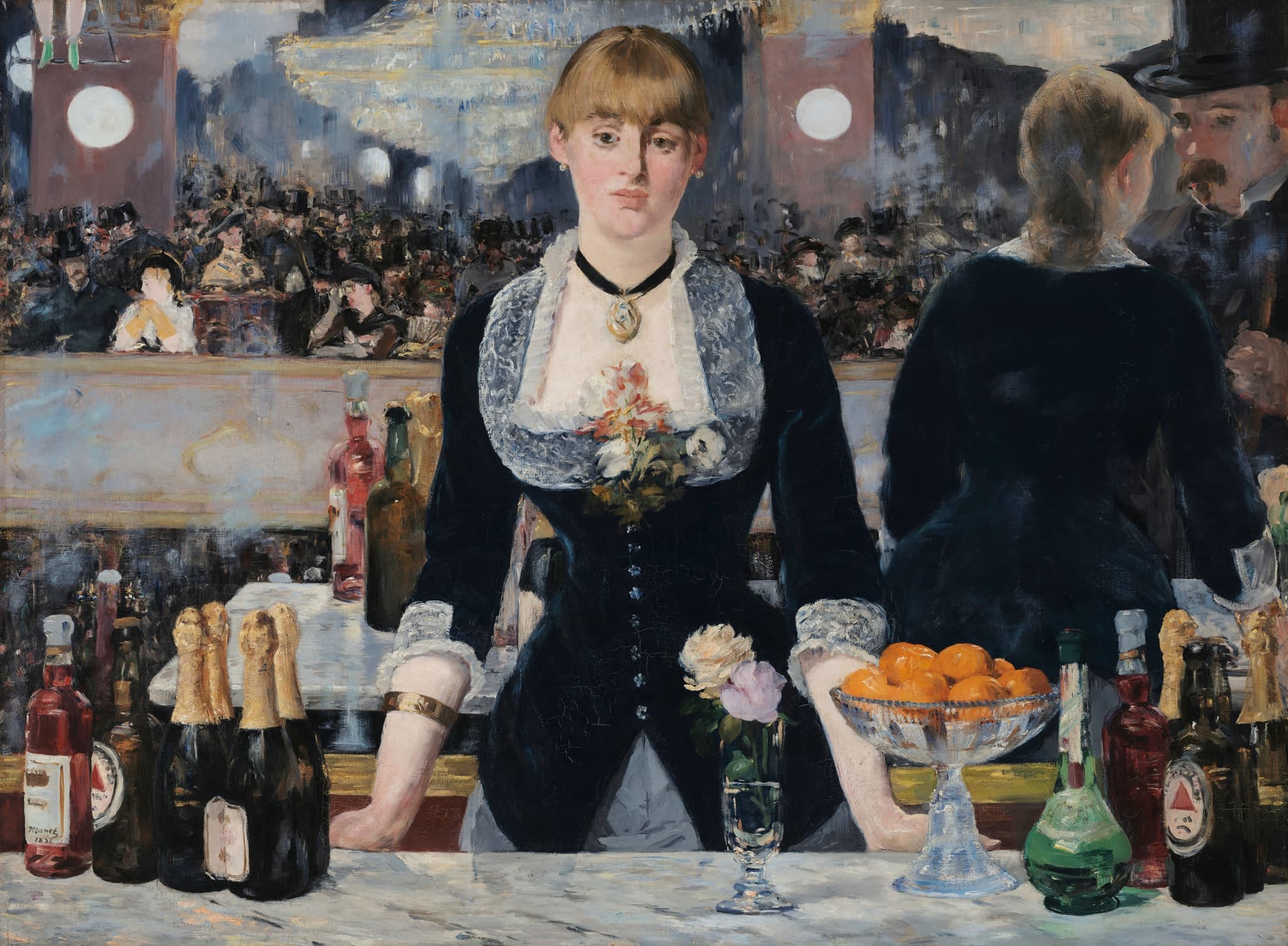
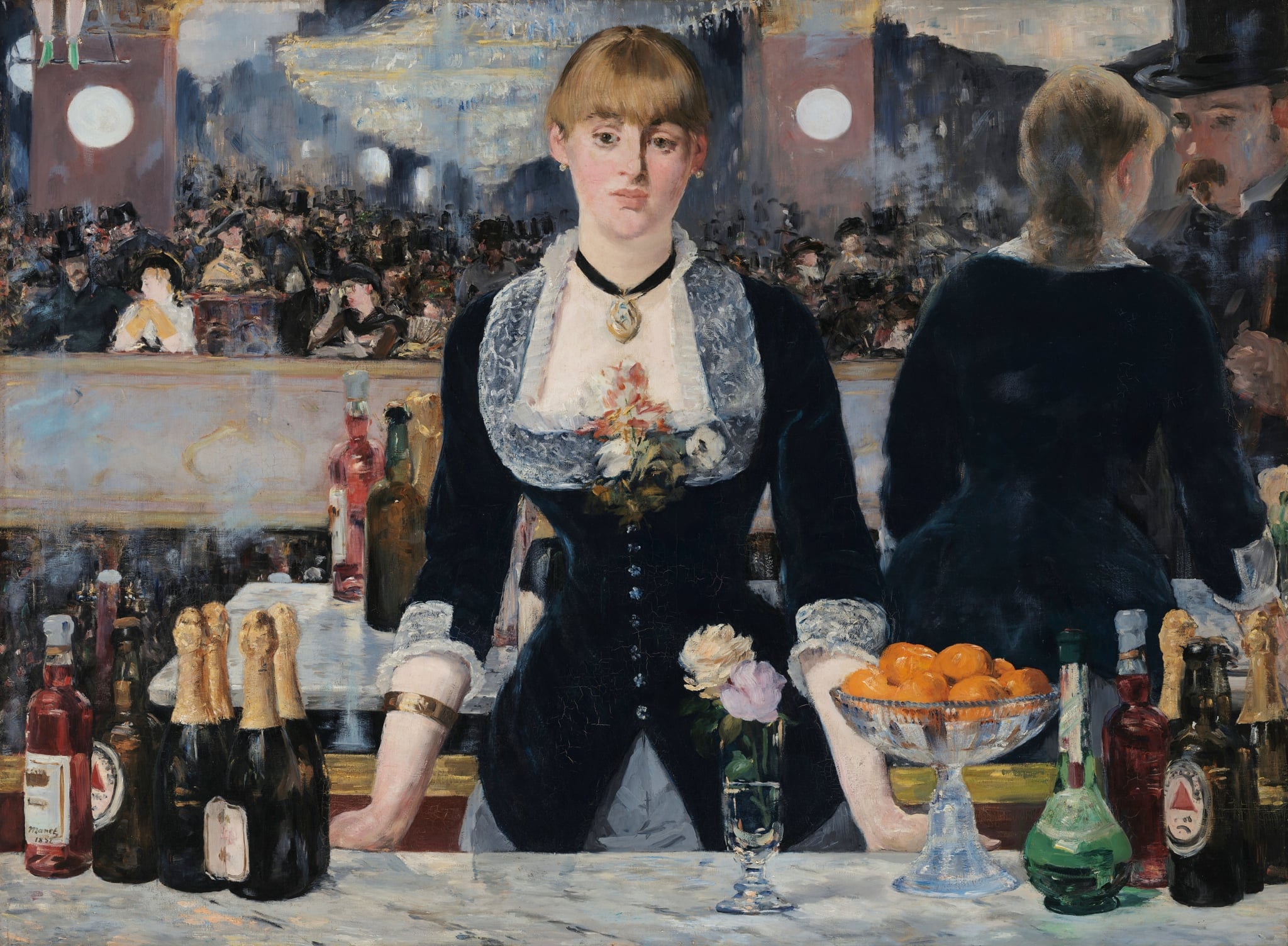
Édouard Manet’s A Bar at the Folies-Bergère stages a face-to-face encounter with modern Paris, where <strong>commerce</strong>, <strong>spectacle</strong>, and <strong>alienation</strong> converge. A composed barmaid fronts a marble counter loaded with branded bottles, flowers, and a brimming bowl of oranges, while a disjunctive <strong>mirror</strong> unravels stable viewing and certainty <sup>[1]</sup><sup>[2]</sup>.
Combing the Hair
Edgar Degas (c.1896)
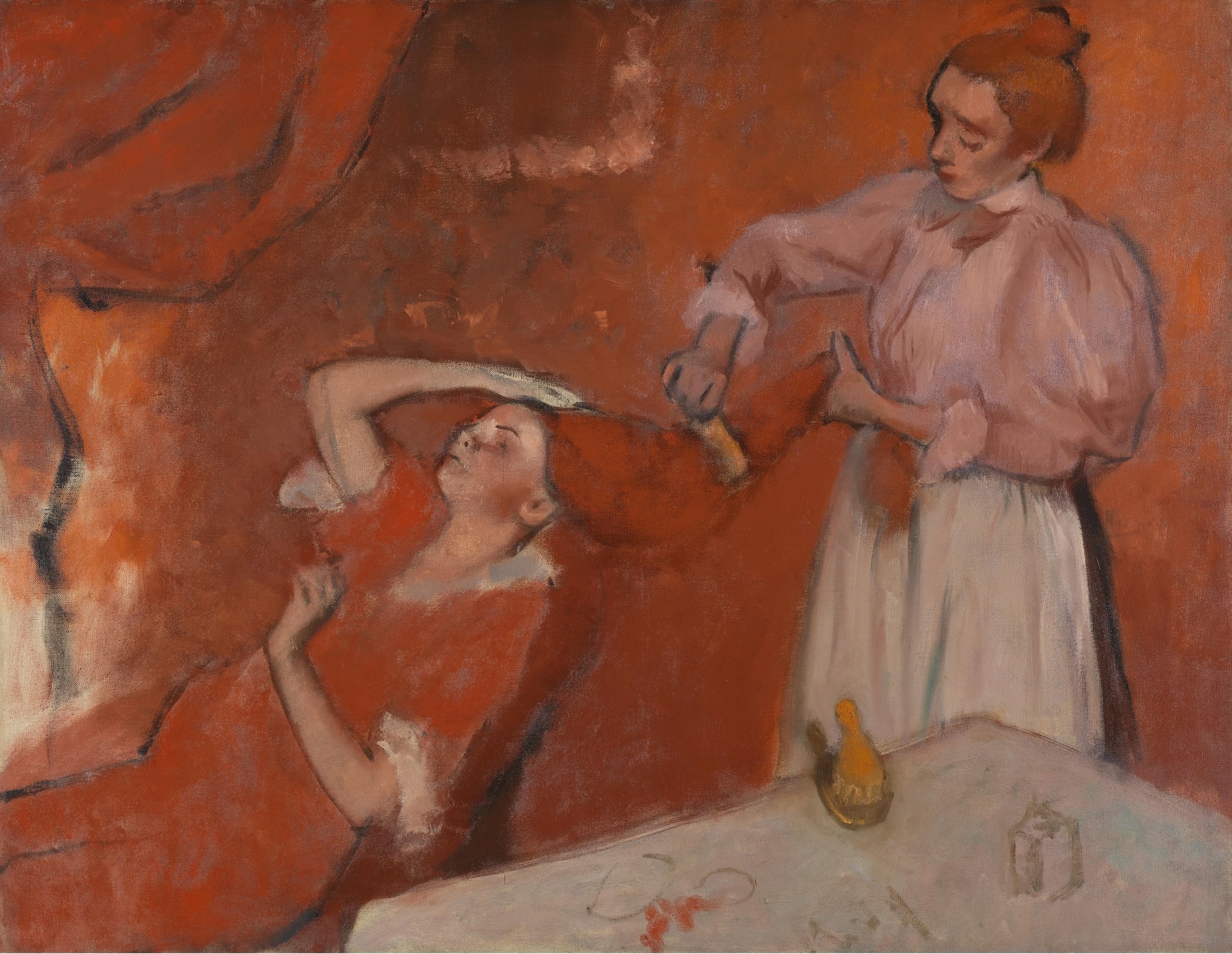
Edgar Degas’s Combing the Hair crystallizes a private ritual into a scene of <strong>compressed intimacy</strong> and <strong>classed labor</strong>. The incandescent field of red fuses figure and room, turning the hair into a <strong>binding ribbon</strong> between attendant and sitter <sup>[1]</sup>.
Dance at Bougival
Pierre-Auguste Renoir (1883)
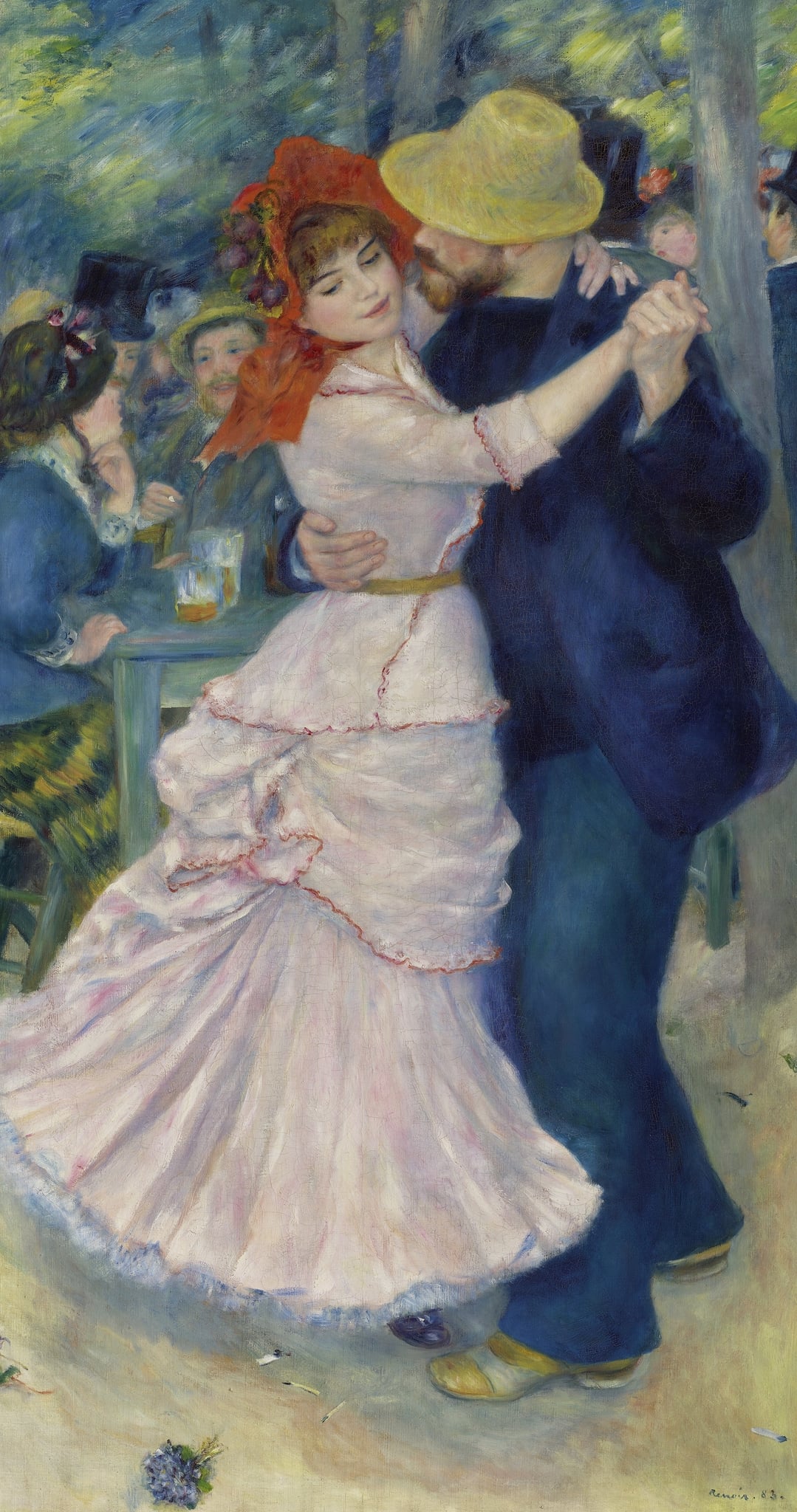
In Dance at Bougival, Pierre-Auguste Renoir turns a crowded suburban dance into a <strong>private vortex of intimacy</strong>. Rose against ultramarine, skin against shade, and a flare of the woman’s <strong>scarlet bonnet</strong> concentrate the scene’s energy into a single turning moment—modern leisure made palpable as <strong>touch, motion, and light</strong> <sup>[1]</sup><sup>[2]</sup>.
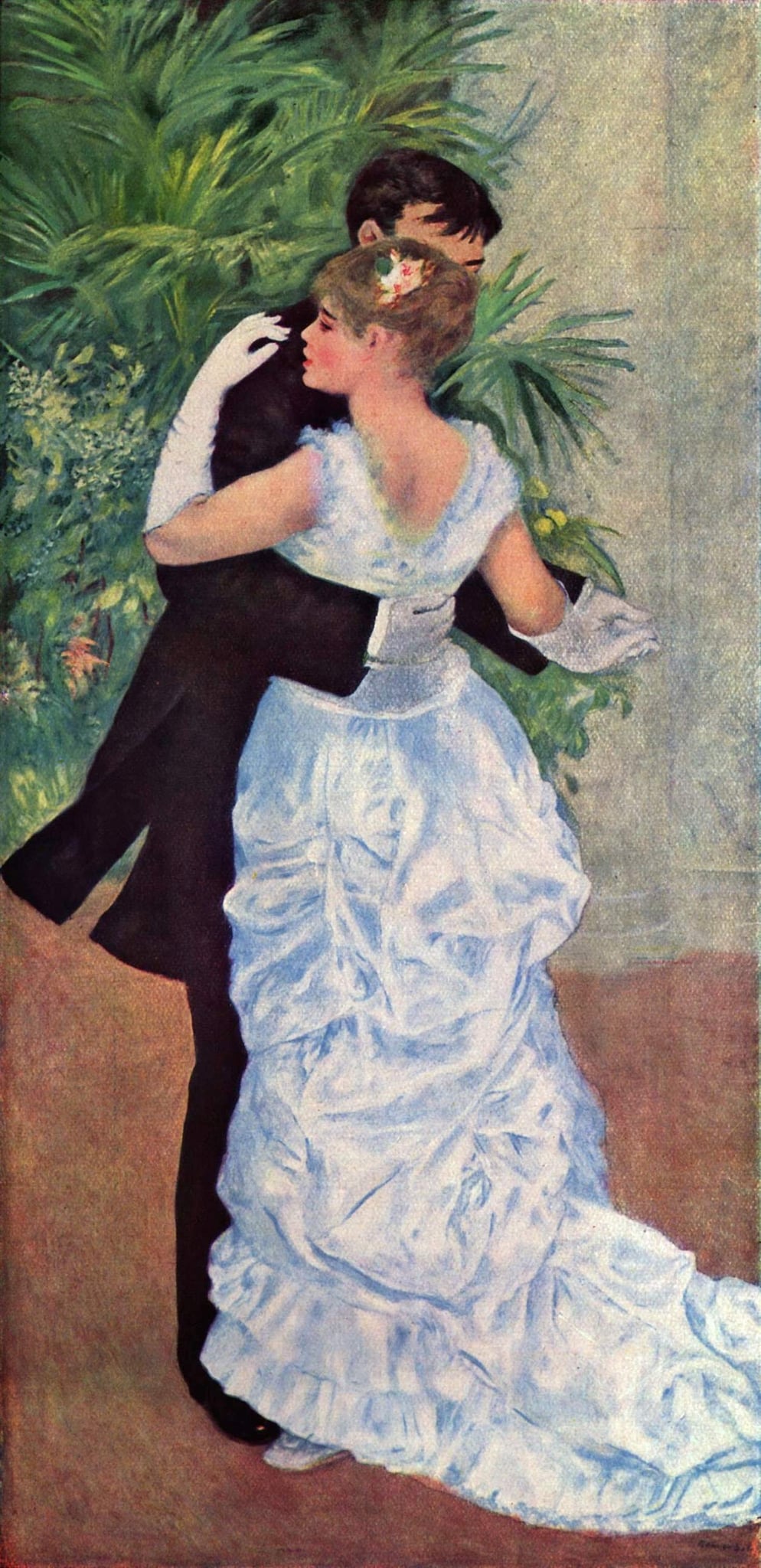
Dance in the City
Pierre-Auguste Renoir (1883)
Pierre-Auguste Renoir’s Dance in the City stages an urban waltz where decorum and desire briefly coincide. A couple’s close embrace—his black tailcoat enclosing her luminous white satin gown—creates a <strong>cool, elegant</strong> harmony against potted palms and marble. Renoir’s refined, post‑Impressionist touch turns social ritual into <strong>sensual modernity</strong> <sup>[1]</sup><sup>[2]</sup>.
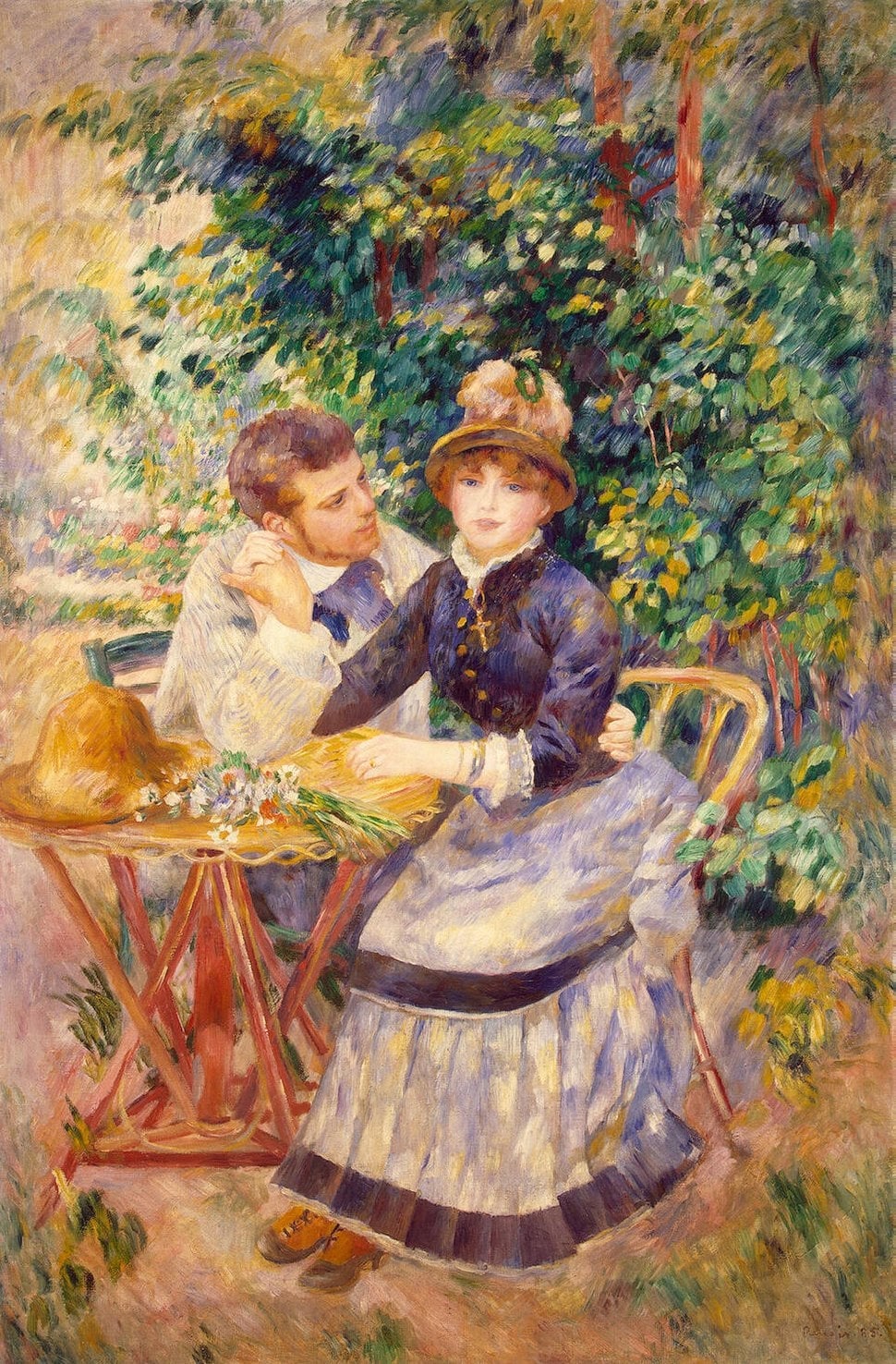
In the Garden
Pierre-Auguste Renoir (1885)
In the Garden presents a charged pause in modern leisure: a young couple at a café table under a living arbor of leaves. Their lightly clasped hands and the bouquet on the tabletop signal courtship, while her calm, front-facing gaze checks his lean. Renoir’s flickering brushwork fuses figures and foliage, rendering love as a <strong>transitory, luminous sensation</strong> <sup>[1]</sup><sup>[3]</sup>.
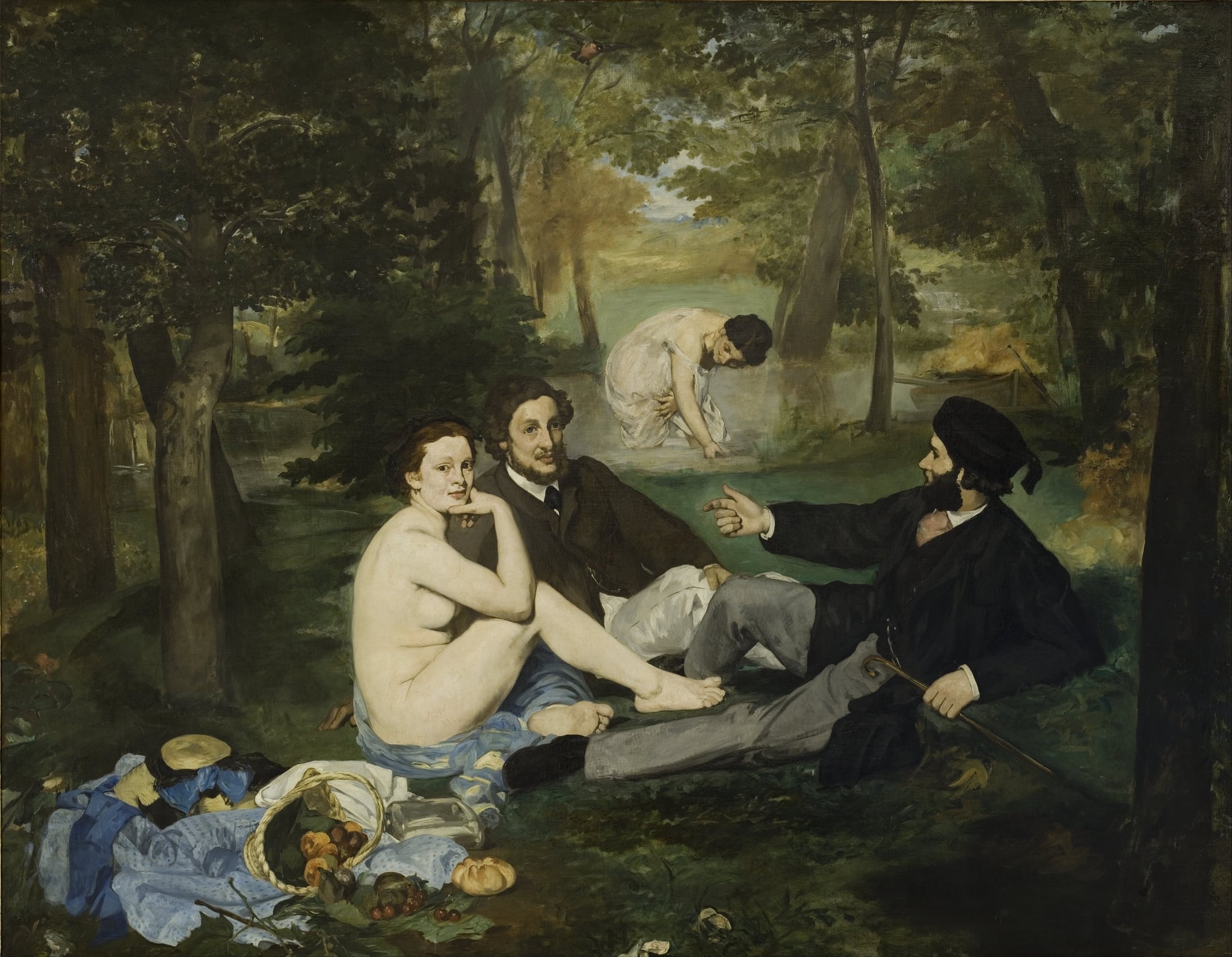
Luncheon on the Grass
Édouard Manet (1863)
Luncheon on the Grass stages a confrontation between <strong>modern Parisian leisure</strong> and <strong>classical precedent</strong>. A nude woman meets our gaze beside two clothed men, while a distant bather and an overturned picnic puncture naturalistic illusion. Manet’s scale and flat, studio-like light convert a park picnic into a manifesto of <strong>modern painting</strong> <sup>[1]</sup><sup>[2]</sup>.
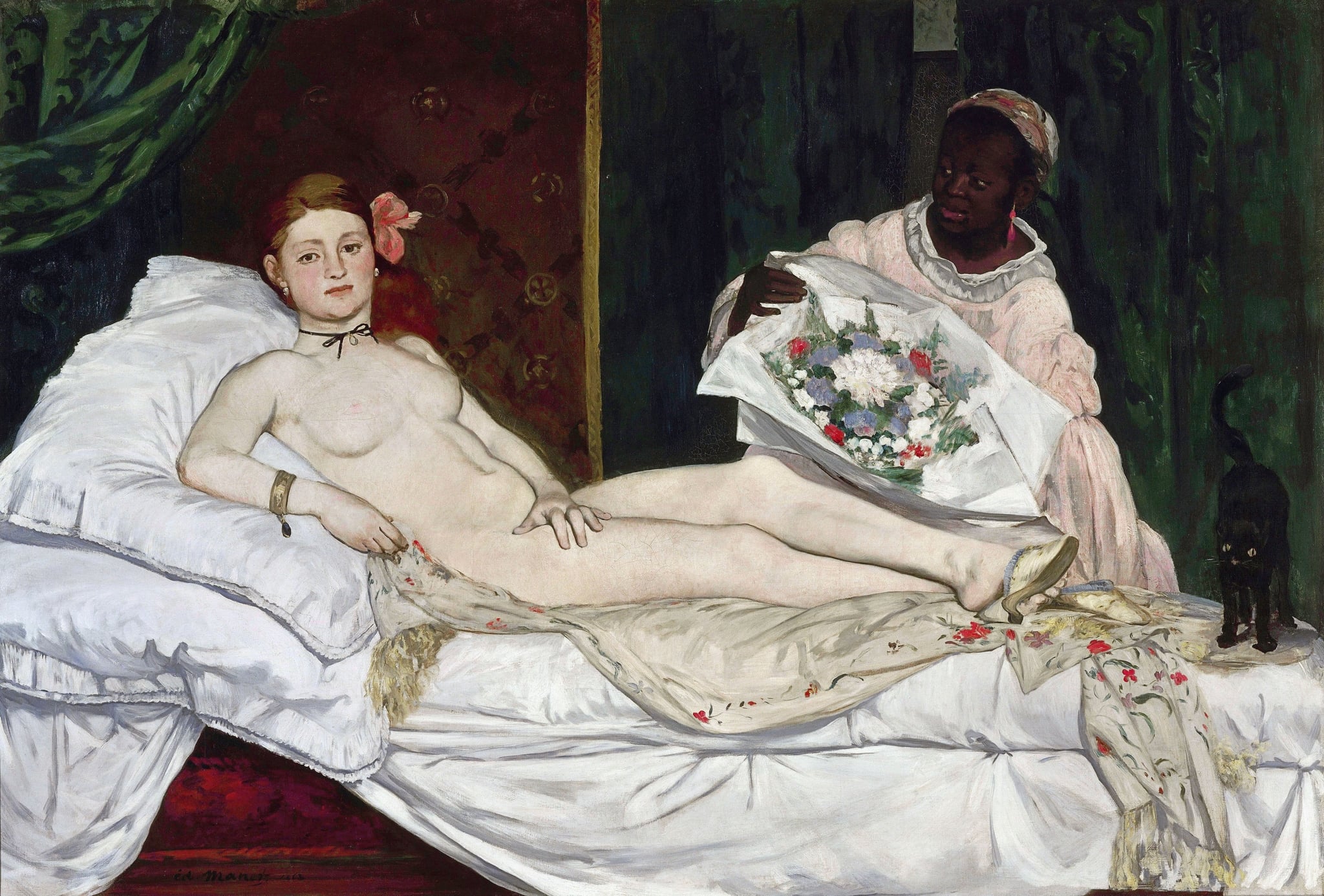
Olympia
Édouard Manet (1863 (Salon 1865))
A defiantly contemporary nude confronts the viewer with a steady gaze and a guarded pose, framed by crisp light and luxury trappings. In Olympia, <strong>Édouard Manet</strong> strips myth from the female nude to expose the <strong>modern economy of desire</strong>, power, and looking <sup>[1]</sup><sup>[3]</sup>.
Poppies
Claude Monet (1873)
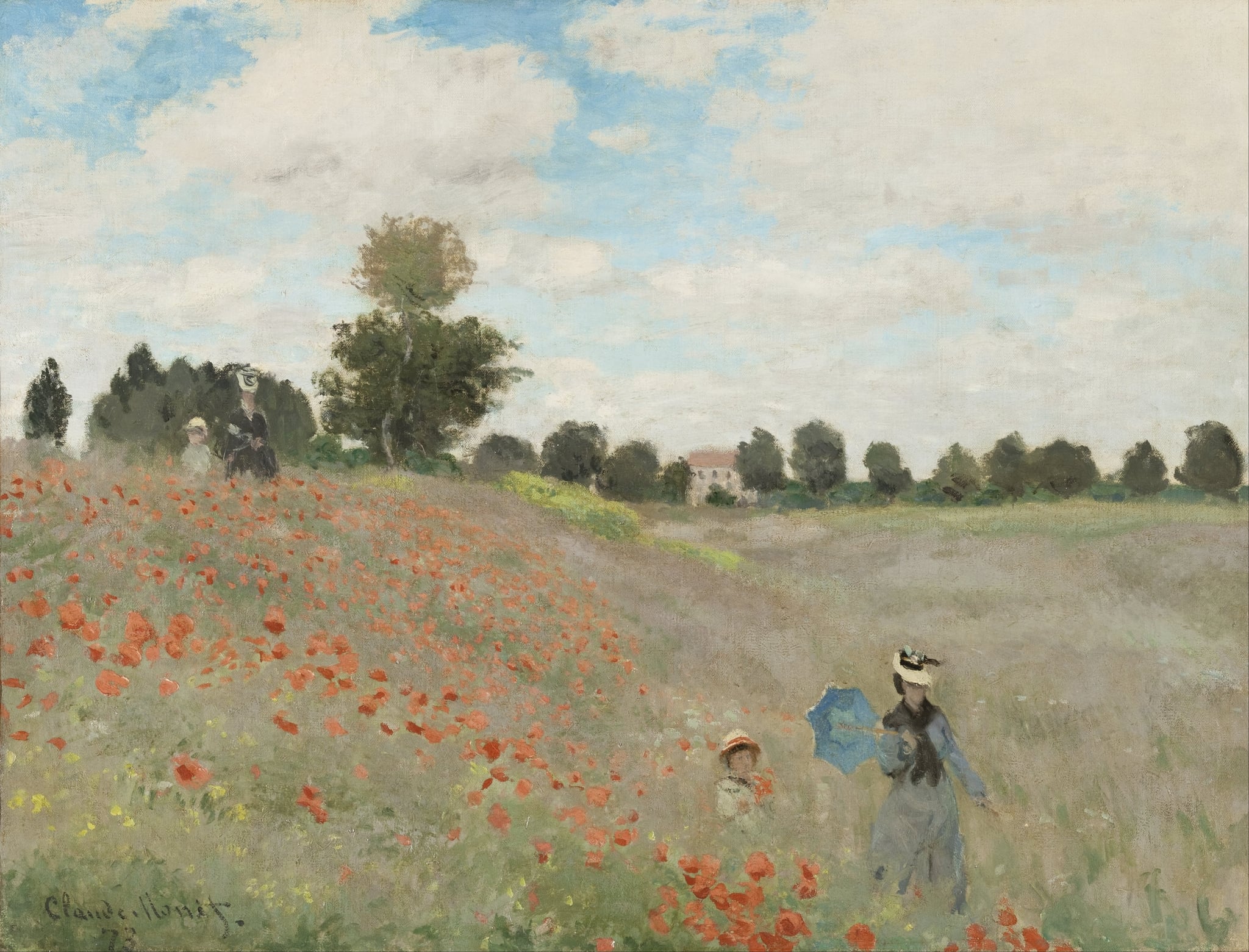
Claude Monet’s Poppies (1873) turns a suburban hillside into a theater of <strong>light, time, and modern leisure</strong>. A red diagonal of poppies counters cool fields and sky, while a woman with a <strong>blue parasol</strong> and a child appear twice along the slope, staging a gentle <strong>echo of moments</strong> rather than a single event <sup>[1]</sup>. The painting asserts sensation over contour, letting broken touches make the day itself the subject.
Portrait of Dr. Gachet
Vincent van Gogh (1890)
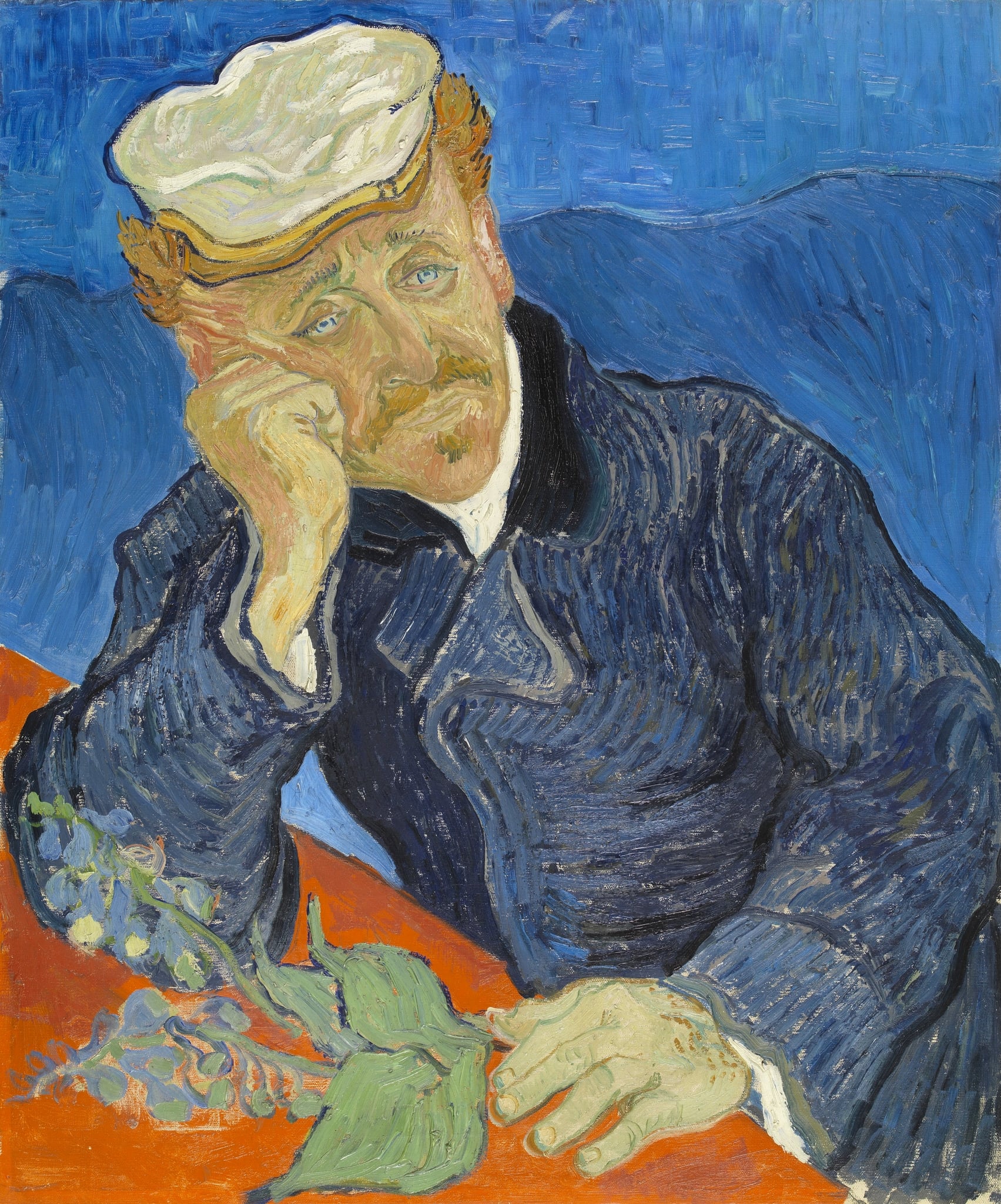
Portrait of Dr. Gachet distills Van Gogh’s late ambition for a <strong>modern, psychological portrait</strong> into vibrating color and touch. The sitter’s head sinks into a greenish hand above a <strong>blazing orange-red table</strong>, foxglove sprig nearby, while waves of <strong>cobalt and ultramarine</strong> churn through coat and background. The chromatic clash turns a quiet pose into an <strong>empathic image of fragility and care</strong> <sup>[1]</sup><sup>[2]</sup>.
Portrait of Jeanne Samary
Pierre-Auguste Renoir (1877)
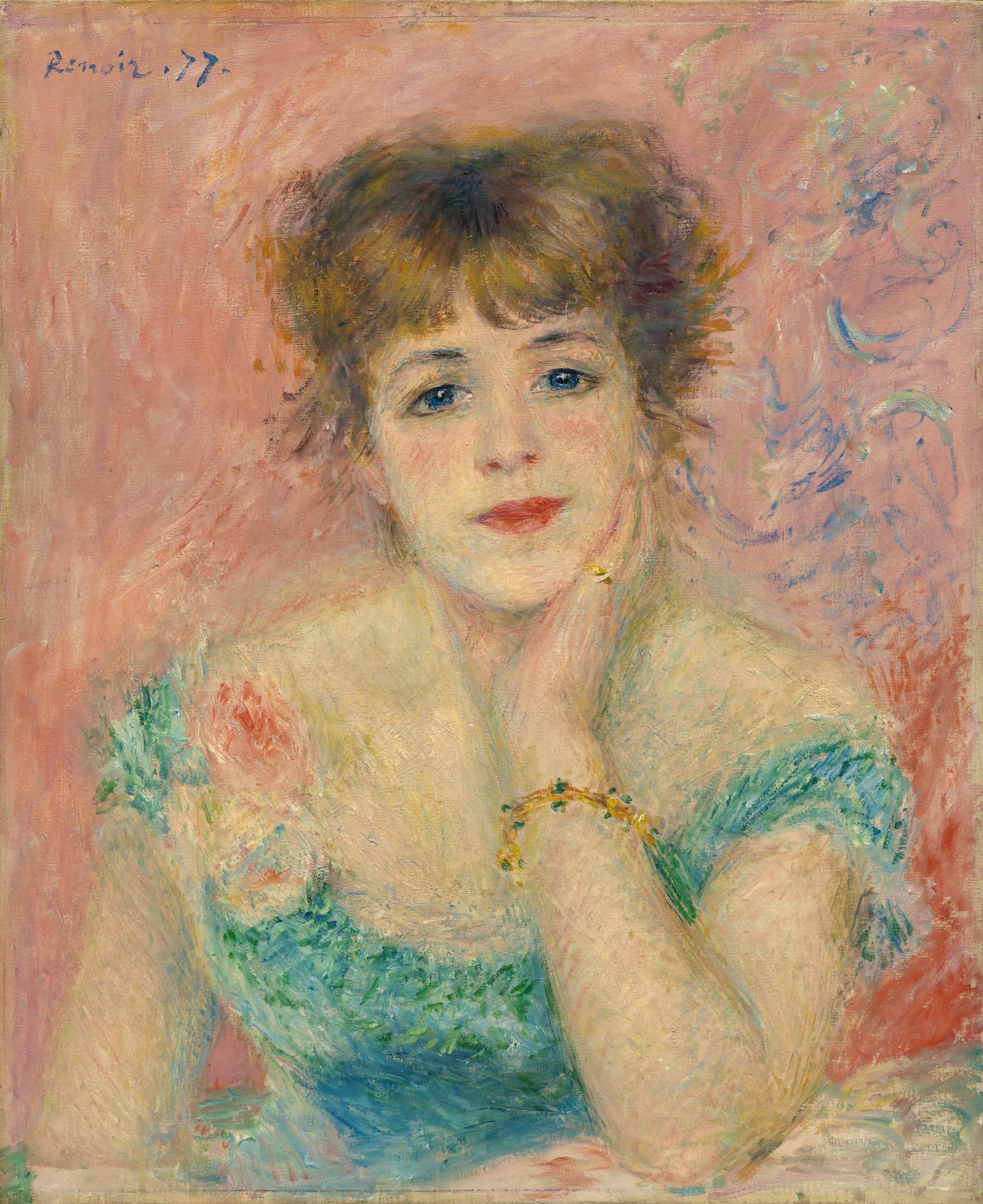
Renoir’s Portrait of Jeanne Samary (1877) turns a modern actress into a study of <strong>radiance and immediacy</strong>, fusing figure and air with shimmering strokes. Cool blue‑green dress notes spark against a warm <strong>coral-pink atmosphere</strong>, while the cheek‑in‑hand pose crystallizes a moment of intimate poise <sup>[1]</sup><sup>[4]</sup>.
The Artist's Garden at Vétheuil
Claude Monet (1881)
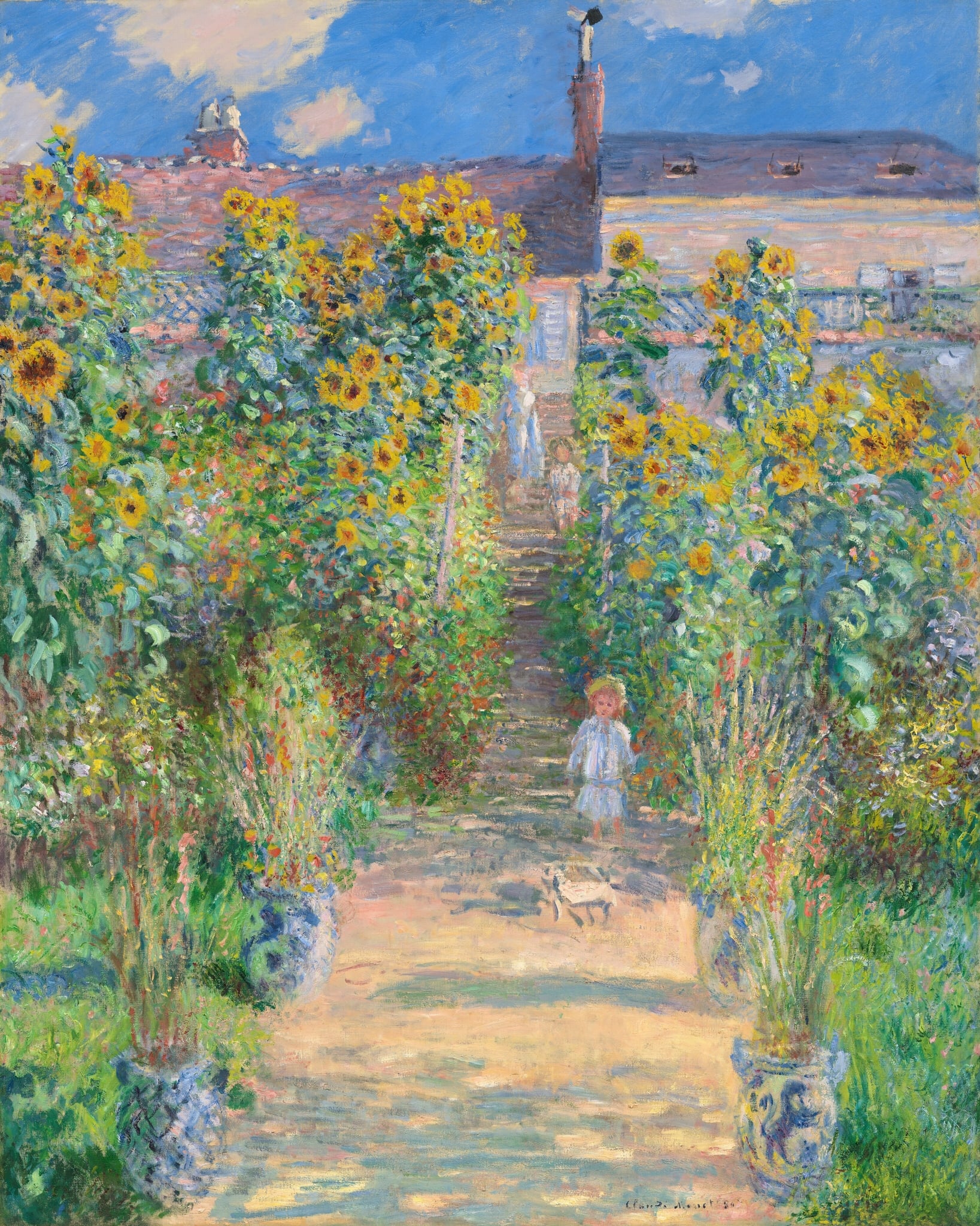
Claude Monet’s The Artist’s Garden at Vétheuil stages a sunlit ascent through a corridor of towering sunflowers toward a modest house, where everyday life meets cultivated nature. Quick, broken strokes make leaves and shadows tremble, asserting <strong>light</strong> and <strong>painterly surface</strong> over linear contour. Blue‑and‑white <strong>jardinieres</strong> anchor the foreground, while a child and dog briefly pause on the path, turning the garden into a <strong>domestic sanctuary</strong> <sup>[1]</sup><sup>[2]</sup>.
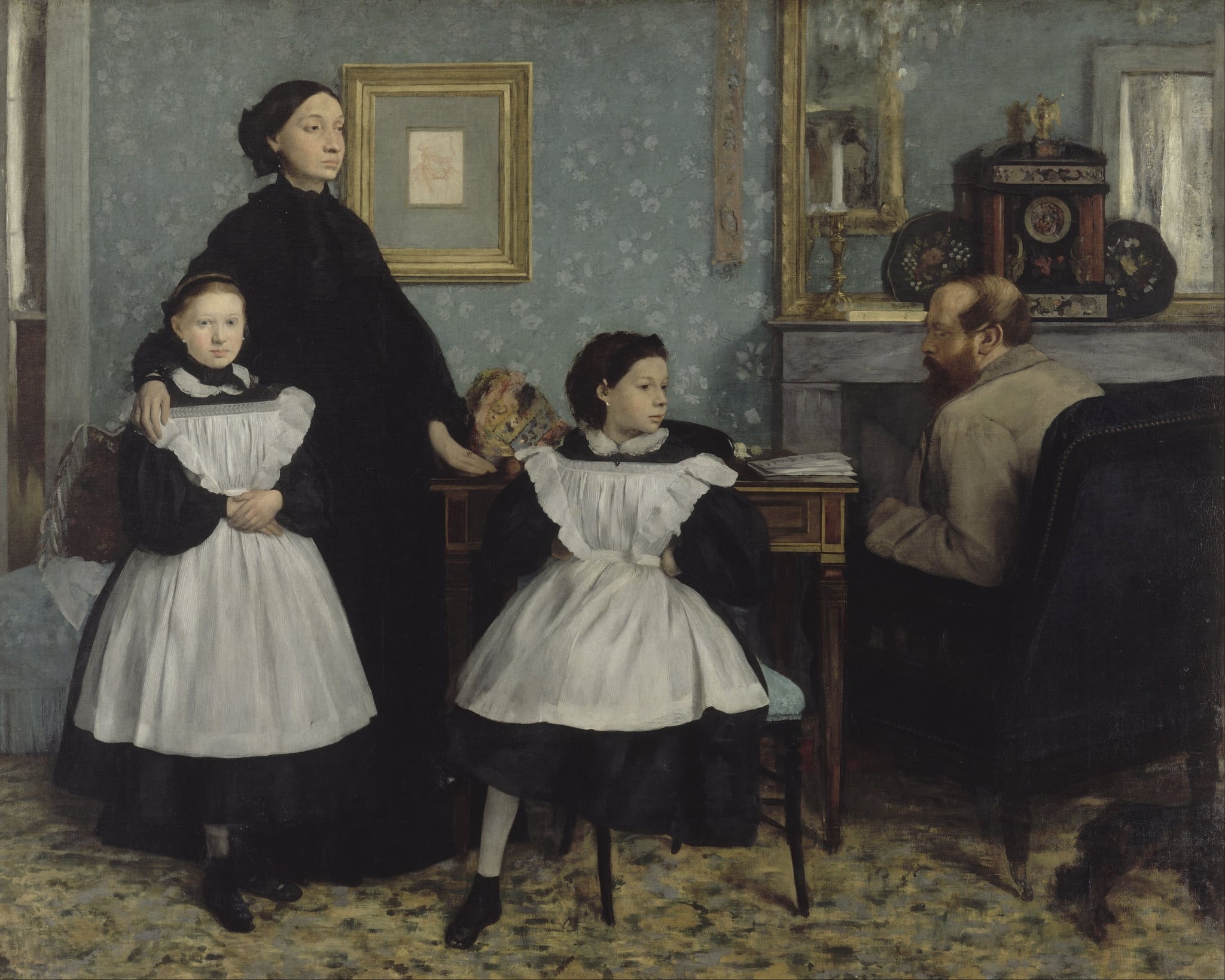
The Bellelli Family
Edgar Degas (1858–1869)
In The Bellelli Family, Edgar Degas orchestrates a poised domestic standoff, using the mother’s column of <strong>mourning black</strong>, the daughters’ <strong>mediating whiteness</strong>, and the father’s turned-away profile to script roles and distance. Rigid furniture lines, a gilt <strong>clock</strong>, and the ancestor’s red-chalk portrait create a stage where time, duty, and inheritance press on a family held in uneasy equilibrium.
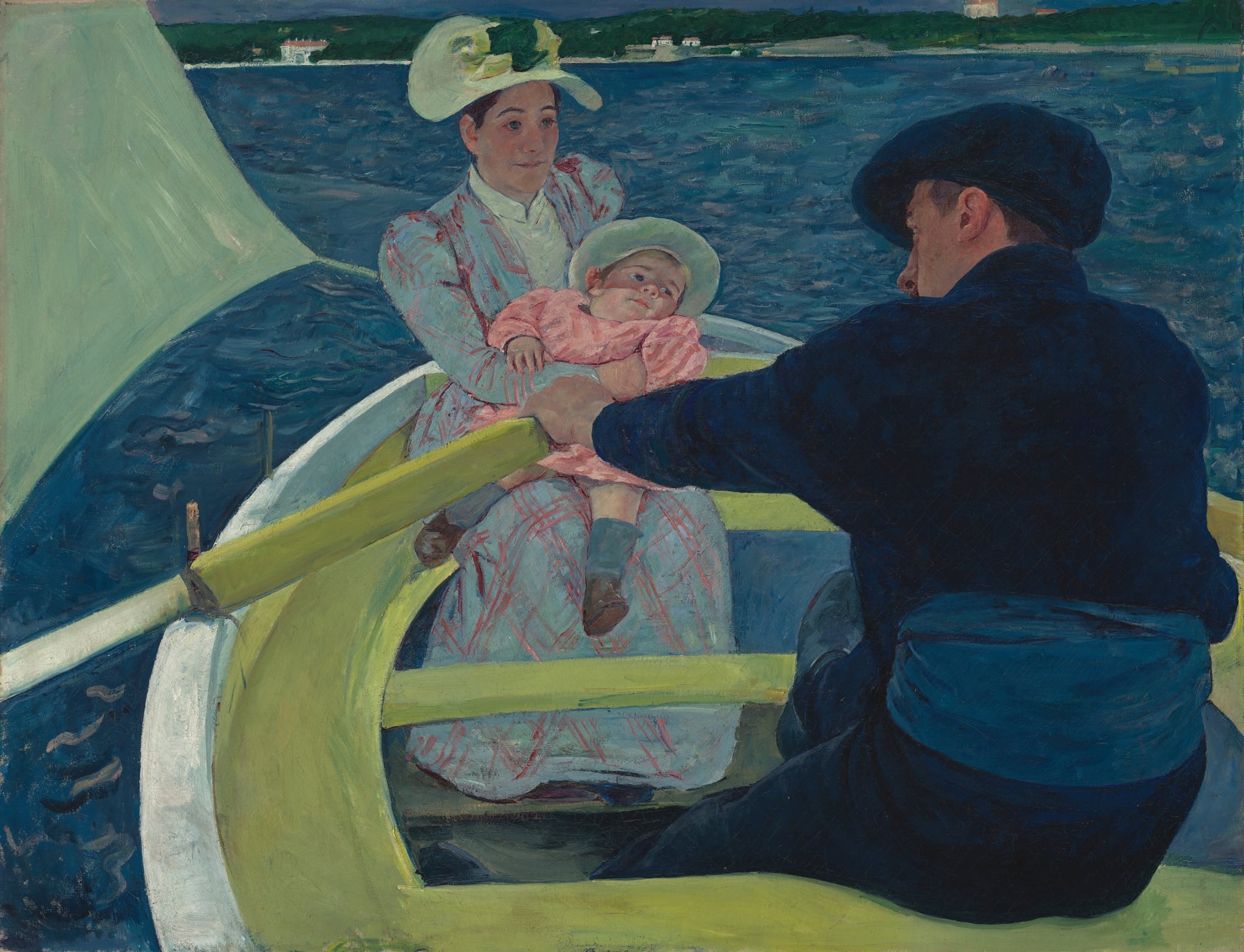
The Boating Party
Mary Cassatt (1893–1894)
In The Boating Party, Mary Cassatt fuses <strong>intimate caregiving</strong> with <strong>modern mobility</strong>, compressing mother, child, and rower inside a skiff that cuts diagonals across ultramarine water. Bold arcs of citron paint and a high, flattened horizon reveal a deliberate <strong>Japonisme</strong> logic that stabilizes the scene even as motion surges around it <sup>[1]</sup>. The painting asserts domestic life as a public, modern subject while testing the limits of Impressionist space and color.
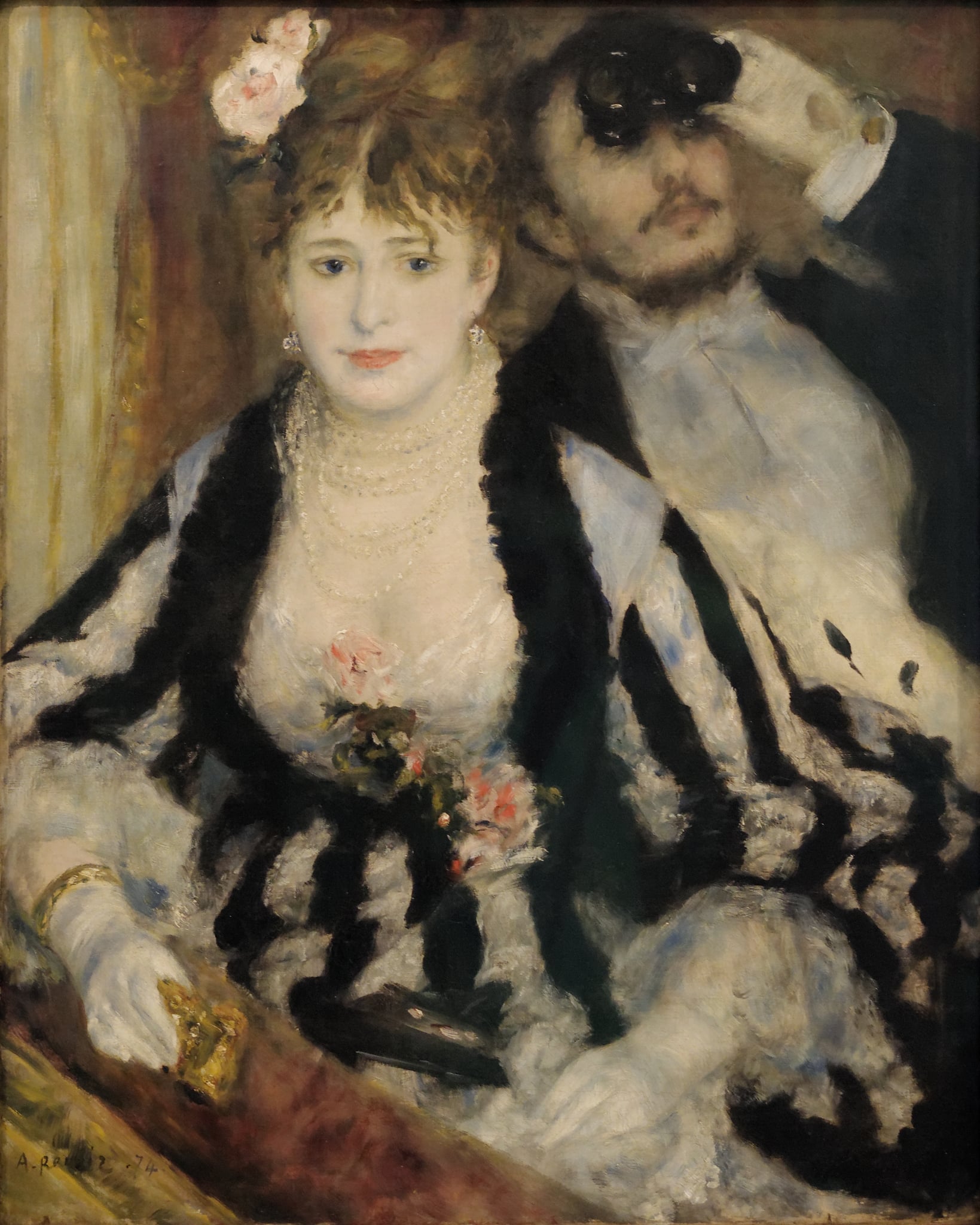
The Loge
Pierre-Auguste Renoir (1874)
Renoir’s The Loge (1874) turns an opera box into a <strong>stage of looking</strong>, where a woman meets our gaze while her companion scans the crowd through binoculars. The painting’s <strong>frame-within-a-frame</strong> and glittering fashion make modern Parisian leisure both alluring and self-conscious, turning spectators into spectacles <sup>[1]</sup><sup>[2]</sup>.
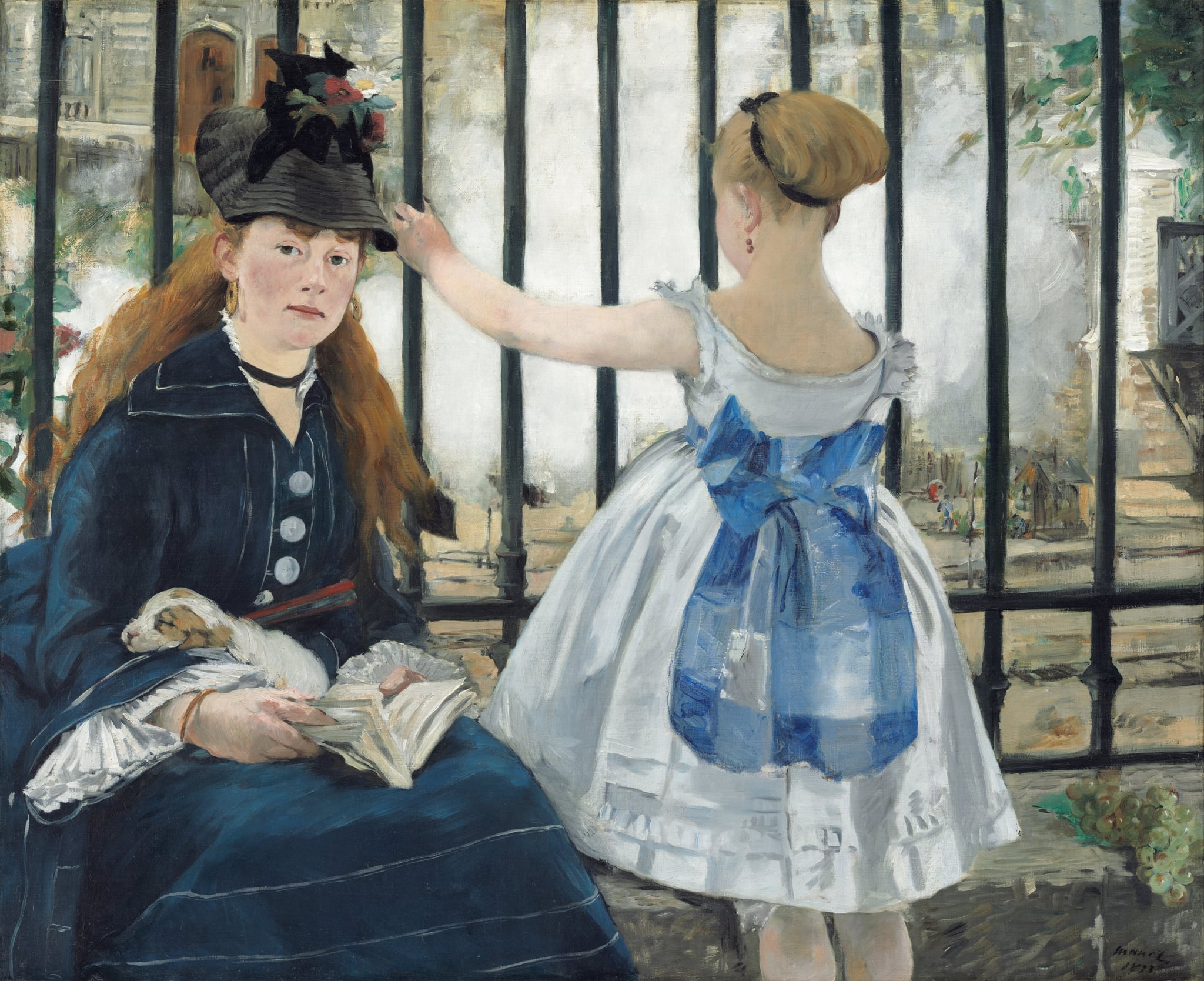
The Railway
Édouard Manet (1873)
Manet’s The Railway is a charged tableau of <strong>modern life</strong>: a composed woman confronts us while a child, bright in <strong>white and blue</strong>, peers through the iron fence toward a cloud of <strong>steam</strong>. The image turns a casual pause at the Gare Saint‑Lazare into a meditation on <strong>spectatorship, separation, and change</strong> <sup>[1]</sup><sup>[3]</sup>.
The Tub
Edgar Degas (1886)
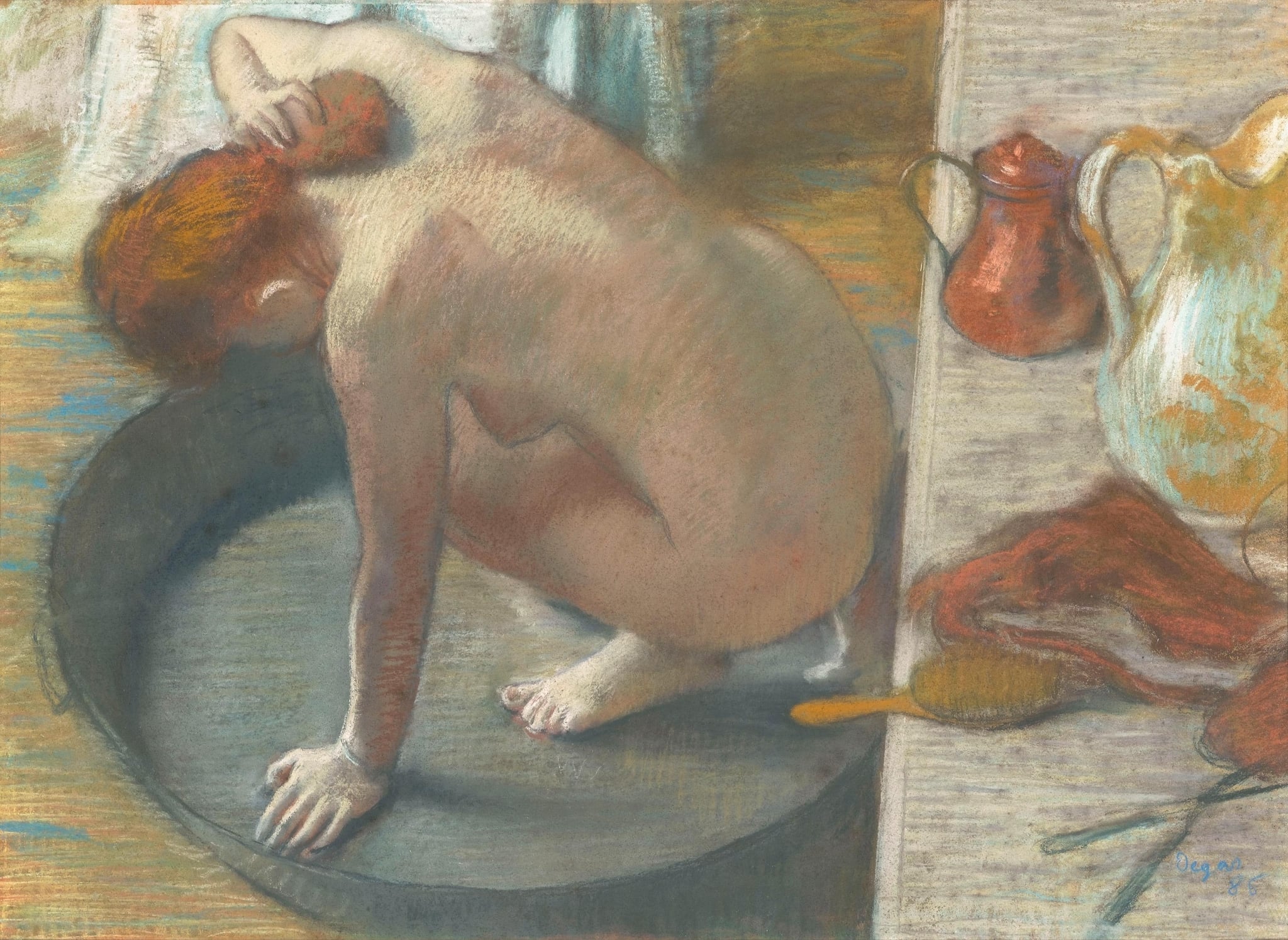
In The Tub (1886), Edgar Degas turns a routine bath into a study of <strong>modern solitude</strong> and <strong>embodied labor</strong>. From a steep, overhead angle, a woman kneels within a circular basin, one hand braced on the rim while the other gathers her hair; to the right, a tabletop packs a ewer, copper pot, comb/brush, and cloth. Degas’s layered pastel binds skin, water, and objects into a single, breathing field of <strong>warm flesh tones</strong> and blue‑greys, collapsing distance between body and still life <sup>[1]</sup>.
Woman at Her Toilette
Berthe Morisot (1875–1880)
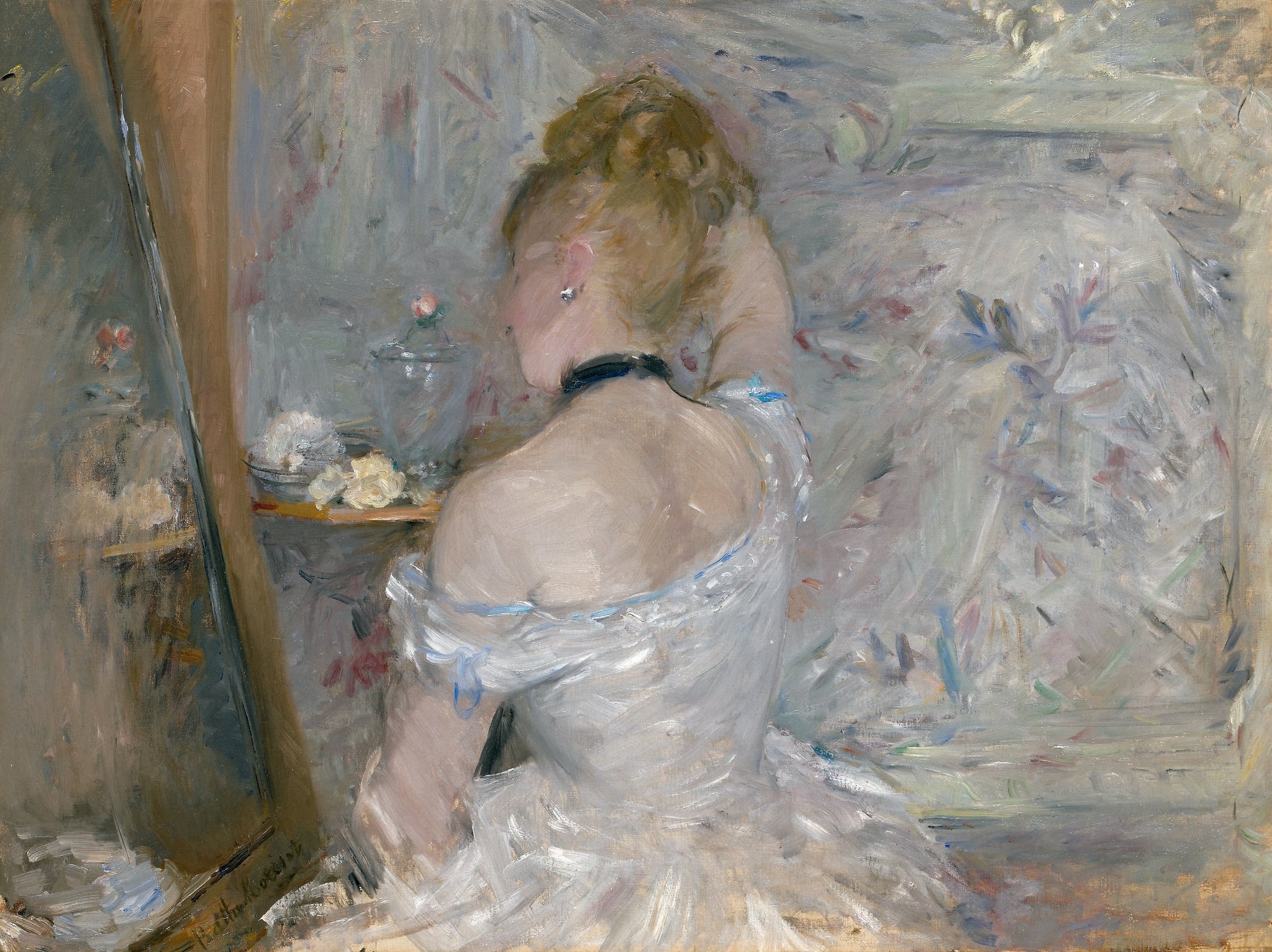
Woman at Her Toilette stages a private ritual of self-fashioning, not a spectacle of vanity. A woman, seen from behind, lifts her arm to adjust her hair as a <strong>black velvet choker</strong> punctuates Morisot’s silvery-violet haze; the <strong>mirror’s blurred reflection</strong> with powders, jars, and a white flower refuses a clear face. Morisot’s <strong>feathery facture</strong> turns a fleeting toilette into modern subjectivity made visible <sup>[1]</sup>.
Woman Reading
Édouard Manet (1880–82)
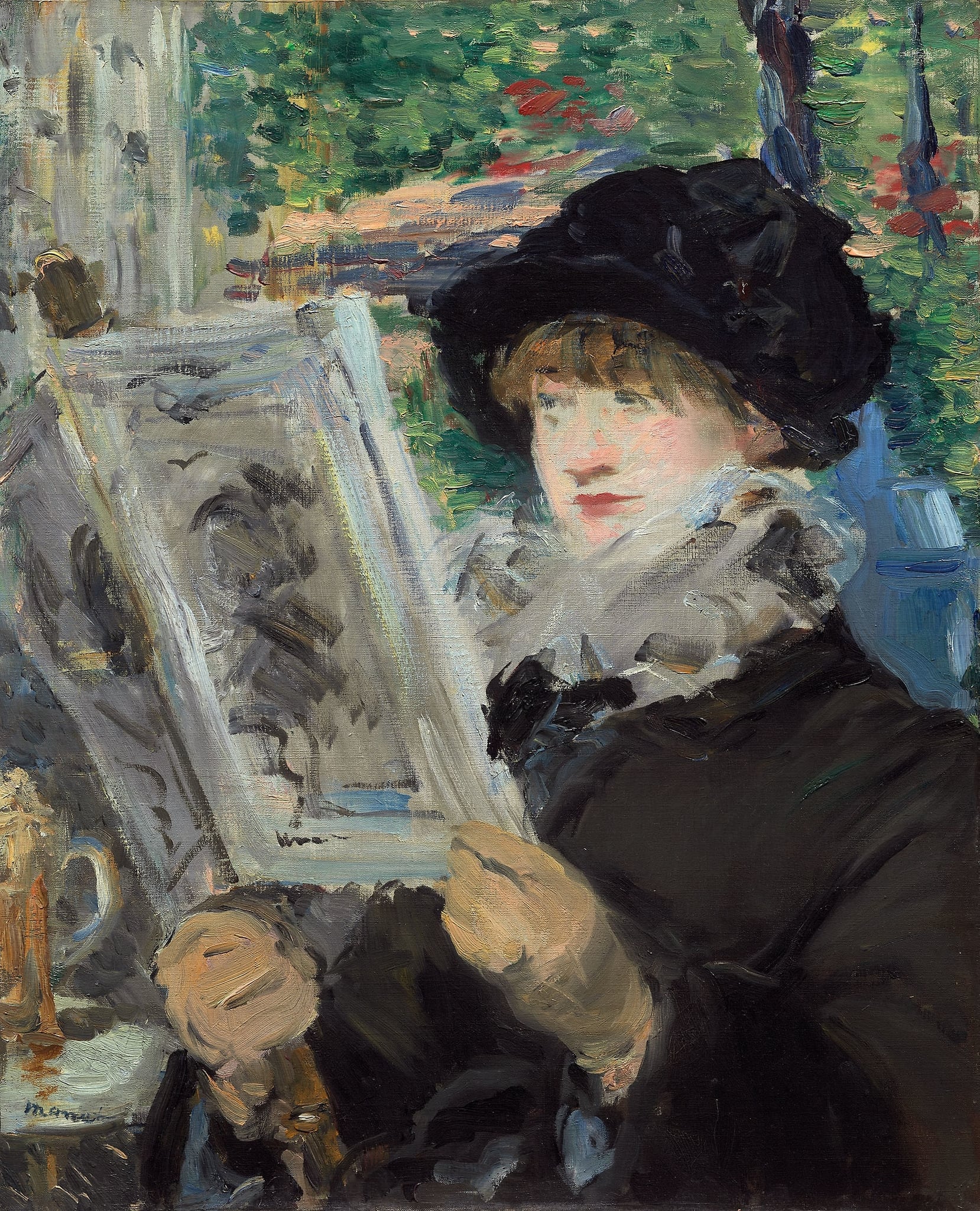
Manet’s Woman Reading distills a fleeting act into an emblem of <strong>modern self-possession</strong>: a bundled figure raises a journal-on-a-stick, her luminous profile set against a brisk mosaic of greens and reds. With quick, loaded strokes and a deliberately cropped <strong>beer glass</strong> and paper, Manet turns perception itself into subject—asserting the drama of a private mind within a public café world <sup>[1]</sup><sup>[2]</sup>.
Woman with a Parasol
Claude Monet (1875)
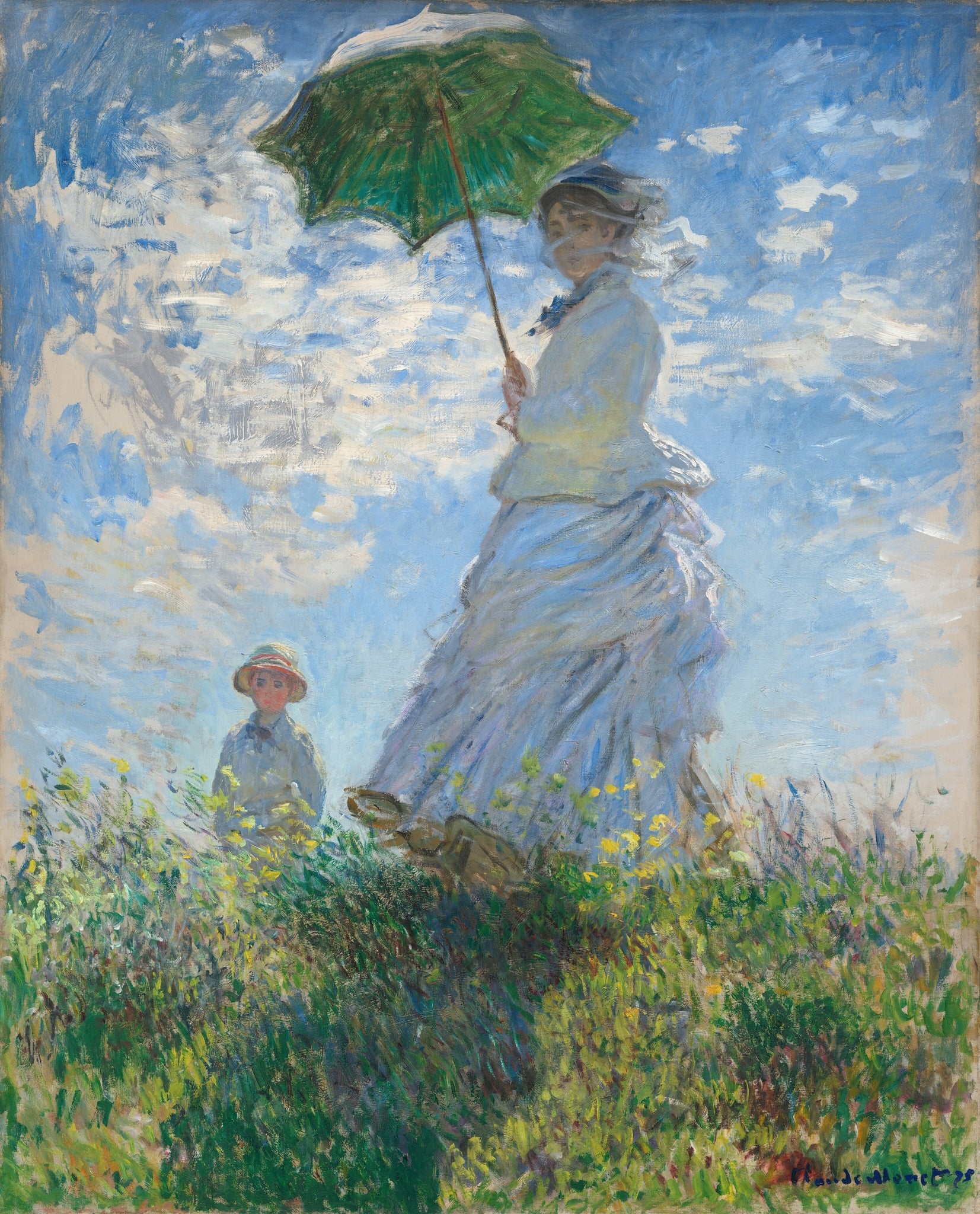
Claude Monet’s Woman with a Parasol fixes a breezy hillside instant in high, shifting light, setting a figure beneath a <strong>green parasol</strong> against a vast, vibrating sky. The low vantage and <strong>broken brushwork</strong> merge dress, clouds, and grasses into one atmosphere, while a child at the rise anchors depth and intimacy <sup>[1]</sup>. It is a manifesto of <strong>plein-air</strong> perception—painting the sensation of air in motion rather than the contours of things <sup>[2]</sup>.
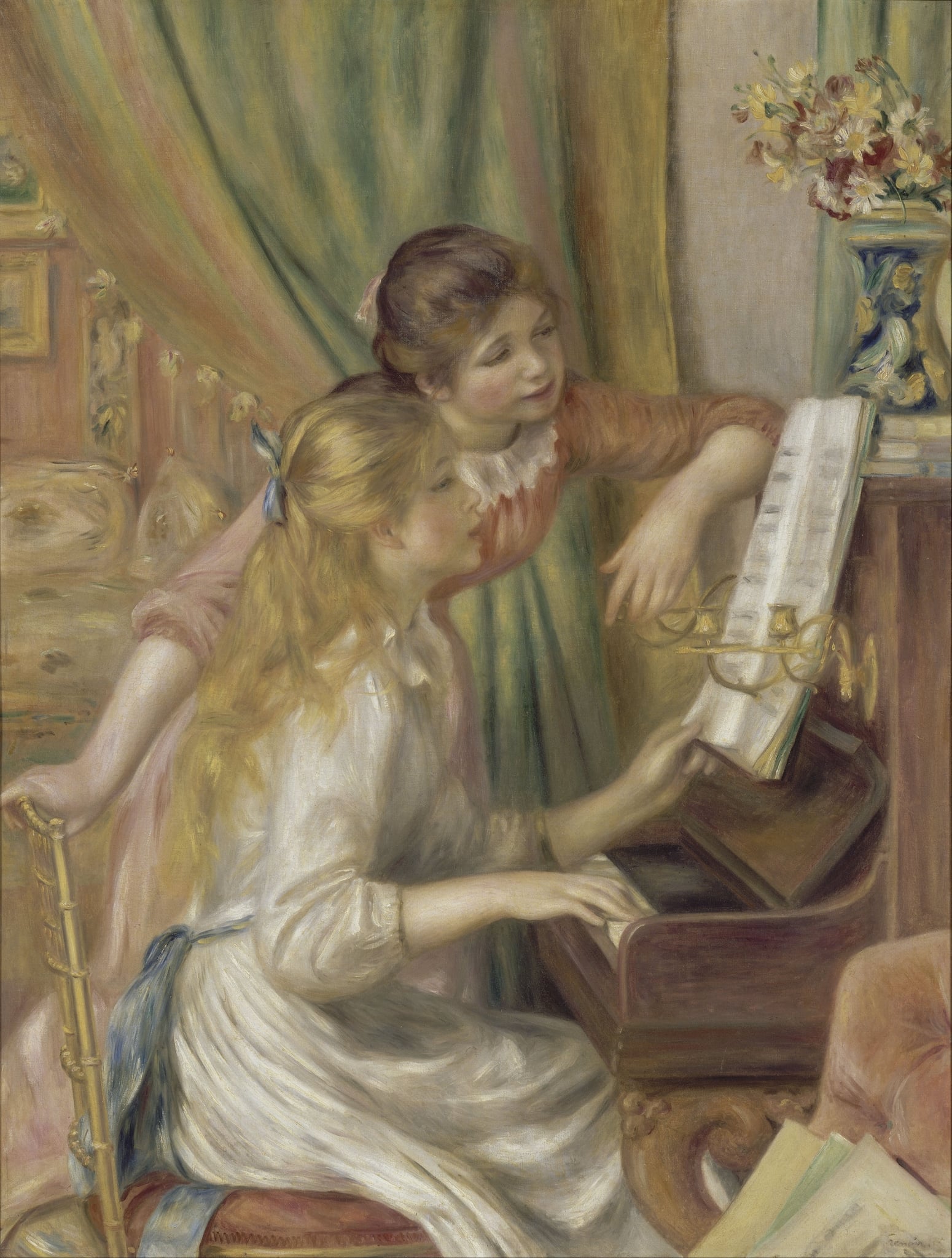
Young Girls at the Piano
Pierre-Auguste Renoir (1892)
Renoir’s Young Girls at the Piano turns a quiet lesson into a scene of <strong>attunement</strong> and <strong>bourgeois grace</strong>. Two adolescents—one seated at the keys, the other leaning to guide the score—embody harmony between discipline and delight, rendered in Renoir’s late, <strong>luminous</strong> touch <sup>[1]</sup><sup>[2]</sup>.
Related Themes
Related Symbolism Categories
Fashion
In Impressionist and related modern painting, fashion functions as a coded system of class, gender, and spectatorship, translating older allegorical and mythic meanings into the language of couture, accessories, and regulated bodily comportment.
Objects
Object symbols in modern and early modern painting transform everyday things—vessels, tools, clocks, mirrors, and branded goods—into compact arguments about labor, desire, time, and spectatorship, updating long iconographic traditions for a modern economy of signs.
Femininity
In late nineteenth‑century painting, femininity is articulated not as an essence but as a mutable ensemble of fashion, gesture, and setting, through which modern artists probe women’s visibility, labor, and agency within emerging urban and suburban worlds.
Within the long history of Western art, the problem of interiority—how to render thought, affect, and self-consciousness in a medium of surfaces—has generated a distinctive repertoire of signs. From Renaissance profile portraits to Romantic reveries, artists have relied on pose, gaze, and modest accessories to intimate what cannot be directly seen. In the modern period, this symbolic vocabulary both contracts and intensifies: instead of grand allegories of the soul, one encounters averted eyes, folded hands, idle opera glasses, or a blurred mirror, each a minute but charged index of inwardness. The works considered here, by Manet, Renoir, Degas, Monet, Morisot, and Van Gogh, deploy such signs not to stabilize psychological meaning, but to stage interiority as unstable, socially mediated, and at times fundamentally opaque.
The gaze is a primary vehicle for this modern semiotics of interior life. In A Bar at the Folies-Bergère, Manet’s barmaid Suzon confronts us frontally, yet her expression hovers between presence and withdrawal. Her drooping eyelids and averted gaze signal “fatigue and guardedness amid visibility; inwardness within public life.” Semiologically, this is a refusal of reciprocity: although her body is presented as a surface for consumption, her eyes do not complete the circuit of desire. Iconographically, Manet reworks the long tradition of the female figure turning aside—with roots in modest Madonnas and demure court portraiture—into a sign of alienated modern subjectivity. The mirror behind her, defined here as a figure of “instability of perception and fractured modern identity,” compounds the problem. Instead of confirming a unified self, the reflection dislocates Suzon’s body and doubles the scene from an oblique angle, making interiority inseparable from the distortions of spectatorship and commodified display.
In Renoir’s more intimate scenes, the rhetoric of interiority shifts from guarded withdrawal to suspended possibility. In the Garden turns on a confrontational gaze/frontality that is, paradoxically, a sign of interior regulation rather than transparency. The young woman faces outward, shoulders squared, engaging the viewer while her lightly clasped hands with her companion encode “courtship, a tentative bond, emotional petition versus restraint.” Semiologically, the joined hands function as the hinge between inner feeling and public decorum; they are neither a loose gesture nor an embrace, but a provisional contact whose very tentativeness makes the unspoken negotiation legible. Renoir allows the woman’s steadied gaze to check the man’s forward lean, staging interior resolve as an embodied, spatial relation. The café-garden becomes an externalization of inward ambivalence: Impressionist flicker and foliage surround a psychological micro-drama focused into the minute symbolism of touch and regard.
A related yet distinct mode of interiority appears in Renoir’s Portrait of Jeanne Samary. Here the sitter’s head propped on hand recalls the canonical “hand-to-cheek” pose long associated with “melancholy and weary contemplation.” Renoir’s description stresses that the pose forms a stabilizing triangle in an otherwise vaporous field of coral-pink and blue-green. In semiotic terms, the prop of the hand is a hinge between body and thought, an economical sign that the mind is elsewhere even as the sitter submits to being seen. Iconographically, this recodes the early modern “melancholy” motif, familiar from Dürer to 18th-century salon portraiture, into a fleeting modern poise. Jeanne’s expression is not a grand allegory of Saturnine temperament but a momentary, perhaps performative, reverie—interiority as a radiant state of color and touch rather than a fixed psychological essence.
Van Gogh radicalizes this vocabulary in the Portrait of Dr. Gachet, where the hand-to-cheek pose becomes the central armature of a chromatic drama. Defined here as “a classic sign of melancholy and weary contemplation,” the gesture is intensified by the “greenish hand” and “waves of cobalt and ultramarine” surrounding the sitter. Semiologically, Van Gogh treats the timeworn iconographic sign as a kind of visual verb—‘to brood, to endure’—and then amplifies its force through dissonant color. The orange-red table is not merely a setting but a counterweight to psychic chill, a hot plane that prevents the blue from swallowing the subject entirely. Interiority in this late-19th-century register is no longer inferred solely from pose; it is externalized as a weather system in the paint itself, an environment of tumult that makes the sitter’s fragile stability legible.
If gaze and hand articulate interior life in these portraits and tête-à-tête scenes, other works foreground the tools and thresholds of self-presentation. Berthe Morisot’s Woman at Her Toilette (evoked in the symbolism of the mirror with blurred reflection and the black velvet choker) displaces interiority from facial expression onto accessories and reflective surfaces. The mirror, whose “hazy reflection… withholds a clear face and redirects looking,” refuses the traditional function of the toilette as a stage for vanity and self-display. Instead of confirming an image of the self, it presents only powders, jars, and a white flower—objects of grooming without the promised revelation. The black velvet choker, “the clearest, sharpest sign of modern self-fashioning,” concentrates subjectivity into a single, decisive accessory. Semiologically, Morisot inverts the hierarchy: the face, blurred and withheld, ceases to guarantee interior truth; a slender band of fabric and a smear of paint at the neck carry the weight of self-definition. Interiority becomes a question of mediated, constructed identity rather than an inner essence legible in the eyes.
A comparable displacement structures Edgar Degas’s Combing the Hair, though here interiority is refracted through labor and bodily tension rather than through mirrors or gaze. The attendant’s apron and work blouse mark her as “service and classed labor; professionalism without sentimentality,” while the sitter’s bracing hand and crouched pose—or more precisely her arm extended to steady herself—encode “embodied labor and balance; the effortful, worklike aspect of bathing.” The toilette, a quintessential locus of self-fashioning and erotic display in earlier art, is reconfigured as a scene where interior life is registered in muscular effort, in the choreography of yielding and pulling. The attendant’s absorbed, almost abstracted face withholds psychological narrative; instead, interiority migrates into the torque of limbs and the incandescent red field that fuses bodies and room. As in Van Gogh, paint itself becomes an index of inward intensity, but without the explicit melancholy of the hand-to-cheek motif.
Across these examples, a network of related symbols—gazes that meet or evade, hands that clasp, brace, or support the head, mirrors that double or blur, modest accessories like chokers and aprons—forms a modern iconography of interiority. Yet this lexicon is decidedly unstable. Manet’s averted, fatigued eyes signal guardedness amidst spectacle; Renoir’s direct, poised gazes stage controlled sociability and tentative desire; Morisot’s blurred reflection denies access altogether, while Van Gogh’s amplified melancholy transposes interior states into chromatic and tactile excess. Over the second half of the 19th century, these symbols are not abandoned so much as reinterpreted: the old rhetorical gestures of introspection and modesty are redirected toward questions of alienation, self-fashioning, and the limits of knowledge about others. Interiority, once figured as a knowable psychological depth behind the mask of the face, becomes in these works a contested surface phenomenon—glimpsed in averted eyes, suspended in a clasp of hands, or dispersed in a vibrating field of color.