Fashion
In Impressionist and related modern painting, fashion functions as a coded system of class, gender, and spectatorship, translating older allegorical and mythic meanings into the language of couture, accessories, and regulated bodily comportment.
Member Symbols
Featured Artworks
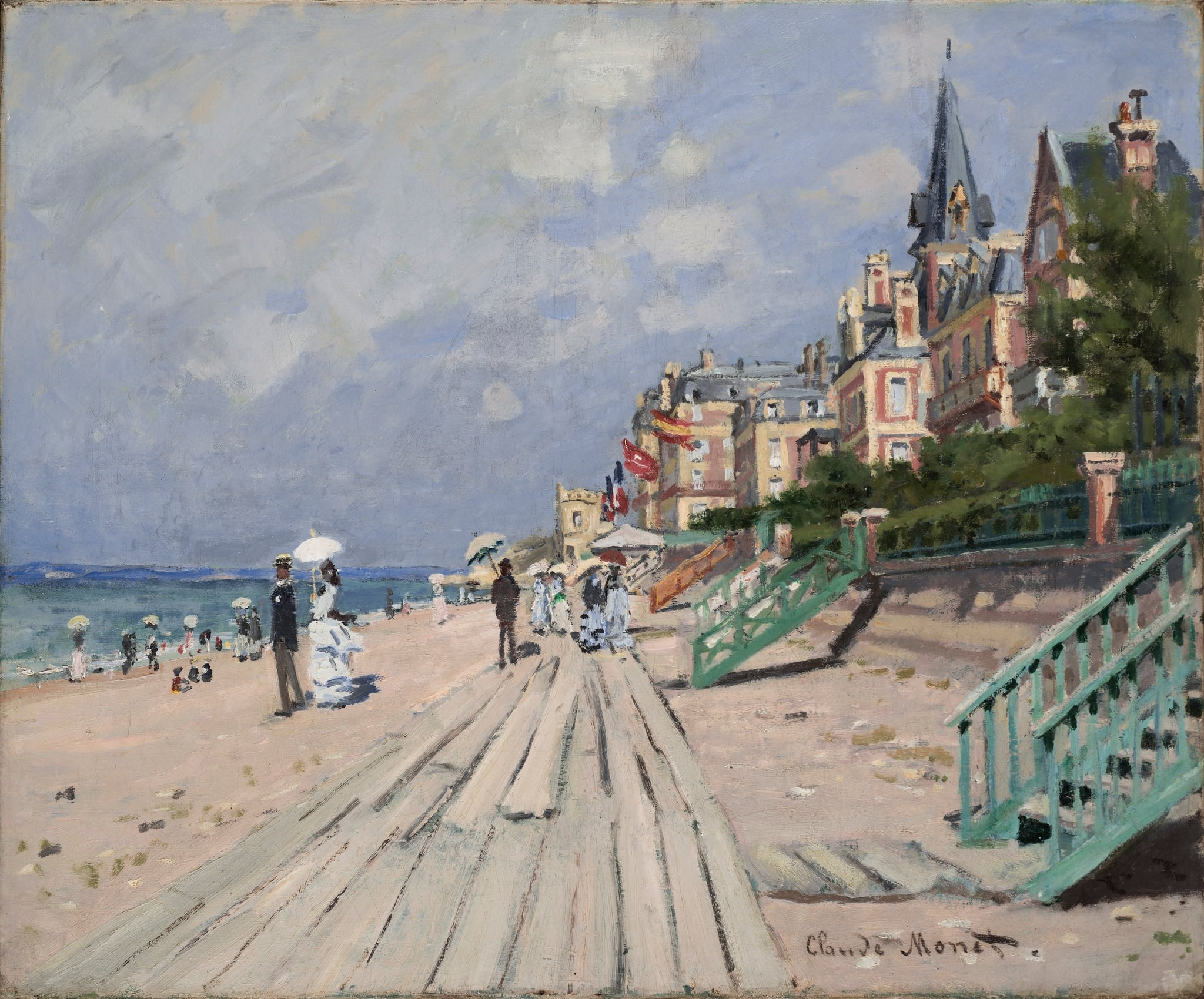
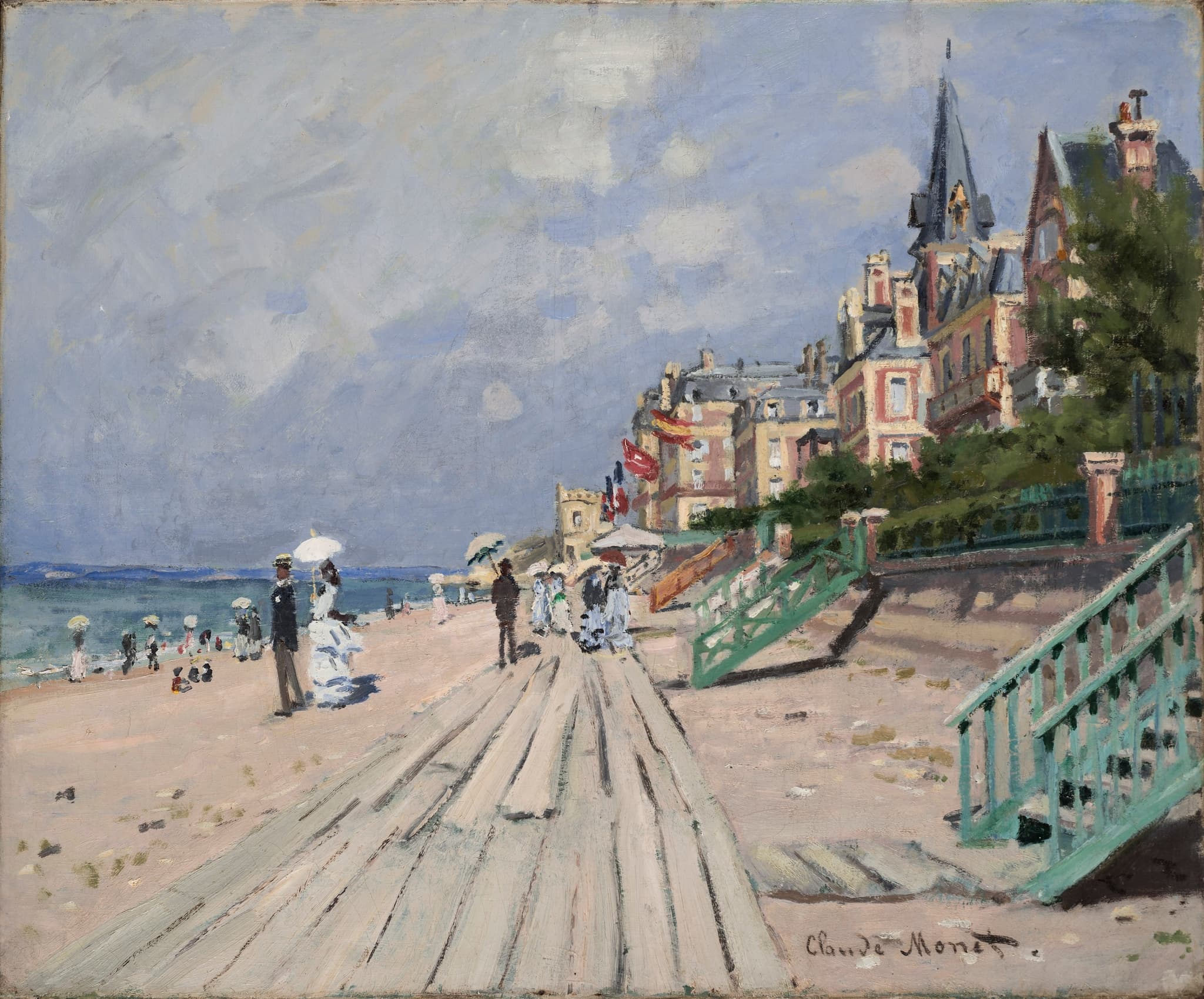
Beach at Trouville
Claude Monet (1870)
Beach at Trouville turns the Normandy resort into a stage where <strong>modern leisure</strong> meets <strong>restless weather</strong>. Monet’s diagonal boardwalk, wind-whipped <strong>red flags</strong>, and white <strong>parasols</strong> marshal the eye through a day animated by light and air rather than by individual stories <sup>[1]</sup><sup>[2]</sup>. The work asserts Impressionism’s claim to immediacy—there is even <strong>sand embedded in the paint</strong> from working on site <sup>[1]</sup>.
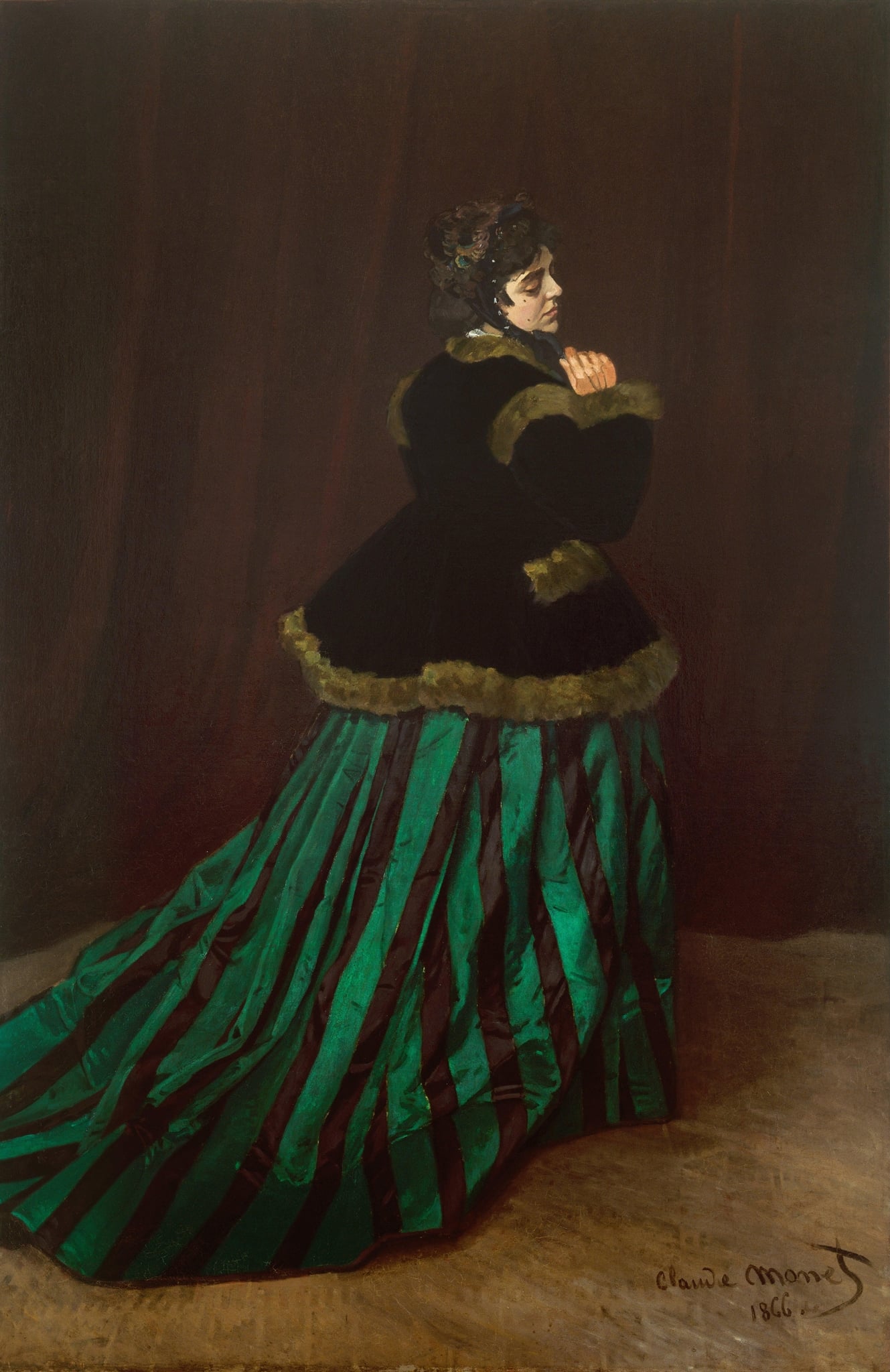
Camille (The Woman in the Green Dress)
Claude Monet (1866)
Monet’s Camille (The Woman in the Green Dress) turns a full-length portrait into a study of <strong>modern spectacle</strong>. The spotlit emerald-and-black skirt, set against a near-black curtain, makes <strong>fashion</strong> the engine of meaning and the vehicle of status.
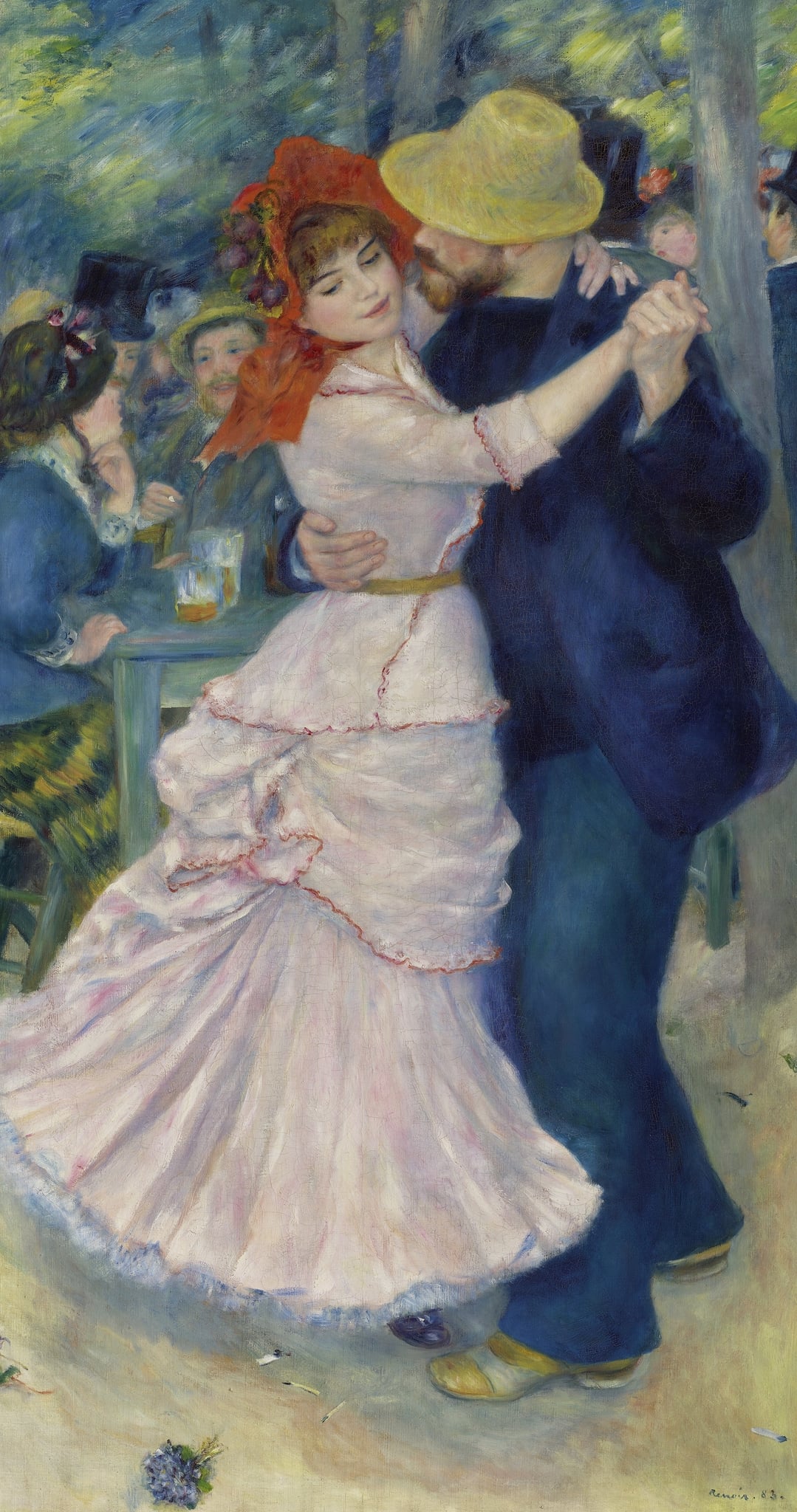
Dance at Bougival
Pierre-Auguste Renoir (1883)
In Dance at Bougival, Pierre-Auguste Renoir turns a crowded suburban dance into a <strong>private vortex of intimacy</strong>. Rose against ultramarine, skin against shade, and a flare of the woman’s <strong>scarlet bonnet</strong> concentrate the scene’s energy into a single turning moment—modern leisure made palpable as <strong>touch, motion, and light</strong> <sup>[1]</sup><sup>[2]</sup>.
Dance in the City
Pierre-Auguste Renoir (1883)
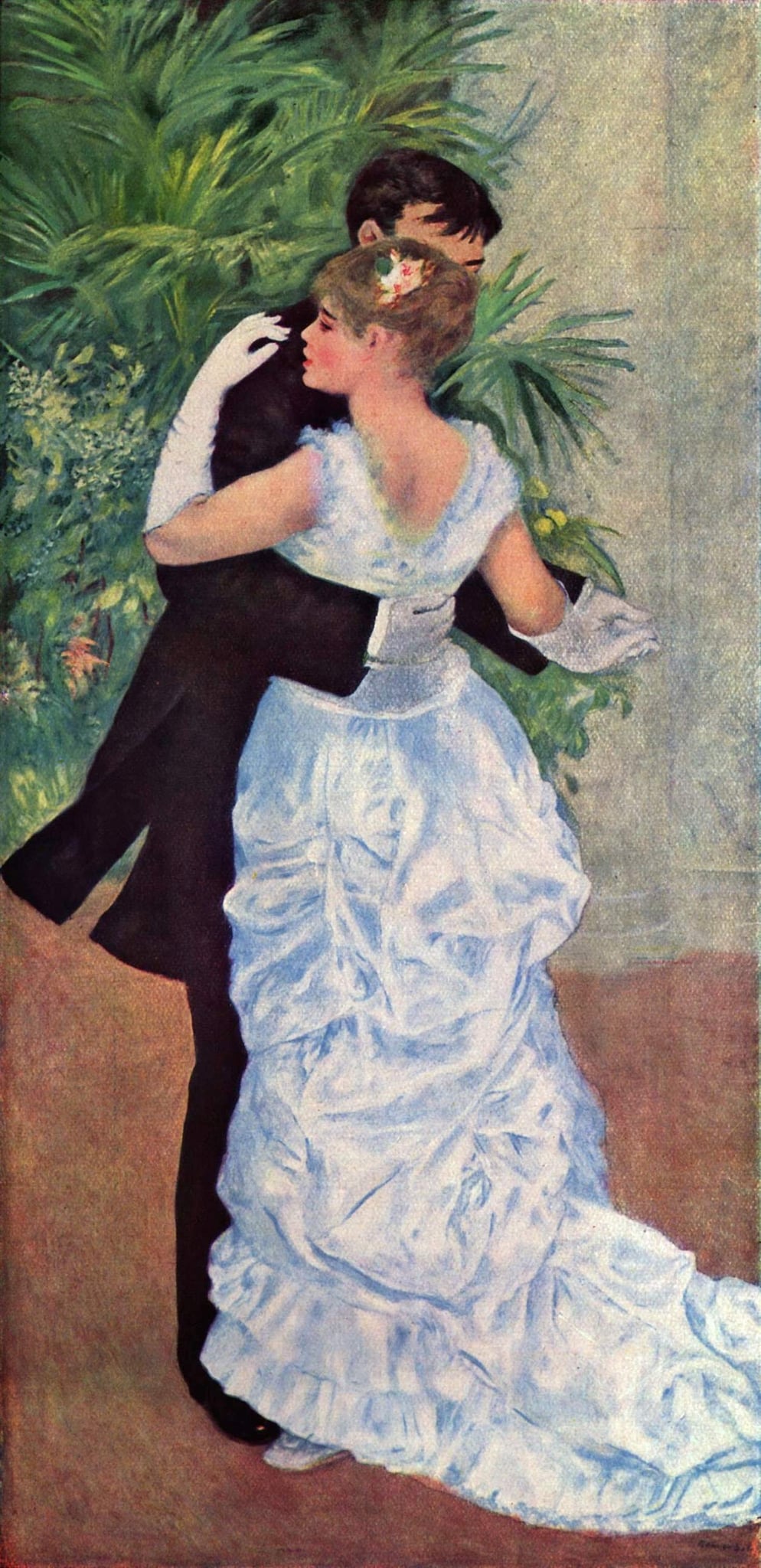
Pierre-Auguste Renoir’s Dance in the City stages an urban waltz where decorum and desire briefly coincide. A couple’s close embrace—his black tailcoat enclosing her luminous white satin gown—creates a <strong>cool, elegant</strong> harmony against potted palms and marble. Renoir’s refined, post‑Impressionist touch turns social ritual into <strong>sensual modernity</strong> <sup>[1]</sup><sup>[2]</sup>.
In the Garden
Pierre-Auguste Renoir (1885)
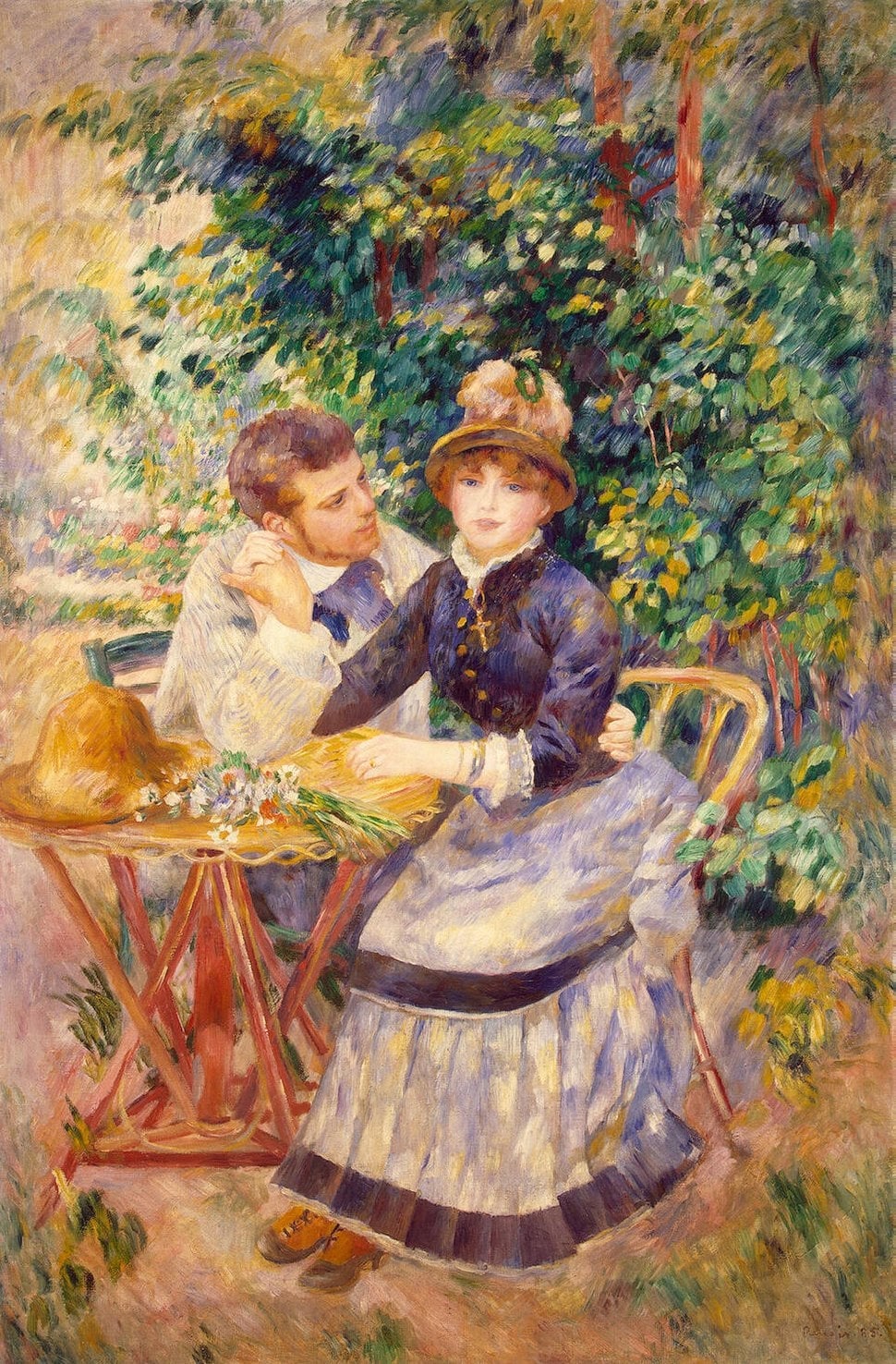
In the Garden presents a charged pause in modern leisure: a young couple at a café table under a living arbor of leaves. Their lightly clasped hands and the bouquet on the tabletop signal courtship, while her calm, front-facing gaze checks his lean. Renoir’s flickering brushwork fuses figures and foliage, rendering love as a <strong>transitory, luminous sensation</strong> <sup>[1]</sup><sup>[3]</sup>.
Jeanne (Spring)
Édouard Manet (1881)
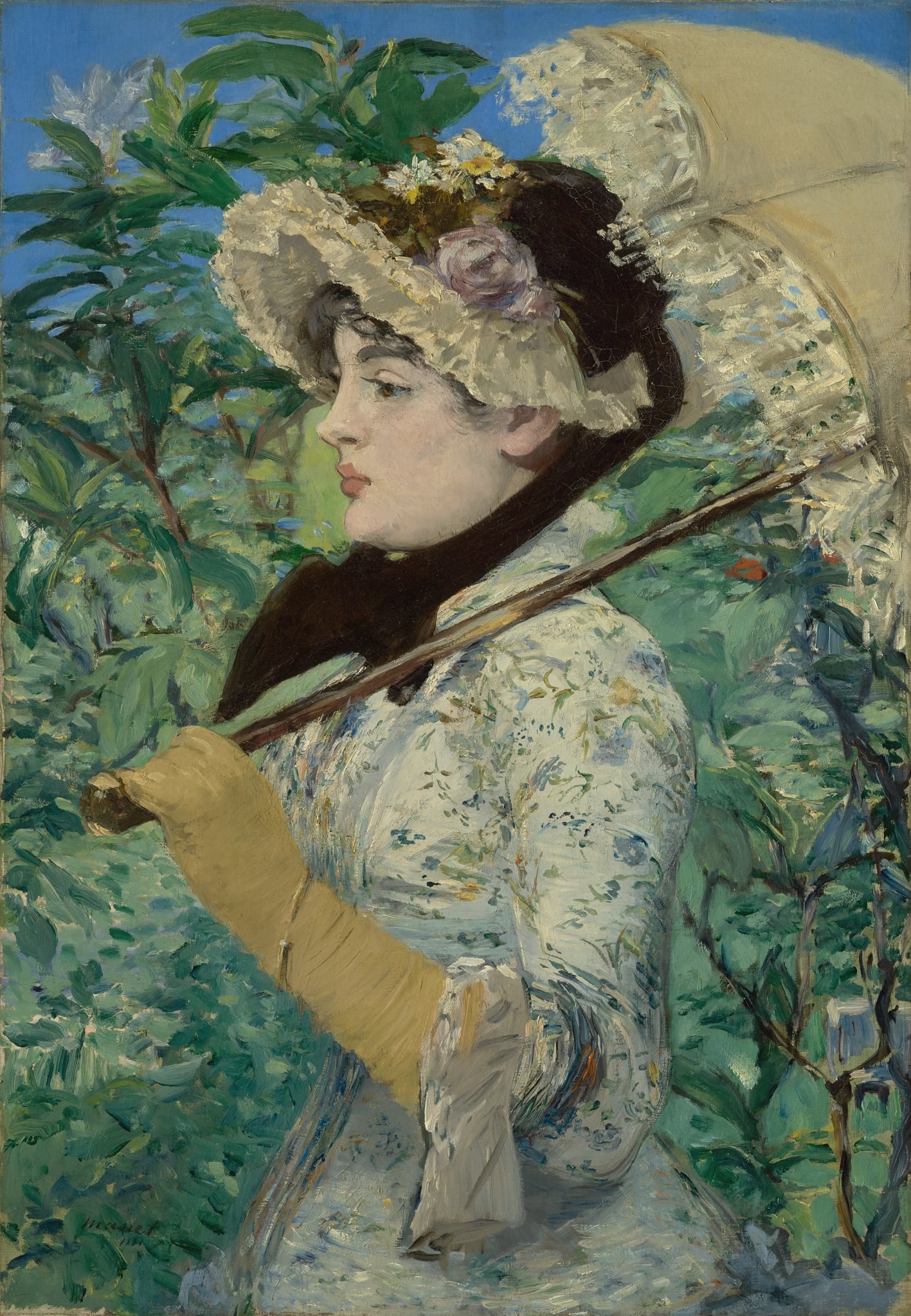
Édouard Manet’s Jeanne (Spring) fuses a time-honored allegory with <strong>modern Parisian fashion</strong>: a crisp profile beneath a cream parasol, set against <strong>luminous, leafy greens</strong>. Manet turns couture—hat, glove, parasol—into the language of <strong>renewal and youth</strong>, making spring feel both perennial and up-to-the-minute <sup>[1]</sup><sup>[2]</sup>.
Madame Monet and Her Son
Pierre-Auguste Renoir (1874)
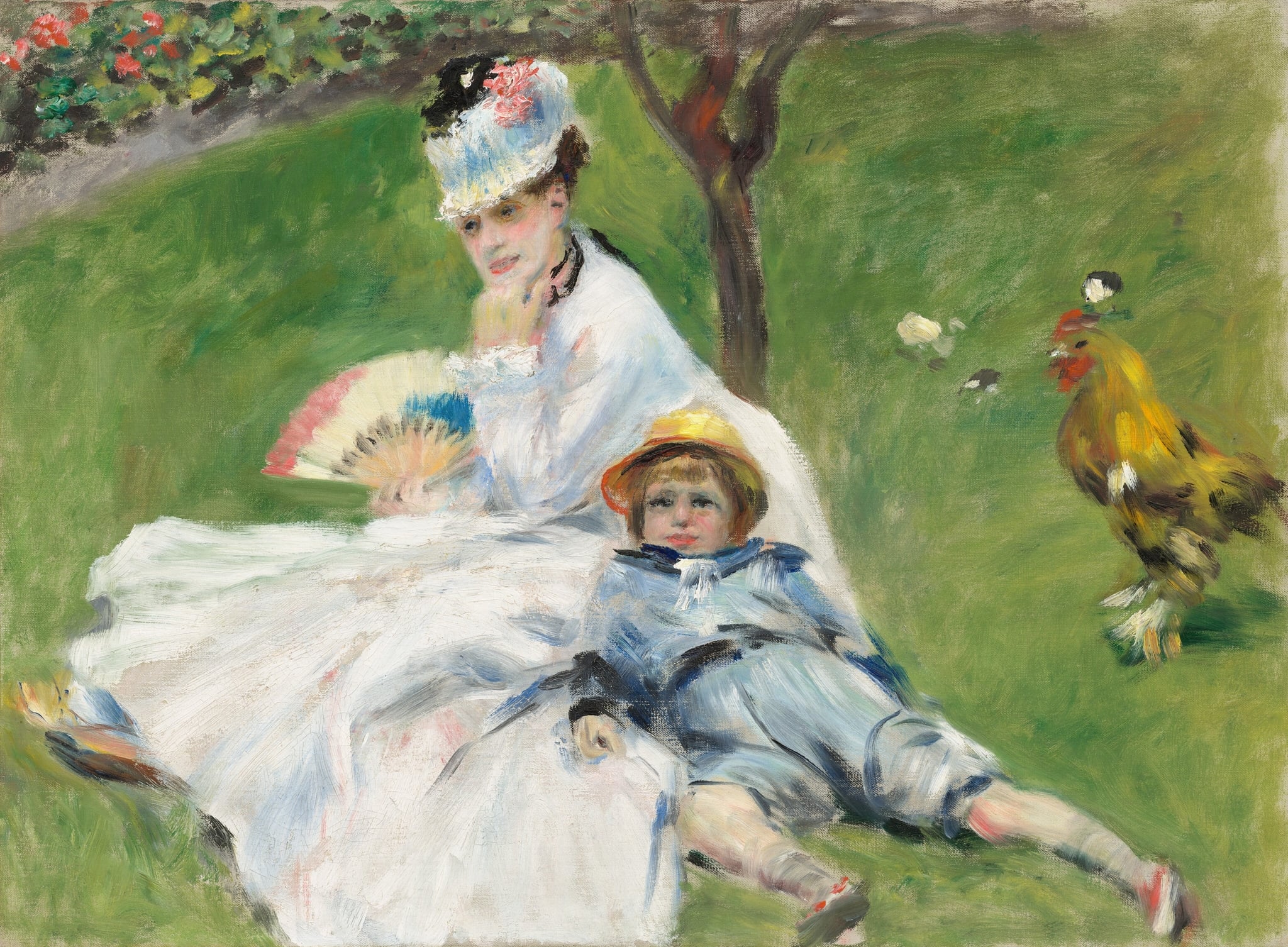
Renoir’s 1874 canvas Madame Monet and Her Son crystallizes <strong>modern domestic leisure</strong> and <strong>plein‑air immediacy</strong> in Argenteuil. A luminous white dress pools into light while a child in a pale‑blue sailor suit reclines diagonally; a strutting rooster punctuates the greens with warm color. The brushwork fuses figure and garden so the moment reads as <strong>lived, not staged</strong> <sup>[1]</sup><sup>[2]</sup><sup>[5]</sup>.
Olympia
Édouard Manet (1863 (Salon 1865))
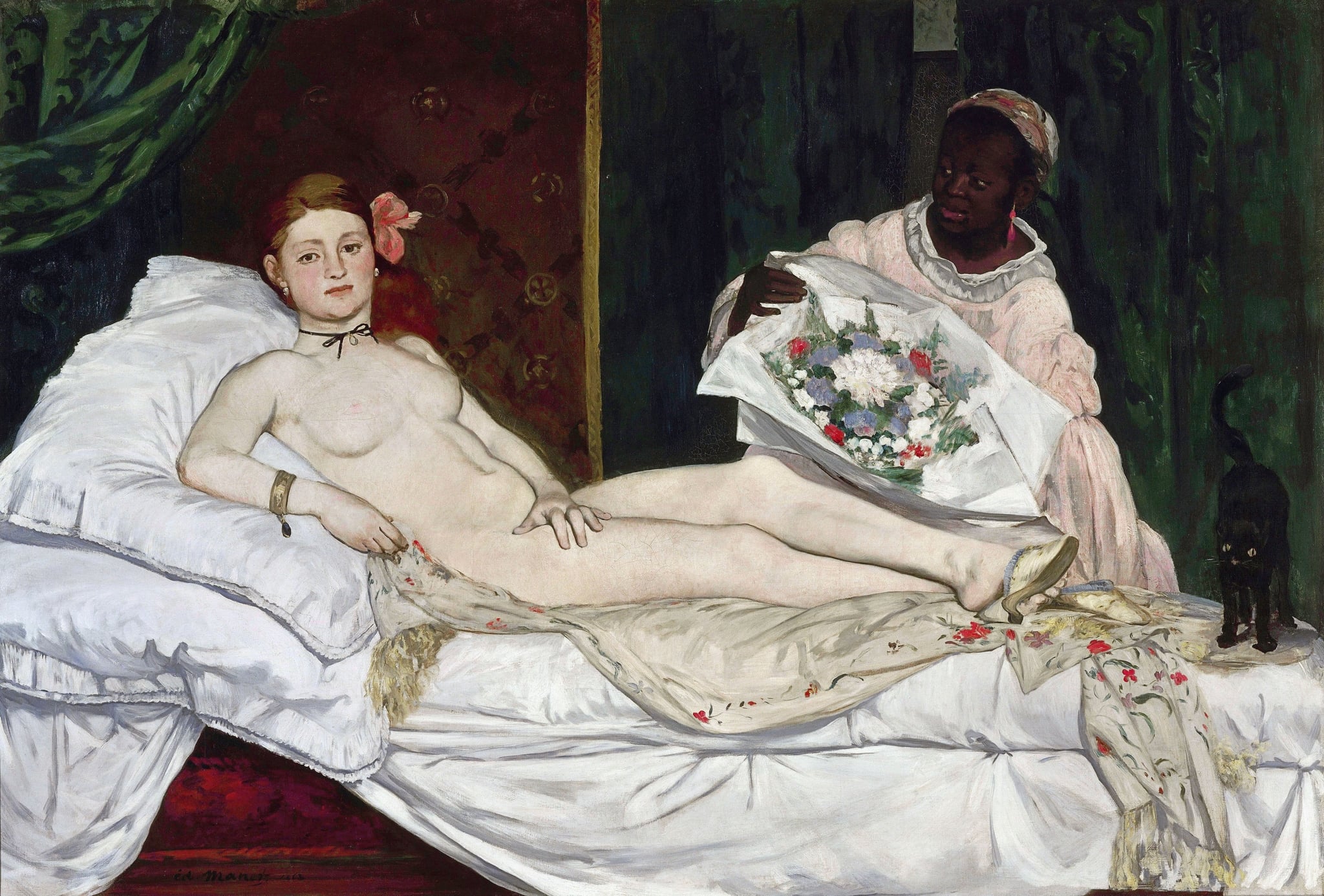
A defiantly contemporary nude confronts the viewer with a steady gaze and a guarded pose, framed by crisp light and luxury trappings. In Olympia, <strong>Édouard Manet</strong> strips myth from the female nude to expose the <strong>modern economy of desire</strong>, power, and looking <sup>[1]</sup><sup>[3]</sup>.
Regatta at Sainte-Adresse
Claude Monet (1867)
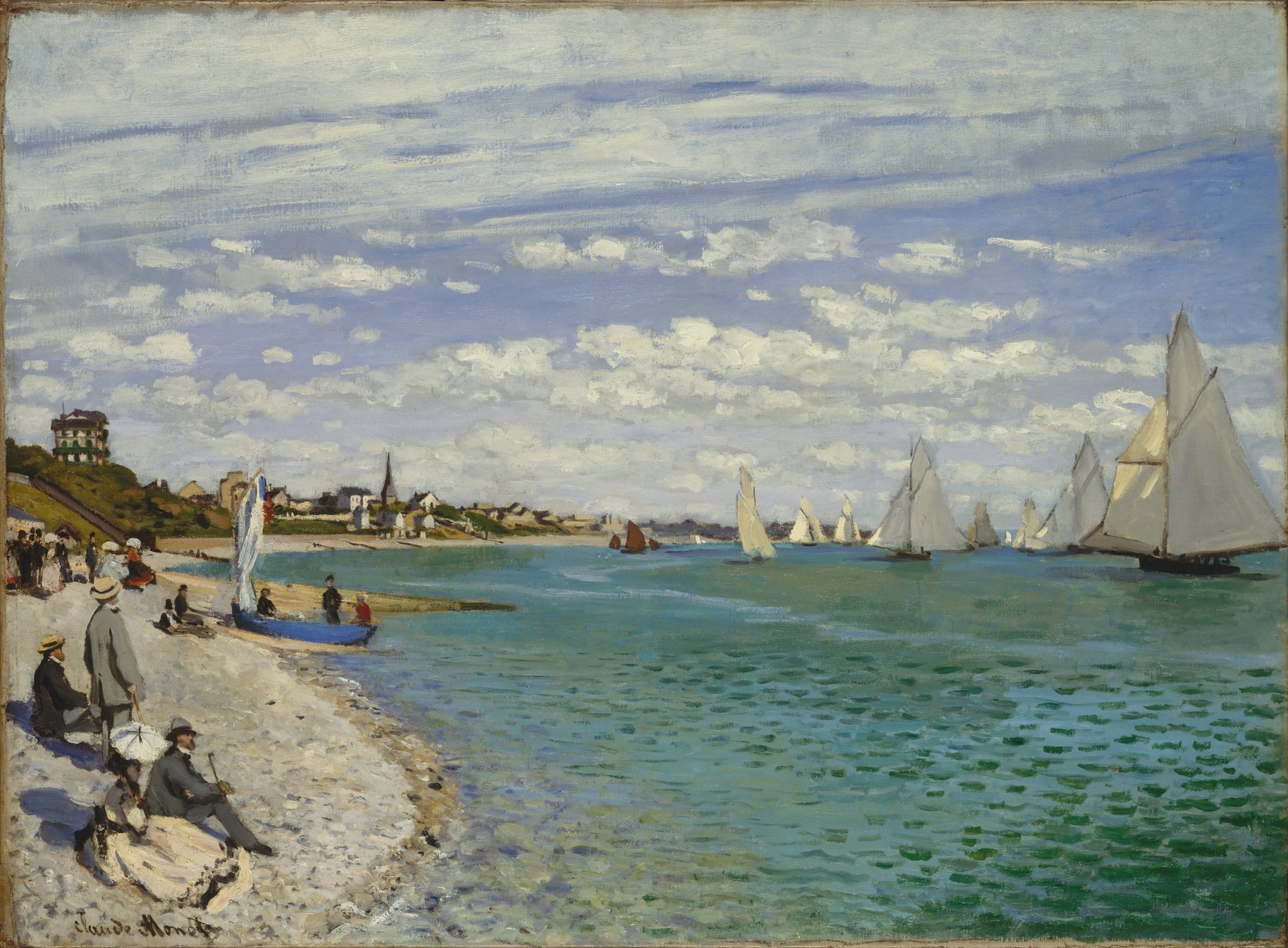
On a brilliant afternoon at the Normandy coast, a diagonal <strong>pebble beach</strong> funnels spectators with parasols toward a bay scattered with <strong>white-sailed yachts</strong>. Monet’s quick, broken strokes set <strong>wind, water, and light</strong> in synchrony, turning a local regatta into a modern scene of leisure held against the vastness of sea and sky <sup>[1]</sup><sup>[2]</sup>.
Summer's Day
Berthe Morisot (about 1879)
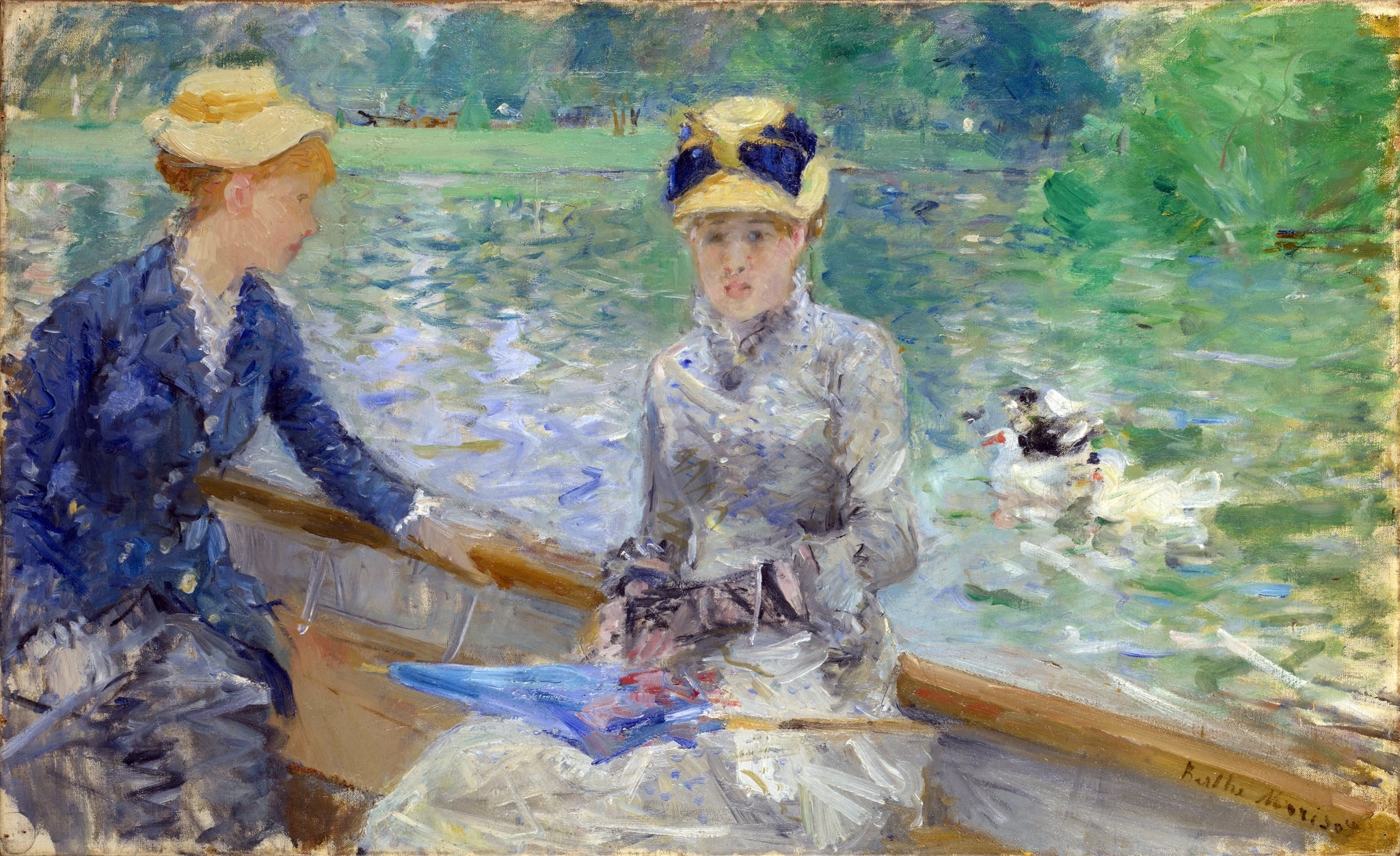
Two women drift on a boat in the Bois de Boulogne, their dresses, hats, and a bright blue parasol fused with the lake’s flicker by Morisot’s swift, <strong>zig‑zag brushwork</strong>. The scene turns a brief outing into a poised study of <strong>modern leisure</strong> and <strong>female companionship</strong> in public space <sup>[1]</sup>.
The Ballet Class
Edgar Degas (1873–1876)
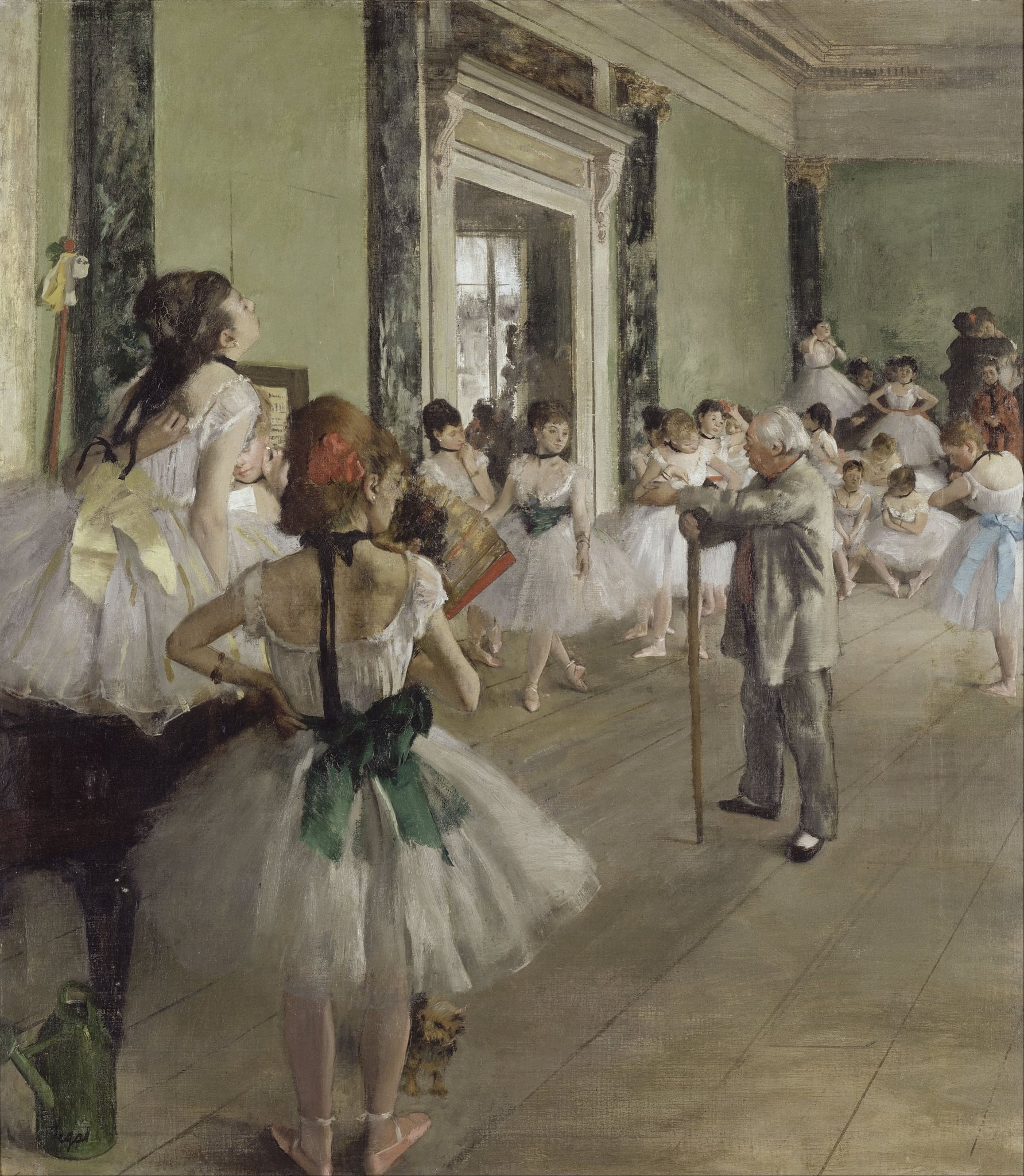
<strong>The Ballet Class</strong> shows the work behind grace: a green-walled studio where young dancers in white tutus rest, fidget, and stretch while the gray-suited master stands with his cane. Degas’s diagonal floorboards, cropped viewpoints, and scattered props—a watering can, a music stand, even a tiny dog—stage a candid vision of routine rather than spectacle. The result is a modern image of discipline, hierarchy, and fleeting poise.
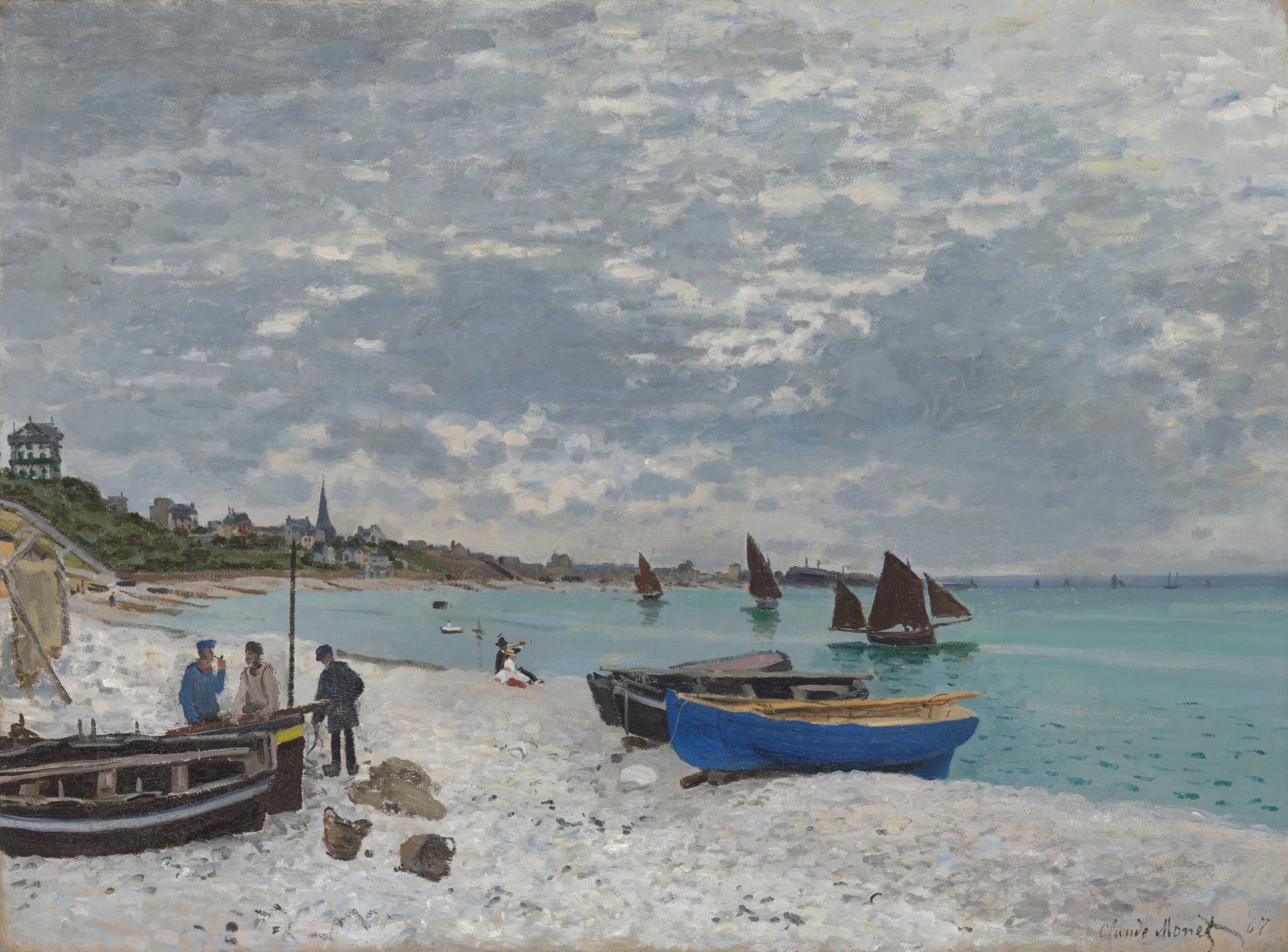
The Beach at Sainte-Adresse
Claude Monet (1867)
In The Beach at Sainte-Adresse, Claude Monet stages a modern shore where <strong>labor and leisure intersect</strong> under a broad, changeable sky. The bright <strong>blue beached boat</strong> and the flotilla of <strong>rust-brown working sails</strong> punctuate a turquoise channel, while a fashionably dressed pair sits mid-beach, spectators to the traffic of the port. Monet’s brisk, broken strokes make the scene feel <strong>caught between tides and weather</strong>, a momentary balance of work, tourism, and atmosphere <sup>[1]</sup><sup>[2]</sup>.
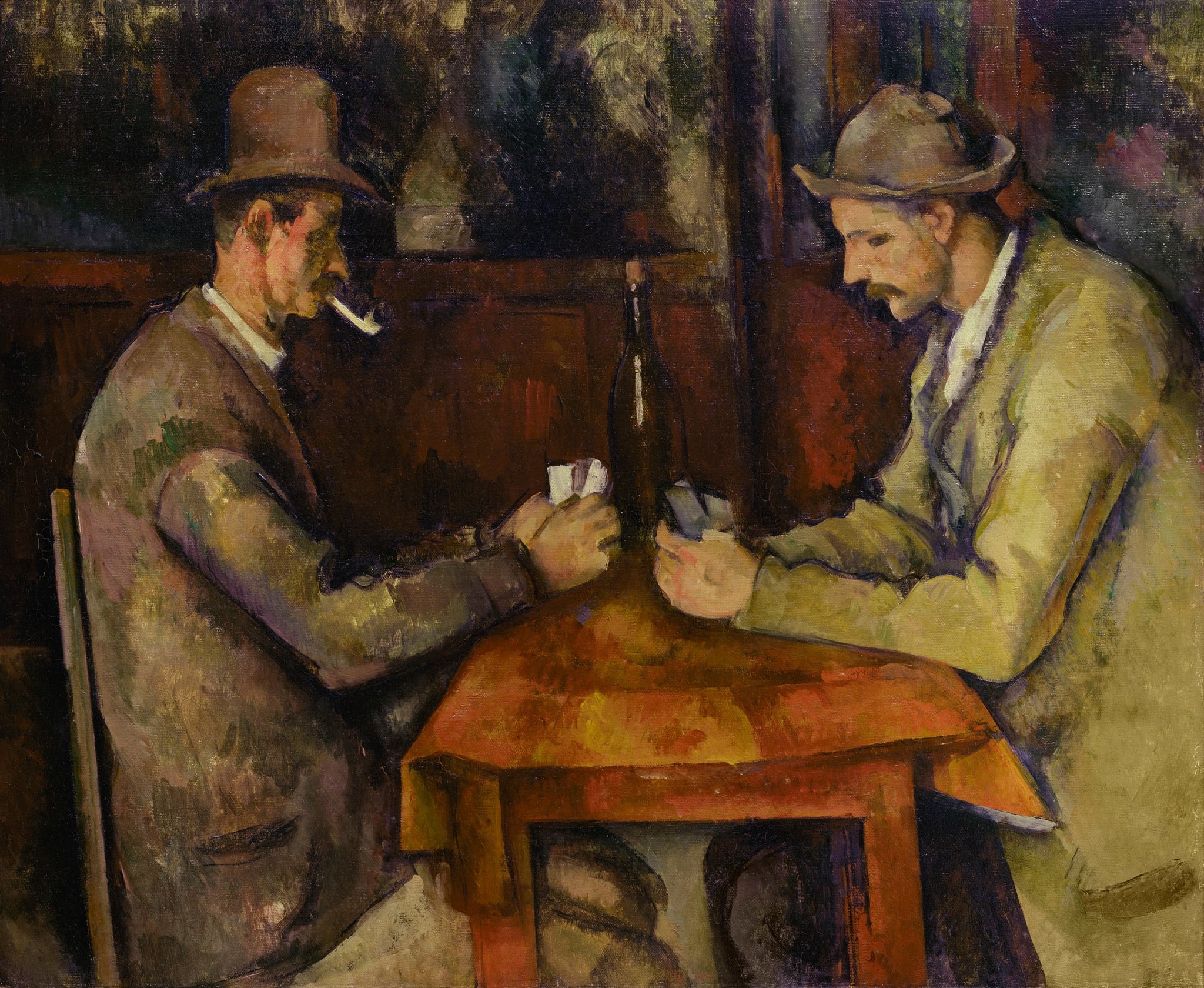
The Card Players by Paul Cézanne | Equilibrium and Form
Paul Cézanne
In The Card Players, Paul Cézanne turns a rural café game into a study of <strong>equilibrium</strong> and <strong>monumentality</strong>. Two hated peasants lean inward across an orange-brown table while a dark bottle stands upright between them, acting as a calm, vertical <strong>axis</strong> that stabilizes their mirrored focus <sup>[2]</sup><sup>[3]</sup>.
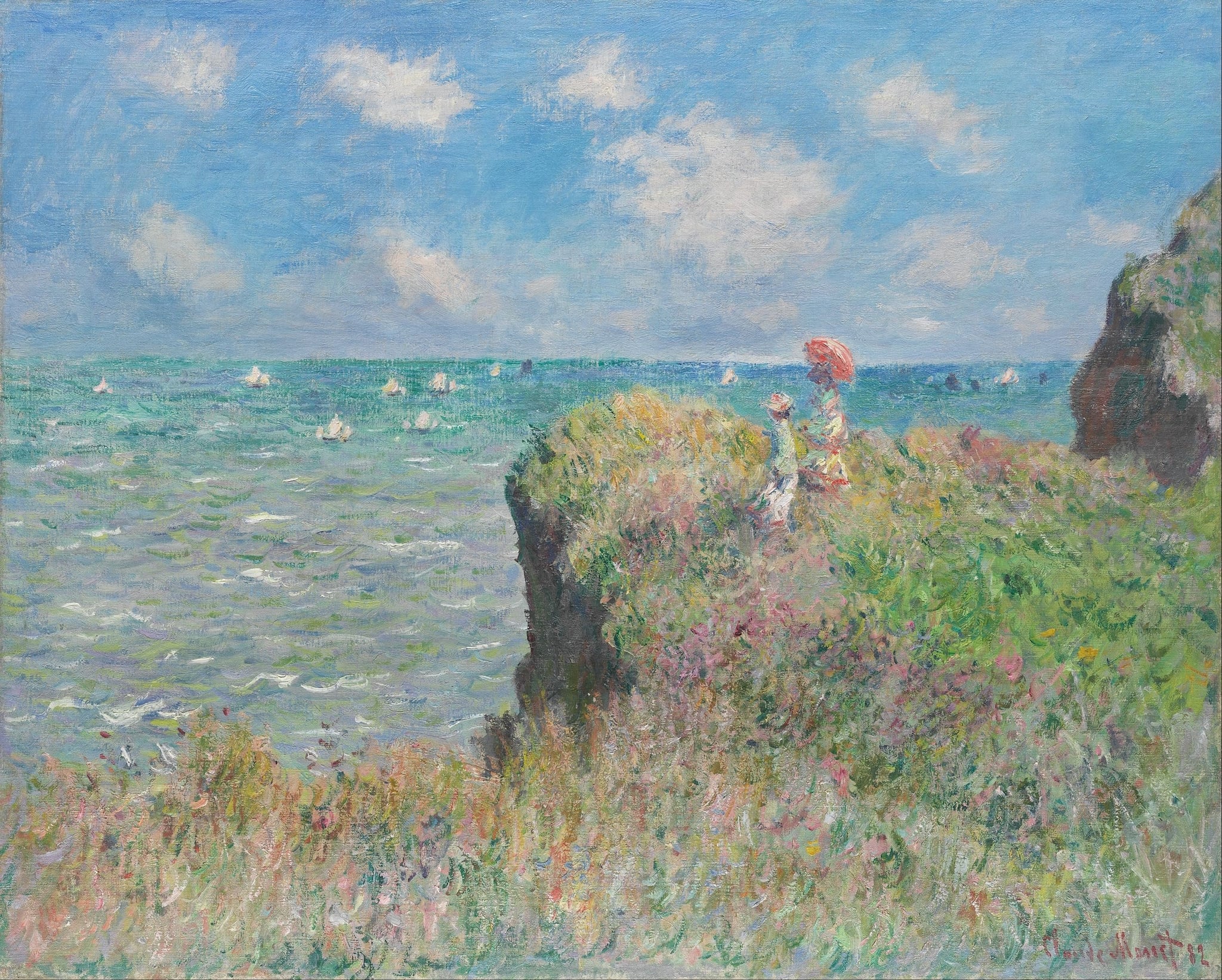
The Cliff Walk at Pourville
Claude Monet (1882)
Claude Monet’s The Cliff Walk at Pourville renders wind, light, and sea as interlocking forces through <strong>shimmering, broken brushwork</strong>. Two small walkers—one beneath a pink parasol—stand near the <strong>precipitous cliff edge</strong>, their presence measuring the vastness of turquoise water and bright sky dotted with white sails. The scene fuses leisure and the <strong>modern sublime</strong>, making perception itself the subject <sup>[1]</sup><sup>[2]</sup>.
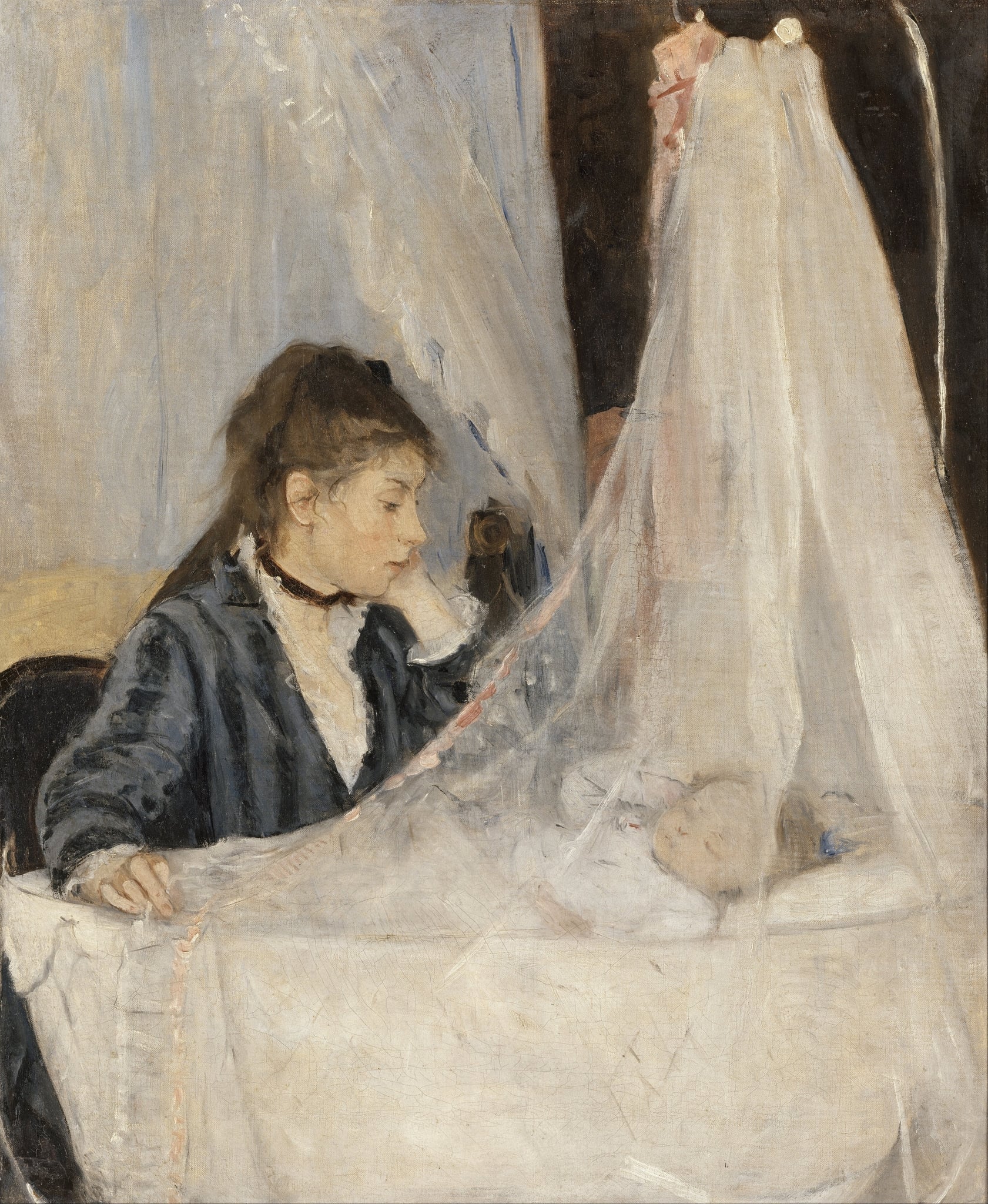
The Cradle
Berthe Morisot (1872)
Berthe Morisot’s The Cradle turns a quiet nursery into a scene of <strong>vigilant love</strong>. A gauzy veil, lifted by the watcher’s hand, forms a <strong>protective boundary</strong> that cocoons the sleeping child in light while linking the two figures through a decisive diagonal <sup>[1]</sup><sup>[2]</sup>. The painting crystallizes modern maternity as a form of attentiveness rather than display—an <strong>unsentimental icon</strong> of care.
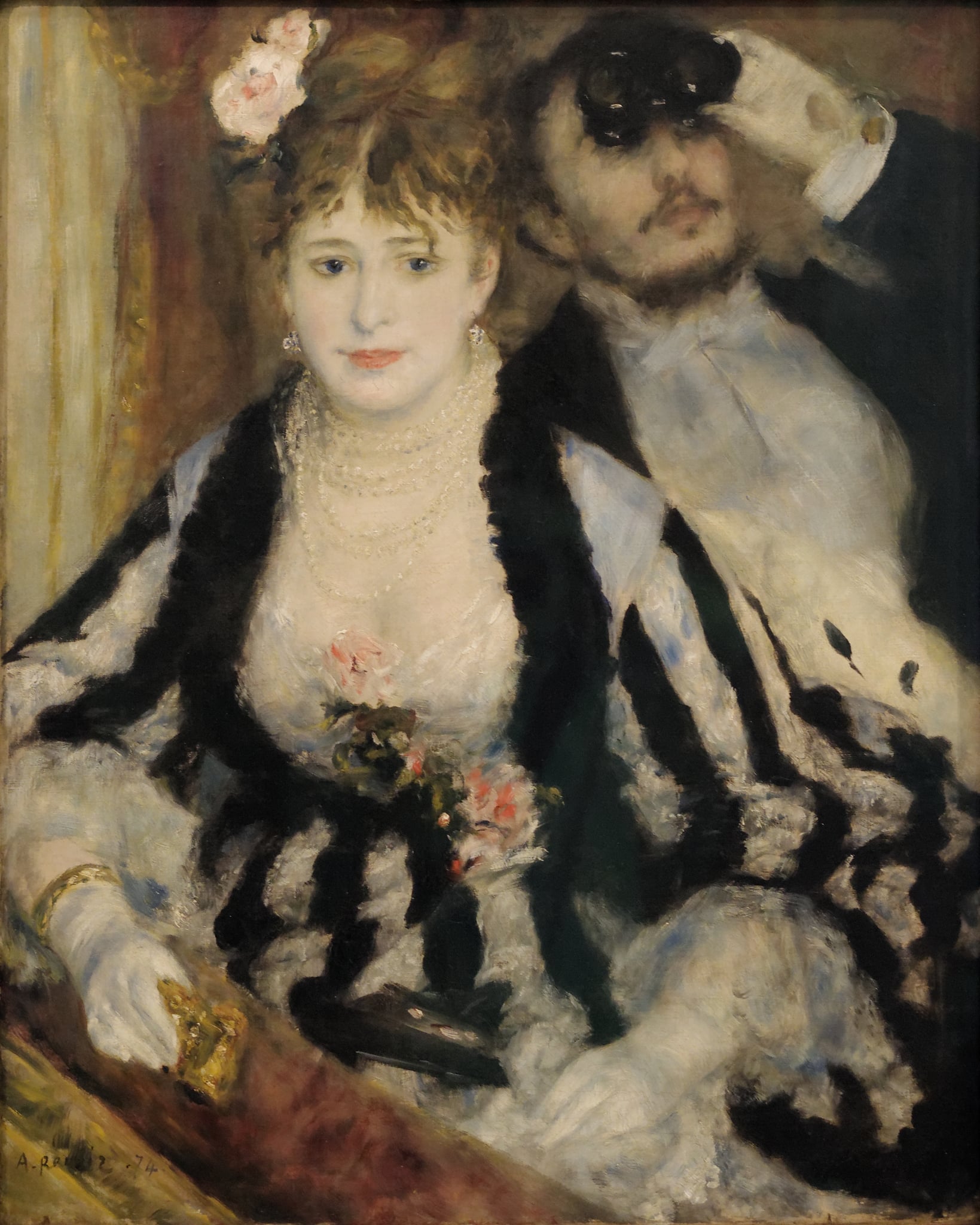
The Loge
Pierre-Auguste Renoir (1874)
Renoir’s The Loge (1874) turns an opera box into a <strong>stage of looking</strong>, where a woman meets our gaze while her companion scans the crowd through binoculars. The painting’s <strong>frame-within-a-frame</strong> and glittering fashion make modern Parisian leisure both alluring and self-conscious, turning spectators into spectacles <sup>[1]</sup><sup>[2]</sup>.
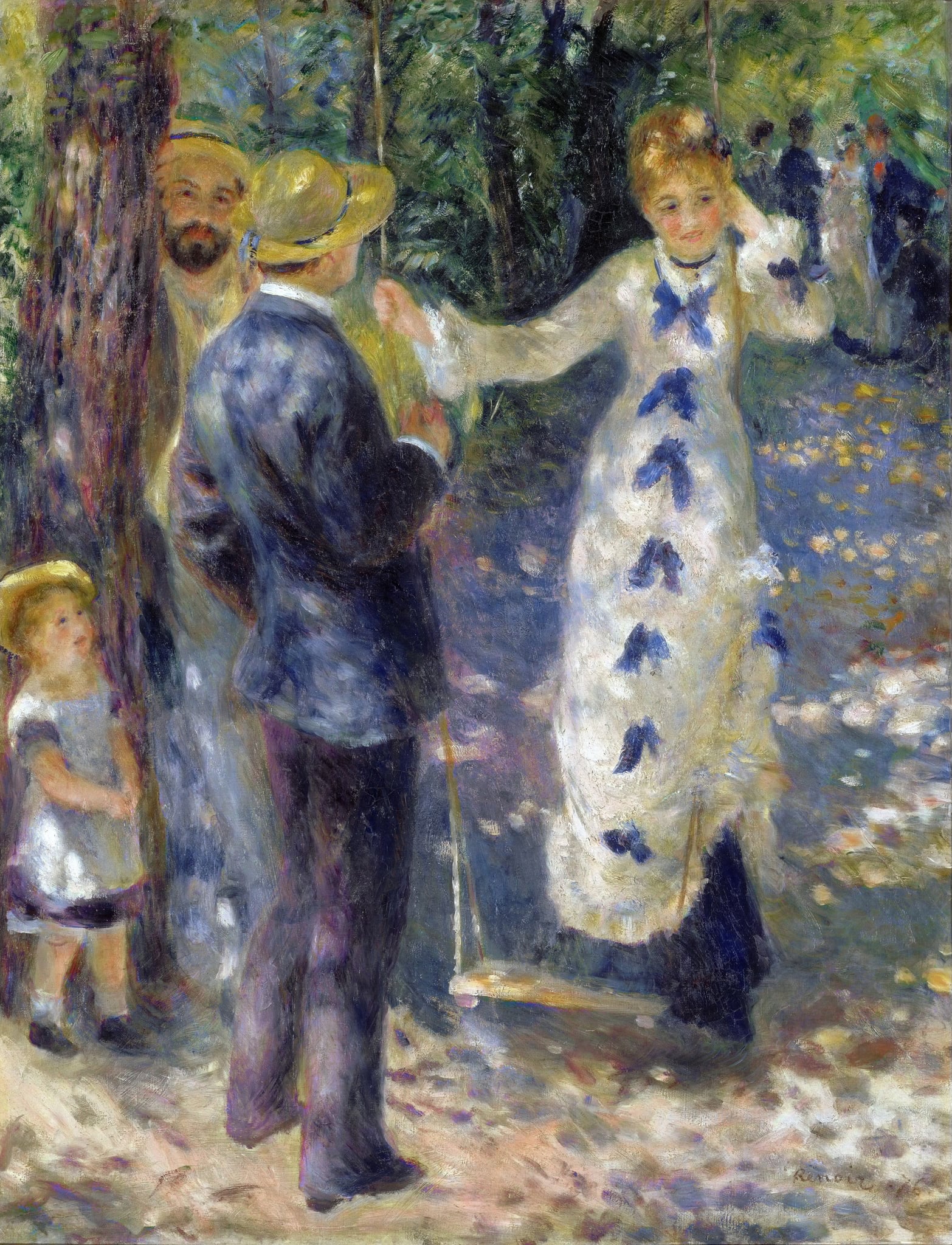
The Swing
Pierre-Auguste Renoir (1876)
Renoir’s The Swing fixes a fleeting, sun-dappled exchange in a Montmartre garden, where a woman in a white dress with blue bows steadies herself on a swing while a man in a blue jacket addresses her. The scene crystallizes <strong>modern leisure</strong>, <strong>flirtation</strong>, and <strong>optical shimmer</strong>, as broken strokes scatter light over faces, fabric, and ground <sup>[1]</sup><sup>[4]</sup>.
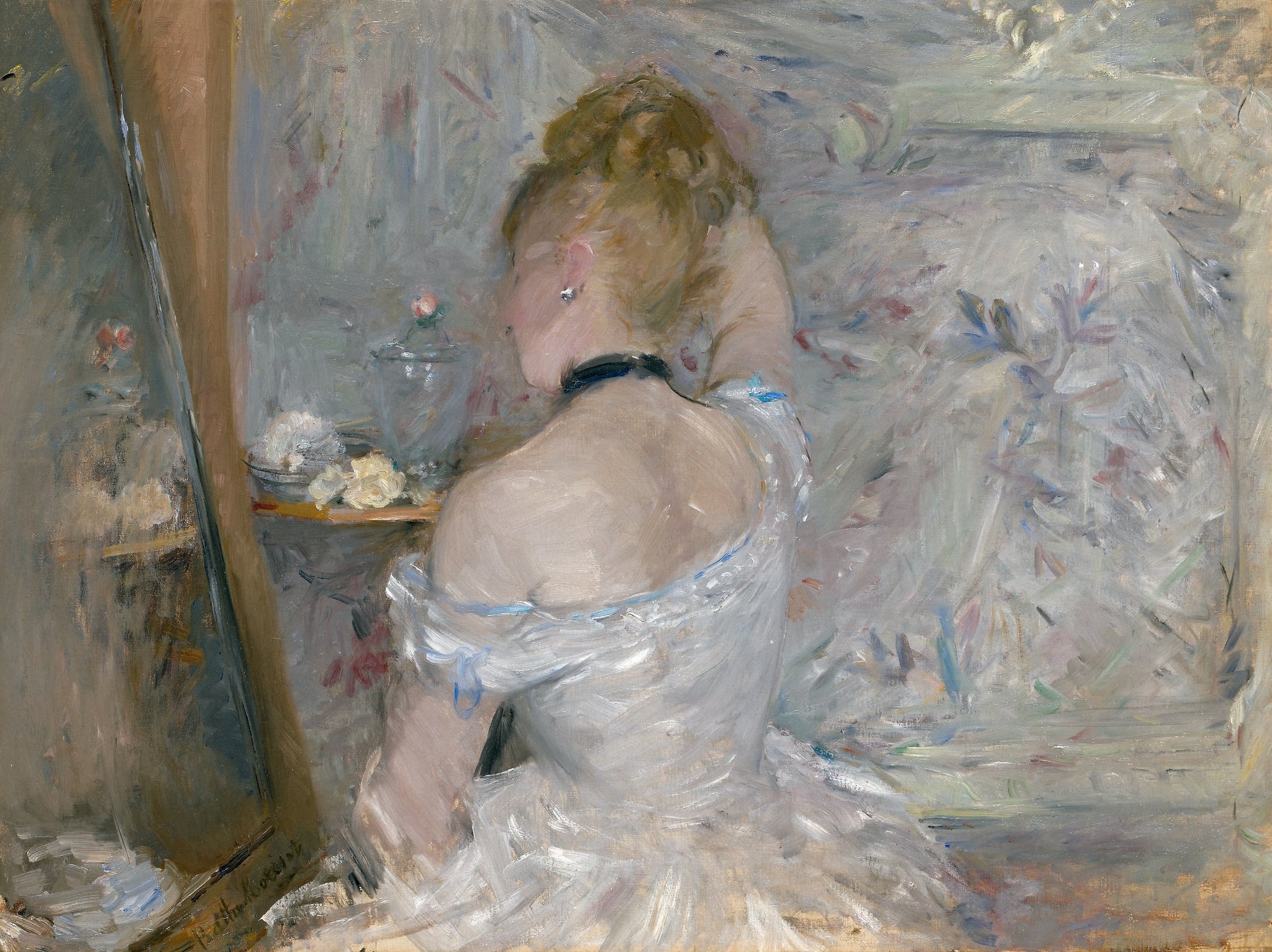
Woman at Her Toilette
Berthe Morisot (1875–1880)
Woman at Her Toilette stages a private ritual of self-fashioning, not a spectacle of vanity. A woman, seen from behind, lifts her arm to adjust her hair as a <strong>black velvet choker</strong> punctuates Morisot’s silvery-violet haze; the <strong>mirror’s blurred reflection</strong> with powders, jars, and a white flower refuses a clear face. Morisot’s <strong>feathery facture</strong> turns a fleeting toilette into modern subjectivity made visible <sup>[1]</sup>.
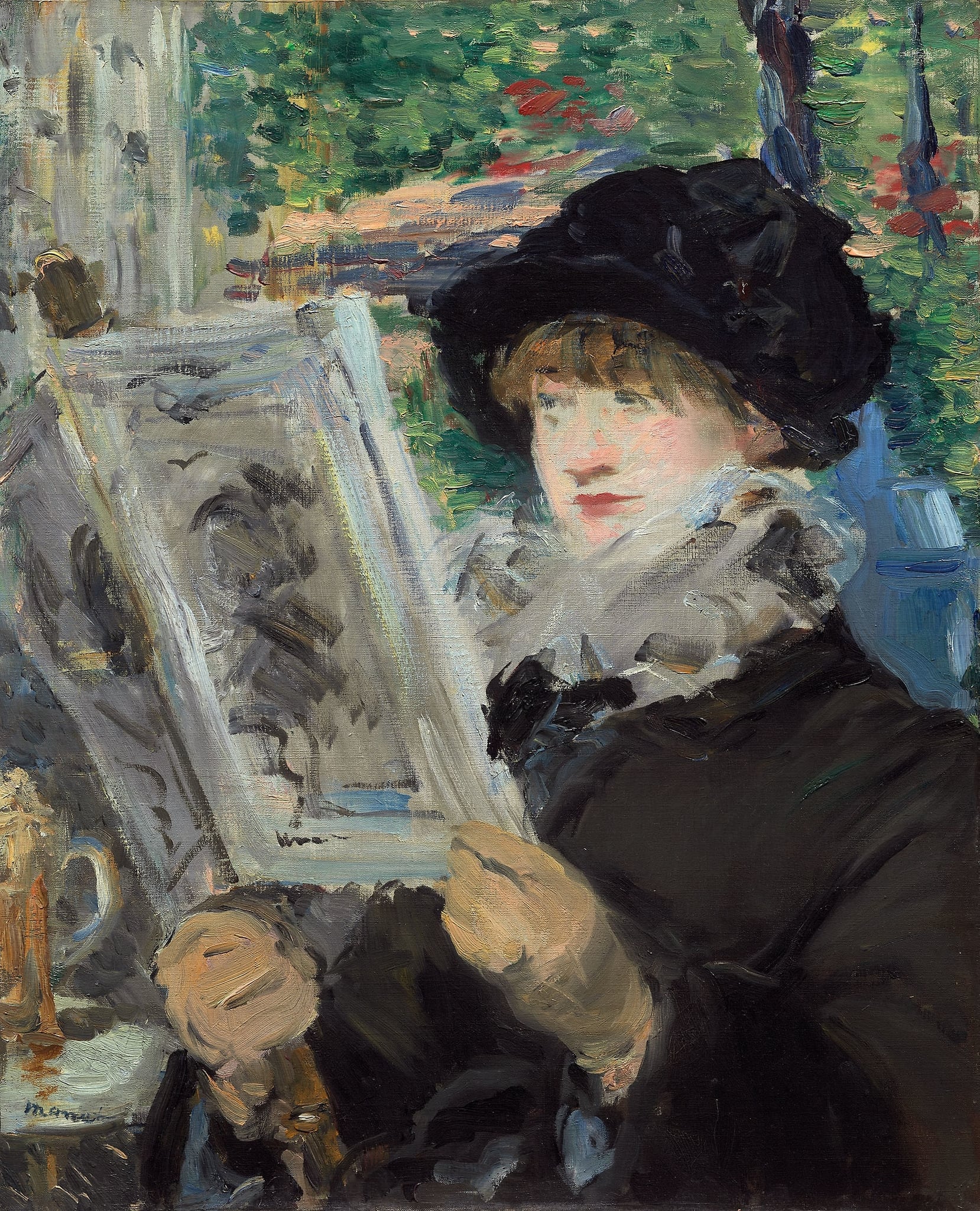
Woman Reading
Édouard Manet (1880–82)
Manet’s Woman Reading distills a fleeting act into an emblem of <strong>modern self-possession</strong>: a bundled figure raises a journal-on-a-stick, her luminous profile set against a brisk mosaic of greens and reds. With quick, loaded strokes and a deliberately cropped <strong>beer glass</strong> and paper, Manet turns perception itself into subject—asserting the drama of a private mind within a public café world <sup>[1]</sup><sup>[2]</sup>.
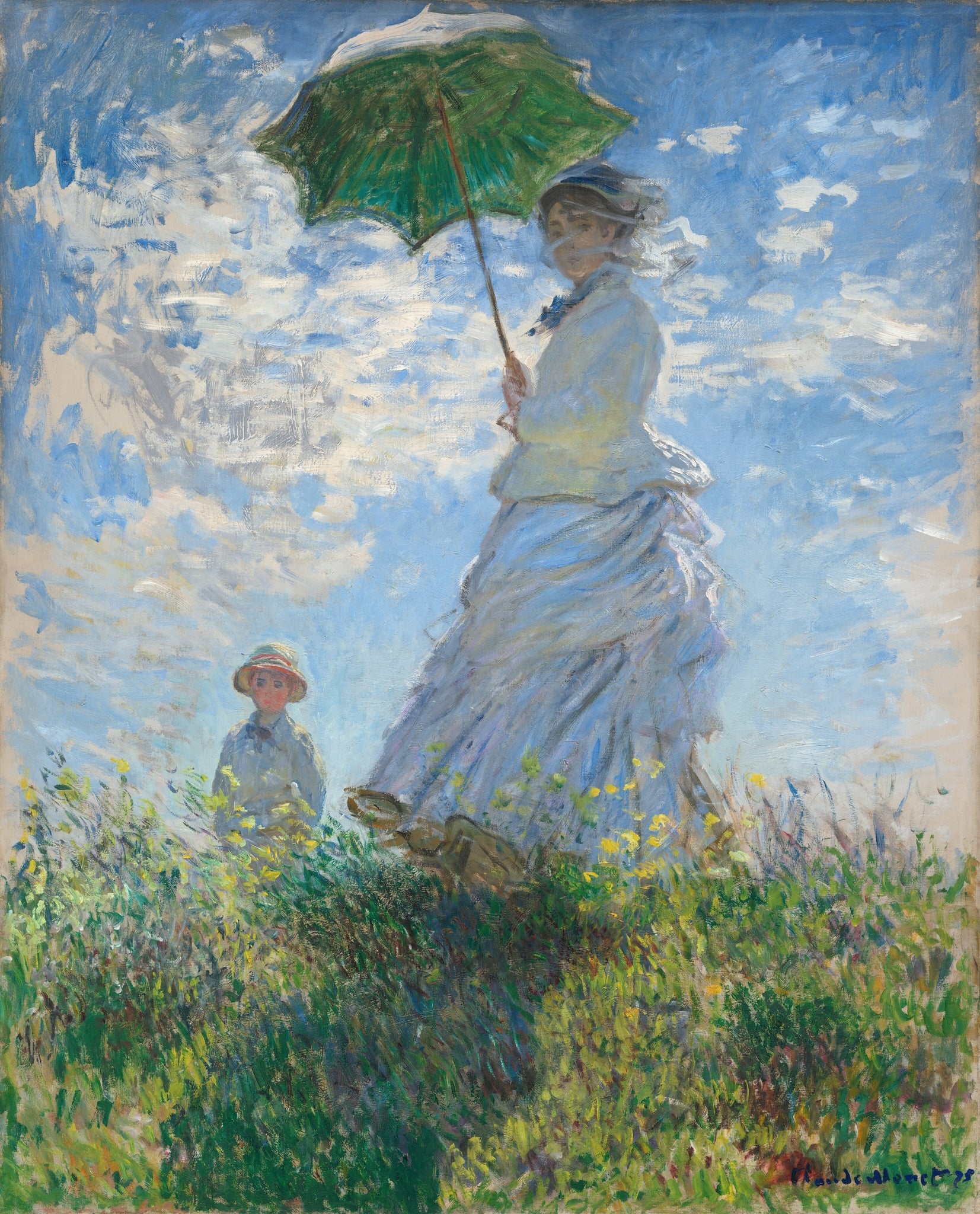
Woman with a Parasol
Claude Monet (1875)
Claude Monet’s Woman with a Parasol fixes a breezy hillside instant in high, shifting light, setting a figure beneath a <strong>green parasol</strong> against a vast, vibrating sky. The low vantage and <strong>broken brushwork</strong> merge dress, clouds, and grasses into one atmosphere, while a child at the rise anchors depth and intimacy <sup>[1]</sup>. It is a manifesto of <strong>plein-air</strong> perception—painting the sensation of air in motion rather than the contours of things <sup>[2]</sup>.
Related Themes
Related Symbolism Categories
Objects
Object symbols in modern and early modern painting transform everyday things—vessels, tools, clocks, mirrors, and branded goods—into compact arguments about labor, desire, time, and spectatorship, updating long iconographic traditions for a modern economy of signs.
Femininity
In late nineteenth‑century painting, femininity is articulated not as an essence but as a mutable ensemble of fashion, gesture, and setting, through which modern artists probe women’s visibility, labor, and agency within emerging urban and suburban worlds.
Interiority
“Interiority” symbols in modern painting transform gesture, gaze, and domestic props into visual indices of inward life, staging psychological depth, self-consciousness, and mediated subjectivity within scenes of everyday modernity.
Within nineteenth-century visual culture, dress and accessories operate less as incidental description than as a rigorously coded vocabulary through which artists renegotiate older allegorical traditions in a modern key. Fashion, in this sense, is not merely topical decoration but a semiotic system: silhouettes, fabrics, and accessories index class and labor, regulate permissible contact, and articulate new modes of spectatorship and self-possession. From the crinolined promenader on the Normandy shore to the white‑gloved ballroom dancer or the parasol-bearing allegory of Spring, fashion reorients the long history of costume symbolism toward the temporality, commodity culture, and social choreography of modern life.
Several works in this group demonstrate how clothing structures desire and decorum simultaneously. Renoir’s Dance in the City (1883) hinges on the black tailcoat and white satin gown that define the couple’s waltz. Iconographically, the tailcoat is more than a sign of male evening dress: it is a dark armature of formality and restraint that literally frames the woman’s body, enclosing the column of ruched white satin within a code of masculine decorum. The semiotics of the gown is equally double: white satin retains a residual association with purity and bridal promise, yet in this urban context it is also an advertisement of refined, up‑to‑date fashion. Renoir intensifies this doubleness through the opera‑length white gloves that regulate touch; the gloved hand on the man’s shoulder makes intimacy legible precisely because etiquette sanctions it. The scene of desire is produced at the intersection of fabrics and protocols: erotic proximity becomes acceptable because it is mediated by full dress.
A related but more centrifugal choreography controls Renoir’s Dance at Bougival (1883). Here the woman’s swirling pale pink dress, trimmed with red‑edged ruffles, and her scarlet bonnet with fruit create a vortex of movement and a node of visual focus within the open‑air dance floor. The bonnet’s high–chroma flare, with its playful fruit trim, codes flirtatious energy and modern fashionability, orchestrating attention around the woman’s face. At the same time, the absence of gloves—bare hands clasped—marks this suburban setting as less tightly regulated than the ballroom of Dance in the City. Accessories, or their suspension, differentiate spaces of leisure: long gloves and tailcoat for the codified urban salon; light dress and flamboyant hat for a more permissive suburban festivity. In both cases, clothing scripts the permissible degree of public intimacy.
Manet’s Olympia (1863) exposes with particular clarity how a single accessory can displace mythic timelessness with contemporary fashion. The black ribbon choker at the nude’s throat is pointedly modern—an inexpensive, purchasable object associated with Parisian couture and, in the period’s visual economy, with contemporary sexuality rather than antique Venus. Semiotically, the choker functions as a sign of commodified allure: a tight black band that both accents and constricts the neck, insisting on the sitter’s urban modernity and her embedment in circuits of exchange. The ribbon does not veil or ennoble; it locates Olympia within a market for bodies and adornments, aligning her with the world of milliners, courtesans, and department-store display rather than with mythological precedents. Fashion here is the very mechanism by which Manet strips away academic fiction.
By contrast, Manet’s later Jeanne (Spring) (1881) demonstrates how fashion can be reabsorbed into allegory without surrendering its contemporaneity. The floral‑trimmed bonnet, long glove, and cream parasol together form a syntactic chain that reads immediately as “spring”: blossoms translated into millinery, pale fabrics harmonized with bright foliage, a parasol signaling seasonal sunlight and bourgeois promenade. Yet each element is resolutely of the Parisian present. The bonnet’s artificial flowers speak to global trade in trims and to the artifice of fashion; the glove connotes respectability and controlled public comportment; the parasol marks stylish outdoor leisure. Manet thus retools the allegory of the season through a couture idiom: nature’s renewal is figured through surfaces of fabric and fringe, making fashion itself the bearer of perennial meaning. The work confirms how, in the late nineteenth century, sartorial detail could supplant mythic attributes as the primary iconographic vehicle.
Impressionist painting repeatedly exploits the parasol and kindred accessories as emblems of a specifically bourgeois leisure. In Monet’s Beach at Trouville (1870), the white parasols punctuating the windswept boardwalk are less individualized possessions than generic signs of resort culture. Their repetitive forms, coupled with flounced skirts and fashionable hats, depersonalize the sitters into types: the seaside tourist newly enabled by rail travel. A few years earlier, Monet’s Regatta at Sainte‑Adresse (1867) had already systematized this code. Seated women and strolling couples, equipped with parasols and straw hats, line the diagonal shingle as spectators to the yacht race. Their attire signals that they are visitors rather than workers, participants in a modern tourism predicated on watching rather than laboring. The parasol thus mediates not only sunlight but also the threshold between participation and observation: it is the prop of the flâneuse and the tourist as much as of the fashion plate.
Renoir’s Madame Monet and Her Son (1874) and Morisot’s Summer’s Day (c. 1879) adjust this vocabulary to domestic and feminine companionship. In the former, the mother’s white dress becomes an Impressionist emblem—a radiant field registering outdoor light and signaling cleanliness and leisure. Opposite her, the boy’s pale‑blue sailor suit identifies him as the product of a healthy, active bourgeois childhood and of modern taste in children’s wear. These garments semiotically stabilize the family as contemporary, respectable, and at ease, even as Renoir’s fused brushwork dissolves contours. Morisot, painting two women in a boat, emphasizes gloves and parasol as signs of propriety in a semi‑public space: the bright blue parasol both anchors the composition chromatically and asserts the sitters’ classed respectability. Fashion here does not advertise spectacle so much as it guarantees a controlled, self‑contained presence on the water’s surface of sociability.
Across these works, then, fashion symbols articulate a spectrum from depersonalized social type to intensely individualized self‑definition. At one end, the coordinated parasols and flounced dresses of Beach at Trouville and Regatta at Sainte‑Adresse reduce figures to an anonymous bourgeois audience, their attire a uniform of spectatorship. At the other, the black ribbon encircling Olympia’s throat, or the floral‑trimmed bonnet in Jeanne (Spring), focus attention on the singular woman and her constructed persona—whether defiantly transactional or aspirationally allegorical. Between these poles, ball gowns, tailcoats, gloves, and hats govern the gradations of permissible intimacy and the choreography of bodies in space.
Over the span from the 1860s to the 1880s represented here, the evolution is less a shift away from symbolism than a reorientation of its sources. Early modern allegories and nudes drew on a transhistorical wardrobe of draperies and attributes. The Impressionists and their contemporaries preserve the symbolic charge of clothing but root it in the temporality of fashion: in Salon‑reviewed dresses, boulevard hats, seaside parasols, and inexpensive chokers. As couture cycles accelerate and urban leisure expands, garments and accessories become the primary carriers of social meaning, encoding class, gender, race, and spectatorship with a precision once reserved for mythic props. Fashion, in these paintings, is not an afterthought to narrative; it is the very medium through which modern subjects—and the act of looking at them—are defined.