Nature
In modern and contemporary painting, natural motifs operate less as fixed emblems than as dynamic structures through which artists negotiate perception, temporality, class, and the sacred, reworking an older iconography of nature into a self-conscious language of light, labor, and psychological atmosphere.
Member Symbols
Featured Artworks
Bathers at Asnières
Georges Seurat (1884)
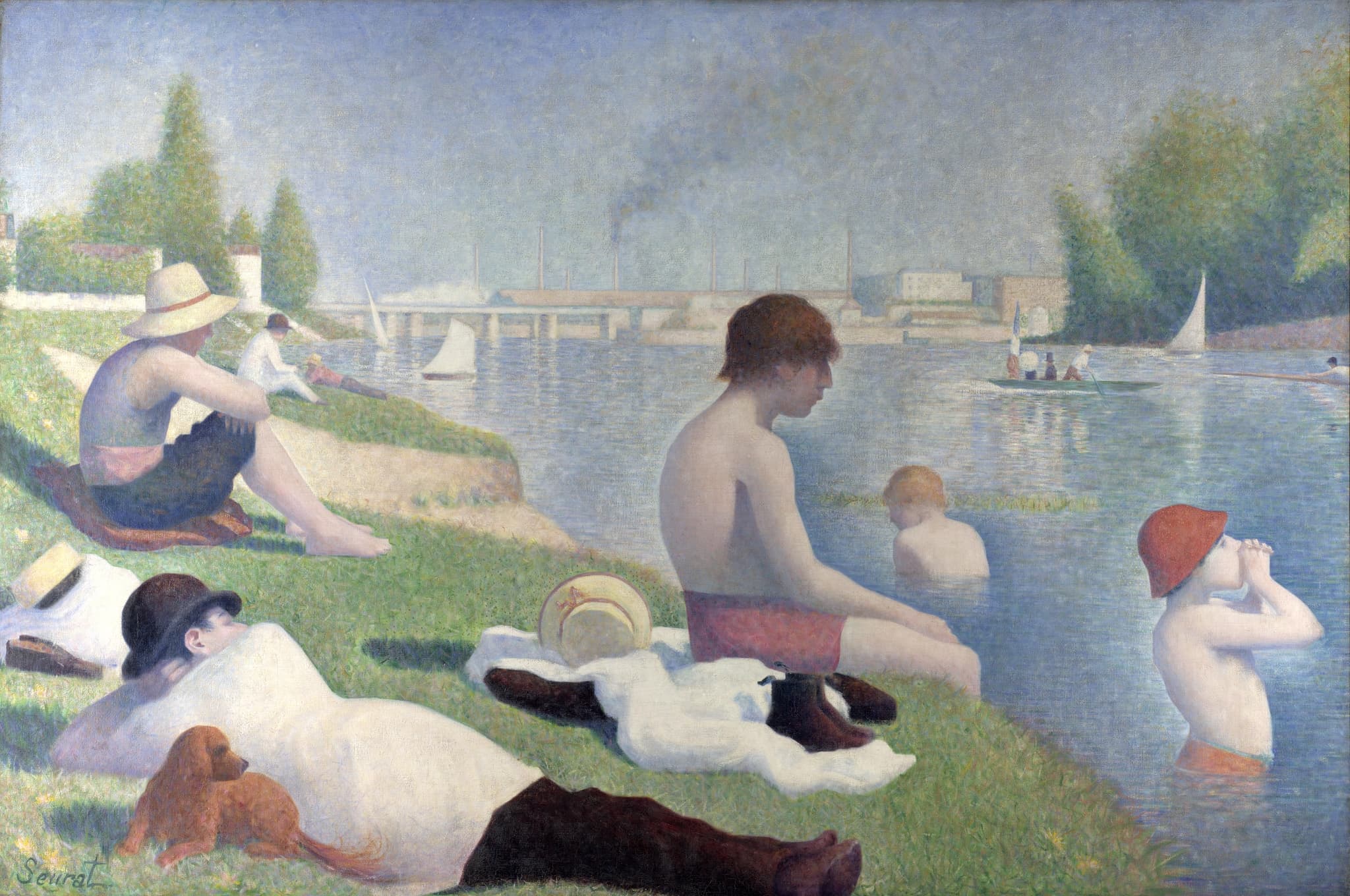
Bathers at Asnières stages a scene of <strong>modern leisure</strong> on the Seine, where workers recline and wade beneath a hazy, unified light. Seurat fuses <strong>classicizing stillness</strong> with an <strong>industrial backdrop</strong> of chimneys, bridges, and boats, turning ordinary rest into a monumental, ordered image of urban life <sup>[1]</sup><sup>[3]</sup>. The canvas balances soft greens and blues with geometric structures, producing a calm yet charged harmony.
Fishing Boats on the Beach at Les Saintes-Maries-de-la-Mer
Vincent van Gogh (1888)
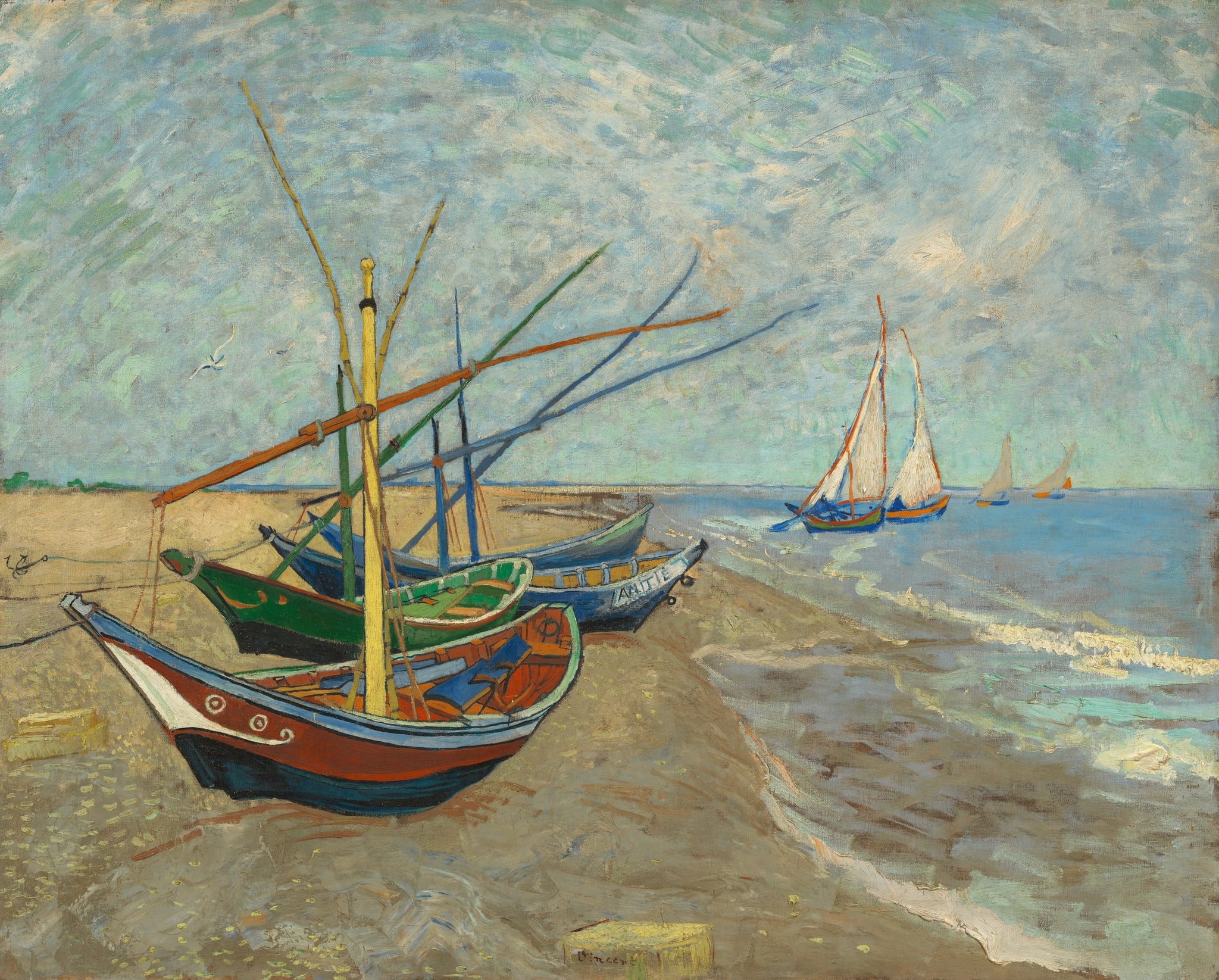
Vincent van Gogh lines up a file of beached craft like actors awaiting their cue, turning working boats into <strong>emblems of readiness and risk</strong>. Bold contours, flattened color, and the wind‑tossed sea and sky translate Mediterranean luminosity into a <strong>Japonisme/Cloisonnism</strong> idiom that clarifies form and heightens feeling. The scene suspends time at the edge of departure, where labor, hope, and the sea’s pull meet.
Garden with Courting Couples: Square Saint-Pierre
Vincent van Gogh (1887)
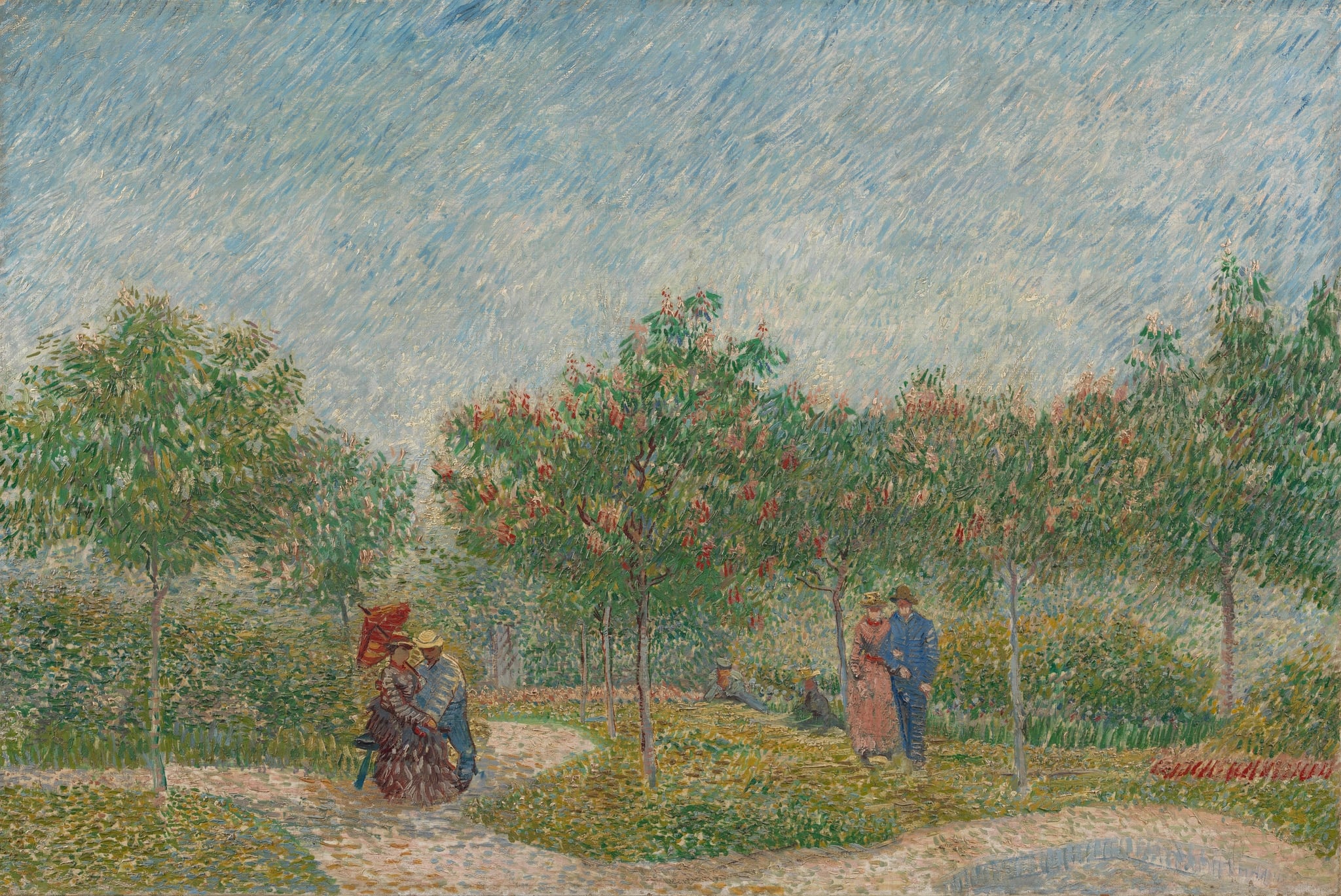
In Garden with Courting Couples: Square Saint-Pierre, Vincent van Gogh turns a small Montmartre park into a stage where <strong>spring</strong>, <strong>intimacy</strong>, and <strong>urban leisure</strong> converge. Short, shimmering strokes fuse pink chestnut blossoms, curving paths, and paired figures into one pulse of <strong>renewal</strong> and <strong>togetherness</strong> <sup>[1]</sup><sup>[2]</sup>.
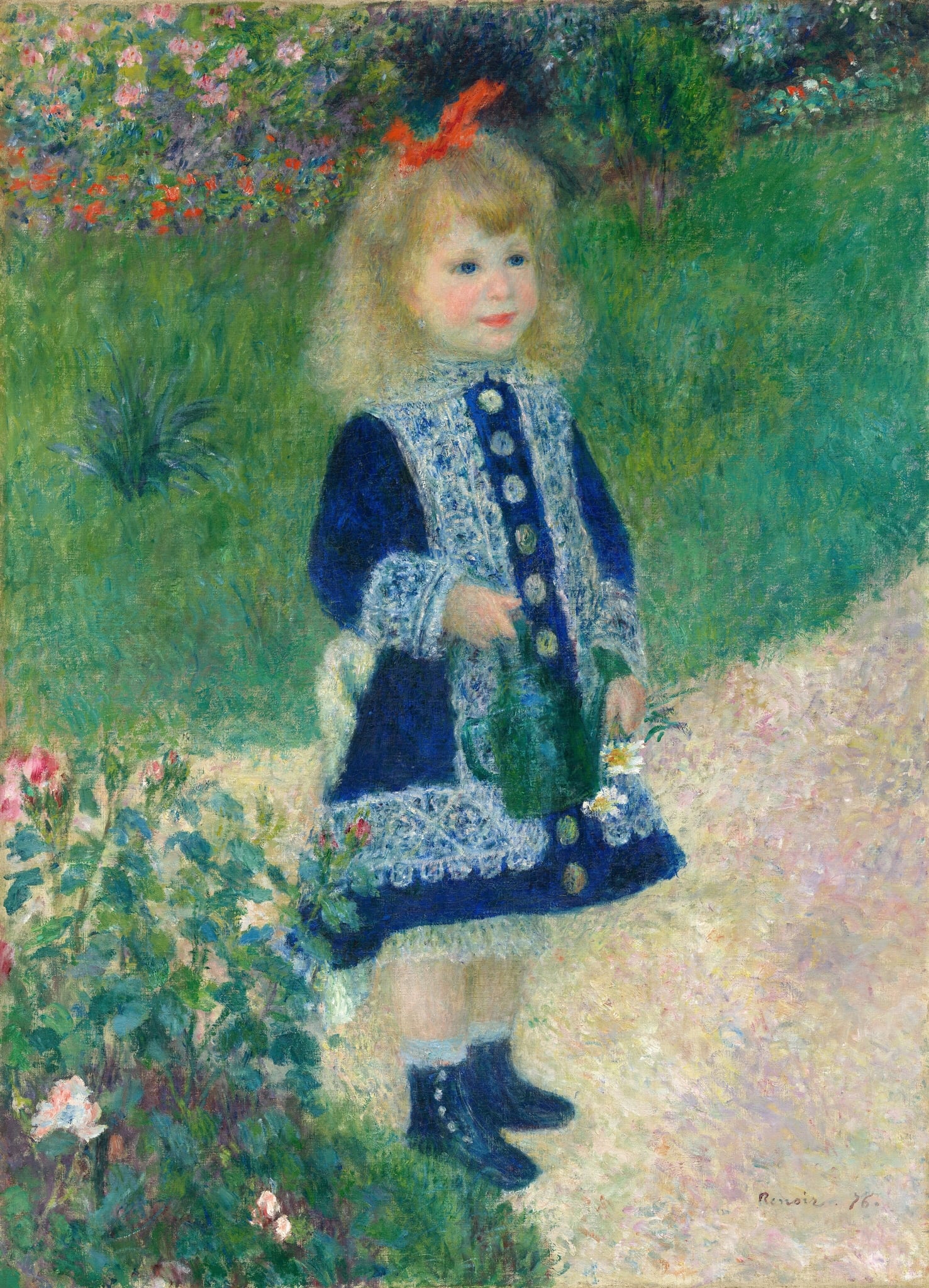
Girl with a Watering Can
Pierre-Auguste Renoir (1876)
Renoir’s 1876 Girl with a Watering Can fuses a crisply perceived child with a dissolving garden atmosphere, using <strong>prismatic color</strong> and <strong>controlled facial modeling</strong> to stage innocence within modern leisure <sup>[1]</sup>. The cobalt dress, red bow, and green can punctuate a haze of pinks and greens, making nurture and growth the scene’s quiet thesis.
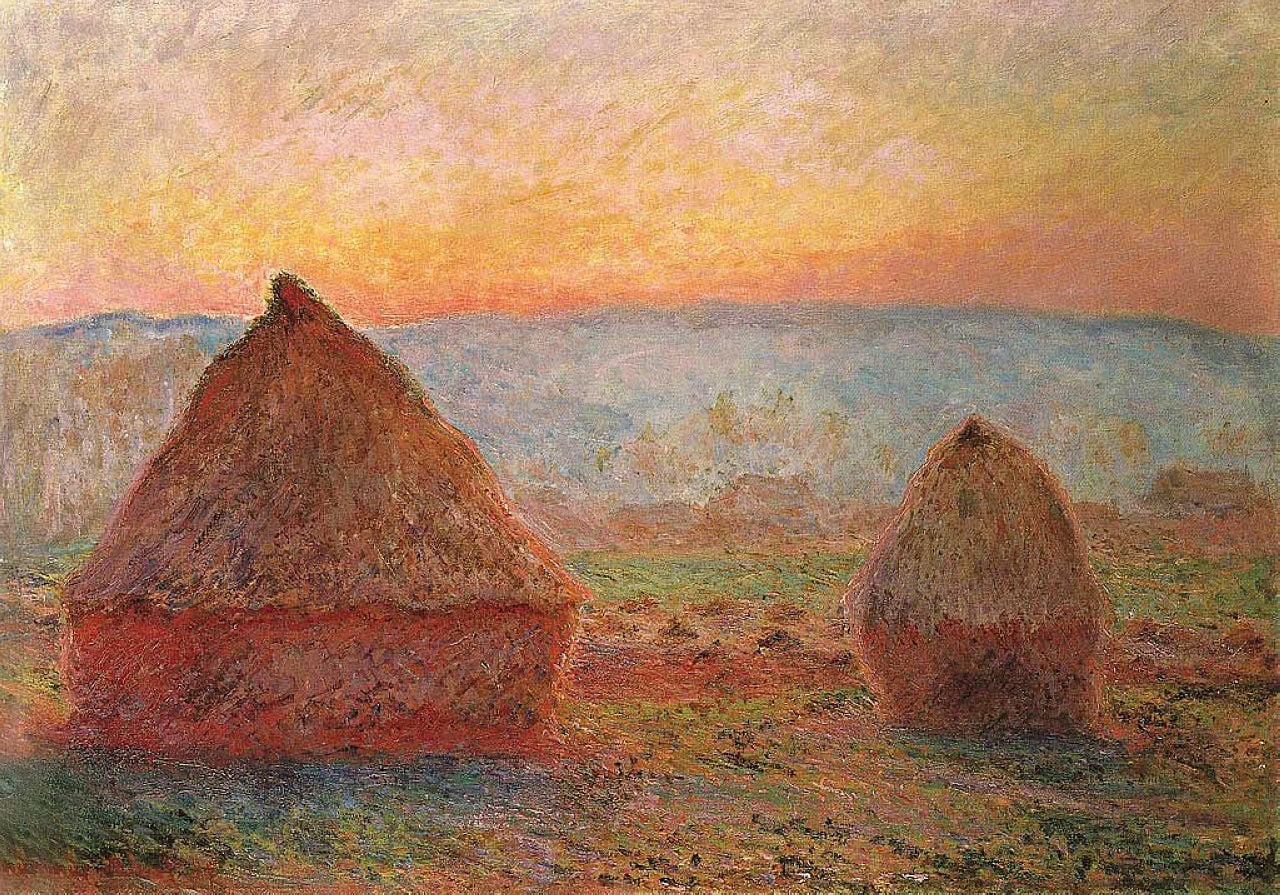
Haystack, Sunset
Claude Monet (1891)
Two conical stacks blaze against a cooling horizon, turning stored grain into a drama of <strong>light, time, and rural wealth</strong>. Monet’s broken strokes fuse warm oranges and cool violets so the stacks seem to glow from within, embodying the <strong>transience</strong> of a single sunset and the <strong>endurance</strong> of agrarian cycles <sup>[1]</sup><sup>[2]</sup><sup>[3]</sup>.
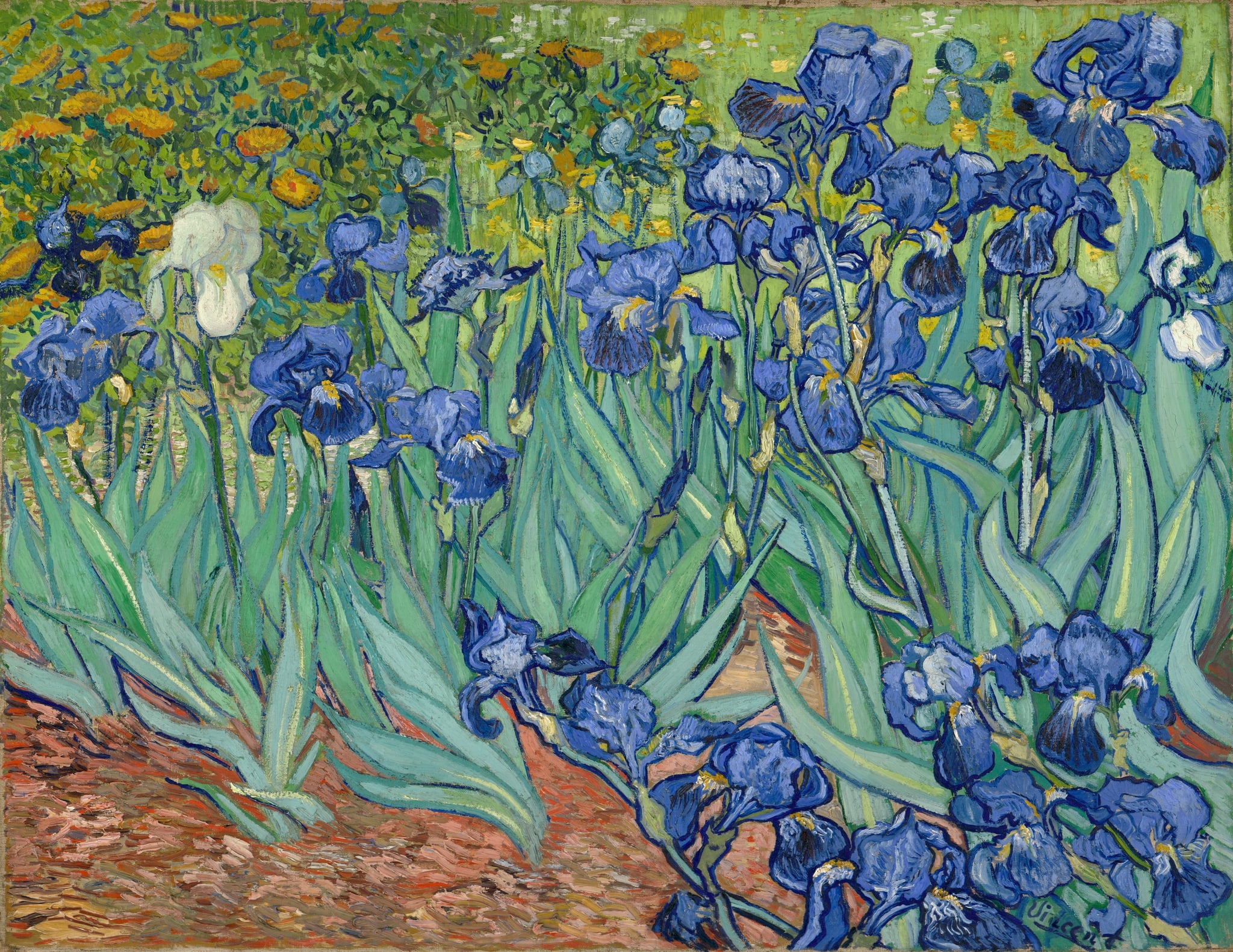
Irises
Vincent van Gogh (1889)
Painted in May 1889 at the Saint-Rémy asylum garden, Vincent van Gogh’s <strong>Irises</strong> turns close observation into an act of repair. Dark contours, a cropped, print-like vantage, and vibrating complements—violet/blue blossoms against <strong>yellow-green</strong> ground—stage a living frieze whose lone <strong>white iris</strong> punctuates the field with arresting clarity <sup>[1]</sup><sup>[2]</sup>.
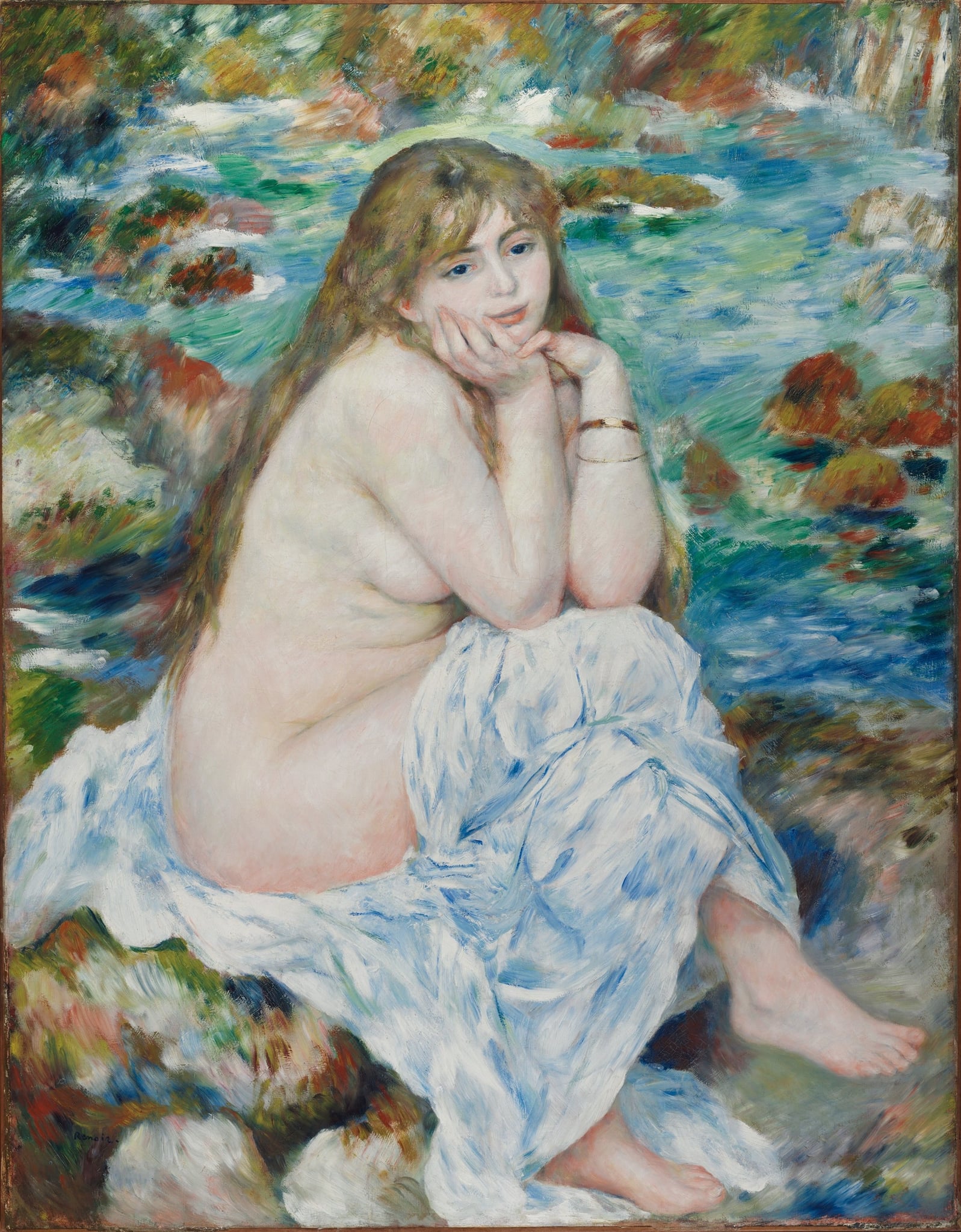
Seated Bather
Pierre-Auguste Renoir
Renoir’s Seated Bather stages a quiet pause between bathing and reverie, fusing the model’s pearly flesh with the flicker of stream and stone. The white drapery pooled around her hips and the soft, frontal gaze convert a simple toilette into a <strong>modern Arcadia</strong> where body and landscape dissolve into light. In this late-Impressionist idiom, Renoir refines the nude as a <strong>timeless ideal</strong> felt through color and touch <sup>[1]</sup><sup>[2]</sup>.
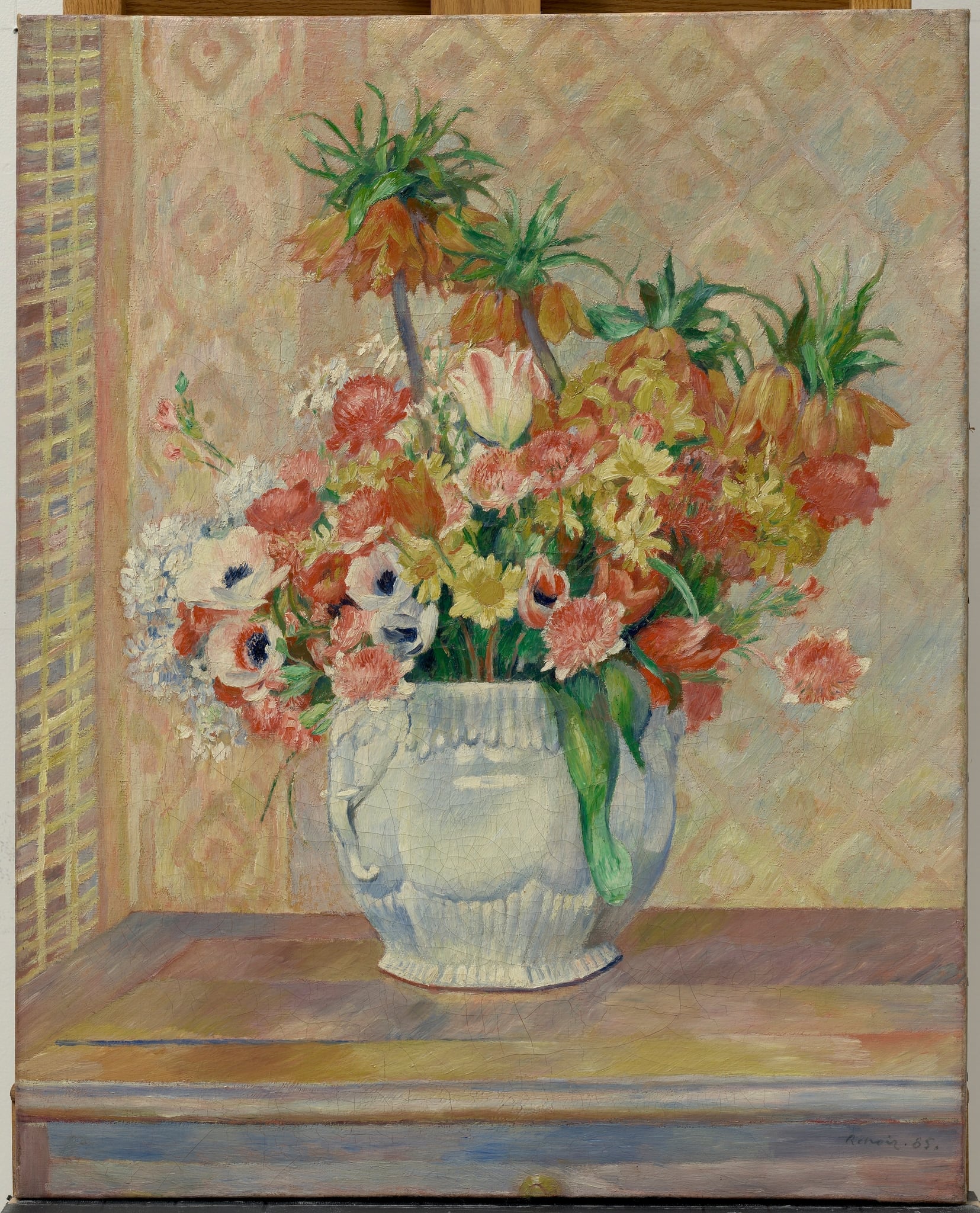
Still Life with Flowers
Pierre-Auguste Renoir (1885)
Pierre-Auguste Renoir’s Still Life with Flowers (1885) sets a jubilant bouquet in a pale, crackled vase against softly dissolving wallpaper and a wicker screen. With quick, clear strokes and a centered, oval mass, the painting unites <strong>Impressionist color</strong> with a <strong>classical, post-Italy structure</strong> <sup>[1]</sup><sup>[2]</sup><sup>[4]</sup>. The slight droop of blossoms turns the domestic scene into a gentle <strong>vanitas</strong>—a savoring of beauty before it fades <sup>[5]</sup>.
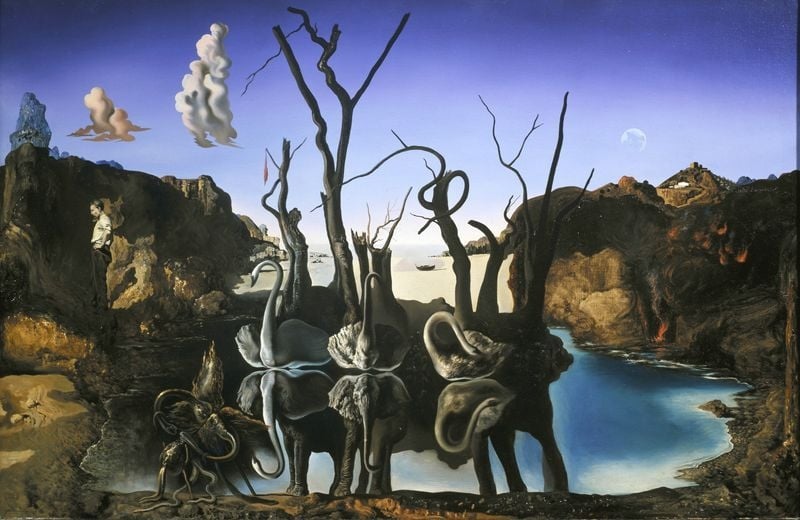
Swans Reflecting Elephants
Salvador Dali (1937)
Swans Reflecting Elephants stages a calm Catalan lagoon where three swans and a thicket of bare trees flip into monumental <strong>elephants</strong> in the mirror of water. Salvador Dali crystallizes his <strong>paranoiac-critical</strong> method: a meticulously painted illusion that makes perception generate its own doubles <sup>[1]</sup><sup>[2]</sup>. The work locks grace to gravity, surface to depth, turning the lake into a theater of <strong>metamorphosis</strong>.
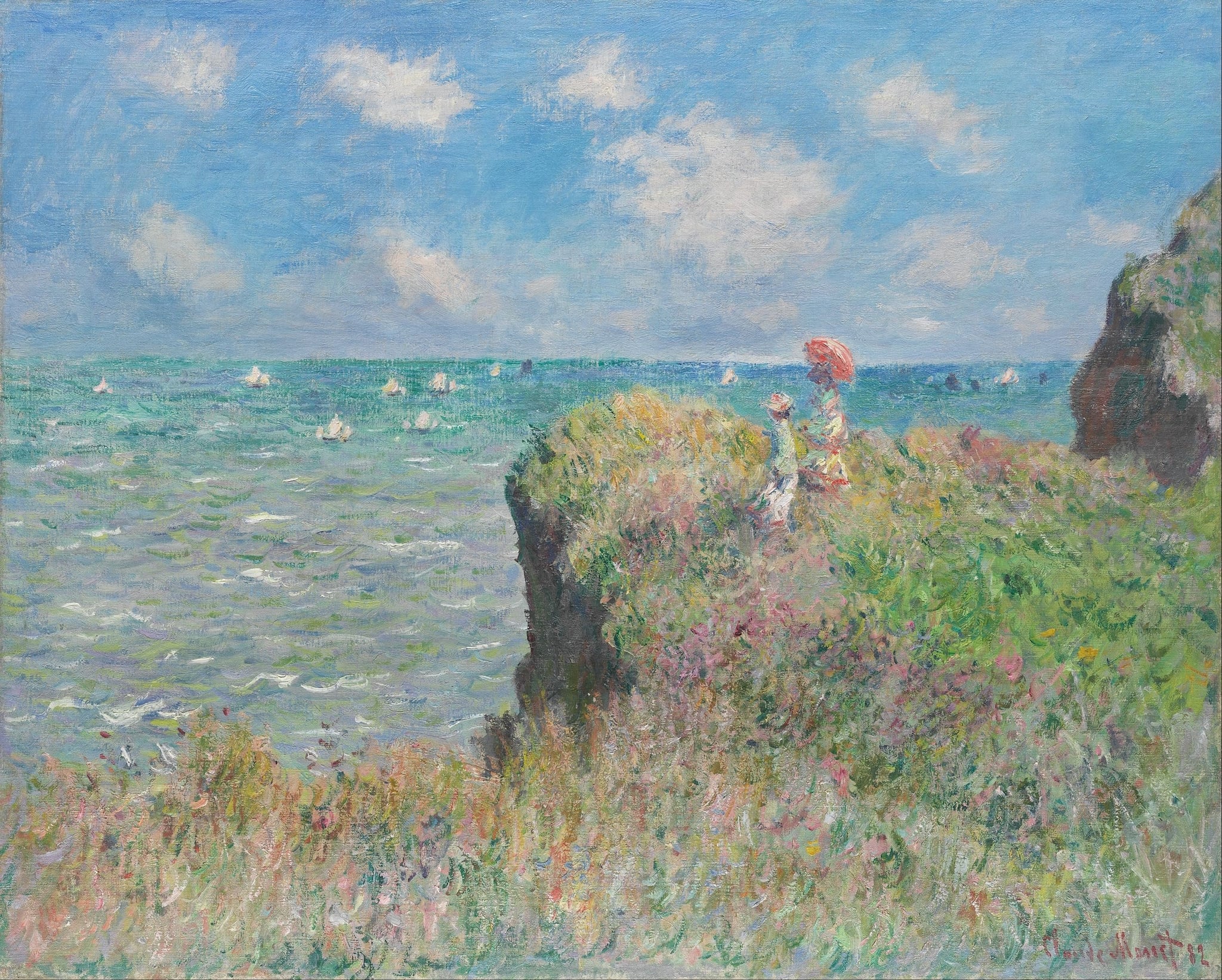
The Cliff Walk at Pourville
Claude Monet (1882)
Claude Monet’s The Cliff Walk at Pourville renders wind, light, and sea as interlocking forces through <strong>shimmering, broken brushwork</strong>. Two small walkers—one beneath a pink parasol—stand near the <strong>precipitous cliff edge</strong>, their presence measuring the vastness of turquoise water and bright sky dotted with white sails. The scene fuses leisure and the <strong>modern sublime</strong>, making perception itself the subject <sup>[1]</sup><sup>[2]</sup>.
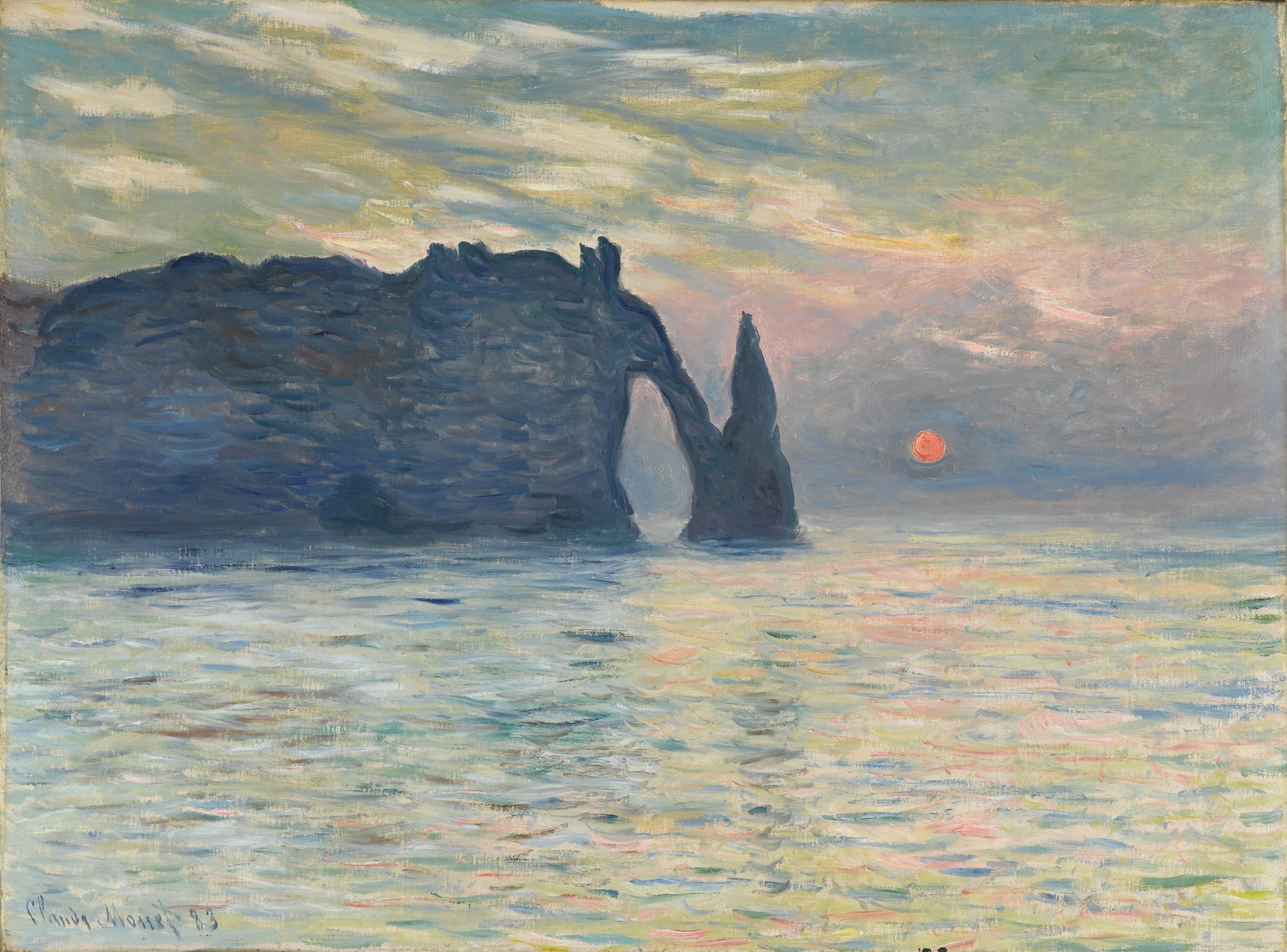
The Cliff, Etretat
Claude Monet (1882–1883)
<strong>The Cliff, Etretat</strong> stages a confrontation between <strong>permanence and flux</strong>: the dark mass of the arch and needle holds like a monument while ripples of coral, green, and blue light skate across the water. The low <strong>solar disk</strong> fixes the instant, and Monet’s fractured strokes make the sea and sky feel like time itself turning toward dusk. The arch reads as a <strong>threshold</strong>—an opening to the unknown that organizes vision and meaning <sup>[1]</sup><sup>[2]</sup>.
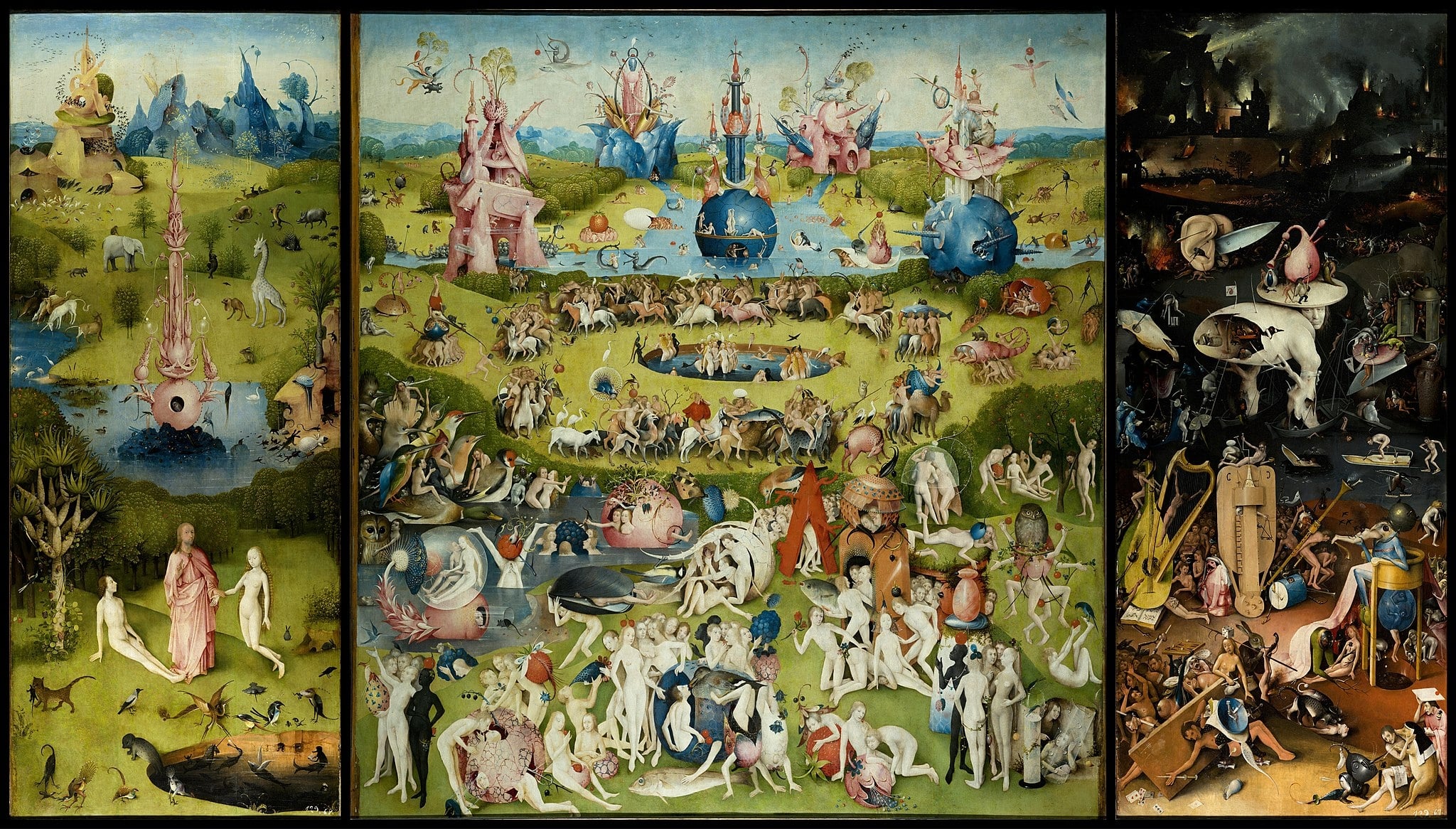
The Garden of Earthly Delights
Hieronymus Bosch (c.1490–1500)
The Garden of Earthly Delights unfolds a three‑act moral narrative—<strong>innocence</strong>, <strong>seduction</strong>, and <strong>retribution</strong>—from Eden to a punitive <strong>Musical Hell</strong>. Bosch binds the scenes through recurring emblems (notably the <strong>owl</strong>) and by echoing Eden’s crystalline fountain in the center’s fragile, candy‑colored architectures, then in Hell’s broken bodies and instruments. The work dazzles with invention while insisting that <strong>sweet, ephemeral pleasures</strong> end in ruin <sup>[1]</sup>.
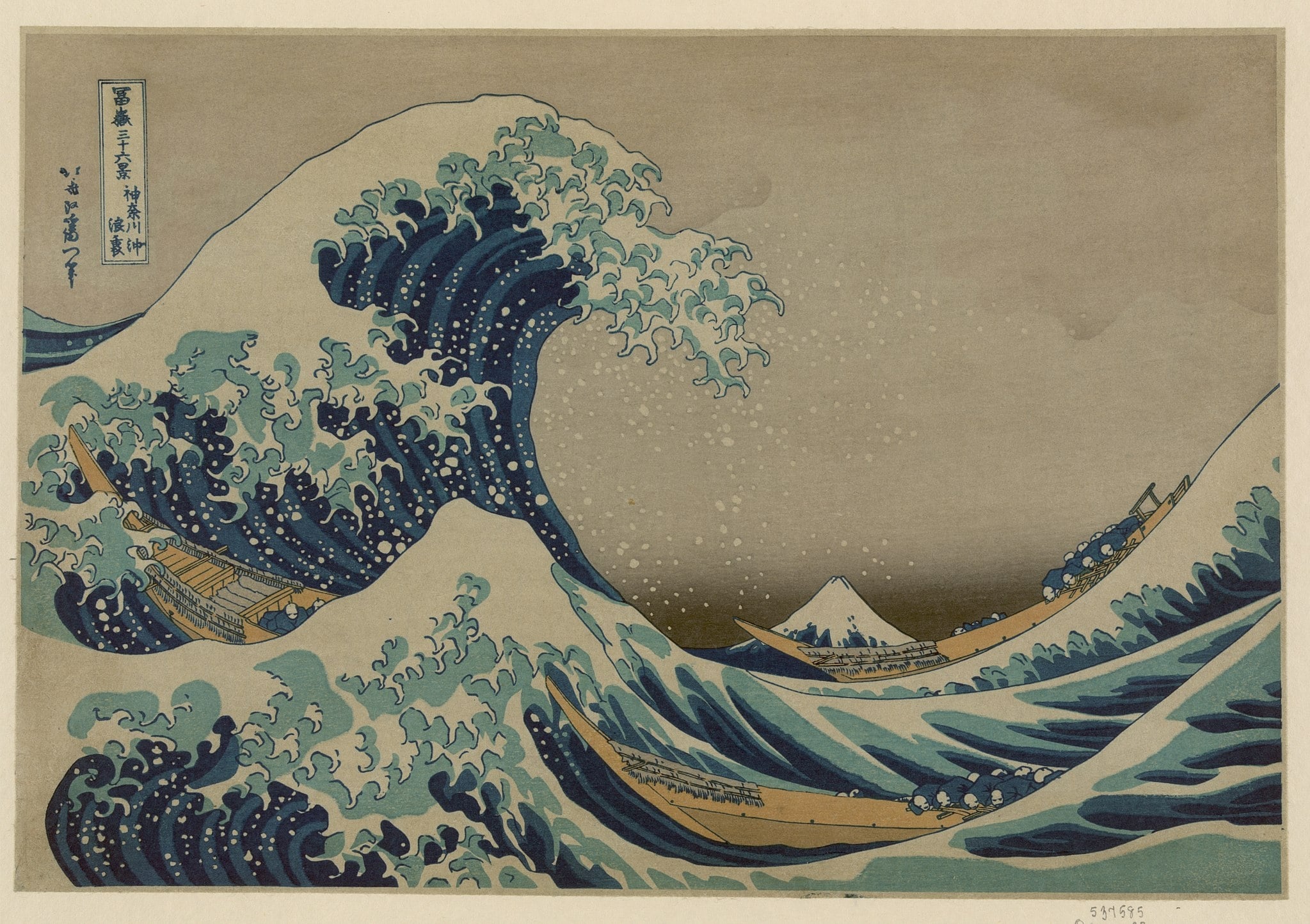
The Great Wave off Kanagawa
Hokusai (ca. 1830–32)
The Great Wave off Kanagawa distills a universal drama: fragile laboring boats face a <strong>towering breaker</strong> while <strong>Mount Fuji</strong> sits small yet immovable. Hokusai wields <strong>Prussian blue</strong> to sculpt depth and cold inevitability, fusing ukiyo‑e elegance with Western perspective to stage nature’s power against human resolve <sup>[1]</sup><sup>[3]</sup>.
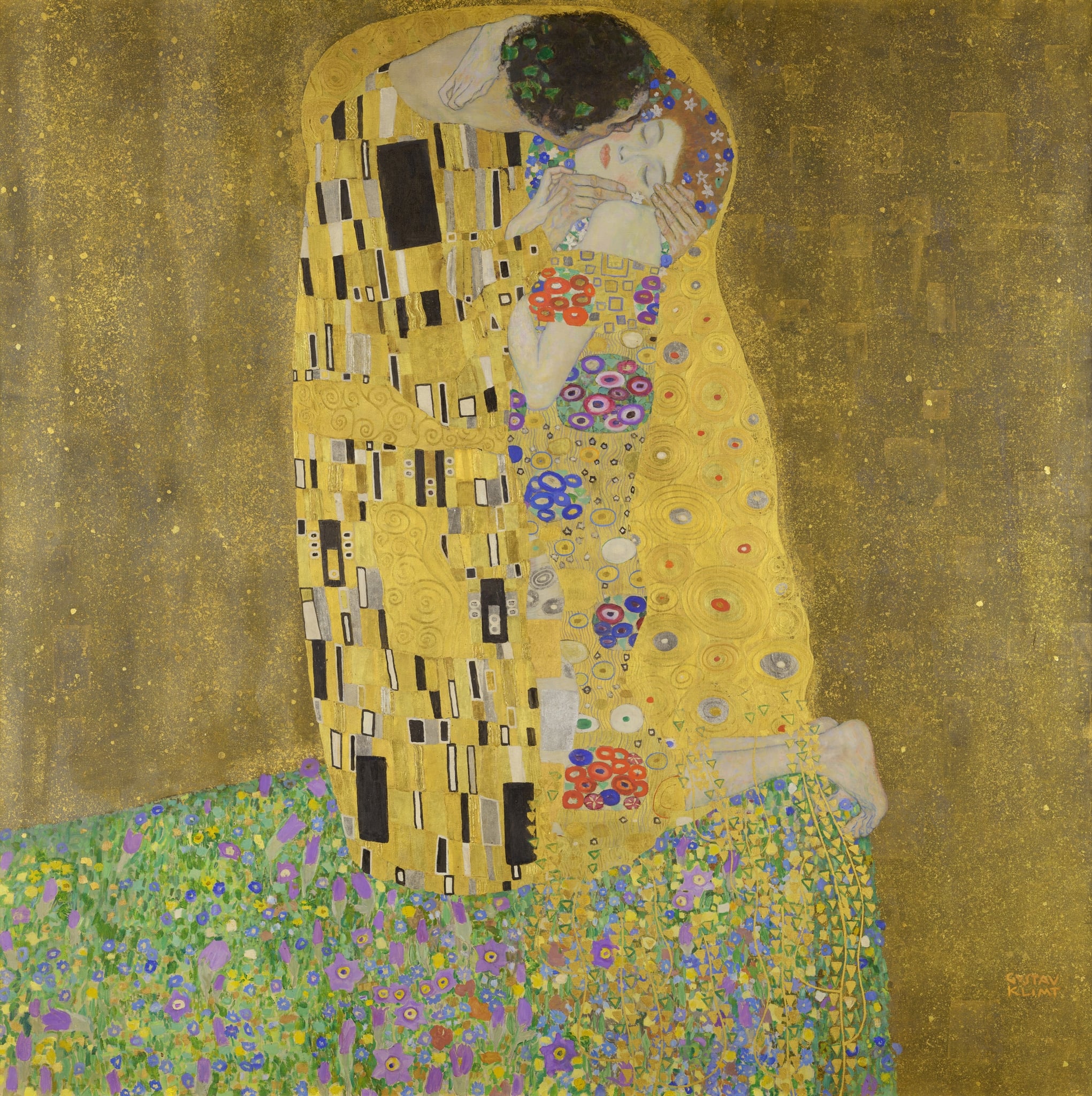
The Kiss
Gustav Klimt (1908 (completed 1909))
The Kiss stages human love as a <strong>sacred union</strong>, fusing two figures into a single, gold-clad form against a timeless field. Klimt opposes <strong>masculine geometry</strong> (black-and-white rectangles) to <strong>feminine organic rhythm</strong> (spirals, circles, flowers), then resolves them in radiant harmony <sup>[1]</sup><sup>[2]</sup>.
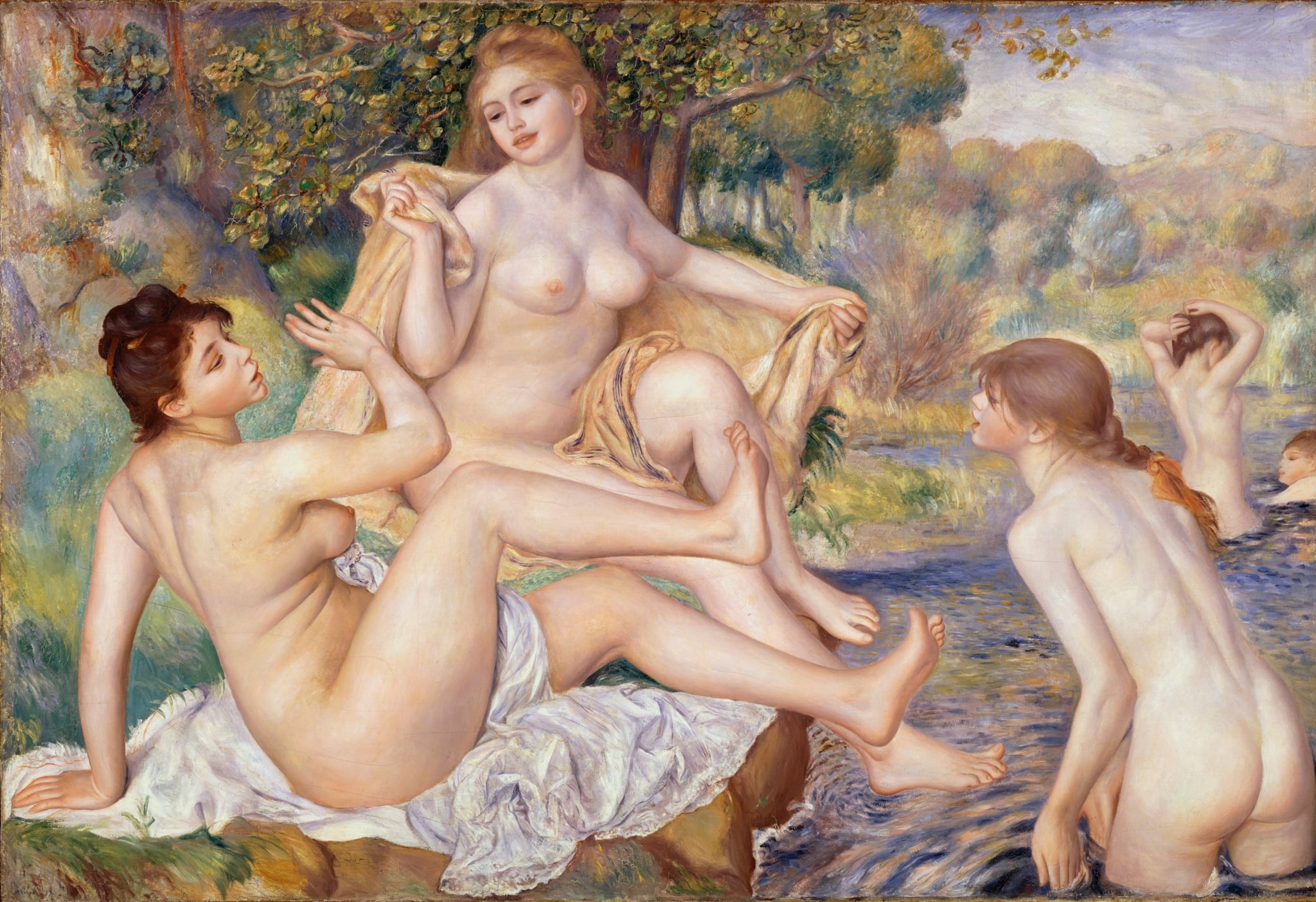
The Large Bathers
Pierre-Auguste Renoir (1884–1887)
Pierre-Auguste Renoir’s The Large Bathers unites modern bodies with a pastoral grove to stage an <strong>Arcadian ideal</strong>. Three monumental nudes form interlocking curves and triangles while two background figures splash and groom, fusing <strong>sensual warmth</strong> with <strong>classical order</strong> <sup>[1]</sup><sup>[2]</sup>.
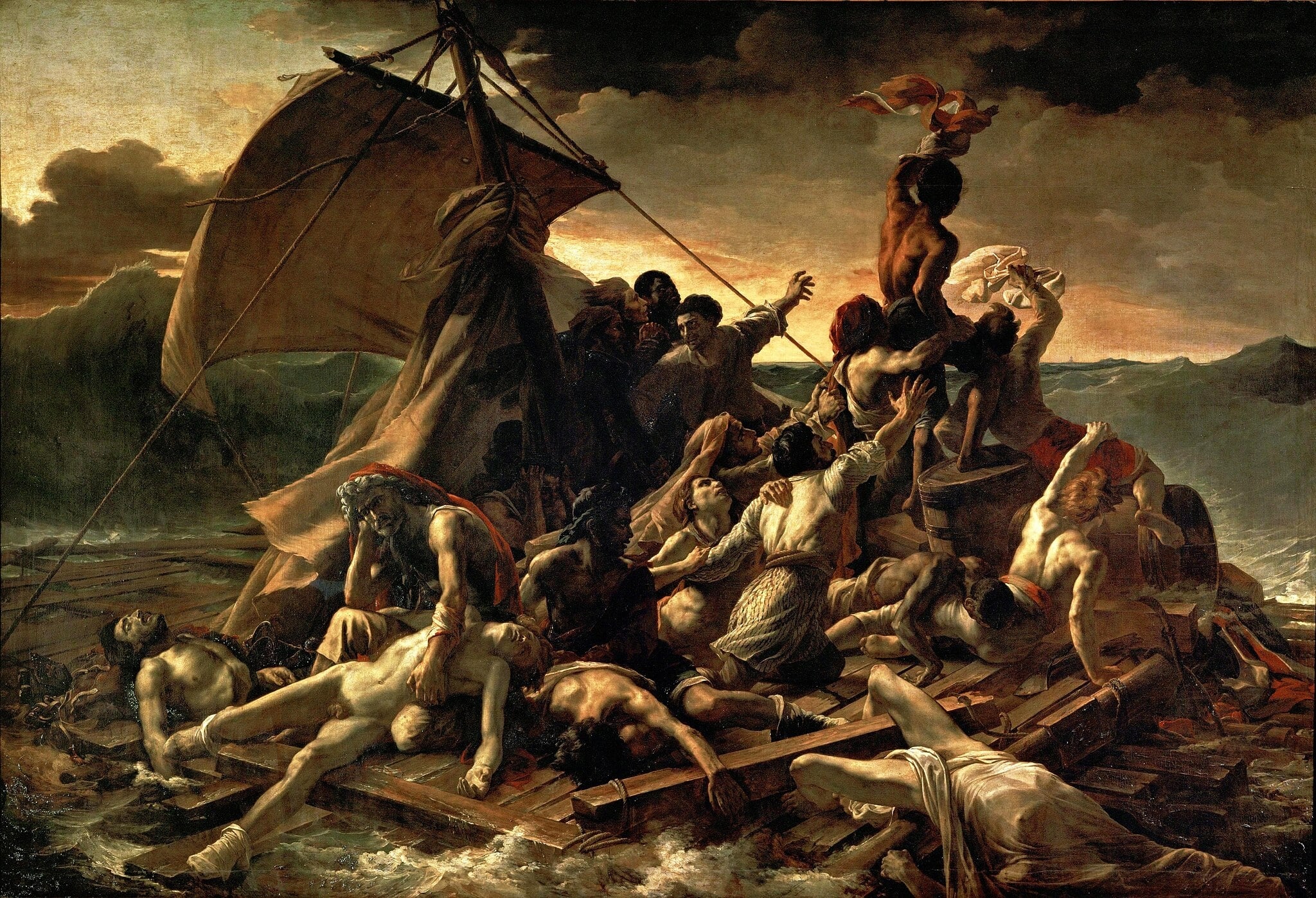
The Raft of the Medusa
Theodore Gericault (1818–1819)
The Raft of the Medusa stages a modern catastrophe as epic tragedy, pivoting from corpses to a surge of <strong>collective hope</strong>. The diagonal mast, torn sail, and a Black figure waving a cloth toward a tiny ship compress the moment when despair turns to <strong>precarious rescue</strong> <sup>[1]</sup><sup>[2]</sup>.
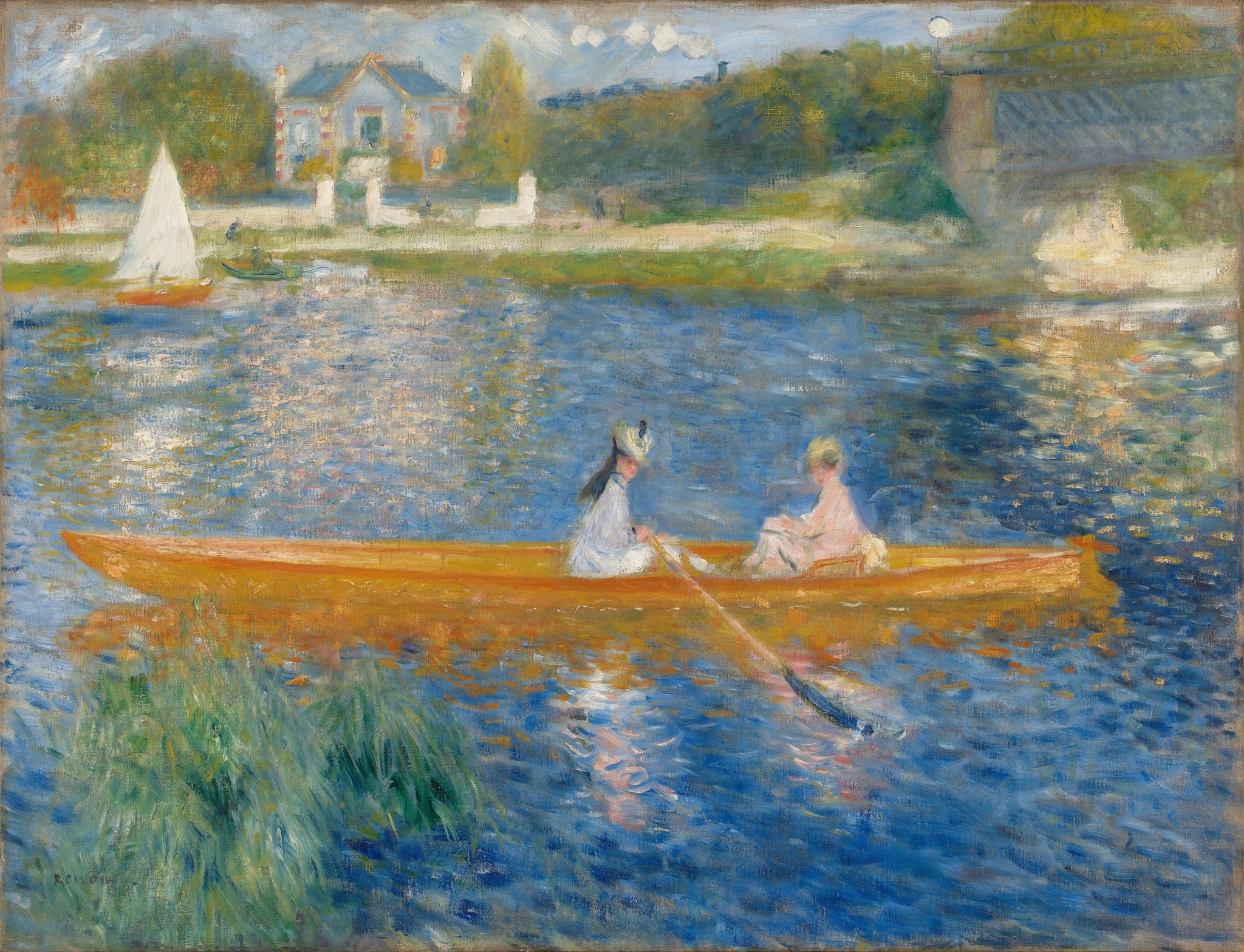
The Skiff (La Yole)
Pierre-Auguste Renoir (1875)
In The Skiff (La Yole), Pierre-Auguste Renoir stages a moment of modern leisure on a broad, vibrating river, where a slender, <strong>orange skiff</strong> cuts across a field of <strong>cool blues</strong>. Two women ride diagonally through the shimmer; an <strong>oar’s sweep</strong> spins a vortex of color as a sailboat, villa, and distant bridge settle the scene on the Seine’s suburban edge <sup>[1]</sup>. Renoir turns motion and light into a single sensation, using a high‑chroma, complementary palette to fuse human pastime with nature’s flux <sup>[1]</sup><sup>[2]</sup>.
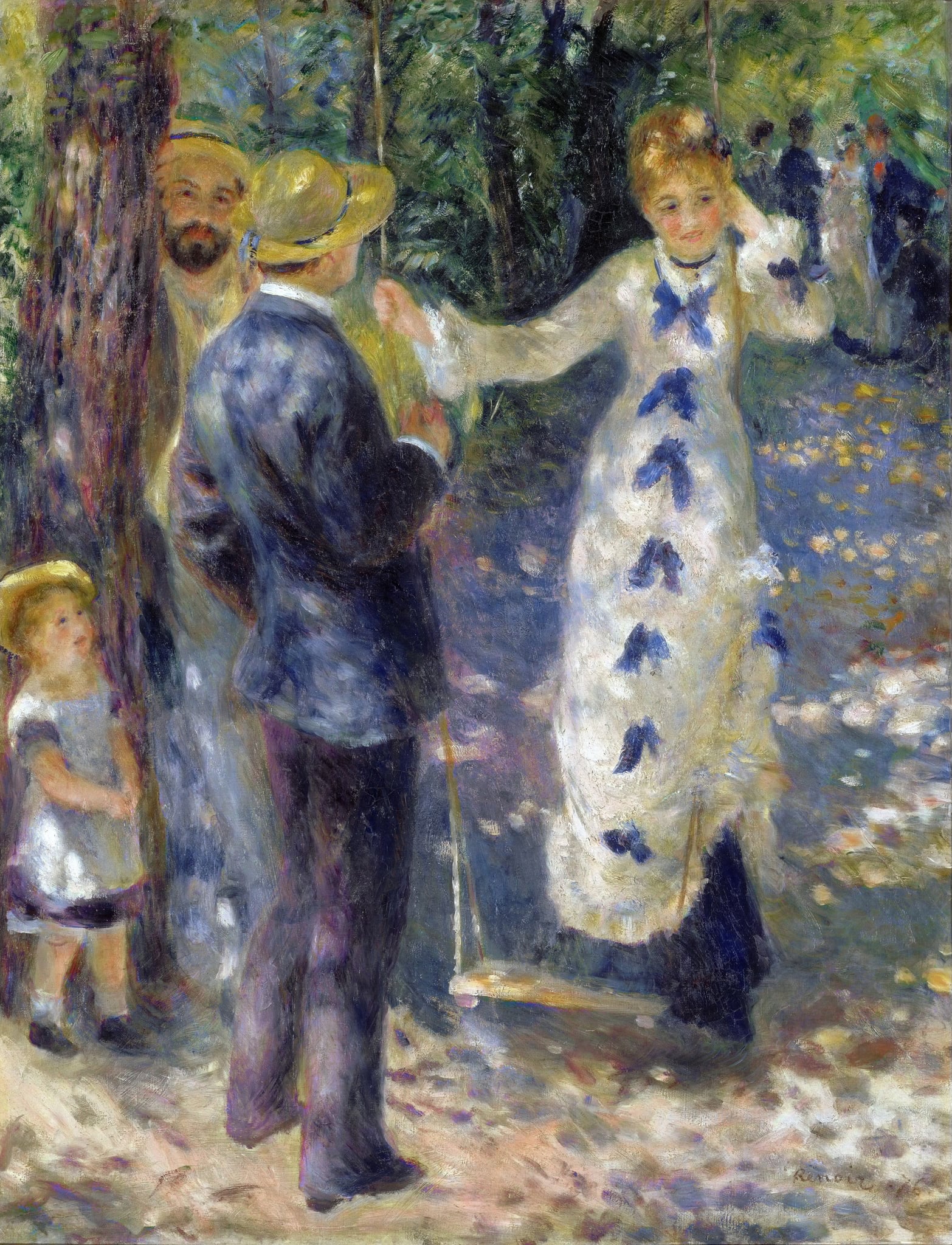
The Swing
Pierre-Auguste Renoir (1876)
Renoir’s The Swing fixes a fleeting, sun-dappled exchange in a Montmartre garden, where a woman in a white dress with blue bows steadies herself on a swing while a man in a blue jacket addresses her. The scene crystallizes <strong>modern leisure</strong>, <strong>flirtation</strong>, and <strong>optical shimmer</strong>, as broken strokes scatter light over faces, fabric, and ground <sup>[1]</sup><sup>[4]</sup>.
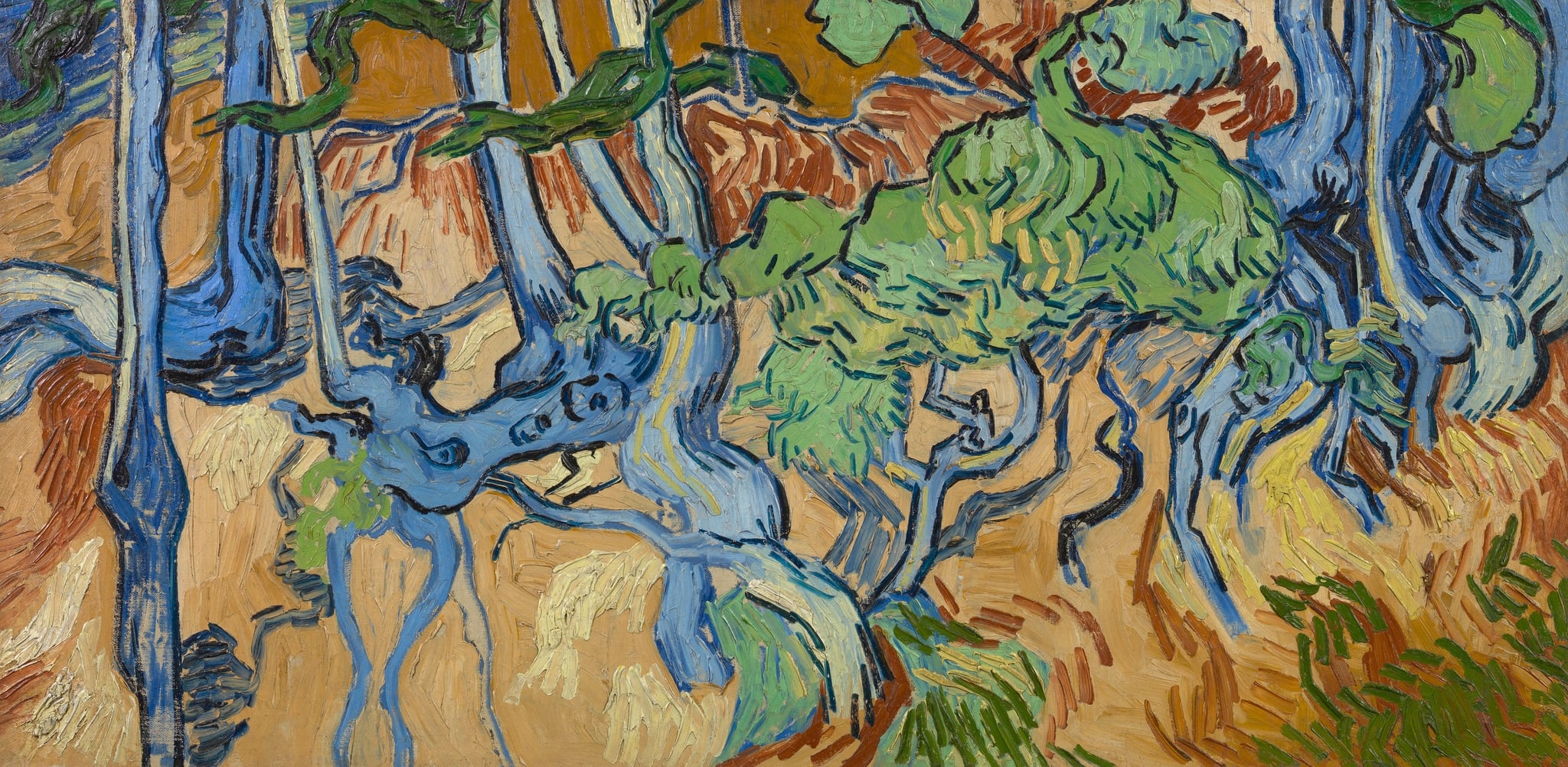
Tree Roots
Vincent van Gogh (1890)
Tree Roots is a late Auvers canvas in a rare, elongated "double‑square" format that compresses the view to nothing but interlaced trunks and roots. Thick, cobalt‑blue contours and vibrating oranges/ochres forge a field of near‑abstraction, turning a roadside bank into a <strong>charged meditation on resilience and exposure</strong> <sup>[1]</sup><sup>[6]</sup><sup>[2]</sup>.
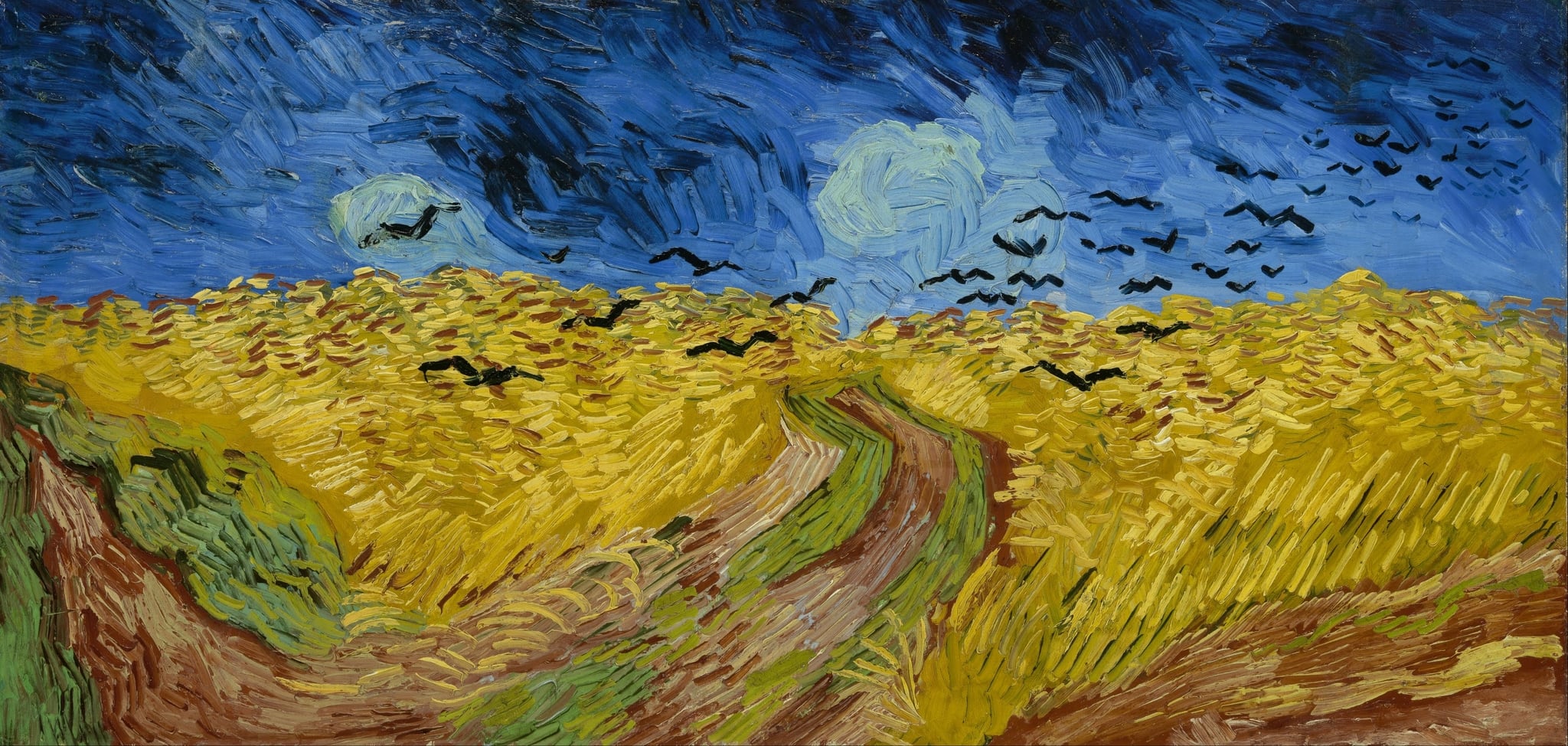
Wheatfield with Crows
Vincent van Gogh (1890)
A panoramic wheatfield splits around a rutted track under a storm-charged sky while black crows rush toward us. Van Gogh drives complementary blues and yellows into collision, fusing <strong>nature’s vitality</strong> with <strong>inner turbulence</strong>.
Related Themes
Related Symbolism Categories
Landscape
Landscape symbolism in modern painting transforms rivers, trees, bridges, and distant horizons into active sign-systems for labor, leisure, perception, and cyclical time, reworking inherited Arcadian and religious motifs under industrial and Impressionist conditions.
Space
In modern painting, spatial symbols become active structures that organize perception, articulate social modernity, and reimagine depth as a charged field of circulation, isolation, and communal ritual.
Color
Color symbolism in late nineteenth‑century painting shifts from fixed allegorical codes to dynamic chromatic structures, in which hues and their contrasts model perception, social experience, and ethical temperature as much as they denote specific ideas.
Within the long history of Western art, “nature” has never been a neutral backdrop. From medieval horti conclusi to the heroic wilderness of Romanticism, landscape and natural motifs have served as dense symbolic fields: sites where theological, political, and erotic meanings are displaced into mountains, streams, trees, and flowers. By the later nineteenth century, however, this inherited iconography begins to be retooled under the pressures of industrial modernity and optical science. The works considered here—by Monet, Renoir, Seurat, Van Gogh, Dalí, and others—exemplify a moment when nature imagery becomes both symbol and method: a vehicle for allegory and, simultaneously, the very medium through which perception, time, and social life are analyzed.
A central shift is the move from emblematic nature to what might be termed “procedural” symbolism, where natural phenomena signify by virtue of how they are painted. Claude Monet’s The Cliff Walk at Pourville stages this transformation with particular clarity. The cliff edge/precipice, long aligned with the sublime as a threshold between safety and danger, is here rendered through shimmering, broken brushwork that fuses air, water, and land into a vibrating continuum. Iconographically, the precipice functions as a modern sublime: a limit-experience in which two diminutive women, one under a pink parasol, measure the expanse of sea and sky. Semiotically, the cliff is a hinge rather than a stable sign: a narrow zone where perception intensifies and where Monet demonstrates that risk and pleasure—leisurely promenade and sheer drop—coexist within the same field of vision. The symbol’s force arises less from narrative content than from the way the cliff’s contour dissolves into the same chromatic particles that construct the water and clouds.
A related complex appears in Monet’s Haystack, Sunset, where the expansive sky with low horizon, chalk cliffs-like permanence of the conical grainstacks, and blue–violet hills (atmospheric veil) together articulate a meditation on time and endurance. The stacks embody stored agrarian wealth and cyclical labor, yet they are visually destabilized by the orange afterglow that floods their flanks and the violet shadows that deny any neutral “local color.” The low horizon assigns dominance to air and light, so that the sky becomes the protagonist and the stacks are read through its chromatic vicissitudes. Here, nature’s solidity (the stacks as quasi-geologic forms) is semiotically overruled by atmosphere; “permanence” is literally veiled by color, recasting rural abundance as a transient optical event.
Van Gogh radicalizes this logic by compressing the scale of nature and intensifying the signifying power of botanical detail. In Irises, the blue‑violet irises operate simultaneously as motif and structuring principle. Iconographically, irises, like anemones, carry connotations of fragile life and vanitas; yet Van Gogh’s frieze-like band of blossoms, their dark contours and vibrating complements against a yellow‑green ground, recode them as a statement about collective vitality. The symbol’s meaning is inseparable from its rhythmic deployment: repeated, slightly varied heads and sword-like leaves form a visual prosody in which difference within repetition becomes a figure for communal life. The single white iris, by its very deviation, sharpens this semiotic field, suggesting individuality as a momentary dissonance within a larger organic order.
Renoir’s flower imagery, by contrast, mobilizes the fragility of blooms to negotiate domesticity and time. In Still Life with Flowers the presence of anemones within the jubilant bouquet introduces a quietly allegorical register. The droop of certain blossoms inflects the scene with vanitas associations—beauty poised at the brink of decay—while the pale, crackled vase and ordered oval mass counterbalance that ephemerality with suggestions of craft and permanence. The symbol of the anemone is thus double: a classical emblem of fleeting life and, in Renoir’s hands, a vehicle through which the still-life genre itself is rearticulated as a poised equilibrium between Impressionist flux and post-Italy structural clarity. The same doubleness underpins Girl with a Watering Can, where the garden’s dappled foliage and light, together with daisies in the child’s hand, situate her in a continuum of nurture and growth. The watering can functions metonymically as an instrument of cultivation; the surrounding nature is not wilderness but garden flower band, a domesticated strip of fertility that frames bourgeois innocence.
Seurat’s Bathers at Asnières relocates nature symbolism to an explicitly industrial periphery. The Seine’s blue, shimmering river is less an Arcadian stream of purification than a cool, reflective band mediating between working-class bathers and a mechanized horizon of bridges, chimneys, and boats. Semiotic tension arises from this juxtaposition: water as a traditional emblem of renewal and communal bonding is here set against the regimented leisure of wage laborers and the distant markers of production. The boats (punt with flag, racing scull, sailboats) off-shore introduce vectors of mobility and class difference—the sleek racing craft as signs of bourgeois sport, counterposed to the still, sculptural bathers on the bank. Nature’s role is to host and reveal these social distinctions, rather than to transcend them.
Van Gogh’s Garden with Courting Couples: Square Saint-Pierre shifts the focus to urban parks, where flowering chestnut trees and curving paths produce a codified language of modern courtship. The low canopy of blossoms asserts springtime renewal and “love in bloom,” while the interlacing paths inscribe a metaphor of relational trajectories—meeting, parting, converging. The park’s vegetation is thus an Arcadian grove translated into a modest Montmartre square: Arcadia miniaturized and democratized. Iconographically, the trees anchor the scene as a cyclical, fertile space; semiotically, their repeated bloom spikes and filtered light unify disparate courting pairs into a single allegory of urban affection as seasonal, recurring, and broadly shared.
Where these natural symbols tend toward harmonizing human and nonhuman orders, Salvador Dalí’s Swans Reflecting Elephants instrumentalizes nature as a destabilizing apparatus. The barren trees, stripped of foliage, stand at the edge of a Catalan lagoon and serve as armatures in the double image: in reflection, they become the elephants’ legs. Traditionally, leafless trees connote desolation and death; Dalí retains this valence but folds it into a Surrealist semiotics of metamorphosis. The lifeless trunks are the skeletal infrastructure that allows forms to “flip identity,” making nature the site where perception unravels and reconstitutes itself. The lagoon’s glassy surface, ringed by eroded cliffs and a black night sky and barren slope at the horizon, amplifies this uncanny register: water, the classical symbol of life and purification, becomes an analog of the unconscious, a depth where graceful swans and monumental elephants coexist as mutually exclusive yet inextricable images. Here, nature no longer guarantees continuity; it stages a crisis in seeing.
Across these works, a set of recurrent natural motifs—cliffs and hills, rivers and waves, flowers and trees—undergoes a marked reinterpretation. In Monet and Renoir, the emphasis falls on atmosphere and touch: fog/haze, dappled shadows, and luminous rivers articulate an Impressionist conviction that nature’s meaning lies in its transience and in the act of perception itself. In Seurat and Van Gogh, the same motifs are drawn into questions of class, psychological repair, and communal life, their semiotic charge strengthened by repetition (the iris bed, the blossoming chestnuts) and by compositional schemata drawn from prints and academic art alike. By the time of Dalí, nature’s iconography has been folded into a self-conscious rhetoric of the psyche, where even the most barren tree or still lagoon is tasked with rendering the instability of reality.
The evolution traced here is less a linear abandonment of traditional symbolism than a complex re-inscription. Mountains, rivers, trees, and flowers retain echoes of older allegories of Eden, vanitas, and the sublime, but modern painters subject them to new regimes of optical analysis and psychological inquiry. Nature becomes at once subject and syntax: a flexible system of signs through which modernity’s concerns—industrialization, interiority, eroticism, and the very reliability of perception—are negotiated on the picture plane.