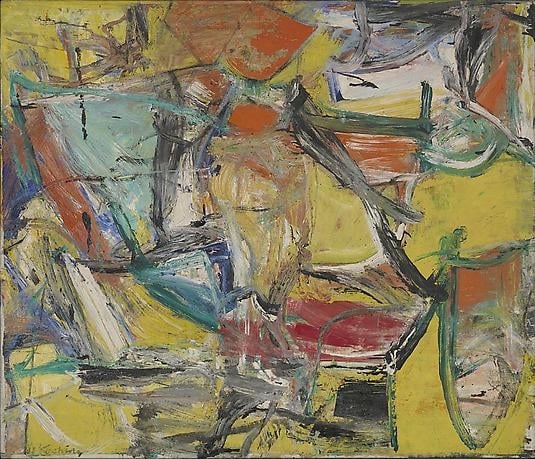
Acidic yellow ground Symbolism
Acidic yellow ground denotes a high-key, caustic yellow field used as a backdrop, often associated with man-made glare and the impersonal wash of urban light. In modern and mid-century abstraction, such grounds flatten depth and heighten contrast, so strokes and fragments read as incidents against a charged ambient field.
Acidic yellow ground in Police Gazette
In Willem de Kooning’s Police Gazette (1955), an acidic yellow ground saturates the canvas like ambient city light, forming an impersonal field against which events unfold. Across this glare, slashed blacks and jolts of teal and coral collide, while the scraped, reworked surface lets half-hinted limbs and curb-like edges surface and dissolve; the yellow makes these gestures register like headlines in motion within a continuous urban noise.
As a key mid-1950s canvas, the work marks de Kooning’s shift toward abstract urban landscapes within Abstract Expressionism. Here the acidic ground operates less as scenery than as atmosphere, the glare that organizes and intensifies incident, turning gesture into event.