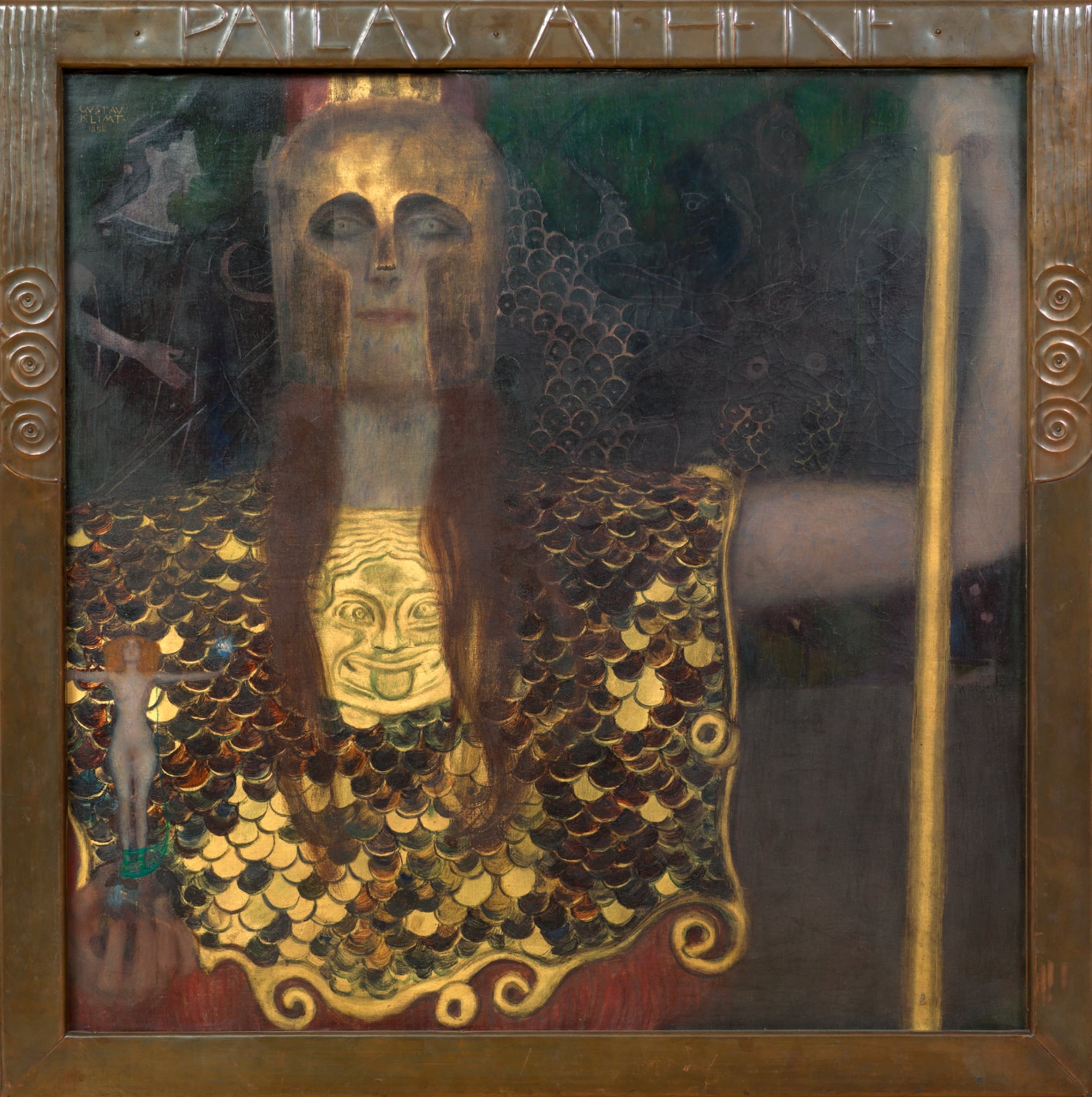
Aegis (scale armor) Symbolism
In art, the aegis (as scale armor) is the divine protective mantle most closely associated with Athena, a sign of unimpeachable authority and protection. When shown as a gleaming, scaled covering crowned by a Gorgoneion, it functions as a fiercely apotropaic emblem that both intimidates and safeguards. Its hard, patterned surface conveys reasoned power and an unassailable presence.
Aegis (scale armor) in Pallas Athena
In Pallas Athena (1898) by Gustav Klimt, the goddess confronts the viewer frontally, helmeted and impassive, her torso armored in a gleaming scale aegis topped with a Gorgoneion. The shimmering scales and Medusa mask turn the mantle into a charge of protection and threat, making the aegis the painting’s central marker of divine authority.
Klimt fuses archaic authority with modern ornament, so the aegis reads not only as mythic armor but as an emblem of Vienna Secession ideals—reason, strategic intelligence, and artistic truth—condensed into a single, implacable image. Within this work, the aegis anchors Athena’s identity and projects the painting’s claim to protective, commanding power.