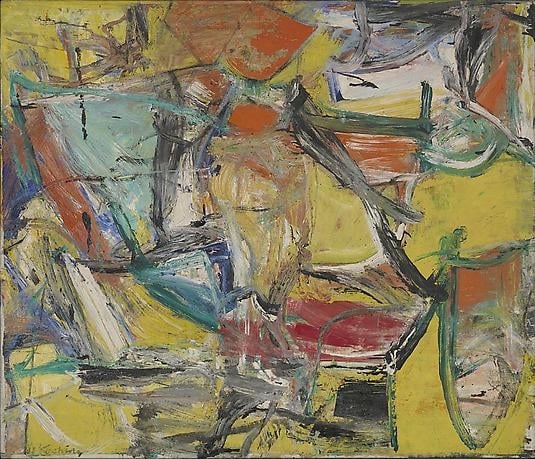
Angled teal band Symbolism
An angled teal band functions as a directional vector, cutting across a picture to suggest movement and a traversable path through unstable space. In mid-century gestural abstraction, such tilted chromatic passages often guide the eye and momentarily organize turbulence without fixing a single, stable form.
Angled teal band in Police Gazette
In Police Gazette (1955), Willem de Kooning sets jolts of teal against an acidic yellow ground, where they appear as slashing, oblique passages that read like angled bands channeling the viewer’s gaze. These teal trajectories cut between slashed blacks and coral, intermittently aligning with curb-like edges before dissolving, so the band becomes a conduit of motion amid the scraped, reworked field—akin to a headline slicing through the city’s noise.