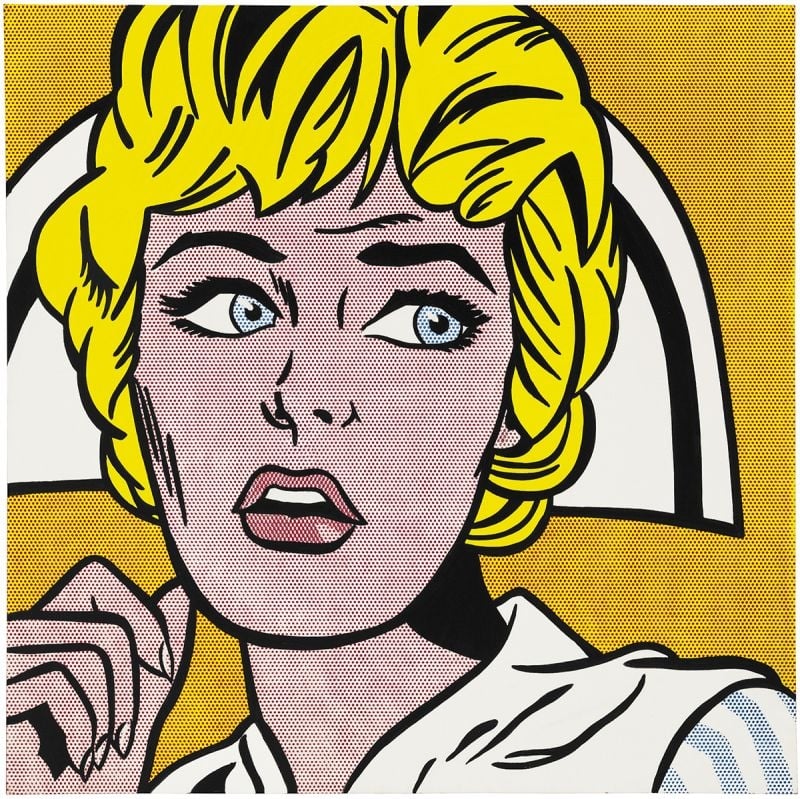
Averted gaze (blue eyes) Symbolism
An averted gaze—eyes glancing to the side rather than meeting the viewer—has long signaled attention drawn beyond the picture, heightening suspense and implying off-frame action. In visual narratives, especially from painting to 20th-century comics, the sidelong look condenses emotion into a single feature, reading as vulnerability, alarm, or hesitation. By withholding direct eye contact, artists cue viewers to search the image’s edges for the missing story.
Averted gaze (blue eyes) in Nurse
Roy Lichtenstein’s Nurse (1964) makes the averted gaze the engine of drama. Cropped to a close-up and rendered in Ben-Day dots, thick black contours, and a high-contrast palette, the figure’s parted lips and sideward look freeze a moment of suspense while speech bubbles are stripped away. In this comic-derived icon, the eyes—turned away from us—direct attention off-frame and concentrate the work’s pulp melodrama into a single, emblematic gesture.